Understanding Eucalyptus in the Bay Area – Dr Joe R. McBride

This article has been republished from the  website of the San Francisco Forest Alliance, with permission. (Edited to add: A somewhat different selection of illustrations has been used.) Dr. Joe McBride of UC Berkeley spoke at the Commonwealth Club in April 2014 as part of the series “The Science of Conservation and Biodiversity in the 21st Century.” His main message:

  • Eucalyptus groves in California provide habitat for as many native species as do most ‘native’ habitats.
  • They grow well at high densities and an average spacing of 8 feet between trees is quite typical.
  • They have relatively high fuel loads, but the cool and damp dense eucalyptus forests reduce the risk of fire.
  • Eucalyptus is subject to few diseases or pests, and parasitic wasps provide pest control.
  • It provides a host of ecosystem services including carbon sequestration, pollution reduction, slope stabilization, windbreaks, wildlife habitat, and recreational value.

Dr. Joe R. McBride was Professor of Landscape Architecture and Environmental Planning, Department of Environmental Science, Policy, and Management, UC Berkeley. (He has since retired.) Read on for notes from Dr. McBride’s talk. (There are also links to his Powerpoint presentation.)

—————————————

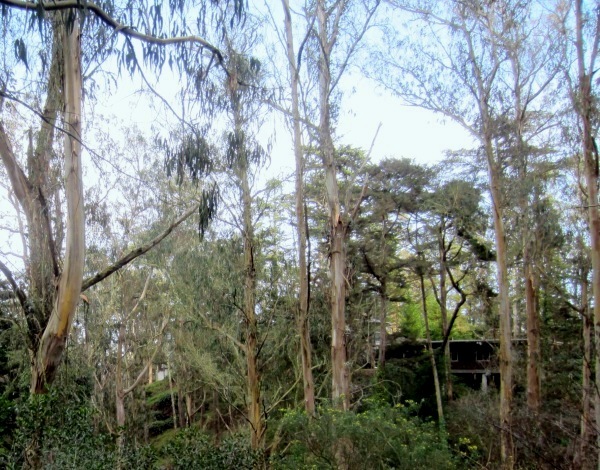
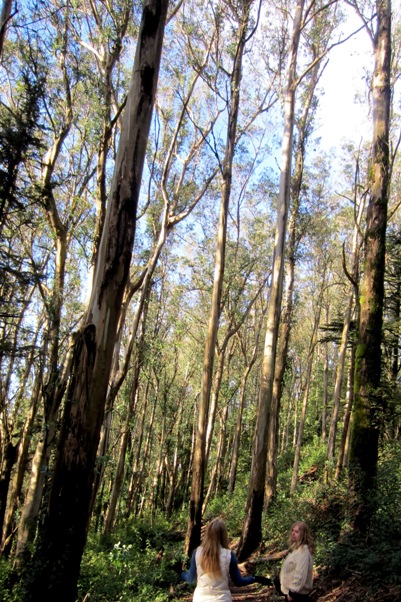
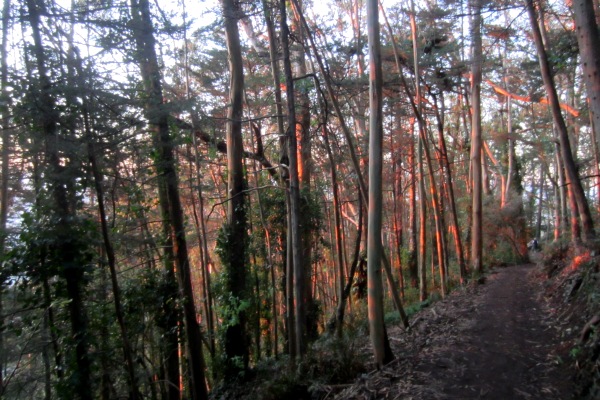
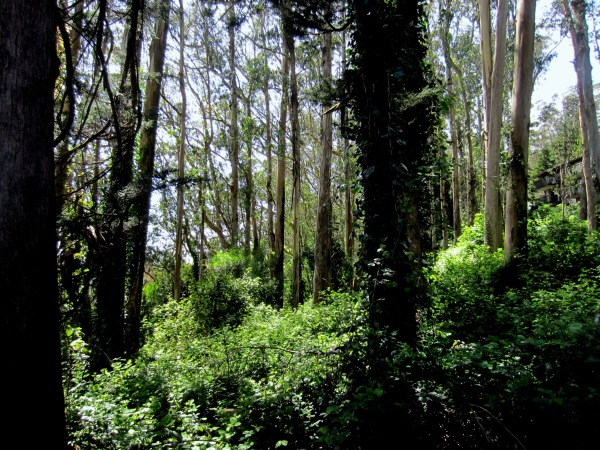
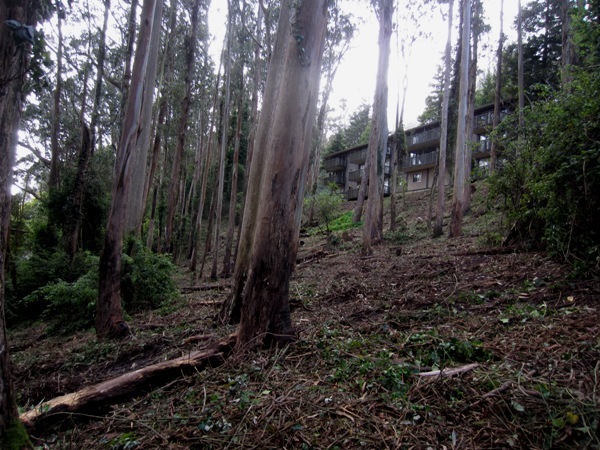
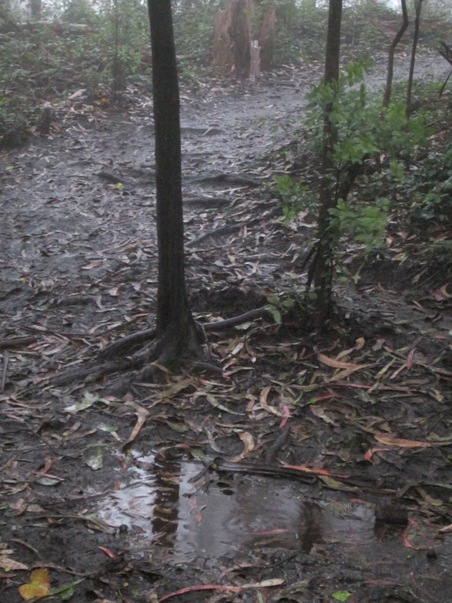
sutro forest with dappled sunlight

THE HISTORY, ECOLOGY AND FUTURE OF EUCALYPTUS PLANTATIONS IN THE BAY AREA

Notes From a Talk By Dr. Joe R. McBride

Dr McBride’s wide-ranging talk covered a lot of ground. He talked about the ecology of the eucalyptus forest in the Bay Area: its structure, the variety of plants and animals that live within it, its health and the ecological functions it performs; the dynamics within these forest stands; and their invasive potential.

WHY EUCALYPTUS CAME TO CALIFORNIA

Eucalyptus was first planted in California during the Gold Rush, possibly for oil to use in eucalyptus king of the forest smgold-mining and in medicine. In the 1870s, eucalyptus planting was encouraged for many objectives: to beautify cities, to improve farmland, as windbreaks, and to dry out swamps to combat malaria. It was grown in woodlots for firewood, but as people switched to natural gas and other fossil fuels this became rare. Later, it was planted for timber – which didn’t work out because the trees were harvested too young; and still later for bio-fuel, which did not become commercially attractive.
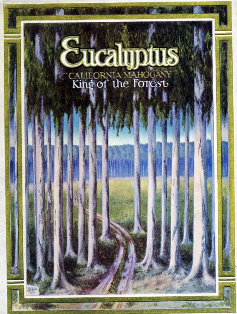
By the 1950s, it had become an integral part of the California landscape. Six species were planted, primarily blue gum in Northern California, and red gum and river gum in Southern California. (Worldwide, there are perhaps 640 species.) Eucalyptus beautifies our cities, and helps stabilize soil on steep hills. The surface area of the leaves, broader than those of conifers, help trap particulate pollution. Unlike deciduous trees, the evergreen foliage of eucalyptus removes pollutants all year long.

HOW DENSE MAKES SENSE?

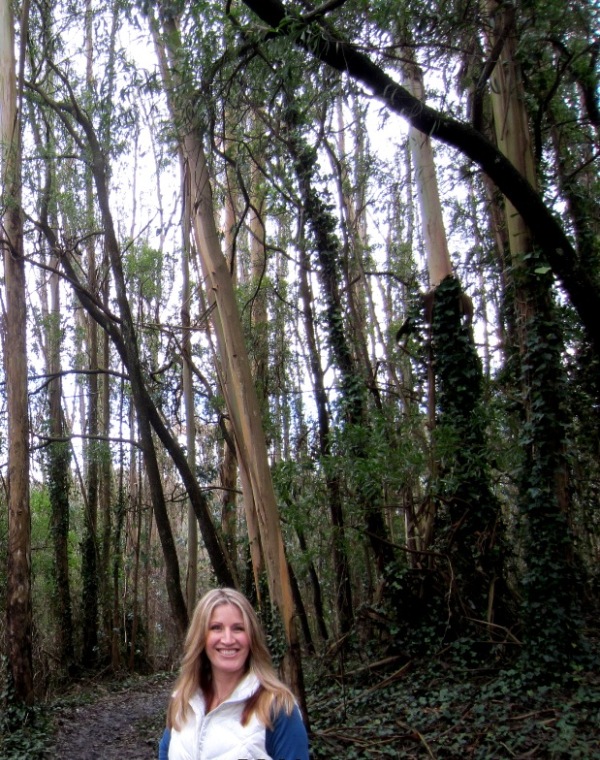
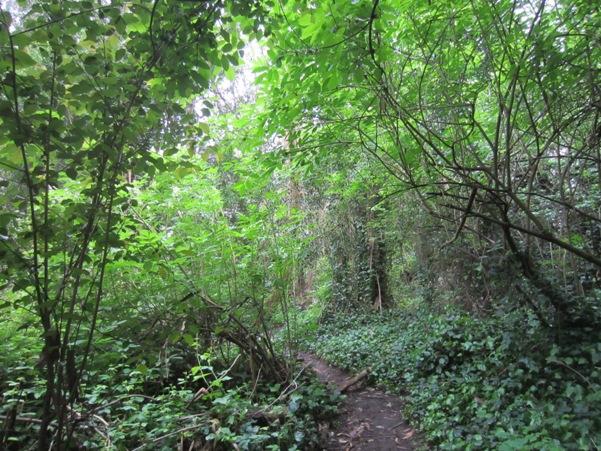
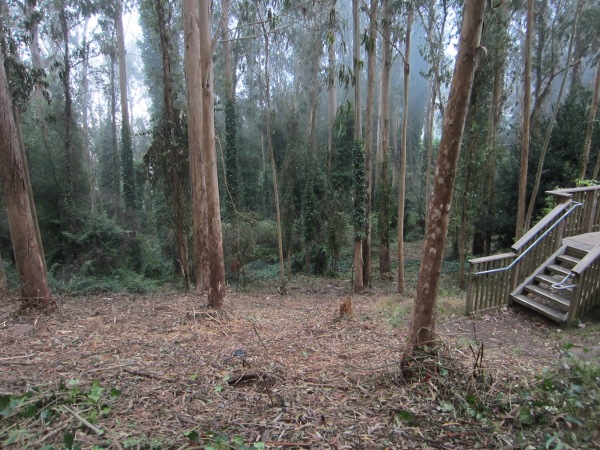
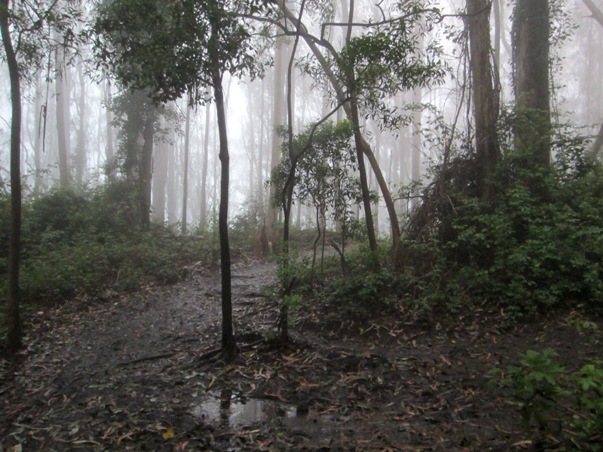
The density of eucalyptus plantations in Bay Area ranges from 150-160 trees per acre to about 1700 trees per acre. mt davidson understory(The highest density resulted from a freeze in 1970s: trees were cut down because of the perceived fire hazard, but the trees presumed dead later resprouted.) On Angel Island, the normal density was 8ft spacing (about 680 trees per acre) but it ranged to 30 feet between trees. In the East Bay, 8 ft. x 8 ft. is quite typical eucalyptus plantation density. Left to grow naturally, stands become denser through in-growth, mainly by sprouting and also by sibling establishment.

Is management by thinning necessary for the health of the forest, someone asked, and what density is ideal? Dr McBride had seen no examples of stands that could be improved by thinning. Eucalyptus grows well with a high density at an average of 8 ft x 8ft spacing between trees. In Australia and New Zealand no one thins; they just harvest the trees and let them regrow from sprouts. In the US, eucalyptus was not marketable, so there’s no history of managing eucalyptus plantations. Also, until recently there were no diseases or insects. The long-horned borer and the psyllid have now appeared in some places, and thinning is not seen as a solution to these insect problems; they are better controlled by certain predatory wasps. Logging eucalyptus would mean a lot of ground disturbance and erosion. If the logs are removed, the skid trails can destabilize the soil.

MUCH GROWS UNDER EUCALYPTUS – NATIVE AND NOT

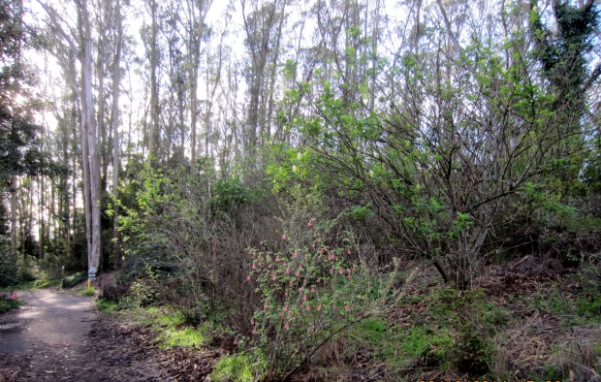
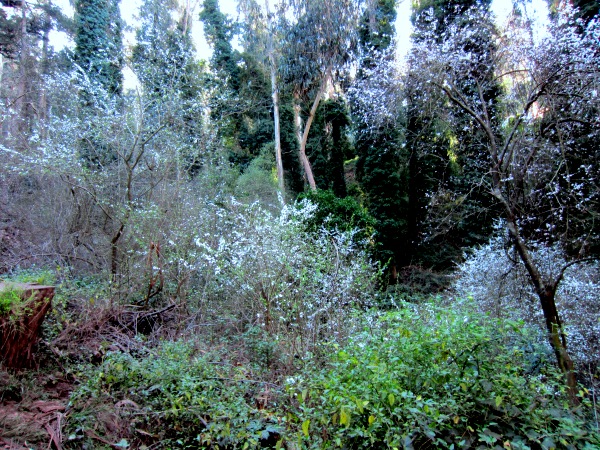
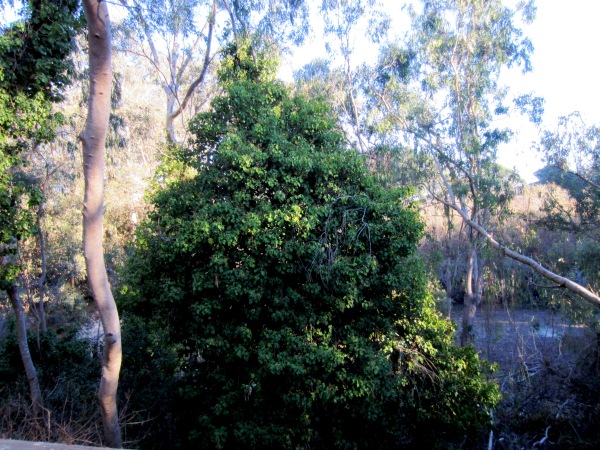
Contrary to popular belief, eucalyptus forests have as many species (or more!) growing in their understory as do oak woodlands. A 1990 survey in Tilden Park found 38 species in the understory of eucalyptus forests (24 native plants; 14 introduced plants), while the oak woodland had 18 species in understory (14 native plants; 5 introduced plants). Only the riparian woodlands in Murray Park are somewhat richer in species than riparian eucalyptus forest (58 species vs 34).  In East Bay eucalyptus forests, California Bay, Coast live oak, poison oak, bedstraw, California blackberry, and chickweed were ubiquitous. The amount of light reaching the ground influences which species can be found in the understory.ferns and blackberry and poison oak What about allelopathy? Under experimental conditions, eucalyptus litter inhibited germination and growth of cucumber seeds, so eucalyptus litter may be somewhat allelopathic to some plants. But a study from UC Santa Barbara indicates that if eucalyptus litter is removed, within 2 years there’s no inhibitory effect on other plants germinating. And clearly, it isn’t allelopathic to all the species mentioned earlier.

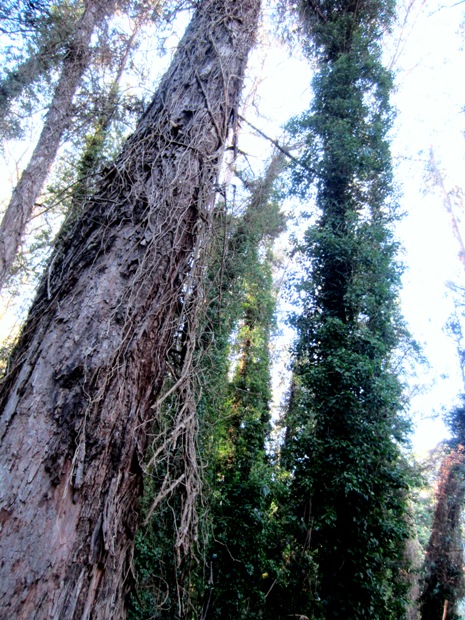
Someone asked whether it would be advisable to “manage eucalyptus stands that have an invasive understory.” Dr McBride responded: “I have no prejudice against invasive plants. I am an invasive Californian myself.” (There was amused applause.) He continued that each eucalyptus grove is different, so it’s important to look at it on a stand-by-stand basis and measure the fire hazard of eucalyptus plantations against the value of each stand for wildlife habitation, recreation, and wind break functions. eucalyptus trees in Sutro Forest In response to a question about whether ivy kills eucalyptus trees, Dr McBride said he has not seen evidence the ivy shades the foliage of eucalyptus trees. He’s seen no evidence of ivy killing eucalyptus, although on Mt. Davidson, he did see ivy growing over trees that had been killed by girdling with an axe or chainsaw.
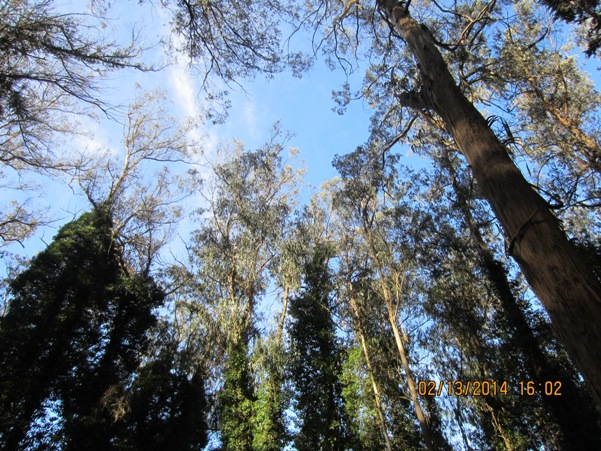
INSIDE A EUCALYPTUS FOREST

Shading and leaf litter changes the microclimate of a eucalyptus grove. As you move in from the edge to the interior of the forest, conditions change. The species change from the edge to the interior of the forest as the amount of light decreases, so there are different species at the edge of the forest and inside it. A 1980s study in the Presidio compared conditions outside a eucalyptus forest and inside it. It showed:

  • Temperature moderation: Daytime temperature fell an average of 10%, and night-time temperature rose an average of 5%
  • Windbreak: Wind velocity dropped 40%
  • Relative humidity was 5% higher (from the edge to the interior).
  • Shade: Light intensity was 90% lower.
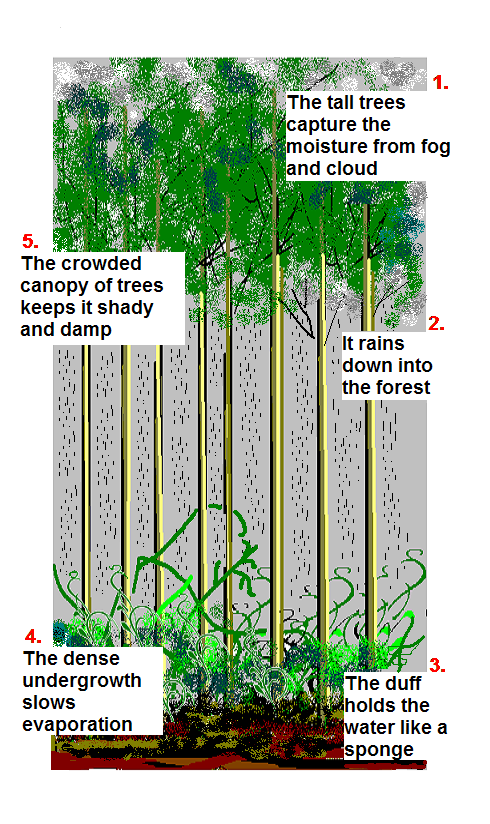
  • Moisture: Precipitation (rain) decreased 12%; but fog-drip (i.e., moisture precipitated from the fog) increased 300%

EUCALYPTUS STORES CARBON

Eucalyptus increases the carbon content in the soil compared to grasslands (Zinke et al, 1988). Its fast growth and large size means it sequesters a lot of carbon in its trunk and root systems.

EUCALYPUS SUPPORTS WILDLIFE

Owlets in an eucalyptus tree nest

Owlets in an eucalyptus tree nest

Again, contrary to belief, eucalyptus provides a good environment for a wide variety of wildlife. A number of studies demonstrate this.

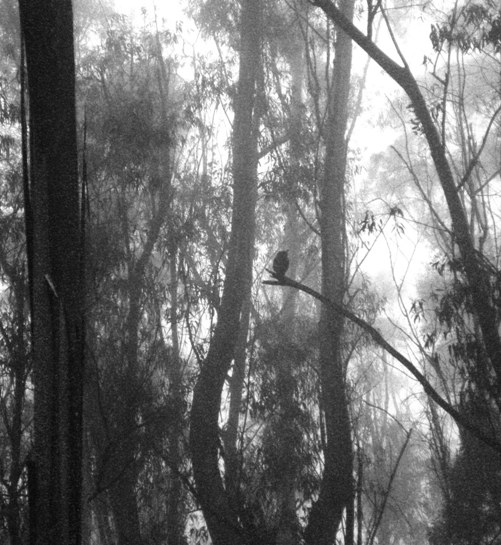
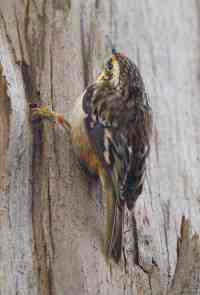
  • A 1970 study showed many birds make “moderate use” of eucs as habitat and a few birds make “great use” of eucs. (Almost all these species are native.) Birds that make most use: mourning doves; Great Horned Owls, whose range has been extended by CA eucalyptus; Stellar’s jays; yellow-bellied sapsuckers; Allen’s hummingbirds; olive-sided flycatchers; brown creepers; dark-eyed juncos; Audubon warblers.
  • Some reptiles make great use of eucalyptus groves: Southern Alligator lizard and the slender salamander. Among mammals, deer mice make “heavy” use of eucalyptus.
  • photo credit: Janet Kessler

    photo credit: Janet Kessler

    Robert Stebbins’ monumental 1978 study on the attractiveness of eucalyptus for habitat in the East Bay found that all species making use of eucalyptus for habitat found eucalyptus about the same as grasslands in attractiveness, but oak/bay woodlands were even more attractive.

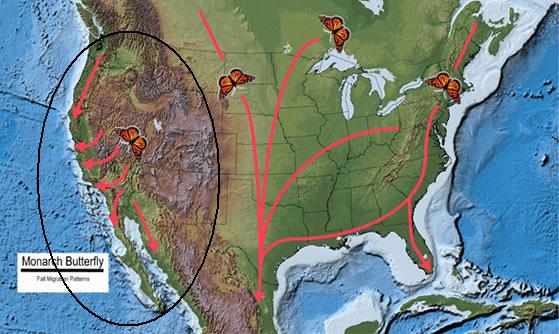
  • Monarch butterflies most commonly use eucalyptus trees in state parks. But some of the insects in eucalyptus hurt the trees. One is the eucalyptus long horned borer – but can be controlled by a parasitic wasp. The red gum lerp psyllid is more of a problem in Southern California, which has more red gum. However, it’s part of the food chain: woodpeckers and other bird species feed on their larvae.
  • A study showed that eucalyptus in a riverside environment doesn’t impact species diversity of stream insects or pollution tolerance compared with native riparian environments.
NATURAL SUCCESSION IN EUCALYPTUS?

Over the next 200-300 years, the eucalyptus forests in the East Bay could gradually – and naturally – shift to oak-bay woodlands. In the East Bay (though not at Mt. Davidson or Mt. Sutro), the eucalyptus plantations have California Coast live oaks and California bay trees in the understory, and they are doing well. The live oaks are “tolerant” of shade and the bays are “very tolerant” of shade. If they aren’t disturbed, the oaks and bays regenerate well in the understory, and being even longer-lived than the eucalyptus trees, they will eventually naturally succeed the eucalyptus. The bay tree is higher in regeneration than the Coast live oak in Tilden Park (McBride, 1990).

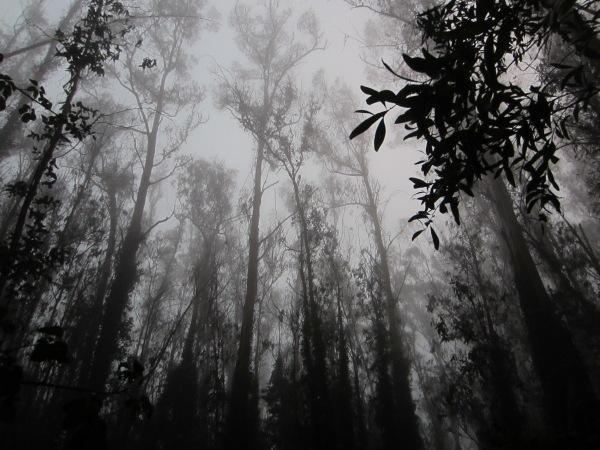
WHAT ABOUT FIRE HAZARD? fog in mt sutro cloud forest sept 2013
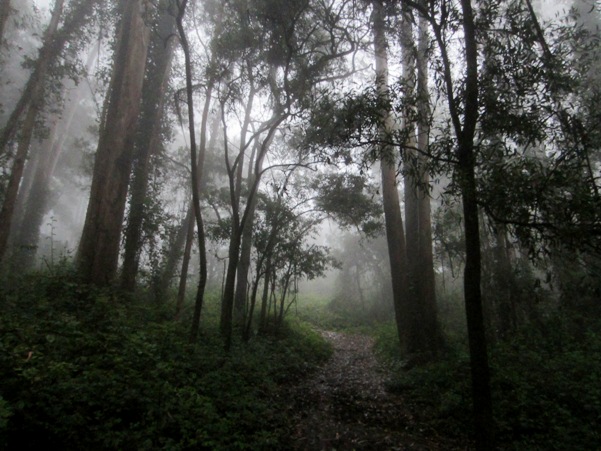
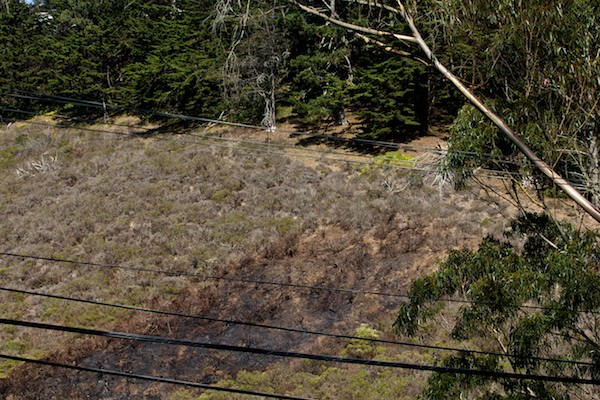
Eucs support considerable fuel load on the ground because of rapid decay of foliage and shredding of its bark. They have a higher fuel load than California bays or Coast live oaks. They release an aromatic compound that can ignite with sparks, and they burn hot. However, while the tree density of eucalyptus plantations can mean a greater accumulation of fuel in the understory, the higher density means a cooler, wetter understory that might not dry out as fast. Three risk factors in fire risks of any tree: amount of fuel it produces; tissue moisture content; fuel ladder based on presence of other plants in its understory.

IS EUCALYPTUS INVASIVE?

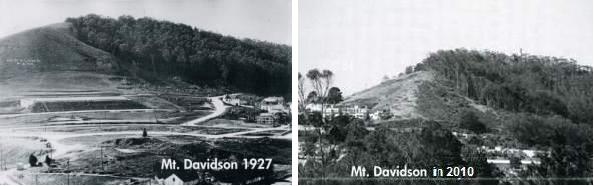
Under certain circumstances, eucalyptus can spread – for instance, on Angel Island, some stands spread through road cuts and prescribed burns (which destroyed competing vegetation). However, in most cases they don’t: aerial photographs show that boundaries are stable. The eucalyptus forests on Mount Davidson and in Tilden Park show stable boundaries. mt D comparison 1927 -2010In the Bay Area, Dr McBride found eucalyptus forest area declined between 1939 and 1997. The natural spread hasn’t increased the area of eucalyptus groves.
DO TREES DEPLETE AQUIFERS?

Someone mentioned attending a talk where the speakers said that tree removal would help to replenish aquifers. Was that true? Dr McBride thought it very unlikely; most aquifers are much deeper than tree roots.

WHAT ABOUT PESTICIDES?

Someone speaking for people with disabilities owing to chemicals said herbicide use in these areas violated their right to access, and wondered how “environmental” organizations – like the Sierra Club – could support this. Dr McBride sympathized, said he was also concerned about toxic herbicide use. He mentioned that the East Bay tree-felling project is on hold owing to a number of unanswered questions that would need further research.

McBride Presentation in ppt format: mcbride-presentation-eucalyptus

McBride Presentation in pptx format: mcbride-presentation-eucalyptus (1)

McBride Presentation as PDF :McBride Presentation – Eucalyptus

Posted in Environment, eucalyptus | Tagged , , , , , | 6 Comments

Sutro Forest: Good News; Bad News; Action Alert

Last month, we wrote about about two things:

  • Tree-cutting in Sutro Forest in the bird nesting season;
  • San Francisco’s new “Office of Biodiversity” that was looking for a $250,000 grant to fund developing a so-called ‘Biodiversity Plan’ that would extend the Natural Areas Program to *all* the open spaces in the city, including people’s back yards.

We have good news, bad news, and an urgent Action Alert for San Francisco residents.

sutro forest may end 2014

GOOD NEWS

The $250,000 grant didn’t happen! A lot of people wrote in and called to object. Sacramento listened to the community and the application was not successful. (Thanks, everyone who made their voices heard.)

The upshot: The California Strategic Growth Council did not select the application from the Office of Biodiversity from the Dept. of Environment. Their staff did not recommend the application to the Council. Other valuable and worthwhile San Francisco projects were funded instead. You can read more about this at the website of the San Francisco Forest Alliance: No Grant for Biodiversity Plan.

ACTION ALERT FOR SAN FRANCISCANS

However, the Biodiversity Coordinator is still pushing to extend their Plan to all the Open Spaces in San Francisco. UCSF is a state institution and can choose to ignore City initiatives – but they probably will not. If they don’t, they have another reason to cut down trees.

This coming Monday, June 16th, 2014, the Land Use Committee of San Francisco’s Board of Supervisors will decide whether to approve the draft Recreation and Open Space Element (ROSE) of the General Plan.

The section called “Policy 4.2” embodies the problem.  It essentially gives the Office of Biodiversity – non-elected, non-appointed staff – a say in the use of all Open Spaces in the city.  It may violate the City Charter, which prohibits the Department of the Environment from interfering in land use decisions.

What it could mean for us is all kinds of restrictions on what can be done with an Open Space that’s listed in this Plan. They could stop a community from putting in a park, because the space could be used to grow native plants. They could tell you what plants you can or cannot grow, if your back yard is part of the Open Space.

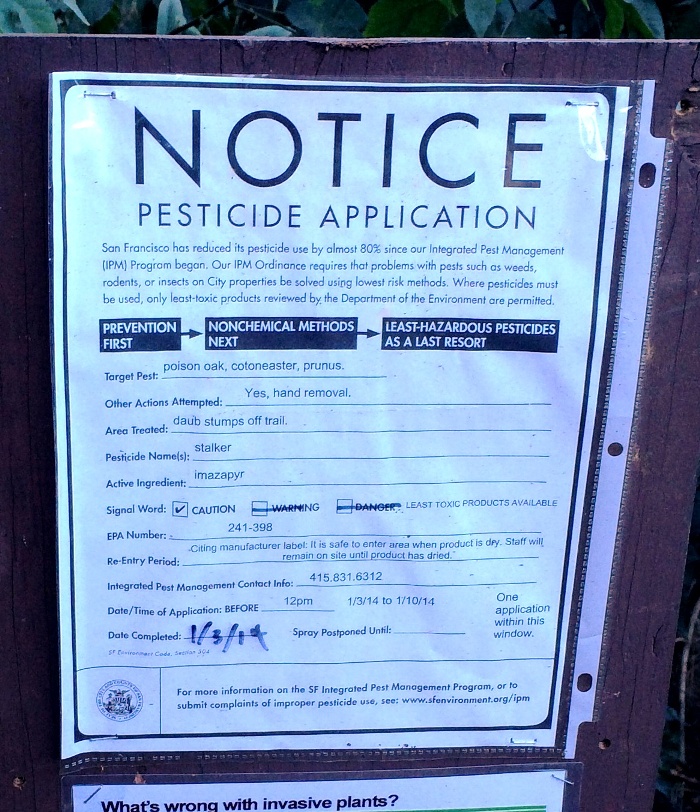
pesticide notice jan 3 2014 imazapyr sutro forest poison oak cotoneaster prunusThis controversial Policy 4.2 will increase conflicts over open space, as NAP’s controversial management plans are extended throughout the City, management that costs too much money, cuts down too many trees, uses too many herbicides, and closes too much access. NAP already uses herbicides in the quarter of Sutro Forest that it controls – even though UCSF does not use it in its part of the forest.

Native-plant-specific biodiversity is a gardening preference, not a science. We don’t think the city should favor one group’s preferences over others. If UCSF goes along with the program, it could turn Sutro Forest into native plant scrub.

Particularly if you are a San Franciscan: Please write to the Supervisors on the Land Use Committee to tell them that they should NOT vote for the draft ROSE. This would send the draft back to the drawing board and hopefully Policy 4.2 would be removed before it’s presented for approval again. The people to contact are:

  • Supervisor Scott Wiener: scott.wiener@sfgov.org (Phone: 415-554-6968);
  • Supervisor Jane Kim: jane.kim@sfgov.org (Phone: 415-554-7970); and
  • Supervisor Malia Cohen: malia.cohen@sfgov.org (Phone: 415-554-7670)

Please try to get an email out before Monday. Your voice may be the one that convinces them. You could say something like this:

Please do not approve the ROSE. Policy 4.2 could be devastating for San Francisco, extending the controversial Natural Areas Program to all open space in the city. This could deter better uses for Open Space, including community initiatives such as new neighborhood parks, and it gives non-elected staff in the Department of the Environment a say in land use decisions. Please vote not to approve the Draft ROSE.

If you can copy the supervisor of your district, that would be even better.

BAD NEWS

UCSF cut down 212 trees in March-May, the height of the nesting season, despite letters from the community asking them to wait. It is impossible to check trees for nests of songbirds, which are well-hidden to avoid predators, so we can assume damage was done to nests and to baby birds.

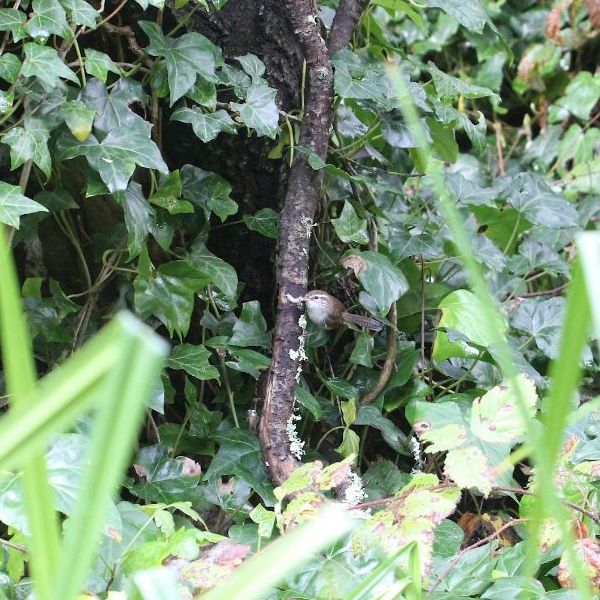
This bewick's wren's nest is hidden. Copyright Janet KesslerMeanwhile, the Sutro Stewards (who favor cutting down trees in Sutro Forest) published an alarmist post on their blog about the “dire straits” of the forest, saying that thousands of trees are riddled with disease, pathogens, and insects. Experts we consulted said it appeared wildly exaggerated: “This is certainly not the first time I have seen someone want to use a disease threat as a roundabout way to get some politically inconvenient trees removed.” We’ll update you when we have more precise information.

But UCSF is using it as a reason to perform another ‘evaluation’ of the trees, and this will likely mean more aggressive tree-cutting. We will keep you posted.

felled trees sutro forest

Posted in Environment, Mount Sutro Stewards, nativism, UCSF | Tagged , , , , , | 1 Comment

Sutro Forest: Risk and Uncertainty

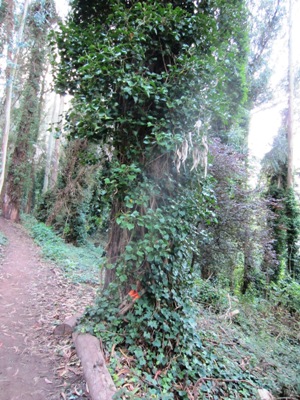
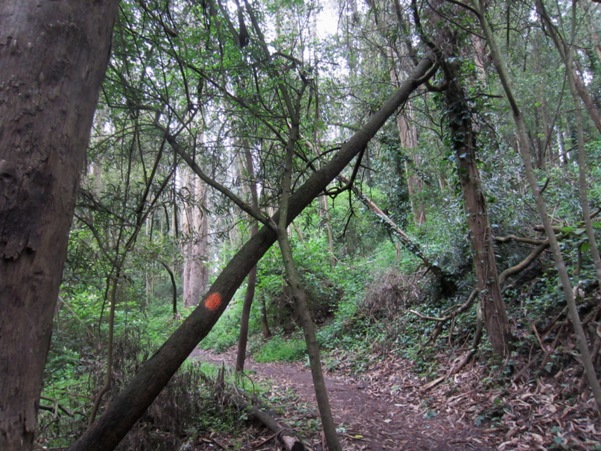
orange paintUCSF’s sent out another notice for tree removals. Presumably, these will be the remaining trees  marked with orange dots last year.  It’s the middle of the nesting season now, and we do not understand either the urgency — or the need. Why can’t these trees – very few of which are actually hazardous – wait a few months to save young wildlife?

[Update June 2014: Some 212 trees were actually cut down. Since it’s nearly impossible to find songbird nests without prolonged observation, we expect there was some damage/ mortality.]

We also have more serious and long-term concerns about UCSF and Sutro Forest:

  •  That “safety” will be an excuse to cut down a lot of trees and destroy the understory; and
  •  That the management of the forest may fall to those who despise it.

IT’S WILDLIFE BABY SEASON

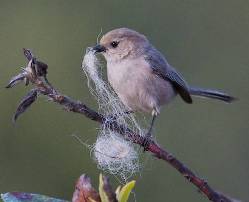
bushtit with nesting material. Copyright Janet Kessler

Bushtit with nesting material. Copyright Janet Kessler

We’re grateful that (until this March!) UCSF has generally respected this downtime allowing birds and animals to breed and raise their families in Sutro Forest. This is not just theoretical. Wildcare, a wonderful organization that cares for injured or displaced wild creatures – including young birds and animals in the breeding season – has an important advisory on their website: Stop! Don’t Prune Those Trees. It say, in part:

“WildCare asks you to please stop and consider the time of year– if it’s spring or summer, animals of all species may be using your tree as a nursery even as you read this! Every spring, baby animals that have been orphaned or injured because their nests were damaged or removed arrive at WildCare… Some species of birds (especially raptors) nest in hidden tree cavities, so don’t forget to check both limbs and trunks thoroughly before trimming or removing. Spring (and summer!) are busy baby season— procrastinate now!”

WHAT UCSF IS DOING

In its forest plans, UCSF  always earmarked the period between mid-February and mid-August as the nesting season when it would do only emergency work.  UCSF’s had good track record on respecting this.  Last year, it postponed an experiment with using goats to reduce underbrush when people pointed out that birds do nest in the understory.

So we were quite  surprised recently that it started tree removals in March 2014, and didn’t heed requests to wait. Some 181 trees had been marked with orange dots, and about half of them were cut down in March. Now, it’s doing the rest. Here’s what they wrote.

“Starting on Monday, May 5, [2014] Bartlett will return to complete the work. There will be intermittent trail closures on weekdays from May 5 through May 23 as the work is being completed, and Bartlett will avoid any noisy work before 9 a.m. Again, this work is focused only on mitigating the potential danger of hazardous trees.”

We wrote to them pointing out it was the nesting season. They replied:

“Thank you for your email regarding bird-nesting season. We are aware of the bird activity in the Mount Sutro Open Space Reserve, and UCSF Facilities Services has a policy to avoid tree removal and pruning if there is active bird-nesting in the tree.  Hazardous tree work is a critical part of our ongoing maintenance program. In the interest of the safety of visitors to the Reserve, this work needs to happen as soon as possible. Again, we appreciate your patience during this work and encourage you to use caution when visiting the Reserve.”

But it’s really difficult to know where birds and animals hide their nests and dens. When there’s disturbance, the parents stay away from the babies. They have to be good at it, or their young will get eaten. It’s unreasonable to expect Bartlett, the tree removal contractor, to responsibly check each of a 100 trees for nesting activity.

This bewick's wren's nest is hidden. Copyright Janet Kessler

This Bewick’s wren’s nest is hidden. Copyright Janet Kessler

And since dead trees (snags) are particularly excellent for wildlife, we can assume that there will be destruction.

snag as hunting groundWERE THEY HAZARDOUS?

We wrote about the trees being marked with orange dots at the time this was first done. Many people objected; some even left notes on the trees.

When arborists examine trees for hazard, they look at how likely the tree is to fail, how big it is, and where it would land.  Hort Science’s method considers three factors:

  • Failure potential (How likely is it that the tree would fall or drop a limb);
  • Size of the part that would fail (the size of the tree or the branch);
  • Value of the target area (if it fell, what would it damage?).

Each is scored on a scale of 1-4, and the scores are added together. This gives a tree a rating of 3 (least problematic) to 12 (most problematic). Only a small young tree far from any road or building or playground would be a 3. The City’s action threshold is 9, and most trees with a 9 or higher rating would be removed.

trees with orange blobsThis methodology is strongly biased against large trees in busy areas. For instance, a big tree near a roadway would get a score of 4 for size, and 4 for “value of target.” This means it is an automatic 9, because the score for “failure potential” cannot be less than 1. But conversely, it does not remove trees merely for being old or spindly or even dead.

Unfortunately, they don’t usually employ this method for natural areas and forests.  There, they just eyeball the trees, and mark for removal any that are in poor condition or are leaning. We suspect the approach used here was just that – remove trees that are dead or dying or leaning.

Very few of these trees were actually hazardous. All of them add to the forest’s character and provide important wildlife habitat.

LONGER TERM CONCERNS

While our immediate concern is with tree felling in the bird nesting season, we have several longer-term concerns.

  • “Hazard” as an excuse for causing more hazards by felling trees.  “Hazard” – whether for trees in poor condition, or the so-called “fire hazard” will be used as an excuse for tree-felling – while ignoring the real and long-term risk of destabilizing the slopes. Scientists believe a tragic landslide in Oso, Washington was due in part to trees being cut above the slope that failed. Rockslides and failures can occur for many years after trees are felled. (We wrote about that HERE.)
  • Managers who hate non-native trees. UCSF has also hinted that it is unsure how to proceed with managing the forest, saying their expertise is in medicine, not forestry:  “…the University is exploring a variety of partnerships and other resources that could provide help and guidance in its stewardship of the Reserve.”  This understandable. Our concern is with the nature of this help and guidance – and the potential use of the nativist “Natural Areas Program” guidelines.

THE PROBLEMATIC ‘BIODIVERSITY PLAN’

Last year, San Francisco’s Department of the Environment hired Peter Brastow as ‘Senior Biodiversity Coordinator.’ Before that, he was Director of ‘Nature in the City’, the original parent organization of the Sutro Stewards. He’s been tasked with putting together a “Biodiversity Plan” for the city, and they are seeking a $0.25 million grant from the Strategic Growth Council to do this. (The Strategic Growth Council is a California state organization.)

This Plan is hugely problematic on two counts.

  • First, the ‘biodiversity’ being considered is an extension of the controversial and destructive Natural Areas Program (NAP) of the San Francisco Recreation and Parks Department. NAP seeks to destroy thousands of trees, close many miles of trails, and already uses more of the “most hazardous” herbicides than the rest of SFRPD put together (excluding Harding Golf Course, which is managed by the PGA Tour and not by SFRPD).
  • Second, it plans to extend this Plan to all the open areas of the city, no matter what the ownership. It would even include people’s backyards. UCSF would not be bound by a city plan, since they are a State-level organization. But they could use it as an excuse to implement something similar.

Biodiversity is a poorly defined term, and as Professor Art Shapiro pointed out “Biodiversity means whatever you want it to mean.” The promoters of this Biodiversity Plan are not friendly to trees, particularly non-native trees. In a recent meeting of the SF DoE, Peter Brastow commented on the Urban Forestry Plan – which seeks to stabilize and then expand San Francisco’s sparse 17.3% tree canopy – with “You can’t plant trees willy nilly” and noted that the tree-canopy objective could conflict with the “biodiversity” objective. In a meeting we attended some years ago, Peter Brastow called eucalyptus “the largest weed.”

Clearly, how they define “biodiversity” is “native plants and shrubs.”

We oppose this Plan, which could have far-reaching adverse consequences for our city and its environment. Trees sequester carbon, fight pollution, provide windbreaks, absorb sound, and stabilize slopes in ways that low-growing plants and shrubs cannot do. Trees are more environmentally valuable, and expanding the tree-canopy is an important objective – as is preserving what we have in Sutro Forest and elsewhere.

It’s a poor idea. It’s based on NAP, whose own Management Plan is still undergoing a million-dollar Environmental Impact Report process that may take until the end of 2014. It covers private property, including, specifically, people’s back yards; it’s not impossible that homeowners would find they needed permission in deciding what to plant or how they manage their own spaces if the Plan produces guidelines that get written into regulations. It doesn’t clarify how this whole effort will be funded.

We hope that the Strategic Growth Council will not waste our money funding this anti-environmental effort. The decision whether to consider the proposal will be taken on May 15th, 2014. The person to write to is Polly Escovedo (polly.escovedo@resources.ca.gov)

Formerly trees

Formerly trees

Posted in Mt Sutro Cloud Forest, UCSF | Tagged , , , , , | 5 Comments

Felling Orange-dot Trees in the Nesting Season

photo credit: 123rf.com

photo credit: 123rf.com

In March 2014, soon after UCSF said it was delaying work on the Draft Environmental Impact Report for now – it sent around this message.

“Beginning on Monday, March 17th, Bartlett Tree Experts will be performing tree work throughout the UCSF Mount Sutro Open Space Reserve trail system in order to mitigate potential hazardous trees. This work will consist of trimming, pruning, and/or removing hazardous trees, branches and limbs that are overhanging, or in close proximity to, trails throughout the Reserve and pose a potential danger to trail users.

We were surprised, because it was (and is) the height of the bird nesting season. We wrote to UCSF and didn’t get a response. We hoped they were responding to actual concerns regarding a few specific trees.

leaning tree orange blob - Mount Sutro ForestBut no. They were removing trees that had been marked over a year earlier – the orange-dotted trees that were in poor condition but not actually hazardous for the most part.

notes in the forest2 - Gina HallForest-lovers were dismayed, and pinned notes on the trees saying “Please Don’t Cut Me Down” – we reported on that HERE. They were ignored. On a recent hike in the forest, we discovered most of the orange-dotted trees had been felled.

orange blob trees - Mount Sutro Forestquirky tree with orange mark - Mount Sutro Foresttrees with orange blobsepiphyteWe learned from UCSF later that 118 trees have already been felled, and another 63 will be taken down in the next few weeks. It’s still the nesting season until September.

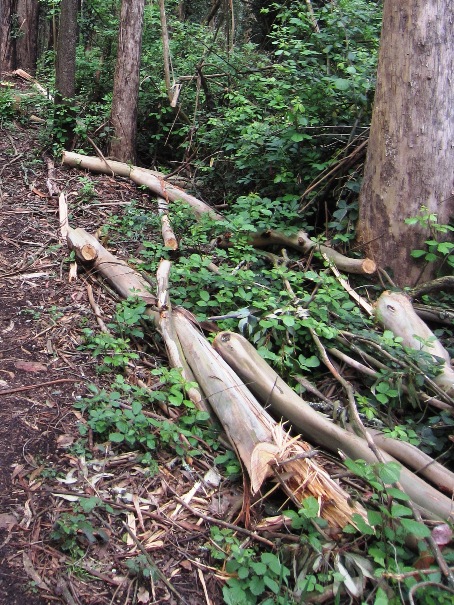
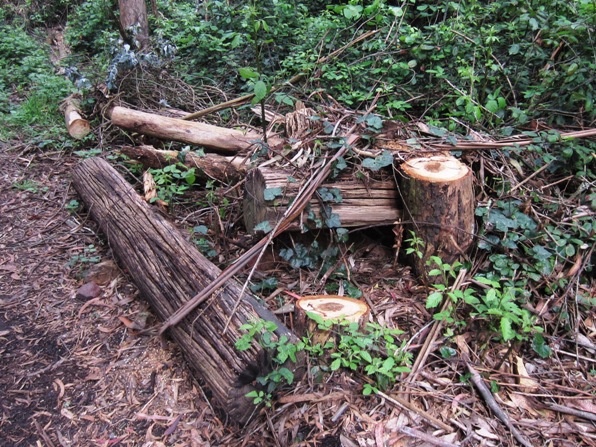
Here are a few of the 118 tree stumps and logs…

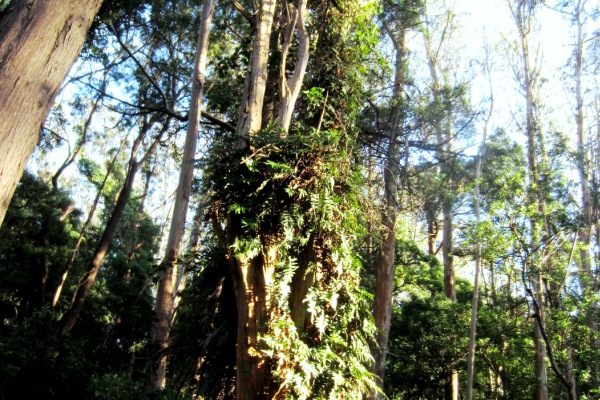
felled treesstumpstumps april 2014stumps in sutro forest april 2014The beautiful fern garden was among the casualties – here it is on the ground:

this was the snag with ferns and epiphytesThese chips were trees.

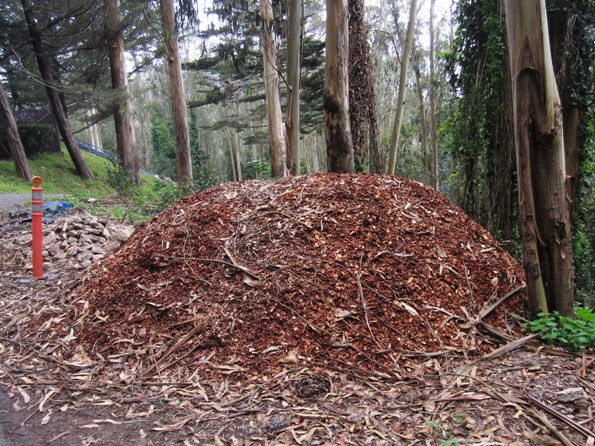
These were treesWHY WE OPPOSE REMOVING THESE TREES

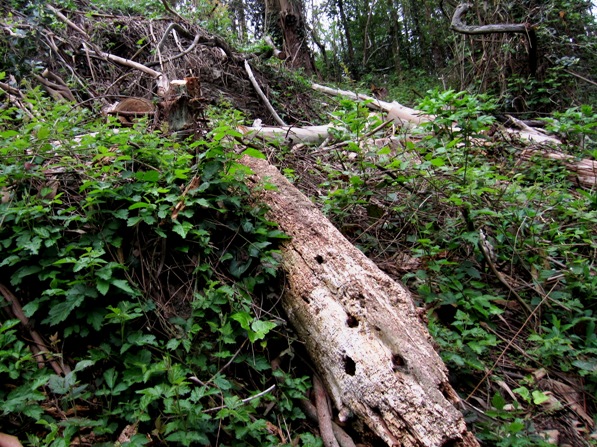
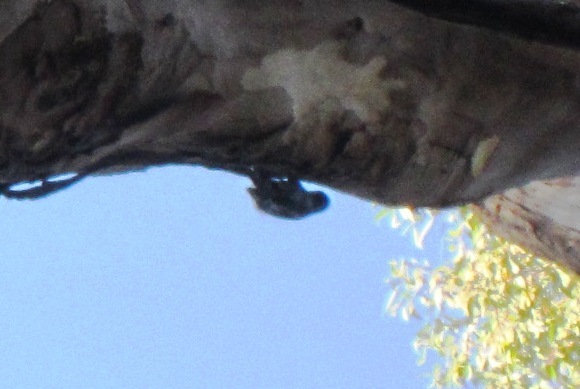
We oppose the removal of these trees – except those that are actual hazards – even though they are “dead or dying.” Snags (standing dead trees) are important as habitat, providing for other plant and animal species. They accumulate ferns, and other epiphytes, and provide food for insects that in turn are food for birds. The snag below is an example – it’s clearly been a hunting ground for woodpeckers or other birds. They add to the visual beauty and character of the naturalized forest.

snag as hunting ground

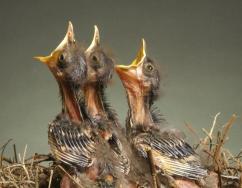
Baby birds (Photo credit www.mi9.com )

Baby birds (Photo credit http://www.mi9.com )

We especially object to their removal during the nesting season. We have to say we’re dismayed. UCSF has always explicitly respected the nesting season in its plans, and have avoided actions that might disturb birds’ nest or destroy them. Spotting nests is never easy, especially song-bird nests. They have to be concealed if they’re to survive predators. Tree companies are not specialists in bird behavior. Wildlife rehabilitators frequently have baby birds and animals brought to them when trees are felled or pruned in the nesting season: HERE’s a page from Wildcare, a Marin-based rehabilitator that’s headed “Stop! Don’t Prune Those Trees!

We know that birds do nest in Sutro Forest. What we don’t know is how much damage this action in the nesting season has done.

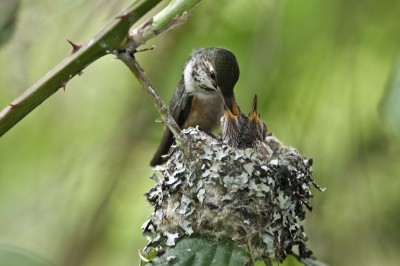
hummingbird nests collected in Sutro Forest

Hummingbird nests collected in Sutro Forest


Posted in Environment, Mt Sutro Cloud Forest, UCSF | Tagged , , , , | 4 Comments

Sutro Forest: Cut Trees, Add Landslide Risk

When UCSF  (or SF Recreation and Parks Department) discusses “Safety” in the forests on Mt Sutro and Mt Davidson,  they generally focus on fire hazard (relatively low in these damp cloud forests), or on the risk of being hit by a falling tree (about half the risk of being hit by lightning). Tree removal could actually increase both those risks, by drying out the forest and by increasing windthrow – the risk of  the remaining trees being blown over.

But what we want to talk about in this post is landslide risk.

Two weeks ago, a horrible mudslide in Washington State engulfed homes and took lives. Some scientists think logging trees in the area contributed to the tragedy. This has implications for Sutro Forest, which grows on a steep hill – and also for the other San Francisco forest, Mount Davidson. Tree removal, ongoing and planned, could destabilize the mountainsides.

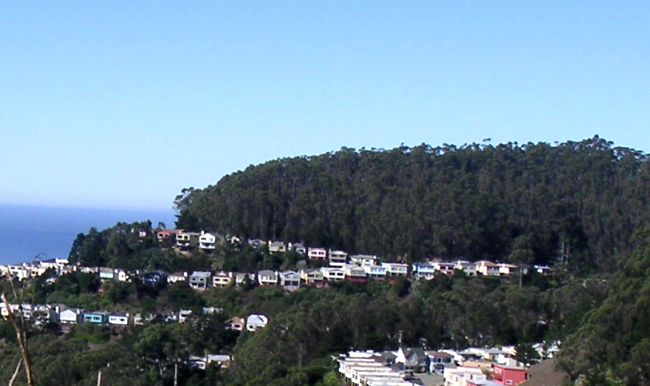
Mount Sutro forest viewed from southeast (Twin Peaks)LOGGING AND LANDSLIDES

On March 22, 2014, a huge landslide destroyed the small Washington community of Oso. Rain was of course a factor, as was erosion at the base of the slope. But it’s probable that tree-cutting above the slide area was an important factor too. An article in the Seattle Times that quotes a report from Lee Benda, a University of Washington geologist. It said tree removal could increase soil water “on the order of 20 to 35 percent” — and that the impact could last 16-27 years, until new trees matured. Benda looked at past slides on the hill and found they occurred within five to 10 years of harvests [i.e. felling trees for timber].

There had been red flags before. The area was second growth forest, grown back from logging in the 1920s/30s. Over 300 acres were again logged in the late 1980s.

  • The first time regulators tried to stop logging on the hill was in 1988. But the owner of the timber successfully argued that measures could be taken to mitigate the risk. Eventually, the state only blocked it from logging some 48 acres, and the owners  gave in on that.
  • In 2004, new owners applied to cut 15 acres; when the Department of Natural Resources (DNR) objected, they halved the area and re-located the cut. DNR gave approval, subject to no work during heavy rain and for a day afterward. The tree-cutting finished in August 2005.
  • In January 2006, there was a major landslide 600 feet from the cut zone. The state built a log wall to shore up the slope.
  • The owners continued logging. In 2009, they removed 20% of the trees. In 2011, they removed another 15%. In 2014, the hillside collapsed.

The regulators were aware of the risk; they thought they were mitigating it with their restrictions and reaching a compromise with the owners. But it wasn’t enough. Destabilizing the mountainside is a long-term thing; the effects can show up in months, but it’s more likely to take years.

THE LESSON FOR SAN FRANCISCO

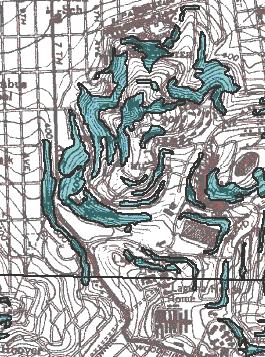
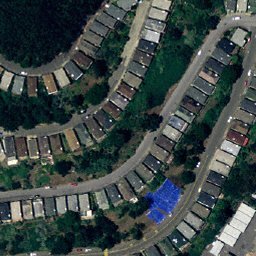
We know our hills are prone to slides. Here’s a geological map of Mt Sutro and surrounding areas. The blue zones show where there’s a potential landslide risk:

Blue areas show "potential for permanent ground displacements..."

Blue areas show “potential for permanent ground displacements…”

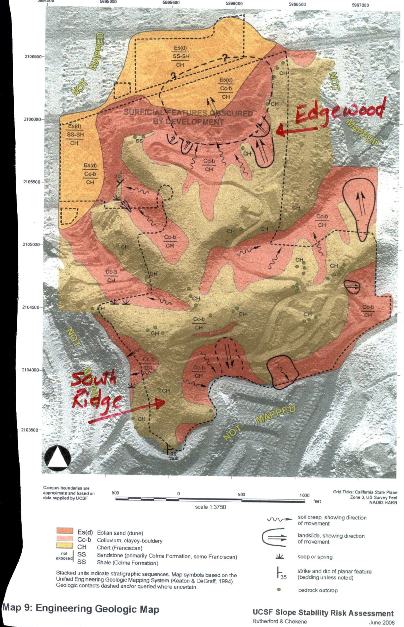
This next map is from a UCSF document. The pink areas and wiggly arrows indicate landslide risk. The double-arrows show where actual landslides seem to have occurred in the past.

Pink areas and wiggly arrows show landslide risk; double line arrows show past landslides.

Pink areas and wiggly arrows show landslide risk; double line arrows show past landslides.

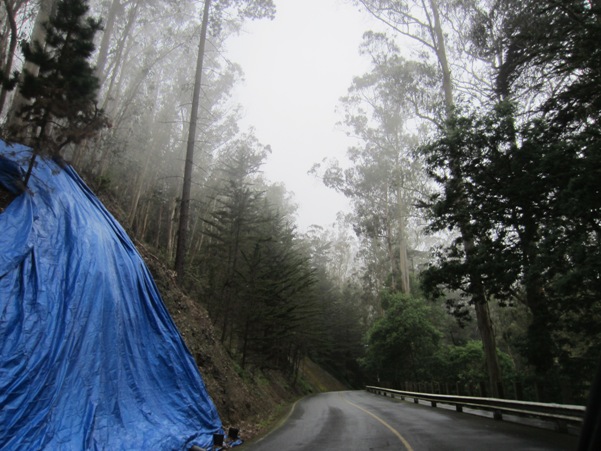
Landslide under blue tarp. South Ridge at top left.

Landslide under blue tarp. South Ridge at top left.

This slope in the Forest Knolls neighborhood was covered in a blue tarp for months after the slope became destabilized by tree removal…

This other blue tarp is on the hillside above Medical Center Way. It was installed soon after some extensive work on the trail in that area, with undergrowth being cleared and trails realigned. When we enquired why it was there, UCSF said there had been some rock slides, and this was a temporary solution.

This photograph was taken in March 2013. A year later, the blue tarp is still there.

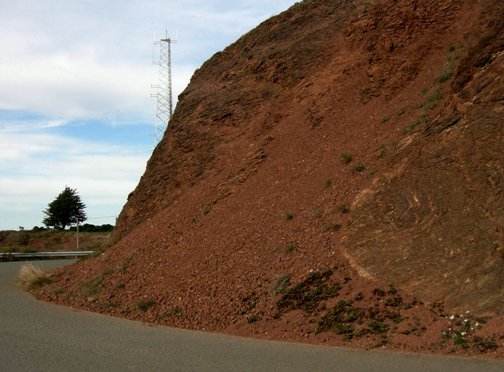
blue tarp above Medical Center WayFor more evidence, there’s the ongoing situation in Twin Peaks, where erosion and rockfalls in rainy weather are ongoing. There, it matters less, because it’s not falling on homes. Landslides on Mt Sutro or Mt Davidson have the potential to damage homes.

rockslide

rockslide

YEARS OF INCREASED RISK

While it’s possible that a slide could happen within months of the tree-felling, it could also happen 6-8 years later as the root systems rot away. It could happen in any year until the trees grow back and conditions are right for water-logging. On that fateful Washington slope, the average was 5-10 years. No one wants to find out the average for San Francisco slopes.

We ask the land managers for these forests to stop removing trees and large shrubs that have successfully stabilized our hillsides for decades.

Posted in deforestation, Environment, Neighborhood impact | Tagged , | 4 Comments

How to Define ‘Biodiversity’

trail under treesSomeone asked UC Davis Professor Arthur Shapiro for a definition of Biodiversity. After all, it’s apparently a key concept in some of the policy-making in San Francisco open spaces.

“A buzzword,” he responded. “Biodiversity means whatever you want it to mean.”

He amplified this definition in an article that’s been published on SFForest.org, HERE.

DEFINING DIVERSITY

In brief: Biodiversity starts with a simple count of all the species in a defined area. That’s also called “species richness.”

But just the number of species isn’t enough. Ecologists want to tell the difference between a community that has, say 95 blackbirds and 5 sparrows, and one that has 50 blackbirds and 50 sparrows. This is called “equitability.”

Eventually, a “diversity index” was developed that could measure both the number of species, and the frequency with which they occurred. This tool was then generalized for use in many ways, so diversity indexes could be calculated for almost everything.

DEFINING SPECIES

The Endangered Species Act was passed to protect animals and plants that were at risk of extinction. But in addition to protecting endangered species, it allowed for the protection of subspecies as well as distinct population segments. Neither of these things was actually defined in biological terms, leaving them open to interpretation.

Genetic analysis seemed to offer a solution. Theoretically, it should be possible to make a genetic analysis of any living thing, and decide whether it’s a species or subspecies or distinct population segment based on its DNA. But instead, it muddied the waters still more, because some plants or animals that looked very alike turned out to be unrelated; while others that looked very different were genetically very similar.

So it’s still a rather confused area (as was evident from the great Manzanita kerfuffle). No one knows how to define biodiversity at the genetic level.

ALPHA, BETA AND GAMMA DIVERSITY

Professor Shapiro gave some further measures of biodiversity:

  • Alpha diversity, which measure species richness at a local level. In San Francisco, if you counted up all the species of birds and animals and insects and plants, that would give you alpha diversity.
  • Beta diversity measures the difference in diversity between various areas in a region – how many different little ecosystems you have within the region. In San Francisco, for instance, you have many different habitats – dense forests beside open scrub land beside well-watered backyard gardens, and potentially different plants and animal life in each. In the San Francisco Bay Area, beta diversity is high for most species.
  • Gamma diversity is diversity over large areas.

Finally, then, how do you define biodiversity? Here’s what Professor Shapiro says:

  • It’s species richness plus
  • the distribution of abundance and rarity, plus
  • the geography of all that, plus
  • the amount of genetic variation in selected species of interest, plus
  • whatever you please.

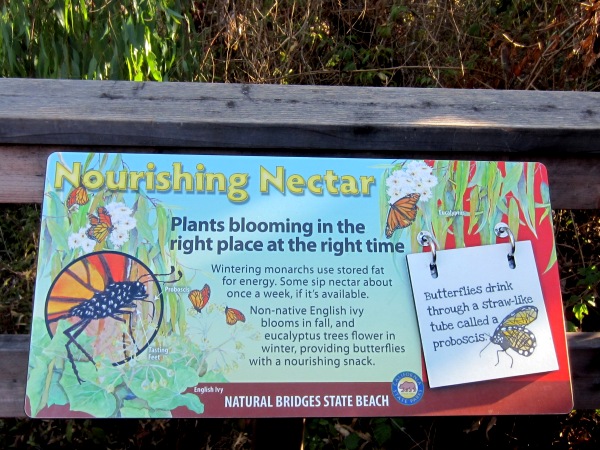
nectaring on ivyHe adds, “Somehow, concepts concepts of “quality” have gotten mixed in, too.” He gives the example of a redwood forest – which actually has low biodiversity – being clear-cut. Left alone, the clear-cut area would fill up with a lot of other plants, many of which would be considered “invasive weeds.” That replacement vegetation would be more diverse – but it would be made up of the “wrong species, whatever that means.”

Because, he points out “Biodiversity is only a buzzword.”


Posted in Environment | Tagged , , , | 4 Comments

Good News: Rat Poisons To Be Restricted in California

Dusk, mist, Great Horned Owl

Dusk, mist, Great Horned Owl

This article is republished from San Francisco Forest Alliance’s website, with permission. Sutro Forest is home to owls and hawks, coyotes, and other predators. It’s also surrounded by neighborhoods, and people may not realize that dealing with their rodent problem could harm wildlife and pets. These restrictions are good news.

—————————————————–

As our readers will know, we’ve been concerned about the use of second-generation rat poisons that cause death by slow internal bleeding. The poisoned mice and rats are likely to be captured and eaten by other animals – owls, coyotes, dogs, cats, hawks. When this happens, they can get poisoned too, and we’ve seen two owls die this way: a barn owl and a Great Horned Owl. These poisons are currently available in stores, and anyone can buy and use them – without knowing they could harm wildlife, pets, and even small children who pick up the bait by accident.

So here’s the GOOD NEWS! California is passing legislation restricting the sale of these products only to licensed applicators, which means that they won’t be available in stores for unthinking use by people who don’t realize their effects. (A link to the actual proposed legislation is HERE.)

The San Francisco Department of the Environment (SFDOE), which has been working on this for years, sent round a message about it, saying:

‘The California Dept. of Pesticide Regulation (DPR) has announced that it is designating the certain hazardous rat baits as “restricted materials.”

These are the products that the US EPA concluded (way back in 2008) pose an “unreasonable risk,” and tried to remove from the consumer market. The active ingredients affected by the DPR decision are brodifacoum, bromadiolone, difenacoum, and difethialone.

Restricting pesticide products means that they may only be applied by licensed applicators, or by those meeting the definition of “private applicator.” In essence, you will no longer see these products on the hardware store shelf. Considering all the data that has been amassed on poisonings of pets, wildlife and children, we consider this a very positive step.”

They asked for emails to be sent to the DPR thanking them to dpr13002@cdpr.ca.gov

If this is an issue you care about, please send them an email of thanks. We’d also like to thank all the organizations that have been involved in trying to get these restrictions, and all those that have campaigned against these rodenticides.

Posted in Mt Sutro Cloud Forest | Tagged , | Comments Off on Good News: Rat Poisons To Be Restricted in California

UCSF Sutro Forest Update

UCSF has decided to wait on Mount Sutro Forest. For now, all plans are suspended except for routine maintenance.

CAG meeting 5 March 2014

We attended UCSF’s Community Advisory Group (CAG) meeting this evening. (UCSF has a sort of citizen’s panel that is supposed to be its interface with the community. We don’t know how they are selected.) Mt Sutro was on the agenda.

THE STORY SO FAR

Readers who have been following this saga will recall that on 21 November 2013, UCSF changed its plans to cut down up to 30,000 trees on 3/4 of the forest, and use large amounts of herbicides repeatedly for 7 years or more to prevent regrowth.

Instead, it would cut down “only” about 3,700 trees (up to 10 inches in diameter) on around 26 acres (this in addition to the “Urgent Fire Safety” work in August 2013 that removed around 1000 trees on 12 acres.) But it did promise not to use herbicides.

At the same meeting, it offered a time-line: It would put out a new Draft Environmental Impact Report (DEIR) in February, open it to 45 days of public comment, have a public meeting in March 2014, and they hoped to do the tree-felling in about a month starting mid-August 2014. More recently, they updated the time-line: new DEIR in March, public meeting in April 2014.

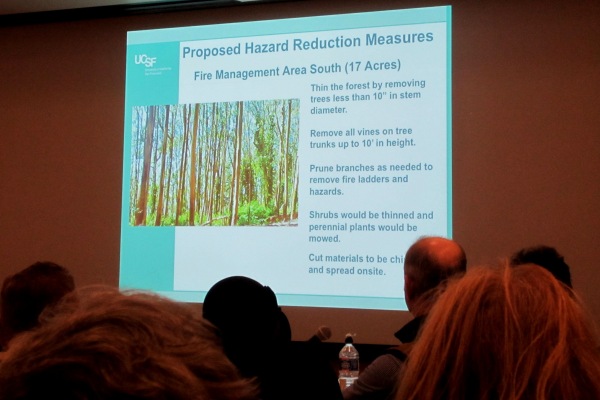
While we were happy to see that herbicides would not be used, and that the objectives had been simplified to safety, we opposed the removal of thousands of trees and the gutting of half the forest. (For instance, in the picture on the screen in the photograph above – we estimate that only 1-2 trees would remain.)

Craig Dawson, Executive Director of the Sutro Stewards (a volunteer group that works on the mountain) was also vehemently opposed to the new plan, and has been publicizing that opposition. Many on the CAG agreed with him. He emphasized its detrimental effects on the forest and its wildlife. (We think he is right about that; we had similar concerns, as we had with previous plans.)

TODAY’S MEETING

At the meeting today, Kent Julin, the arborist hired by UCSF, presented the “New Plan” for those who had not seen it on November 21, 2013.  Vice-Chancellor Barbara French explained that they had arrived at the plan by considering all the comments they had received. She thought that while there were “pockets” of opposition to the 2013 Plan, there was consensus around not using herbicide and around fire safety. Hence they had brought in Kent Julin to advise on fire safety. (He is based in the East Bay, and accustomed to the dry forests there.)

However, VC French said, while UCSF had planned to publish the new DEIR this spring, that was not going to happen. Associate Vice Chancellor Lori Yamauchi’s office (Campus Planning), which would have that responsibility, was now busy with the Long Range Development Plan.

They have set no new date for the DEIR to come out.

We ascertained that this meant nothing would happen in the forest for now. She said that routine maintenance – cutting back bushes, dealing with hazardous trees – would continue, but the New Plan would not be implemented until an Environmental Impact Report was approved.

We will keep you posted about updates, but we do think this is a sensible approach.  First, do no harm.

Posted in Environment, eucalyptus, UCSF | Tagged , , , | 6 Comments

Time and Ecological Communities – Talk by Dr Art Shapiro – 24 March 2014

Last year, we posted here about an interesting new series of lectures in January, March and April of 2014. It’s the Science of Conservation and Biodiversity in the 21st Century series, from three professors each giving one talk in San Francisco.

According to the email from the Commonwealth Club, the sponsor: “This series of lectures will present a new way of looking at public issues in conservation. The things we’ve assumed as facts often are not. Traditional approaches are losing ground as science illuminates new pathways for framing and achieving conservation goals.”

bumble bee on strawberry tree 3The first talk (on Conciliation Biology, by Dr Scott Carroll),  was excellent. The room was packed, with standing room only.  We hope to post notes and a link to the presentation on this site when we have permission.

These talks provide important thought leadership that could shift the way San Francisco manages its wild spaces. A good turnout would encourage the Commonwealth Club to have more such talks. Please do attend if you can.

MARCH 24, 2014, 12 NOON: DR. ARTHUR SHAPIRO ON ECOLOGICAL COMMUNITIES AND TIME

Dr. Arthur M. Shapiro is Distinguished Professor in the Department of Evolution and Ecology, College of Biological Sciences, at UC Davis. He’s speaking on Ecological Communities and the March of Time.

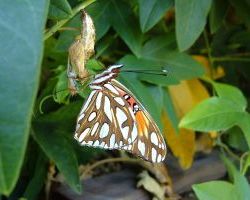
Gulf Fritillary Butterfly emerges on passiflora plant

Gulf Fritillary butterfly breeds on non-native passionflower – wikimedia

From the website: “Ecological communities as we know them are similar to freeze-frames from a long movie. Associations among species are very dynamic on millennial scales, as demonstrated by the evidence since deglaciation 15,000 years ago. Coevolution of species occurs locally in geographic mosaics, and can be extremely dynamic as well. Frederic Clements, the father of American community ecology, had a holistic vision. He saw communities as super-organisms. He was wrong.”

Register at: www.commonwealthclub.org/events/2014-03-24/arthur-m-shapiro-ecological-communities-and-march-time

The tickets cost $20 to the general public, FREE for members of the Commonwealth Club, and $7 for students carrying appropriate ID. (We also have some discount codes available; if you wish to attend and are not a Club member, please email us at fk94131@yahoo.com and we’ll send you the code if qualified.)

WEDNESDAY APRIL 9, 12 NOON: DR JOE MCBRIDE ON EUCALYPTUS IN THE BAY AREA

ferns and blackberry and poison oak

Eucalyptus forest understory on Mt Sutro

Dr. Joe R. McBride is Professor of Landscape Architecture and Environmental Planning, Department of Environmental Science, Policy, and Management, UC Berkeley. His talk is about The History, Ecology and Future of Eucalyptus Plantations in the Bay Area.
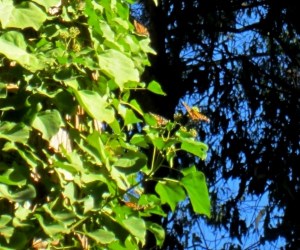
The website says: “McBride will explain the ecology of the eucalyptus forest in the Bay Area. He will discuss its structure, the variety of plants and animals that live within it, its health and the ecological functions it performs. There will be a description of the dynamics within these forest stands (such as whether they are successional or a climax-species that replace themselves over time without human input) and about their invasive potential.”

Register at: www.commonwealthclub.org/events/2014-04-09/joe-r-mcbride-history-ecology-and-future-eucalyptus-plantations-bay-area

The tickets cost $20 to the general public, $8 for members of the Commonwealth Club, and $7 for students carrying appropriate ID. (We also have some discount codes available; if you wish to attend and are not a Club member, please email us at fk94131@yahoo.com and we’ll send you the code if qualified.)

WHERE AND HOW

  • All lectures are at the San Francisco Club Office, 595 Market St.
  • You can register to attend at the links we gave, or call 415.597.6705
Posted in Environment | Tagged , , | Comments Off on Time and Ecological Communities – Talk by Dr Art Shapiro – 24 March 2014

February Idyll in Mount Sutro Forest: Bikes, Flowers, Slug

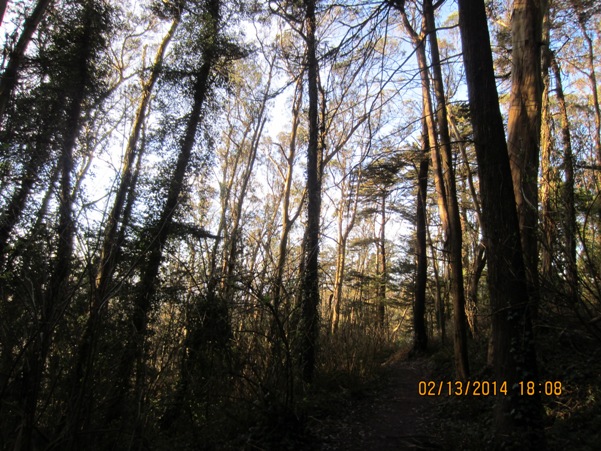
The welcome little storm that passed through a few days ago watered the forest, but it wasn’t actually raining on February 13th. So when someone emailed us to say they wanted to see the forest – for the first time – they could hardly have picked a better day for a hike. (If you’re interested in hiking on Mount Sutro – we have pointers HERE.)

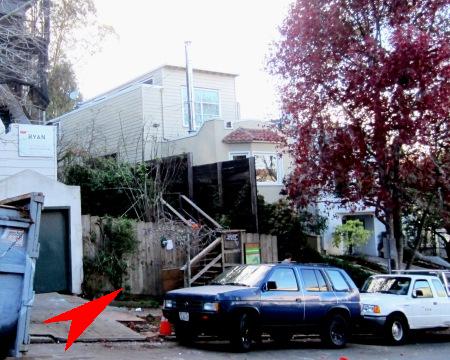
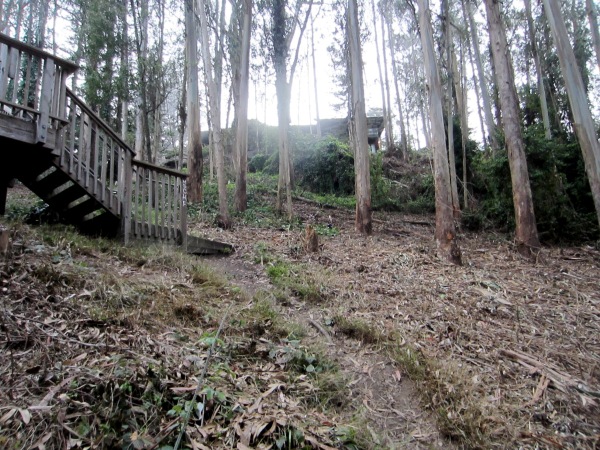
stanyan trailhead

Trailhead for Sutro Forest – Stanyan street, two houses above the intersection with 17th Ave

Though the Stanyan Street trail head (two houses above the intersection with 17th Avenue) is marked by a wooden staircase and a map, it’s still easy to miss.

“It looks like someone’s back yard” commented one observer who went right past it. But it’s  still a convenient entrance to the forest for drivers. There’s 2-hour street parking on Stanyan until 5 p.m.

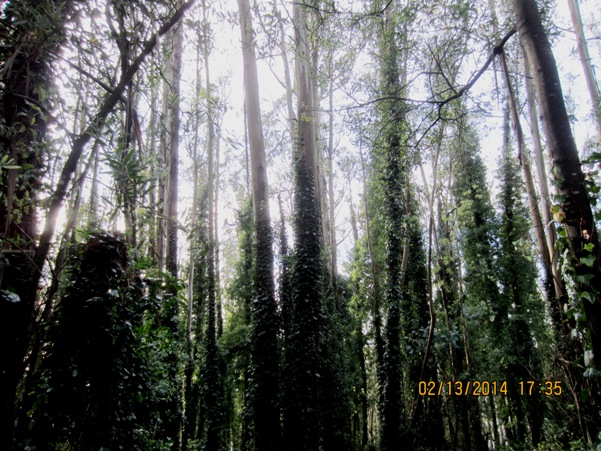
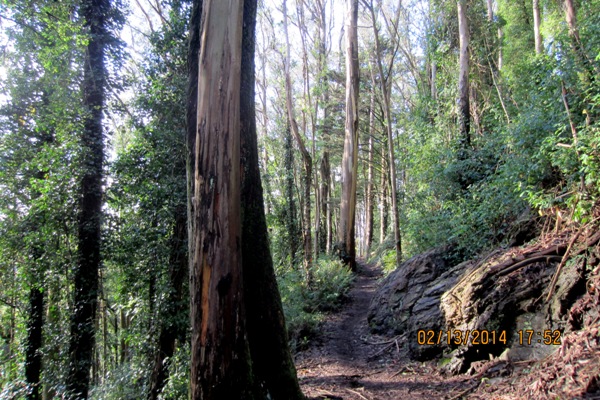
eucalyptus trees in Sutro ForestWe entered a  forest fragrant with eucalyptus. My companions paused just to breathe it in. “It smells so amazing!”

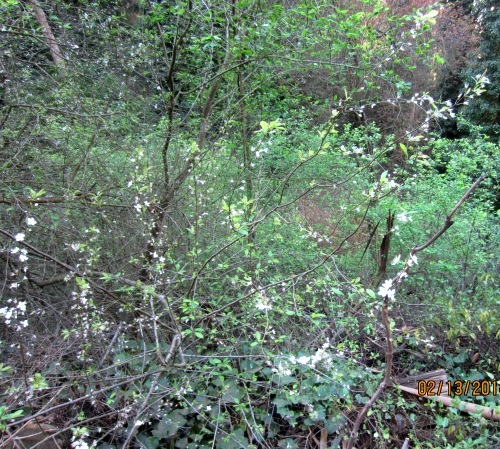
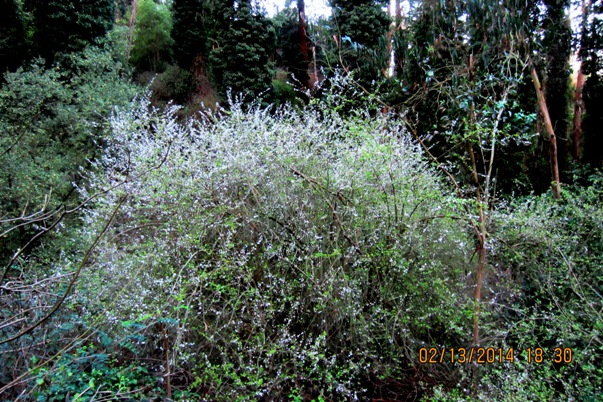
plum blossoms 1A damp trail led past a stand of plum trees, still blooming prettily.

plum blossoms in Sutro Forest 2Several  joggers came by, and people walking enthusiastic dogs who were delighted by the multifarious smells of the forest. mountain biker in Sutro Forest  Some mountain bikers zoomed around the trails. We were pleased to see a woman among them; most mountain bikers seem to be men, at least on Mt Sutro.

Generally, they were courteous and careful.  One slowed almost to a stop at a slushy spot. “I want to be careful not to splash you,” he said as he negotiated the mud. We wished him a good ride.

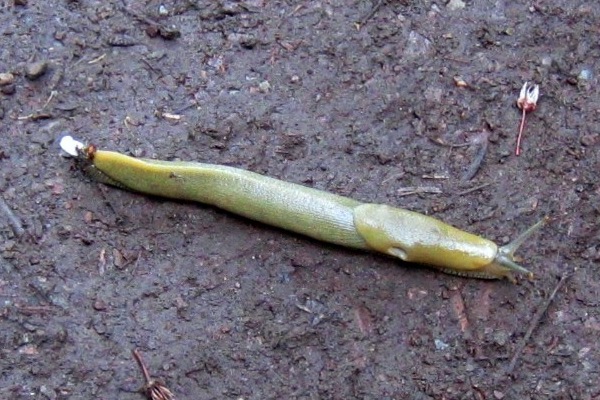
WHY DID THE BANANA SLUG CROSS THE ROAD?

The damp trail conditions encouraged this little critter to cross the trail. We watched as it made its sluggish way, a plum petal stuck to its butt.

My companion was concerned. “We should rescue it,” she said.

banana slug

She was right. One fast mountain bike, and it would be roadkill. So we carefully picked it up with a stick, and deposited it in the greenery on the other side of the trail. “It fell upside down,” she said. “Do you think it can right itself?”

We thought it could. Banana slugs seem pretty flexible.

THE IVY

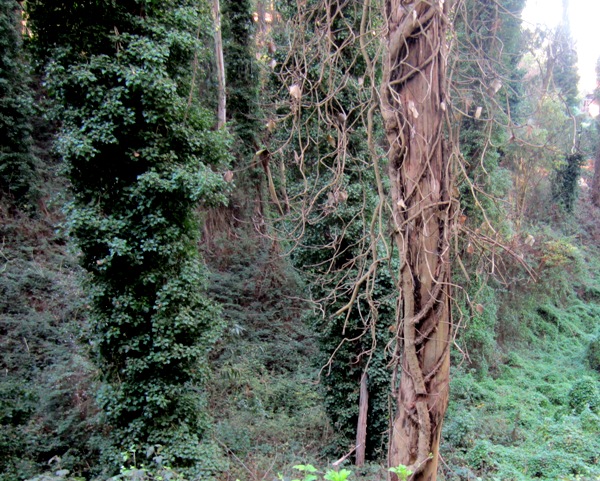
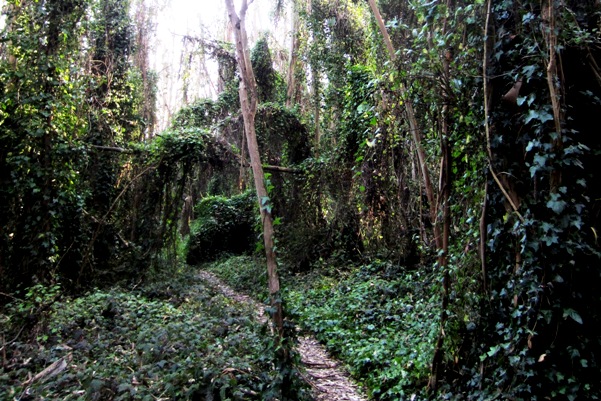
Everywhere along the trail, we saw trees festooned in the brown skeletons of dead ivy. The vines, thick as a human wrist, had been cut through and left to die. The fear is that the ivy kills the trees, but according to Jim Clark of Hort Science, there’s no evidence that it does. Vines can hurt trees in three ways; by covering their canopies, so they don’t get enough light for photosynthesis; by girdling the trees by twisting tightly around it; and by increasing its vulnerability to the wind through the “sail effect.”

ivy cut on sutro forest tree

Ivy living, Ivy killed

In fact, Jim Clark says, the ivy doesn’t get into the canopy of the trees; and that’s borne out by what we’ve seen in the forest. The ivy gets up the column of the tree, and it stops and flowers – providing excellent habitat and food supply to insects and birds. It also doesn’t circle the tree; it tends to travel straight up as is evident from the picture above. And in forest conditions, it actually helps slow the wind, and so all the ivy-bearing trees protect each other.

Ivy doesn't climb into the canopiesWe’ve also heard people argue that the sheer weight of the vegetation could pull down the tree. In fact, by growing all the way up the trunk, it more likely acts to stabilize the tree by lowering its center of gravity and providing hawser-like support structures. Some trees do fall in the forest, as they occasionally – but they are not usually the ivy-covered ones.

THE FAIRY GATES TRAIL TO THE CHANCELLOR’S HOUSE

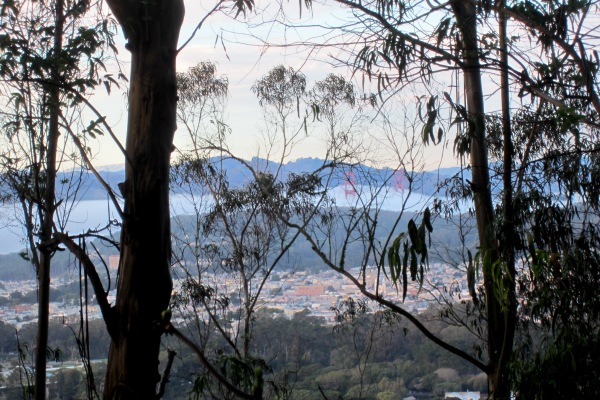
We took the Fairy Gates trail because the visitors wanted to see the Chancellor’s residence. It’s a wonderful house, with a view over to Marin and the Golden Gate Bridge in front, and the forest at its back. The best of all possible worlds.

UCSF chancellors house in Sutro Forest

The Fairy Gates trail, though, is sadly exposed by the “Urgent Fire Safety” understory and tree removal in August. Before, the trail appeared to follow a secluded mountainside, with a sharp drop-off to a valley below. But with the bushes that hid it cut down, the traffic on Medical Center Way and the buildings at Aldea are visible and it’s obviously just following the road . The magical name seems less appropriate.

We paused briefly to admire the redwood trees growing next to the house, then took the East Ridge trail up the mountain. That area, too, is denuded and brown; it’s an unhappy contrast with the lush greenery that hid the trail only a couple of years ago.

But as we climbed up, the forest became more green.

in mount sutro forest

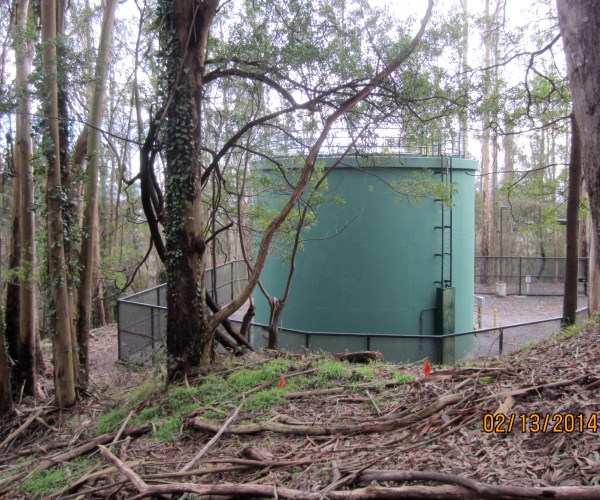
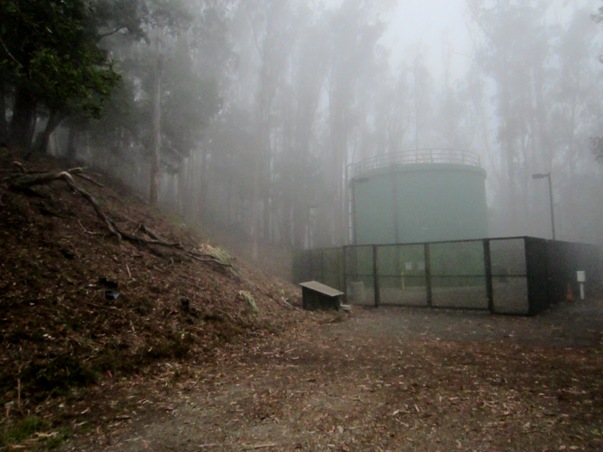
a very visible water tankThen again there was a denuded area around the now very visible water-tank that used to be quite hidden.

THE NATIVE PLANT GARDEN

The trail brought us into the native plant garden.

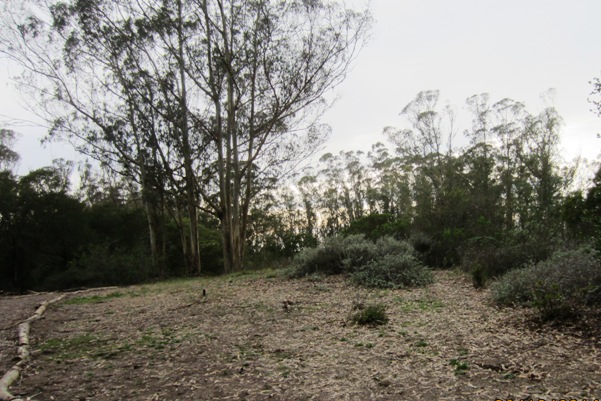
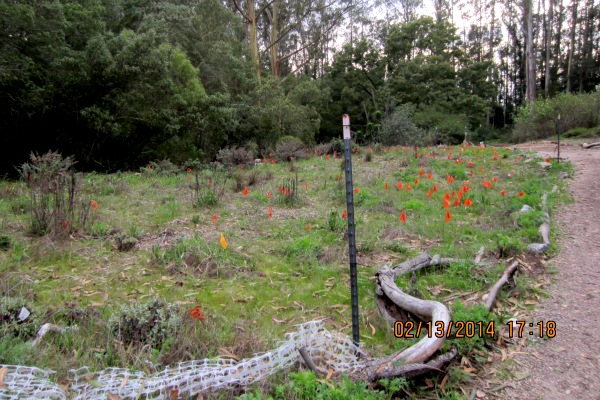
native plant gardenThe meadow section was mostly brown, though the replanted field was better: green grass and some promising poppies and sticky monkey flower plants – and the perpetual crop of orange flags.

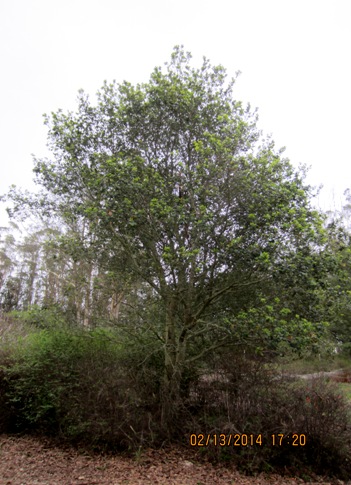
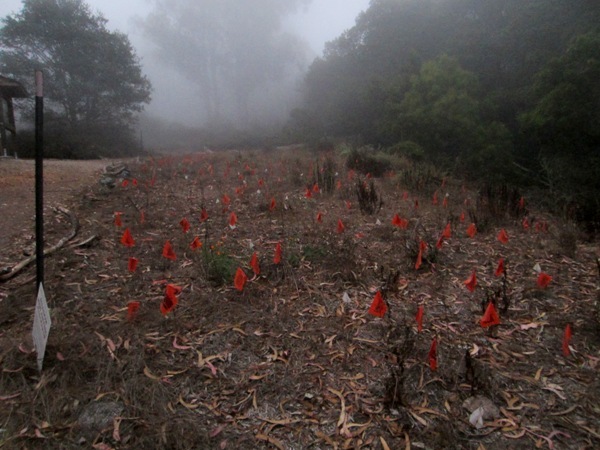
Pollinator field of orange flagsoak tree in native garden on Mount SutroThe oak tree, though still small compared to the eucalyptus that surround the garden and protect it from the wind, is growing. The garden has matured enough to provide  habitat.

It was pleasant to sit on the stone bench and hear birds in the surrounding eucalyptus, acacia, blackberry and ivy – and also in the garden itself, including in the oak tree.

The pink-flowering currant was also blooming. This shrub’s attractive and delicate flowers don’t last very long. This would be a good time to see it.

from the native plant gardenWe continued down the mountain into some of the loveliest parts of the forest.

mt sutro forest trail 4mt sutro forest trail 2hummingbirdThe forest had a lot of birds – more than we’ve heard in some time.

A hummingbird flew down and posed on a bush right in front of us, but was off again by the time we could focus. We think it was an Anna’s hummingbird, but it’s hard to tell from this picture. Point-and-shoot cameras don’t do good bird photography.

As we rounded the bend of the Historic Trail, we could see the fog rolling in through the Golden Gate.

view from Sutro Forest to Golden Gate Bridge and a fog layerA golden light lit the trees and threw them into silhouettes.

sunset light in Sutro ForestIt was time to head back from a wonderful experience of the forest for a couple of first-time visitors.

Sutro Forest trees so tallWe went down the staircase into the street. The visitors looked a little stunned. “And just like that,” one said, “We’re back in the city.”

Posted in Environment, Hiking, Mt Sutro Cloud Forest | Tagged , , , , , | 2 Comments

UCSF Meeting Report – 11 Feb 2014

UCSF Feb 2014 meeting for LRDPUCSF had called this meeting to discuss, not Mount Sutro Forest, but their Long Range Development Plan. However, Craig Dawson, Executive Director of the Sutro Stewards sent out a call for people to attend and talk about Mt Sutro, apparently to push UCSF to revert to the previous plan.

We therefore asked people who support the forest also to attend to counter attempts to turn the Plan backward. While we oppose the felling of thousands of trees in the New Plan, we think it’s progress compared to the Previous Plan that was much worse.

BACKSTORY

In February 2013, UCSF published a Draft Environmental Impact Report (DEIR) that embodied a plan to cut down tens of thousands of trees in two phases, with the possibility of using large amounts of toxic herbicides to prevent regrowth. In Phase I, they would cut down 80-90% of  trees on 7.5 acres (about 5,000), remove all the understory, and amputate vines at 10 feet off the ground so they died. In Phase II, they would extend the same management plan to cover 3/4 of the Mount Sutro Open Space Reserve, doing one-quarter (10-12 acres) at a time. This implied that 90% of the trees on 3/4 of the forest would be gone in 4-5 years – and large amounts of toxic herbicides would be used in an area which has seen no herbicides since 2008.

In November 2013, in response to the public comments on the DEIR, UCSF announced a New Plan. It would commit to not using herbicides at all in Sutro Forest. It would simplify its multiple objectives in the Previous Plan down to a single one: Safety. And as a safety measure, it would cut down trees up to 10 inches in diameter on about half the forest all at one time.

The four affected areas are shown on the map below: (1) The South side – in purple (2) the strip on either side of Medical Center Way (3) The orange area on the West side, and (4) the blue area on the North side (behind Edgewood).

We consider the new Plan to be progress over the horrendous Previous Plan, though still destructive of trees and habitat. Our post about that is HERE.

ucsf new mt sutro plan nov 2013THEMES OF THE COMMENTS

UCSF noted that while this meeting was not about Mt Sutro, they would accept comments about  the forest.  After the presentation (which focused entirely on the LRDP) it was comments time. A few people spoke to the LRDP issues; but many more spoke about the forest.

Some of the themes:

1. Let down? The Sutro Stewards and their supporters felt UCSF had let them down with the New Plan. However, others felt that UCSF was actually listening to other views for the first time.

2. Forest needs management? They also emphasized that the forest “a plantation” required management and was dry, not a “rain forest.” Others want the forest to remain natural, with only enough management to keep the trails open and remediate hazards.

3. Previous Plan – Better or Worse? The Sutro Stewards supporters spoke about the previous plan as a gradual one, with little loss of trees or vegetation.  However, we pointed out this was not actually in the Plan as embodied in the Feb 2013 DEIR.  What that Previous Plan would have done was the same thing as the New Plan, only on more land, over 4 years, and with added toxic herbicides.

4.  UCSF thanked for eschewing herbicides. Supporters of the forest expressed gratitude to UCSF for its commitment not to use toxic herbicides in the forest. One Stewards supporter also said he did not want pesticides used.

5.  Opposed to Tree-cutting and Forest-gutting.  The Stewards’ supporters were quite eloquent about how awful the forest would look with its understory gone on 25 acres, and all the trees under 10 inches cut down, and how it would destroy habitat. Forest supporters agreed on this, and asked UCSF to revisit the Plan. They spoke of the beauty of the forest, the importance of every tree in a time of climate change

There seemed to be broad agreement that the commitment not to use pesticides was good; and that thousands of  trees should not be cut down, nor the understory removed.

5. Other themes:

  • Would the forest sequester more carbon or less?
  • Risk of mosquitoes if the stream on the North side is revived but becomes standing pools of water.
  • Should the Aldea student housing units be preserved as UCSF wishes? (Original plan was to demolish them and add them to the Open Space.)
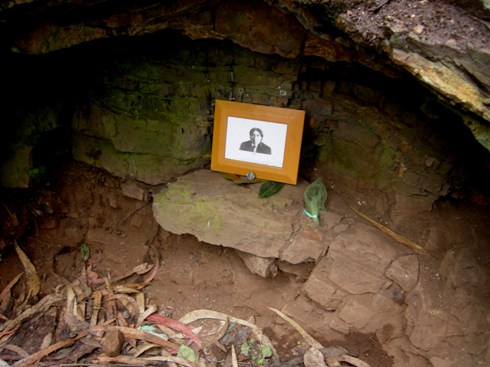
  • [Edited to Add: One commenter pointed out that Ishi, a native American, in his last years spent a lot of time in this forest. He suggested preserving the trees had historical value, and also asked for a memorial for Ishi.]

Since the objective is now limited to Safety, the question is whether the planned actions would make the forest more safe. We do not think it will; in fact, by destroying the understory and weakening the remaining trees, it could increase the risk.

NEW INFORMATION ABOUT THE FOREST

1) Important Timeline Change: The revised DEIR will come out in March 2014 (not February), and a Sutro Forest public meeting will be held in April 2014 (not March).

2) The revised DEIR will not incorporate the Previous Plan as one of the alternatives. It will be only look at the Environmental Impacts of the New Plan.

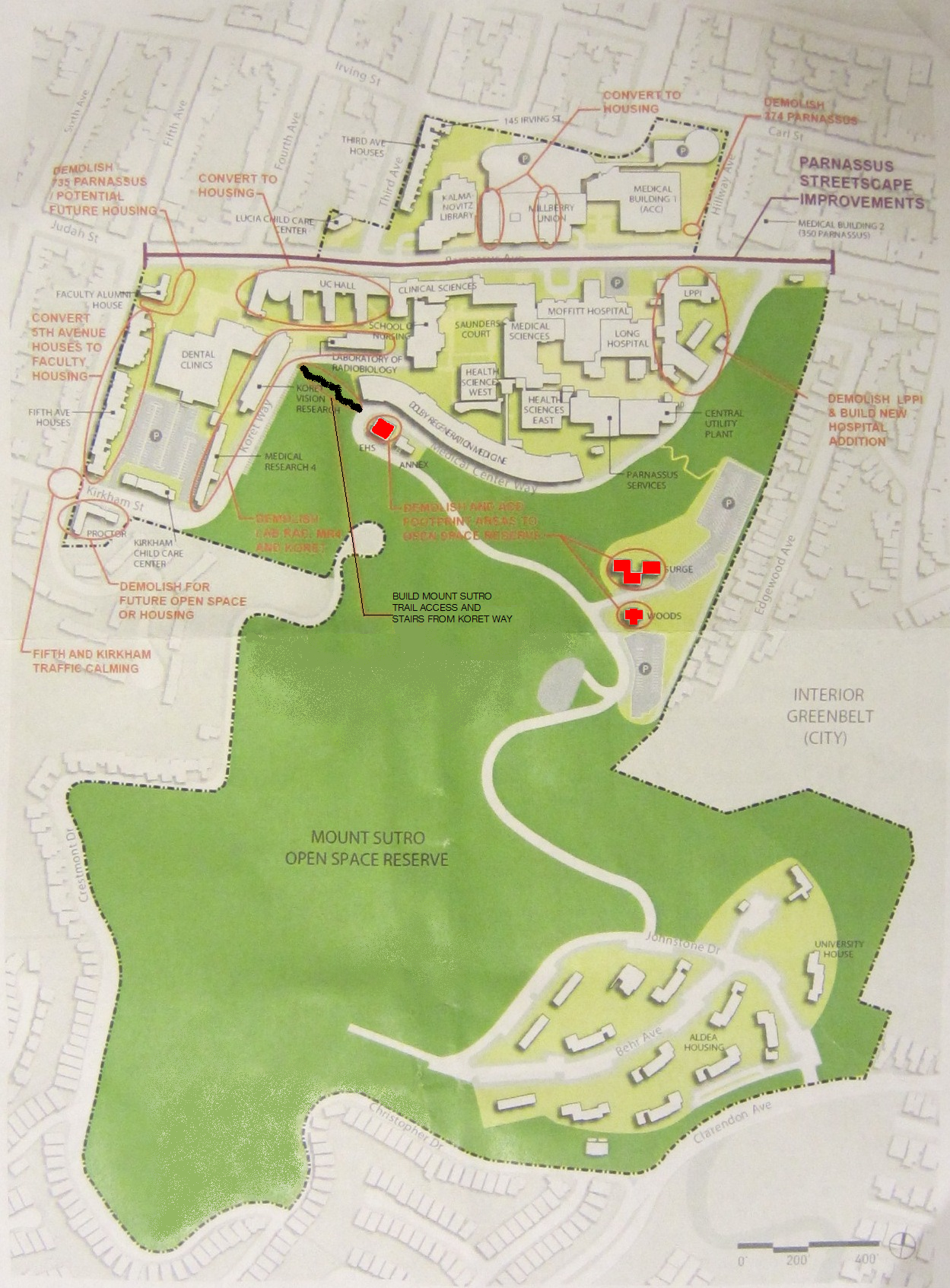
3)  We learned that Sutro Forest is independent of the LRDP. However, there are some things the LRDP covers  that will affect the forest:

  • A new staircase and trail will be added to provide access from the West side of the mountain to the trail system.
  • Three buildings in the forest will be knocked down and the footprint added to the Open Space Reserve. Those are the red squares on the map below.
  • Three student housing units on Aldea that were planned to be knocked down, will not be.

UCSF LRDP Feb 2014

Posted in Environment, eucalyptus, Herbicides, Mount Sutro Stewards, Mt Sutro Cloud Forest, UCSF | Tagged , , , , | 8 Comments

Sutro Forest in January 2014

vista from the Historic TrailThe unusual winter weather, with bright sunny days and hardly any rain, has drawn a lot of people to Sutro Forest. We’ve been up there a couple of times recently, and found an unusually large number of joggers, bicycle-riders, and hikers – even on weekday afternoons. If you would like to check it out yourself, our HIKING section is HERE.

hikers in Sutro Forest Jan 2014The trails are drier than usual, though some of the upper ones are damp and firm underfoot. If you’re a birder, you may want to bring binoculars. While waiting for our group to assemble, two birders saw a Peregrine falcon fly over, and the forest has other birds.

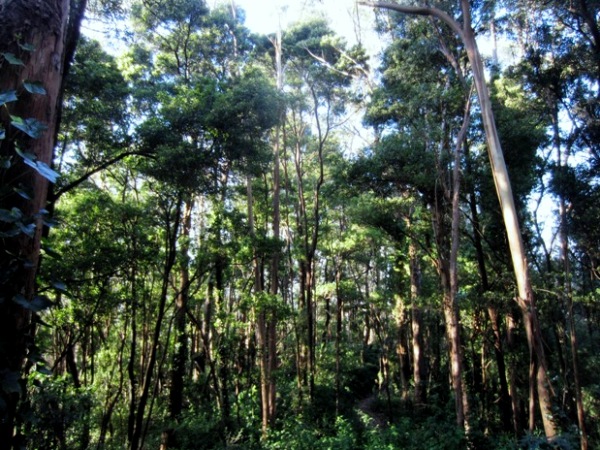
sutro forest with dappled sunlightMuch of the forest is very lovely and green, even though it’s much drier than usual. It’s taken a double-whammy. The extremely dry weather has denied it most of the rain it gets this time of the year. And a lot of understory has been cut back, reducing the forest’s ability to preserve what moisture it gets – the “sponge effect” by which forests take in water and release it slowly.

Some areas where UCSF did its so-called “Urgent Fire Safety” work in August 2013 are covered in wood chips, so they are dry and brown. But where it’s been left alone or the understory has had some chance to grow back, it’s beautiful. Even in this situation, the forest has been capturing and preserving enough moisture to keep its plants alive.

plum trees blossom in Sutro Forest jan 2014
plum blossoms in the forestThe plum trees are in bloom, covered in tiny white flowers. The Interior Green Belt (above Stanyan) has a number of these pretty trees (of which more later). They were very popular with birds, which were biting off the blossoms. Some bees were buzzing the flowers.

BIRDS

One of our visits was with “Trek and Talk,” that organizes (free) treks to places in the city. Someone identified the birds in the plum trees as Fox Sparrows and Song sparrows, and explained that the birds were probably eating flowers for the moisture. (They ate yellow oxalis, too, probably for similar reasons.)

[Edited to Add: It looks like Fox Sparrows aren’t on our earlier lists – HERE and HERE – so that brings the total number of species to 46 – and counting! A bird blog by Craig and Eileen Newmark, who live on the edge of the forest, has 48 species of birds, many of which are not on our list.]

tree with destroyed vineParadoxically, the dry conditions and the thinner understory made it easier to spot birds. A Townsend’s Warbler crossed the path, and later we saw pygmy nuthatches and ruby-crowned kinglets in the eucalyptus trees.

In total, we saw some 19 species of birds on that visit, including a red-tailed hawk, California towhee, house finch, Anna’s hummingbird, American robin, Chestnut-backed chickadee, black phoebe, Steller’s jay, Western scrub jay, American crow, raven, Western gull, and of course – rock pigeons.

The Cape Ivy and English Ivy growing up the columns of the trees – which is also being cut and allowed to die on the tree-trunks – is important as habitat. It provides cover for small birds, and nesting sites. It also blooms in winter, and provides nectar for insects and thus starts a food chain.

We think this is actually creating a fire hazard, rather than reducing one; the dry vine is more of a fire ladder than the live ivy that contains a lot of moisture. It’s certainly destroying habitat.

EVENING IN THE FOREST

evening sunlight in sutro forestThe forest is lovely at sunset these days, with the light turning red in the trees.

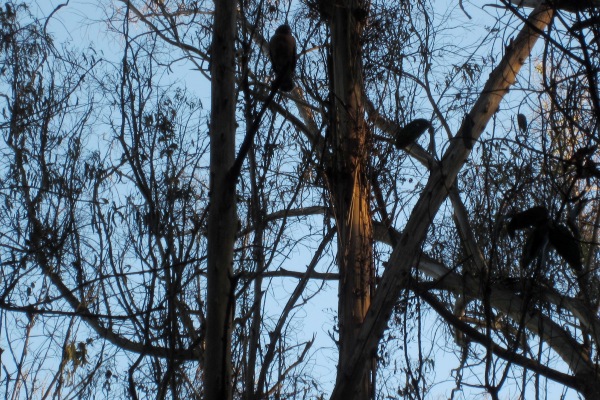
hawk in tree - sutro foresthawkOn another visit, we went in the evening. This hawk sat unmoving in a tall tree; it’s probably a red-tail though without binocs, there was no way to be sure. Here’s another crop of the same picture, in case someone wants to take a stab at identifying it.

[Edited to Add: “I believe that the hawk in question is a Red-shouldered Hawk, not a Red-tailed Hawk.” – From a birding reader of this site.]

We saw some smaller birds – possibly Pacific wrens and juncos; and around 5.30 p.m, heard a Great Horned Owl.

The sun reddened the trees along the trail.

sunset reddened trees 2 - jan 2014 sutro forestThe sun reddened the trees along the trail, and eventually a full moon rose into a sunset sky.

full moon rising 1Magical evenings in the forest are reminders that it’s worth the battle to save it.  Thus far, we’ve focused largely on UCSF. But there’s another entity involved –  the Natural Areas Program (NAP) of San Francisco’s Recreation and Parks Department.

It’s a program that focuses on Native Plants. Originally intended to preserve those areas of Native Plants that still existed (for instance, in some parts of Twin Peaks), it’s now destroying existing non-native forests and habitat to replace it with “native” plants. In the process, it cuts down trees. (Most trees are not native to San Francisco, which was windblown scrub before a city was built here). It also uses more of the most hazardous pesticides (Tier I) than any San Francisco Rec and Parks Department except Harding Golf Course.

THE INTERIOR GREEN BELT

UCSF is responsible for three-fourths of the forest, but a quarter of it – above Cole Valley and along Clarendon Avenue – is city-owned and falls under the Natural Areas Program (NAP). It’s called the Interior Green Belt. NAP’s plans include cutting down 140 trees, which would effectively remove the tree-cover in the area leaving only a sparse canopy with many openings. They would also remove vines, and pull out the non-native understory plants.

walking in Sutro Forestimazapyr for cotoneaster prunus poison oak interior green belt dec 2013Unlike UCSF, the Natural Areas Program has decided it will use pesticides in the forest. The first notice since 2010 went up in January: Imazapyr, to daub on stumps of poison oak, cotoneaster (a red-berried shrub that birds love) and “prunus” – most likely the plum trees that blossom so prettily.

Imazapyr is a pesticide that moves around, being absorbed by the poisoned stumps and pushed out through the root system into the soil; and it doesn’t disappear. Its breakdown product is neurotoxic.

This is an important and beautiful part of the forest. A lot of the understory has already been stripped out in stages; houses and other structures that were once hidden are now in plain sight, again removing the other-worldly sense of seclusion.

With the reduction in the understory, and the killing of vines leaving dried twining stems instead of leafy ones, the forest has lost much of its mystery. Only a few trails now provide the sense of isolation from the city and other visitors to the forest.

More and more, it’s becoming a see-through forest, and eventually if this continues it will feel at best like a stand of trees rather than a forest. We hope that when the moisture returns to the forest either as rain or as fog, so too will the lush understory that is so valuable for habitat, beauty, and safety.

We also hope the Plans for it can be stopped, and that NAP will stop its pesticide use.

Mayor Lee Stop NAPThe San Francisco Forest Alliance has a new petition addressed to the Mayor, asking him to preserve trees and access, and stop the use of herbicides in Natural Areas.  Click on the yellow button to get to the petition. If you haven’t already signed, please do.

Posted in Environment, Herbicides, Hiking, Natural areas Program | Tagged , , , | Comments Off on Sutro Forest in January 2014

SF RPD 2013 Herbicide Use – A Correction

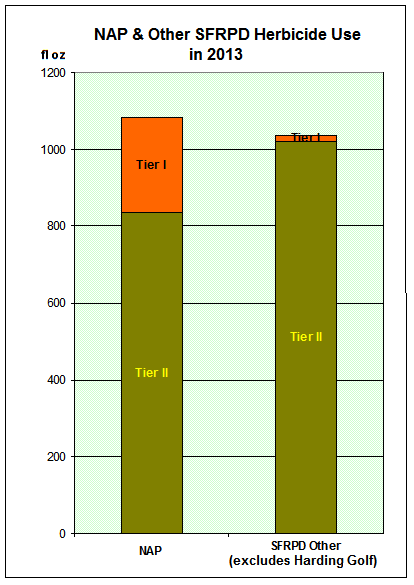
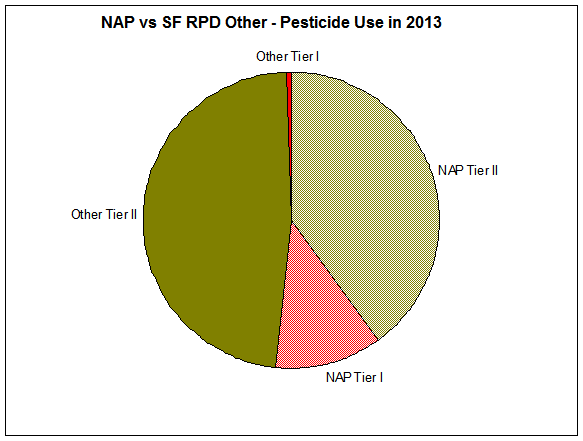
Recently, we published our analysis of the San Francisco Natural Areas Program (NAP)’s use of pesticide, and compared it with the rest of SF Recreation and Parks Department (SFRPD) .  We said that NAP’s pesticide use had risen in 2013, and it had used more herbicide than the the rest of SFRPD put together (excluding Harding Park Golf Course).

That’s not quite true. They actually used only 84% as much by volume, and 78% as much by Active Ingredient, with one-quarter of the total area.

Here’s the corrected graph. This one is by volume of herbicide used.

NAP vs SFRPD Other by vol corrected

Here’s the graph we showed earlier:

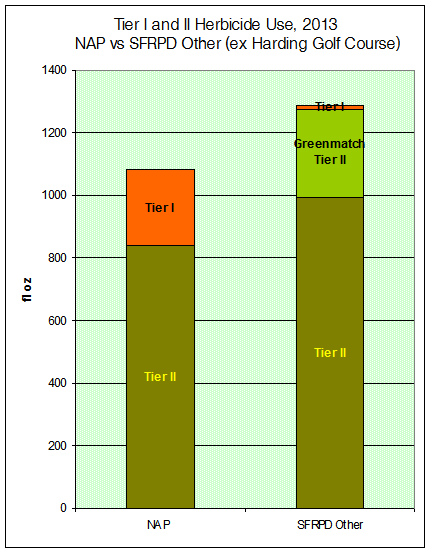
NAP vs Other SFRPD 2013What’s the difference? In a word, Greenmatch.

WHAT’S GREENMATCH?

Greenmatch is a herbicide based on lemongrass oil, or what is called a “botanical.” It’s actually considered acceptable for organic gardening. We’d known SF Department of the Environment (SF DoE) had rated it Tier III, least hazardous. We’d therefore omitted it from our calculations since we’re concerned with Tier I and Tier II (more hazardous and most hazardous) herbicides.

We hadn’t realized that in 2013, SF DoE had downgraded Greenmatch to Tier II. Thus, to be consistent, we needed to include it. The SFRPD used quite a lot of it – around 280 fl oz, because it is a good option compared to some of the synthetic herbicides. NAP didn’t use any Greenmatch in 2013.

ACTIVE INGREDIENT

Our earlier calculation also looked at simple volumes. We do this calculation because some of the “inert” substances that make up maybe half of the products applied are not necessarily innocuous, and so the total volume matters.

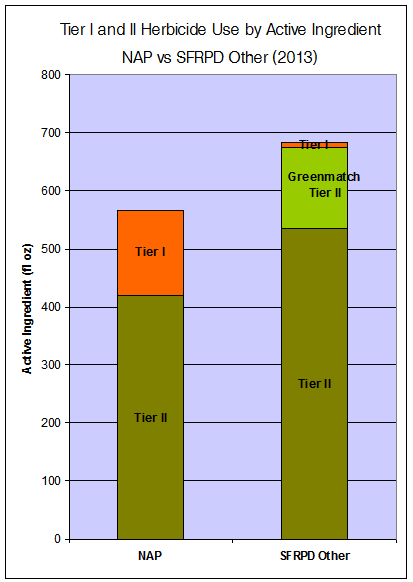
However, we also looked at the “active ingredient” – the amount of actual pesticide.  Here’s that graph.

NAP vs SFRPD Other 2013 by Active IngredientAgain, it’s Greenmatch that makes the difference.

NAP USES MORE TIER I HERBICIDES

NAP was by far the largest user of Tier I herbicide -mainly Garlon 4 Ultra. (Other SFRPD used a small amount of Garlon, and one application of Cleary’s fungicide in the Golden Gate nursery, inside a greenhouse.)

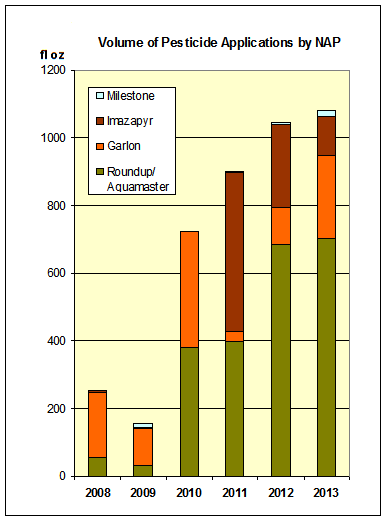
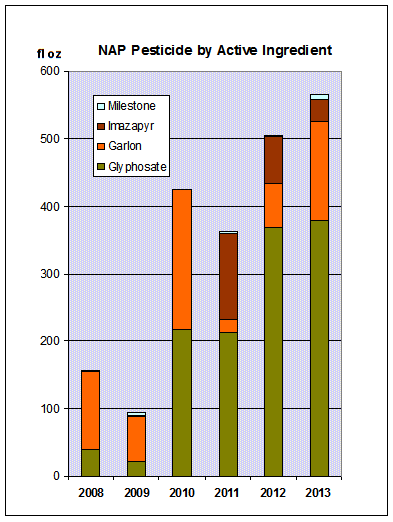
Since NAP does not use Greenmatch, we haven’t changed our other assessment – that NAP’s overall herbicide use rose again in 2013.  This graph shows volume of herbicide applied.

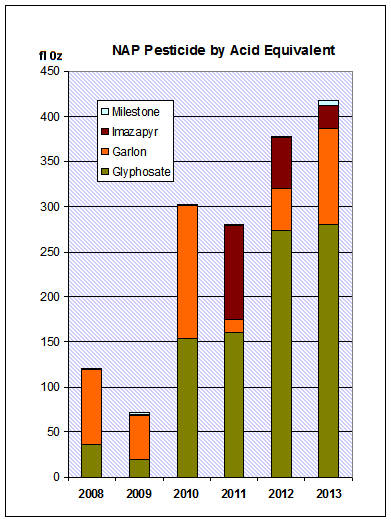
Volume of pesticide use by NAP 2008-2013This one shows amounts by Active Ingredient.

NAP Pesticide by Active Ingredient 2008-2013OUR METHODOLOGY

For those who want to dig into how we got our numbers:

1. Under the Sunshine Act, we obtained the ‘usage reports’ – the monthly reports submitted by each department. This lists how much of each pesticide they used, where, for what purpose, how applied, under what conditions and by whom. NAP usually submits two, separately for pesticides it applies, and the pesticides used by their contractor Shelterbelt. These are what we used for 2011-2013. (For 2010, for NAP we had a mix of monthly reports and compiled data supplied by SF DoE, and for 2009 and 2008, it was compiled data from SF DoE.)

2. If any data were illegible, we requested -and got – clarifications. We entered these data into a spreadsheet. In 2013 we kept a record not only of NAP pesticide use, but also other SFRPD Departments’ herbicide use.

3. We calculated total herbicide use, by product, for NAP and SFRPD Other.

4. We excluded Harding Golf Course. It used a substantial amount of pesticides because it’s required to maintain the course in tournament-ready condition. There’s a contract that’s  really outside SFRPD’s control, and so would distort the picture. But we do include the other city-owned golf courses -which are under SFRPD control and actually use little Tier II or Tier I pesticide.

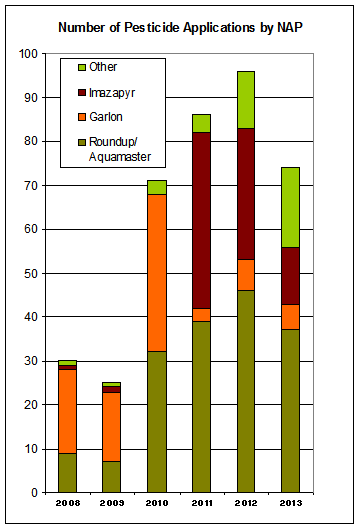
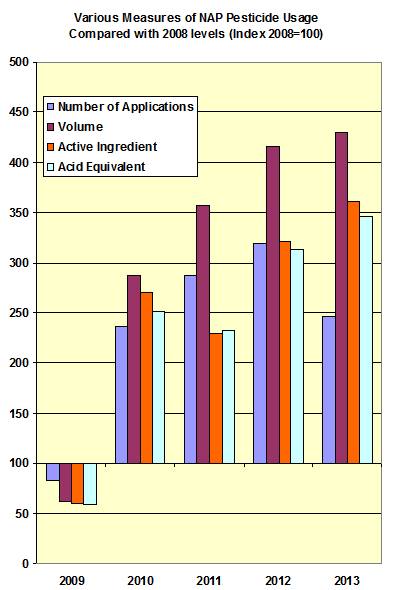
5. We calculate four measures of usage for NAP:

  • Number of applications. This measures the number of opportunities for exposure.
  • Volume of applications. This takes into account that the other ingredients in a pesticide formulation could be chemically active, though not pesticides themselves.
  • Volume by active ingredient. This is the most common measure and the one SF DoE prefers to use; and
  • Volume by acid equivalent. This is largely significant when two or more products with the same active ingredient are being used.

To get the last two measures, we use a factor derived from the Materials Safety Data Sheets for each product.

6. To compare SFRPD Other (excluding Harding) we looked at volume, as well as active ingredient. Those are the graphs shown above. (We couldn’t do an acid equivalent because it doesn’t apply to lemongrass oil in Greenmatch EX.)

We try to be rigorous in our analysis, and offer reproducible results. If we discover errors, we will acknowledge and correct them here.

Posted in Herbicides, Natural areas Program | Tagged , , | 1 Comment

Please Sign SF Forest Alliance’s NEW Petition to Save Natural Areas

This post is republished from SFForest.org (with permission). The Natural Areas Program controls about a quarter of Sutro Forest, and has recently used pesticide there. Meanwhile, UCSF has said they will not use pesticide in the area they control.

New life in a park tree

New life in a park tree

San Francisco Forest Alliance has a new petition up to ask the Mayor to rein in the Natural Areas Program, and stop them from cutting down healthy trees, ripping out understory habitat, using growing amounts of pesticides, and restricting public access.

Wait, isn’t that what our existing petition does?

Polaris Herbicide warning signYes. But from an October 2013 SF Chronicle article, we learned that Mayor Lee has undertaken to respond to petitions provided in a specific format on provider Change.org, once they cross a certain number of signatures. So we think this is a more direct way to approach him. (Our other petition continues live.)

So we’re asking you to please sign this new petition in support of all our wilder parks, and to preserve our access to them. And please pass it on.

CLICK HERE TO GO TO THE NEW PETITION

Mayor Lee Stop NAP

We especially request San Francisco residents to sign this! But we’re a world class city, and depend on people from everywhere. So we think this issue affects people from all of the Bay Area, or beyond.

Posted in Environment, Natural areas Program | Tagged , | Comments Off on Please Sign SF Forest Alliance’s NEW Petition to Save Natural Areas

SF’s Natural Areas Program – More Pesticide in 2013

Edited to Add: We’ve corrected the comparison between NAP and other SFRPD herbicide use to account for a reclassification of Greenmatch EX, a lemongrass-based herbicide. Details HERE.

imazapyr for cotoneaster prunus poison oak interior green belt dec 2013

Interior Green Belt, Dec 2013

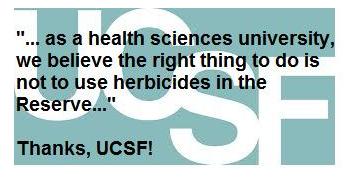
UCSF logo with herbicide statementEven as we celebrate UCSF’s decision not to use pesticides in Sutro Forest, we’re reminded that the section of the forest above Cole Valley is managed by San Francisco Recreation and Parks Department (SF RPD) and falls under the misnamed Natural Areas Program (NAP). That area is not spared toxic herbicides, as we saw when a pesticide notice went up there for the first time since 2010.

NAP Number of applicns 2008-2013NAP is responsible for around 1100 acres in San Francisco in 32 parks (including 19 acres of Sutro Forest).  It has a very different attitude to pesticides. We’ve been tracking NAP’s  rising herbicide use, compiling reports we obtain under San Francisco’s Sunshine Act. (The report for 2012 is HERE; and for 2011 is HERE.) For a year or two, we hoped the rise was an anomaly. Apparently not. With the 2013 data in, the best things we can say are that the rate of increase is not as high as in the last four year; and that the number of applications fell.

But the volume of toxic herbicides used still rose.

People have asked us: But why complain about NAP? Surely a garden like Golden Gate Park with all those lawns and golf courses uses lots more herbicide than NAP? This year, we tracked that too.  NAP also uses more pesticides than the rest of SFRPD put together.

NAP USES MORE HERBICIDES THAN THE REST OF SFRPD

NAP vs Other SFRPD 2013NAP, which manages one-fourth of the area under the SF RPD, uses more pesticide than the rest of SF RPD put together. That counts all the golf courses except Harding, which is apparently under contract to be tournament-ready.

Also, NAP is the main user of the most toxic pesticides. San Francisco’s Department of the Environment (SF DoE) – which watches out for pesticide use on city-owned property – rates the permitted pesticides into three Tiers. Tier III is the least hazardous; Tier II is more hazardous; and Tier I is most hazardous. NAP is the major user of the Tier I pesticide, Garlon.

VOLUMES UP

As we mentioned earlier, NAP’s pesticide use continued to increase in 2013, though the number of applications went down. The lower number of applications slightly reduces the opportunities for exposure to freshly applied toxins. But this is more than offset by the fact that actual amounts of pesticides continued to rise – and that many of these chemicals are the ones that are most toxic and very persistent.

Volume of pesticide use by NAP 2008-2013

THE FOUR PESTICIDES NAP USES

NAP currently uses four pesticides: Glyphosate (Roundup/ Aquamaster); Triclopyr (Garlon 4 Ultra); Imazapyr (Polaris or Stalker); and Aminopyralid (Milestone VM). They are all of concern. Of these, SF DoE rates Garlon as Tier I (most hazardous); the remaining three are currently rated as Tier II.

Despite the manufacturer’s claims, there is evidence that these herbicides are not safe. Our article summarizing this is HERE: Natural Areas Program: Toxic and Toxic-er.

ROUNDUP/ AQUAMASTER (Glyphosate)

Classified as a Tier II (More Hazardous) chemical by the San Francisco Department of the Environment, this is the most-used pesticide of the four. However, there’s been growing evidence that it’s not a safe herbicide.

  1. Toxic to human cells, particularly embryonic and placental cells. Here’s an article in Scientific American, about the effect of Roundup on human cells – not just the active ingredient, Glyphosate, but the “inert” one, POEA. (Aquamaster does not contain POEA.)
  2. Damage to liver, red blood cells, lymph system. Here’s a series of research articles detailing some of illnesses caused by Roundup.
  3. Link to birth defects. Here’s an abstract of a May 2010 article in the journal Chemical Research in Toxicology.
    heart breaking

    heart breaking

    It indicates that Roundup increased retinoic acid activity in vertebrate embryos, causing “neural defects and craniofacial malformations.” The actual article, which we read elsewhere describes some of the birth defects: microcephaly (tiny head); microphthalmia (tiny undeveloped eyes); impairment of hindbrain development; cyclopia (a single eye in the middle of the forehead); and neural tube defects. Our summary of this article is HERE.

  4. Linked to cancer, specifically, Non-Hodgkins Lymphoma. A 1999 article on research linking Roundup to cancer, specifically non-Hodgkins lymphoma, and HERE is a follow-up published in 2008 in the International Journal of Cancer.
  5. Dangerous to amphibians. This article cites University of Pittsburgh research showing Roundup is highly lethal to amphibians.
  6. Suspected endocrine disruptor. Initial research suggests that it is an endocrine disruptor in human cell lines. It’s on the list of chemicals the EPA is reviewing for endocrine disruption.

GARLON (Triclopyr)

NAP accounts for 96% of the use within SF RPD of this Tier I (Most Hazardous) chemical. Garlon kills broad-leaved plants (not grasses or conifers) by sending them a hormonal signal to grow uncontrollably. This weakens the plant until it dies. Its breakdown products are triclopyr acid and then ‘TCP’ – both of which are, fortunately, somewhat less toxic than Garlon. (Imazapyr, by contrast, has a breakdown product that is neurotoxic.)

Our article is based on the Garlon chapter of Draft Vegetation Management from the Marin Muncipal Water District (which can be found here as a PDF file). It was a pretty thorough multi-source review of what was known about the chemical, and it clarified the risks: birth defects; kidney damage; liver damage; damage to the blood. What stood out, though, was how much is not known, particularly about the effects of repeated low-level exposure. There simply isn’t that much research out there, and few human studies. “Although triclopyr has been registered in the US since 1979, there are still very few studies on triclopyr that are not part of the EPA registration process.” Most of the research that exists is on Garlon 4. What NAP uses is Garlon 4 Ultra. It’s similar but isn’t mixed in kerosine. It’s mixed in a less flammable but apparently equally toxic methylated seed oil.
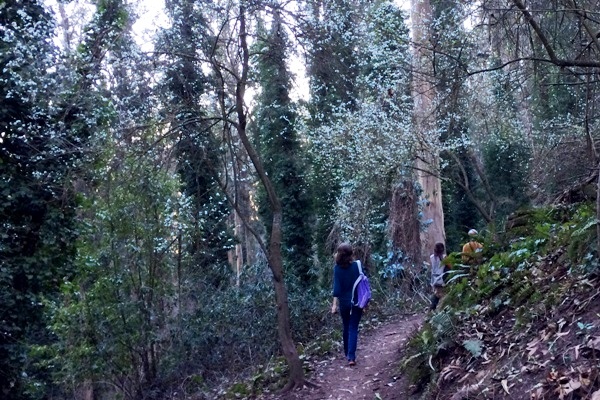
What is known makes uncomfortable reading.

  • Birth defects. Garlon “causes severe birth defects in rats at relatively low levels of exposure.” The rats were born with brains outside their skulls, or without eyelids. “Maternal toxicity was high” and exposed rats also had more failed pregnancies.
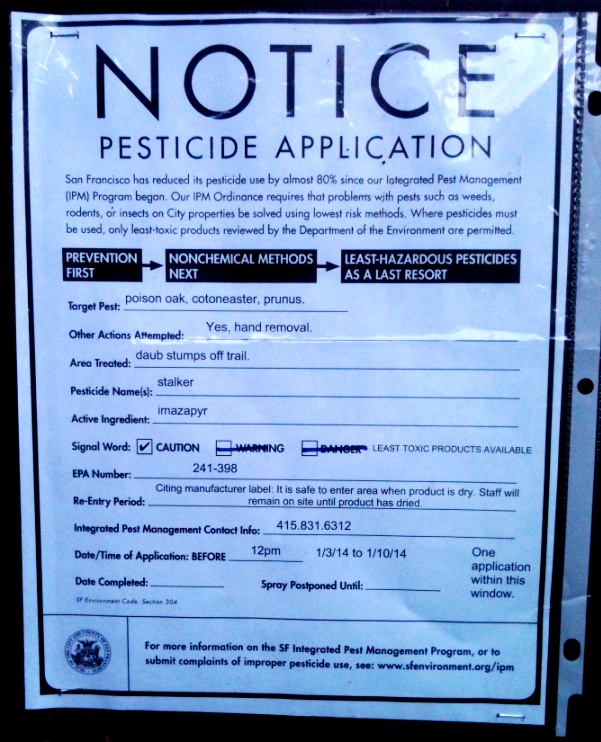
  • Damage to kidneys, liver, blood. Rat and dog studies showed damage to the kidneys, the liver, and the blood. It’s insidious, because there’s no immediate effect that’s apparent. If someone’s being poisoned, they wouldn’t even know it. In a study on six Shetland ponies, high doses killed two ponies in a week, and two others were destroyed.
  • Skin absorption. About 1-2% of Garlon falling on human skin is absorbed within a day. For rodents, its absorbed twelve times as fast.
  • Dogs may be particularly vulnerable; their kidneys may not be able to handle Garlon as well as rats or humans. “The pharmacokinetics of triclopyr is very different in the dog, which is unique in its limited capacity to clear weak acids from the blood and excrete them in the urine.” Dow Chemical objected when EPA said that decreased red-dye excretion was an adverse effect, so now it’s just listed as an “effect.”
  • Insufficient information. There was insufficient information about Garlon’s potential effect on the immune system, or as an endocrine disruptor.
  • Not quite carcinogenic. It isn’t considered a carcinogen under today’s more lenient guidelines, but would have been one under the stricter 1986 guidelines.
  • Probably alters soil biology. “There is little information on the toxicity of triclopyr to terrestrial microorganisms. Garlon 4 can inhibit growth in the mycorrhizal fungi…” (These are funguses in the soil that help plant nutrition.) No one knows what it does to soil microbes, because it hasn’t been studied.
  • Dangerous to aquatic creatures: fish (particularly salmon); invertebrates; and aquatic plants.
  • Some effect on honey bees. It doesn’t generally kill adult honeybees, but there are no studies of other insects. Some studies show slight “acute toxicity” to honeybees.
  • Garlon can persist in dead vegetation for up to two years.

Given all the information we do have on this chemical (and all the information we don’t have ) we have to question why native plant restoration is worth spraying poisons on some of the highest points in our city. Garlon must be used when the weather is wet; if the plants don’t have water, they will not grow and the chemical won’t work. But the runoff from these hills is enormous during the rain – it washes down in rivulets and streams, and it will end in the reservoirs, the groundwater, and the bay.

IMAZAPYR

Classified as a Tier II (More Hazardous) chemical by the San Francisco Department of the Environment, this is another pesticide used mainly by NAP. In 2013, NAP accounted for 97% of the imazapyr used by SFRPD.  NAP started using Imazapyr even before the SF DoE had approved its use. Now it’s being used in Sutro Forest.  Here’s our article on Imazapyr.

The main issues with it are that plants push it out through their root system, so that it can spread and affect other plants; it is very persistent. Its breakdown product is neurotoxic. It’s banned in Europe.

According to a BASF Safety Data Sheet from Europe, it’s “Harmful to aquatic organisms, may cause long-term adverse effects in the aquatic environment.” However, a BASF Material Safety Data Sheet from the US says, “There is a high probability that the product is not acutely harmful to fish. There is a high probability that the product is not acutely harmful to aquatic invertebrates. Acutely harmful for aquatic plants.”

Interesting.

MILESTONE VM (Aminopyralid)

SF DoE originally classified this chemical as Tier I, Most Hazardous, because of its uncanny persistence. In 2013, it was reclassified as Tier II – More Hazardous. At the time, we protested that the down-classification would increase its use; SF DoE didn’t think so. But this year, NAP’s use of Milestone has risen 200% from 2012.  (Only NAP uses Milestone in the SF RPD.)

Milestone is even more persistent that Imazapyr, and can survive being ingested by animals. Thus, if it is used to treat plants and animals eat and excrete them, they spread the poison. It is banned in New York for fear it will get in the groundwater, and was for a time banned in the UK.

STILL RISING

For purists, we also calculated NAP’s pesticide usage based on “Active Ingredient” and based on “Acid Equivalent.” (The post explaining those measure is HERE.) By those calculations, it’s gone up even more.

NAP Pesticide by Active Ingredient 2008-2013NAP Pesticide by Acid Equiv 2008-2013 Index of NAP Pesticide Use 2009-2013The graph here shows index numbers of the various indicators, with a base of 2008 (i.e, 2008 = 100). After a dip in 2009, NAP’s pesticide use has trended upward for four years.

We cannot quite understand the need for the continuous rise in pesticide use in NAP. We can only wonder if it correlates to budget availability.

We call upon SF RPD to stop all Tier I and Tier II herbicide use in Natural Areas. It would make the Natural Areas more … natural. And it would halve SF RPD’s herbicide consumption, and nearly eliminate their use of Tier I pesticides.

NAP vs SF RPD Other 2013

Posted in Herbicides, Natural areas Program | Tagged , , , , , , , , | 6 Comments

John Muir, Eucalyptus, and Happy New Year!

muir-john-new year-card frontOn January 2, 1911, John Muir – founder of the Sierra Club and the man who saved Yosemite – sent out this greeting card. It has a painting of a eucalyptus tree, and a poem about the tree: “From eucalyptus cloistered aisles Sweet wind born anthems rise And from tall silvery spires there wafts A living incense to the skies.” Over a hundred years later, we’d like to celebrate the tree’s grace and beauty as we wish you all a Happy New Year in 2014. This post is republished with permission and some changes from Death of a Million Trees.

——————————

muir-john-new year-card backThis 1911 New Year’s greeting from John Muir is a reflection of his fondness for eucalyptus.  He planted eucalypts around his home in Martinez, California.

Muir’s daughter reported that her father bought about a dozen different varieties of eucalyptus from a neighbor and she helped to plant them on the property.  The property was planted with many non-native plants and trees, including palms that now tower over the property.

John Muir National Historical Site, NPS photo

John Muir National Historical Site, NPS photo

Muir’s home was built by his wife’s parents in 1882.  Muir and his wife moved into the home in 1890 after his wife’s father died.  Muir lived in that home for the last 24 years of his life.  It is now The John Muir National Historic Site. The site is administered by the National Park Service which unfortunately actively engages in ecological “restorations” that destroy non-native species.  In the San Francisco Bay Area, eucalypts are one of their highest priority targets for destruction.  According to the Martinez News Gazette, the Park Service destroyed the eucalypts on Muir’s property in about 1991 and replaced them with redwoods.  Twenty years later, they destroyed the redwoods because they decided they weren’t historically accurate.  The Park Service has a contradictory mission of ecological “restoration” to a native landscape which is inconsistent with its mission of maintaining the historical integrity of the properties it manages. John Muir was co-founder of the Sierra Club.  He is also given credit for convincing President Teddy Roosevelt to protect Yosemite, Sequoia, Grand Canyon and Mt. Rainier as National Parks.  Wouldn’t Muir be appalled by the current policies of the Sierra Club and the National Park Service which advocate for the destruction of eucalyptus in our public lands? 

The recipient of John Muir’s New Year’s greeting was another eucalyptus aficionado.  Jared Farmer mentions Muir’s holiday card to Theodore Lukens in Trees in Paradise:  “In 1911 Muir sent a holiday card to his friend Lukens with a watercolor depicting gum trees and a poem evoking the ‘cloistered aisles,’ ‘silvery spires,’ and ‘living incense’ of eucalypts.” (2) According to Farmer’s excellent historical account of eucalyptus in California, Lukens was a “banker, real estate developer, one-time mayor, and self-taught forester” in Southern California who “worked tirelessly on behalf of afforestation.”  Lukens and Muir shared the belief that “forest cover was key to the whole hydrological system:  trees and tree litter encouraged rainfall, captured fog drip, increased rainfall retention, decreased transpiration and regulated stream flow.”

[Edited to remove an endorsement.]

We wish our readers a Merry Christmas and a Happy New Year.  We are hopeful that the New Year will bring more success to our mission to save healthy trees from destruction which will also reduce the needless use of pesticides in our public open spaces.

 ******************************

(1) Published in Images of the Pacific Rim by Erika Esau, Power Publishing, February 2011.

(2) Jared Farmer, Trees in Paradise:  A California History, Norton & Company, 2013.

Posted in Environment, eucalyptus, nativism | Tagged , | Comments Off on John Muir, Eucalyptus, and Happy New Year!

‘Natural’ Areas Program Using Pesticide in Sutro Forest

UCSF logo with herbicide statementNo sooner had UCSF announced it would not use pesticides than the Natural Areas Program (NAP) suddenly decided that it needed to use imazapyr in SF RPD’s part of Sutro Forest. The Forest is mostly owned by UCSF, but 19 acres called the Interior Green Belt are owned by the city and fall under the Natural Areas Program.

A VINDICTIVE USE OF PESTICIDES?

Unlike Mt Davidson,  Twin Peaks, Glen Canyon and McLaren Park, which are regularly sprayed with toxic pesticides, NAP has used hardly any in Sutro Forest before this. Except for once in September 2010, we do not know of any use of toxins there since 2009.

The timing suggests that this use is a response to UCSF’s decision and demonstrates that community opinion is considered a challenge rather than useful feedback.

1 sutroforest stanyan pesticides dec 2013

And the targeted species? Poison oak; cotoneaster (which bears red berries that birds love to eat); and ‘prunus’ – cherry and plum trees, which are treasured by humans and wildlife.

NAP RINGS IN THE NEW YEAR WITH IMAZAPYR IN SUTRO FOREST

Imazapyr is a Tier II (more hazardous) pesticide according to San Francisco’s Department of the Environment (SFDOE). In San Francisco’s parks, NAP is the main user of this chemical. In the first 11 months of 2013, NAP accounted for over 97% of the imazapyr used by San Francisco Recreation and Parks Department.

imazapyr for cotoneaster prunus poison oak interior green belt dec 2013

WHAT’S IMAZAPYR?

Imazapyr is a persistent and toxic pesticide, which breaks down into chemicals that may be even more toxic. Here’s what we wrote the first time we saw NAP using it:

“Imazapyr is sold under the brand name of “Habitat” when it’s for Native Plant Restoration. Its other trade names are slightly less benign: Chopper. Stalker. Arsenal. Assault.

“It persists in the soil for up to 17 months. It’s water-soluble, and moves through soil to get into groundwater. ‘Traces of imazapyr were detected in the groundwater even 8 years after application,’ according to a study by scientists from the Swedish University of Agricultural Sciences. (Pest Management Science, June 2004.)

[We should note that this part of the forest is within the watershed of a seasonal creek.]

“It’s a broad-spectrum killer, so it kills most things it hits (except some weeds that have become resistant). It’s also a difficult herbicide to target with any degree of precision.

“In fact, some plants actually push it out, so it gets into the tangled roots below the soil and kills other plants. From the Nature Conservancy’s Weed Control Methods handbook: “… imazapyr may be actively exuded from the roots of legumes (such as mesquite), likely as a defense mechanism by those plants… the ability of imazapyr to move via intertwined root grafts may therefore adversely affect the surrounding desirable vegetation with little to no control of the target species.”

“This is the chemical opponents compared to Agent Orange, when the border patrol planned to spray it on tall cane growing along the Rio Grande river. Communities on both sides feared contamination of the water. The plan was suspended.

“In people, it can cause irreversible damage to the eyes, and irritate the skin and mucosa. As early as 1996, the Journal of Pesticide Reform noted that a major breakdown product is quinolic acid, which is “irritating to eyes, the respiratory system and skin. It is also a neurotoxin, causing nerve lesions and symptoms similar to Huntington’s disease.”

“Oh, and Imazapyr is illegal in the European Community.”

A TERRIBLE PLACE TO USE IMAZAPYR

There’s no good place to use imazapyr, but this forest is a particularly bad one.

  • It can stay in the soil, and run off the mountain when the rains start – or if they fail this year, when the fog starts the Cloud Forest effect. The forest is on high ground above neighborhoods.
  • It’s in the watershed of a seasonal creek, so the chemical could be spread well outside the forest.
  • Since the tree roots are intergrafted, it could kill or damage other trees besides the ones to which its applied.

interior green belt pesticide notice imazapyr


Posted in Environment, Herbicides, Mt Sutro Cloud Forest, Natural areas Program | Tagged , , , , , | 4 Comments

The Plants that Monarch Butterflies Need

No more Natural BridgesThe famed and eponymous natural bridges at Natural Bridges State Beach at Santa Cruz no longer exist; a 1994 winter storm destroyed the last one. But no matter: what we recently went there to see was the over-wintering Monarch butterflies that cluster in its eucalyptus grove from November through January.

A boardwalk trail leads from the parking lot near the gift shop into a sheltered hollow with a number of eucalyptus trees. The butterflies hang in them like clusters of dead leaves. The last time we’d visited, on a cold gray day, the butterflies’ camouflage had been excellent, and it took careful observation to recognize the clusters for what they were.

butterflies looking like dead leavesOn this sunny afternoon, it wasn’t difficult to find the butterflies. They were in motion around the cluster, opening their wings for warmth, flying around and seeking nectar.

monarch butterflies in eucs

Monarchs on eucalyptus flowers -blurry

Blurry picture of Monarch butterflies on eucalyptus flowers

We’d read that Monarchs might feed from eucalyptus flowers, which provide a winter resource to so much wildlife. That proved to be true. Looking through binoculars, we saw the eucalyptus flowers far overhead were full of butterflies.

We knew, of course, that Monarchs depend on eucalyptus trees along the West Coast. What we also learned was that other so-called “invasive” plants also help Monarch butterflies to survive. The boardwalk trail has interpretive signs with infographics. We found this one, Nourishing Nectar, particularly interesting.

nourishing nectar sign about Monarch butterfliesEnglish ivy is one of the key plant species of Sutro Forest – and it’s under attack in both the old and new Plan for Sutro Forest. Since the Monarch butterflies found its nectar a nourishing snack, surely this would also be true of other nectar-feeders. Are UCSF – and the Sutro Stewards who do much of the actual work – aware of the habitat destruction killing this ivy causes?

cape ivy

Cape Ivy provides cover and habitat

We didn’t see English ivy in bloom at Natural Bridges State Park this December. Maybe as a fall-flowering plant, its season was over. But Cape Ivy around the tree trunks had small yellow flowers that offered the Monarch butterflies another snack.

monarch butterfly nectaring on Cape Ivy 2

Monarch Butterfly nectaring on Cape Ivy Flower

Cape Ivy is also one of the plants in the understory of Sutro Forest, and it’s being targeted for destruction along with English ivy. Yet its nectar clearly has nutritional value for insects and thus, it has a place in the food chain. And it’s obviously important as habitat and cover for small birds.

THE MONARCH’S WESTERN MIGRATION

We were interested to learn that, unlike the Monarchs east of the Rockies (which migrate from Canada to Mexico and back), the butterflies in the West migrate between the interior and the coast.  The butterflies east of the Rocky Mountains go south to Mexico in winter. The butterflies on the Western side come to the California coast.

fallmigrationmap usfwsThe Monarchs in the Western migration depend heavily on non-native, naturalized species of plants. Some 75% of the Monarch roosts are mainly eucalyptus. In fact, eucalyptus, Monterey Pine, and Monterey Cypress (which nativists consider an “non-native” species outside the Monterey Peninsula) account for around 90% of the tree species they use.

But as we saw, they also draw sustenance from Fall and Winter-blooming ‘weeds’ like English ivy and Cape ivy. This can be critical – the Fall generation of these butterflies is the longest-lived, and makes the migration to the Coast and back again that preserves the species. The extra nutrition improves their likelihood of surviving.

Western migration explanation

Of course, it’s not just naturalized plants. Milkweed is the Monarch’s nursery plant; that’s where it lays its eggs and where its larvae feed. The main threat to the Eastern migration – which has been declining sharply – is that farmers use more pesticides than ever to eradicate weeds, and the butterflies are simply not finding enough of it. There’s a move to grow more milkweed.

Meanwhile, it’s crucial to preserve the Western migration, which seems robust for now. What would happen if the eucalyptus that shelters these butterflies are felled?

It could happen. We don’t think that anyone would cut down trees that are well-known as Monarch roosts – as in Natural Bridges State Beach. But in some years, the butterflies spill out into other trees, and could potentially establish new overwintering sites. Two years ago, they even came to San Francisco.

NATURALIZED PLANTS – RESILIENT HABITAT

The whole area we visited was a lively habitat of naturalized plants. Eucalyptus. Ivy. Blackberry. Grasses. It was full of wildlife, and not just butterflies. We saw a lot of birds, and heard the rustles and twitters of even more. A Townsend’s warbler made a brief appearance before diving back into cover. And high above, we heard a woodpecker – maybe a Downy – in a eucalyptus tree.

woodpecker tree

maybe downy woodpecker

Downy Woodpecker?

Native plant advocates say that native plants provide superior habitat for native species of animal life. There’s no evidence that this is true. Some few species of insects are tied to particular plants, but even then, the rapid reproduction rates of insects suggests that they would evolve to use new plant species once they’re plentiful enough. A great example: How the soapberry bug adapted to use a new food source – in only 100 generations (about 20-50 years).

All the evidence is that naturalized plants provide a resilient and rich habitat for a range of animal species – and with no extra effort from land managers. We only have to avoid destroying them.

Posted in Environment, eucalyptus | Tagged , , , , , | 1 Comment

Commonwealth Club: 3 Important 2014 Lectures

The year’s winding down, and many of us are making plans for the next few months. An email from the Commonwealth Club told us of an interesting new series of lectures  in January, March and April of 2014. It’s the Science of Conservation and Biodiversity in the 21st Century series, from three professors each giving one talk in San Francisco.

According to the email: “This series of lectures will present a new way of looking at public issues in conservation. The things we’ve assumed as facts often are not. Traditional approaches are losing ground as science illuminates new pathways for framing and achieving conservation goals.”

This is important thought leadership that could shift the way San Francisco manages its wild spaces. A good turnout would encourage the Commonwealth Club to have more such talks. Please do attend if you can.

JANUARY 30, 2014, 6 PM: Dr SCOTT CARROLL ON CONCILIATION BIOLOGY

bumble bee on strawberry tree

Native bumble-bee on non-native Strawberry Tree

Dr Scott Carroll is the Founding Director, Institute for Contemporary Evolution and Department of Entomology at  UC Davis. He will talk about Conciliation Biology: An Approach to Conservation that Reconciles Past, Present and Future Landscapes in Nature.

Here’s what the Commonwealth Club website says: Biologists are now considering the “conciliatory approach.” This approach recognizes that mutual adaptation of native and non-native species is changing best practices for promoting biodiversity. Dr. Carroll investigates how organisms respond to human-caused environmental change. Carroll advocates for interdisciplinary solutions to problems of environmental conservation.

Register at the club’s website: www.commonwealthclub.org/events/2014-01-30/scott-carroll-conciliation-biology

MARCH 24, 2014, 12 NOON: DR. ARTHUR SHAPIRO ON ECOLOGICAL COMMUNITIES

Dr. Arthur M. Shapiro is Distinguished Professor in the Department of Evolution and Ecology, College of Biological Sciences, at UC Davis. He’s speaking on Ecological Communities and the March of Time.

Gulf Fritillary Butterfly emerges on passiflora plant

Gulf Fritillary butterfly breeds on non-native passionflower – wikimedia

From the website: “Ecological communities as we know them are similar to freeze-frames from a long movie. Associations among species are very dynamic on millennial scales, as demonstrated by the evidence since deglaciation 15,000 years ago. Coevolution of species occurs locally in geographic mosaics, and can be extremely dynamic as well. Frederic Clements, the father of American community ecology, had a holistic vision. He saw communities as super-organisms. He was wrong.”

Register at: www.commonwealthclub.org/events/2014-03-24/arthur-m-shapiro-ecological-communities-and-march-time

WEDNESDAY APRIL 9, 12 NOON: DR JOE MCBRIDE ON EUCALYPTUS IN THE BAY AREA

ferns and blackberry and poison oak

Eucalyptus forest understory on Mt Sutro

Dr. Joe R. McBride is Professor of Landscape Architecture and Environmental Planning, Department of Environmental Science, Policy, and Management, UC Berkeley. His talk is about The History, Ecology and Future of Eucalyptus Plantations in the Bay Area.

The website says: “McBride will explain the ecology of the eucalyptus forest in the Bay Area. He will discuss its structure, the variety of plants and animals that live within it, its health and the ecological functions it performs. There will be a description of the dynamics within these forest stands (such as whether they are successional or a climax-species that replace themselves over time without human input) and about their invasive potential.”

Register at: www.commonwealthclub.org/events/2014-04-09/joe-r-mcbride-history-ecology-and-future-eucalyptus-plantations-bay-area

WHERE AND HOW MUCH

  • All lectures are at the San Francisco Club Office, 595 Market St.
  • The tickets cost $20 to the general public, $8 for members of the Commonwealth Club, and $7 for students carrying appropiate ID.
  • You can register to attend at the links we gave, or call 415.597.6705
Posted in Environment | Tagged , , , , | 1 Comment

“Invasive” Plants can Save Native Wildlife

We recently came upon this article by author Toby Hemenway, on his blog Pattern Literacy.  Written from the point of view of a permaculturist, it responds to nativist objections that the permaculture community plants non-native or even “invasive” species. Since we’ve had discussions here about the value of non-native plants as wildlife habitat for native insects and birds, we reprint it here with permission. (We have made minor edits, and added  the emphasis and photographs.)

————————–

monarch butterflies in eucs

SAVING NATIVE WILDLIFE WITH “INVASIVE” PLANTS
BY TOBY HEMENWAY

There’s been a lively discussion on permaculturists’ occasional planting of introduced species known to naturalize (or, in loaded terms, invasive species) at this blog: Native Plants and Wildlife Gardens. Some there have disputed that exotics can play critical roles in habitat, and I posted the words below to show that removal of exotics can be very damaging to native wildlife:

Here are hard data on introduced plants that have rapidly formed partnerships with native insects, from a paper, “Exotics as Host Plants of the California Butterfly Fauna,” by Sherri Graves and Arthur Shapiro, in Biological Conservation (2003) 110:413-433. It was sent to me by a [San Francisco Bay Area] blogger, Death of a Million Trees, concerned about the wholesale removal of healthy exotic trees from large swaths of rural [SF-Bay area] parks. Other ecologists questioning the wisdom of natives-only policies are Mark Davis, Dov Sax, Erle Ellis, Matt Chew, and Peter Del Tredici. There is, indeed, widespread criticism of invasion biology by biologists.

Dr Shapiro is an ecologist at UC-Davis. His findings:

In 1925, California had 292 species of naturalized exotic plants. In 1993, there were 1057. So about 75% of California’s exotics have been there less than a century. Yet overall, 32% of California’s native butterfly species are now feeding or breeding in non-native plants.

Some specifics:

  • Yellow star thistle, a noted pest plant, is a major nectar source for many central valley and foothill butterflies.
  • Eucalyptus is a major roosting species for Monarchs now that native trees have been decimated by logging and development along Monarch migration routes. Eucs may have prevented great reduction of Monarch populations.
  • Marshland butterfly species, greatly reduced by development, have increased again by breeding and feeding on introduced wetland plants, and these non-natives stay green longer than the natives once did, allowing extension of the breeding season. These introduced hosts may have been critical for the survival of wetland butterflies decimated by development. In at least two, and possibly more cases, exotics allowed other butterfly species to extend their breeding from 2 to 4-6 or more generations per year, helping their populations rebound.

In the city of Davis, 29 of 32 butterfly species breed on introduced plants. 13 of them have no known native hosts in Davis at all. This suggests that introduced plants have prevented the extinction of local butterfly populations in developed areas. Alfalfa and vetch fields have been colonized by at least 12 species of butterflies, with extremely dense populations.

Gulf Fritillary Butterfly emerges on passiflora plant

Gulf Fritillary butterfly on passionflower (Wikimedia Commons)

Shapiro shows many other cases where native butterflies are feeding and breeding on introduced plants like Cork oak, passionflower, Bermuda grass, Senna, Rumex, as well as Monterey pine outside of its natural range. On the downside, Shapiro noted two cases of butterflies breeding on exotics that were toxic to larvae, wasting those breedings. But the overall finding was that many species of introduced plants could each support many species of insects, and individual species of insects were able to feed on multiple introduced species.

There are many papers like this. Multiply this California paper on one order of bugs by 50 states and all the insect orders, and you have thousands of insect species relying, critically, on thousands of introduced plant species.

What is interesting here is that, like native enthusiast Doug Tallamy, Art Shapiro is an entomologist, yet the two come to opposite conclusions based on hard data. I think the data support both: native plants are critical for insect health, and exotics have rapidly co-evolved with many species of native insects for critical support, especially in cases where development has destroyed local hosts.

So I think it’s time to start dialing down the rhetoric about exotics breaking up native-species partnerships. In fact, to me this raises an irony. This paper shows that when development or farming has eliminated native hosts, removal of large areas of introduced plants can destroy the only available hosts for native insects. So I’d like to turn around the whole question raised by this blog: We have absolutely no evidence that permaculturists (as opposed to, say, nurseries) have ever introduced a species that has later escaped into the wild from their planting. That’s just a “what if” scenario with no support for it, so, quoting Beatriz (a poster at the above blog): “Where are the DATA” for this assertion?

But we know very definitely that natives-only people have removed from large areas, wholesale, valuable host species, like Eucalyptus, star thistle, and many others. Dr. Shapiro and many others have expressed abhorrence for this very damaging practice: See Professor Arthur Shapiro’s Comment on the Environmental Impact Report for the Natural Areas Program.

Permaculturists, unlike nativists, are not going into wild and semi-wild lands and exterminating valuable host species. Permies don’t have the kind of hubris that says we know what’s best for wild land (we have other forms of hubris!). We restrict our activities to planting valuable wildlife species in yards, farms, and other highly developed areas. We’re taught to stay out of the bush, as Mollison says. That is a far more conservative and safe action than messing around in the wild.

I think we can safely conclude that native plant enthusiasts have done far more damage to native insect populations than any permaculturists, real damage at scale, versus hypothetical damage. And I am grateful to Sue’s blog for the irony of helping to point that out.

Look, we’re all human, and we tinker with things we don’t understand, as part of our nature. Permaculturists are learning from nativists that it’s a bad idea to plant introduced species known to be local “naturalizers,” to use a neutral term. And I hope the nativists (and I am a native plant lover) will learn that it is equally unwise to exterminate naturalized species, because the roles of those species are not understood, but are known now to often be critical hosts to many natives. We have a lot to learn.

About the Author:  Toby Hemenway is the author of Gaia’s Garden: A Guide to Home-Scale Permaculture, which was awarded the Nautilus Gold Medal in 2011, was named by the Washington Post as one of the ten best gardening books of 2010, and for the last eight years has been the best-selling permaculture book in the world. Toby has been an adjunct professor at Portland State University, Scholar-in-Residence at Pacific University. He has presented lectures and workshops at major sustainability conferences such as Bioneers, SolFest, and EcoFarm, and at Duke University, Tufts University, University of Minnesota, University of Delaware and many other educational venues. His writing has appeared in magazines such as Natural Home, Whole Earth Review, and American Gardener. He has contributed book chapters for WorldWatch Institute and to several publications on ecological design. He has a degree in biology from Tufts University. More information on his website: Biography for Toby Hemenway

Posted in Environment, eucalyptus, nativism | Tagged , , , , , | 1 Comment

UCSF: No Pesticides for Mount Sutro Forest

A few weeks ago, we posted about UCSF’s revised plan for the forest. It was a substantial improvement – though we continue to have reservations. (Read about the changed direction and our comments HERE.)

Today, we’d like to focus on one aspect in particular: Pesticide use. We think UCSF has scored a big win by promising not to use pesticides in the forest.

sutro forest path

BACKGROUND

July 31/ Aug 3 2009, 7 AM-2.30 PM

July 31/ Aug 3 2009, 7 AM-2.30 PM

It wasn’t always so. Neighbors who’ve walked in the forest for twenty or thirty years recall when they would see pesticide notices there from time to time.  And UCSF still used pesticides, very visibly, in the Aldea Student Housing area. For years, neighbors wrote in, asking them to stop, but got no response.

We started documenting pesticide notices like this one – and found that not only were they spraying Roundup all over the Aldea Housing, they were doing so many times annually. We also wrote to them, sharing the information we had found about the potential dangers of glyphosate.

UCSF declared a moratorium on glyphosate use in Aldea Student Housing – and also confirmed that no herbicides had been used in the forest since end-2008. It didn’t promise never to use herbicides; it focused on the risk from the surfactant (POEA) in Roundup and considered looking at other surfactants. Here’s a quote from their note:

“Herbicides have not been used in the Mount Sutro Open Space Reserve since 2008, and are not being used at Aldea pending an evaluation of a herbicide commonly known as “Roundup”. UCSF is evaluating Roundup as a result of recent studies on the active ingredient in Roundup and similar glyphosate-based herbicides.”

But in the years since 2009, to the best of our knowledge, UCSF has not used herbicides either in the forest or in the Aldea campus. Sutro Forest may be the only herbicide-free wild land in the city, since the Natural Areas Program (NAP) of the SF Recreation and Parks Department (SFRPD) uses a considerable amount of toxic pesticides in the so-called Natural Areas. (Thanks, UCSF, and well done!)

WHAT WAS PLANNED

This was all set to change under the UCSF Plan for the forest that was published as part of its Draft Environmental Impact Report (DEIR) in January 2013.

Sutro DEIR pesticidesInstead of being pesticide-free, the forest would potentially have been sprayed with 5-15 times more toxins on 61 acres than NAP used on all its 1100 acres. (In the graph above, the yellow band shows NAP pesticide level for 2012. The brown columns show the projected pesticide use in UCSF’s 2013 DEIR .)

UCSF WALKS AWAY FROM POISONS IN SUTRO FOREST

This planned pesticide use is what UCSF has walked away from, with this statement:

“…as a health sciences university, we believe the right thing to do is not to use herbicides in the Reserve.”

UCSF logo with herbicide statementKudos, UCSF.  And thank you from all of us who care about the environment.

We hope San Francisco’s Recreation and Parks Department will follow your lead – especially the NAP, which uses more pesticides than all the other SFRPD departments put together. Including all city golf courses except Harding.

Posted in Herbicides, Herbicides: Roundup, Garlon, UCSF | Tagged , , , | 6 Comments

Progress! UCSF’s Changed Plans for Mt Sutro Forest (Meeting Report)

Thank you, everyone who came for the UCSF Mt Sutro Forest meeting on 21 November 2013. It was a significant one. UCSF indicated a changed direction from its earlier plan.

Key changes:

  1. Restricted objective: Safety. The main objective will be safety – the safety of structures and people. (Earlier objectives included Native Plant restoration.)
  2. Somewhat reduced area. The area to be “treated” will be reduced to 25 acres, but this may be in addition to some of the 12 acres already treated under the “Emergency Fire Hazard” work done in August 2013. (This area of around 35 acres compares with 46 acres under the earlier Plan.)
  3. Fewer trees felled. Trees 10 inches or less in diameter will be felled, compared with a 12-inch diameter the earlier plan used  as the benchmark. UCSF’s hired forester Kent Julin estimates this will mean about 3,700 trees, in addition to around 1000 trees already cut down in the “Emergency” work. No pre-determined spacing will be used. This total of about 4,700 trees compares with around 27-30,000 trees under the earlier Plan, which sought a spacing of 30-60 feet between trees. [Edited to Add: This section has been updated with corrections that UCSF sent out 5 days after the meeting.]
  4. No pesticides will be used. (This compares with a potential use of bucketloads of herbicides under the earlier plan.)

forest beforeforest afterThis is similar in nature to the “Emergency” work UCSF did on 12 acres in August 2013. (See “Before” and “After” pictures above.)

This revised Plan is clearly a significant improvement over the previous one. It drastically reduces the number of trees under threat. It removes the ideological preference for Native Plants in what is clearly a cosmopolitan and diverse forest. It keeps the forest pesticide-free, as it has been from 2008.

ucsf new mt sutro plan nov 2013

New UCSF Plan. (Map: UCSF)

The current plan preserves a core area of around 25 acres north and east of the summit. However, it guts a huge 17-acre area on the South side above the Forest Knolls neighborhood (the purple area on the map above.)

OUR CONCERNS

The Plan stills calls for removing all the understory in the “treated” areas,  trees 10 inches in diameter (nearly 3 feet around!), as well as amputating the vines to kill them. Some of our concerns:forest 6

1. Drying out the Forest. The understory and the vines are key to retaining moisture in the Cloud Forest. It’s the canopy that harvests the fog moisture, but it is the understory that prevents evaporation. We are concerned that this plan will dry out these areas of the forest, raising the fire hazard instead of reducing it. (See How a Cloud Forest Works)

2. Destroying Habitat and Ecosystem. The removal of the understory and vines destroys habitat. The forest is home to a lot of birds and animals. (See “A Forest Full of Birds.”) These measures will be disastrous for the wildlife that use the understory of the forest. It also compromises an ecosystem that’s established itself there over decades.

3.  Increased Landslide risk. Many parts of the Plan area are extremely steep. The South Ridge, in particular, above Forest Knolls, is known to be vulnerable to landslides. (See our post on Landslide Risk.) The networked tree roots, as well as the dense vegetation, all stabilize these slopes. Removing large quantities of shrubs could cause these slopes to become unstable – even as late as 6-8 years afterward.

4. Lost Sense of Seclusion. One of the wonders of this forest is that even though it’s in the heart of the city and surrounded by neighborhoods, once you enter it, you step into another world. The dense shrubbery absorbs the sounds of the city, and blocks the sight of the homes and streets. As the pictures above show, removing trees and understory changes this from a forest to a see-through stand of trees, losing the seclusion.

While we think this plan is an improvement, some remain skeptical. Here’s a note we received from one reader after this meeting:

“Personally, I think it’s just the new way of getting around efforts to save trees.  With the ‘fire safety’ angle, they are attacking the perimeter of the forest and thinning from the outside in, instead of their previous plan to gut it from the inside out. There is a new battle cry, ‘fire’ instead of ‘alien.’  Because,  from the sound of the crowd, no one’s buying that any longer and people are now deeply suspicious of UCSF on the subject.”

NEXT STEPS AND TIME LINE

UCSF also announced its next steps. Since this is a major change, it will need to issue an Amended Draft Environmental Impact Report (DEIR). It plans to do this in February 2014. This will be open to public comment for 45 days. They plan a public meeting in March 2014, during which they will take oral comments as well. Then they hope to respond to all the comments – the ones on the existing DEIR, as well as the Revised section – and certify the Environmental Impact Report (EIR) in May/ June 2014. This would clear the way for them to start the tree-cutting by late August 2014.

[Edited to Add: At a meeting on Feb 11th, 2014, UCSF announced a slightly change in the timeline. The new DEIR will be issued in March; there will be a public comment period, and a public meeting in April 2014.]

To summarize:

[Edited to Add on 13 Feb 2014: This section has been updated with the new timeline]

  • Revised Environmental Impact Report: March 2014 [Earlier: Feb 2014]
  • Public Comment Period for 45 days from publication of Revised DEIR: March/ April 2014 [Earlier: Feb/ March 2014]
  • UCSF’s Public Meeting about the DEIR: April 2014 [Earlier: March 2014]
  • Response to Comments: May 2014
  • Certifying EIR: May/ June 2014
  • Project Approval (after Certification of EIR): May- July 2014
  • Tree-cutting potentially starts after the Bird Nesting season: August 15th 2014

PUBLIC COMMENTS

Thanks to everyone who came for this meeting!  About 26 people spoke. The meeting ran past 9.30 p.m. and some people had to leave before they could speak, or there’d probably have been even more speakers.

Of the 26 speakers, around 20 opposed UCSF’s earlier plan, and many expressed concerns even about the revised plan.

Only some 6-7 individuals – mainly Sutro Stewards, and/or the “Community Action Group” spoke to support UCSF, claiming there was a fire hazard, and that the forest was in decline and needed “management.” One compared it with pruning a tree.

Some of the themes of those concerned about UCSF’s plans:

  • Trust Issues with UCSF: Many speakers were skeptical of UCSF’s motives in doing the project at all.  Even opponents acknowledged UCSF’s awesome work as a premier medical school and research center; but the forest management was a separate issue where UCSF had proved unreliable. One speaker called it a “cockamamie project.”
  • Overstated fire hazard: The Cloud forest has less fire hazard than most places, and there are better ways to mitigate the risk during brief periods of elevated risk –  a few days every few years. The way in which the “Emergency Fire Safety work was handled, and the spin put on it reduced trust in UCSF. Speakers called it a “stunt”, a “red herring”, a “fabrication”, “fear used to circumvent a democratic process” and “choreographing a crisis.” Anyway, drying out the forest will not reduce the risk.
  • Skepticism about the Native Plant agenda: Speakers were concerned about a hidden Native Plant Restoration agenda, and questioned this ideology, calling it things like “botanical chauvinism.” One speaker shared excerpts from this New York Times editorial: “Hey You calling me an Invasive Species?
  • Carbon sequestration and global warming: In an era of global warming, every tree counts. Cutting down trees and destroying understory releases carbon.
  • Ecosystem services: The forest provides eco-system services like clean air, oxygen, slope stabilization, slowing water run-off. This will be compromised.
  • Wild forest is a jewel: Several speakers stressed the uniqueness, beauty, and value of a wild forest in the heart of a city. They spoke of their emotional responses to its beauty -one called it a “sacred forest.”
  • Historic and landmark status: Some speakers addressed the history and age of the forest, calling for it to have the status of a historic landmark and mentioning the history of Ishi, the last of the Yahi Indians, who spent his last years here. UCSF’s plans ignore the uniqueness of this forest.
  • Wildlife: Some speakers were concerned about the impact of these measures on the wildlife – birds and animals – that use the forest as a habitat.
  • Cost: how much will this project cost? UCSF has not shared any projected costs after 1995. At a time when UC needs resources for its staff and students, should UCSF be wasting its money? (UCSF responded to say that it will develop estimates, and it should be much less than the $13 million or so earlier estimated.)

(There’s a link to the complete 2 hour 40 minute audio recording HERE.)

[Edited to Add: You can see UCSF’s Powerpoint presentation here: Sutro Cmty Mtg PPT 11-21-13 ]

green trail - Mount Sutro Forest

Most of this greenery will be gone

Posted in Mt Sutro Cloud Forest, Sutro Forest "Fire Risk" | Tagged , , , | 11 Comments

Reminder: Come to UCSF’s Mt Sutro Meeting on Nov. 21 2013

We’re re-posting this as a reminder – please come to the UCSF Sutro Forest community meeting on Thursday Nov 21st, 2013 evening!

————————————-

UCSF has called a meeting to talk about its plans for Mount Sutro Forest.

It’s scheduled for 21st November, 2013, at 6.30 pm, and will be held at Millberry Conference Center, 500 Parnassus Avenue, San Francisco CA 94122. We understand that they will talk about the recent “Urgent Fire Safety” work on the forest, (and perhaps seek to gauge reactions). They will also talk about future steps for the forest.

We think this is an important meeting. Please attend if you can, and make sure to comment. Public comments are crucial to their gauging sentiment, and leave a record that you were there.

ucsf announcement 21 nov 2013  meeting


Posted in Mt Sutro Cloud Forest, UCSF | Tagged , | 1 Comment

What Vegetation Burns?

Recently, there was a small fire on the slope above Laguna Honda reservoir in San Francisco. UCSF sent around a photograph, and emphasized that it was near Mount Sutro Forest.

It was. But it was on the area that is now and may always have been Native Plant scrubland. It was a brush fire. Here are some photographs (photo credit J. Kessler).

Native Plant fire scorch above Laguna Honda San Francisco 1

Photo credit: J. Kessler

Native Plant fire scorch above Laguna Honda San Francisco 2

Photo credit: J. Kessler

Native Plant fire scorch above Laguna Honda San Francisco 3

Photo credit: J. Kessler

As the pictures show, the native plants and grasses are dry, and that’s what caught fire. Grass fires and brush fires ignite easily and move fast. Fortunately, the SF Fire Department dealt with this one and there was no damage.

CREATING FLAMMABLE CONDITIONS

This fire underlines our concerns about the plans for Mount Sutro, which would involve cutting down most of the trees and removing the understory. This will make the forest drier, more windy, and more flammable.

While using the threat of fire to achieve the Plan, they can actually intensify the fire hazard.

San Francisco RPD’s Natural Areas Program (NAP) should also pay attention.

This Native Plant scrubland represents the kind of vegetation that NAP seeks to achieve in many of its “Natural Areas. It may in fact be the pre-1769 vegetation at this site (which, incidentally, has not been invaded by the eucalyptus from the nearby forest). There’s no record that it was planted or grazed. 

If NAP is successful, they will also be creating flammable landscaping. And since most of the Natural Areas in San Francisco are close to homes and other buildings, this is more concerning than, say, the increased flammability of Angel Island (where there was no record of vegetation fires until nearly all the eucalyptus was removed –  but several fires have burned there since, notably a large one in 2008).

Posted in Natural areas Program, Sutro Forest "Fire Risk", UCSF | Tagged , | Comments Off on What Vegetation Burns?

Come to UCSF’s Mt Sutro Meeting: 21 Nov 2013

UCSF has called a meeting to talk about its plans for Mount Sutro Forest.

It’s scheduled for 21st November, 2013, at 6.30 pm, and will be held at Millberry Conference Center, 500 Parnassus Avenue, San Francisco CA 94122. We understand that they will talk about the recent “Urgent Fire Safety” work on the forest, (and perhaps seek to gauge reactions). They will also talk about future steps for the forest.

We think this is an important meeting. Please attend if you can, and make sure to comment. Public comments are crucial to their gauging sentiment, and leave a record that you were there.

ucsf announcement 21 nov 2013  meeting

LONG RANGE DEVELOPMENT PLAN

Separate, but related: UCSF is currently in the process of working toward its new Long Range Development Plan (LRDP).

This will cover all the physical changes they expect to make to their facilities at Parnassus (including Mt Sutro); at Mission Bay, their big new campus; at Mt Zion; and at Laurel Heights. They’ve published the Initial Study which is meant to outline what they will need to cover in the Draft Environmental Impact Report for that over-arching plan. The Initial Study is HERE: initial study for LRDP 2014

On 28th Oct, 2013, they had their official Scoping meeting to present the Initial Study. (The scoping meeting is to help determine areas that the community thinks may have an environmental impact.) Comments are due before November 12th, 2013.

In Sutro Forest, apart from the measures outlined in the Sutro Forest DEIR (which we wrote about HERE), they plan to:
– Build a retaining wall on Medical Center Way above the Regenerative Medicine Building;
– Demolish three small offices;
– Demolish three student housing buildings within the Aldea Student Housing area.

It’s not clear what they will do with the area where they’ve demolished the buildings. The last time they demolished an Aldea building, they were supposed to plant it to blend into the forest. Instead, it’s become a chainlink-enclosed “Native Plant Nursery.”

sutro stewards native plant nursery

Posted in Meetings, UCSF | Comments Off on Come to UCSF’s Mt Sutro Meeting: 21 Nov 2013

Trails Report: Dry October in Mount Sutro Forest

About ten days ago, we went up into Mount Sutro Forest. There’d been a string of sunny days, the closest to summer that San Francisco gets.

The trails were  dry and  last month’s puddles were gone. Unusually, there’s no mud. (This does make for easier hiking.) The removal and thinning of the brush has clearly reduced the forest’s ability to capture and retain moisture.

triple archStill – the vegetation everywhere was alive and green and growing. (Except, of course, in areas where it had been torn up and chipped. Or where vines had been cut off so they’d die and dry out.) We were pleased to see the “triple arch” on the South Ridge hadn’t been destroyed.

forest sceneAs usual at this time of the year, some of the driest areas were in the Native Garden on the summit.

native garden dryThe denuded areas where UCSF performed its “urgent fire safety work” last month looked pretty dismal too. This area is near one of the water tanks. The understory has basically been removed, together with a lot of slender trees. This isn’t going to retain much moisture.

denuded areaElsewhere, the acacia trees that form the sub-canopy were flourishing. These trees fix nitrogen, and so help provide food for all the other plants of the forest, from the smallest grasses and flowers to the towering eucalyptus.

path 1

path 2 Eucalyptus forests with an acacia sub-canopy are even better at sucking up carbon and storing it than eucalyptus forests without acacia.

sunlight in the forestThe blackberry understory – one of the best habitat shrubs for birds and other wildlife (including coyotes!)  – was growing back from the last time it had been mowed down, and there were some flowers.

blackberry understoryContinuing on down the trail, we saw this snag covered in epiphytes. Leather fern?

epiphyteThere weren’t too many people around; this hiker was one of the few we saw.

hikerTHE FOREST SHRINE

Ishi in 1914

Ishi in 1914

We’ve written before about this little shrine, a small shallow cave in the rocks beside a trail. When we first encountered it, back in 2009, it was a shrine to Ishi, the last of the Yahi tribe. ishi shrine

It remained that way for more than a year. But eventually, someone removed the picture that had stood on a little natural stone shelf. It remained empty for a while, and then it morphed into an eclectic, ever-changing little area.

shrine July 2011It always felt like more than just a display of random items, and occasionally, we’d write about what we found there. A cairn of stones. An elephant and a fortune card. A tiny painting of a peace sign, and a mysterious box.

It’s been reorganized again. There’s a twig broom leaning on one side; someone’s put a lichen-covered twig in there. There’s a little white gnome, and on a sand-dollar, someone has written: Dying is believing that nothing stays on.

the eclectic shrine
But what intrigued us most this time was not the human inputs into the shrine – but an interesting cobweb. It wasn’t the classical orb-weaver’s radial design – it looked like a pouch.
interesting spider webNaturalists at the California Academy of Science who looked at the photograph think it might belong to a “Bowl-and-Doily Spider.” This spider builds a two-part web: the bowl above, and a flat web, the doily, below. And it hangs out at the bottom of the bowl. This particular web, though, apparently had no one at home.

FAIRY GATES TRAIL

We walked to the Aldea campus by the Fairy Gates trail, which suffered in the “work” performed last month – most of the bushes that screened the campus from the trail and kept the sense of seclusion has been removed. Bushes below the path have also been cleared. It’s barer and drier. But still dramatic, with the small gap between the rocks to pass through.

fairy gatesWe ended our walk as evening fell with this view of Sutro Tower barely visible through the tall trees. (Look carefully!)

sutro tower just visible behind the trees

Posted in Environment, Hiking, Mt Sutro Cloud Forest | Tagged , , , | 1 Comment

Sutro Forest Report: What’s Been Done?

On Sept 11th, UCSF emailed its list that it had “completed urgent fire-safety measures on approximately 12 acres on Mount Sutro.”  In the same email, UCSF said that the measures were “in response to an assessment this summer by the San Francisco Fire Department (SFFD) that found “extra hazardous fire conditions” in the urban forest.” (In fact, UCSF drafted the letter for SFFD.  That story is HERE.)

Mt Sutro 'fire safety work' map AfterWe’ve been taking a look around at the areas where UCSF has recently removed understory habitat and trees under 6 inches in diameter. Our conclusion: There’s good news and bad news.

The impact has been varied. About 4 acres have the worst impact; another 4 acres or so have been moderately impacted; and the remaining areas have minor impacts. (Or even no impacts – UCSF initially expected to do 15.6 acres, but has done only 12. We still have an information request to UCSF to tell us exactly what it did, and where.)

All told, about 20% of the Mt Sutro Open Space Reserve has been affected.

In the map, we’ve indicated the worst-affected and moderately-affected areas. The worst-affected areas are those South and North of the Aldea student housing. Areas that surround the water tanks and run along Christopher and Crestmont streets (the “South Defensible Space”) were moderately impacted.  The “West Defensible space” (near UCSF’s offices) and “North Defensible space” and the “Woods/ Surge Defensible Space” aren’t nearly as bad. (More details – and some photographs – are given below.)

WHERE’S THE WIN?

Even though the “work” is not as bad as it might have been, we have to wonder what the win is for UCSF in this.

  • Credibility. The end-run around the California Environmental Quality Act (CEQA) didn’t improve its credibility.
  • Costs. With work over two weeks and 12 acres, the costs must have been high (we’re still trying to find out how high).
  • Reduced safety. The “work” may have reduced, not increased fire safety; and on some steep slopes, removing the ground cover may have increased the risk of erosion and soil movement.

This has led to all kinds of theories as to the actual motivation, ranging from “They wanted the last word” to “Facilities management budget – use it or lose it” to the ever-popular “Clearing to show buildable lots.” We’re not adding our voice to the speculation, but we do think it’s inevitable.

GUTTING THE FOREST

One of the worst impacted areas lies between the Aldea campus and Christopher Drive, where they have essentially gutted the forest.

forest beforeWe’ve shown these photographs before, but in case you missed them, here they are again. The picture above is the “Before” photograph. The one below is “After” the work.

forest afterWhat have we lost?

Apart from uglifying this section of the forest and destroying its ecosystem, several things:

  • Habitat. This was one of the “birdiest” areas of the forest. It was relatively undisturbed, dense enough to provide cover at various levels from the ground to the canopy. Now, it’s like an empty house. Only the canopy remains; there’s no sub-canopy, no understory, no herbaceous layer.
  • A visual screen. Apart from the beauty of this section of forest, it also provided a visual screen between the Aldea campus and the Forest Knolls neighborhood. This screen was already decimated some years ago when a water project required moving the pump-house, and a large number of trees were removed despite neighbors’ protests. That screen has been severely compromised by the “work.”
  • A windbreak. This is one of the windiest areas of the city. The dense woodland provided a windbreak and a sound-absorbing barrier. Gutting the forest of its understory and small trees reduces this effect.

Is it safer? We don’t think so. This area is squarely in the fog belt. If left undisturbed (as in the “before” picture), not only would the trees harvest the moisture from the fog, but the dense vegetation would reduce evaporation even on dry days so the forest remained damp year round. Now its capacity to retain moisture is reduced. Also, with dense vegetation – including impenetrable blackberry – no one went in there, which greatly mitigated ignition risk. On the whole, we think this is now less safe than before.

OBLITERATING GREENERY NORTH OF ALDEA

The area below the Aldea campus on the North side is also one of the most severely impacted. This is an “after” picture.

north of Aldea campusWe don’t have a “before” picture immediately available, but the area in the background of the picture below shows the preserved area north of the “work” area. (Much of that is ‘Interior Green Belt’ land belonging to the City.) This gives a sense of what it naturally is.

north of aldea 2We are concerned about increased hazard here. We know from experience that this is an area that does dry out considerably where it’s opened up; the contrast can be striking with areas of mud only inches from dust.

In the “work” area, the understory has been removed; small trees have been felled and chipped and the wood chips left on the ground; and vines have been cut, which will kill them so they dry up and become much more flammable than when they were alive and moisture-filled. This ecosystem has lost much of  its capacity to store moisture, and with the sub-canopy and tall bushes gone, it may even have lost some of its ability to harvest the moisture from the fog.

Fortunately, we believe there is an easy mitigation possible: sprinkler systems. There is water availability and irrigated landscape within the campus, and presumably that could be extended to this area. (We would also suggest UCSF consider something similar for the dry, open areas north of the Chancellor’s residence.) Could they have installed sprinklers without gutting the area? Probably. It might have been cheaper.

MODERATE IMPACT AREAS

We checked out the area around the upper water tank (the same one that’s now unfortunately visible from the Native Garden). Here’s the Before picture (taken in July 2013).

water tank 1 in July 2013

The picture below is what it looks like now: all the vegetation surrounding and partially hiding it has been removed.

water tank 1

It’s been chipped and left on the ground. The stumps of the small trees that were removed have been covered in black tarp.

around water tank

From another moderately-impacted area, here’s a photo from the work along Christopher.

cleared strip

Essentially, they’ve cut back vegetation to about 20-30 feet from the road. (Ironically, this is the area where SF DPW did some careful brushing a month ago, deploying goats.)

MINIMAL IMPACT

According the the SFFD letter, the “Western” space along Koret Way, has research, academic and clinical buildings on downhill side, with  “potentially flammable chemicals stored within the laboratories.  This sounds quite dire, but in fact the work here had minimal impact. Here’s a “before” picture from Google maps, with a date of August 2012.

koret before - aug 2012, Google mapHere’s the same area after the work, on September 13th, 2013.

koret way afterThey mainly seem to have removed ground cover. We hope that doesn’t mean erosion and soil movement when it rains this winter; that slope is quite steep. For now, the impact appears minor.

SMALL IMPACT ON TRAILS

Since most of the work was concentrated on the perimeter, fortunately only a few trails have been affected:

  • The “Fairy Gates” trail, which runs parallel to the paved road, Medical Center Way, nevertheless felt magically secluded with high bushes concealing the road. It’s less so now.  Shrubbery along Medical Center Way has been removed, so a hiker can see roads and buildings.
  • the fairy gates trail - not so secludedThe Belgrave trail to the campus now ends in a bare area of woodchips.
  • belgrave trail ends in woodchipsThe trail through the Native Plant Garden on the summit now has a view of the unprepossessing water-tank that was earlier hidden by acacia and blackberry bushes.

top of water tank

Posted in Environment, Mt Sutro Cloud Forest, Sutro Forest "Fire Risk", UCSF | Tagged , , , , , | 3 Comments

UCSF, Sutro Forest, and – “Emergency”?

We’ve had questions ever since UCSF sent out statements that it was initiating “urgent fire safety” work in response to an “independent assessment” of “extra-hazardous fire conditions” by San Francisco Fire Department (SFFD) – and that the California Environmental Quality Act (CEQA) didn’t apply because it was addressing “immediate fire safety and emergency concerns.

Specifically:

1) How did SFFD make this independent assessment of “extra-hazardous fire conditions”?

This is important, because “extra-hazardous” requires a clearance of 100 feet instead of the normal 30 feet. UCSF already had 30 feet clearance in most places, and wouldn’t have needed to do much – if anything – to maintain that clearance.

2) What was the “emergency”?

After all, UCSF is in the midst of a multi-year process for which a Draft Environmental Impact Report (DEIR) had been published and where it is in the process of responding to public comments. The DEIR in fact discusses fire hazard. So what emergency arose, requiring a response within ten days, with no public meetings or discussion?

Others had those questions, too.

The San Francisco Forest Alliance got answers, obtaining documents from SFFD under the Sunshine Act.  In short, it looks like there was no independent assessment at the time UCSF took the decision. Instead, UCSF drafted a letter for SFFD, stating that there were such conditions. SFFD duly provided the letter, which was sent out with UCSF’s announcement.

Later, when San Francisco Forest Alliance persisted in trying to obtain evidence of any such assessment, UCSF did prevail on SFFD to visit the forest – on August 26th, the day the gutting of the forest started. That was summarized in a letter dated August 29th – well after the work started. The “independent assessment” was a single general paragraph, describing conditions that were unchanged from previous years.

There was also no evidence of any emergency. Separately from the Forest Alliance efforts, your webmaster attempted to obtain some information about this from SFFD. In addition to some correspondence, we received this comment from the person responding: “I was informed by the Fire Marshal that, in addition to the annual fire season being upon us, today’s current weather conditions is an example of extra hazardous conditions making the area in question an emergency situation.  A red flag warning for fire danger has been issued for the entire Bay Area region.[Edited to Add: The ‘Fire Marshall’ is actually the same person who signed the UCSF draft letter.]

But in fact, the Red Flag warning excluded San Francisco. Here’s the map for that day:

fire weather avoids San Francisco

Annotated screen-capture of CalFire Red Flag Warning Map, Aug 20 2013

And here’s a picture taken only hours before the time of the red flag warning – which clearly indicates *why* San Francisco is excluded:

Mt Sutro Forest - East sideThat’s fog. A billowing, damp, fog. The “annual fire season” hits South, East, even North of San Francisco. In Sutro Forest, there are puddles not fire.

FROM SFFOREST.ORG

We reproduce below (with permission) a slightly truncated version of a recent post on the San Francisco Forest Alliance website. It includes the time-line reconstructed from the documents they obtained under the Sunshine Act.

—————————————————————–

UCSF’s “Urgent Fire Safety” on Mt Sutro – How True?

Until recently, we understood that the tree-felling had been postponed to 2014, as UCSF needed more time to respond to the detailed and voluminous public comments on the DEIR.

Mt Sutro Forest, Sept 2013 (Photo: SutroForest.com)

Then UCSF sent out a notice that it would be performing “urgent fire safety work,” felling over 1000 trees and mowing down understory on Mount Sutro in response to San Francisco Fire Department (SFFD) having provided an “independent assessment of the Reserve.” (We reported on that HERE.) On its own website announcing it had completed work, UCSF says, “The measures, which began Aug. 26, are in response to an assessment this summer by the San Francisco Fire Department that found “extra hazardous fire conditions” in the urban forest.”

All of this creates the impression that SFFD came in, took a close look at the forest, and found “extra hazardous conditions” – and that UCSF’s actions were in response. But is that what really happened?

EXTRA-HAZARDOUS = 100 FEET

The determination that fire conditions are “extra-hazardous” is important. If they’re just the normal fire-risk, then the required clearance to structures is 30 feet. If it’s “extra-hazardous” then it’s 100 feet.

At 30 feet of clearance, UCSF would need to do very little: This amount of clearance already existed in most places. But by declaring it “extra-hazardous” UCSF decided to clear understory and slender trees on around 20-25% of the Mt Sutro Open Space Reserve.

The discussions about Sutro Forest have been going on since about 1995. Right now, there’s a Draft EIR on a Management Plan being processed. This sudden August 15th UCSF notice planned to start work within 10 days, without any public meeting or discussion, or reference to the California Environmental Quality Act (CEQA) because it addressed “immediate fire safety and emergency concerns.”

So of course we were very interested in just how the extra hazard – and emergency – had suddenly been decided.

INDEPENDENT ASSESSMENT?

UCSF claimed an “independent assessment” by the SF Fire Department (SFFD). But was it?

Under the Sunshine Act, we obtained documents from SFFD, covering the correspondence between UCSF and the San Francisco Fire Department. It demonstrates no independent assessment nor any evidence of “extra-hazardous” fire conditions at that time. It appears that UCSF, finding its efforts to start gutting the forest this year had been stymied by the overwhelming public opposition to its Draft EIR, decided to do an end run around CEQA.

  • SFFD had not independently expressed any concerns about fire hazards on Mount Sutro. UCSF tried to get them to come to Mt. Sutro and tell UCSF to cut down trees. That apparently didn’t happen.
  • Then UCSF drafted a letter for SFFD saying there were extra-hazardous conditions requiring the 100-foot clearance.
  • Only after our Public Records Act request revealed that SFFD had been used to get around CEQA, after the public had been told that SFFD had made an independent assessment, on the very day that cutting started, did SFFD perform an after-the-fact walk-through of Mount Sutro to justify what was being done.

TIME-LINE

Here’s the timeline:

  • 13 June – 10 July 2013: UCSF tried to get the San Francisco Fire Department (“SFFD”) to come to UCSF to do a fire hazard inspection on July 11th. There’s no record that the meeting ever happened.

(This is a PDF of email correspondence apparently trying to set up such a meeting – but no evidence or acknowledgement that it occurred. Please note UCSF labeled them ‘Attorney-Client Privileged’ – even though they are not. This looks like they’re trying to prevent the public from seeing them. Email messages July 2013 (UCSF-SFFD) )

  • 23 July 2013: UCSF drafted a letter for SFFD’s signature stating that “SFFD has determined that 100 feet of fuel clearance for structures is required due to extra hazardous fire conditions.” (There was no substantiation of these “extra-hazardous conditions. Without them, a clearance of 30 feet – which already existed in most places – would have been sufficient.)
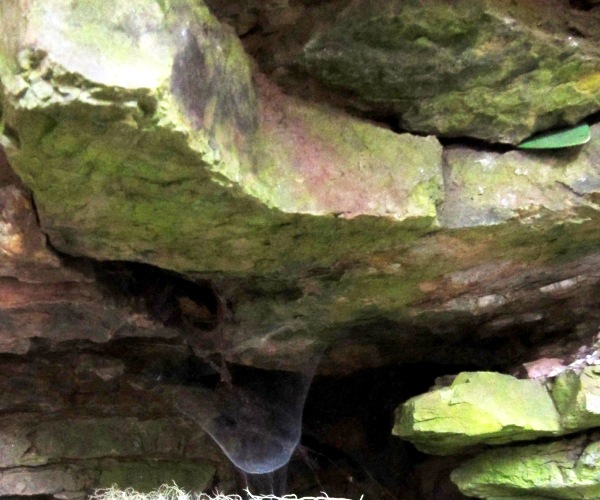
(Here’s the PDF of correspondence between UCSF and SFFD indicating that UCSF provided the draft letter: UCSF – SFFD emails July 2013 )

  • 27 July 2013: Due to overwhelming number of comments on the Draft Environmental Impact Report opposing felling trees on Mount Sutro, UCSF announced that it would not be able to complete responses and hold the hearing approving the EIR in time for work to begin in 2013, and this would be postponed to 2014 after the bird-nesting season (around mid-August).
  • 14 August 2013: UCSF sent out a public notice that it would begin tree removals on August 26, and attached the SFFD letter (which had been drafted by UCSF) as justification.
  • 20 August 2013: San Francisco Forest Alliance sent SFFD a letter demanding immediate disclosure of all records pertaining to fire hazards or assessments of fire hazards on Mt. Sutro.
  • 23 August 2013: SFFD provided no records of any fire assessment on Mt. Sutro, and only produced one document showing that UCSF had scheduled a tentative Mt. Sutro site visit on July 11th (and no evidence or assurance that this site visit had occurred).
  • 26 August 2013: (1) “Urgent fire safety” work started. (2) On the same day, the day tree-felling began, SFFD actually did a site inspection of Mt. Sutro. This was reported in a letter to UCSF dated August 29th, when the work was well under way. Clearly, it was after the fact, and not independent. The inspecting contingent included several UCSF staff. From SFFD, it apparently included Fire Chief Joanne Hayes-White together with several other SFFD staff. Most of the letter details the work that is being done – all of which is apparently based on UCSF-provided information. The “independent assessment” is one paragraph of generalities, describing conditions that have been unchanged in at least the last ten years, and don’t therefore substantiate any “emergency.” That letter is HERE. SFFD Aug 29 letter to UCSF
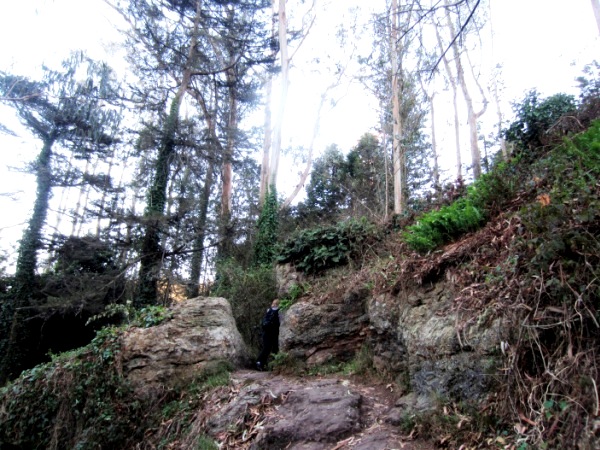
Is it possible that this letter, too, was drafted by UCSF? We don’t know. If we find out one way or the other, we’ll publish it here.

In any case, SFFD has clearly provided this support as a courtesy to UCSF, and there has still been no independent substantiation of the ‘extra-hazardous’ conditions throughout the areas where the “work” was performed. Or of any emergency.
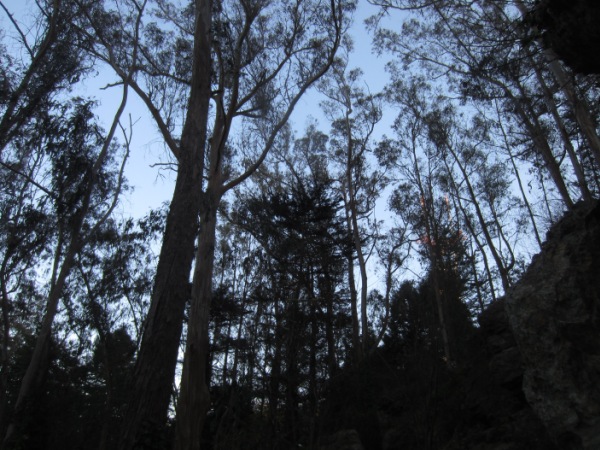
BEFORE picture in Sutro Forest. (Photo: SutroForest.com)

AFTER picture in Sutro Forest. (Photo: SutroForest.com)

Posted in Mt Sutro Cloud Forest, Sutro Forest "Fire Risk", UCSF | Tagged , , , | 4 Comments

Mt Sutro Cloud Forest Evening: Puddles, Not Fire

The fog blowing in last evening softened all the colors to gray. It was growing late, too late for the forest. We went anyway. These are some of the most beautiful times in the Cloud Forest, and we’d been away too long.

Mt Sutro Cloud Forest eveningToday, we climbed into a steady patter of the forest’s interior rain.  The trail was muddy, and there were puddles.

Mt Sutro Cloud Forest sept 2013

fog in mt sutro cloud forest sept 2013

fog in Mt Sutro Cloud Forest sept 2013 -2NATIVE PLANT GARDEN IN SUMMER DEADNESS

We continued into the Native Plant garden, where the sign, now surrounded by greenery is perhaps the most attractive element.

Mt Sutro Forest native plant garden signFor the rest, the Native Plant Garden definitely done for the year. Everything but the bushes and the trees are brown and dry. They’ll stay that way until spring when we should get three months of greenery and flowers.

dried plants in the Native Garden on Mount SutroThe most color comes from the orange plastic flags in the meadow that’s being replanted. (Again.)

orange flag meadow on Mt Sutrotop of water tankThis is one of the driest areas of the forest. Except for some patches under the trees, where the grass is still green, there’s no fog-capture here.

UCSF has recently removed a lot of vegetation around the water-tank, and as a result, it’s now clearly visible from the Native Garden. Though it’s painted an inoffensive minty green, it doesn’t add a lot of charm.

By the time we made our way down to the North Ridge Trail, it was quite dark. We trod carefully, avoiding puddles, mud, and tree-roots. Suddenly, at a turning, we saw something brindled move, then freeze. A coyote! We’d heard they were in the forest, but this was the first time we’d seen one. It turned and pelted down the path. Just to be sure, we clapped and yelled, and continued to do so for some distance, to enable the animal to stay out of our way.

We were tempted to take the Fairy Gates Trail, but by now it was completely dark. Discretion being the better part of valor, we ended the hike with a walk through UCSF’s foggy Aldea campus.

FIRE WEATHER SOUTH AND EAST

The trails show the typical summer pattern – wet, even muddy, in many places; dry in others, particularly where the forest has been opened up and either the canopy is gone, or the subcanopy and understory are sparse.  But even where it’s dry, the only vegetation that dries out are grasses in opened-up spaces – like the Native Plant Garden. In most of the forest, the understory and the herbaceous layer are green and moist. (For a description of the forest’s ecology, go HERE.)

mt diablo fire sept 2013 abclocal site

Click to go to ABC local story on Mt Diablo fire sept 2013

Elsewhere, it’s fire weather. Only 10 miles south and two days ago, San Bruno Mountain had a fifty-acre fire in grass and brush. Even at this writing, fire-fighters are trying to contain a 3700-acre fire on Mt Diablo 50 miles east of the forest. Both those mountains are covered in tinder-dry grass and brush.

On Mt Sutro, there are puddles.

puddle in mt sutro cloud forest

Posted in Environment, Sutro Forest "Fire Risk" | Tagged , , , , | 3 Comments

Sutro Forest – Protesting the Tree-cutting

sign 2robin sutro poster jpgThe peaceful demonstration last Thursday drew a number of supporters, both those who have already been active and newcomers. A few people approached us to find out what was happening, then offered to carry signs or distribute materials themselves.

sign 4We lined both sides of the street with signs and posters, distributed postcards and flyers, and asked people to sign our petition. We exhausted our entire stock of postcards and flyers.

sign 1The UCSF police were standing by in force – maybe about ten people outside Millberry Union at 10.45 a.m., before the 11 a.m. start time. Though they looked intimidating, they were actually quite cordial and asked only that we should not prevent people from crossing the road, or block the steps into Millberry Union. We assured them we planned a peaceful protest, and wanted to inform, not disrupt. In fact, we’re pleased to say that as far as we know, all the protestors were conscientious about it. One had brought a sign asking for cars to “honk” in support, but realizing we were opposite a hospital, she immediately discarded that.

sign 3UCSF had a table set up by their Community Relations staff, and were handing out materials of their own. They had a forester, Kent Julin, in attendance. Occasionally, people would stop at their table, assuming they were part of the protest, and ask to sign the petition. After that happened a couple of times, one of us stood nearby and directed them to the person with the Petition.

TREE-CUTTING UNDERWAY

Meanwhile, the cutting has started. They are clearing most trees under 6 inches in diameter, and all the understory and vines from 15 acres of the forest. By the time they finish (around Sept 7th or so) they would have removed over 1250 trees.

Though the trees are under 6 inches in diameter – it takes a newly planted tree years to reach that size. If San Francisco were to plant one tree for every tree removed today, it would take until 2020 or 2023 for those trees to get to where these trees are now.

Here’s a before picture of the forest between the Aldea campus and Christopher Drive, as it was in April 2013.

forest beforeThe picture below is the same area as it was 2 days ago, after “urgent fire safety” work.

forest after

NOT SAFER

Has this expensive destruction of the smaller trees and all the understory habitat made the forest safer? We don’t think so, given the microclimate. In fact, we think it creates a hazard where none existed.

This  area is squarely in the fog belt, and it’s very foggy. The moisture that condenses on trees and bushes makes for a localized rain that forms actual puddles on Christopher. On the street, it evaporates in a few hours. On the bare earth, maybe in a day or two. But where it falls into dense undergrowth, it remains damp for weeks. In fact, it hardly ever dries out, as is evident in the year-round greenery. It’s lush even when it doesn’t rain.

Now that the understory is gone, that won’t happen. It’s going to dry out very much faster than before. And that’s going to be more flammable, not less so.

felled trees clarendon and christopherWe remain concerned about what UCSF is doing here, for the reasons we described earlier HERE.  We also note that this particular section of clearing just happens to be where the Sutro Stewards plan to put in a controversial trail running parallel to Christopher.

[Edited to Add: We got a note from UCSF’s Damon Lew, clarifying that the felled tree in the last picture was cut down by PG&E – which was doing its tree-work at the same time – and not by UCSF. “I’m not sure if you were aware, but I did want to let you know that the trees in the picture were cut down by PG&E as they were doing work around the powerlines on Clarendon Avenue.  You may have noticed their crew cutting branches near the powerlines along both the north and south sides of Clarendon about two weeks ago.  These trees were not cut down by UCSF or the contractor that was performing the urgent fire safety measures in/around the Reserve.”]

Posted in deforestation, Environment, Sutro Forest "Fire Risk", UCSF | Tagged , , , | 4 Comments