ABC7 Television, an Idyllic Forest, and Fear of Fire

ABC7 television had a 2-minute piece on Sutro Forest recently.

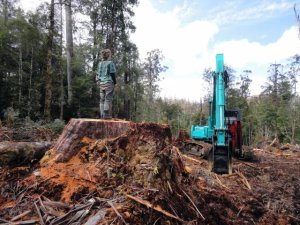
4 forest feb 2013

Click on the picture to go to the ABC7 video

We think it’s great coverage, and ABC7 is doing the community a service by getting this issue out there.

But we’re concerned about how two interviewees focused on fire hazard,  which has been exaggerated.

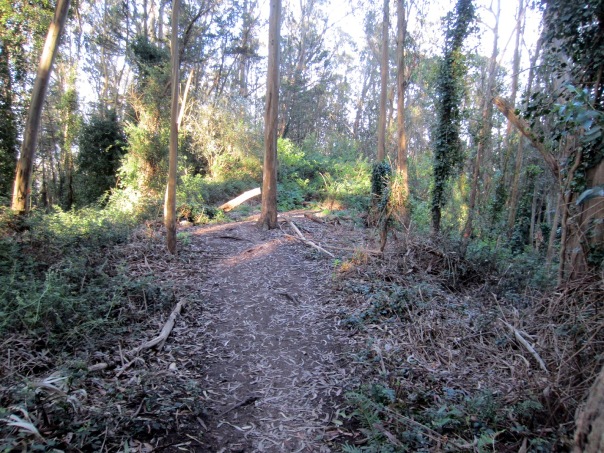
cloud forest, muddy trail

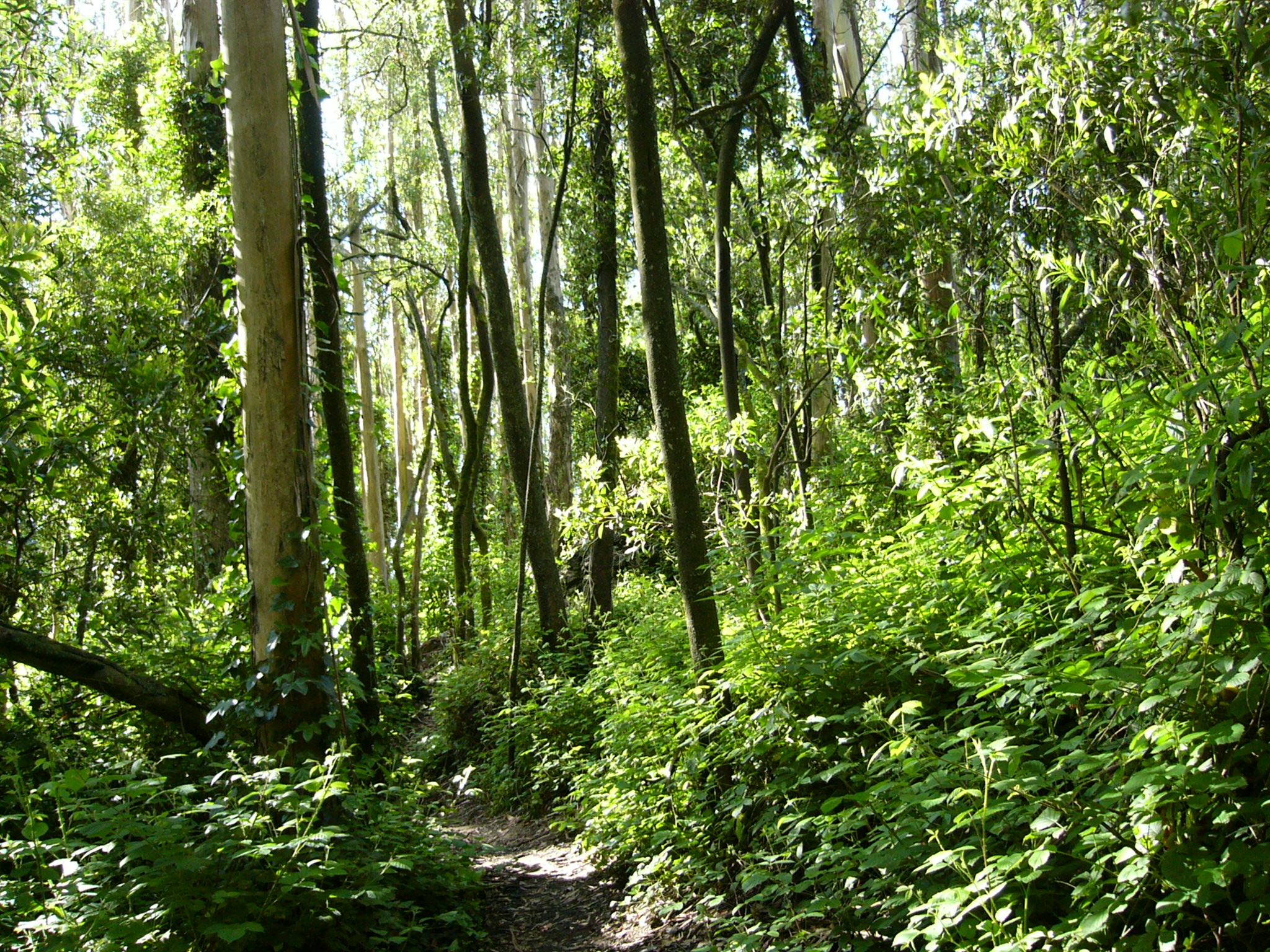
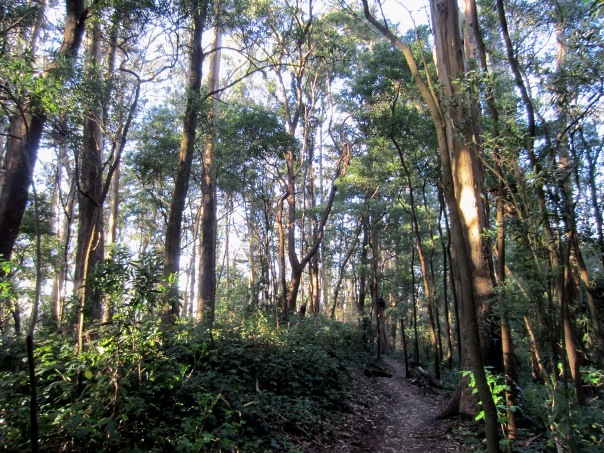
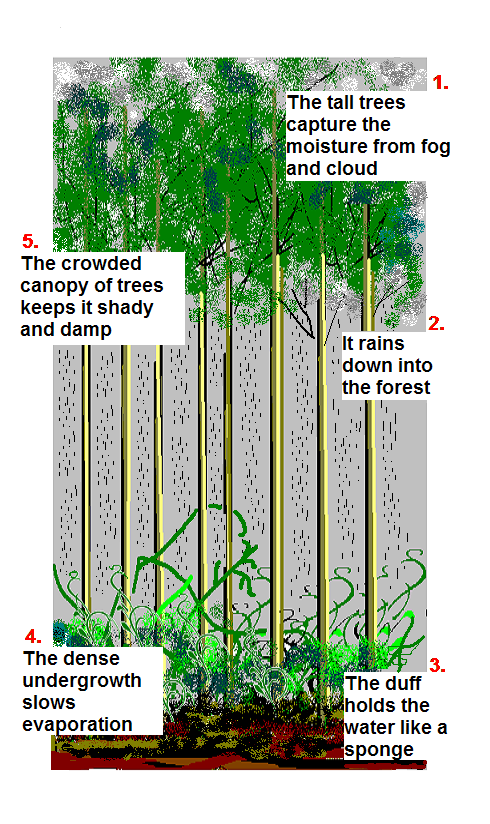
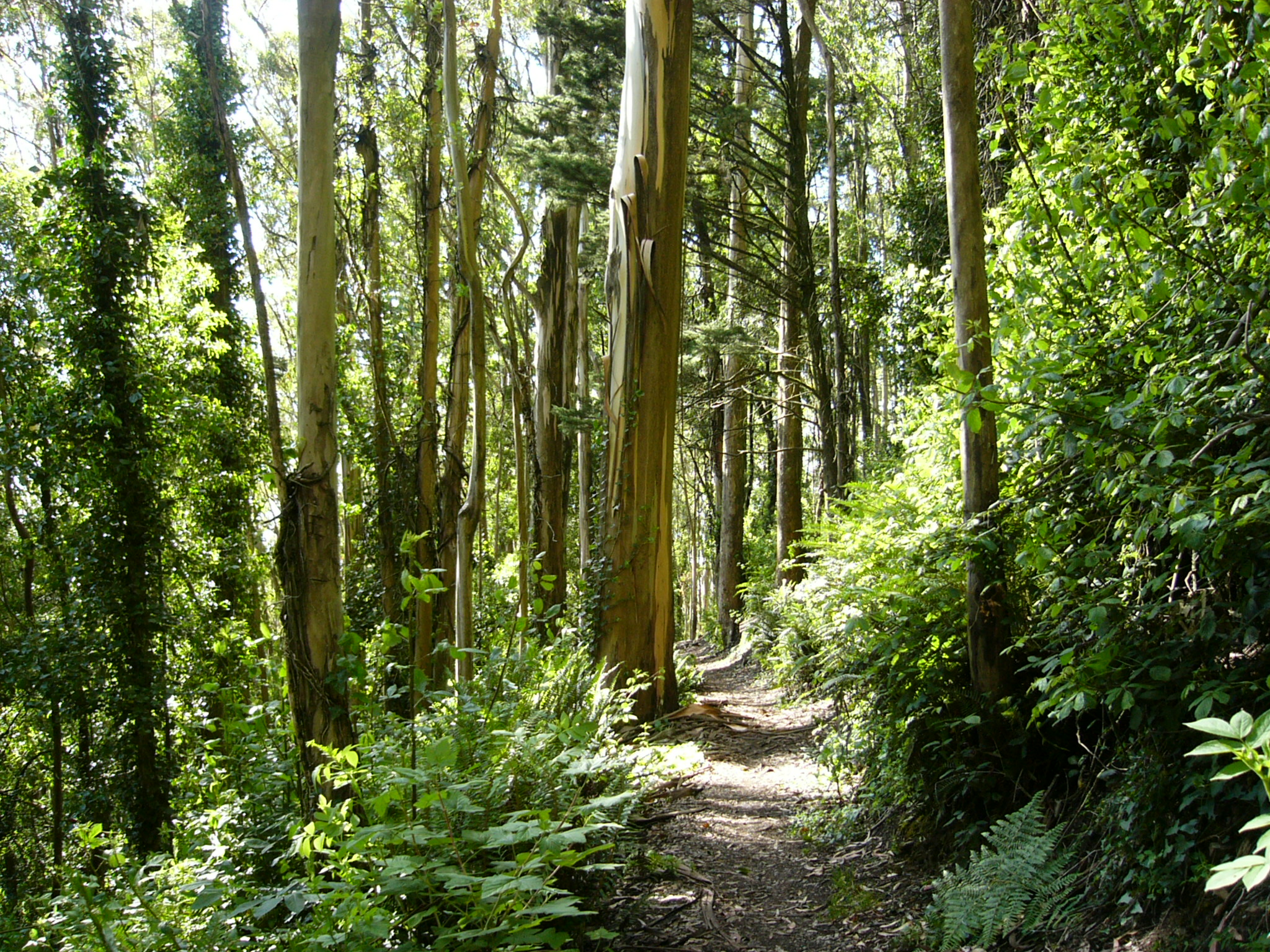
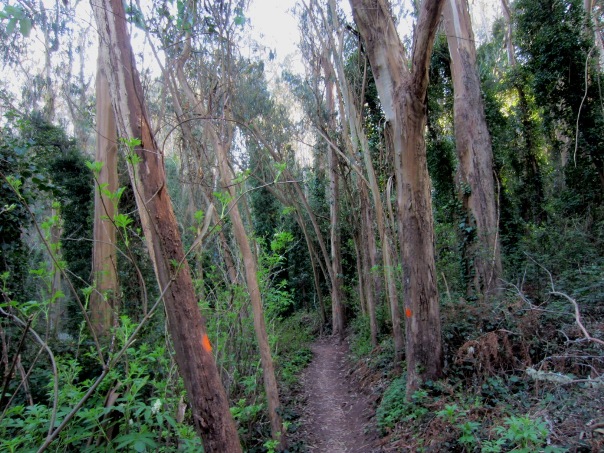
Right now, the forest, which lies squarely in the Fog Belt, is a Cloud Forest – meaning it’s wet year around. It captures 30-40% of its moisture from the fog, and traps it in its dense understory. Save Sutro kept a “Fog Log” in the dry year of 2009, and found the longest dry spell was – 7 days.  (A dry spell was defined as an unbroken string of days when the forest got moisture from neither rain nor fog.) In UCSF’s own 2001 report, it mentions “up to ten days in the autumn.” At a public hearing to open the Stanyan Trail, we heard from Ray Moritz, UCSF’s hired arborist, speaking as a fire ecologist. He said the fire hazard was low. The greatest danger, he suggested was when people did not clear debris from the roof area around fireplace chimneys.

Ms Noyola, who was interviewed together with Dr Morley Singer, and Ms Barbara Bagot Lopez (of UCSF’s Community Relations), lives beside the Interior Greenbelt, the city-owned part of the forest. (She also spoke at UCSF’s Feb 25th public hearing.)

We’re not sure if she recognizes that UCSF’s Plan will actually raise the fire hazard.

CREATING A FIRE HAZARD

“Thinning” the forest will make it drier and windier, thus increasing the fire hazard. Consider the statement of Dr Mascaro, who is a professional ecologist: “By thinning the forest and removing most of the understory vegetation, the management activity will open the canopy of the forest resulting in drier and hotter duff on the forest floor and a greater risk of fire.”

In fact, we think it will be even worse. Removing thousands of trees and tearing gaps in the canopy will reduce the amount of moisture captured in the first place. Then, with no shaded understory (since more sunlight is reaching the forest floor and 90% of the understory removed), there’s nothing to retard evaporation.

The picture below (from the Interior Greenbelt part of the forest) is an example of what might be expected.

managed forest2 - Gina Hall

fireladderThe DEIR says it’s the South-facing slopes that are warmer and drier, but in fact it’s the open areas on the east side that are dry now – while the trails up the South side are quite damp. You can see evidence of this drying on the new trail from Stanyan, where 50 trees were cut along the trail, thus opening huge gaps in the canopy. A lot of understory was also removed. The forest is visibly drier there than in the more enclosed parts. A walk along the Historic Trail illustrates this as well – the path can change from dry dust to damp earth within a few inches, depending on the state of the forest. If the whole forest is made as dry and dusty as these areas, by removing thousands of trees and nearly all the understory, the hazard could increase.

In addition, the Plan calls for cutting vines to 10 feet above the ground. This is going to leave the few remaining trees festooned with dead vines which are supposed to dry up and blow away, but actually dry up and remain for years. We wrote about that back when the Community meetings were in progress, here: Creating a Fire Ladder?

WATER AND ROADS IN THIS FOREST

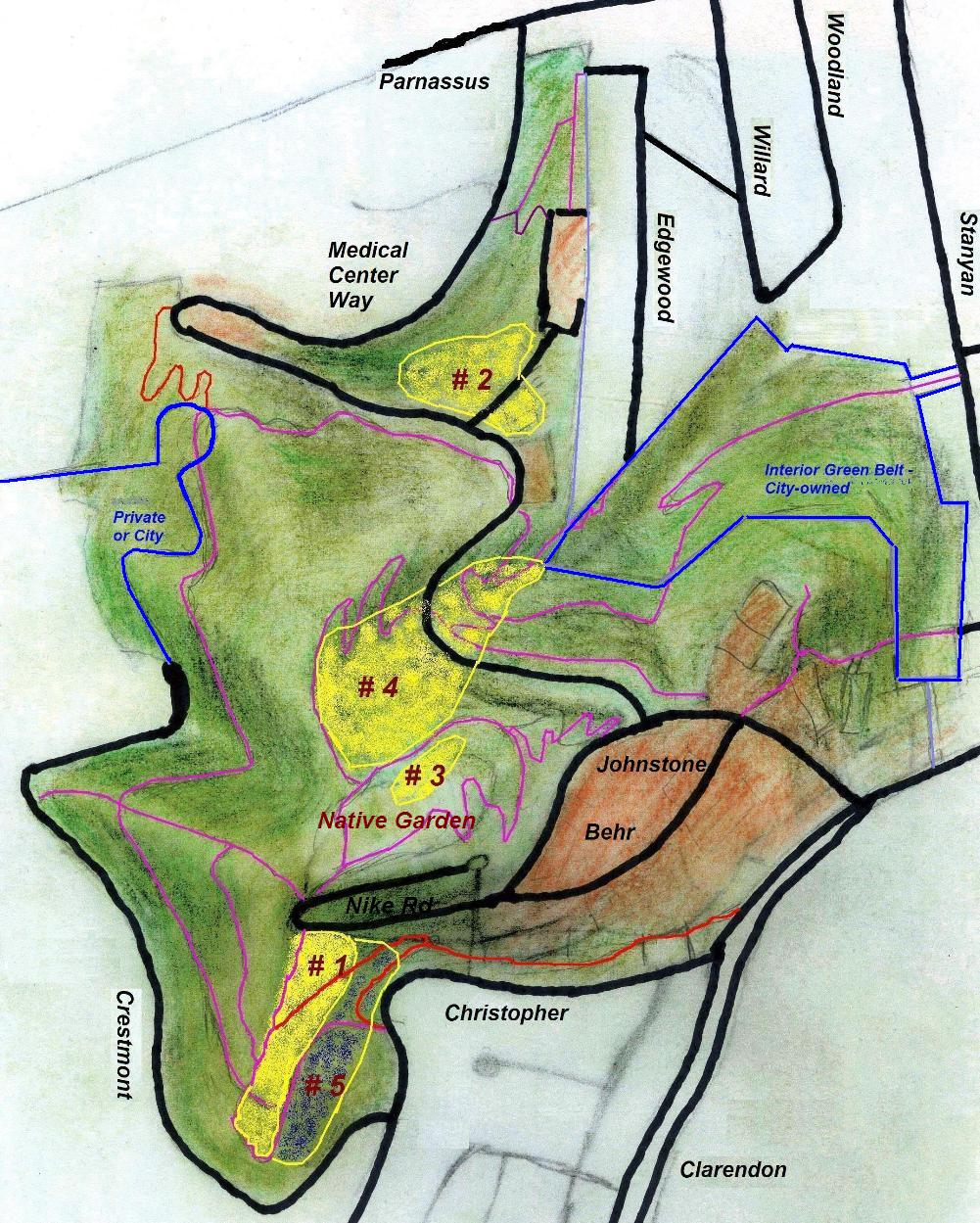
In any case, there are other options. Water lines run to the summit of the mountain, and there’s a water tank within a few yards of it. Water is supplied to the Aldea campus, and to the office buildings along Medical Center Way. Fire trucks can access most of the forest either from paved roads surround it, or from the paved Nike Road to the summit of the mountain. The blue lines on the map below indicate paved roads. The yellow dot is the water tank close to the summit (which has water pipes and has even been irrigated). The orange spots are office buildings, which would have a water supply.
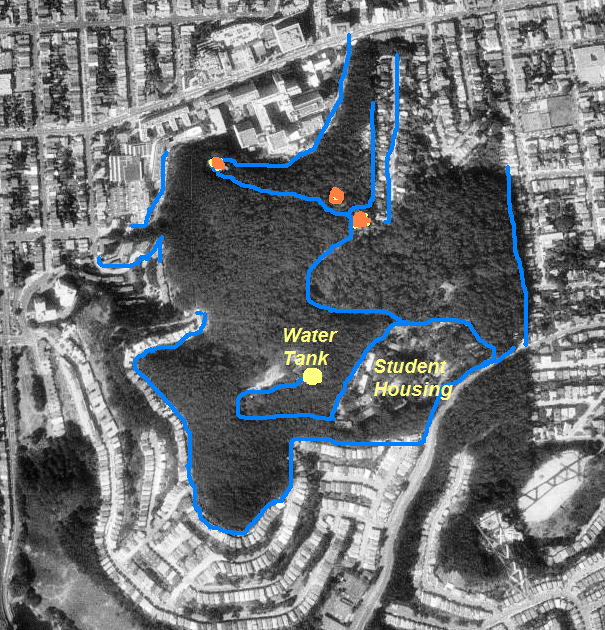
map usgs ed paved roads in Sutro ForestEven though the forest gives a feeling of seclusion and entering another world – it’s actually quite accessible. If there’s a dry spell, it would be cheaper and less destructive to bring in a tanker to just spray the forest once or even twice.

The least accessible portion – the western slopes overlooking the Inner Sunset – is in fact the 15 acre part that won’t be thinned under the UCSF Plan.

THE “FIRE HAZARD” STORY

It’s not fair, though, to blame those who do fear fire. UCSF has been talking up the fire hazard at least since 2009, when it applied for a grant from FEMA to reduce fire hazard by cutting down most of the trees on 14 acres of the forest: 8 acres on the South Ridge (around Demonstration Area #1) and 6 acres behind Edgewood (around Demonstration Area #2). FEMA came back with a lot of questions that UCSF couldn’t answer. Instead, UCSF withdrew its application.

FEMA noted that UCSF “inaccurately interprets a map”, “provides inadequate details regarding the history of wildfires in Sutro Forest, and provides a simplistic and ineffective comparison of the wildfire hazard in the Sutro Forest to the hazard in other areas that have burned in the San Francisco Bay area.”

It notes that the CALFIRE map is the relevant one, and that shows the forest to be a “moderate” fire hazard – the lowest rating of the three that CALFIRE assigns.

fire hazard FEMA critNow, quite surprisingly, the DEIR still uses the same maps that FEMA found it “inaccurately interprets” – and it still inaccurately interprets them in the same way. (The whole “map” story, for anyone who wants that level of detail, is HERE.)

The DEIR also suggests that the CALFIRE map is “a draft” and could change, though it was prepared in 2007 and a note on its website affirmed, in November 2008, that our city and county had no areas of Very High Fire Hazard areas: Update, 11/2008: CAL FIRE has determined that this county has no Very High Fire Hazard Severity Zones in LRA [Local Responsibility Area]. ”  That covers Mount Sutro Forest. Clearly, in CALFIRE’s assessment, there is no Very High Fire Hazard. (Meanwhile, the maps that UCSF “inaccurately interprets” were prepared in 2004 and 2005.)

CAL FIRE map shows Mt Sutro Forest has the lowest level of fire hazard (gray color indicates areas not rated - mainly built areas)

CAL FIRE map shows Mt Sutro Forest has the lowest level of fire hazard (gray color indicates areas not rated – mainly built areas)

ERRONEOUS COMPARISONS

It also continues to make the same simplistic comparisons to fires elsewhere: the fires in Oakland and on Angel Island.

In fact, both Angel Island and the Oakland fire are counter-examples. Angel Island was covered with eucalyptus trees for decades. During that time, the only reference we could find to fire was a fire in a building. Since the trees were removed, there have been a number of fires, culminating in the huge October 2008 fire.  It burned the grass and shrubs over half the island, and stopped at the tree-line.

The Oakland fire also started with shrubs and grasses. It spread to trees and buildings, but the trees were victims of the fire, not the cause of it. The main fire spread from house to house. A report on that fire, from David Maloney who was on the investigative task force, is HERE. It also clarifies that eucalyptus is not particularly flammable.

The weather conditions in Oakland and on Angel Island are also have drier and more extreme weather than San Francisco’s Fog Belt. Besides, Sutro Forest’s uniquely wet micro-climate is not comparable – though ironically, once the forest has been thinned and dried out, the comparisons might be closer. Nevertheless, San Francisco’s climate remains much less extreme than either place – cooler (and wetter, with the fog) in summer; and warmer in winter.

To everyone who is concerned about the fire hazard: Ask UCSF and the Sutro Stewards (the volunteers who actually manage the forest) to maintain it as a functional cloud forest.

  • Stop tearing out understory unless its actually to maintain trails.
  • Avoid cutting down trees unless they are actually hazardous, not just because they are in poor condition.
  • Build the trails to channel water across them to the downslope side, and maintain the dense vegetation on either side. That way, the areas that aren’t actually trail will remain damp, and the vegetation will help remove moisture from the trail.
  • Ask UCSF to put in place a sensible emergency plan for any situations where the forest – very rarely – does get dry.
Posted in Sutro Forest "Fire Risk", UCSF | Tagged , , , , , | 3 Comments

“Don’t Cut Me Down”: Found in Sutro Forest

A few weeks ago, we’d mentioned seeing lots of trees along the Sutro Forest trails marked with orange blobs of paint. They were mostly trees in apparently poor condition, though they didn’t look especially hazardous. We assumed they had been tagged for removal and regretted it – these trees are part of the forest, and valuable as habitat.

trees with orange blobs

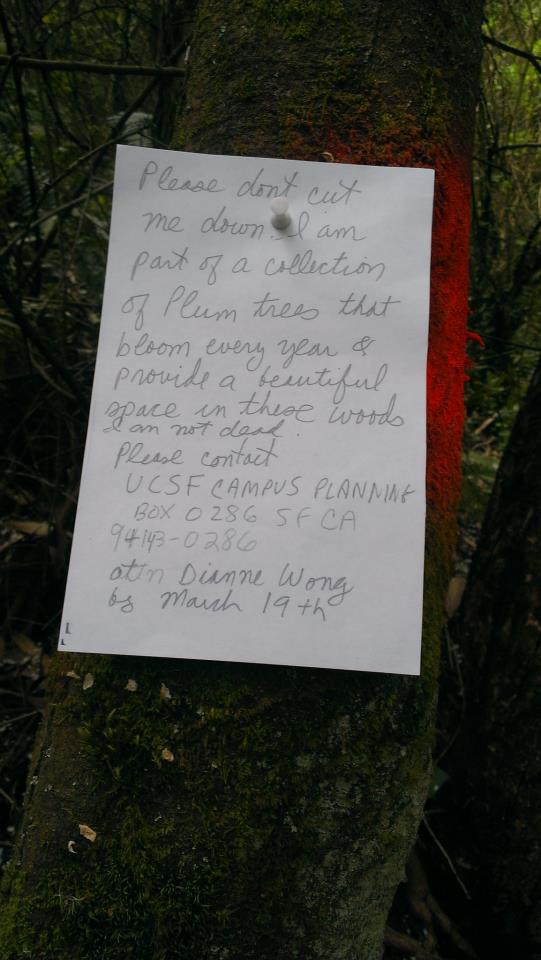
Today, hiker Gina Hall posted pictures on Facebook of notes she found on these trees all over the forest: “Please don’t cut me down...” They suggested writing to UCSF Campus Planning, Box 0286 SF, California 94143-0286 – Attention Diane Wong. Before March 19th, 2013.

notes in the forest2 - Gina HallThere are not many pine trees in these woods,” said this note. “Please leave me standing for some different than usual kind of beauty here.

In the picture below, it says, “I am part of a collection of plum trees that bloom every year & provide a beautiful space in these woods. I am not dead.”

notes in the forest - Gina Hall

[Edited to Add: Another note on a tree, below. It says, “I might be dead but I am beautiful to look at and am a home to birds and other living things. Forests need dead trees.“]

notes in the forest3- Gina Hall

“I didn’t write these notes,” Gina Hall wrote,  “but I did read them all over the forest today…”

We’d also like to note that though public comments on the Draft Environmental Impact Report are due on March 19th, that is not the day tree-felling will start. We understand that will wait for the bird nesting season (which runs approximately February through August) to end. So please do write into UCSF – even if it’s after March 19. You could also address your notes to Ms Lori Yamauchi, Assistant Vice Chancellor for Campus Planning, at info@planning.ucsf.edu or the same address as given above.

[Edited to Add the following section.]

WHAT CRITERIA FOR BLOBBING?

We don’t know what criteria were used for selecting trees for the orange paint blobs, or who decided. Hort Science, which did the original 1995 study of the forest has a specific assessment system for hazardous trees.

The method Hort uses for rating trees is this. It considers three factors:

  •     Failure potential (How likely is it that the tree would fall or drop a limb);
  •     Size of the part that would fail (the size of the tree or the branch);
  •     Value of the target area (if it fell, what would it damage?).

Each is scored on a scale of 1-4, and the scores are added together. This gives a tree a rating of 3 (least problematic) to 12 (most problematic). Only a small young tree far from any road or building or playground would be a 3. The City’s action threshold is 9, and most trees with a 9 or higher rating would be removed. This methodology is strongly biased against large trees in busy areas. For instance, a big tree near a roadway would get a score of 4 for size, and 4 for “value of target.” This means it is an automatic 9, because the score for “failure potential” cannot be less than 1. But conversely, it does not remove trees merely for being old or spindly or even dead.

Unfortunately, this is not usually the criterion used in San Francisco’s Natural Areas – or, presumably, Sutro Forest. There, they just eyeball the trees, and mark for removal any that are in poor condition or are leaning. We suspect the approach used here was just that – remove trees that are dead or dying or leaning.

This is a poor approach for a naturalized forest. It’s destructive of a forest’s ecology; dead and dying trees are important to a forest, and ones that lean add interest to the landscape.

(We have a query in to UCSF, and if they respond, we’ll post it here.)

Posted in Mt Sutro Cloud Forest, UCSF | Tagged , , | 7 Comments

Flaws in UCSF’s Sutro DEIR: Public Comments Due 19th March 2013

This post is about flaws in UCSF’s Draft Environmental Impact Report (DEIR) for Mount Sutro Open Space Reserve. It isn’t comprehensive, but hits some of the high points.

Here is the PDF of the DEIR: Mount_Sutro_EIR_1-16-13_with_Appendices

MISLEADING PICTURES

The DEIR avoids showing mock-ups of what the forest might look like after its Plan is implemented. Instead, it shows two sets of Before and After pictures eucalyptus trees elsewhere, provided by hired urban forester, Ray Moritz. (Page 4.1-15 and 4.1-16 of the DEIR, included here for purposes of discussion and criticism.)

Ray Moritz 13 curves pixThe pictures show a forest with understory removed, but the trees are clearly not spaced 30 (or 60) feet apart. They appear to be spaced 8-10 feet apart,  similar to the average spacing in Mount Sutro Forest now. (Given 740 trees per acre, it’s 8-9 feet apart.) Both “after” pictures include thin trees of the kind that would be eradicated under the Plan. So what the pictures actually represent is how the forest might look without its understory, vines, or epiphytes – but without any tree-felling.
ray moritz camino del canyon

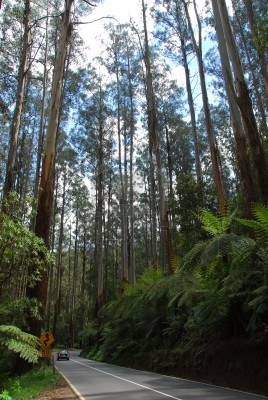
Image credit: timchen / 123RF Stock Photo

Australian eucalyptus forest. Photo credit: Tim Chen, 123RF Stock Photo

sparse tree canopies says UCSF

This is a normal eucalyptus canopy but UCSF calls it sparse. Source: UCSF

The DEIR also includes pictures of the canopy which it characterizes as sparse and unhealthy. This reflects a misunderstanding of the forest and the species; it is actually the natural canopy of a eucalyptus forest, which is airy and not very dense, thus allowing for a subcanopy of smaller trees (acacia, plum in Sutro Forest), and a lush understory. [Edited to Add pictures. For comparison, we show a stock photo of an Australian eucalyptus forest as well as the “sparse tree canopies” from the DEIR. (Page 4.7-4 of the DEIR, included here for purposes of discussion and criticism.)]

EXAGGERATED FIRE HAZARD – AND HIGH-RISK “SOLUTION”

The DEIR exaggerates the fire hazard – and its Plan will actually increase the risk by making the forest much drier and windier. (There’s a statement from a professional forest ecologist HERE.)

The arguments in the DEIR repeat those in the FEMA application: Eucalyptus is uniquely flammable owing to shed bark and oils within the leaves; dense forests are more flammable than open ones; that fires in the forest in 1899 and 1934 indicate its vulnerability; that the fires on Angel Island and Oakland are examples of fires that could occur in Mount Sutro Forest; that hot dry northeast winds in autumn cause a period of vulnerability for “several weeks.”  We thought we had already answered those arguments in this post: UCSF, Sutro Stewards, and the Fund-Raising Fire Hazard, and in this earlier post, Mt Sutro: The Fire Hazard That Wasn’t.

Sutro Forest is a de-facto Cloud Forest. It gets 30-40% more moisture than surrounding areas by catching moisture from the fog, which it then holds in its duff and understory. (We have an illustration of the process HERE.) This may be the wettest part of the city that isn’t actually under water.

According to CALFIRE, the hazard rating for Mount Sutro Forest is “moderate” – its lowest risk rating. The DEIR seeks to dismiss this by saying the map is a draft and could change. However, CALFIRE also noted: Update, 11/2008: CAL FIRE has determined that this county has no Very High Fire Hazard Severity Zones in LRA [Local Responsibility Area]. ” That covers Mount Sutro Forest. Clearly, in CALFIRE’s assessment, there is no Very High Fire Hazard.

FRAP map.38

San Francisco city does not get hot dry northeasterly winds (commonly called ‘Diablo’ winds); even when the East Bay has these conditions, the city remains cooler. According to the 2001 Plan, the vulnerability is for “up to ten days in the autumn.” In 2009, we maintained a daily FogLog during this so-called ‘period of vulnerability’ and recorded only 7 dry days – i.e. days when neither fog nor rain provided the forest with moisture. It will not dry out in 7-10 days in its natural state.

The fire hazard can be raised, however, by “thinning” the forest. This will dry out the “thinned” areas, and increase wind-speeds, thus increasing the likelihood that fires will spread if they start. So far, there have been – we are told – 3 small fires, the last in 1999. It was extinguished in 20 minutes. Had the forest had been drier and windier, and had it been a fire of grass and shrubs, it could have spread rapidly as the Angel Island fire did.

In fact, both Angel Island and the Oakland fire are counter-examples. Angel Island was covered with eucalyptus trees for decades. During that time, the only reference we could find to fire was a fire in a building. Since the trees were removed, there have been a number of fires, culminating in the October 2008 fire – which burned the grass and shrubs and stopped at the tree-line.

The Oakland fire also started with shrubs and grasses. It spread to trees and buildings, but the trees were victims of the fire, not the cause of it. The main fire spread from house to house. A report on that fire, from David Maloney who was on the investigative task force, is HERE. It also clarifies that eucalyptus is not particularly flammable.

The weather conditions in Oakland and on Angel Island are also completely different from Mount Sutro’s. Both those places have more extreme and drier weather.  Sutro Forest’s uniquely wet micro-climate is not comparable – though once the forest has been thinned and dried out, the comparisons might be closer.

You can already see evidence of this drying on the new trail from Stanyan, where 50 trees were cut along the trail, thus opening huge gaps in the canopy. A lot of understory was also removed. The forest is visibly drier there than in the more enclosed parts. Even the DEIR says it’s the South-facing slopes that are warmer and drier, in fact it’s the open areas on the east side that are dry now. A walk along the Historic Trail illustrates this as well – the path can change from dry dust to damp earth within a few inches, depending on the state of the forest.  If the whole forest is made as dry and dusty as these areas, by removing thousands of trees and nearly all the understory, the hazard could increase.

Incidentally, during the public meeting prior to that trail being built, Ray Moritz, who is UCSF’s hired arborist, also made a presentation as a fire ecologist and declared the fire hazard to be low.

CARBON SEQUESTRATION

With global warming, carbon storage is becoming an increasingly important issue. In fact, California has a specific law about it: AB32. UCSF also has a policy to reduce greenhouse gases.

Eucalyptus trees are excellent carbon sinks: They grow large and fast, the wood is dense, and they’re long-lived in wet conditions like Mount Sutro (around 400-500 years). The acacia understory makes the forest even better at sequestering carbon; acacia is a nitrogen-fixing tree, so both the eucalyptus and the acacia grow better together. They also store more carbon in the soil. Obviously, felling these trees will be a double whammy. They won’t be pulling more carbon out of the air. Instead, they’ll be chipped and mulched and decaying – and thus releasing carbon.

The DEIR makes several mistakes as it attempts to wiggle its way out of this dilemma: chopping down thousands of trees and leaving them to decay, vs the negative carbon impact. Here’s what it does:

First, it underestimates the carbon stored in the forest, and continued sequestration, in six ways:

  • It uses calculations based on six tiny cherry-picked plots (one-tenth of an acre each) that had fewer and smaller trees (averaging 175 trees per acre instead of 740 trees per acre for the whole forest!);
  • It calculates the tree-loss per acre based on the 175 trees/ acre and estimates 62 trees per acre will be left standing – so only 113 trees per acre are felled instead of 678
  • It excludes all trees under 5 inches in diameter;
  • It excludes understory vegetation because it’s only 5% of the total carbon storage;
  • It ignores soil storage (about 50% of a forest’s carbon storage) because it’s stable, even though the kind of activities planned for the Reserve would undoubtedly cause soil disturbance and release carbon; and
  • It uses a calculation based on 40% of the wood from felled trees being used for timber (like for furniture) – which of course means the carbon is stored for a much longer time than if the tree is in woodchips decaying on the ground. It reaches a conclusion that the short-term reduction in carbon storage would be 29% of the forest’s total storage – 11,286 tons (or 10,239 metric tons) of carbon dioxide.
  • It argues that mature trees have stopped sequestering carbon, while young trees would absorb carbon at higher rates. This is only true if trees stop growing; but there’s no evidence that these trees have. They are young for eucalyptus trees, which can live 400-500 years. In fact, since trees absorb carbon in proportion to the wood they add, the larger trees may be absorbing carbon at a lower rate than small trees, but actually taking in a larger amount.

We estimate their numbers are between 1/3 and 1/4 of the realistic amounts. The storage numbers are understated, and the removal numbers even more understated.

Second, it looks at a 30-year scenario (the projected life of the Plan), and divides the carbon storage loss by 30. We are not sure where the 30-year project life comes from.

Third, it argues that over 30 years, the carbon storage capacity will recover. The trees will be thinned the trees that remain will be healthier and grow larger, (despite the risk of wind throw killing remaining trees, and destruction be herbicides through the intergrafted root system).  Because the understory will be destroyed, they say, new trees will be able to grow (despite the thick layer of eucalyptus chip mulch and the plan to poison them or yank them to prevent them from growing.) It also claims reduction in tree mortality because there’ll be fewer pest infestations (which don’t actually exist now, but are speculated about).

HEALTH OF THE FOREST

The DEIR claims the forest is unhealthy, with overcrowding, dying trees, and an infestation of various insects including of snout beetles in some areas.

  • We wonder if UCSF had an entomologist look at the beetles, because snout beetles have mainly been seen in Southern California. In any case, they are readily controlled through release of a parasitic wasp. (This UC Davis publication has details.)
  • Except for major infestations, it’s normal for a forest to have insects – they’re part of the ecosystem, in fact, the foundation of it.
  • The DEIR states that the forest is crowded because eucalyptus is well-adapted to the site, it’s very prolific, and re-sprouts vigorously. This does not sound exactly like ill-health.
  • Some trees – especially the thin saplings that have not reached the canopy – are dead or dying. This is a natural process of self-thinning. It is better than the artificial thinning proposed in the Plan, because the forest varies greatly in terms of topography, wind, temperatures, and other growing conditions. The trees that flourish are best adapted for that particular space.
  • The DEIR mentions that new trees are not growing into the canopy. We cannot see why this is an issue, since the tree density is considered more than adequate already. We cannot see why felling 90%  of the trees per acre will improve the health of the forest.
  • The last detailed assessment of the forest was made in 1999, by Hort Science. Though the DEIR claims that two arborists hired subsequently reported a deterioration in conditions, they haven’t actually documented anything. Now, 13 years later, the DEIR still uses Hort’s estimate of tree density and tree numbers: 740 trees per acre, and 45,000 trees in total. This suggests that the deterioration is insignificant.
  • It also “spun” Hort’s report as follows: “the general condition of the Reserve’s trees is only fair to good, but the prevalent small trees throughout the forest are generally in worse condition than the large trees that dominate the forest canopy.” Here’s what Hort actually wrote: “In general, the trees that make up the canopy were in good condition. Trees in the understory had generally poor health.” Hort’s report sounds like a forest in the process of self-thinning. The trees that win the race for light flourish; the others survive or die depending on their specific circumstances.

If the forest is considered as a naturalized forest, it will be seen as healthy and self-regulating; it’s a population of trees in various conditions. Only if it’s considered a plantation – or still worse, an invasive species – does it make sense to intervene aggressively.

AIR QUALITY

Trees and bushes fight pollution, especially small particulate matter that is bad for human lungs. They trap these particles on their leaves until they are rained down, thus removing them from the air, and absorb noxious gases. The DEIR does not address or quantify the loss of pollution control – which is likely to run to thousands of pounds of contaminants.

WILDLIFE

The assessment of wildlife is based on two (presumably daytime) site visits by the consultants, and guesswork based on the habitat conditions. There was no camera trapping, extended observation, or year-round observation to allow for seasonal changes.

  • Insects. The DEIR only speculates, and it’s wrong. “Native insect within the Reserve is expected to be low because of the dominance of non-native eucalyptus.” The insect fauna of the shady understory of the eucalyptus forest would include moths, flies, and beetles. (We have also observed butterflies.) Further, it’s not true that native insects use only native plants; many species adapt to non-native plants quite readily. It adds “two species of eucalyptus borer may occur… heavy infestation of these species may kill eucalyptus trees.” We are not clear why this section was even included, since it contains no actual information as to what species of insects actually occur (not “may” occur) in the forest.
  • Amphibians and reptiles. They didn’t see any on their two site visits. They’re guessing at what might live there, based on the habitat.
  • Birds. This section is the most descriptive, and they actually observed some birds, and actually recognizes its value to birds, both resident and migratory. It fails to describe the impact of removing 90% of the trees and understory on birdlife. The olive-sided flycatcher is a species of special concern that may nest in the forest. It’s a forest species, and was heard in the East Bowl, the area of Demonstration Project #4 – which, spaced at 12-15 trees per acre, will no longer be forest once the Plan is implemented. It also needs snags – dead trees – which will be the first to go when the thinning starts.
  • Mammals. They only saw a squirrel, but think the forest could house oppossum, deer mice, raccoons, skunks – and black-tailed deer. No, we have no deer. They also guess at what bats might use the forest.

On page 4.3-20, it claims the forest is not a wildlife corridor because it’s surrounded by urban development. In fact, if viewed from an animal’s viewpoint, it is part of a system that connects to a broader area –  Glen Canyon, Twin Peaks, Laguna Honda Reservoir, and Golden Gate Park. It says “the relatively limited amount of vegetation removal… would not interfere…” We’re not sure it defines the loss of 90% of the understory (which is what matters most to non-flying critters) as “relatively limited.”

The mitigation for birds nesting is also interesting – they’re going to try to work outside the nesting season, and retain a few snags for woodpeckers. If they’re working between Dec 15 and August 15, they’ll call in a biologist to do a nest survey and cordon off nests. But the DEIR ignores the effect of the reduced habitat for birds the following season, which certainly is not “less than significant.”

TIME TO SEND IN PUBLIC COMMENTS

We think there are other flaws and lacunae in the DEIR, but we are now closing in on the public comments deadline: 19 March 2013. Please take a few minutes to send in your comments!

  • Submit a written public comment by 5 PM, March 19, 2013 to UCSF Environmental Coordinator Diane Wong at EIR@planning.ucsf.edu
  • Or, by mail to UCSF Campus Planning, Box 0286, San Francisco, CA 94143-0286.
  • Include your full name and address.
Posted in Environment, Mt Sutro Cloud Forest, UCSF | Tagged , , , , , , | 12 Comments

Sutro Forest Statement by Dr Joseph Mascaro

This is the statement of Dr Joseph Mascaro at the February 25th 2013 hearing UCSF held about the Draft Environmental Impact Report regarding Sutro Forest. It is published here with permission and added emphasis.

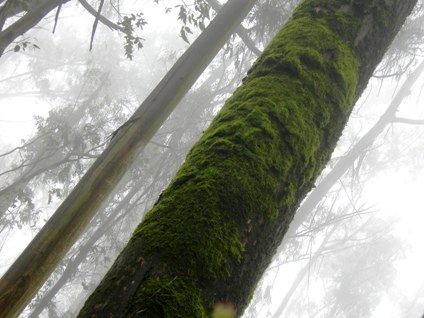
mossy tree trunk

——————————-

My name is Dr. Joseph Mascaro, I am a forest ecologist at the Carnegie Institution for Science in Stanford, California.  Although I cannot be present at the meeting today due to prior travel arrangements, I asked Keith McAllister to read this statement on my behalf.  I wish to deliver my expert opinion as an ecologist, but please note that my views regarding Mt. Sutro are not endorsed by, or affiliated with, the Carnegie Institution for Science.

I have worked in forest ecosystems throughout the United States, as well as tropical forests in Central and South America, Oceana and Australia, where I worked in forests dominated by eucalyptus and acacia species.  Having experienced conditions in eucalyptus forests in their native habitat, I believe the management objectives of the draft environmental impact report by the University of California, San Francisco will have three significant and unnecessary negative impacts on the environment, and in light of these negative impacts, I strenuously object to the proposed management activity.

First, the management activity will increase—not decrease—the risk of fire.  The present microclimate of the Sutro forest is cool and moist, with predominately healthy trees.  The forest promotes fog drip, and blocks wind.  By thinning the forest and removing most of the understory vegetation, the management activity will open the canopy of the forest resulting in drier and hotter duff on the forest floor and a greater risk of fire.

Second, the management activity will increase carbon emissions to the atmosphere.  In the report, UCSF justifies these carbon emissions on the grounds that, after the cutting, more eucalyptus trees will grow to accumulate any lost carbon.  UCSF is disingenuous on its views regarding eucalyptus: they first suggest that it is bad because it increases fire risk, and then suggest it is good because it grows quickly.

Third, the management activity will damage the biological diversity and character of Mt. Sutro.  The forest on Mt. Sutro is, indeed, a novel ecosystem with many introduced species.  Yet it is a diverse, functioning ecosystem providing many services, the most interesting of which is that it provides a small piece of wild nature in the heart of our city.  The forest is old, but it may not yet be mature.  There is no forest perfectly analogous to what exists on Mt. Sutro – a cosmopolitan mix of species, much like San Francisco.  The fact that the forest is strange to us is not a sufficient  justification for destroying it.

I urge UCSF to withdraw their management proposal.

Posted in Environment, eucalyptus, Meetings, Sutro Forest "Fire Risk", UCSF | Tagged , , , , , | 7 Comments

UCSF’s Mt Sutro DEIR: How Many Felled Trees – 30,000 or 22,000 or zero?

As we’ve noted before, UCSF’s Draft Environmental Impact Report (DEIR) on the Management Plan for Sutro Forest has been published, and public comments are due by March 19th, 2013. It covers what UCSF designates the Mount Sutro Open Space Reserve, an area of 61 acres.

Here is the PDF of the DEIR. Mount_Sutro_EIR_1-16-13_with_Appendices

You can submit a written public comment by 5 PM, March 19, 2013 to UCSF Environmental Coordinator Diane Wong at EIR@planning.ucsf.edu or by mail to UCSF Campus Planning, Box 0286, San Francisco, CA 94143-0286. Include your full name and address.

Mount sutro forest greenery

Perhaps one tree would remain of these; the other trees and greenery would be gone.

THE MANAGEMENT PLAN

UCSF proposes a two-stage Plan. In the first stage, it would:

  • Cut down around 3,000 trees on four “Demonstration Projects” totaling 7.5 acres;
  • Build three new trails, including one through a narrow ribbon of trees separating the Forest Knolls neighborhood from UCSF Student Housing;
  • Remove 90% of the understory habitat in 7 acres of the Demonstration Projects.
  • Amputate tree-climbing vines on the remaining trees (around 10% of the current total on this acreage).

In the second stage, it would extend the same Plan to the remainder of the Open Space Reserve, except for 15 acres considered too steep that would be left untouched. This would effectively remove 90% of the trees on 3/4 of the Reserve – a total of around 27,000-30,000 trees.

The DEIR considers two alternatives. The “No Project Alternative” is a requirement – what would happen if UCSF did not go ahead with this Plan. They also have a Reduced Project Alternative.

NO PROJECT ALTERNATIVE  (No trees removed)

This alternative would continue existing management:  maintaining trails, removing only hazardous trees, and pruning trees and bushes. (It claims “herbicide use would continue in a limited manner”, which we don’t understand given UCSF’s claim that no herbicides have been used in the forest since 2008.)

It claims that this would mean the forest would “continue to decline in health.” This presupposes that its health is indeed declining, which we dispute on the assessment of two Certified Arborists, who consider it healthy.

This is the option that we believe is ecologically positive, responsive to the public, and financially responsible. We would also expect UCSF to maintain its current No-Herbicide policy in the forest.

REDUCED PROJECT ALTERNATIVE (22,000 trees)

The DEIR claims this is the Environmentally Superior Alternative, since the noise impacts on Edgewood would not exist.It would do the following:

  • Space the trees to 15 feet instead of 30 feet. This would give around 200 trees per acre (instead of 50 that would result from a 30-foot spacing).
  • No Management Activities adjacent to Edgewood Avenue. Though the DEIR doesn’t specify the acreage, we assume this would be an area of around 6 acres that were included in the original application to FEMA.
  • Reduce understory removal to 45% instead of 90%. Instead of mowing down all the understory habitat, they would take out about half of it.
  • Everything else would be the same – tree cutting for views, trails, herbicide use. And, we presume, the exclusion of the 15 acres above Inner Sunset.

The DEIR claims this is the Environmentally Superior Alternative, since the noise impacts on Edgewood would not exist. This Reduced Project alternative would cut down 22,000 trees – about 75% of the trees on 65% of the forest.

According to the DEIR, “The Reduced Project Alternative would partially meet the project objectives, but not at the scope and scale that UCSF desires.”

In view of what the DEIR actually states as UCSF’s desires, we wonder why they object to our statements that they plan to fell 30,000 trees.

NEIGHBORHOOD IMPACTS

hand-drawn map with neighborhoods The differential impact on the three neighborhoods adjacent to the Reserve is curious, though we presume coincidental.

  • The proposed Management Plan spares any direct impact on the Inner Sunset neighborhood, which lies below the steep Western slopes that are excluded from tree-felling or understory removal. (This is the home neighborhood of Craig Dawson, Executive Director of the Sutro Stewards, and member of the Parnassus Community Action Team.)
  • The Reduced Project Alternative would remove the direct impact on Edgewood, which stands to lose its windbreak and sound barrier under the proposed Plan.
  • Under either scenario, the third neighborhood adjoining the forest – Forest Knolls – is still directly impacted. The 3-acre Demonstration Project #1 lies directly above it, and that is the only area where pesticides will be used in the project’s first stage. (This is the home neighborhood of SaveSutro’s webmaster.)

But – as we’re sure both UCSF and the Sutro Stewards, (who would be responsible for at least the continued maintenance if not for actually implementing this plan) understand – the appeal of this forest is not limited to direct neighbors. Its beauty, its unique ecology, and the ecosystem benefits that it provides are important to everyone in the city – and to visitors from other cities and other countries.

A FOREST PEOPLE LOVE

We’ll end with a few comments from supporters who signed the petition:

“Mt Sutro is a beautiful green space within a busy residential area of a major city. It is a jewel with its greenery and walking/biking trail. Finding it while visiting San Francisco has been a real high point of my trip. To think someone or group wants to tear it down to ‘improve it’ is horrible. It is wonderful as it is.”

“I visited San Francisco briefly last year and went straight to Mt Sutro. A friend from Australia is visiting soon and I’ve convinced him to do the same. Mt Sutro is a major tourist draw for nature lovers because it is so unique, and because there are such beautiful photos of it coming out on social media. Please don’t contaminate the jewel in your crown!”

“This forest I’ve loved since I was a kid. Please help save this Treasure within the city.”

“Don’t destroy something so beautiful and rare as a forest inside a metropolitan city!”

“This is such a unique site and one so ecologically important. Please don’t destroy this!”

“Spare the trees! Spare the Air! Spare our FUTURE!”

Posted in Environment, Mount Sutro Stewards, Mt Sutro Cloud Forest, Neighborhood impact, UCSF | Tagged , , , | 2 Comments

Tree Wars by Joel Engardio

Joel P. Engardio lives West of Twin Peaks and serves on the Board of Directors of Plan C and the Alice B. Toklas LGBT Democratic Club. You can follow his blog at www.engardio.com or find him on Facebook.

The article below was first published in a shortened version in the San Francisco Chronicle, and then at full length in the Bay Times. We have reprinted it below from the Bay Times version (with added subheads and pictures).

————————————

joel engardioTree Wars by Joel P. Engardio
Published: March 7, 2013

In San Francisco, there seems to be a correlation between well-intended bans, unintended consequences and jokes on Jon Stewart’s Daily Show (we banned toys in Happy Meals, but kids are still getting fat).

Now there are plans to cut down large numbers of trees and replace them with native plants because ancient San Francisco was naturally treeless. Can we agree that attempting to turn back the botanical clock is a nerve-racking feat in a city that’s still trying to get the buses to run on time?

The issue is ripe for parody because the call for tree destruction is coming from environmental activists who favor native plants. Meanwhile, many longtime residents and retired homeowners concerned with loss of windbreak and property value play the role of unlikely tree-huggers.

The resulting Tree Wars are being fought on Mt. Davidson and Mt. Sutro, where Adolph Sutro planted a dense forest of Australian eucalyptus trees in the 1880s when San Francisco was mostly sand dunes. Today, Sutro is both cursed and praised for his choice of tree.

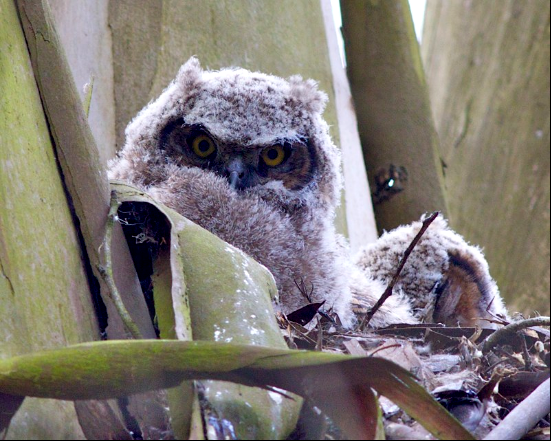
Great horned owlets in eucalyptus. San Francisco. Janet KesslerSome view the Westside peaks as lush and gorgeous “cloud forests” where fog gathers and hangs in the eucalyptus. Others see ugly and invasive “trees-as-weeds” that choke the land of natural life. When an arborist declares the forest is dying, another comes forward to say it will thrive for decades. When people claim that eucalyptus trees can’t support wildlife, photographers post pictures of baby owls nesting. And on it goes.

NOT MANY TREES IN SAN FRANCISCO

What’s missing in the eucalyptus debate is the fact that there aren’t many trees of any kind in San Francisco. Our overall tree canopy is just 12 percent, compared to 36 percent in Atlanta and 29 percent in Boston. New York’s concrete jungle has double the trees we have. Even the parking lot known as Los Angeles beats us in tree cover (18 percent).

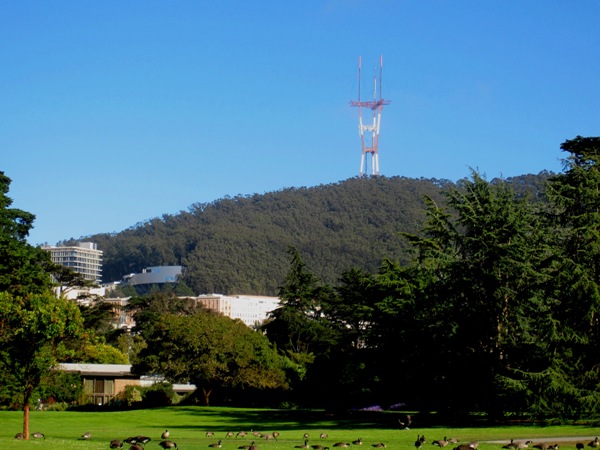
How can San Francisco — a self-proclaimed “green” city – have so few trees? Why aren’t we planting more trees that can clean the air, absorb traffic noise and help prevent landslides? sutro tower with UCSF and  forest seen from botanic gardensWe have environmentalists who say returning to native grass is better because that’s what was here before humans came and messed up San Francisco’s unique ecosystem. But what about all the non-native houses, office buildings, roads and people that make up the nation’s 14th largest city – not to mention the iconic cross and giant TV tower that sit on top of Mt. Davidson and Mt. Sutro, where the native plant movement is most focused?

While I think trees are good and we need more of them, I have yet to hug one. If there’s a eucalyptus (or any tree) in danger of burning or falling, cut it down. If a tree stands in the way of a needed development, cut it down. Common sense says life and property come before trees.

But I question if we should spend scarce tax dollars to replace healthy trees with native plants when the city had to borrow $200 million last year to fix dilapidated playgrounds. Parks in a crowded city should put the recreation needs of people and pets first. That’s why native plant programs – which restrict access for the sake of the plants – seem better suited for places like Yosemite over urban areas.

The city’s Natural Areas Program oversees the reintroduction of native plants and it isn’t cheap. Much has already been spent on trying to create fields of native grass. Some failed after multiple plantings and others sacrificed tall trees for what’s been described as “scraggly scrub brush.”

Beauty is subjective, but how can the city justify funding native plant programs when it says it can’t afford to maintain street trees?

Homeowners resent that they’re now required to pay for pruning city trees in front of their property. Rather than fall into the money pit of native plant programs, the city should put resources into planting and maintaining more trees along streets and in parks.

CREATING A SENSE OF FEAR AROUND EUCALYPTUS

For me, the most compelling argument I’ve heard against the eucalyptus is the claim they are more flammable than other trees — how the oil in the wood can flare under intense heat. It’s scary to read about firestorms in hot, dry climates (like the devastating 1991 Oakland Hills fire).

the forest in fogBut didn’t grass, wooden structures and trees of all types fuel that fire in addition to eucalyptus? And how often is it hot and dry on Mt. Davidson and Mt. Sutro, where there is a perpetual wet fog? A eucalyptus in the Australian outback is not a eucalyptus in San Francisco.

I have to wonder if creating a sense of fear around the eucalyptus helps some environmentalists justify cutting down lots of trees to make way for the native grass fields they prefer.

Consider what’s happening at UCSF, which wants to reduce eucalyptus trees on the 60 acres of forest it controls on Mt. Sutro. Replacing trees with native grass is expensive, so UCSF applied for a Federal Emergency Management Agency (FEMA) grant to help pay for it. The “emergency” in the UCSF application was the eucalyptus fire hazard. But FEMA responded by saying “UCSF inaccurately interprets a [wildfire hazard] map, provides inadequate details regarding the history of wildfires in the Sutro Forest, and provides a simplistic and ineffective comparison of the wildfire hazard in the Sutro Forest to the hazard in other areas that have burned in the San Francisco Bay Area.”

FEMA was also curious if replacing dense trees with open fields of grass might change wind patterns and create more danger by drying out the area. FEMA asked UCSF to “provide a citable and logical defense regarding how the proposed projects…would not result in an increase in the wildfire hazard in the Sutro Forest.”

UCSF withdrew its application and announced it would do the tree removal without a FEMA grant. California taxpayers will pay the bill, which means that every UCSF student facing a tuition increase and scientist looking for research funding has a stake in San Francisco’s tree wars.

NO PLANS TO EXPAND INTO THE FOREST…

UCSF says it has no plans to expand into the forest, which the UC Board of Regents designated as permanent open space in 1976. UCSF also says it won’t replace every tree with native grass. But the blogs still question the push for native plants. While UCSF would face many obstacles to develop the land, getting rid of the trees eliminates one big hurdle: It’s much easier to build on grass. Now is a good time to get informed. Public comment on the UCSF plan ends March 19 and the San Francisco Board of Supervisors will consider non-native tree removal on city-owned land later this year.

When the Daily Show spoofs our tree wars, it’s hard to say which side will get the most laughs. Both sides have extremists to skewer.

Hopefully there’s a middle majority who believes that more trees of all varieties are good for San Francisco – a majority who’s tired of our city giving Jon Stewart easy material.

Posted in Environment, Mt Sutro Cloud Forest, UCSF | Tagged , , , , | 1 Comment

Fimrite’s Forest: The Evil Twin of Sutro Forest

Fimrite’s Forest is the evil twin of Mount Sutro Cloud Forest. It occupies the same space, but it’s quite different from the forest we know and love. It’s described in Peter Fimrite’s recent article in the San Francisco Chronicle, and it’s a Very Scary Place.

unusually hyperactive treesIt’s populated with “eucalyptus, an unusually hyperactive tree” that’s “causing havoc on a forested San Francisco hillside…” And if that didn’t give you a mental image of manic Ents running around screaming, it did us.

The article, headlined “Mount Sutro’s Eucalyptus Forest -Trash or Treasure?” in the paper edition, is titled UCSF, neighbors tangle over eucalyptus” in the online SFGate article, which rather oddly appears under the “Science” category. The article goes on to describe this unpleasant place…

It has a “dense tangle of trees, poison oak, and English ivy…” and it’s “unhealthy and infested with beetles…”

Copy of forest with beetles

“A steady rain of falling limbs is dangerous to neighbors and their property…”

a steady rain of falling limbs

And “oily litter and underbrush” that would endanger them even more if it “ever caught fire.”

THE REALITY OF SUTRO FOREST…

The article attributes much of this description to unnamed “UCSF officials” – unless they meant Barbara Bagot-Lopez, who is quoted as wanting to “keep the forest beautiful, accessible to the community, healthy as a forest, and safe for our community and for our neighbors’ homes.” Actually, if she had been talking of Sutro Forest, UCSF should be proud that they have already achieved all those conditions, without spending the millions of dollars the Management Plan would require.

gilded by the setting sun

  • Its beauty is evident, and noted worldwide. One tourist who signed the petition (which at this time has 2225 signatures) wrote this: “I visited San Francisco briefly last year and went straight to Mt Sutro. A friend from Australia is visiting soon and I’ve convinced him to do the same. Mt Sutro is a major tourist draw for nature lovers because it is so unique, and because there are such beautiful photos of it coming out on social media. Please don’t contaminate the jewel in your crown!”
  • The forest is already accessible to the community, which has been walking there for over thirty years. Newly-built trails, signage, the availability of trail maps – and, dare we say, the Hiking Information on this website – have increased accessibility.
  • Two Certified Arborists have assessed it as healthy (as did a professional forest ecologist whose statement was read out at the Feb 25th meeting).
  • As a functional cloud forest, and perhaps the wettest place in San Francisco outside the bay, it has little risk of a fire. In any case, felling thousands of trees and tearing out 90% of the understory would raise the fire hazard, not reduce it – especially if native plants, which are notoriously flammable, were introduced in the understory instead of the blackberry and ivy that don’t easily ignite.
  • As for the dangers posed by hazardous trees, UCSF has been dealing with those promptly. Unlike the San Francisco Recreation and Parks Department, which cites budget constraints and has over 400 open items in terms of calls for tree remediation, UCSF has been responsive to neighbors who have complained about dangerous trees. We have observed this in Forest Knolls, a neighborhood that abuts the forest, on at least two occasions, most recently in the episode of the poisoned trees.

…ISN’T TRUE OF FIMRITE’S FOREST

scared manBut it’s obviously not true of Fimrite’s Forest, which is ugly, inaccessible, unhealthy, and unsafe.

There, the only way to save the forest is to destroy it. Here’s the solution he describes from UCSF: “The plan is to significantly thin out the dense tangle of trees, poison oak and English ivy … to reintroduce native plants and shrubs around the select eucalyptus trees that would remain.”

The article then goes on to describe the historical background, and the details of the plan. The opposition to it, (which Fimrite describes as “public hysteria”) is apparently “fueled by claims that the University intends to clear-cut 30,000 trees.” He reports the 27,000 trees that result from UCSF’s simplified calculation, and UCSF’s Bagot-Lopez as saying “the actual number will probably be much lower than that.”

He doesn’t, however, say how many thousands of these hyperactive trees would actually be felled. Neither, presumably, does Bagot-Lopez, though we suppose since only “select eucalyptus trees” will remain, it can’t be very far from that number.

Jaundice eyeSo – a warning to our readers: Please avoid Fimrite’s Forest. It occupies the same space as the mysteriously beautiful Sutro Forest that neighbors, hikers, and other forest visitors love, but it’s visible only to a jaundiced eye. If Fimrite’s Forest is what you see on Mount Sutro, here’s a friendly warning: Do not enter.

Posted in Environment, eucalyptus, Mt Sutro Cloud Forest, Sutro Forest "Fire Risk", UCSF | Tagged , , , , , , | 5 Comments

Mission Blue Butterfly – Uncertainty Saga

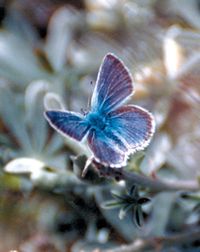
Missionblue public domain (Wikimedia)

Public domain picture (Source: Wikimedia)

Regular readers of this website know that we’ve been following the Natural Areas Programs attempts to reintroduce the Mission Blue Butterfly to Twin Peaks. We’ve just obtained the latest report from San Francisco Recreation and Parks Dept (SFRPD). It’s very mixed.

(The whole report is here as a PDF. Mission Blue Butterfly response- ProgressReportNov2012)

[Edited to Add (June 17, 2013): There’s better news in 2013. Scroll down to the bottom to read about it.]

THE STORY SO FAR

San Francisco Recreation and Parks Department (SFRPD)  through its Natural Areas Program (NAP) is trying to reintroduce the Mission Blue Butterfly to Twin Peaks by transplanting them from San Bruno Mountain, where a natural population still flies. After planting Twin Peaks with the nursery plant, lupine, in 2008, they began moving butterflies in 2009.

We have a more detailed account and analysis HERE, but here it is in brief:

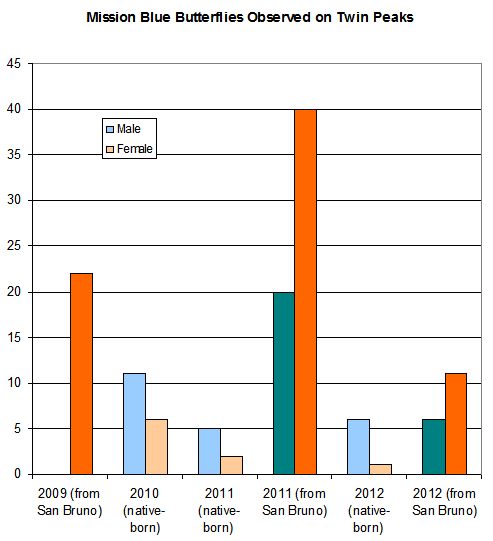
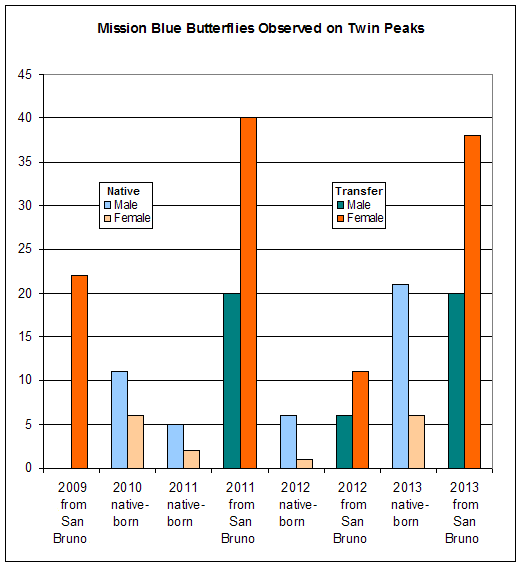
  • In 2009, they moved 22 female butterflies to Twin Peaks and caged them over lupine plants until they laid their eggs. They hoped the butterflies would go forth and multiply.  Only a small number made it.
  • In 2010, NAP observers counted 14 larvae, and 17 adult butterflies.  This was not a self-sustaining population.
  • In 2011, they spotted only 3 larvae and  7 adults, of which two were females. So they got US Fish and Wildlife Service permits to take more butterflies from San Bruno Mountain – 40 females and 20 males – which they released in May 2011.

WHAT HAPPENED IN 2012

Mission Blue Butterfly on Twin Peaks GraphUnfortunately, the larger release didn’t really seem to pay off. The survey in the first few months of 2012 showed only 6 larvae and 7 adults (of which one was female). This may have been because 2012 was a bad Mission Blue year all round. So bad, in fact, that they could not get 60 new butterflies from San Bruno Mountain to release, (though they had a US Fish and Wildlife Service permit to move 40 females and 20 males). They only moved 16 butterflies, of which 11 were females.

Nevertheless, the butterflies do seem to have laid a decent number of eggs. Observers counted 273 of them.  That’s nearly as many as the 295 they found after the big 60-butterfly move in 2011. So there’s hope yet.

HOW MUCH HOPE?

How much hope, we don’t know. How many of the 273 eggs will complete the maturation to butterflies? Probably no more than 10-15%. In addition to normal predation, conditions on Twin Peaks may not be optimal.

  • Mission Blue caterpillars are guarded by ants, which are attracted to them by honeydew, a sweet excretion. They reduce predation on the caterpillars by other insects. But we don’t know if Twin Peaks has the right ant populations or not.
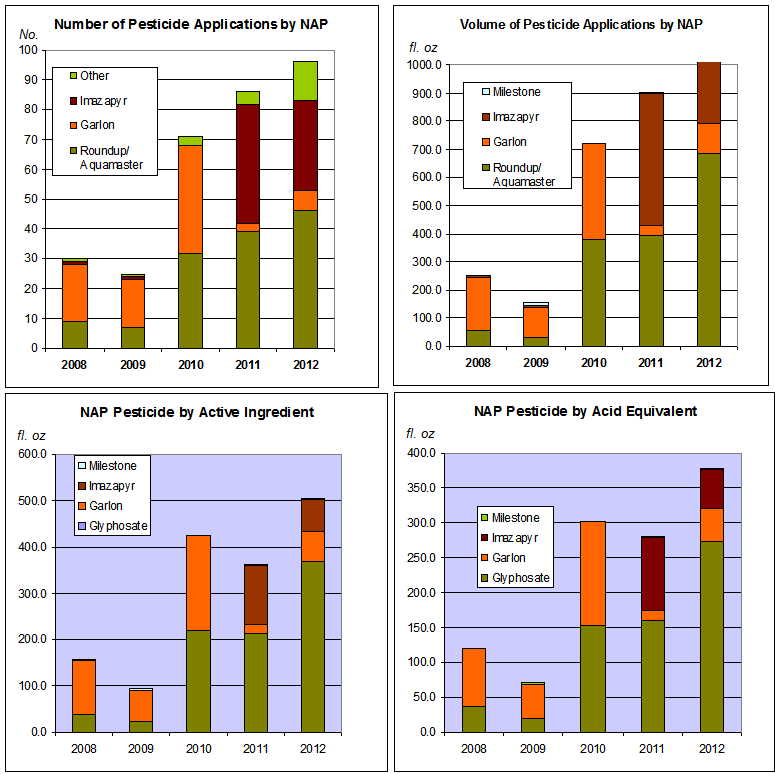
  • In an attempt to encourage native plants in general and lupine in particular, NAP regularly sprays Twin Peaks with pesticides (17 times in 2012, according to pesticide records we obtained under the Sunshine Act). This could have an adverse effect on the caterpillars. A study on metalmark butterflies showed three pesticides gave a 24-36% reduction in the number of caterpillars making it to the pupa stage. We don’t know if it would be the same for Mission Blues. (Chris Geiger of SF’s Department of the Environment told us that the study, conducted under laboratory conditions, was not necessarily field-applicable.) But SFRPD is using two of the tested pesticides – Garlon and Imazapyr – on Twin Peaks. Is it worth it? We don’t know, but we can’t help wondering if Bermuda buttercups might be better for the butterflies than Garlon. (The study on metalmark butterflies and herbicides is here: Stark_2012 metalmark research)

WILL MORE BUTTERFLIES BE MOVED?

We’re not sure what happens next. It probably depends on whether the city or USFWS are willing to fund ongoing relocations of butterflies. It’s costly and labor-intensive.  They need to avoid taking too many butterflies from any one place on any one day (which implies repeated visits), they need to transport them carefully and keep them under observation as they release them.

The Mission Blue Butterfly population on Twin Peaks is unlikely to be self-sustaining at present, though as the report points out, it has been proved that the butterfly can complete its life-cycle these. But that’s the barest standard of success. It’s barely hanging on. Can it thrive?

[EDITED TO ADD: UPDATE, JUNE 2013

Graph updated with 2013 data

Graph updated with 2013 data

There’s better news in 2013’s crop. They spotted the largest number of Mission Blue eggs ever: 1170 of them. They also saw 27 native-born adult butterflies, 6 females and 21 males, prior to moving in another 58 butterflies from San Bruno mountain – 38 females and 20 males.

It’s the most promising year thus far. It makes us wonder whether the dry winter had anything to do with it.

Here’s the updated graph.]

Posted in Herbicides, Natural areas Program | Tagged , , , , | 4 Comments

Sutro Forest’s on Channel 2 News

Channel 2 (KTVU) has coverage of the proposed tree-felling in Sutro Forest. Click on the picture below to go to their video.

Sutro Forest - KTVU coverage Feb 2013

Click on the picture for KTVU’s video report on Sutro Forest

They were also present for part of  UCSF’s public hearing this evening.

Posted in deforestation, Environment, Mt Sutro Cloud Forest, UCSF | Tagged , , , , , | 2 Comments

Report: UCSF’s Public Hearing Strongly Favors Preserving Sutro Forest

This is a quick post reporting on UCSF’s Feb 25th hearing. We’ll update it as necessary from the transcript and notes. [Edited to Add: Post updated to put in actual numbers of speakers and add two themes.]

—————————-

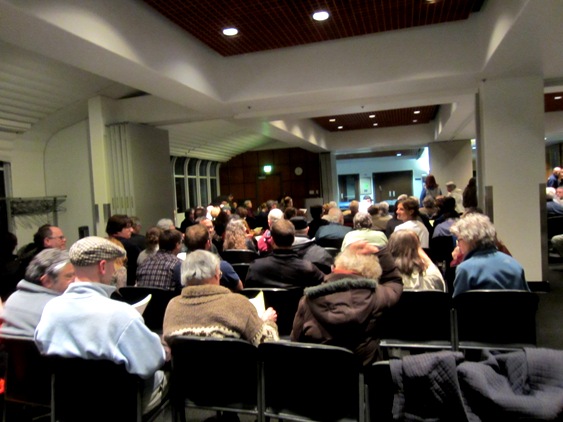
Around 250 people came to the meeting, and 47 55 people actually spoke. Speakers were limited to 2 minutes each, but even so, the hearing ran from 7 p.m. to 9.15 p.m. Sentiment ran more than 2:1 against UCSF’s tree-felling plan.  The crowd clapped and cheered in support of the points the speakers made. Though UCSF held this public hearing as a legality, it clearly became a platform for people to express their opinions about the actual project. [Updated to correct number of people speaking. Over 70% favored preserving the forest.]

Lori Yamauchi was the Hearing Officer, and she needed to take comments about the Draft Environmental Impact Report (DEIR), but could not respond. (They would be addressed later, in writing.) Written comments have the same weight as oral ones, and if you would like to comment on the DEIR, please write before March 19th. (Details on how you can help are HERE.)

UCSF did take the opportunity to distribute flyers asserting that they had no plans to cut down 30,000 trees – essentially the same material we addressed in our last post, HERE.  We did the same, distributing our flyers to everyone in the room.

UCSF Public Hearing on Sutro Forest feb 2013

THEMES AND CONCERNS

Some of the themes addressed (we may update or expand this section later):

  • The appeal of Sutro Forest as an untamed forest. People love the forest, and the unexpected wildness in the heart of the city. These were comments that spoke to the sense of wonder and magic, even a sense of emotional and spiritual connection. They recalled childhood games in the forest, decades ago. Some spoke of the wildlife in the forest habitat. They were all dismayed at the thought that thousands of trees would be felled.
  • How many trees? Some commenters were concerned about the extent of the planned tree-cutting, though they wouldn’t have objected to removing a few selected trees as part of a management plan. UCSF’s statement about not having a plan to cut down 30,000 trees didn’t convince them because that’s what the DEIR implied. One person suggested that UCSF needed to supply its own number if it did not agree with this estimate. There were also concerns about the Demonstration Projects (which we estimate will cost 3,000 trees) and whether they were demonstrations at all or actual implementation.
  • Herbicides. People objected to UCSF changing its no-pesticides policy on Mount Sutro. They were unconvinced by the DEIR’s promise to use herbicides in small quantities; once it started, usage might expand. Some strongly preferred the zero-pesticide solution. One person mentioned the sense of threat to his young children and his pregnant wife.
  • Fire Hazard. There were mixed views on the reality of the fire hazard. Some felt that it was overstated, and that the Plan would actually raise the risk by drying the forest – which is currently damp year-round – and encouraging the growth of flammable fuels like grasses and shrubs. A statement from a professional ecologist who is familiar with the forest declared this to be true. [ETA: Read his whole statement HERE.] Others felt that there was indeed a fire hazard, though no one addressed the issue of how the Plan would reduce such a hazard.
  • Adverse effects. Some speakers addressed potential adverse effects of the planned felling, including the likelihood of rockslides as the root systems died, (as has happened at the Presidio) and the increased wind on all sides of the mountain. An additional concern was that the wind would not just be unpleasant for people, but would also cause “windthrow” and destroy even more trees.
  • Environmental impacts. Some speakers noted the effect of cutting down thousands of trees on carbon sequestration, especially in the context of global warming; and on pollution control. “Every tree counts,” said several speakers. [Updated.]
  • Does the Forest need management at all? Opinion was strongly divided on whether management is needed, and if so, how much. Some consider the forest self-regulating, and wanted it left alone. Others believe it needs aggressive management, and they support UCSF’s plan. A few thought it needed some management, but that the current plan was too drastic.
  • “Native” Plants. Many speakers noted that it’s not right to dismiss eucalyptus trees for being non-native; we are all non-native, as are the buildings. Some pointed out that Native Plant restorations don’t make successful gardens; most native plants die after they’re planted. Glen Canyon and the Presidio were noted as unfortunate examples. [Update]
  • Historical context? One speaker pointed out that Sutro Forest was a historic forest with landmark designation, and this would imply restoration – replanting the forest with the same species of tree as the ones removed. Another speaker said that it had been logged or thinned at various times, and this would be a similar activity.
  • Cumulative impacts. The DEIR doesn’t consider the cumulative actions of cutting down thousands of trees, when SF Recreation and Parks Dept is also felling thousands of trees, both as part of the Native Areas Program and tree-removal for other reasons, as is the Golden Gate National Recreation Area. This will result in very significant impacts that are not considered. [Update]
  • Genesis of the Plan and UCSF’s reasons.  Some speakers wanted to know who in UCSF initiated the plan and was driving it. Craig Dawson, Executive Director of the Sutro Stewards, held up a copy of the 2001 Plan, and said the whole DEIR grew out of that plan. He also noted the Stewards built trails in the forest. (Others said there always had been trails that they used well before the Stewards got involved; but it is true that the Stewards have improved many of the trails, and maintain all of them.) A couple of speakers questioned why UCSF was involved in this exercise at all, and implied there were financial incentives or real-estate possibilities.
Posted in deforestation, Environment, eucalyptus, Herbicides, Mount Sutro Stewards, Mt Sutro Cloud Forest, Mt Sutro landslide risk, Neighborhood impact, Sutro Forest "Fire Risk", UCSF | Tagged , , , , | 8 Comments

Mount Sutro Forest: Why UCSF’s Protests Aren’t Convincing

UCSF has been messaging their mailing list, claiming they have no plans to fell 30,000 trees. They only intend to fell trees on 7.5 acres, the four “Demonstration Projects.” After that, they’ll get community input to figure out how many more trees to cut down.

In their own words: “Before a management plan is designed for the entire Reserve, four demonstration projects totaling less than 7.5 acres were chosen–with substantial community involvement–to evaluate different land management techniques, such as appropriate tree spacing, undergrowth removal, and native plant restoration.” And from the FAQ that accompanied the memo: “While a large percentage of underbrush, including blackberry, ivy and poison oak, will be removed in the demonstration areas, the removal of trees, especially those larger than saplings, will be far more limited and selective, based primarily on their health, potential for long-term survival, and if they pose any falling or other hazard.”

[That FAQ is available here: UCSF Sutro FAQ 2013 0220]

4 forest feb 2013So why aren’t we reassured?

1) WE DON’T KNOW WHY THEY WANT TO DO IT

UCSF claims the forest is unhealthy and a fire hazard. Neither claim is accurate, and they must be aware of challenges to that assessment. (We posted about that HERE.) But if they really do believe – however unrealistically – that there is such a hazard, and that felling trees will mitigate it, why is it reasonable for them to stop at the Demonstration Areas?

Unless we know why UCSF is so committed to this lengthy, expensive, and controversial process, the only parameter we can work with is what’s set down in the DEIR. And that comes out to over 30,000 trees.

2) THE DEMONSTRATION AREAS ARE NOT EXPERIMENTS

The description of the demonstration projects makes it sound as though they are experiments to “evaluate different land management techniques, such as appropriate tree spacing, undergrowth removal, and native plant restoration.” This is not true.

hand-drawn map not to scale

The “appropriate tree-spacing” has already been determined, as has the end-point. The DEIR does not say “limited and selective.” It says: “Removal of dead and unhealthy trees; Tree thinning of remaining trees to average spacing of about 30 feet between trunks.” (In Area #4, it’s 60 feet between trunks.)

3) EVEN THE DEMONSTRATION PROJECTS WILL FELL 3,000+ TREES

We estimate that the 7.5 acres of “Demonstration Areas” have around 3600 trees. The demonstration project will retain perhaps 170 of them, given the spacing described. They will be removing over 3,500 trees just for the Demonstration Projects.

If what’s left doesn’t sound like a forest, it’s not meant to. In earlier meetings, it was described as a “park-like setting.” Later, they changed the terminology to “Forest with open understory” – but they didn’t change the actual actions, which included the 30-foot spacing and the removal of understory habitat and vines. At the agenda-planning meeting in July 2010, the objectives for these areas was laid out. This is from our contemporaneous notes and our post made the same night:

UCSF added new information about expected outcomes of the projects. For South Ridge and Edgewood (Projects #1 and #2), they seek a park-like setting, with an open understorey, and trees spaced, like street trees, an average of 30 feet apart. After the demonstration, they will seek community input, and then extend the same spacing to 40 acres of forest. This would imply that 47.5 acres of the 61 acres would be thinned, leaving very little forest as such.

“Project #3 (the small area near the summit) would be a grassy area with a view of the city. Afterward, more view corridors would be considered in other areas.

“Project #4 (the “redwood bowl”) would have trees spaced 60 feet apart, and a sunny meadow (or presumably, a foggy one).”

The only evaluative portion would be regarding pesticide use to prevent regrowth. In area #1, three methods will be used: Tarping of stumps; poisoning with pesticide; and manual removal. They expect to demonstrate that pesticides will be needed. Preventing regrowth is already accepted as an end-point.

We would also point out that “native plant restoration” has nothing to do with either safety or forest health – and also that the Demonstration Projects are not designed to show either increased forest health, or reduced fire hazard, the key project justifications.

4)  COMMUNITY INPUT: LISTENING VS ACCEPTING

UCSF has been excellent at listening to community input; they have been very selective in accepting it.  We have been active participants in meetings documented here from 2009 onward; some of us have been active since the year 2000. UCSF has held a large number of meetings, and we attended and reported on most of them:  (19 Oct 2009), (Feb 2010), (May 2010), (26 May 2010), (8 June 2010), (June 2010), (13 July 2010), (July 2010), (Nov 2010),  and EIR Scoping meeting Jan 2011.)

The only inputs that have actually been accepted have a strong bias to proponents of the plan – those who supported the “parklike environment” with native plants. UCSF essentially ignored opponents who want a dense forest with a lush understory and habitat, and a continuation of UCSF’s no-pesticide policy. We called it “The Opposites Game”; click HERE to see why.

The only “concession” UCSF made to those who want to conserve the Sutro Forest as a dense, lush, functional cloud forest was to add a “hands-off area” (#5) parallel to Demonstration Project #1. This is meaningless for several reasons:

  • The whole forest – except for the four Demonstration Areas – is theoretically a “hands off” area during that time, according to UCSF’s own statements;
  • It’s only for one year;
  • Between the time the area was identified and the DEIR was published, a new trail had been driven through the “hands off” area.

5) CEQA HAS ITS REASONS

Here’s what UCSF says:  “Contrary to rumors being circulated, there is no plan to cut down 30,000 trees in the Mount Sutro Open Space Reserve, and it is unfortunate that this misinformation continues to spread.” In the FAQ, they explain: “So where did the number 30,000 come from? The California Environmental Quality Act (CEQA) requires UCSF to examine what the maximum impact of the most aggressive management practice contemplated would be in its Environmental Impact Report (EIR) of the Reserve, so someone may be confusing the report with a final forest management plan. Once the demonstration projects have been implemented and evaluated, a final forest management plan will be developed based on the effectiveness of the practices in the demonstration areas.

However, in all the meetings, UCSF stated that the objective of the Plan is to extend the 30-foot spacing to the entire reserve, except for the areas too steep to access with machinery. Why does CEQA require an evaluation of the “worst-case” scenario? Perhaps because too often, the so-called worst case represents what will really be implemented.

In this case, the 30-foot spacing on 3/4ths of the reserve (which would require removing about 90% of the trees in that area) represents a maximum, the ceiling. UCSF has suggested that the actual plan may well be different, depending on “community input” – with the implication that the actual number would be much smaller.

The question is, why? If UCSF actually believes – however improbably – that the forest is an unhealthy fire-hazard and that felling trees to achieve a 30-foot spacing would remedy this problem, then we can assume they would indeed extend it to all the accessible areas of the forest. Would they look at the denuded “Demonstration Projects” and realize that 30 feet was too much? Or would they decide to go for a 60-foot spacing, as they are planning for one of the Demonstration Areas? Could UCSF change its mind?

It’s happened before.

  • At the time the Open Space Reserve was created, UCSF also instituted a “space ceiling” that determined restricted the built space in the Parnassus campus to 3.55 million square feet. But UCSF exceeded the space ceiling years ago, and there’s no prospect of return.
  • In January 2000, UCSF committed that it would demolish two old dormitories in the Aldea campus, and replant the pad to blend in with the forest. But when one dorm was demolished, it wasn’t planted to blend in. Instead, it was enclosed with a chain-link fence and the Sutro Stewards installed a Native Plant Nursery there. That story is HERE.
  • In February 2010, when UCSF withdrew its funding applications to FEMA, here’s how it described the next steps: In keeping with the 2001 Plan, UCSF will work closely with neighbors to plan, implement, and evaluate a small (approximately 2 acres) demonstration area that would embrace best practices to ensure public safety (through fire mitigation) and improve the health of the forest while maintaining scenic quality.  But the “small” demonstration area has more than tripled in size, to 4 areas totaling 7.5 acres.

For these reasons, we are concerned when UCSF says that it’s only felling trees (over 3,000 of them) on 7.5 acres, and it doesn’t really plan to extend it to 30,000 trees no matter what the DEIR says. Once the EIR is certified, and the project itself approved, what would stop UCSF from proceeding to the remaining area? If it’s “community input” – we would expect they could get whatever input they want.

6) MISINFORMATION

Though UCSF suggests that opponents of the plan are spreading misinformation, we’d like to point out two items of misinformation in their  FAQ.

  • It’s referred to as “an aging eucalyptus forest.”  This is often used to justify tree-felling. Here’s an example of a news item in the Chronicle about Sutro Forest. But it’s a myth. Eucalyptus in the tropical and arid areas of Northern Australia tend to get killed by termites and fire before they’re 200 years old. In temperate, rainy Southern Australia they live 400-500 years. San Francisco’s Sutro Forest is much closer to Southern Australia in climate, since it lacks wildfires and cyclones and receives rain as well as summer fog drip. [Reference: “Eucalypt ecology” by Jann Elizabeth Williams, John Woinarski (Cambridge University Press, 1997)]
  • forest 6The forest is referred to as “comparatively dry” owing to eucalyptus draining the moisture. As anyone who has visited the forest regularly will know, it’s only “comparatively dry” if you compare it to the Bay. The only time the forest could dry out is in the Fall – and even then, rain and fog keep it damp.

However, in areas where the canopy has been opened up and the understory removed – the very conditions that the Plan seeks to create – the forest can indeed become dry. It’s not because of the eucalyptus, which create wet conditions by harvesting moisture from the clouds and fog. It’s because the duff, the understory, the subcanopy, and the canopy all help to prevent evaporation. This is one reason why the plan will raise the fire hazard, not reduce it.

[Click HERE to read how this forest functions as a Cloud Forest – and why opening it up decreases the moisture levels.]

We recognize this forest as unique, and a particularly San Francisco treasure. It’s a novel ecology, yet naturalized. In the heart of a world-class city, it’s a functional temperate cloud forest, only a thousand feet above sea level. We call on those who have stewardship of it to protect it, not destroy it.

Posted in deforestation, Mount Sutro Stewards, Mt Sutro Cloud Forest, UCSF | Tagged , , , , | 5 Comments

Why Does UCSF Want to Destroy Sutro Forest?

This article is republished from Death of a Million Trees with permission and minor edits.

—————-

Why Does UCSF Want to Destroy Sutro Forest?

The short answer to that question is “I don’t know.” However, since many of the over 1,200 1600 signers of the petition to University of California San Francisco (UCSF) to save the forest have asked this question, it seems that they deserve some answer. So, in this post, we will tell you the reasons that UCSF has given for its plans to destroy the forest.

UCSF makes two erroneous claims about the Sutro forest which it uses to justify its destruction. They claim that the forest is unhealthy and that destroying most of the forest will benefit the few trees that remain. They also claim that the forest is very flammable and that destroying most of the forest will make it less flammable. This is our response to these claims.

THE SUTRO FOREST IS NOT UNHEALTHY

Mount Sutro Forest

Mount Sutro Forest

The Save Sutro website recently posted the professional opinion of two arborists who evaluated the Sutro forest and pronounced it healthy. We recommend that article as a starting point for anyone who wishes to be reassured on this important point.
The Draft Environmental Impact Report for UCSF’s planned project claims that the forest is old and dying. If we don’t beat it to the punch and kill it first, it will soon die without our help. An analogy comes to mind: “We had to destroy the village to save it,” which was the explanation given for the destruction of a village during the Vietnam War. It didn’t make sense then and it doesn’t make sense now.

The fact is, the Sutro forest is young and in the prime of its life. Eighty-two percent of the forest is blue gum eucalyptus. Blue gums live in Australia from 200 to 500 years. (1) They live toward the longer end of that range in milder climates such as the San Francisco Bay Area. The blue gum eucalypts were planted on Mount Sutro in the 1880s. It is still a young forest.

Another indication that the forest is young is that the individual trees are small by blue gum standards. The study plots used by the Draft Environmental Impact Report (DEIR) to calculate how much carbon is stored in the trees found that 77% of the trunks of the trees are 5 inches in diameter at breast height or less (if the study plots are representative of the entire forest, which is questionable). It also says that this species of eucalyptus grows very fast and that its trunk is 9 inches in diameter after only three years of growth. In other words, the DEIR claims that the trees are old and no longer growing, yet it says that most of the trees are very small and it intends to destroy the small trees, not the big ones. This is just one of many contradictions that we find in the DEIR.

THERE IS LITTLE RISK OF WILDFIRE IN THE SUTRO FOREST

One of the most powerful rhetorical tools used by native plant advocates to justify the destruction of our urban forest and motivate the public to pay for these expensive projects is the fear of fire. UCSF uses this strategy as well. Frankly, we doubt that UCSF believes it themselves because they applied for a Federal Emergency Management Agency (FEMA) grant to pay for this project in 2008. FEMA informed UCSF that there is little risk of wildfire on Mount Sutro. UCSF withdrew its grant application rather than answer FEMA’s questions.

FEMA asked UCSF to supply scientific evidence that the project would reduce fire risk despite the fact that the project would reduce fog condensation from the tall trees which moistens the forest floor, making ignition unlikely. FEMA also asked for scientific evidence that a wind driven wildfire would not be more likely after the destruction of the wind break provided by the forest. UCSF chose to withdraw its grant application, presumably because they could not answer those questions.

In 2010, UCSF applied for another fire hazard mitigation grant from the California Fire Safe Council. The Council has funded 150 such grants in California, but they denied UCSF’s application. That suggests that the California Fire Safe Council shares FEMA’s opinion.

You might ask, where is UCSF getting the money to pay for this project? We don’t know, but we consider that a legitimate and important question given that UCSF is a publicly funded enterprise.

UCSF may not be able to answer FEMA’s questions, but we can, using specific scientific studies. In 1987, 20,000 hectares burned in a wildfire in the Shasta-Trinity National Forest. The effects of that fire on the forest were studied by Weatherspoon and Skinner of the USDA Forest Service. They reported the results of their study in Forest Science. (2) They found the least amount of fire damage in those sections of the forest that had not been thinned or clear-cut. In other words, the more trees there were, the less damage was done by the fire. They explained that finding:

“The occurrence of lower Fire Damage Classes in uncut stands [of trees] probably is attributable largely to the absence of activity fuels [e.g., grasses] and to the relatively closed canopy, which reduces insolation [exposure to the sun], wind movement near the surface, and associated drying of fuels. Conversely, opening the stand by partial cutting adds fuels and creates a microclimate conducive to increased fire intensities.”

In other words the denser the forest,

  • The less wind on the forest floor, thereby slowing the spread of fire
  • The more shade on the forest floor.
    • The less flammable vegetation on the forest floor
    • The more moist the forest floor

All of these factors combine to reduce fire hazard in dense forest. Likewise, in a study of fire behavior in eucalyptus forest in Australia, based on a series of experimental controlled burns, wind speed and fire spread were significantly reduced on the forest floor.(3) Thinning the forest will not reduce fire hazard. In fact, it will increase fire hazard.

Jon E. Keeley of the USGS is a world-renowned expert on the fire ecology of California. We have read his recently published book (Fire in Mediterranean Ecosystems: Ecology, Evolution and Management, Cambridge University Press, 2011) and many of his articles. Anyone with a sincere interest in wildfire hazards in California would be wise to read these publications. Reference to Keeley’s work is conspicuously absent from the Draft EIR.

Keeley’s most recently published study of specific wildfires in the Wildland-Urban-Interface (WUI) of California is most relevant to consideration of wildfire hazard in the Sutro Reserve. (4) The authors studied the property damage resulting from specific wildfires in California “…and identified the main contributors to property loss.” Keeley and his colleagues found that steep slopes in canyons that create wind corridors were the best predictors of fire damage and that grassy fuels were more likely to spread the fire than woody fuels. Applying these observations to Mount Sutro, its topography is the biggest factor in the potential for wildfire and substituting the forest with grassland and scrub will result in more dangerous fuel loads.

Scripps Ranch fire, San Diego, 2003.  All the homes burned, but the eucalypts that surrounded them did not catch fire.  New York Times

Scripps Ranch fire, San Diego, 2003. All the homes burned, but the eucalypts that surrounded them did not catch fire.

UCSF and native plant advocates make allegations about the flammability of eucalypts by misrepresenting actual wildfires in the Bay Area. These allegations are addressed elsewhere on Million Trees, which we invite you to visit if you have more questions:

ALL PAIN NO GAIN

So, if the forest is healthy and destroying it does not reduce fire hazards, how can UCSF justify all the damage this project will do to the environment:

    • Releasing thousands of tons of carbon dioxide into the atmosphere that are stored in the trees and significantly reducing the ability of the forest to sequester carbon in the future, thereby contributing to climate change.
    • Increasing air pollution by reducing the ability of the forest to absorb air pollutants.
    • Using pesticides to destroy the vegetation in the understory and preventing the trees that are destroyed from resprouting.
    • Destroying the food and cover of the birds and animals that live in the forest.
    • Eliminating the noise and wind barrier that protects UCSF’s neighbors
    • Increasing the risk of wildfire by eliminating the windbreak, reducing the moisture in the forest, and littering the forest with the dead logs and wood chips of the trees that are destroyed.

We can’t imagine why UCSF wants to destroy its forest. We understand why native plant advocates support this project because they are making the same demands all over the Bay Area. They want land managers to destroy non-native trees because they believe that destroying them will result in the return of native plants. The UCSF project makes no commitment to plant native plants after the forest is destroyed, with the exception of a few small areas and then only if “money is available.” Native plants will not magically emerge from the wood-chip tomb on the forest floor. Is it possible that UCSF shares the fantasy of native plant advocates that this destructive project will result in a landscape of grassland and chaparral which is the native landscape on Mount Sutro? Surely a scientific institution of such distinction knows better. Or it should.

Here are the things you can do to help us save this beautiful forest:

  • Sign the petition to save the forest. Available here.
  • Attend and speak at a UCSF hearing about the project: Monday, February 25, 2013, 7 pm, Millberry Union Conference Center, 500 Parnassus Ave, Golden Gate Room
  • Submit a written public comment by 5 PM, March 19, 2013 to UCSF Environmental Coordinator Diane Wong at EIR@planning.ucsf.edu or mail to UCSF Campus Planning, Box 0286, San Francisco, CA 94143-0286. Include your full name and address.
  • Write to the Board of Regents to ask why a public medical institution is engaging in such a controversial, expensive, and environmentally destructive act. Address: Office of the Secretary and Chief of Staff to the Regents,
1111 Franklin St., 12th Floor, Oakland, CA 94607
 Fax: (510) 987-9224
  • Subscribe to the website SaveSutro.com for ongoing information and analysis.

****************************

(1) Eucalypt ecology: Individuals to ecosystems, by Jann Elizabeth Williams, John Woinarski ,Cambridge University Press, 1997

(2) Weatherspoon, C.P. and Skinner, C.N., “An Assessment of Factors Associated with Damage to Tree Crowns from the 1987 Wildfires in Northern California,” Forest Science, Vol. 41, No 3, pages 430-453

(3) Gould, J.S., et. al., Project Vesta: Fire in Dry Eucalyptus Forests, Commonwealth Scientific and Industrial Research Organisation and Department of Environment and Conservation, Western Australia, November 2007

(4) Alexandra Syphard, Jon E. Keeley, et. al., “Housing Arrangement and Location Determine the Likelihood of Housing Loss Due to Wildfire.” PLOS ONE, March 18, 2012

Posted in Environment, eucalyptus, Mt Sutro Cloud Forest, nativism, Sutro Forest "Fire Risk", UCSF | Tagged , , , , , , | 3 Comments

Message to UCSF: Do the math!!

We are reprinting, with permission, the following article from the Million Trees blog.

*************************************************************************************

UCSF has sent an email to its neighbors about its plans for the Sutro forest in which they say, “Contrary to rumors being circulated, there is no plan to cut down 30,000 trees in the Mount Sutro Open Space Reserve, and it is unfortunate that this misinformation continues to spread.”

Our response is, Do the math!!

The Draft Environmental Impact Report (DEIR) claims that the thinned forest will have 62 trees per acre. (DEIR Appendix F) The DEIR arrives at this figure by assuming that each tree will occupy a circle with a radius of 15’. In fact, it is not possible to pack circles into another geometric space, whether it is a bigger circle, a rectangle or a square without wasting space. Therefore, this calculation arrives at a bogus answer which is larger than is physically possible.
We have calculated the number of trees remaining in the thinned forest based on the number of squares in an acre that are 30’ X 30’. Such calculations of tree density are found in books regarding arboriculture, which corroborates that we are using a standard calculation used by the timber industry and the DEIR is not. (1)

48.4

43560/900 = trees per acre if 30 feet apart (the proposed plan)

12.1

43560/3600 = trees per acre if 60 feet apart (the proposed plan)

45000

Total number of trees existing now on 61 acres (according to UCSF)

34040

46 acres X 740 trees/acre = Number of trees existing in project area

2112

44 acres X 48 trees/acre = thinned forest with 30’ spacing

24

2 acres (Demo Area #4) X 12 trees/acre = thinned forest with 60’ spacing

31904

Existing Trees – Thinned Forest = Trees Removed in Project Area

70.9%

Trees Removed/Existing Trees in total forest = Percent of Trees Removed in Total Forest

If UCSF wishes to reduce the number of trees that will be removed by the proposed plan, it can do so by reducing the spacing between the trees or the number of acres to be “thinned.” All other numbers used to arrive at an estimated number of tree removals are straight-forward mathematical calculations based on the information provided by UCSF.

UCSF would be wise to read the DEIR for its project, which says, “Under full-implementation or worst-case implementation of management activities under the proposed project, approximately 60% of all existing trees, including large and small trees, could be removed.” UCSF reports that there are 45,000 trees in the Mount Sutro Reserve presently. Sixty-percent of 45,000 is 27,000 trees. We think UCSF’s estimate of tree removals is just a few thousand trees less than what is actually planned. What are we quibbling about?

Once again, we invite UCSF to revise its proposed project to reduce the number of trees that will be removed.

****************************
(1) Ecology and Silviculture of Eucalypt Forests, R.G. Florence, CSIRO, Australia

Posted in deforestation, Environment, Mt Sutro Cloud Forest, UCSF | Tagged , , , , , | 3 Comments

Mount Sutro Forest Hike in February

The day was perfect, the weather unusually nice. A long weekend, and perhaps the publicity surrounding UCSF’s plans to “thin” the forest, drew many more hikers than usual. We hiked up the steep trail from Christopher (scheduled to be closed and replaced with a long hairpin) and reached the South Ridge.

4 forest feb 2013

Though the last rain was a few days ago, the trails were uniformly damp; the understory and canopy prevent it from drying out. This gives a good footing, without either dust or slush, so it’s great for hiking or jogging. It’s a winter pattern – in summer, the trails will be damp or muddy where there’s tree cover and understory, and dry where the Cloud Forest has been opened up.

cleared area

It was a bittersweet afternoon in the forest. There’s already been a lot of understory removal here and there. Most of the forest is no longer as lush as it was when we first started this record. If you’d never been there before, it was still amazingly lovely. But we’ve seen it denser and lusher, and we knew the plans were to remove 90% of the trees on 3/4 of this forest. We looked at the “Demonstration Areas” where the felling is to start.

trees with orange blobsAll along all the trails, snags – standing dead trees – were marked with orange blobs of paint, as were some trees that were leaning. We presume these trees will be gone soon. None of them looked hazardous and snags are good for birds, but removing them isn’t as bad as taking out live trees.

meadow replanting

pink flowering currantThe Native Garden bloomed with a forest of orange flags where they’re replanting a meadow again. But flowers are also blooming – pink-flowering currant, forget-me-nots, an occasional oxalis or dandelion.

The grass in the Native Garden is green, and it’s probably at its best right now.

plum tree bloomingElsewhere in the forest, plum trees are covered in little white blossoms.

forest feb 2013

Down along the North Ridge trail is where the forest is relatively dense still, and it’s beautiful.

3 forest feb 2013 029

“THINNING” THE FOREST

We saw more people in the forest today than we ever have before – maybe two dozen hikers and joggers, three dogs, and only three bike-riders. One group was clearly exploring the forest; we asked if they knew about plans to fell 30,000 trees.

“But we met someone who was giving a tour,” said one, “And he said it was just rumors. What they’re going to do is just some thinning.”

Well, yes, true. If removing 90% of the trees and 90% of the understory on the affected acreage (3/4 of the forest) counts as thinning. We referred them to the actual UCSF Draft Environmental Impact Review, so they could get the facts from the official source.

[Here is the PDF of the DEIR: Mount_Sutro_EIR_1-16-13_with_Appendices ]

They knew about that, and about this website, and SFForest.Net, the website of the San Francisco Forest Alliance.  Now its for them – and for all our readers – to decide for  where they stand on this.

If you would like to help the effort to save the forest, there’s a list of what you can do HERE. And please sign the petition (if you have already signed, there’s no need to sign again).

sign for sutro forest

Meanwhile, it’s a wonderful time to visit the forest. The Sutro Stewards may stop removing understory now since the birds are beginning to nest, and it should start to rebound.  If the project goes through, the tree-felling on the “Demonstration Areas” could start as early as Fall of 2013.  The next few months may be the time to make your memories of the forest.

path through the forest

Posted in Mount Sutro Stewards, Mt Sutro Cloud Forest, UCSF | Tagged , , , , | 4 Comments

Is UCSF’s Sutro Forest Actually Unhealthy?

The main argument UCSF makes for the plan to remove 30,000 trees is that the forest is unhealthy. But is it? The letter below is from Alma Hecht, a Certified Arborist who evaluated the forest.

SAN FRANCISCO’S FORESTS by Alma Hecht

Recently, UCSF published its Draft Environmental Impact Report on its plan for the Mount Sutro Open Space Reserve – an area of 61 acres covered by a dense eucalyptus forest over a century old. Ostensibly to improve the health of the forest, UCSF plans to remove 90% of the trees on three-quarters of the forest. Meanwhile, Ruth Gravanis published an article in the Miraloma newsletter that claimed a similar eucalyptus forest on Mount Davidson was headed for “self-destruction.” [We note that Ruth Gravanis, who is on the Environment Commission and a passionate supporter of the SF RPD’s Natural Areas Program, is not an arborist.]

sutro forest

I am a Certified Arborist and in 2010 with Certified Arborist Jocelyn Cohen evaluated Mount Sutro Forest. We saw a thriving forest. Here are some excerpts from our notes:
mossy tree trunk•    Trees were well rooted along hillsides and flat areas.
•    Visual evidence of a naturalized forest is obvious in trees’ calibers that offer insight into age and health. Tree girths range from wide in oldest trees to narrow where the trees are younger, more closely spaced and/or receiving less sunlight.
•     Poor management of the trees as evidenced by hanging branches and fallen/cut limb piles. Some lower branches were pruned; many cuts were improper leaving stubs or flush cuts into the parent stem.
•    Snags (i.e. standing dead trees) were left in place—perhaps by happenstance — providing habitat for wildlife.
•    Swaths of acacias establishing in areas of recent woodland removal for path expansions or other purposes.
•    When thick carpet of forest duff pushed aside, the soil is very moist to several inches down. Yet, in places where paths have been expanded, the ecotope is becoming drier and dustier.
•    Thriving mosses and lichens on rocks and tree-trunks.
•    Epiphytes colonized in branch crotches.
•    In many areas, climbing vines have been cut, generally at five-ten feet, left dry and dangling from branches in thick nets.”

sutro forest pathWe also noted that it had the characteristics of a fog or cloud forest. Again, from our notes: “As is typical in [such] forests, trees are crowded. Branching is high. Understory is deep. Leaves drip.  Some trees are mature and mighty with crowns beyond view. Others are rangy, young and low enough to meet eye-levels. ‘In forest stands or in other mixed plantings, all trees do not grow at the same rate. Over time certain individuals dominate over others.’ (Reference – Arboriculture: Integrated Management of Trees Shrubs and Vines, Richard Harris, Greg Steinke, James Clark and Nelda Matheny, Prentice Hall 2003.)”

As would be expected in a cloud forest, we saw it was drying out where it had been opened up: “In some areas with indiscriminate thinning and removal of trees, the ground is dry (compared with wet conditions through most of the forest and even on the same trail). Those areas also seem to have higher wind velocities. Dry conditions are particularly noticeable at the Rotary Meadow where an existing clearing was replanted into a landscape of native plants.  Significant differences in moisture conditions are visible.”

The forest appeared healthy, and we saw signs of regeneration in forest trees including eucalyptus. UCSFhas suggested that the forest is dying and infested with beetles. Since it’s a living eco-system, a normal amount of insect life can be expected. But there’s no evidence of a unhealthy levels of infestation, or of a moribund woodland. In particular, the eucalyptus snout beetle, mentioned as a threat to the forest, is not known to be present in San Francisco, being more a pest of Southern California eucalypts. And even there, it’s been well-contained with the introduction of a parasitic wasp.

We are also familiar with the forest on Mount Davidson, which has similar conditions. We think the different opinions stem from a fundamental misunderstanding of tree forms in natural,or naturalized, forests. Here criteria for gardens or timber plantations where the objective is to optimize individual trees for aesthetics or lumber is inapplicable. In either of these naturalized forests the trees comprise a whole entity, wherein some trees might flourish, others might die, but are essential to the living whole.

Muir Woods

“Unhealthy” Sutro Forest? No, Muir Woods

Trees in a forest – especially a dense cloud forest – tend to grow high and fast to reach the canopy, and do little branching until they get into the light. This results in trees that  appear spindly and tufted, but in fact are healthy and well adapted to the place in which they are growing. A wet environment like Mount Sutro Cloud Forestor Mount Davidson) can sustain a very high density of trees and vegetation.

In any case, natural forests -and naturalized forests, like these- will “self-thin” – the trees that are unable to get enough nutrients or light will eventually die.  When this happens, it is the weakest trees that eliminate themselves, and the strongest trees that remain. This results in a forest that is best adapted to the conditions in which it grows. Artificial tree removals for arbitrary spacing destroys the forest’s adaptive mechanism. Removing existing trees in these forests will not improve the forest’shealth. In fact it will send the forest into decline destroying a healthy environmental treasure.

Posted in eucalyptus, Mt Sutro Cloud Forest, UCSF | Tagged , , , , , | 8 Comments

A Hiker’s Letter: Sutro Forest A Midcity Treasure

We received this letter recently, and publish it here with permission.

forest trailI’m a solitary hiker who loves San Francisco’s beautiful parks and am concerned about all the overdone enthusiasm lately for baring our forests so that there will be mostly native plants, as in the drastic deforestation of hundreds to thousands of healthy mature trees.

In these days of confirmed climate change and global warming, I continue to read that more and more experts on the subject are advising that use of pesticides should be reduced and more trees should be planted — instead of doing the exact opposite and destroying hundreds or thousands of perfectly healthy trees, and making this mountaintop practically bald (like nearby Twin Peaks and Tank Hill) — as appears to be the case with the advocates of this destruction.

Sutro Forest just FITS so perfectly; it is a totally unique midcity treasure and people have become used to having it here over many years.

The native plant advocates can plant their natives all over the place without destroying so much of the forest. They can extend trails, trim the ivy, do trailwork, etc. without cutting down all those trees. Why is there such a trend these days to overdo things instead of trying harder to protect our precious, dwindling open spaces.

I’d like to also mention the Presidio Trust as regards its management. When the Trust has projects planned, they TELL people in detail about what is planned, send out explanatory e-letters, answer people’s email inquiries, and even take people on walks to show them what is planned for the particular area, i.e., El Polin Spring before the wood boardwalk was built. The Trust makes an effort to include neighbors and park-goers in discussions instead of seemingly trying to thwart any opposition, or in my case being blocked on Sutro Stewards’ Facebook site for merely asking about their plans.

I merely expressed concern and asked the Stewards at their Facebook site what was going on with all this. I wanted to hear what people in the group had to say. I got an answer after several posts saying only that I was mistaken and not to believe everything I read. So naturally I wanted to ask them to explain their “side” of this, but then found myself to be blocked from further comments. This, to me, is like a parent saying to a kid, “Because I SAY so” and not allowing any further discussion at all to try to shut them up. With me, it has the opposite effect.

I made an attempt to email Craig Dawson [Executive Director of Sutro Stewards] separately but my rebuttal went into “Other” and will likely be ignored. This is no way to get people to think favorably toward a company or group. Instead it tends to make me feel that they do indeed want to block the public from disagreeing or even commenting.

Tree-felling in Glen Canyon, San Francisco

Tree-felling in Glen Canyon, San Francisco

I had the same off-putting experience when I was concerned about the Glen Canyon deforestation recently. I sent an email to a guy hoping he would print it in his blog and that people could comment on it. Instead, he did not print it and just told me I was wrong, again without any further explanation on his part. What IS this — some sort of conspiracy to shut the common folk up if they express disagreement on something?

So how can I help but think, from these recent examples from native-plant enthusiasts, that something fishy is going on here, and that they would prefer not to hear from the “little guys” out there, the people who live in the area and/or who love and use these parks.

Is it because they also have plans to develop the area and don’t want the public to find out until it is too late to stop it? I am thinking about two past instances of neighbors working to get the city to buy open spaces to be used as parks, i.e., Mount Davidson’s summit area and Bernal Heights Park, so that greedy developers couldn’t snap them up to build a bunch of “little boxes” on them. This was successful; hopefully if Mount Sutro is indeed in danger of development, this can be nipped in the bud too.

coastal scrub above Laguna Honda Reservoir

Off-limits coastal scrubland above Laguna Honda Reservoir

I am NOT opposed to common-sense trail maintenance/extensions and taking down trees or other plants that are ailing or dead. In fact, one of the things I’d most like to see and would enthusiastically support would be to open up the no-trespassing-signed areas around here to hikers that are now owned by various city agencies, like the water dept. For instance, the area on the other side of Laguna Honda reservoir where hikers are not supposed to go. That is, GREENING the city more in the process — allowing more trails while still keeping as many of the gorgeous old trees as possible — NOT doing the exact opposite! Natives are fine, but let’s not get so carried away and destroy all those healthy trees in your enthusiasm. Again, more common sense is needed in these days of concern for global warming and the environment. I am especially concerned about the rampant use of pesticides. LESS poisons, not more!

In summary, I am an ordinary animal/nature-lover, treehugger, and hiker who has enjoyed hiking Mount Sutro for many years, back before all the trailwork was begun, who wants to see protection for the area from development, destruction of animal habitats, use of poisons to kill the plants, and the massive, shocking deforestation causing multiple bare spots atop the mountain — thus causing lots of environmental problems as well. I want to see common sense prevail, and that neighbors and concerned citizens might have just as much a say in this very serious matter as the owners of the land, the overly enthusiastic native plant advocates, and Rec & Park have. I think we deserve this. We live here too.

Let our beloved forest live on and stop this unbelievably nasty trend of excessive tree removal from this and all San Francisco’s parks for no good reason. Let ordinary people speak up and force the rich landowners and some seemingly misguided native-plant people out there to let the public know what they are up to, and prevent destruction of our plants and animals in the name of “progress” or whatever they choose to call this horror nowadays.

Tony Holiday
San Francisco

website: http://galomorro.weebly.com

[Webmaster: Thank you for the letter, Tony, and for supporting this beautiful forest. In fairness, while UCSF   have not been as responsive to our concerns as we had hoped, they have held a number of hearings in 2009 and 2010 – you will find reports on this website.]

Posted in deforestation, Mount Sutro Stewards, Mt Sutro Cloud Forest, UCSF | Tagged , , , , | 5 Comments

Nearly 800 Signatures on the Mount Sutro Forest Petition

At midnight of Feb 7, the petition already had 789 signatures,  and of course, many more comments. If you’re interested,  please go to the petition by clicking on the button below. And if you haven’t signed it but would like to – please do. (If you’ve signed once, no need to do so again.)

sign for sutro forest

Meanwhile, here’s a selection of comments, picked up more or less randomly:

#151:  “The Mount Sutro Forest is a healthy, functioning ecosystem. The University of California, with all its talk of underfunding, would be foolish to spend money to destroy it. The forest is one of the great joys of the surrounding neighborhoods.”

#167: “I lived in Cole Valley for 19 years and loved the Sutro Forest. It was a main feature of living there: visually it softened the landscape; it was a wonderful place to walk and relieve the stress of urban life. Please leave it as it is- a touch of wildness in the midst of concrete.”

A forest in the clouds

A forest in the clouds

#175: “I see no reason to alter this natural treasure. I’ve been to the rain forests of Costa Rica. These trees look very similar. No problems to fix here.”

#179: “These forests help keep the CITY in balance with nature, and add elements of beauty that no building or man made structure can approach. Once they are destroyed for nefarious and incomprehensible reasons (could it be “development and dollars” at work??? in the guise of safety???) the change will have effects we can not foresee and diminish the CITY greatly.  Stop the KILL.”

#186: “Why should a medical establishment need to cause such destruction? This habitat is valuable.”

#204: “Between what the University if California is proposing to do, and what the Natural Areas Progran that SF Parks and Rec is doing, we will become a city of cement, and smog, devoid of birds and animal life. What clown is in charge of this circus?”

#229: “The pollution of the air across our earth is well known to scientists. Trees clean the air. SF in particular needs every single tree remaining, and more trees planted. This eco boutique thinking ( native plants ) is fairy tale thinking, dogma thinking, to forget about the huge population SF has now, compared to the 1850’s when the plants here were “natives” is to forget about and deny the disaster of air pollution in our reality unraveling and poisoning everything. Trees clean air; big established old growth trees are the most effective.”

#251: “Do not be blinded by the idea that “native” must be restored to San Francisco open spaces. Destroying what is already working is not planning for the future. When you return the entire site of Golden Gate Park to its original form – sand dunes – then I would support your misguided plan to destroy the forest.”

lights through the trees#276: “This is one of the most beautiful places in San Francisco. There are few left.”

#286: “I gave birth at UCSF and the view out the window was of this beautiful forest. It should not be destroyed!”

#288: “All the trees are gone from my area because of hospital expansion (view also). I now have seasonal breathing problems”

#294: “I grew up with Mt. Sutro forest being basically like an extension to my backyard. I loved playing in the woods on weekends, finding the cave believed to be Ishi’s last “wild” home with my mom, and spending hours just enjoying the quiet, densely wooded solitude. The forest on Mt. Sutro is a San Francisco gem, please don’t destroy it by getting rid of so many trees.”

#306: “I am an alumna of the UC system and find it extremely disturbing that such a wonderful institution would launch an all out attack of few precious havens in the City. 30,000 trees!!!! This is just very misguided and short sighted. Please reconsider this terrible plan.”

#307: “What are you thinking? Or, are you thinking at all? Why destroy some of what few, precious trees there are in the city?”

#313: “What possible benefit would come from the destruction of 90% of the trees in Sutro Forest that would outweigh the harm to an important bird habitat and one of the treasures of the city of San Francisco for the refuge it provides from urban life? Please reconsider. Don’t do it.”

#340: “Please do not cut down the trees in Mount Sutro Forest. They are a haven and habitat for animals and birds. They remove tons of CO2 from the atmosphere. These trees are a precious resource in the city where we have few wild spaces. Save the trees!”

#360: “Aside from the environmental devastation and horrible waste of money, it is frightening that this idea would even travel as far as it has in a city that has helped set the standard in environmental policy. This city needs more healthy trees, not less. Stop this nonsense before it’s too late!”

#364: “Not smart: trees = air cleaning. The dead chipped trees will release carbon dioxide into the atmosphere. Trees also reduce air pollution by TRAPPING particulate matter on their leaves. The project will be extremely costly, and require the use of pesticides like Roundup and Garlon. Roundup is a systemic pesticide and is being banned in Europe due to its ties with pollinator deaths! I.e bees and butterflies, responsible for all fruit and vegetable growth in yr farmlands outside the city… TOTALLY estupido, I think”

#376: “As a San Francisco resident, I have grown sick and tired of seeing organizations attempt to destroy the urban forests that make our city so beautiful and unique. Let Mother Nature work unmolested.”

We leave you with one that spoke to us particularly, the more so since we both care passionately about the forest, and respect UCSF as a premier medical institution for research, teaching, and for its patients.

#398: “I worked as a reforester and sylviculturist for a significant number of years. The process of thinning a forest never removes 90% of the trees. A maturing forest that has not been tampered with by humans will typically sort out overcrowding issues. If you look at the old-growth forests that still exist in the hills hugging the California coast, you can witness how a forest that sustains itself primarily from fog and carbon dioxide from the atmosphere evolves over time. While Mount Sutro Forest differs in composition from Redwood forests, it is following a similar path. Leave it be, and allow it to mature naturally. UCSF should focus on what it does best: be a center for higher learning, and it should let Mount Sutro Forest do what it does best: be a forest.

Dusk, mist, Great Horned Owl

Dusk, mist, Great Horned Owl

Posted in deforestation, Environment, eucalyptus, Mt Sutro Cloud Forest, UCSF | Tagged , , , , , | 1 Comment

“Enough with this Tree Genocide”: Comments from The Petition to Save Mount Sutro Forest

tall trees in mistIn two days, 540 people have signed the petition to save the trees on Mt Sutro. To recap, the UCSF plan for Mount Sutro Open Space Reserve – of which it owns 61 acres – proposes to fell over 90% of the trees on 45 acres for a total of some 30,000 trees. Only 15 acres will be left alone, on the steep Western side overlooking the Inner Sunset.

We started a petition to oppose this felling on February 4th, 2013. By midnight of Feb 6th, there were already 540 signatures, and the number continues to grow. But people weren’t just signing – many of them left comments that showed just how much they cared about this forest.

We had intended to showcase all the comments here, but there are so many that we can’t.  Here is a  fairly random selection (with typos corrected and emphasis added) from the first 100 signers.  If you still haven’t signed the petition, or just want to read the comments, the button below will take you to the petition.

sign for sutro forest

#3:  “This is our midcity treasure. How could you even think of such an atrocity? What’s going on that you need to cut down healthy trees like this? Can’t you spend your money on REAL issues and leave the trees in our parks and dwindling open spaces alone? First Glen Canyon, then Mount Sutro. I would never vote for a person who condones something like this.”

#7:  “How can the State of California justify spending millions to cut down a healthy forests that store tons of carbon and absorbs air pollutants, particularly when State University’s budgets have been slashed?”

mount sutro forest and cloudscape#8:  “The destruction of over 30,000 trees on Mount Sutro Forest – in the center of San Francisco – is the ecological equivalent of ethnic cleansing. It is wrong and must be stopped! Shame on UCSF to even propose this insane plan in the first place. We need trees in the city; they provide a needed resource for converting carbon dioxide to oxygen, trees clean the air and provide habitat for the many animal and bird species living on the mountain. Every mature, healthy tree must be preserved. It is clear that their plan is a cynical and manipulative ploy for environmental destruction that is consistent with what San Francisco’s Rec and Park’s Natural Areas Program is trying to do in city parks. Save the Mount Sutro cloud forest ecosystem!”

#13: “Save our San Francisco trees. Enough with this tree genocide. For a city that values beauty I do not understand our compulsion to fell so many trees.”

#22: “This historic cultural landscape should be protected for so many reasons, but especially now as the temperature of the planet continues to rise and these trees absorb much more CO2 than the shrubs they plan to replace them with. How can the university continue to increase tuition to spend the money on this!”

cloud forest, muddy trail#26: “Mt Sutro Forest is an important urban forest to many of us who live in the area West of Twin Peaks (I am a resident of Miraloma Park) and to many other visitors from inside and outside of SF. We appreciate it as a forest: the trails, the birds and other wildlife, the density of the trees and undergrowth are what make a unique and treasured place to hike and hang out in the midst of a busy city environment. The views alone de-stress and I’ve had some magical experiences with all my senses there. As city-dwellers, we need a place like this. It is safe enough and it is unique enough to merit protection. UCSF has a responsibility to our community not to groom and ruin this environment that is an environmental plus just as it is. Please do not manicure and limit the wildness. We don’t need another typical park space here. And so many beautiful birds, animals, and plants would be lost by the proposed actions. Thanks for listening.”

#42: “I understand the desire to create and protect natural landscapes, but not at the expense of what we have. Pesticides, chopping down healthy trees, and reducing carbon sequestration are an inexcusable way to achieve this goal.”

#43:  “The forest is a haven for animals and people who need a rest from the city. It is healthy and thriving. Please leave it alone.”

#47: “In this day, how can even one person *consider* the thought of this immoral destruction? We are digging our own graves in a hurry if we continue in this manner. Save the trees. Surely the Board of Regents has a collective soul? Trees give us life. Let us return the favor.”

#50: “This plan reflects bad forestry practices; an unwise expenditure of scarce UC dollars and an apparent lack of awareness of basic climate change dynamics.”

#53:  “My family does not want you to tear down any portion of this forest that we use often and love dearly!!

#57:  “As a resident living just below Mount Sutro, I ask that you please not diminish this neighborhood treasure. it is a lovely place to enjoy peace and quiet in the heart of the city.”

#60: “Keep our cloud forest. I use it.”

#67: “I used to live on Parnassus Heights; on Mt. Sutro itself…Save it Now or Regret it Forever!!

#75: “I walk in this beautiful forest all the time and would hate to see the big beautiful trees and the habitat they create harmed.”

sutro forest with approaching clouds#86: “I used to live on Crestmont Dr., on the forest’s west side. It is my firm belief that all San Franciscans benefit from a healthy, vibrant, unmolested green core visible throughout most of the city. This core serves to remind us of who we are at the most fundamental level- not creatures of managed artifice but rather descendants of tree-dwellers. Destroying a resource like the Sutro Preserve is always lamentable, but it is especially sad in this case as much of the impetus for this move comes from groups and individuals who believe that they are able to improve upon nature by “restoring native plants” (the trees proposed for planting in Native Plant Areas never grew on Mt Sutro). Nature is already adapting to the introduction of non-native species! Anyone who walks in the Mt Sutro Preserve quickly recognizes that it is a very vibrant forest. Leave it alone. Show that humans can work with nature. Erosion, defoliation, and desertification are never good policies.”

#88: “This city is getting downright stupid. I expect tree-o-cide to happen elsewhere but not here!!”

forest at sunset#90: “Why is there this attack in the city on beautiful mature trees? It is beautiful as it is, and not costing a ton of money, and not being an accessory to putting poisons in the earth. Evidently we need more tree huggers. Trees are not the enemy. And if you want to get rid of non-natives, why not start with the non-native humans here! Now of course, that is ridiculous as well.”

#96: “How can UCSF, which is in need of funding, spend money uselessly on getting rid of healthy trees when most urban places are planting trees to sequester carbon? It is a total non sequitur!”

More tomorrow!

Posted in deforestation, eucalyptus, Mt Sutro Cloud Forest, UCSF | Tagged , , , , , | 1 Comment

Save Mount Sutro Forest – How You Can Help

forest girl 3If you would like to help save this forest, there are a number of ways to help.

1)   Write to Governor Jerry Brown. He is ex-officio a Regent of the UC Board of Regents.

Governor Jerry Brown
c/o State Capitol, Suite 1173
Sacramento, CA 95814

Phone: (916) 445-2841
Fax: (916) 558-3160

“Due to limited resources, responses to inquiries via mail may take up to 90 days. If you would like a more timely
response, please use the email form ….” HERE.

2) Write to the Board of Regents to ask why a public medical institution is engaging in such a controversial, expensive, and environmentally destructive act.

Address: Office of the Secretary and
Chief of Staff to the Regents,
 1111 Franklin St., 12th Floor, Oakland, CA 94607

Fax: (510) 987-9224.

Their email address is: regentsoffice@ucop.edu

3)  Sign the petition to save the forest. Available HERE.

sign for sutro forest

4)  Subscribe to this website, www. SaveSutro.com for ongoing information and analysis. (You can subscribe by going to the top right corner of any page of the website, and entering your email address.)

5) Spread the word! Tell people about this website and the petition. You can download a double-sided flyer here: Mount Sutro Forest Flyer April 2013

4)  Attend and speak at a UCSF hearing about the project: Monday,
February 25, 2013, 7 pm, Millberry Union Conference Center, 500
Parnassus Ave, Golden Gate Room [The meeting is over; the report is HERE.]

2)  Submit a written public comment by 5 PM, March 19, 2013 to UCSF
Environmental Coordinator Diane Wong at EIR@planning.ucsf.edu or mail
to UCSF Campus Planning, Box 0286, San Francisco, CA 94143-0286.
Include your full name and address. [The comment period is over; UCSF estimates they will respond to them in a couple of months.]

Thanks for the support!

Posted in Environment, Mt Sutro Cloud Forest, UCSF | Tagged , , , , | 8 Comments

UCSF Plans to Fell More Than 30 Thousand Trees on Mount Sutro

Mount Sutro Forest has approximately 45,000 trees in the 61 acres belonging to UCSF, and designated as an open space reserve. This dense forest, with an estimated  740 trees per acre, a sub-canopy of acacia, an understory of blackberry and nearly a hundred other plant species, is functionally a cloud forest. All summer long, it gets its moisture from the fog, and the dense greenery holds it in. Where it isn’t disturbed, it’s a lush beautiful forest, providing habitat for birds and animals, and a wonderful sense of seclusion from urban sounds and sights.

Mount sutro forest greenery

THE TREE REMOVAL PLAN

UCSF now has published a Draft Environmental Impact Report (DEIR) on a project to remove over 90% of the trees on three-quarters of the area. Only 15 acres – on the steep western edge of the forest – will remain as they are. Tree-felling could start as early as Fall 2014 2013. [Note: Owing to the large number of comments on the DEIR, which UCSF must respond to, this has been postponed by a year to 2014 after the nesting season ends around mid-August.]

[Edited to Add:

Here is the PDF of the DEIR.  Mount_Sutro_EIR_1-16-13_with_Appendices

Comments were due on March 4th, but because of the length and complexity of the document, neighbors asked for, and got, an extension. Comments are now due before March 19, 2013.]

On most of the forest (44 acres), UCSF plans to cut down trees to achieve a spacing of 30 feet between trees – the width of a small road – and mow down nearly all the understory habitat. On another 2 acres, they will space the trees 60 feet apart.

The stumps of the trees will be covered in black plastic, or else poisoned with Garlon to prevent re-sprouting. Eventually, this will kill the roots, which will start to decay. We’ll address some of these issues in more detail in later posts.

Right now, we want to talk about the number of trees that will be felled. A spacing of 30 feet between trees gives about 50-60 trees per acre. A spacing of 60 feet gives 12-15 trees per acre.

(The easiest way to think about it is that each tree occupies a 30 x 30 foot space, or 900 sq ft. An acre is 43,560 sq ft, so this would give 48.4 trees to an acre. The DEIR calculates it as 61 trees per acre, assuming each tree occupies a circle that’s 30 feet in diameter, 707 sq ft. But there’s no way to arrange circles without wasted spaces between them, so this doesn’t exactly work.)

So on 44 acres, they will retain maybe 50 trees per acre (or maybe fewer). On two more acres with a 60-ft spacing, they will retain 12-15 trees per acre. All the rest will be cut down. Even using the DEIR’s overly optimistic calculation, they will be felling some 31,000 trees.  Our calculations are closer to 32,000. Either way, it’s a huge number.

That means that in the 46 acres where UCSF will be felling trees, they will remove more than 90% of the standing trees.

The DEIR says that they will start by cutting down trees that are dead or dying. Aside from their value as habitat (some birds like woodpeckers depend on them), there are not all that many of them in Sutro Forest, which despite everything that has been claimed to to opposite, is a thriving forest.  Next in line will be trees with diameters under 12 inches, or roughly 3 feet around – as thick as an adult’s waist. Then they’ll start on the larger trees. Since it’s going to be 90% of the trees, we expect thousands of large trees to be removed.

IT GETS WORSE

However, this is not all. We expect further tree losses for four reasons:

  1. Wind throw. Since these trees have grown up in a dense forest where they shelter each other, removing 90% of the trees exposes the remaining 10% to winds to which they’re not adapted. This can be expected to knock down a significant number of the trees not felled. Since the Plan only calls for monitoring the trees and felling any that seem vulnerable to wind-throw, it’s unlikely any vulnerable trees will be saved.
  2. Physical damage. Damage done to the remaining trees in the process of removing the ones they intend to fell. With such large-scale felling, damage to the other trees is inevitable, from machinery, erosion, and falling timbers.
  3. Something like AvatarPesticide damage. This forest has an intertwined, intergrafted root system. When pesticides are used to prevent resprouting on tree-stumps and cut shrubs and ivy, it is quite possible for it to enter the root system and damage remaining trees.
  4. Loss of support. Compounding the effects of the wind-throw, the remaining trees will suffer from a lack of support as the root network dies with 90% of the trees being removed. This could destabilize them, and make them more likely to fail.

What remains will be a seriously weakened forest with a greater risk of failure and tree-loss, not the healthier forest that the DEIR claims. It is likely that the long-term impact of the Project will be the elimination of the forest altogether, and instead will be something like Tank Hill or Twin Peaks plus a few trees.

IMPLEMENTING THIS PLAN

The project is to be implemented in two phases. In the first phase, trees will be felled and the understory removed in four “demonstration areas” totaling 7.5 acres. They are shown on the map below in yellow, as areas #1-#4. (One of these, #4 “East Bowl”, is the two-acre area slated to have only 12-15 trees per acre.

hand-drawn map not to scale

One area (#5 on the map) is supposed to be a “hands off” area to demonstrate the untouched forest. However, a trail has already been punched through it in November 2011, even before the DEIR had been published.

During this phase, they would experiment with the 3 acres on the South Ridge, just above the Forest Knolls neighborhood. On 1 acre, they would use tarping to prevent regrowth of felled trees; on 1 acre, they would use pesticides, particularly Garlon; and 1 acre they would trim off sprouts by hand. They could also use pesticides on the understory “consistent with city standards” – presumably those of the Natural Areas Program (See article on NAP’s Pesticide Use.)

In the second year, the plan would be extended to the remaining forest, with the proviso that not more than a quarter of the forest would be “thinned” at “any given time.”

[Edited to Add the ways to help, below]

HOW YOU CAN HELP

You can help by writing to the Regents; commenting on the EIR in writing and at the Public Hearing on Feb 25, 2013; and signing the petition to save the forest.

The details are in our next article, HERE.

And most of all, you can help by getting the word out! Most people – even those who hike in the forest and love it don’t know what’s planned for Mount Sutro Forest.

Posted in Herbicides: Roundup, Garlon, Mt Sutro Cloud Forest, UCSF | Tagged , , , , | 9 Comments

Sutro Forest is Visible From Space

The Bernalwood blog alerted us to this interesting photograph, sent out by Chris Hadfield, commander of the International Space Station over his Twitter feed. (Twitter is a social medium that allows people to share their pictures and their thoughts in 140 characters or less. Bernalwood is a fun and creative blog for the Bernal Heights neighborhood.)

space station view of san francisco

While they were focused on the visibility of their neighborhood, and Commander Hadfield was looking at the Golden Gate Bridge, we of course looked for Sutro Forest. And there it is – visible from the International Space Station. (Twin Peaks is barely visible, but the greenery of the forest – that can be seen from space.)

How iconic is that?

Posted in Mt Sutro Cloud Forest | Tagged , | 1 Comment

The Draft Environmental Impact Report for Sutro Forest

The Draft Environmental Impact Report (DEIR) for Sutro Forest is available for comment.

Tank Hill

Tank Hill

It’s long, and we’re still going through it. (We find the report cover a little disturbing, though; the “forest” seems to consist of some trees growing in an open setting, and flowers in the Native Plant garden at the summit – and a map that shows bold areas of intervention and large trails. It implies a vision for the forest that’s similar to Tank Hill.)

UCSF draft report cover

Here’s the summary of the planned project, taken from the DEIR (our emphasis):

PROJECT DESCRIPTION

“The University of California, San Francisco (UCSF) proposes to implement a number of
management activities in the UCSF Mount Sutro Open Space Reserve (“Reserve”) at its flagship campus site at Parnassus Heights. The University‐owned Reserve is a largely undeveloped 61‐ acre forest located within the Parnassus Heights campus site near the geographical center of San Francisco. The Reserve is surrounded by the UCSF campus ‐‐ UCSF’s hospital, research, educational and support structures to the north/northwest ‐‐ and by urban residential neighborhoods to the south, east and west. In addition, the Interior Greenbelt natural area, owned by the City and County of San Francisco, is adjacent to the east side of Reserve.

“The proposed project would involve implementation of a number of management activities, including thinning of the forest, native plant restoration and enhancement, and conversion planting (removal of non‐native trees and plants and conversion to native species). Vegetation management actions are proposed to occur throughout the Reserve over many years. Under full or worst‐case implementation of management activities under the proposed project, approximately 60% of all the existing trees, including large and small trees, could be removed from the Reserve, the majority of which would be small trees less than 12 inches in diameter.

“Implementation would be phased beginning with four demonstration projects that were crafted with the interested public in the community process described below.
The first three demonstration projects are planned for implementation following the completion of environmental review and project approval. The fourth demonstration project would be implemented approximately one year after the first three demonstration projects to incorporate lessons learned from the first three demonstration projects. Also, the proposed project would include a “Hands‐Off” management area at the request of some community members. In the Hands‐Off management area, no vegetation management would be undertaken for the one‐year
duration of the first three demonstration projects.

“The demonstration projects would include a range of potential management actions that could be implemented later throughout the entire Reserve. Such actions would be first implemented in these four small areas to “demonstrate” to the public the range of potential results. Public feedback would then inform the University’s choices in the management activities to be applied to the remainder of the Reserve over time. The management actions identified for the demonstration areas are proposed to be applied ultimately beyond the demonstration areas to the remainder of the Reserve, as appropriate, subject to further refinement by UCSF in consultation with the interested public. Accordingly, this EIR conservatively analyzes environmental impacts resulting from the full range of management activities proposed for the entire 61‐acre Reserve.
Several principles will govern the implementation of management activities, including:

  • Adaptive Management: UCSF is committed to the principle of adaptive management as defined in the 2001 Plan, allowing for public input and opinion and adjustment of management activities before application to other areas of the Reserve. (Adaptive management is a flexible, learning‐based management approach that allows for changes in response to a problem or issue based on new information. Decision‐making incorporates monitoring of a situation, learning, and modifying actions if necessary in order improve long‐term management outcomes.)
  • Limited Use of Herbicides: Where herbicide use is indicated, targeted spot‐application methods would be employed on tree stumps, vine, blackberry and broom stems, and on poison oak adjacent to trails.
  • Tree Spacing: Where tree removal is indicated, the priority for removal is dead, dying, unhealthy, and hazardous trees. Where trees must be removed to achieve desired spacing, the next priority would be removal of trees smaller than 12 inches in diameter, followed by removal of trees larger than 12 inches in diameter.”

HERE’S THE DEIR PDF

For those who would like to start looking at it themselves, we’re putting the PDF below.

Mount_Sutro_EIR_1-16-13_with_Appendices

Though it’s apparently very long (over 1000 pages), it in fact incorporates the whole of the Initial Study (which we wrote about in January 2011). We’re pleased to note that they have actually responded to comments asking them to evaluate some factors they hadn’t planned on doing two years ago. You don’t actually need to read the Initial Study now.

Posted in Mt Sutro Cloud Forest, UCSF | Tagged , , | 1 Comment

SF’s Natural Areas Program Uses Even More Pesticides

This article was reprinted from sffforest.net with minor changes and additions. Sutro Forest may be the only pesticide-free wild land in San Francisco – but that could change this year.

————————-

The 2012 final data are in, and it’s official: In 2012, the Natural Areas Program used more pesticides than in any year from 2008 (the first year for which we have data provided by the City). This is true by any measure, as the graphs below indicate.
pesticide use number n vol 2008 to 2012Depending on the measure you choose, usage has increased anywhere from 12% to 40% from 2011. It’s between 3 and 4 times the usage in 2008.

THE FEARSOME FOUR AGAIN

What pesticides have they been using?

The same as before: Tier II and Tier I pesticides, defined as more hazardous and most hazardous. (For a detailed discussion of these chemicals, click HERE:  Natural Areas Program’s Pesticides: Toxic and Toxic-er.)

  • Aquamaster/ Roundup (Glyphosate). (Tier II)  This is one of the world’s most widely used herbicides, but in vitro research has linked these chemicals to changes to human cells, some of which are of the kind that could cause birth-defects. The EPA is studying whether it is an endocrine disruptor. The fact that it’s widely used gives us little comfort; a different widely-used class of herbicides – neocotinoids –  has just been declared unacceptably toxic to bees.
  • Garlon (Triclopyr). (Tier I) To NAP’s credit, they have reduced the use of this extremely toxic herbicide since the peak in 2010. It’s a Tier I pesticide, and associated with numerous diseases in humans, and potential kidney impacts on dogs.
  • Milestone (Amino-pyralid). This was a Tier I toxic chemical, but SF Dept of the Environment reclassified it as Tier II. It sticks around even more persistently than imazapyr. It was banned for a time in the UK because if animals eat and excrete it, the droppings are still poisonous – as is the manure made from it. It’s banned in New York state because they aren’t sure it won’t poison the water: “However, the Department does not consider products which have the potential to impact groundwater resources as “Reduced Risk” without acceptable environmental fate data.” (The PDF of the letter confirming that Dow is withdrawing its application is here: Aminopyralid  New York. ) NAP’s used Milestone in Lake Merced, Pine Lake, Glen Canyon, and Mount Davidson, all of which are areas where water contamination is possible.

BAD FOR PEOPLE, BUTTERFLIES AND FROGS

Of course these chemicals are not good for people, and one would think that in a city that is so conscious of organic and green produce and products, wild lands would be one area that we’d try to keep organic. Not so. We even found evidence of blackberry bushes being sprayed – during the fruiting season when children and adults, birds and animals feast on the bonanza of berries.

Recent research indicates that both triclopyr and imazapyr are potentially toxic to butterflies – but NAP continues to use both Garlon and Polaris on Twin Peaks, where NAP are also struggling to re-introduce the endangered Mission Blue butterfly. (At a recent meeting, Chris Geiger, who heads Integrated Pest Management at SF Department of the Environment, questioned the methodology of the research since it was performed on captive caterpillars, not in field conditions.)

Glyphosate is known to be dangerous to amphibians; but NAP uses Aquamaster around Lake Merced, Pine Lake, and in Glen Canyon – all near water-courses.

Finally, we have another problem with this use: it may be glorifying chemical solutions. A few months ago, a “volunteer” in Glen Canyon was found applying an unapproved pesticide to an area near a trail, without posting any notices or keeping any record of amounts or conditions. He believed he was doing a good thing for the environment. We have heard since of many other instances of random herbicide application in Natural Areas.

PLEASE STOP TIER I AND TIER II PESTICIDES IN NATURAL AREAS

Furthermore, the list of plants on which it’s used also keeps expanding. It’s currently around 30, up from under 2 dozen a year ago. Some of the plants being sprayed aren’t on the list of the California Invasive Plants Council or USDA noxious plants lists.

We ask SF Recreation and Parks Dept  to stop using Tier I and Tier II pesticides in the Natural Areas. An escalating use of herbicides is bad for the environment and the people, pets and wildlife using these parks;  sends a damaging message about priorities; and indicates a lack of success.

————————-

COMING SOON TO A FOREST NEAR US?

Sutro Forest may currently be the only pesticide-free wildland in San Francisco. In contrast with NAP’s rising use of herbicides, UCSF stopped using pesticides even in the Aldea student housing in 2009, and in the the forest in 2008.

The Sutro Forest Draft Environmental Impact Review is open for public comment. Here’s a link to a PDF of the DEIR:
http://campusplanning.ucsf.edu/pdf/Mount_Sutro_EIR_1-16-13_with_Appendices.pdf

If this report is certified, then tree-felling, understory removal, and vine removal could start this Fall. It will almost certainly herald a change in this no-pesticide policy.

Posted in Herbicides, Natural areas Program | Tagged , , , , , | 8 Comments

Sutro Forest Draft Environmental Impact Report: Opening For Comments

Today we learned that the Draft Environmental Impact Report for Sutro Forest will open for comments on January 18th, 2013.  The public will have 45 days in which to comment on the DEIR, until March 4, 2013. There’s a meeting on February 25th at 7 p.m. Here’s a photo of the notice. (Clicking on it will give a larger version.)

DEIR notice Jan 2012

UCSF is in the process of putting together its Long Range Development Plan for 2014-2035. HERE are more details of the plans.

Posted in Mt Sutro Cloud Forest, UCSF | Tagged , , , | 1 Comment

Glen Canyon Park: The Tree-Cutting Started

We’ve been following the situation in Glen Canyon Park at this site for some time now. In a nutshell: Major changes are planned for Glen Canyon, which until a couple of years ago was a bucolic treasure of a park. Most of them involve cutting down trees and restricting access.

Glen Canyon Park

THIS IS GLEN CANYON PARK

Ten acres of flat grounds near the Elk St entrance are for recreation: A historic club-house, a soccer field, tennis courts, a delightful playground with steps up to bushes where children loved to hide – and the real playground of twisted old acacias perfect for climbing on. At the entrance stood a row of century-old historic eucalyptus.

Ancient acacia tree along the ground, with kids climbing it

This ‘playground tree’ is a goner

Further in, there’s a lodge used by a pre-school and a summer camp, situated on a creek surrounded by wonderful old willow trees that create a little jungle. Beyond that are thickets providing cover for all kinds of birds and animals. Tall eucalyptus trees forest the canyon, and a pair of Great Horned Owls nest there most years – as do little Bewick’s wrens. On the slopes above are rocks that for generations have provided real rock-climbing practice and open lands with trails and a bench or two to take in the views – which can be exquisite. (See this article: The Prettiest Day) All this in 70 acres.

But changes are coming to Glen Canyon, and its wild-land character changed for ever. A series of projects are planned for the Canyon. Some are much needed, others more disputable. But for all of them, the plan seems to be to cut down large numbers of trees. The total is estimated at something between 300 and 500 trees to be removed for the various projects. Thickets are already being torn out and the place made much barer than before. Pesticides are used more frequently in Glen Canyon than at most “Natural Areas” in an effort to remove naturalized plants in favor of “native” plants.

THE FIRST PROJECT IS UNDERWAY

The first project, funded by the 2008 Parks Bond, moves the tennis courts, expands the area of the playground, adds a heating system and an ADA-compliant restroom, and also a grand new entrance with native plant gardens. It also requires felling the century-old eucalyptus trees at the existing entrance, as well as other trees for a total of 58 trees.

SFRPD plans to plant 163 “trees” to replace the ones they will fell for this and subsequent projects. However, the term “trees” includes a large number of shrubs and small trees; only 33 of the trees will be over 80 feet tall at maturity – and it’s going to take a long time. In the next 20 years, only a handful of the trees will reach that height.

Various neighbors and organizations tried to bring these issues to light, and spread the word. Most people were not aware of the planned changes. San Francisco Forest Alliance had an outreach meeting and a street demonstration.

Neighbor Anastasia Glikshtern made an appeal to the Board of Appeals. (We reported on that HERE.) Unfortunately, the appeal was denied. (That report HERE.) Ms Glikshtern appealed the denial, but then withdrew her appeal when WiserParksSF (formerly ForestForestForever) appealed to the Board of Supervisors regarding misstatements that SFRPD made in getting the project exemption from an Environmental Impact Review under the California Environmental Quality Act (CEQA).  When that appeal was ruled “untimely” only legal action was possible. WiserParks decided not to go that route.

Meanwhile, various neighbors – and San Francisco Forest Alliance – requested District 8 Supervisor Scott Wiener to organize a meeting to discuss which trees were being removed and why. That was held on January 7, 2012. Presenters included SFRPD’s Karen Mauny-Brodek, the hired arborist, Jim Clark of Hort Science, and Supervisor Wiener; it was moderated by a member of the Glen Park Association. At the meeting, neighbors expressed a great deal of concern regarding the tree removals.

THE ANCIENT TREES ARE BEING CHOPPED DOWN

It went ahead anyway. On January 10th, the tree felling began, starting with the signature line of historic eucalyptus trees lining Alms Road. (See Glen Canyon Tree Felling Started Today and Glen Canyon Tree Demolition Videos – Day 1 and 2.) [Edited to Add: There’s more, from Day 3 HERE and Day 4 HERE. We’ll keep updating this as long as the tree-lovers keep documenting it.]

Tree-felling in Glen Canyon, San Francisco

Tree-felling in Glen Canyon, San Francisco

SF Forest Alliance is now trying to get details on the planned tree-felling in the rest of the canyon for all the remaining projects. While they support the removal of hazardous trees, they are concerned that trees are being removed under that guise even though they are not determined to be hazardous.

Meanwhile SFRPD appears to have no sense of urgency about the trees actually assessed to be hazardous. Some 20 of them remain unabated in the canyon.

Posted in deforestation, Natural areas Program, Neighborhood impact | Tagged , , , , | 1 Comment

“Functional, Beautiful Ecosystems Should Be Left Alone”

We received this letter from one of our readers, “R.R.”. It’s republished here with permission.

———————————

forest at sunset

To Whom it May Concern:

I am appalled at the planned destruction of thousands of trees by UCSF and the SFNAP [San Francisco Natural Areas Program]. I consider myself a practical-minded person. I understand the regret some people feel at the loss of what was San Francisco ‘s “native ecosystems.” But the overwhelmingly obvious fact that should guide the use and management of our public and private lands is this: our ecosystem now, at this moment, is what we have. The “restoration” of an idealized past by reintroducing “native” plants and destroying trees deemed “invasive” is an exercise in futility as well as an unwanted course of action by the majority of San Francisco residents.

Tree-felling in Glen Canyon, San Francisco

Tree-felling in Glen Canyon, San Francisco

The attempt to reintroduce certain species of plants is just as artificial as the original introduction of non-native species was. Where no “native” species still exist, the functional, beautiful ecosystems in place should be left alone. It is a MASSIVE act of hubris and environmental destruction to try to engineer a new ecosystem. RESTORATION is not the same as PROTECTION. Restoration is an act of ecological engineering. Protection is an attempt to save what is still in existence. Historically “native” plants are no more “native” than the current flora which have become dominant over the course of hundreds of years.

It all depends on the timeframe being referenced. Why idealize a certain set of plants which were dominant for only a minuscule amount of time on a geological scale. Why not go back further and remove ALL vegetation in favor of cyanobacteria and Archaea? It is foolishness and misplaced idealism.

Most importantly, we, as SF residents, have the great fortune to live in a city of great natural beauty. Aside from geological formations, most of this beauty is man made. People have chosen, rightly, a more diverse and pleasing ecosystem, that now has become home to an amazing variety of wildlife. Just because it does not fit a few extremists’ definition of “natural” doesn’t mean it is less beautiful or valuable. What is “natural,” anyway? Do NAP members actually believe that before European settlement, the Native People never molded the land to their vision and need? That is ignorant and condescending.

As to the suitability of Eucalypts, this is a pointless discussion. People ignorant of arboriculture have too much influence. There are hundreds of species of Eucalypts, many of which most people don’t even recognize as being Eucalypts. An amazingly diverse group with amazingly diverse habit, form and ecological influence, Eucalypts are very well adapted for our climate and have been here much, much longer than any of their ill-informed critics.

I do not want to see San Francisco devoid of trees and covered in “dunes and scrub.” It wouldn’t work, and it shouldn’t happen. Like it or not, this is an urban area, not a nature preserve.

Posted in Environment, Natural areas Program, UCSF | Tagged , , , , | 2 Comments

Rat Poison Killed Glen Canyon’s Owl

This article has been republished from ForestKnolls.info as a caution to everyone interested in protecting our owls. They live in Sutro Forest, too. We hope and believe that UCSF does not use rodenticides in the Aldea Student Housing, but we expect that some people in the surrounding neighborhoods still do.

They probably don’t know they could be endangering other wildlife – like this beautiful owl.  [Edited to Add: There is more information about the actual poisons found in this owl HERE.]
————————
Great horned owl in eucs (Photo: Janet Kessler)A few weeks ago, the Glen Park group had news of a Great Horned Owl found dead in Glen Canyon. There’s a well-known pair of owls that nest there every year, and typically raise two or three chicks. Neighbors fear this may be the male of that pair.

Of course people were upset, and they raised money for a necropsy – an autopsy for animals. This was conducted by Wildcare, a wonderful organization that rehabilitates injured wildlife. (I’ve written about them before, HERE.)

The result came in today. The owl died from eating poisoned rodents.

According the Wildcare press release,

“Commonly available rodenticides [rat poisons] are consumed by rodents, the basic food source for a number of different predators all the way up the food chain. These poisons kill by making whatever animal eats them bleed to death internally – slowly and painfully. While the poisoned animals – targeted or not – are still alive, they can be consumed by other predators. It is a terrifying prospect; to kill many animals while targeting only one.”

three owlets (Photo: Janet Kessler)A Great Horned Owl eats about 5 rodents a day, and much more if it’s feeding young. Its favorite prey is skunk, but it also eats rats and mice, rabbits, and birds. If someone poisons rats to get rid of them, they don’t die right away. Instead they wander around, increasingly weak and slow – and thus particularly attractive to predators. The poison can then kill the bird or animal that eats it – or even the next animal up the food chain.

PROTECTING OUR NEIGHBORHOOD OWLS

We have Great Horned Owls in our neighborhood. I’ve seen them in Sutro Forest, up on the hillside, and in trees along Crestmont and Christopher. I’ve seen one on a lamp-post on Clarendon Avenue. We also have barn owls, which are even more vulnerable because they’re not large enough to eat skunks but eat more rats and mice instead. Every time we use rat poison, we’re endangering these birds.

Great Horned Owl in Mount Sutro Cloud Forest

Great Horned Owl in Mount Sutro Cloud Forest, San Francisco

Posted in Environment | Tagged , , , | 4 Comments

Stand with Miranda – Saving Forests in Tasmania

Miranda Gibson has spent one year living in a tree in a Tasmanian forest, protesting the logging of old-growth forest. We wrote about her about a year ago: Her “Day 13” blogpost. Her unflinching courage and dedication impressed us then. And though the forests she seeks to save are measured in square miles, it still resonated with us in our own effort to save Mount Sutro Forest. Today, it’s even more true.

Miranda in Tasmania

Protestor on a felled tree stump - TasmaniaWhen she climbed the tree in December 2011, it was summer in Tasmania. Winter in June and July brought rain and snow, but Miranda stayed in the tree. Her blog and Facebook page gained a worldwide audience. The BBC ran a story about her.

There’s more on the website of Still Wild Still Threatened, an organization that is working to preserve the most beautiful old-growth eucalyptus forests of Tasmania. (The image of the lone protestor above is from that website.)

We stand with Miranda.

Posted in deforestation, Environment, eucalyptus | Tagged , | 1 Comment

Sunset and Mushrooms: Mount Sutro Forest Hike, December 2012

Winter weather seems to have set in, with some major storms coming through. Last night, we had a major rain-storm. This evening, we grabbed the chance to go up into the forest.

The setting sun gilded the trees.

gilded by the setting sun

forest at sunset

From the summit:
sunset in Sutro Forest

If you look up into the tops of these tall trees, it’s awe-inspiring.

tall eucalyptus in Sutro Forestlooking up a tree

THE TRAILS ARE WET BUT NOT TOO SLUSHY

All the trails were wet, as might be expected, with some puddles randomly distributed in dips along the trails. The winter wetness is quite different from the pattern of summer in the Cloud Forest, when it can be really slushy along some or all of the trails, depending on the moisture harvested from the fog. Now it’s equally wet everywhere, with some mud, but less so than in summer.

[If you want to hike in the forest, there’s a map and pointers HERE.]

Trail in Mt Sutro Forest

There weren’t many people around, though it was a Sunday evening. In an hour and a half, we saw:

  • Five riders on bicycles.  (We were pleased to see two girls among the riders – this is only the second time we’ve seen women on mountain bikes in the forest. It’s usually young guys.)
  • Two dogs and their people.
  • One student heading back to the campus through the woods.
  • No joggers.

MUSHROOMS AND OTHER FUNGI

Even though we’ve had some major storms and strong winds, we didn’t notice many trees down. A few do fall each winter, part of the life-cycle of the forest. The downed trees have their own value in the ecosystem – like hosting this elegant fungus.

fungus on a log

We saw more toadstools (or mushrooms, we’re not sure which) than usual in the forest.

toadstools 1

Some of them were pretty big – compare the size to the ivy leaves among which they’re nestled. [Edited to Add: Please note, not all – or even most – mushrooms are edible. Some taste good but are lethal when eaten. We don’t know which ones these are.]
toadstools 2

In the Native Garden on the summit, the re-planted meadow has greened out, we suspect with non-native grasses. There’s still a lot of dry brown sticks and no flowers, though a few forget-me-nots are blooming along the Nike Road on the way up despite the efforts of the Sutro Stewards to suppress them with mulch. (The little white things here are plastic flags.)

meadow replanting on mt sutro

Plastic flags were also blooming along the top end of the Gash in the forest made by the SF Water Department five years ago when it laid pipe. The neighbors were waiting for it to fill in, but for years, “volunteers” kept destroying any trees or bushes that grew back.

the gash sprouts plastic flags

Eventually, the neighbors protested, and the bottom end (near Christopher Drive in the Forest Knolls neighborhood) was allowed to re-vegetate naturally. The top end is presumably being planted with native plants. It’s right next to the Native Plant nursery that’s been set up by the Sutro Stewards in the space that was supposed to be replanted to blend in with the forest (which is what UCSF had promised neighbors, in writing, back in the year 2000). This chain-link-fenced nursery isn’t exactly blending in.

the chain link nursery

tree tunnel to the Fairy Gates trailSadly, the understory has been mowed down everywhere in the forest, with ivy replacing the tall blackberry thickets that make such an excellent habitat for birds and small animals.

We made our way back via the Fairy Gates trail, which has one of the most romantic entrances in the forest: A tunnel of trees. (This is next to the Chancellor’s house.)

It was a beautiful evening, and the lights of the city were visible through the trees as we climbed back up along the Historic Trail. The picture below doesn’t do it justice, this camera doesn’t like low-light conditions. The California Academy of Sciences shone like a bright white dome, and the lights of Golden Gate Bridge sparkled in the distance.

lights through the trees

Posted in Mt Sutro Cloud Forest | Tagged , , , , , , | 3 Comments

Speaking for Glen Canyon’s Trees

We received a report (and opinion-piece) from a supporter of Anastasia Glikshtern in her appeal regarding the Glen Canyon project. [The background is HERE:  Saving the Trees of Glen Canyon Park.]

While the appeal was denied, it was clear that Anastasia spoke for the trees of Glen Canyon, and it was heartening how many turned out to support her and the wonderful trees of Glen Canyon.

Children examine the historic tree doomed for an Entryway

Here’s the report (with minor edits):

——————–

Hi Everyone,

The Board of Appeals denied the appeal.  They accepted San Francisco Recreation and Parks Department’s (SFRPD) contention that community outreach had been adequate, and found no problem with building code compliance.

They noted that it’s the responsibility of the Board of Supervisors to decide issues related to California Environmental Quality (CEQA).

POPULAR INVOLVEMENT

Though opponents tried to position the appeal as an attempt by a single individual to block a popular project, this hearing made it so clear that she actually represents an important section of the public who want the project tweaked to save the trees of Glen Canyon.

The Appeals’ clerk said about “500 letters” were received on the appeal. A quick scan of the file suggested it was  fairly divided between people for and against the appeal.  The hearing video isn’t up yet [Webmaster: We will edit in a link once it is available] but it felt like a little less than 50% for saving the trees, 15% for native plants, and 35% for just getting on with the playgrounds/project (but I may be biased).

THE COMMUNITY OUTREACH PROCESS

The main argument against the appeal was that repeated community workshops allowed people to voice their concerns.  I find it strange that the workshops are put on such a pedestal.  During the workshops, SFRPD disclosed only about 11 of the 58 tree removals for this project; no one mentioned other funded projects (like the Trails project) that will quickly take down about 100 more trees deemed “unsuitable” by Rec & Park.

It’s funny to me how the community workshops do allow people to speak out — but then do nothing nothing to ensure buy-in or consensus.  If the community doesn’t like what SFRPD is doing, they can voice their concerns; but SFRPD doesn’t have to do anything about those concerns. These workshops have no mechanism for identifying and resolving controversy so Rec & Park just does what they like. It’s still considered an adequate community process.

Many of the letters and the speakers highlighted the fact  that community workshops and Rec & Park just suppressed objections, and never offered any options other than removal of the beautiful old heritage trees. (Later, of course, it turned out to be many more than just the 11 trees mentioned during the workshops.)

A NATIVIST VIEWPOINT

What struck me the most was Ruth Gravanis, a Dept of Environment commissioner and “biodiversity” advocate who has earned awards from San Francisco Tomorrow, the Sierra Club, and the Golden Gate Audubon Society, supporting moving on with the project. She expressed no concern about non-compliance with State environmental regulations. I have to believe if, instead of hundreds of massive eucalyptus, even one native oak sapling was coming down, it would be quite different.

One would think a Commissioner for the Environment would advocate for analyzing the impact of removing hundreds of mature and healthy trees on carbon sequestration, air quality, wildlife, property values, historic resources, allergies, and noise, sound, water, and wind buffering.

It’s strange how extremists only want the environmental laws to apply when it benefits native plants. Everyone should definitely check out the Death of a Million Trees post about other extremists’ efforts: HERE.

Liam O’Brien [Webmaster: San Francisco’s butterfly expert] also tried to speak, but was told he couldn’t because he works for the city (not sure if as a contractor or employee).

SFRPD PROPAGANDA WEAKENS

I really appreciated the President of the Board asking some pretty probing questions of SFRPD about the tree removals.  In my biased opinion, SFRPD’s chest-thumping about hazardous trees is getting weaker and less convincing with each outing.  Part of Rec & Park’s argument included the slanted article in the San Francisco Chronicle.  It was an interesting exercise in circular logic: SFRPD gets the Chronicle  to write about dangerous trees and that somehow implies it is true.  Karen Mauney-Brodek  also said a person was injured recently by a tree – I think it was in the Panhandle — which is strange since I believe that was after SFRPD did their Forestry work to remove hazardous trees.  HERE‘s the only internet reference I can find to an injury in Golden Gate Park — and it is someone using a branch to attack a police officer.

The Board’s President didn’t seem convinced, but was persuaded that the California CEQA determination is not within the Board’s purview.

WHAT’S NEXT?

The probable next step is to appeal the CEQA determination to the Board of Supervisors.  While I hope I’m not right, I fear the Supervisors would also uphold the determination and give little consideration to the merits of the case.  The next step after that would be to go to State Court, which might provide a fair hearing.

The City could probably get the project done faster and cheaper by either deciding to comply with State regulations immediately, or by changing the design such that it is less drastic and doesn’t require an environmental review.

The community priorities (a larger playground for the children, an Elk Street drop-off space, ADA access, etc.) don’t require moving the tennis courts into the hillside or removing “unsuitable” trees in the Natural Areas.

Here are the elements to be included and balanced in the project design:

  1. Retaining the Grand Eucalyptus trees and the Alms Rd,
  2. Correctly aligning the tennis courts so the sun would not be in the players’ eyes,
  3. A new grand native plant entrance, and
  4. Zero reduction in the large grassy field.

SFRPD’s current design does 3 and 4 but not 1 or 2.

While it’s sad we’re being forced to slow down all the high-priority improvements planned for Glen Canyon, I think it is important.  It’s important for SFRPD to respect environmental protection regulations and stop diverting funds promised for the recreation center to deforestation and native plant gardens.

Even though the appeal failed, a huge THANK YOU to those that wrote or spoke! And thank you to all that continue to support Anastasia in her quest to preserve Glen Canyon Park’s legacy and to stop the bit-by-bit destruction of trees and wildlife habitat in city parks.

Thanks again!

——————–

These are some of the targeted trees

“ANASTASIA IS MY HERO”

People have accused Anastasia of seeking the limelight. In fact, she’s a private person who has involved herself in this battle because she cares passionately about the trees. A supporter writes:

“Fearlessly standing up to the powerful Rec & Park and San Francisco political machine is not for the faint of heart.  Retired, with few daily responsibilities other than picking up her grandson or walking her 14-year old dog in the park, suddenly this grandmother has become the only shield stopping Rec & Park from destroying the much-loved heritage eucalyptus trees, grown over the past 130 years, the Gum Tree Ranch legacy.  SFRPD’s pushing the angle in media outlets about ‘how dare one person stand in the way.’ But  defying all odds, the SFRPD political machine didn’t squash the ‘One Person.’ Anastasia is MY HERO.”

Another person who attended the hearing added:  “By the way, the electricity went off — creating drama during the hearing — precisely when the Appeal Board’s vice president was making a very important comment. He said it was odd that in the last 4 months they have had more appeal hearings against SFRPD than he can remember. He thought this was something that should be noted. It really sounds like people are not happy with SFRPD.”

Majestic trees in Glen Canyon (see the person in the picture for scale)

Posted in deforestation, nativism, Natural areas Program | 1 Comment