SF Fire Department Busts Some Myths – And More “Work” in Sutro Forest?

This post is republished with permission and minor edits from the website of the San Francisco Forest Alliance. We think it is of particular interest not only because of the myth-busting, but because we were told for the first time that UCSF may do another round of “fire-safety” work in the forest.
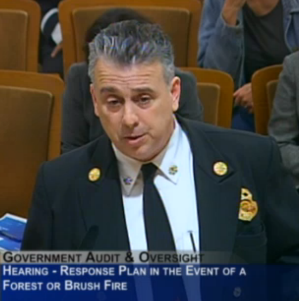
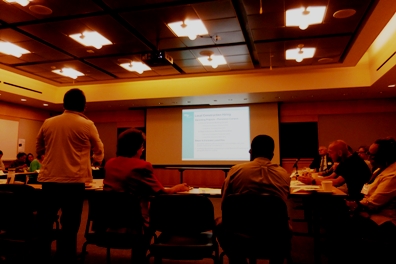
Deputy Fire Chief Mark Gonzales smRecently, Supervisor Norman Yee called a hearing of the Government Audit and Oversight Committee to find out how prepared San Francisco was to deal with fires in brush and forest. The San Francisco Fire Department busted some myths we’ve heard all too often.

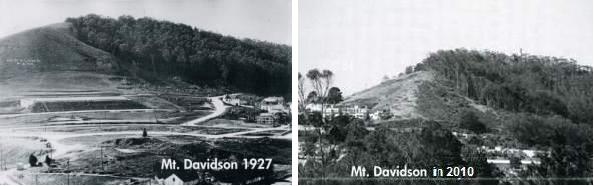
MYTH #1: The forests of San Francisco – in particular those on Mount Sutro and Mount Davidson – are a fire hazard. Vegetation fires are 12-13 times more likely to occur in grass and brush than in forests. And importantly – in the north and west of the city, the fog protects it by adding moisture. The south-east is more vulnerable to vegetation fires, particularly around the freeways. (But the real fire danger in San Francisco is from structure fires because of closely-placed wooden houses, not so much from vegetation fires.)

MYTH #2: As city fire-fighters, SFFD wouldn’t know how to respond to a forest fire. Actually, SFFD have 200 fire-fighters trained to fight vegetation fires. This myth is a quarter-century out of date.

MYTH #3: SFFD doesn’t have the equipment or information to fight vegetation fires. Actually, SFFD has special resources including four maneuverable “mini-pumpers” for fighting outside fires. And it has a mutual aid agreement with other cities and can call on their resources if needed.

MYTH #4: San Francisco’s Wildland Urban Interface is a very high fire hazard severity zone. No, it’s not. It’s not technically a Wildland Urban Interface (though there are some pockets) and the whole of San Francisco has a “moderate” fire hazard severity rating (that’s CALFIRE’s lowest rating).

We attended the hearing, and were impressed by SFFD’s well-planned arrangements. After an introduction from Supervisor Norman Yee who convened the hearing and Fire Chief Joanna Hayes-White who stressed that SFFD was prepared for vegetation fires, Deputy Chief Mark Gonzales gave a detailed presentation on where they happened and how SFFD handled it. This was followed by a talk about prevention from Lieutenant Mary Shea, (mainly weed-abatement in vacant lots and similar). The Department of Emergency Services’ Bijan Karimi described preparedness, to help affected families stay safe and return to normalcy in the event of any disaster. Then Curtis Itson, UCSF’s fire marshal, spoke specifically about Sutro Forest, and finally there were some comments from the public – including a singer!

WHERE THE OUTSIDE FIRES ARE

San Francisco’s main concern is actually more with structure fires, because as Deputy Chief Gonzales said, “…we have wood buildings in the districts, and they’re all next to each other.”

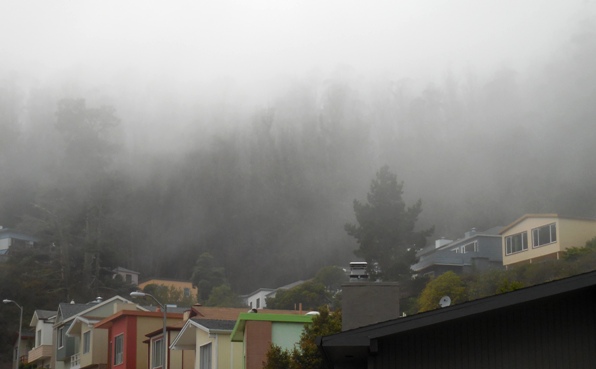
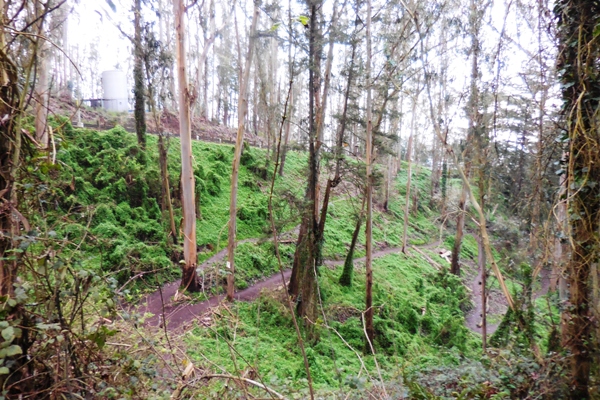
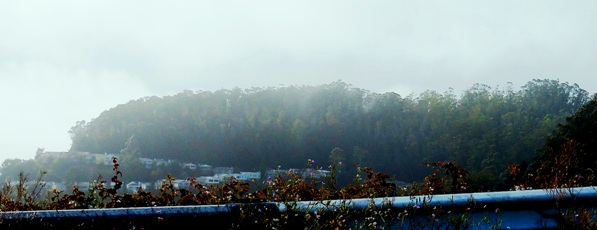
However, there are some calls for outside fires. They tend to be concentrated around the south and east of the city. Because of the fog, the north and west of the city (i.e., areas that include Mount Sutro Forest and Mount Davidson) are generally moist and not a concern.

[See our recent post,  Sutro Forest: Fog and Puddles While Elsewhere Fires Burn, for an illustration of this effect.]

The focus for outside fires is in the drier South east part of San Francisco: Hunter’s Point, McLaren Park.

grass and outside fire calls - SFFD

From the presentation by Deputy Chief Mark Gonzales:

“… we have fog and even during the drought [in] the rest of the city, the west and the northwest gets the fog. The best weather is in Hunters Point, southeast, so that’s where it’s driest. One of the concerns is Mclaren park. So the four mini-pumpers are in that area. We have front line stations in the city. A lot of those companies have been trained in wild land operations, and the chief mentioned that we have over 200 firefighters that do that.”

The open weedy area around freeways are also a concern. Thrown cigarettes and occasional campfires may account for ignition. He said: “…actually there is a big correlation if you noticed near the freeways… all along and open patches of lands that we respond to, to knock those out.”

When there are vegetation fires, they are mostly in grass and brush. The data the Deputy Fire Chief showed indicated that in the last three years, fires in grassland and/or brush were 12-13 times more likely than fires in forested areas/ wild lands.

He also pointed out that SFFD did have the resources to fight vegetation fires:

  • Four “mini-pumpers” – small maneuverable trucks for fighting outside fires (as well as operating in crowded conditions). They can go off-road and carry special equipment for fighting vegetation fires.
  • Two hundred firefighters with training in fighting vegetation fires, unlike 20-25 years ago when it had few if any. In fact, 30 of SFFD’s people were deployed to help fight the Butte fire and the Valley fire in other parts of California.
  • There’s a mutual aid arrangement in place that would allow SFFD to call for help if it faced an outside fire it could not control with its own resources. The people it would call on would be at least as well-trained as SFFD’s own fire-fighters – possibly more so because they are from hotter less built-up areas where they experience more outside fires.

NOT A WILDLAND URBAN INTERFACE, AND ONLY MODERATE HAZARD

Lieutenant Mary Shea, who is responsible for Prevention, started by pointing out that San Francisco was not technically considered a Wildland-Urban interface, though there were pockets that appeared so. She also said that based on topography and fuel, CALFIRE considered San Francisco a moderate fire hazard area, not a high fire hazard zone. [“Moderate” is actually CALFIRE’s lowest rating. We wrote about that here: The “Fire Hazard” that Wasn’t]
not WUI fire area
Her prevention efforts therefore focused on overgrowth of weeds, grass and vines, 30-foot defensible spaces, tree-limbs within 10 feet of chimney outlet, buildup of leaves or pine needles on roofs.

They mainly responded to complaints from neighbors, perhaps half of which were justified and the remainder were people disgruntled with the next-door tree overhanging their house or yard. They usually sent out abatement notices two weeks before 4th of July. Owners usually complied and most yards were well-maintained – the owners didn’t want fires, either. The main problem was in abandoned properties where the neighbor could not be found, or people unable for some reason to maintain their homes. SFFD worked with such cases to ensure safety. Most notices came from Hunters Point/ Bayview around the freeways, and Bernal, places like that.

UCSF MAY DO ANOTHER ROUND OF “FIRE HAZARD REDUCTION”

Chief Joanna Hayes-White praised UCSF for the “fire safety” work 2 years ago, and they said they would be reviewing it this fall. She talked about defensible space and fuel reduction.

[We wrote about that here – Sutro Forest: Tree Felling Notices Posted ]

UCSF’s fire marshall, Curtis Itson, emphasized that UCSF has a commitment to keep buildings, visitors, and nearby neighborhoods safe.

In comments, we pointed out that given the fog and the way the vegetation trapped moisture, we needed to be careful that we did not increase fire hazard by reducing the forest’s ability to retain moisture.

[In August 2013, we think that UCSF and SFFD were stampeded into a rushed action. We hope that this year, with more time to conduct moisture studies and properly understand the terrain and microclimate, they will be able to take a more thoughtful approach that would preserve, even enhance, the moisture in the vegetation.]

OTHER PUBLIC COMMENTS

More important public comments:

  • In the parks and Golden Gate National Recreation Area, native plant interests are felling trees and substituting more-flammable native plants for fire-resistant non-natives like trees and ice-plant. These landscape transformations increase fire hazard.
  • Trees are a lot less flammable than the myths say. In the parks, trees are felled and left on the ground as fuel, while toxic herbicides are in use. SFRPD’s forest management needs improvement.
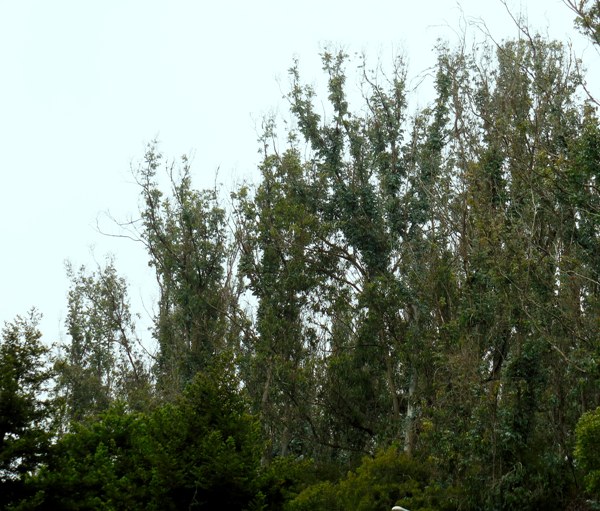
  • Someone talked about dying trees as fire hazards along O’Shaughnessy, and a singer sang that it would be alright.

If you want to view the hour-long hearing, here’s the LINK.

Posted in Sutro Forest "Fire Risk" | Tagged , , , , , | 1 Comment

Sutro Forest: Fog and Puddles While Elsewhere Fires Burn

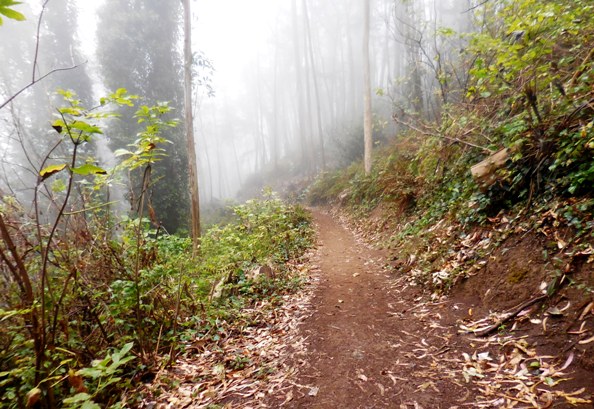
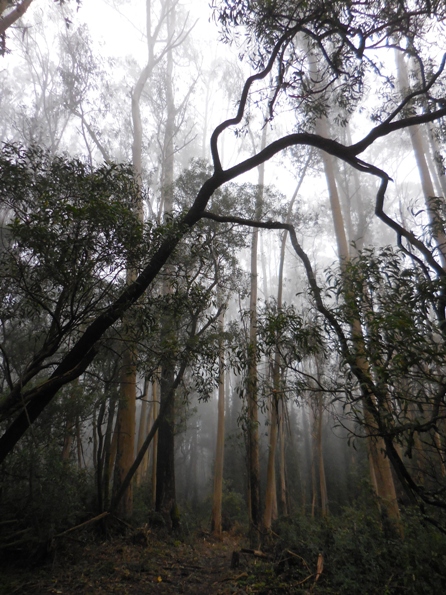
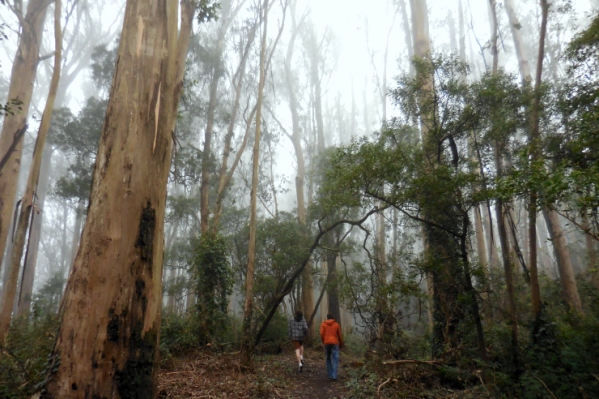
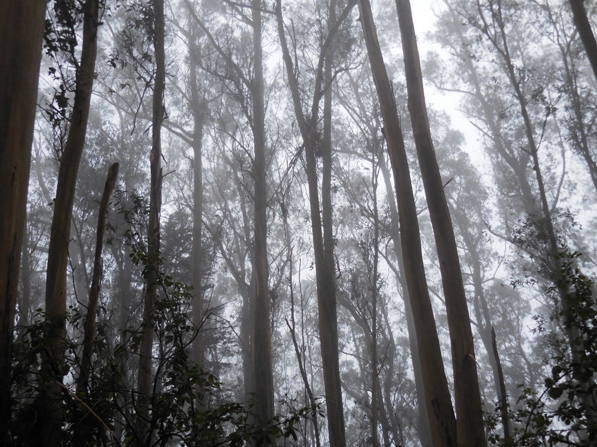
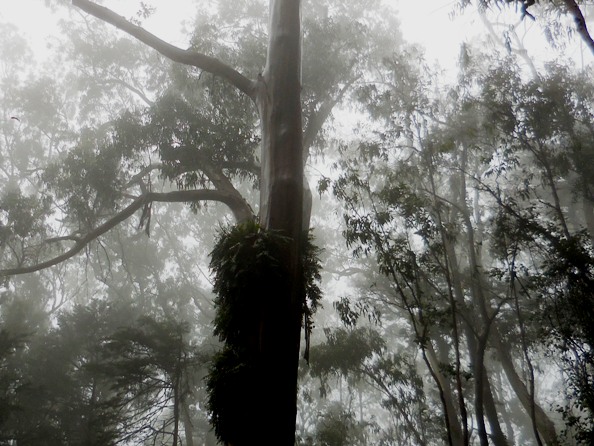
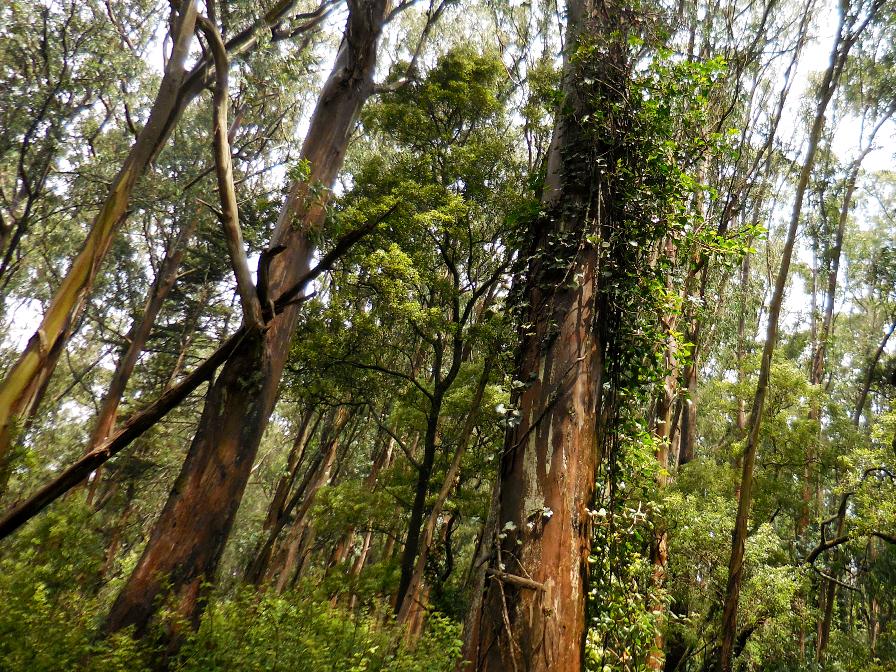
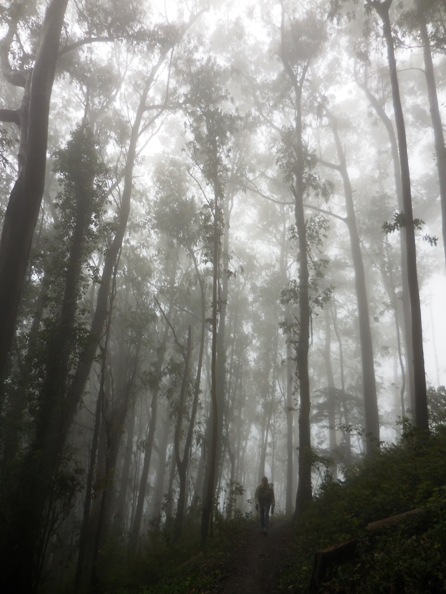
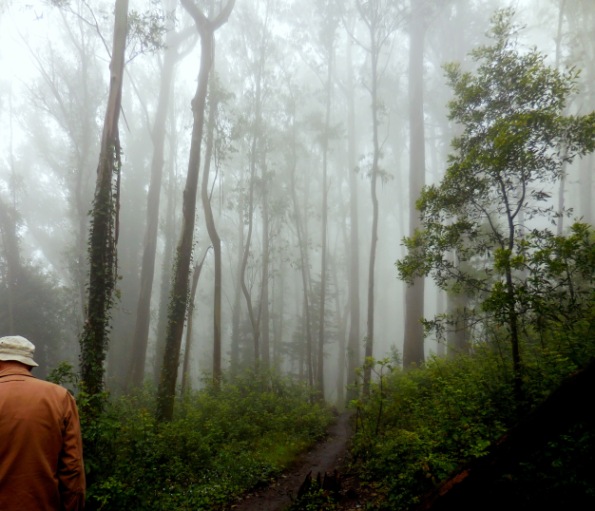
The fog rolled in, the mist filled the trees, and the forest’s music was the patter of the Cloud Forest’s internal rain. This was Sutro Cloud Forest on Saturday, September 12th 2015. We were glad of our raincoat as we walked through the beautiful woods.
pics24 005 sutro forest in the fogThere were a few puddles along long the trail, though the trail-builders had tried to slope them so water would not collect.
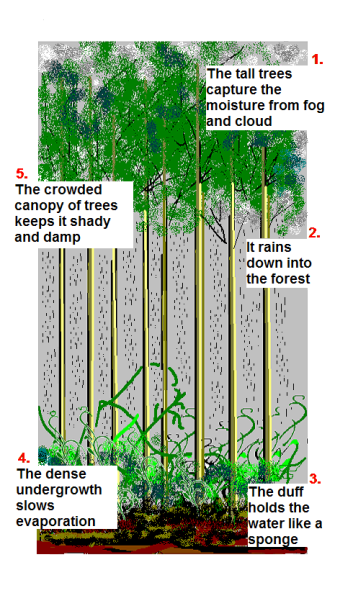
puddle in sutro forest sept 2015The upper forest – above Medical Center Way, the paved road that runs through Sutro Forest – gets the fog first. The tallest trees at the higher elevations of Mount Sutro reach into the clouds and harvest the moisture, which collects on their leaves and twigs and branches, and rains down into the forest. As the fog settled in and came down to a lower level, the whole forest damped down. (The next day, Medical Center way was wet with the forest’s rain.)

pics24 009 sutro cloud forest sept 2015The picture below shows why it’s so important to preserve the trees. The trail goes from damp where trees have dropped fog-moisture on it to dry where there’s no canopy – over just a few inches. Further, where there are trees, it’s damp again.

Sutro Forest wet and dry trailTREES IN A FOG FOREST OR CLOUD FOREST

cloud forest diagramHere in San Francisco, we get fog whenever it gets too hot. This makes sense – the fog comes from the difference between the temperature of the sea and the land. So fire season inland brings the fog to us.

But trees fight fire in other ways than just capturing moisture. The tree canopies shade the ground below, discouraging the growth of some flammable fine fuels like grass, and slowing evaporation so that even when it’s dry elsewhere the vegetation in the forest remains green.

They act as a windbreak. Even if a fire is lighted, it cannot easily spread.

Tall healthy trees perform these functions best, but even trees in poor condition contribute. You can find dead trees with fog-moisture pouring down their trunks like a rain-spout. And they also help to block wind and shade the ground.

ELSEWHERE, IT’S FIRE SEASON

Meanwhile, on the same days as we took the forest pictures, the Valley Fire in California’s Lake County spread to 25,000 acres.

Our thoughts are with the people who, at this writing, face burned out towns and a fire yet uncontained.

fog over sutro forest - 13 sept 2015

Sutro Forest – fog, not smoke!

And we’re grateful for the fog and the forest.

dense fog over sutro forest - view from tank hill - 13 sept 2015

Posted in Mt Sutro Cloud Forest, Sutro Forest "Fire Risk" | Tagged , , , | 4 Comments

Sutro Forest Attrition

The July message from UCSF was both innocuous and concerning. They were going to do some “hazardous tree work” immediately… and more in the Fall.

UCSF must immediately remove some hazardous trees in the Mount Sutro Open Space Reserve in early July. UCSF arborists and external consulting arborists identified 20 trees that are dead and dying and need to be removed immediately to protect the safety of trail users, employees, neighbors and neighboring homes. We anticipate additional hazardous tree work will be done in the fall.

Even though it was the bird nesting season, UCSF went ahead with the work. To clarify: we support the removal of trees that are actual hazards especially to buildings, though we have to say that in the past, the trees removed have seldom been actual hazards.

What concerns us is that “hazardous tree work” is the latest in a series of excuses to remove trees.

WHAT ABOUT THE BIRDS?

What was even more concerning was this paragraph:

UCSF consulted with a wildlife biologist to determine whether there is currently any bird-nesting activity in the Reserve.  The biologist conducted a nesting bird survey in and adjacent to the trees slated for removal and found no signs of active bird-nesting in the Reserve, and specifically, found no signs of bird-nesting along the Farnsworth Trail or near the parking lots and Environmental Health and Safety building.

hummingbird nests collected in Sutro ForestReally? It is impossible that birds would avoid Sutro Forest. They nest in the eucalyptus trees, in the others trees like acacia that form the subcanopy, and in the blackberry and other bushes. One of our observers who went to watch the work being done noted  “bird nesting in bushes around eucs at one end of the trail they closed to cut the dead eucs.”

We have asked for a copy of the wildlife biologist’s report.

UCSF appears to pay lip-service at least to avoiding tree-work during the nesting season:

It is UCSF policy to avoid any non-urgent tree work during bird-nesting season.  Bird-nesting season generally lasts from March to August or September, though there is some evidence that it started earlier this year due to the warm weather.

Our concern regarding birds is two-fold. First, clearly the “no signs of active nesting” reflects inadequate observation. There is no reason for birds to avoid nesting in Sutro Forest, which is resource-rich for birds – and even a casual observer saw this activity even while the tree work was going on. Second, in addition to the tree work volunteers continually remove bushes and understory shrubbery throughout the season. These are all nesting sites.

LOSING TREES IN THE FOREST

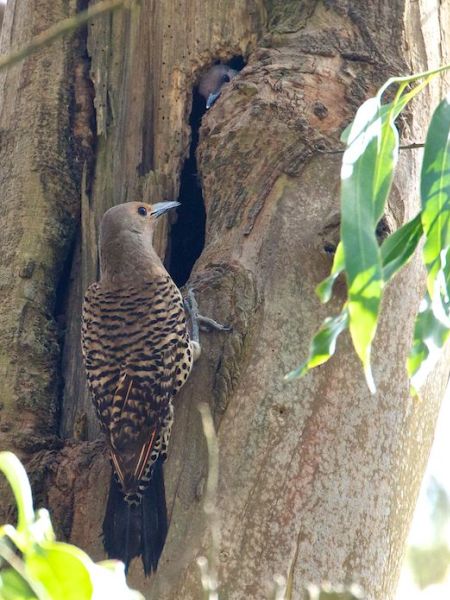
The eucalyptus-tree nest hole of the red-shafted flicker - San Francisco. Janet KesslerMore “hazardous tree removal” is planned for the Fall. One supporter of the forest said, “…this constant tree trimming, killing and shredding will not stop in the Sutro Cloud Forest in San Francisco. Please stop immediately…

It seems the current strategy in Sutro Forest is a process of attrition. In the last few years, hundreds of trees have been cut down -1250 by 2014, more in two batches in 2015.

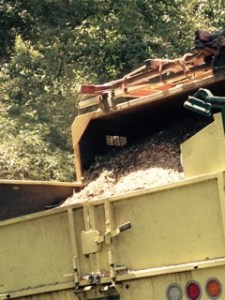
valley crest truck 29th jan 2015

We would like to point out that even dead and dying trees are valuable to a forest; they provide excellent habitat for birds such as woodpeckers, and for wild bees. They also help maintain the cloud forest ecosystem by harvesting fog moisture and helping to preserve it.

Unless they are actually hazardous, UCSF should preserve them as part of the forest’s eco-system.

Posted in deforestation, Mt Sutro Cloud Forest, UCSF | Tagged , , | 2 Comments

Petition the Sierra Club to Stop Advocating Against Trees and For Pesticides

Million Trees and The San Francisco Forest Alliance  have a petition to ask the Sierra Club to stop advocating for the destruction of trees and the use of pesticides in the San Francisco Bay Area. You may be shocked to learn that the local chapter of the Sierra Club is supporting – not opposing! – the destruction of 450,000 trees in the East Bay and is in fact suing to force FEMA to destroy all the trees, not just most of them. There is a petition to Sierra Club to withdraw its support for this environmental disaster.

Cutting these trees down will stop them from fighting climate change and reducing pollution. The project would release thousands of gallons of toxic herbicides into the environment. It would increase fire risk by encouraging the replacement of damp and cool tree stands with shrubs and grasses that burn rapidly when dry. This post below is reproduced with permission from SFForest.org and from Death of a Million Trees, which fights the unnecessary destruction of our urban forest.

Please sign the Petition HERE.

sign petition to sierra clubPlease also note the planned demonstration on Tuesday, August 25, 2015, at 4 pm, 2530 San Pablo Ave, Suite I, Berkeley, CA – the headquarters of the Sierra Club’s Bay Chapter.

————————————–

Monarch butterflies over-winter in California's eucalyptus groves

Monarch butterflies over-winter in California’s eucalyptus groves

Million Trees is sponsoring a petition to the national leadership of the Sierra Club in collaboration with San Francisco Forest Alliance. The petition asks the Sierra Club to quit advocating for the destruction of the urban forest and the use of pesticides in the San Francisco Bay Area. It also asks the Sierra Club to withdraw its suit against FEMA, which demands the destruction of 100% of all “non-native” trees (eucalyptus, Monterey pine, acacia). This is an on-line petition which can be signed HERE. If you are signing this petition and you are a present or former member of the Sierra Club, please mention it in your comments.

There will be a demonstration by supporters of this petition at the headquarters of the San Francisco Bay Area Chapter of the Sierra Club on Tuesday, August 25, 2015, at 4 pm, 2530 San Pablo Ave, Suite I, Berkeley, CA. Please join us if you can.

If you are a regular reader of Million Trees, you probably understand why we are making this request of the Sierra Club. For the benefit of newer readers, we recap the long history of trying to convince the San Francisco Bay Area Chapter of the Sierra Club that its support for the destruction of our urban forest, as well as the pesticides used to prevent its return, contradicts the mission of the Sierra Club as a protector of the environment.

  • This “open letter” was sent to the leadership of the local chapter of the Sierra Club. It informs the Sierra Club of many misstatements of fact in the chapter’s newsletter about the “Wildfire Hazard Reduction and Resource Management Plan” of the East Bay Regional Park District.
  • This article is about the Sierra Club’s public comment on the “Wildfire Hazard Reduction and Resource Management Plan” of the East Bay Regional Park District. The Sierra Club instructs EBRPD to put the “restoration of native plant communities” on an equal footing with fire hazard reduction. It also specifically endorses the use of pesticides for this project. In other words, native plants are more important than public safety in the opinion of the Sierra Club.
  • This “open letter” is about misstatements of fact in the chapter newsletter about San Francisco’s Natural Areas Program. We wrote that “open letter” because the newsletter refused to publish our letter to the editor.
  • This article is about misstatements of fact in the chapter newsletter about the FEMA projects in the East Bay Hills. This incident occurred during the brief period of time when the on-line version of the newsletter was accepting on-line comments. That opportunity to communicate with the chapter enabled a correction of inaccurate statements in the newsletter.

Sierra Club’s suit against FEMA, which demands the destruction of 100% of all “non-native” trees in the East Bay Hills was the proverbial straw that broke the camel’s back. Chronic annoyance at the club’s endorsement of destructive and poisonous projects was suddenly elevated to outrage. HERE is the Club’s description of its suit, which is available in its on-line newsletter. Attempts to communicate our outrage to the Club by posting comments on that article failed. That is, the Club is no longer publishing comments it doesn’t like, thereby cutting off any means of communicating with them. Our petition is the only means of communication left to us. The text of the petition follows and it can be signed HERE. Please distribute this petition to your friends and neighbors who share our concern about the destruction and poisoning of our public lands in the San Francisco Bay Area.


Title: Sierra Club must STOP advocating for deforestation and pesticide use in San Francisco Bay Area

Petition by: Million Trees and San Francisco Forest Alliance

To be delivered to:
Michael Brune, Executive Director, Sierra Club, michaelbrune@sierraclub.org
Aaron Mair, President, Board of Directors, Sierra Club, aaronmair@gmail.com

We are environmentalists who ask the Sierra Club to quit advocating for the destruction of the urban forest and the use of pesticides in the San Francisco Bay Area. We also ask that the Sierra Club withdraw its suit against FEMA, which demands the destruction of 100% of all “non-native” trees (eucalyptus, Monterey pine, acacia). If you are signing this petition and you are a present or former member of the Sierra Club, please mention it in your comments.

Over the past 15 years, tens of thousands of trees have been destroyed on public lands in the San Francisco Bay Area. Now hundreds of thousands of trees in the East Bay are in jeopardy of being destroyed by a FEMA grant to three public land managers. The Bay Area Chapter of the Sierra Club has actively supported all of these projects and now it has sued FEMA to demand the destruction of 100% of all “non-native” trees.

These projects have already used hundreds of gallons of herbicide to prevent the trees from resprouting and to kill the weeds that grow when the shade of the canopy is destroyed. Now, the FEMA project intends to use thousands of gallons of herbicide for the same purpose. These herbicides (glyphosate, triclopyr, imazapyr) are known to be harmful to wildlife, pets, and humans.

This environmental disaster will release tons of carbon into the atmosphere, thereby contributing to climate change. It will destroy valuable habitat for wildlife, introduce poisons into our watershed, cause erosion, and eliminate our windbreak. We call on the national leadership of the Sierra Club to prevent the active participation of the Bay Area Chapter of the Sierra Club in this environmental disaster.

Petition background:

The San Francisco Bay Area was virtually treeless prior to the arrival of Europeans. The landscape was predominantly grassland, scrub, and chaparral. Trees grew only in ravines where they were sheltered from the wind and water was funneled to them. The trees that were brought from other areas of California and from other countries were chosen because they are the species that are best adapted to our local conditions. John Muir, the Founder of the Sierra Club, also planted these tree species around his home in Martinez and was as fond of those trees as many of us are still today.

The Sierra Club has now turned its back on this cosmopolitan view of nature in favor of returning our landscape to the pre-settlement landscape of grassland, scrub, and chaparral. This approach has led to the destruction of tens of thousands of trees and the use of herbicides to prevent them from resprouting.

In the East Bay, native plant advocates have also falsely claimed that “non-native” trees are more flammable than native plants. Although fire hazard reduction was the stated purpose of the FEMA grants, fire hazards will be increased by the clear-cuts of our urban forest for the following reasons:

  • Tons of dead, dry wood chips will be scattered on the ground to a depth of 24 inches.
  • The fog drip which is condensed by the tall trees moistens the ground and will be lost when the canopy is destroyed. The ground vegetation will therefore be drier and more likely to ignite.
  • The tall trees provide a windbreak which has been demonstrated repeatedly to be capable of stopping a wind-driven fire, which is typical of California wildfires.
  • The project does not intend to plant any replacement plants or trees. Therefore, the most likely colonizers of the bare ground are annual grasses which ignite easily during the dry season and in which most fires in California start and spread.
Hummingbird in eucalyptus flower. Courtesy Melanie Hoffman

Hummingbird in eucalyptus flower. Courtesy Melanie Hoffman

Many empirical studies document the rich biodiversity of our urban forest today. Bees, hummingbirds, and monarch butterflies require eucalyptus trees during the winter months when there are few other sources of nectar. Raptors nest in our tall “non-native” trees and an empirical study finds that their nesting success is greater in those trees than in native trees.

In short, the Bay Area Chapter of the Sierra Club is promoting an environmental disaster that is adamantly opposed by tens of thousands of people. FEMA received over 13,000 public comments on its draft Environmental Impact Statement, over 90% in opposition to this project, according to FEMA’s own estimate. The signers of this petition are also opposed to this project as presently described by FEMA grant applications and its Environmental Impact Statement.

Environmentalists in the San Francisco Bay Area have been denied due process by the local chapter of the Sierra Club. The Bay Area Chapter has blocked every effort to communicate with them: they ignore our emails, block our comments on their blog, refuse our letters to the editor of their newsletter, and do not answer our phone calls. We believe that the national leadership has an obligation to consider our complaint because the actions of the local chapter are inconsistent with the mission of the Sierra Club. The local chapter is actively contributing to climate change and endorsing the use of toxic pesticides in our environment.

Posted in Environment | Tagged , , | 2 Comments

“Are Eucalyptus Trees Going To Kill Us All?” Talk by Jack Gescheidt – Aug 15, 2015

Jack Gescheidt of the Tree Spirit Project, uses a unique method to draw attention to threatened forests: He gets volunteers of all ages to pose nude among the trees to create art photographs. He came to Sutro Forest two years ago. (See: Tree Spirit Project in Sutro Forest and The Making of the Tree Spirit Project in Sutro Forest.)

Jack_Gescheidt_TreeSpirit_Sutro_Forest_0026_550p_WEB Jack Gescheidt Tree Spirit ProjectNow – together with a number of other groups – he’s fighting the destruction of 450,000 trees in the East Bay. Here’s an NBC report: NBC report on East Bay Tree Destruction

But he’s also using less unconventional methods. Here’s his email about a presentation he will be giving  on  August 15, 2015 in San Rafael.

“Please share news of my presentation — ARE EUCALYPTUS TREES GOING TO KILL US ALL?!” — about eucalyptus trees, the native vs. non-native issue, invasive species, and the plan to cut down hundreds of thousands of trees in the SF Bay Area. Marin and SF both have deforestation campaigns for the same reasons, so I see this as a big issue beyond just the East Bay (as you all know).

“WHEN & WHERE: Saturday, August 15th, 2015, 7:30pm at Open Secret Community Center & Bookstore, #923 C St., San Rafael, CA. (3 blocks from the Rafael Film Center).”

(Tickets information:  $10 Advance Tickets: call Open Secret with credit card: 415.457.4191; or $15 at the door)

“EVENT DETAILS (webpage): http://treespiritproject.com/events
All are welcome, from all sides of these issues. Audience participation will be encouraged; a lively evening expected.”

It sounds interesting, and we hope he’ll draw in people who don’t yet know about the devastation planned, or don’t understand what it will actually mean for the Bay Area.

Jack-OPEN-SECRET-talk-AUG-15-2015-v2-800p-WEB

Posted in deforestation | Tagged , , | Comments Off on “Are Eucalyptus Trees Going To Kill Us All?” Talk by Jack Gescheidt – Aug 15, 2015

Sutro Forest in May 2015 – Green Despite the Drought

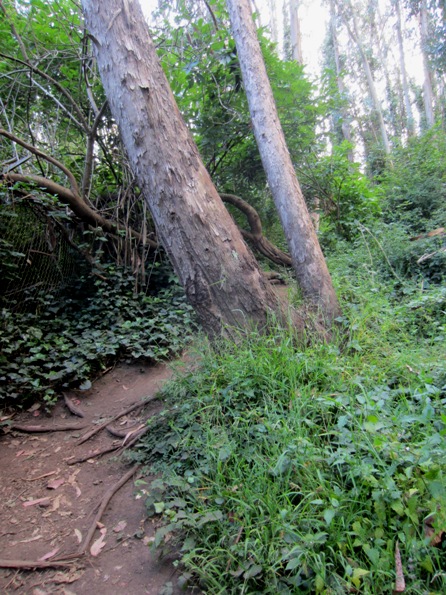
Green trail in Sutro Forestcloud forest diagramWe’re into the second year of a drought, here in California. In Sutro Forest, you’d hardly know it. The forest is lush and green.

We took these pictures  a month ago. We meant to put them up then, but here they are, better late than never!

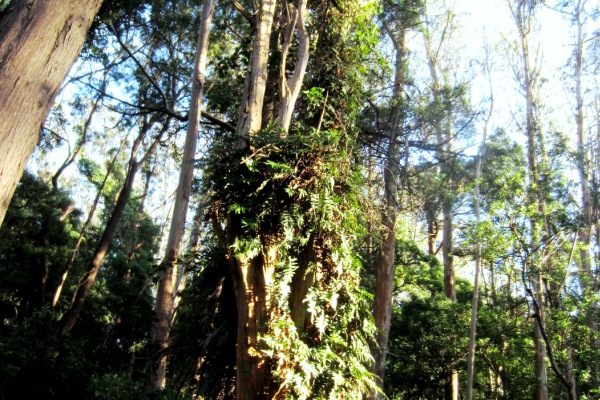
Sutro Forest is a de facto cloud forest. It doesn’t rely only on rain; in summer, the tall eucalyptus trees harvest the moisture from the fog. (Some of the trees are 200 feet tall.) They keep their understory well-watered, and the understory in turn helps to retard evaporation and keep it damp. Here’s a diagram of how it works.

On this visit, the actual trails were dry, but the vegetation was green. Even the grasses and the small plants that form the herbaceous layer, which indicates that there’s been enough surface moisture to keep them not just alive but thriving .

green understory in the forestThis picture shows lots of greenery. And even the grasses edging the trail in the picture below are green and growing, not drying out.

green grasses by trailMore small plants here.

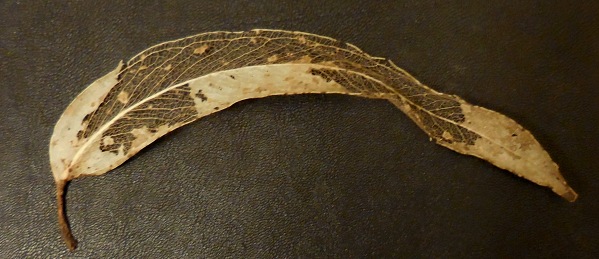
herbaceous layer plantsWe even found skeleton leaves of eucalyptus – which is quite unusual. It suggests that they stayed wet long enough for the soft matter to rot out, and then dried, leaving the skeleton.

natural skeleton leaf eucalyptus

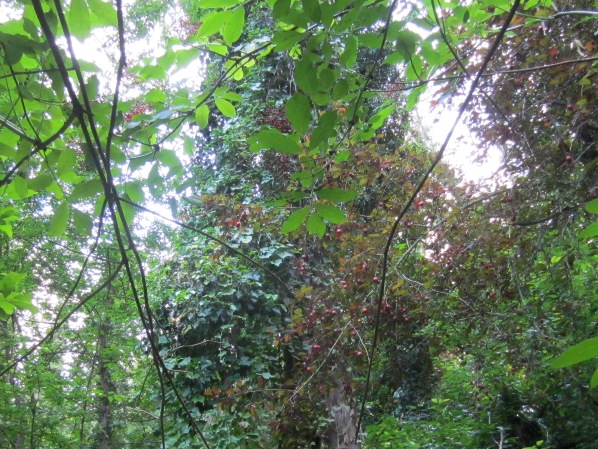
Sutro Forest is known for its tall trees and green understory, not for its flowers. In May, though, they’re there – together with red elderberries, and the plums on the wild prunus trees that bloomed earlier this year. (Be careful of the red elderberry – it’s also called the stinking elderberry because its leaves smell bad when bruised, and the berries are probably inedible to humans – though not to birds.) There are a few forget-me-nots here and there, some Robert geraniums, some nasturtiums.

red elderberries wild plumsCHANGES IN THE FOREST (WITH SOME OLD PICTURES)

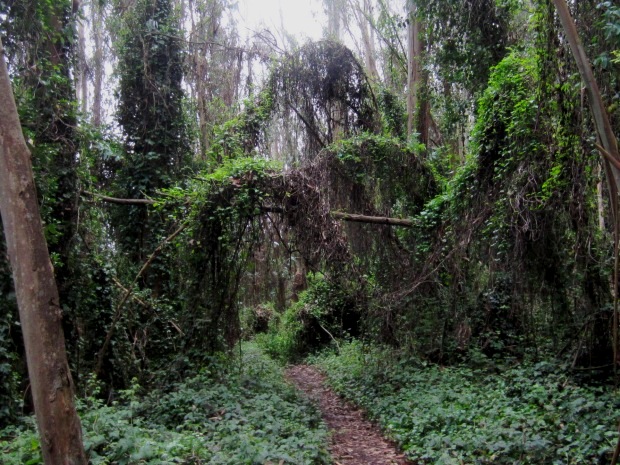
There’s been work along the trails, and some things have changed. The triple arches formed of vines covering branches across the trail are gone.

triple arches 2The picture above is from 2013, the one below from 2015. Well, at least we had them for some years.

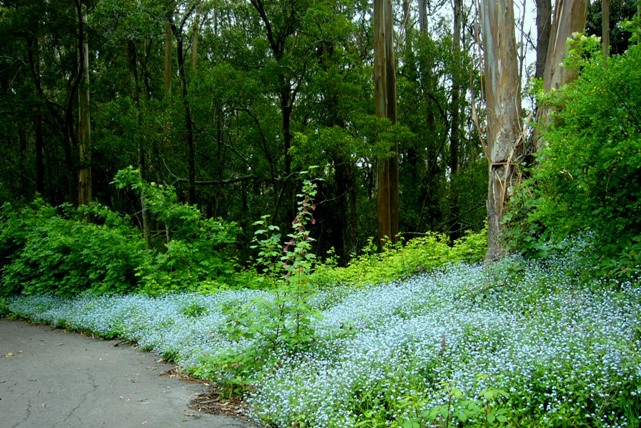
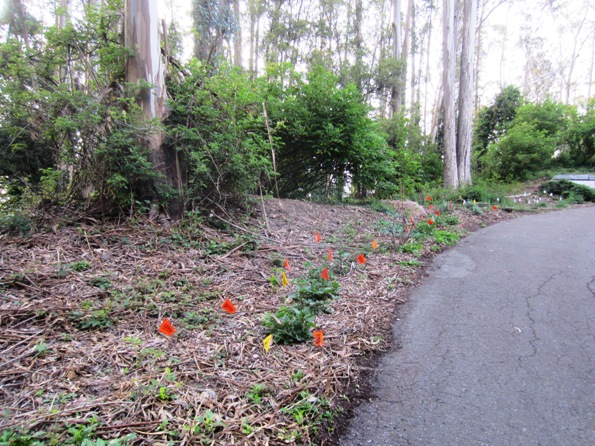
no more triple archThe bed of forget-me-nots on the road up to the Native Plant Garden on the summit is now a bed of plastic flags.

sutro forest forget-me-nots april 2011
The forget-me-nots of 2011 were mulched out of existence, and have now been replaced by the plastic flags of 2015. Presumably, some Native Plants have been planted there. We hope they take. They current brown chips are unlovely.

formerly forget me notsWe found an unexplained structure in the forest, perhaps intended as a barrier of some kind. Or maybe someone just got inspired to create art.

trail structureTHE FOREST AT EVENING

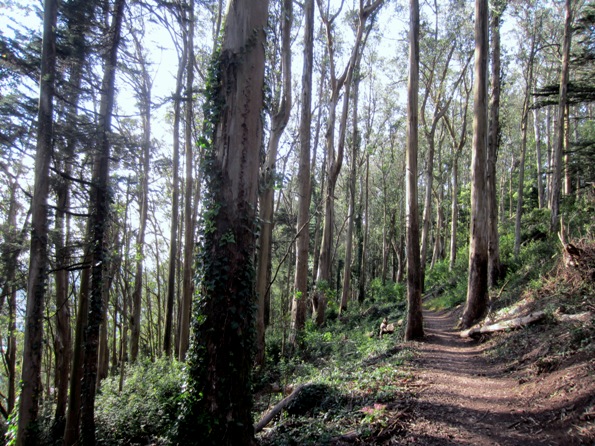
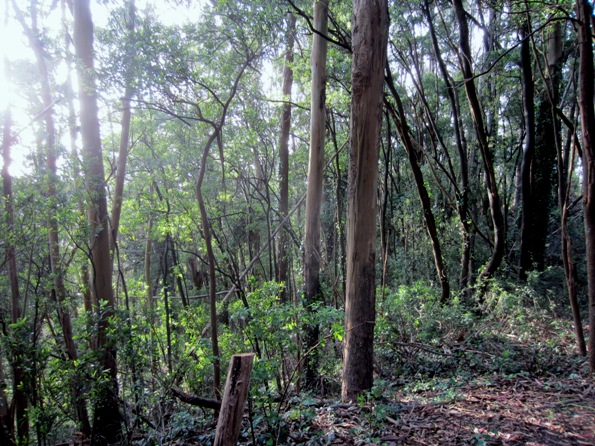
Despite the 1250 trees cut down in the last couple of years, and the destruction of understory that helps retain moisture and provide habitat,  the forest is still very beautiful. Here are a few pictures taken along the trails, with the evening sunlight streaming through the trees.

forest at evening 1forest at evening 2forest at evening 4MAJESTIC TREES

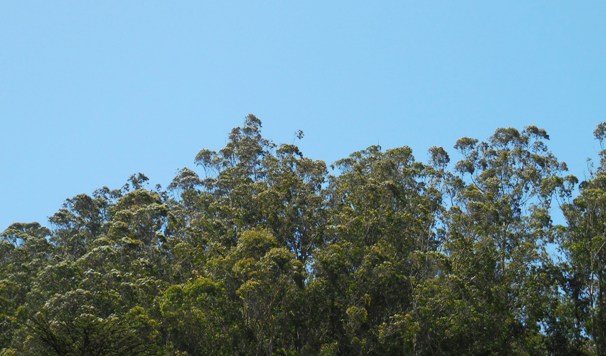
One of the challenges of trying to show this beauty in photographs (given that we’re not professional photographers, and are using a variety of point-and-shoot cameras), is the sheer size and majesty of the trees. We’re never completely successful.

tall eucalyptus treesforest at evening 3Here is a composite of the two pictures above. We hope it’ll give some sense of the scale of these trees, which can be as tall as a 20-story building. Or a stack of a dozen giraffes.

tall trees composite

Posted in Environment, Hiking, Mt Sutro Cloud Forest | Tagged , , | 2 Comments

Drought-Adapted Eucalyptus NOT Dying by the Thousand

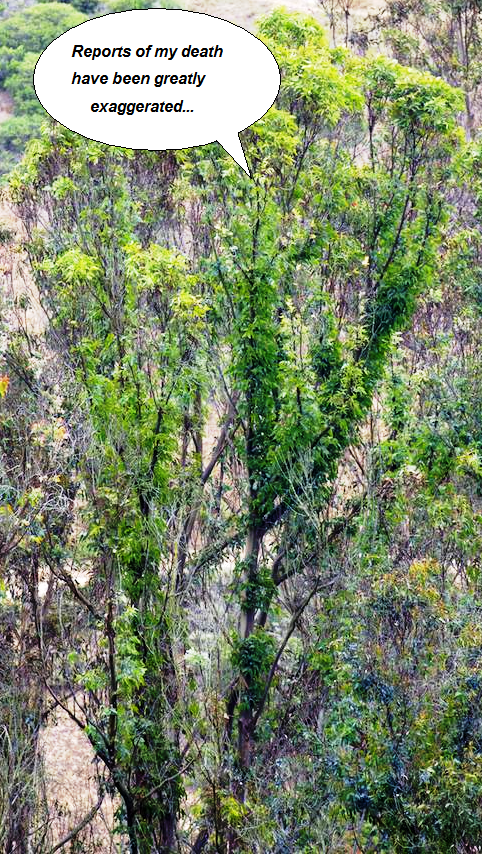
Jake Sigg, retired San Francisco Recreation and Parks Department (SFRPD) gardener who is considered the doyen of the Native Plant movement in San Francisco, has a widely circulated email newsletter. In it, he has been pushing the argument that thousands of eucalyptus trees in San Francisco are dying of drought, as evidenced by epicormic growth on these trees: “2015 is the year of decision, forced upon us by 20,000 to 30,000 dead trees.” He is suggesting they will be a fire hazard and that SFRPD act, presumably by cutting down the trees. In a recent post, he published a picture of a tree covered in young blue-green leaves, and predicted it would be dead within a year.

But he’s mistaken.

Eucalyptus trees are drought-adapted, and the shedding of mature leaves followed by sprouting of juvenile leaves (epicormic sprouting) is one of their defense mechanisms. These trees survive in areas far drier than San Francisco, where fog-drip provides an important source of summer moisture.

2015-05-27 ab eucalyptus with epicormic growth wordEUCALYPTUS RESPONSE TO DROUGHT

Eucalyptus trees are adapted to drought. They shed mature leaves and twigs so they don’t lose water through transpiration (the tree version of breathing, which takes place mainly in the leaves.) Later, they can replace the lost branches and leaves through “epicormic sprouting.”

Blue gum eucalyptus trees have buds buried deep under their bark. When the tree is stressed, they may shed adult leaves and later sprout new leaves along their branches. When you see a eucalyptus tree that seems to have shaggy light bluish-green new leaves along its branches or trunk – that’s epicormic sprouting.

Here’s what Jake Sigg said in a recent newsletter: “According to arborists, the trees produce these abnormal shoots from epicormic buds when their lives are seriously threatened.  In this case, the tree is expected to be dead by the end of 2015.  On Bayview Hill, barring heavy unseasonal rain, hundreds of the trees will be dead this year.  Yet the City continues to not see a problem.”

We asked UC Berkeley Professor Emeritus Joe McBride, California’s leading expert on eucalyptus, for his opinion. He’s observed this condition in trees along the edge of the Presidio forest and explains, “This response is common in blue gum as a mechanism to reduce transpiration rates in order to survive drought years.”

He continues: “I am not convinced that the trees will die in large numbers.

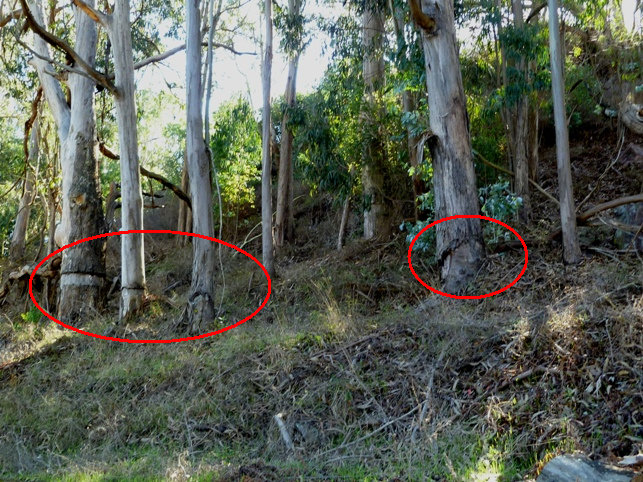
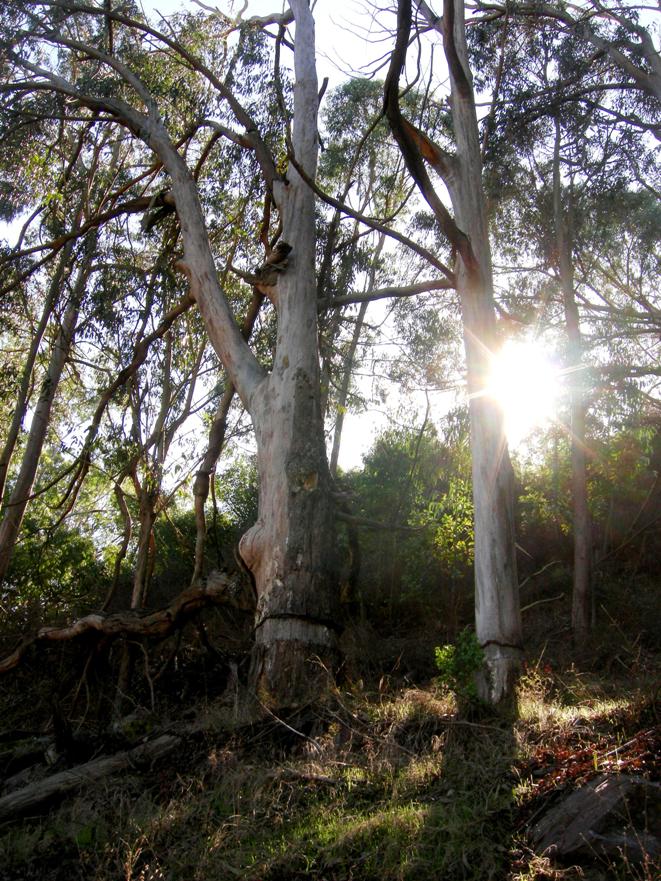
bayview-hill-2010 smTwo girdled treesTHE GIRDLED TREES OF BAYVIEW HILL

As an aside, we find it ironic that Mr Sigg should be so concerned with dead trees on Bayview Hill, given that’s where nativists girdled hundreds of healthy eucalyptus trees to kill them. (This is done by cutting around the tree, thus starving it of nutrients that are carried only in the outer layers of the tree-trunk.) It’s clearly visible in the two photographs here, both taken on Bayview Hill.

EUCALYPTUS ADAPTS

Eucalyptus globulus thrives in Southern California, Spain, Portugal, India – all places hotter and drier than San Francisco. In fact, one of the reasons eucalyptus is so widely planted – including in climates both hotter and drier than in San Francisco – is that it adapts to a wide range of conditions.

Here’s a quote from R.G. Florence’s textbook, Ecology and Silviculture of Eucalyptus Forests:

florence quote

From p.121 of the same book: “… they regulate their water usage in hot dry summers by closing their stomata [breathing pores in the leaves] during the day and lowering their rates of gaseous exchange. They adapt by their elastic cell structure to water stress.”

EPICORMIC SPROUTING IS IMPORTANT IN EUCALYPTUS

Mr Sigg describes “how to identify a dying blue gum” as follows: “Look for trees with thinning foliage and copious juvenile leaves (called coppice shoots) hugging the main stems.  These coppice shoots are easy to see because of their blue color and tight clustering, as opposed to the adult leaves, which are 6-8 inches-long, dull-olive-colored and sickle-shaped and which hang from the ends of long branches.  These coppice shoots are the give-away that the tree is in trouble and is destined to die soon…” (He later corrected “coppice shoots” to epicormic growth.)

But again, this is not actually true.

In fact, epicormic sprouting allows eucalyptus to survive not only drought, as described above, but even fire. The epicormic sprouting grows into new branches to replace the ones that have been damaged in the fire. This is from Wikipedia: “As one of their responses to frequent bushfires which would destroy most other plants, many Eucalypt trees found widely throughout Australia have extensive epicormic buds which sprout following a fire, allowing the vegetative regeneration of branches from their trunks.[4][5] These epicormic buds are highly protected, set deeper beneath the thick bark than in other tree species, allowing both the buds and vascular cambium to be insulated from the intense heat.[4]”

(The references are: [4] “Effects of fire on plants and animals: individual level”. Fire ecology and management in northern Australia. Tropical Savannas CRC & Bushfire CRC. 2010. Retrieved 27 December 2010. [5] “Learn about eucalypts”. EUCLID – Eucalypts of Australia. Centre for Plant Biodiversity Research. Retrieved 27 December 2010.)

And sometimes, dead branches and leaves and epicormic growth don’t even indicate stress – it’s part of the normal growth cycle. R.G. Florence’s book on eucalyptus says: the “mature crown of a eucalypt maintains itself by the continual production of new crown units, which die in turn. There will always be some dead branches in a healthy mature crown.” He goes on to say an “undue proportion of dead branches is an unhealthy sign” but a “reasonable proportion of death of crown units should be accepted as normal.” He also discusses the “epicormic shoots from dormant buds on the top and sides of the branch develop into leaf-bearing units of the mature crown.” (p.13) Eucalypts go through stages of development that include extensive self-thinning, particularly in younger trees. (p. 194)

Another reason for epicormic sprouts on eucalyptus is increased light. From Wikipedia, with references:  “Epicormic buds lie beneath the bark, their growth suppressed by hormones from active shoots higher up the plant. Under certain conditions, they develop into active shoots, such as when damage occurs to higher parts of the plant or light levels are increased following removal of nearby plant. Epicormic buds and shoots occur in many woody species, but are absent from many others, such as most conifers.” [The Wikipedia article references the Encyclopedia Britannica.]

We have seen these epicormic sprouts in eucalyptus trees around the clubhouse in Glen Canyon after many trees were removed.

epicormic sprouts on eucalyptus when nearby trees removed

We also saw them on Mount Sutro near where 1,200 trees were removed for “fire safety.”

 MISTAKING DEFENSES FOR DEATH THROES

In summary, then, epicormic sprouting does not indicate that the tree is near death. It may indicate that the tree is responding to drought (or even to other stresses like pesticide use or damage to its root systems) with defensive measures. It’s like declaring that everyone who has a fever is bound to die of it. The trees below are the same ones featured in the picture at the start of this article – one year later, they’re surviving, not dying.

Epicormic sprouting on eucapyptus 2014In some cases, epicormic sprouting may indicate nothing at all, except that the tree is going through a normal growth phase, or changed light conditions following removal of nearby trees.

LIVING WITH A FEW DEAD TREES

We asked Dr McBride if it made sense to cut down these trees.  “I do not think the city would be justified in cutting trees down as a fire prevention action,” he says. “Cutting down drought-stressed trees at this point would be much more costly, sprouting would be difficult to control without herbicides, and the litter on the ground would have to be removed to decrease the fire hazard.”

“The problem as I see it is the accumulation of leaves, bark, and small branches on the ground.  This material presents a serious fuel problem when it dries out sufficiently.” However, he points out that “In many eucalyptus stands in San Francisco the eucalyptus ground fuel (leaves, bark, and small branches) seldom dries to a point that it can be ignited because of summer fog and fog drip.” In dry areas, the best course is to “launch a program of ground fuel reduction by removing the litter from beneath eucalyptus stands.”

The eucalyptus-tree nest hole of the red-shafted flicker - San Francisco. Janet Kessler

Eucalyptus-tree nest hole of red-shafted flicker – San Francisco. Copyright Janet Kessler

A few trees may indeed die, with the drought or without it. If you think of a forest as a normal population, you expect to find some trees that are in thriving and some that are hanging on, and some that are dying – just like in any population. And dead and dying trees are very valuable to wildlife: They’re more likely to have cavities that are suitable for nesting (and are easier to excavate for woodpeckers and other cavity-building species). They also have bugs that come to feast on the decaying wood, and that’s bird-food.

Posted in Environment, eucalyptus, nativism | Tagged , , | 6 Comments

Fighting SF Bay Area Deforestation

mini poster War on Nature smWe’ve been extremely concerned about this disastrous East Bay project – a plan to cut down up to 450,000 trees. Others are fighting back. The post below has three ways in which you can help. It’s republished with permission from SFForest.org

The graphic on the right is available as a poster in PDF format here: 450k trees in danger-e-print

Please help us spread the word!

—————————-

Nearly half a million trees are likely to be felled in Berkeley and the East Bay Hills of the San Francisco Bay Area. There’s an extremely destructive project planned. The land managers sought Federal Emergency Management Agency (FEMA) funding for this project, and a Draft Environmental Impact Statement (EIS) was published. We wrote about this project HERE. The good news is that people responded: There were around 13,000 comments on the draft EIS. The bad news is that the Final EIS, released recently, still plans to destroy hundreds of thousands of trees, increase fire hazard, destabilize slopes, and use huge amounts of herbicide. It will be a disaster for the environment and for wildlife habitat.

People are fighting back to save the trees and the environment. As TreeSpirit says on their website, “Can you even imagine 450,000 trees being cut down?”

THREE WAYS TO FIGHT BACK

We are aware of three separate initiatives, and we urge you to give them your support.

HCN Save the East Bay Hills Trees sm1) The Hills Conservation Network (HCN) is raising funds to take legal action. They are a registered charity, a 501(c)3 organization, and have been fighting this battle from the start. They have a GoFundMe page where you can help by contributing toward the legal fund. Here’s the link: http://www.gofundme.com/SaveEastBayTrees

2) SaveEastBayHills has a website about this project saveeastbayhills.org where you can go to the ‘Take Action’ page to which details about what you can do to write to the decision makers to protest this project. SaveEastBayHills is led by Nathan Winograd, who also cares about animals and has been a force in working for no-kill shelters.

Treespirit fundraiser to save east bay trees sm3) TreeSpirit Project is working to get the word out, because most people still don’t know what’s about to happen. An informed public is going to be crucial to stopping this horrible project. They’re raising funds for publicity. Here’s a link to the page describing what’s happening, and a planned photo shoot. http://treespiritproject.com/sfbayclearcut/

They also have a GoFundMe fundraiser going on: http://www.gofundme.com/SFBayClearcut

TreeSpirit Project is the work of photographer Jack Gescheidt, who creates beautiful pictures of unclothed people (all volunteers) in forests to draw attention to the vulnerability of trees. (HERE’s an example from Sutro Forest.)

TreeSpirit Project has the support of Kevin Danaher of Global Exchange, who wrote on his Facebook page: “If people knew the huge numbers of trees to be killed, they’d not stand for it, and so the numbers are not revealed, nor discussed. Several citizens groups, including my friend Jack Gescheidt’s TreeSpirit Project, have uncovered and now disseminate these mind-boggling numbers. We kindly urge you to, also!”

WHAT YOU CAN DO

There isn’t much time to save these trees; felling is planned to start this fall. It’s a disaster in the making, and all based on an unreasonable prejudice against eucalyptus and a large number of myths that have been propagated. Please do what you can:
1) Make a contribution as you can to the HCN legal fund and the TreeSpirit Project publicity fund;
2) Write to the decision-makers listed HERE, protesting the project: http://www.saveeastbayhills.org/take-action.html
Thank you to all our readers for their involvement. Without your help, thousands of trees would already be felled.
Posted in deforestation, eucalyptus, Herbicides: Roundup, Garlon | Tagged , , , | Comments Off on Fighting SF Bay Area Deforestation

Cal-IPC Eucalyptus Reassessment: Not So Invasive

Back in July 2014, we wrote about the California Invasive Plant Council’s draft reassessment of eucalyptus. It had produced the same “Moderate” rating as before, but for different reasons. But last month, they came out with the final reassessment. Cal-IPC actually reduces the rating to “Limited” – their lowest rating. We are impressed.

mountain biker in Sutro ForestHere’s what we wrote in July 2014:

“The California Invasive Plant Council (Cal-IPC) designates eucalyptus as “moderately invasive.” Land managers all over California have used this designation as an excuse to cut down thousands of trees. Recently, people wrote to Cal-IPC citing evidence that eucalyptus forests in California are shrinking, not expanding, and they decided to revisit the assessment. However, their new Draft assessment comes to the same result – “moderately invasive.” Only the reasons are different.

“Most people think Cal-IPC is a government body. It’s not. It’s a not-for-profit organization with a 501(c) 3 designation. So if it’s just another non-profit, why does it matter?

“Here’s why: It’s in the business of designating plants as “invasive” (and by implication, bad.) Its assessments are repeated far and wide by land managers, repeated on the UC Davis website,  and used by government agencies as a standard. (For example: In a 2013 letter from the Fish and Wildlife Service to the CA Department of Transportation, it requires the Department to avoid planting “invasives” as determined by Cal-IPC: fws dot letter mentioning Cal-IPC) It clearly has been given a great deal of weight. Although Cal-IPC doesn’t explicitly ask land managers to eradicate “invasives,” that’s how the list is used.

“Unfortunately, since Cal-IPC not a government body, it isn’t subject to the same rules or accountability to the electorate.”

You may rightly gauge that we were pessimistic about Cal-IPC actually making a reassessment. In that, we were wrong.

photo credit: Janet Kessler

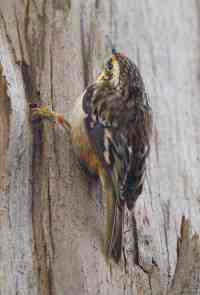
Brown creeper on eucalyptus – photo credit: Janet Kessler

In the preface to the final reassessment, Cal-IPC notes: “Management decisions for stands in urban areas will necessarily involve consideration of a range of factors, such as recreational and aesthetic values and the trees’ much-debated role in wildfire risk. For these stands, the information provided in this assessment can help assess impacts on native habitat, which may also be a factor in management decisions.”

We still don’t agree with all their points, and think they downplayed research showing the environmental value of eucalyptus, particularly in carbon sequestration and to wildlife. But we are pleased they have actually made this reassessment.

The eucalyptus-tree nest hole of the red-shafted flicker - San Francisco. Janet Kessler

The eucalyptus-tree nest hole of the red-shafted flicker – San Francisco. Janet Kessler

“Decay-resistant wood offers limited nesting opportunities for woodpeckers and birds that excavate their own holes.” (Not really!)

You can read the entire paper here: Eucalyptus_globulus – final reassessment by Cal IPC. Perhaps another time, we’ll point out where we think better data would be useful. Meanwhile, we’d like to thank readers who took the time and effort to offer feedback to Cal-IPC when they sought public comments.


Posted in eucalyptus | Tagged , | 1 Comment

Law Suit to Stop FEMA from Funding East Bay Deforestation

lake-chabot cropped Photo credit MillionTrees dot meRecently, we had written about the hugely destructive plan to cut down hundreds of thousands of trees in the East Bay. The new Plan, written in response to 13,000 comments, was as bad as the previous one. (Read that here: East Bay Trees to be Destroyed.) Trees fight climate change, and removing these trees will negative environmental impacts. It will also increase fire hazard.

Now, the Hills Conservation Network is suing to stop the funding for this destruction of the trees. The article below is republished with permission and minor changes from Death of a Million Trees, which fights unnecessary tree-destruction.

———————

HILLS CONSERVATION NETWORK FILES SUIT TO STOP FEMA GRANTS IN EAST BAY HILLS

Ten years after UC Berkeley, City of Oakland, and East Bay Regional Park District applied for FEMA grants to fund the destruction of hundreds of thousands of non-native trees on 1,000 acres of public open space, FEMA announced its final decision on Thursday, March 5, 2015. FEMA’s announcement of that final decision, which was sent to those who commented on the draft plans, implied that the projects had been revised to be less destructive. In fact, those who take the time to read the final version of the plans will learn that the original plans are fundamentally unchanged in the final version.

East Bay Regional Park District (EBRPD) will destroy about 90% of the trees in its project area, as originally planned. “Thinning” is not an accurate description of EBRPD’s project. UC Berkeley (UCB) and City of Oakland will destroy 100% of all non-native trees on their project properties. On a small portion of UCB and Oakland property (29 of 460 acres), tree removals will be phased over the 10-year project period. In other words, the final version of these projects will destroy as many trees as originally proposed by the grant applicants. However, FEMA has refused to fund tree removals on Frowning Ridge (185 acres) because UC Berkeley removed hundreds of trees there before the Environmental Impact Statement was complete, in violation of FEMA policy.

UC Berkeley destroyed hundreds of trees on Frowning Ridge in August 2014, before the Environmental Impact Statement was complete.

UC Berkeley destroyed hundreds of trees on Frowning Ridge in August 2014, before the Environmental Impact Statement was complete.

The Hills Conservation Network (HCN) filed suit to prevent the funding and implementation of these projects on March 6, 2015. Below is the press release announcing HCN’s suit. Please contact the Hills Conservation Network if you wish to contribute to the cost of this suit: http://www.hillsconservationnetwork.org/HillsConservation3/Blog/Blog.html or email inquiries@hillsconservationnetwork.org


Hills Conservation Network

Preserving the East Bay Hills

March 6, 2015

For Immediate Release

HCN announces lawsuit against FEMA EIS

Today the Hills Conservation Network, an Oakland, CA based environmental non-­‐profit, filed suit against the Federal Emergency Management Agency, also naming the Regents of the University of California, the City of Oakland, and East Bay Regional Park District in the suit.

The suit was filed in opposition to the Record of Decision released March 5, 2015 finalizing FEMA’s decision to award approximately $7.5 million in fire risk mitigation grants. The suit contends that the Environmental Impact Study used as part of the grant process was significantly flawed, and as such cannot be used to justify awarding these funds.

The lawsuit argues that FEMA did not consider a reasonable range of alternatives and reached unsupportable conclusions in deciding to allow the three agencies named in the suit to remove large numbers of healthy trees, with the goal of eradicating certain species of non-­‐native trees (acacia, Monterey pine, eucalyptus) by the end of ten years. HCN proposed a more nuanced approach that would have resulted in higher levels of fire risk mitigation at a much lower cost and with far less environmental damage than the current plan that calls for the removal of well in excess of 100,000 healthy trees that provide shade canopy (preventing the growth of highly flammable weeds) as well as storing tons of carbon that contribute to the greenhouse gases warming our planet.

This step marks the latest chapter in this process that began in 2005. During the Draft EIS review in 2013 approximately 13,000 comment letters were received by FEMA, 90% of them opposed to the proposed projects. In response to this public outcry FEMA reworked the EIS, and while the Final EIS is somewhat less destructive than the Draft EIS, it essentially calls for the same level of environmental damage, but over a longer time period.

The Hills Conservation Network is an Oakland, California based 501c3 comprised of residents of the Oakland hills that were directly affected by the 1991 fire. Several members of the group lost their homes in this conflagration and have committed themselves to driving change in Oakland to ensure that similar events never happen again. Members of HCN have been involved in the Grand Jury investigation of the ’91 fire and in developing enhanced emergency response capabilities in Oakland.

Please direct inquiries to Dan Grassetti at 510-­‐849-­‐2601.

################

Posted in deforestation, Environment, Uncategorized | Tagged , , , , | 1 Comment

UCSF Quarterly CAG Meeting – March 2015 – Sutro Forest

We attended the quarterly Community Advisory Group (CAG) meeting, held this quarter at Mission Bay in UCSF’s new hospital and campus.

march 2015 CAG meetingSUTRO FOREST

The section relevant to Sutro Forest were:
1) Today, March 5th, they are planning to cut down around 8 snags (standing dead trees). Sutro Stewards is organizing a party of around 100 women to work in the forest on Saturday, March 7th.

Here’s the email we got from them only a few hours ago:
“This weekend, UCSF will host approximately 100 women to work on a large habitat project in the Mount Sutro Open Space Reserve for International Women’s Trail Day. They will be working on a section of the Gardeners Trail, which is located between the South Ridge and West Ridge areas of Mount Sutro. UCSF staff have determined that a grouping of dead trees near where the volunteers will be working could be a potential hazard to workers. Bartlett Tree Experts will work in the Reserve tomorrow, Thursday, March 5, to remove overhanging dead branches and to remove the standing dead trees. Our staff counted approximately eight trees to be removed.”

Speaking for the San Francisco Forest Alliance, we thanked UCSF for maintaining safe trails but pointed out that it’s bird nesting season, that snags are valued habitat for birds, and we assume that they have made a bird nesting study before planning this tree work. We asked for a copy of the bird nesting survey.

GGAS Healthy Trees Healthy Birds brochure 1

2) Barbara Bagot Lopez, speaking for UCSF also announced they have hired a certified arborist, Morgan Vaisset-Fauvel formerly of Bartlett Tree Care.

ucsf new arborist Morgan Vaisset-FauvelPARNASSUS CHANGES

UCSF also had updates about planned construction and changes around Parnassus, with one building be closed temporarily, another demolished and the space used for contractors’ parking, and many moves happening – which would not have a net impact on the population of the Parnassus campus or the traffic.

They also mentioned a private planned new project at 5th and Kirkham abutting the Forest. It’s not theirs, but they mentioned it because it may have some impact along with all they’re doing. It will basically demolish a building with 86 apartments, and substitute a new building with 460 apartments. The project website is at thekirkhamproject.com

OTHER STUFF

They also had presentations with updates for their plans at Mt Zion, and talked about their ongoing efforts to hire locally for their construction projects. (Not going too well, because with the burst of construction going on in the city, there’s a lot of competition for local talent.)

Most of the presentations were about such things as partnership with educational organizations, and on the Bay Area Science Fair (including a cool demo of how to extract the DNA of a strawberry – filter the juice of one strawberry through filter paper into a clean cup, add isopropanol, wait for it to become snotty and then carefully lift the ‘snot’ into a test-tube).

strawberry DNA extraction

Posted in Environment, UCSF | Tagged , | Comments Off on UCSF Quarterly CAG Meeting – March 2015 – Sutro Forest

Winter Walk in Mt Sutro Cloud Forest

It was the perfect afternoon for a walk in the company of a friend’s friend who wanted to see Sutro forest. It rained the previous day, but now the weather offered no more than an occasional sprinkle. The tops of the trees reached into the clouds, barely distinguishable from fog.

sutro cloud forest  097The forest was beautiful in the mist, with a deep green my camera doesn’t really capture. In low-light conditions, it gets fifty shades of gray.

sutro cloud forest feb 2015

TRAIL CONDITIONS
Winter trail conditions are comfortable in Sutro Forest. We don’t have the deep mud we’ll get in foggy summers; the rain wets the trails, but the surface water runs into the understory. All the trails are evenly damp.

In summer, some trails are wet, even muddy because of the Cloud Forest effect, but open areas (including denuded trails) are dry. With the odd weather patterns we’ve had this winter, it’s been a combination of winter-like and summer-like conditions. We’ve had clouds and rain – and we’ve had summer fog!

joggers in Mt Sutro Cloud ForestThis visit, there were more people out there than usual – joggers, bike riders, hikers like us, and people with dogs. Perhaps because it was the break in the weather, perhaps it was a weekend afternoon, and perhaps it was because the forest is being noticed as a destination for its beauty and almost magical seclusion. There was the article in Via, the AAA magazine, and in January 2015, Where ran a piece on Sutro Forest using one of our favorite forest pictures (with permission). It’s the same one we used as our New Year greeting.

WHERE magazine jan 2015FOR HIKERS: We have a useful ‘pointers’ post here: Hiking in Mount Sutro Forest – Pointers and Map. It tells about access and precautions.

THE NATIVE PLANT GARDEN

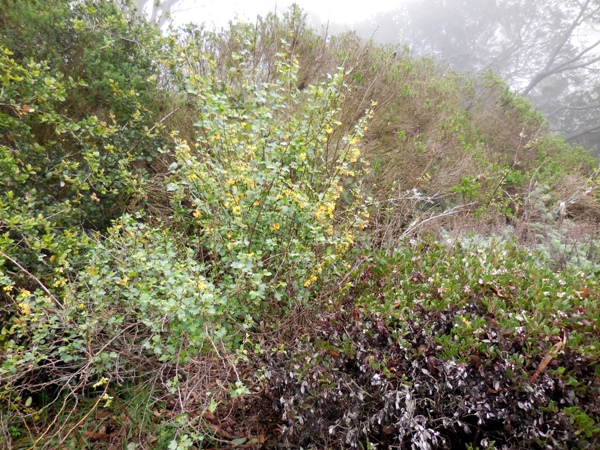
The Native Plant garden on the summit on Mount Sutro is green from the rain. These are the best few months to see it before it goes brown and dry in the summer. Right now, the shrubs are green, the yellow-flowering currant and manzanita  have little flowers.

“That manzanita isn’t native to this place,” said my companion. “It doesn’t matter, unless you’re particular about native plants.” We weren’t, and neither was the Anna’s hummingbird that checked them out. (It was moving too fast for our cameras.)

ribes and manzanita in Mt Sutro native plant gardennative gardenEven the Field of Plastic Flags (a meadow that the Sutro Stewards have been working on planting as a pollinator garden, with mixed success) was green – though mainly with non-native grasses.

 field of plastic flagsWe stopped to admire this small oak tree in the Native Plant garden.

 oak“It’s doing well,” said my companion. “Those eucalyptus trees are blocking the wind for it.” Yes. Native and non-native, thriving together.

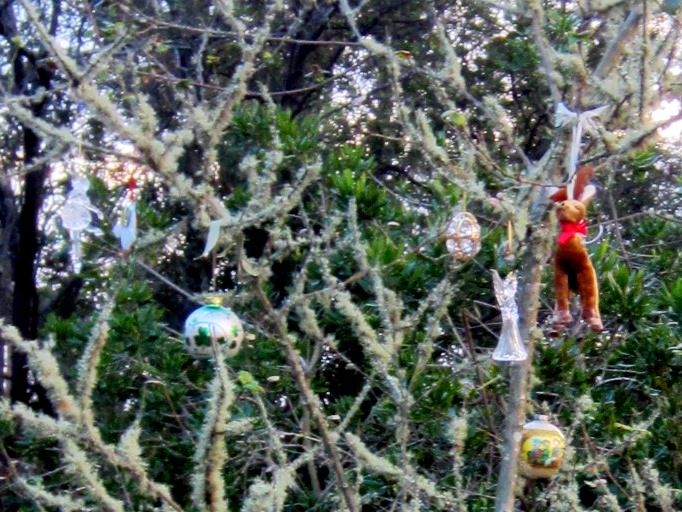
On another tree, which wasn’t doing so well and was covered in lichen, someone had hung Christmas tree ornaments – including a highly-appropriate owl. We’d noticed it first last month, and people had helped themselves to some of them

ornaments in dying tree in Sutro Forest Native Gardenornaments on a small tree in Sutro Forest Native GardenISHI’S SHRINE

We walked back past the little shrine that used to be Ishi’s Shrine.

ishi-with-bowIt’s now an eclectic mix of things but still a special place.

For readers who don’t know about this – there’s a history. When we first started this record, the little cave below was a shrine to Ishi, the last of the Yahi Indians. Then the picture was removed – we don’t know by whom. The shrine gradually changed into a sort of place of wishes and things.

Here’s what it looks like right now. But we still remember Ishi each time we walk by it. We left a quarter in his memory anyhow.

forest shrine

Ishi in 1914

Ishi in 1914

The forest is beautiful, especially on foggy or cloudy days. But there’s no denying that some parts of it have been damaged by the tree-felling that’s occurred in 2013 and 2014, and the massive removal of understory vegetation. The area in the picture below got a double-whammy – the area above Medical Center Way road had understory and many trees removed for “fire safety” work around the now-very-visible water-tank; and below the road, many large trees were removed as ‘hazardous’ even if they actually posed no real threat.

pics6 155 logged forestpics6 152 wreckThis used to be some of the lushest and densest area of the forest, full of tree tunnels and loud with the song of the Pacific wren.

So much vegetation has been removed that this thing has surfaced. Not quite sure what it is, but it’s a wreck. Someone has taken a really nice picture of it and labelled it “Hell of a Hull.” (Follow the link to see that picture.)

baby eucalyptus will grow tall one dayIn some places in the forest, it’s trying to come back. This little eucalyptus sapling will one day be as tall as the beautiful mature trees beside it – if it isn’t knocked down first by the euc-haters.

This picture also clearly shows the acacia sub-canopy of the forest. Acacia and eucalyptus together are superb at sequestering carbon. Acacia fixes nitrogen, feeding the other plants and trees. And eucalyptus, with its dense wood, large size, fast growth and long like is one of the best carbon-sinks there is.

BIRDS

We did see and hear quite a few birds, though we didn’t have binoculars: There were Pacific wrens on the other side of the mountain, fox sparrows, song sparrows, juncos, robins, ruby-crowned kinglets, pygmy nuthatches, and Anna’s hummingbirds. It’s not surprising, given that nearly 50 species of birds have been seen and heard in Sutro Forest. The disturbances in the forest and the habitat removal with the understory being destroyed have reduced the sheer numbers, but there are still a lot of birds around.

“This looks like a pretty healthy forest,” said my companion as we explained about all the allegations it was dying. It did. It’s a naturalized forest, which has to be thought of as a forest, a population with some trees that are thriving and some that are declining, and they’re all part of the forest with an ecological role to play. And we have to say it again – the forest is still lovely, and given a chance will heal from all the disturbance and damage.

Mt Sutro cloud forest We’d like to end by sharing a quirky picture – it’s not much good as a photograph… but it suggested an abstract Impressionist water-color of Mount Sutro Cloud Forest.

sutro forest - almost a watercolor 167


Posted in Environment, eucalyptus, Mt Sutro Cloud Forest | Tagged , , , | 2 Comments

Mission Blue Butterfly- The Latest on Twin Peaks

Public domain photp Mission Blue by Will ElderNPSIn November 2014, San Francisco Recreation and Parks Department published an upbeat progress report on their project to reintroduce the Mission Blue butterfly to Twin Peaks.  This butterfly is an endangered subspecies of the not-threatened Boisduval’s Blue.

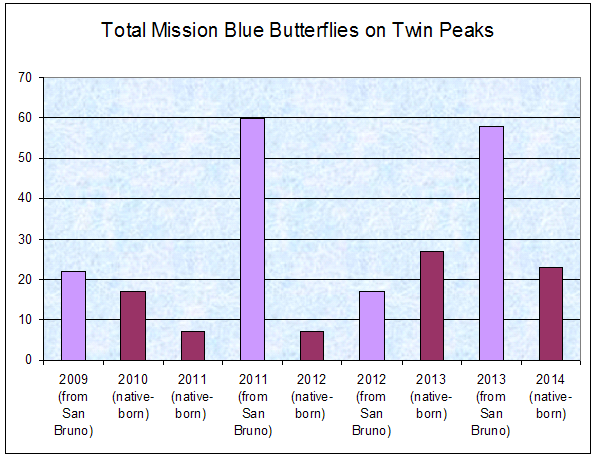
The project staff (SF RPD and outside consultants) have been transporting specimens to Twin Peaks from San Bruno mountain, which has the largest Mission Blue population. The graph below shows the total number of butterflies introduced from San Bruno mountain (light purple) and the butterflies born on Twin Peaks (dark-colored columns) by year. Of course, the dark-colored columns only count the butterflies actually observed; the actual number present is probably much larger.

Mission blue graph 2014 totalWe’ve been following the multi-year project and reporting on it from time to time – HERE (March 2013), HERE (April 2011) and HERE (June 2010). Our own assessment is more tempered.

THE BACKSTORY

The project started some years earlier, with three kinds of lupine being planted on Twin Peaks. Lupine is the nursery plant of the Mission Blue – it’s the only plant on which it’s know to lay its eggs and which the caterpillars eat. Lupine planting continues.

Mission blue eggs hatch into caterpillars which eat the lupine, shedding their skins as they grow. The larger caterpillars are tended by native ant species, who protect them from predators while benefiting from “honeydew” – sugary caterpillar pee. When they’ve grown to their full size, they form their pupae near the base of the plants, or even on the soil beneath, and remain there for months (in diapause). They hatch into butterflies in spring, sip nectar from a range of flowers,  mate, and lay eggs on lupines.

These butterflies have only one generation a year and an 8-10 week flight season, becoming visible in April and May. The males live an average of 7 days, and females for 8 days. The males usually hatch before the females do, so they are ready to mate when the females appear.

Here’s what has happened on the project so far:

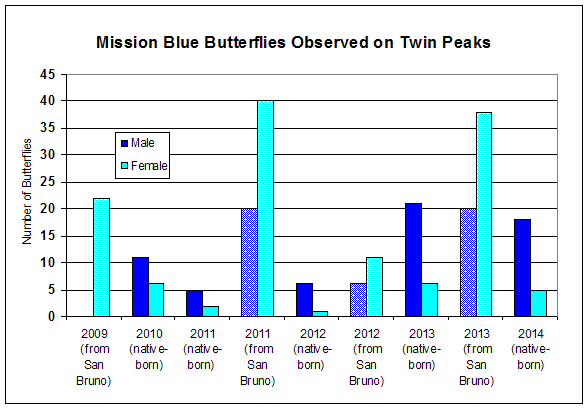
  • In 2009, the project staff moved 22 female butterflies to Twin Peaks and caged them over lupine plants until they laid their eggs. They hoped the butterflies would go forth and multiply.  Only a small number made it.
  • In 2010, NAP observers counted 17 adult butterflies,  and 14 larvae.  This was not a self-sustaining population.
  • In 2011, they spotted only 7 adults of which two were females, and 3 larvae. So they got US Fish and Wildlife Service permits to take more butterflies from San Bruno Mountain – 40 females and 20 males – which they released in May 2011.
  • In 2012, they observed 7 butterflies (one female) and 6 larvae. Then they transported 11 female and 5 male butterflies from San Bruno Mountain. (They had permission to transport 60, but could not get them.)
  • In 2013, they saw a total of 27 native-born butterflies, of which 6 were female – and 5 larvae. Then they caught 38 female and 20 male butterflies on San Bruno mountain and released them on Twin Peaks. Follow-up surveys observed a lot of eggs – 1120 – on Twin Peaks – much more than in previous years, when the highest number observed was 273.

Mission Blue 2014 graphWHAT’S HAPPENING NOW

The large number of eggs seen in 2013 didn’t pay off as a population spike – the number of butterflies born on Twin Peaks didn’t go up in 2014. The attrition rate from egg to butterfly is high, because of everything from predators to disease to parasitoids. And bad weather.

In 2014, they saw  23 native-born butterflies on Twin Peaks (5 female). This was despite spending more time looking than in the previous year (9 visits instead of 5) and going across the whole season. Since they didn’t move any butterflies from San Bruno in 2014, and so were not spending time capturing butterflies, project staff could spend more time observing them on Twin Peaks.

Based on their experience on San Bruno mountain, the project leaders believe that this sample indicates that Twin Peaks has between 137 and 274 butterflies, of which half would be female.

So here’s the big question: Is the Twin Peaks population of the Mission Blue reproducing and expanding? Or is it dependent on continuing transfers from San Bruno mountain? With a sample this small, it’s difficult to tell, and the project staff  note that their methodology is a work in progress.  The population estimates could change.

What is clear is that the current situation is marginal. The project staff plan to get USFWS permission for another transfer of butterflies from San Bruno mountain in spring of 2015.

Some good news: 55 Mission Blue caterpillars were spotted in 2014, compared with less than 15 in all previous years back to 2009. And – an ant was seen tending one, which is encouraging. Ants help to fend off parasitoids.

GARDENING THE HABITAT

It’s hard work maintaining habitat for the Mission Blue, for several reasons.

  • Lupine is a plant of disturbed areas. It tends to die out in more stable environments. So to maintain lupine, SFRPD will have to keep planting it and creating the conditions it needs, including watering it for the first couple of months until it’s established.
  • The butterfly stays close to home, so they need to plant a lot of lupine so they don’t have fragmented populations. Most don’t travel further than 600 meters, according to the USFWS.
  • The butterfly prefers areas with short grass where the lupine patches are visible. Volunteers have been trimming the grass around the lupine patches.
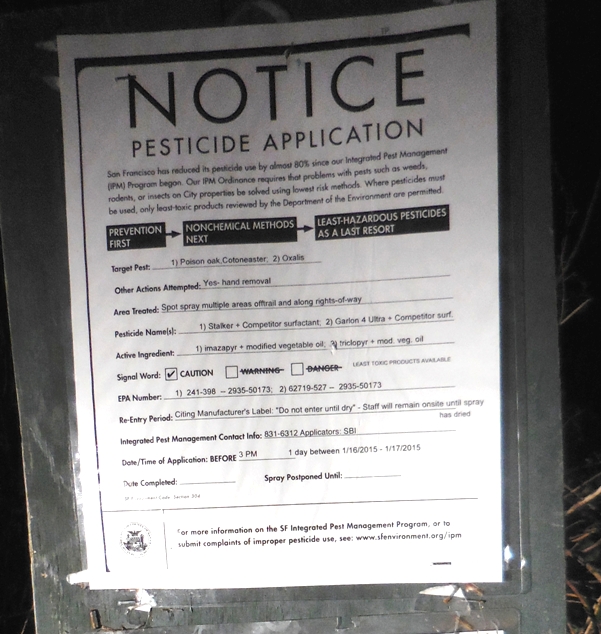
  • With natural succession,  grasslands tend to become scrub. Keeping them open as grasslands means a battle with shrubs moving in – very often the coyote brush. Ironically it’s a native plant, but SFRPD has removed 5000 square feet of it on Twin Peaks. They also use a lot of herbicides – Garlon (triclopyr) and Stalker (imazapyr) for the purpose and to fight other plants that they don’t want there.

twin peaks - jan 2015 - imazapyr and garlon for poison oak cotoneaster oxalisThe ongoing use of toxic herbicides, in addition to being bad for the environment might not be much good for the butterflies either. In a study on Metalmark butterflies [Stark_2012 – Metalmark butterflies and pesticides], researchers found that triclopyr and imazapyr reduced reproductive success by 24-36%.

What this means is that maintaining a Mission Blue garden on Twin Peaks will never stop requiring a lot of volunteer labor with SFRPD staff and outside consultants supervising. As the report says, “unmanaged habitat degrades quickly.”

(You can read the actual report here: TwinPeaksProgressReportNov2014 )

Posted in Environment | Tagged , | 6 Comments

SF Forest Alliance Sent 1700 Signatures to Mayor Lee!

Supporters may recall that in January 2014, we published a request for signatures for a new petition from San Francisco Forest Alliance, asking Mayor Lee to rein in the Natural Areas Program (NAP) of the SF Recreation and Parks Department. That petition is closed – with over 1700 signatures! SF Forest Alliance now seek signatures for their ongoing petition, which had been dormant as they focused on the new one.

Copy (4) of sign button
Here’s the report from the SFForest website, republished with permission.

(The Natural Areas Program controls about a quarter of Sutro Forest, and has recently used pesticide there. Meanwhile, UCSF has said they will not use pesticide in the area they control.)

———————

OVER 1700 SIGNATURES TO MAYOR LEE

Fairytale forest on Mt Davidson

Our supporters will recall that last year, we ran an online signature campaign specifically addressed to Mayor Lee, asking him to:

Stop NAP from destroying trees and thickets, spraying dangerous herbicides, disrupting healthy ecosystems that support hundreds of species, and restricting access to our city parks.

twin peaks - jan 2015 - imazapyr and garlon for poison oak cotoneaster oxalis

Stalker and Garlon on Twin Peaks – Jan 2015

NAP is the Natural Areas Program under San Francisco Recreation and Parks Department. It is essentially a “native plant program.” It prioritizes native plant introduction (using the dog-whistle term “biodiversity”) over other values, whether environmental, ecosystem services, or recreational.

We had learned the Mayor’s office would respond to petitions directed to him via Change.org. That petition got over 1700 signatures, and is now closed.

However, our ongoing petition continues, and if you have not signed it, please do? (It currently has 1500 signatures as people shifted their focus to the newer petition.)

Stop NAP buttonWe need to keep sending the message that people want public parks preserved for the public, with trees, trails and no toxins.

Posted in Environment, Natural areas Program | Tagged , | Comments Off on SF Forest Alliance Sent 1700 Signatures to Mayor Lee!

What Happened to Sutro Forest in 2014 – and Happy New Year!

Happy New Year to all our readers! We thought we’d end the year by reviewing the pluses and minuses for 2014.

POSITIVES

UCSF logo with herbicide statement+ UCSF has suspended its plans to cut down 90% of the trees in Sutro Forest. A new plan and a new EIR are due, but we don’t know when.
+ UCSF held off on cutting down the white-dotted trees in Sutro Forest, which could have happened by now. They say they are going to review the trees carefully and only remove those that are actually a hazard.
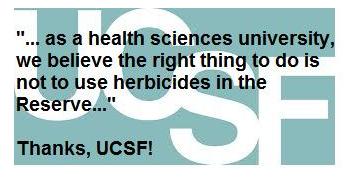
+ UCSF has committed to not using herbicides in Sutro Forest: “…as a health sciences university, we believe that the right thing to do is not to use herbicides in the Reserve…”  The forest has been herbicide-free since the end of 2008, and the Aldea Student Housing since 2009. This means that people need not fear herbicide contamination for themselves, their children or pets, and residential neighborhoods downslope of the forest need not fear herbicides washing into their yards and streets. Thanks, UCSF!
+ We’re beginning to make headway with spreading the word. This site got 29 Thousand views in 2014. Our Facebook page has nearly 700 “likes.”

NEGATIVES

Some 1250 trees were removed in two batches (Aug 2013 and March-May 2014). The first was as a so-called “fire-safety” measure that may instead have increased the hazard by drying out the forest and disturbing tree roots to damage trees; and the second to remove “hazardous” trees, few of which were actually hazardous.
While UCSF has suspended its plans to cut down forest trees, we’re unsure they have actually decided against it.
The guiding principle of removing vegetation and trees and replanting only scrubby plants remains. We’re not sure why UCSF should remain invested in a nativist ideology that is increasingly being challenged, but for now, we think it continues.

MEANWHILE, ELSEWHERE IN THE BAY AREA…

For more 2014 Pluses and Minuses in the general fight to save trees and forests in the Bay Area, please follow this link to the Million Trees year-end wrap-up.

If you feel inclined to make a donation to help save hundreds of thousands of trees, the Hills Conservation Network – which spearheads the battle to save the East Bay forests – is raising funds: “This takes money, so please do what you can either by sending a check to HCN at P.O. Box 5426, Berkeley, CA 94705 or by making a donation through our website at http://hillsconservationnetwork.org/HillsConservation3/Support_HCN.html ” It’s a 501c3 organization, so your donations would be deductible.

A CARD FROM SUTRO FOREST

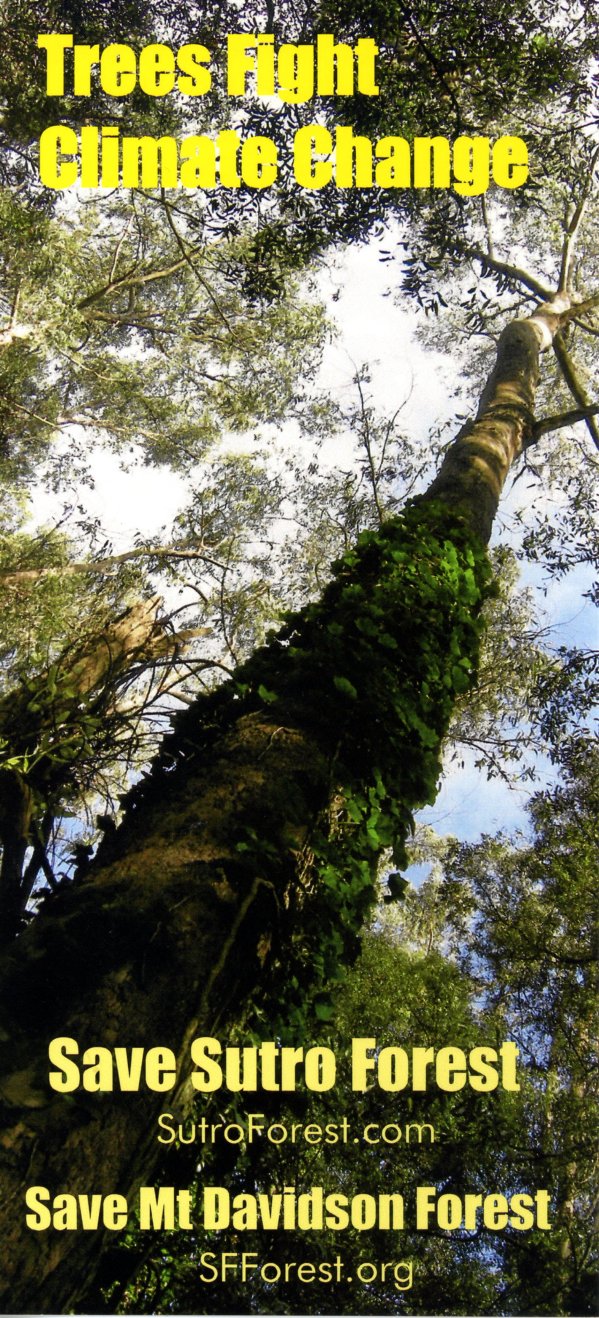
And here’s a New Year card from us to all our readers: Trees Fight Climate Change.

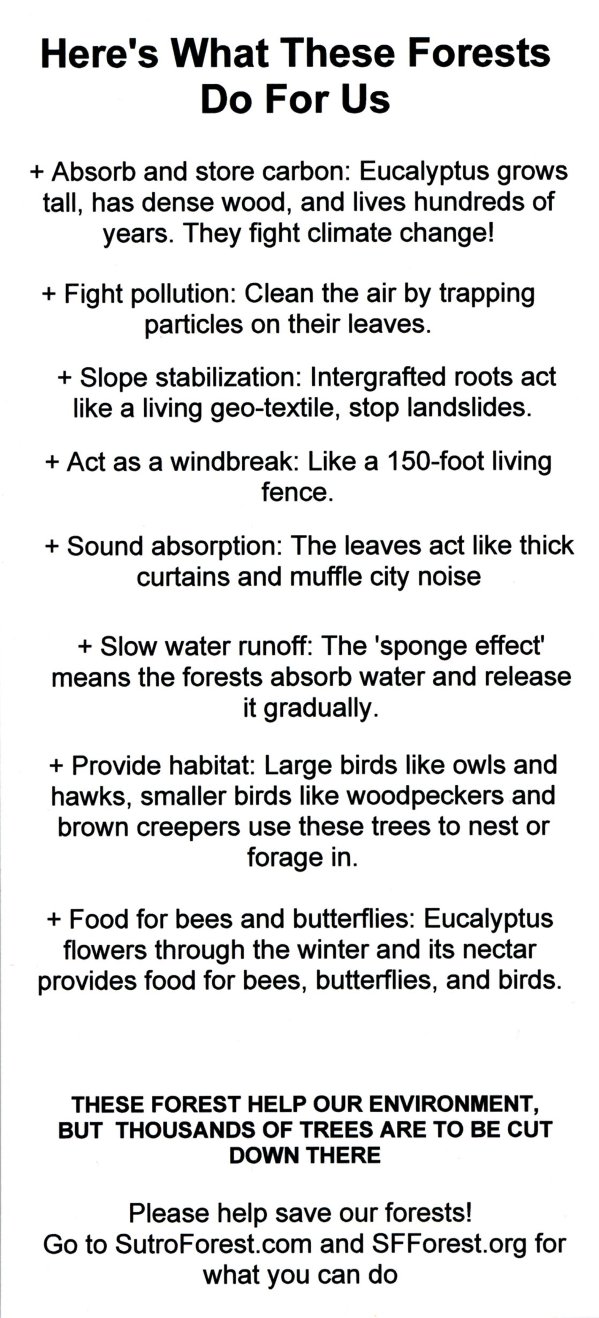
sutro tree message card smHere’s why our forests are important:

sutro tree message card 2 smThanks for all your support all these years! We’re still working to save our trees and forests!

Posted in Environment, Mt Sutro Cloud Forest, nativism, UCSF | Tagged , , , , | 3 Comments

East Bay Trees to be Destroyed – How to Help

lake-chabot cropped Photo credit MillionTrees dot meOur regular readers may recall that an extremely destructive project is planned for Berkeley and the East Bay Hills of the San Francisco Bay Area. It’s going to fell nearly half a million trees. The land managers sought FEMA funding for this project, and a Draft Environmental Impact Statement (EIS) was published. We wrote about this project HERE.

The good news is that people responded: There were around 13,000 comments on the draft EIS. The bad news is that the Final EIS, released recently, is not a significant improvement. It will still destroy hundreds of thousands of trees, increase fire hazard, destabilize slopes, and use huge amounts of herbicide.

The fight to save the trees and environment is not over. We ask you to support the Hills Conservation Network, which is spearheading the effort.

The article below is republished with permission and minor changes from Death of a Million Trees, which fights unnecessary tree-destruction.

FINAL EIS FOR FEMA PROJECTS IN THE EAST BAY IS

NOT AN IMPROVEMENT!

On December 1, 2014, FEMA published the final Environmental Impact Statement (EIS) for the projects in the East Bay Hills which propose to destroy hundreds of thousands of non-native trees. FEMA’s email announcement of the publication of the EIS implied that the projects had been revised. Two of the agencies applying for FEMA grants—UC Berkeley and City of Oakland—had originally proposed to destroy all non-native trees on their properties. The third agency –East Bay Regional Parks District—had proposed to thin non-native trees in most areas and destroy all in a few areas. FEMA’s email announcement of the final EIS implied that both UC Berkeley and City of Oakland would be required to use the same “thinning” strategy as East Bay Regional Parks District.

After reading the final EIS, the Hills Conservation Network (HCN) is reporting that FEMA’s email announcement was rather misleading. In fact, both UC Berkeley and City of Oakland will be allowed to destroy all non-native trees on their properties. In a small sub-section (28.5 acres) of their total project acres (406.2 acres), UC Berkeley and City of Oakland are being asked by FEMA to destroy the trees more slowly than originally planned. However, they will all be destroyed by the end of the 10 year project period.

HCN has analyzed the EIS and consulted legal counsel. The following is HCN’s assessment of the EIS and their plans to respond to FEMA. We publish HCN’s assessment with their permission. Note that HCN is asking the public to send comments to FEMA and they are raising funds to prepare for a potential legal suit.

HCN LETTER

“After having reviewed the Final EIS in depth and having consulted with various stakeholders, HCN has concluded that the Final EIS, in spite of FEMA’s efforts to improve it from the Draft version, remains unacceptable.

“While FEMA has made some modifications to portions of the EIS in response to the enormous number of comments submitted last year [more than 13,000], the fact remains that if implemented in their current form, these projects would remove essentially all of the eucalyptus, pines, and acacias from the subject area. While for portions of the area FEMA is now proposing that there be a phased removal of these species, the fact remains that the objective is ultimately to convert the current moist and verdant ecosystem into one dominated by grasses, shrubs, and some smaller trees. This will forever alter the character of these hills that so many of us have grown up with, know and love.

“But worse than that, these projects would actually increase fire risk, destabilize hillsides, cause immense loss of habitat, release significant amounts of sequestered greenhouse gases, and require the use of extraordinary amounts of herbicides over a large area for at least a decade.

“Additionally, by preemptively clearcutting 7 acres of Frowning Ridge in August of this year, UC not only made a clear violation of FEMA rules but also essentially negated the accuracy and relevance of the EIS. While FEMA acknowledges this in the EIS, they still want to move forward with a document that may no longer accurately reflect the reality of the current environment, the cumulative impacts of these projects, and any of the other factors that underpin the EIS process.

“For these reasons, HCN will be submitting a comment letter to FEMA asking that the EIS be pulled back, reworked, and recirculated….at a minimum. Additionally, we are currently exploring legal options should the EIS be finally released on January 5, 2015 in its current form. One way or another, we are committed to ensuring that the will of a small number of influential people doesn’t result in the loss of a treasured resource to the vast majority of us (both human and other).

“We ask your support in sending additional comment letters to FEMA [ebh-eis@fema.dhs.gov] and most importantly that you consider making a tax-deductible contribution to HCN. While we wish we did not have to do this, the fact is that the only way we can have a shot at preventing this irreparable harm from happening is by hiring lawyers, and that is what we will do. This takes money, so please do what you can either by sending a check to HCN at P.O. Box 5426, Berkeley, CA 94705 or by making a donation through our website at http://hillsconservationnetwork.org/HillsConservation3/Support_HCN.html.

“Thanks again for all your support,

“Hills Conservation Network”

Posted in deforestation, Environment | Tagged , , | 1 Comment

Black Lives Matter to Everyone

This site focuses on Mount Sutro Cloud Forest, but in the past we’ve digressed into other areas of environmental and public interest. We discussed butterflies, herbicides, and even a particularly egregious study that attempted to indicate that cats were major killers of birds though their data actually disproved the claim.

forest girlWE STAND AGAINST PREJUDICE

Today’s digression is on a much more serious topic. We’re moved and upset by what has surfaced about the risk to African-Americans adults and even children as a result of embedded  prejudice. It’s increasingly clear that across large parts of the country, they cannot take for granted the simple liberties and courtesies that most others expect as a right. We’ve been dismayed by mothers and fathers saying they have to have “The Talk” with their children at increasingly early ages. We’re dismayed that such a Talk is necessary. There’s discussion of a post-racial society; clearly, we are not there.

As our cities rise in protest, we want to declare our solidarity with those who agitate: The Black Lives Matter movement; the Medical Students’ Die-In; and all those who fight the injustice that imperils our communities of color.

We stand with them.


Posted in nativism | Tagged | 1 Comment

Sutro Forest Thanksgiving

Fall in San Francisco brings uncertain weather – (welcome) rainy days mixed in with days of beautiful crisp clarity (also welcome). The day before Thanksgiving was a picture-book  afternoon, and Sutro Forest beckoned.

pix9 072 forest
We went up perhaps an hour before sunset, and the light was already turning golden.

A tiny crescent moon shone high up. We used to call a daytime moon “the Children’s Moon” – a leftover from the Victorian era in which children were put to bed so early in summer that they didn’t see the moon at night.

Childrens moon  over Sutro Forest
There’s still a wildness to the forest, and a natural beauty that hasn’t yet been cut away. Not all the trees are straight, and the leaning and twisted ones add to the forest’s character.

symmetry
There aren’t many flowers in the forest now, but some nasturtiums persist.

nasturtiums in sutro forest
We heard a lot of birds in the canopy, too far for us to recognize them. A few also scratched and darted around the bushes. We heard a humming bird clicking and buzzing, and here’s a fuzzy picture of (probably) a hermit thrush.

hermit thrush in sutro forest

LOST AND  FOUND

As sometimes happens, we came across things people had left behind.

 lost spade
Sutro Stewards, if you are missing this spade – it’s near the Christopher trail head.

animal cap
And whoever belongs to this animal cap/scarf – it’s been careful placed on a log on the North Ridge trail down from the Native Garden.

Sutro Forest trail
We continued down the trails with the light slanting in.  For such a lovely day, there were few people in the forest. There were maybe half a dozen hikers over two hours, and three or four bikers enjoying the natural beauty and peace of the forest.

pix9 051 forest at sunset
Without the fog, there were views out of the forest.

golden gate bridge from Sutro Forest
The trails are damp from recent rain, but not muddy except in a very few easily avoided places.
pix9 098 view window
The forest has some bare areas it didn’t have before – those that have been decimated by the so-called ‘fire-safety work’, the felling of over 200 trees declared hazardous, and drastic understory removal.

cleared area in sutro forest
Still, you can avoid those areas, and much of the forest is still very lovely.

Sutro Forest glows golden in the sunset

THANKSGIVING

So on Thanksgiving Day 2014, here’s what we’re thankful for:

  • That Adolph Sutro planted this wonderful forest 125 years ago.
  • That this piece survived when much of the rest of his forest was cut down;
  • That through the efforts of neighbors who fought to save it in the 1970s, it did not become a construction site;
  • And that 15 years since the Plan to destroy most of its trees and understory, it yet stands tall and beautiful.
Posted in Environment, Hiking | Tagged , , , | 2 Comments

Managing Urban Coyotes: by Janet Kessler

coyote npsA few months ago, coyotes were sighted in and around Sutro Forest. In fact, all urban parks – and some neighborhoods – in San Francisco have families of coyotes visiting or living in them. For those who love wildlife, this is a charming development. However, there are concerns especially around small, off-leash dogs. We’re republishing this article (with permission and minor changes) from CoyoteYipps.com to help people who want to know how to react to coyotes. Janet Kessler is a wildlife observer and photographer, specializing in urban coyotes in San Francisco. She has been called the Jane Goodall of San Francisco’s coyotes. The takeaway for us:

  • Killing coyotes destabilizes territories, resulting in more, younger coyotes coming in. Fortunately, San Francisco does not usually kill coyotes.
  • Shooing off coyotes shouldn’t be done unless they are really close. If they’re at a ‘safe’ distance, they’ll just get accustomed to people making loud noises. When it’s done, it must be done convincingly. Here’s a PDF from Coyote Coexistence explaining how: shoo-coyotes-off-final-7-23-14
  • Feeding coyotes is a bad idea; it encourages them to hang around areas where pets and people are found.
  • Leashing dogs in coyote areas, and keeping pet cats indoors protects your pets. Coyotes may consider small pets as food.

——————-

MANAGING URBAN COYOTES: by Janet Kessler

2014-11-15 (4)

MANAGING COYOTES

Most cities seem to leave it to individuals — not even larger neighborhood groups — to trap and kill coyotes as they see fit. Folks have long been taught that killing them is the way to manage them, even though it has been proven that this results in higher and younger populations, and fewer stable families to keep other coyotes away. In some places a permit might be required at certain times of the year, but usually not, and sometimes a reason is required to get the permit — including that the coyote was a “nuisance”. In one community, coyote yipping sounds were deemed a “nuisance”. These protocols seem to be the norm. There is no education behind them.

Few cities have actual written “coyote management plans”, such as the plans in Vancouver and Denver. More cities have informational websites offering the standard guidelines and explaining that killing coyotes doesn’t work — again, folks are free to trap and kill if they want to in these communities.

Here in San Francisco trapping and killing are not permitted, but we do not have a written coyote management plan per se, because it was deemed unnecessary. A coyote organization attempted to push its plan through in San Francisco — a plan that included extensive hazing — which the San Francisco Animal Commission wisely turned down. Coyotes do not need to be “hazed” whenever they’re seen — it can be counterproductive. See below.

What works here in San Francisco is educating the public about coyotes and their behavior and giving folks guidelines which will prevent conflicts and other issues. I’ve helped convert many folks to a positive mindset just by telling them a little about coyote family life and iterating the guidelines with some one-on-one help on shooing them off. Coyotes do not approach people unless taught to do so with food, so feeding of coyotes is forbidden, and folks are taught not to leave food attractants out in their yards.

As everyone should know, pets are the main issue of concern, but this is an issue which can be easily managed by not allowing pets to roam free, and by keeping dogs leashed in coyote areas. Basically, what the authorities have been saying here in San Francisco is, that if a dog is bitten by a coyote because the dog was not leashed, or if a cat is taken because it was allowed to roam free, it’s really the owner’s fault and could have been prevented by following the guidelines — please take better care of your pet. This protocol is the only way to make coexistence work: it’s easy, it’s effective, it’s responsible, and the burden of responsibility is on the pet owner to guard his/her pets.

HABITUATION AND HAZING

I would like to add something here. . . . In my opinion, some of the “expert” information out there is counterproductive and remiss — it’s actually hurting coyotes and increasing fears in humans. For instance, “hazing” — mostly noise and erratic movement such as arm waving — is promoted as a cure-all which will cause coyotes to flee. But as I’ve seen here in San Francisco, and as we’ve seen in several cities which have now returned to trapping, for example in Seal Beach in Southern California, coyotes can get used to this and begin responding to it more slowly or even ignoring it.

The big problem then is what this does to people’s perceptions about coyotes: folks are under the impression that if a coyote doesn’t flee quickly when hazed, that it is therefore “habituated” and that it now poses a danger to the community. This is not so. Folks have been taught that a “habituated” animal is a dangerous one. This, also, is not true. Because of what has been taught incorrectly about habituation, folks feel that if they simply see a coyote, or if it doesn’t flee quickly upon seeing a person, it must be habituated, or on its way to becoming habituated, and, therefore, to becoming dangerous. Where does this come from? There is no science at all behind it. Telling folks this is increasing their fears. So teaching that “hazing” is a solution has actually backfired.

COYOTE BEHAVIORS

We all need to become aware of coyote behaviors so that we can know how to prevent issues. Yes, coyotes don’t like canine intruders in their territories: they even don’t allow non-family coyotes in.

  • All canines, be they wolves, dogs, foxes or coyotes, don’t really like each other and all will exclude the others, as well as members of their same species who are non-family members, from their territories. This is instinctive behavior. We can’t really change their instincts of survival, but we can learn about them and understand them, and modify our own behaviors, so that all of us — human, cat, dog, coyote — can coexist. The guidelines are few and simple.
  • The other instinct driving coyote behavior is a food drive. We all need to eat. Coyotes normally hunt small rodents, but they will look for free food which they may find on their wanderings, and they may grab a small pet if the opportunity arises. So, hey, let’s not let those opportunities arise!
  • Roaming through their territories as they visit their hunting spaces is another instinctive behavior. Everyone should know that, by doing so, coyotes in fact are preventing other coyotes from moving in.

Most importantly, coyotes really want to avoid humans. In most urban areas they’ve altered their schedules to avoid us: they are active mostly at night when we are not, even though they are not nocturnal animals.

SIMPLE GUIDELINES ARE WHAT’S NEEDED

What actually needs to be taught is that habituation is normal: all animals become habituated to sounds and movements in their environments. It’s okay, and even fun, to see a coyote. This should not cause fear. We should be shaping the overall mindset of folks to think more positively about coyotes. And we need to teach that coyotes are wary — not fearful — of people: they’ll do their best to avoid us, even if they might not flee as quickly as someone might want them to. In spite of this, coyotes will always be wary of people to a certain degree.

It is feeding coyotes which should always be strictly forbidden — it is food-conditioning that could teach them to become demanding or even aggressive in their behavior — and attractants of any sort should be eliminated from yards: you don’t want to invite them to visit, and you might even want to discourage them by shooing them off if you happen to be there. Everyone should be taught how to shoo away a coyote effectively. Scaring or shooing them off intensely should be reserved mostly for when the coyote has entered your personal space — say 30 feet — or is coming after your dog, or if one has entered your yard. Everyone should be taught to respect a coyote’s space and keep away from it. But seeing a coyote off in the distance, or even as close as 50 feet, in a park during the day is normal and healthy coyote behavior. Please see this flyer for detailed information and explanation on scaring off a coyote: PRESS HERE.

Because of territoriality and because small pets are often seen as prey, but also because pets may be seen as an annoyance to coyotes — the presence and activity of small pets can be interpreted by coyotes as harassing or challenging them, so it’s not always about predation — it’s of prime importance that folks guard their pets: keep pets from roaming free, leash pets in coyote areas, don’t let pets chase coyotes, don’t leave food and other attractants out in your yards, know how to shoo away a coyote if it approaches your pet or if it comes into your yard. Aside from guarding pets, the most important management tool we have is habitat modification, consisting mostly of removing all food attractants to keep coyotes away. BUT, on occasion, folks need to realize that a coyote might come by — but that this should not be cause for alarm.

EXAMPLES OF MISINFORMATION AND MISBEHAVIOR BY HUMANS

One of the problems in the New York State community of Westchester, is that, due to misinformation presented to the residents, folks felt that “hazing” was no longer working, that because coyotes were becoming “habituated” to the hazing and appearing in someone’s yard, the coyotes were perceived as aggressive and dangerous: a coyote was shot a week ago in that area, in Mamaroneck, simply because it was sighted in a backyard and, therefore, deemed aggressive!! [Edited here] Let’s educate the public properly and let’s use habitat modification as a primary tool, such as removing food sources. I’ve sent a version of this letter out to others, who, like me are helping with the coyote issue in Westchester.

Here is an example of irresponsible and counterproductive behavior by humans. I’ve been keeping track of a particular group of dogs in one of our parks in San Francisco whose owners don’t leash-up and who allow their dogs to chase after coyotes. Fascinatingly, it’s this group of dogs — almost certainly because of their hostile and antagonistic behavior towards coyotes — that the coyotes watch and monitor. These dog owners feel that coyotes are a nuisance, but it is their non-compliance with leashing guidelines and allowing their dogs to chase coyotes which makes these dogs subjects of interest for the coyotes. The owners have, in effect, been allowing their dogs and the coyotes to engage and interact. It’s our responsibility not to allow any such engagement: the repetitive cycle can be broken by leashing the dogs. Other dogs in this park are leashed-up and walk on, and, not surprisingly, these dogs and coyotes leave each other alone.

These are my current conclusions, based on my own experience and observations over the last 7+ years, and from reading some of the recent reports from various locations around the US.

2014-11-15 (3)

Posted in Environment, Mt Sutro Cloud Forest | Tagged , | 1 Comment

SF Beautiful Nominates Your Webmaster

sutro forest 1SF Beautiful, a non-profit organization that promotes and celebrates efforts to make – and keep – the city beautiful, nominated your webmaster for an award as an ‘unsung hero.’ The real unsung hero, of course, was beautiful Sutro forest itself, which was featured in a slide show at the reception. (These are the two pictures that were shown.)

sutro forest 2

Boutonniere from SF Beautiful

Nominees’ boutonnieres from SF Beautiful

The winner in this category was Kathleen Russell, an absolutely amazing community volunteer who built and maintains a community garden near St Mary’s Hospital, at Stanyan and Fulton. She is out there every day or every other day, as she has done for 20 years! Her dog, who usually accompanies her, is a therapy dog at the hospital and also a happy meet-and-greeter for neighbors who stop by.

Congratulations, Kathleen! It was an honor to be on the same slate as you.

And thank you, SF Beautiful, for the nomination and for all you do to support and celebrate the beauty of this city.


Posted in Uncategorized | Tagged , , | 2 Comments

No Comments at UCSF’s LRDP EIR Hearing – 22 Sept 2014

UCSF held a meeting for public comments on the Draft Environmental Impact Report (DEIR) on its Long Range Development Plan (LRDP) on Sept 22, 2014. About 15-20 neighbors showed up. No one had any comments. The meeting started at 7p.m. and adjourned at 7.15 p.m. They had a few copies of the DEIR; it’s roughly 2 inches thick.  The electronic version on UCSF’s website is HERE.

UCSF are accepting written comments until October 14th.

DEIR for UCSF LRDP 2014

It was surprising that no one commented. It was such a contrast with a similar meeting last year for DEIR comments about cutting down trees in Sutro Forest. There, 250 people showed up, 50 spoke (with over 70% opposed), and it  ran to 9.15 p.m.

WHAT’S HAPPENING ABOUT SUTRO FOREST?

This EIR was for the Long Range Development Plan, which is mainly about construction and changes in usage in Parnassus as well as UCSF’s other campuses. They have said that Sutro Forest is specifically excluded, since it will have its own Plan and will presumably have another EIR.

(As of now, we understand that UCSF has a new plan for Sutro Forest that focuses on fire hazard and commits to not using herbicides. We actually think the plan will increase, not decrease, the fire hazard by drying out the forest and making it windier. Anyway, the only information we have about the plan came from a Powerpoint presentation. There’s no EIR yet, but UCSF has said the new plan would need a new EIR when they can devote resources to it.)

Meanwhile, what UCSF has been doing is cutting down trees first for “fire safety” and then for “hazard reduction. More trees are expected to be felled before year end. This is considered routine maintenance and doesn’t require an EIR.

DOES THE LRDP AFFECT THE FOREST?

As far as we can gauge right now, the LRDP still affects the Forest in three ways:

  • A new trail is to be built from the Inner Sunset side, which is good; but it is likely to  cost trees, which is bad.
  • They are removing Aldea Student Housing from the space ceiling, with the immediate effect of preserving some buildings scheduled to be knocked down, and a long term impact of – who knows?
  • They plan to knock down two small office buildings in the forest – just off the parking lots. It’s a Space Ceiling issue.


Posted in Meetings, Neighborhood impact, UCSF | Tagged , | Comments Off on No Comments at UCSF’s LRDP EIR Hearing – 22 Sept 2014

A 1927 San Francisco Tourist Map Shows Sutro Forest

This delightful tourist map from 1927 has been circulating on the Internet. It’s got a lot of fun detail. (Clicking on this map will make it larger.)

san francisco 1927The RichmondSF blog researched the map, and had some interesting notes about the cartoons and what they referenced. The artist was Harrison Godwin, 1899-1984, and he created other cartoon maps including one for Hollywood.

Sutro Forest is prominently displayed – with a hunter, and a hold-up, and Affiliated Colleges (which later became UCSF).  That’s visible in the cropped and brightened version below.

san francisco 1927 sutro forest 1000 px

If you’re interested in buying a copy of the map, reprints are available from David Rumsey Map Collection.  Go HERE to access them on the web. They can do reproductions from 10 inches to 50 inches in size, and crop it if you want to.

Posted in Maps, Mt Sutro Cloud Forest, UCSF | Tagged , | Comments Off on A 1927 San Francisco Tourist Map Shows Sutro Forest

UCSF Meeting: Sutro Forest Notes (3 Sept 2014)

ucsf CAG meeting sept 2014UCSF’s quarterly Community Advisory Group (CAG) quarterly meeting was held on September 3rd, 2014. The CAG consists of selected people from the community, many of whom have been on it for years or decades. Though our point of view is not represented there, it is a public meeting, and we do often attend (and make comments).

Here’s what we learned about Mount Sutro Forest and Aldea Student Housing.

fern epiphytes on eucalyptus in Sutro Cloud Forest

1)  A new “hazardous tree” assessment has been made, and more trees will be felled before year end. This is in addition to over 1200 trees that were cut down since August 2013. UCSF said they have received the report, but will go through the forest and try to save as many trees as possible.

felled trees sutro forestWe sincerely hope this is true. Already, cutting down these trees is making the forest more vulnerable by reducing its ability to hold moisture, and by increasing wind velocities. It’s also destroying valuable habitat.

They said they do a hazardous tree assessment every two years, but they delayed cutting down the trees from the previous assessment until this spring (in the bird nesting season!) because they did the “urgent fire safety” work instead. So this year they will have done two rounds of tree cutting.

We’re concerned. From what we’ve seen, this tree felling seems to be concentrated in some areas – for instance, there’s been a lot of clearing below Medical Center Way, completely opening up the forest. This “hazardous tree removal” could destroy the forest in a few years by making the remaining trees more vulnerable.

2) A new trail – the “Sunset Trail” is being included in the new capital budget for 2014-2015. The trail could be built this year or next. They didn’t say how many trees it would cost, now or later.

3) pics47They will be putting in 5 signs to warn mountain-bike riders to yield to joggers and hikers. We’ve found bikers on the whole to be courteous and careful, but there are always a few who are not. It’s a multi-use trail on a steep mountain. It’s important to be careful.

In Aldea housing4) UCSF plans to remove the Aldea Student Housing from the space ceiling. They have said they do not plan to ask the UC Board of Regents to repeal the Space Ceiling (or the designation of Mount Sutro as an Open Space Reserve in perpetuity). For now, it means they will not demolish three dorms they had undertaken to remove and return the footprint to the forest.

Later, it could mean more building in Aldea, but no such plans are included in the Long Range Development Plan under way. (For an explanation of the Aldea space ceiling issue, go HERE)

Posted in deforestation, Environment, Mt Sutro Cloud Forest, UCSF | Tagged , , , | 2 Comments

AAA Says, Don’t Miss Mount Sutro

We’ve been members of AAA for decades, now, and value their adventure-inspiring magazine, Via, almost as much as their roadside service. Recently, we were particularly delighted to see a great article on one of San Francisco’s best-kept secrets – Sutro Cloud Forest.

AAA article on Mt Sutro

Here’s how the article starts:

“Step into the mist-shrouded forests of Mount Sutro Open Space Reserve and the spell is cast: The noise of neighboring Cole Valley vanishes, replaced by the creak of towering trees, an invisible chorus of warblers and sparrows, and the burble of a seasonal stream. Orange and yellow nasturtiums spill down the steep hillsides next to sword ferns and dense blackberry bushes.”

As many of our readers know, the unique and mysterious beauty of Sutro Forest is one reason so many people love the place and want to save it from those who would cut down thousands of its trees. (If you want to sign the petition to save the forest, and have not yet done so, it’s HERE.)

Unfortunately, the online version of the Via story – though more legible than our photo of the page above – doesn’t have the evocative photograph carried by the print version.after the fog in Sutro Forest

ADOLPH SUTRO LOVED TREES

They give a shout-out to the philanthropist Adolph Sutro, who planted this forest: “…purportedly in celebration of Arbor Day, though cynics claim he was motivated by a tax break for forested land within city limits.”

The cynics’ cynicism is misplaced. What the record shows is that he did it to beautify the city. Here’s what he wrote: “…people… will wander through the majestic groves rising from the trees we are now planting, reverencing the memory of those whose foresight clothed the earth with emerald robes and made nature beautiful to look upon.”

Here’s an item from the newspaper The San Francisco Call, written on 11th Oct 1901:

A FOREST— G. H. I., City. The forest that is on the hillside east, south and west of the Affiliated Colleges covers 194 acres. It is part of the San Miguel Ranch that was purchased by the late Adolph Sutro after making his millions by means of the Sutro tunnel on the Comstock. He named the place Mount Parnassus, after the mountain of that name in Phocis, greatly celebrated among the ancients and regarded by the Greeks as the central point of their country. Mr. Sutro was a great believer in the idea that for every tree that is destroyed two should be planted, and to show that trees will grow on barren hills he at the time he inaugurated tree planting in this city and on Goat Island a quarter of a century ago set out thousands of trees on Mount Parnassus, with the result that is noticeable to-day.

In fact, we understand he had willed that no trees would be cut down in the life-time of his heirs. But after his death, his will was broken and much of the land developed. Sutro Forest and Mount Davidson are the last century-old remnants of a forest that once covered more than a thousand acres.

If you want to know more about Adolph Sutro, here’s a well-researched article by historian Jacqueline Proctor – The Father of Tree Planting in California/ Adolph Sutro’s Urban Forests: Influences and Lasting Benefits.

epiphyte

Posted in Environment, eucalyptus, Mt Sutro Cloud Forest | Tagged , , , | 4 Comments

Mount Sutro: Fungi in the Forest

possibly lepiota rhacodes in Mt Sutro Cloud Forest

In an earlier post, we’d said that fungi and mushrooms were so unusual in Sutro Forest that we took photographs when we saw them – like on this walk in December 2012.

mushrooms 4But recently, on another visit to the forest, we found more mushrooms than we’d ever seen there before. They lined one of the trails, growing singly or in clusters.

mushroomsWe were interested to find out what they were.  One naturalist we consulted thought they could be a Lepiota species, possibly L. rhacodes. (Obviously, that’s NOT a definite identification, since it’s based on photographs not specimens.)
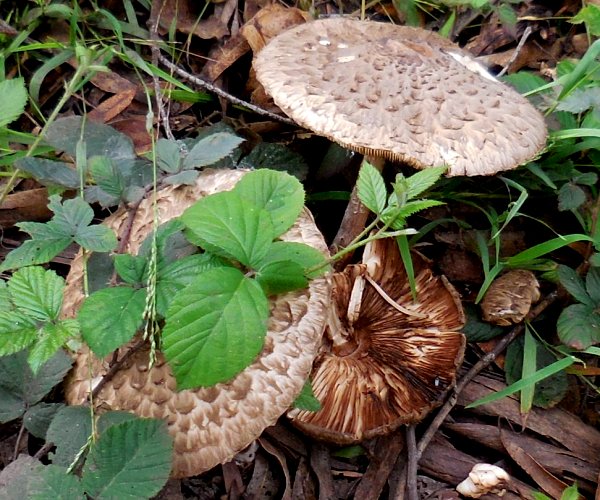
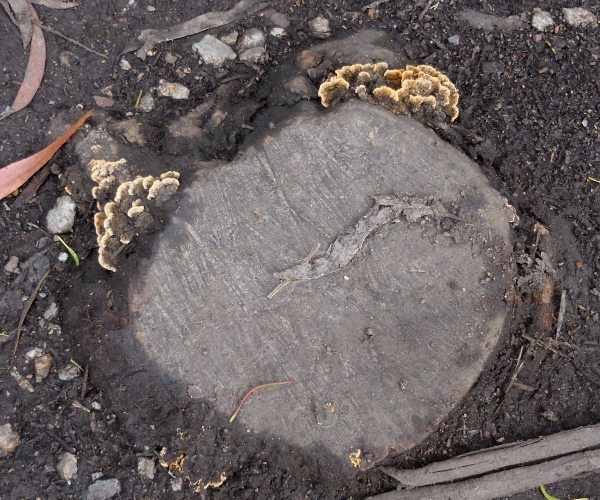
mushrooms 2

It would make sense. It’s the kind of mushroom that lives on dead wood, helping to recycle nutrients into the soil. And it’s know to occur under eucalyptus.

mushrooms - saprophytesWe’ve seen these before, but never in such numbers. Which also makes sense; with hundreds of trees having been cut down, there’s lots of dead wood for these fungi.

But they’re not the only ones. We saw a few of these bracket fungus, too, on stumps or logs. Possibly ‘False Turkey Tail’ – also helping the forest ecosystem along by digesting and recycling the dead wood.

more fungi

Posted in Environment, eucalyptus, Mt Sutro Cloud Forest | Tagged , , , , | Comments Off on Mount Sutro: Fungi in the Forest

Sutro Forest: NATURAL, Not Diseased or Dying

sutro forest canopy June 2014 smCRYING WOLF WITH BEETLES

In the Sutro Stewards blog last month, Craig Dawson (who is its Executive Director) wrote a post claiming that the forest was in dire straits, infected with funguses and beetles: specifically, Anthracnose, armillaria, phytopthora, wood decay fungi, the snout beetle and the tortoise beetle. It concluded: “The bottom line is that we cannot expect much of the declining forest to recover from the condition it is currently found in, rather we can expect further widespread die-off. The dying trees will quickly pose a significant hazard within a year or two as we have already witnessed.”

It sounded alarming.

We sent the link to the article to a number of experts. None of them thought it was particularly serious. (One academic ecologist called it  “…pure twaddle…” ) Nor did they agree with its conclusion that the forest would therefore decline.

  • “The diseases and insects mentioned in the Sutro report could be found in any forest…” (from a certified arborist and plant pathologist)
  • “The description of common conditions of eucalypt trees on the part of Mr Dawson’s piece seems to me solid as such—a description—but unconvincing as an argument that pretends to show some state of pathological emergency in Sutro…” (from an environmental science professor)
  • “This is amateur plant pathology at its best….” (from an urban forester)
  • “…faith-based botany…” (from an urban forester)
  • “This is certainly not the first time I have seen someone want to use a disease threat as a roundabout way to get some politically inconvenient trees removed.” (from an academic plant pathologist)

 THE SPECIFICS

Some commented specifically on the individual fungi/ beetles. We also investigated ourselves, using the UC Davis website.

  • Anthracnose: “anthracnose is found on the leaves of many plants…” [In San Francisco] “sycamore leaves are filled with anthracnose…” (We would also note the UC Davis website says, “In California, anthracnose rarely causes permanent damage to plants except for elm trees.”)
  • Armillaria: “…definitely all over the place in the coast ranges and is even rampant in Golden Gate Park.” (This does not indicate a dire disease requiring intervention, especially tree-felling.)
  • Phytopthora: We could find no references to phytophthora in eucalyptus in California.
  • Wood decay fungi: “..these are mostly associated with older trees. The pictures represent Trametes versicolor – mostly found on dead wood, very rarely on living trees; Laetiporus gilbertsolnii – common on living Eucalyptus and oaks…” (Again, there’s no indication that these are reason for alarm.)
  • Eucalyptus snout beetle:  These beetles feed on eucalyptus leaves. According to UC Davis’s website, “Eucalyptus snout beetle is controlled biologically by Anaphes nitens, an introduced parasitic wasp. No further control is necessary.”
  • Eucalyptus tortoise beetle: Also a leaf feeder, these beetles don’t usually kill trees. From the UC Davis website: “Unsightly, tattered leaves are usually just an annoyance that does not appear to threaten eucalyptus survival or health.” Since some tattered leaves in a forest setting are quite natural, we don’t think this is a problem.

Following a recent walk through Sutro Forest, Dr McBride (Professor Emeritus, UC Berkeley) noted that the forest looked healthy and thriving, with no evidence of the feared decline. He pointed out that in a naturalized setting like this one, we should expect some number of trees to do poorly or even die, as the forest “self-thins.”  Furthermore, he said, without fungi and other creatures as part of the forest ecosystem, we’d be up to our eyeballs in dead logs.

fungus on a stump - sutro forest - june 2014We have to say that in our years of frequent walks in the forest, in all weather and at all times of the year, most of these fungi and beetles are rare. Rare enough, in fact, that when we see fungi or mushrooms (the fruiting body of some fungi) we take pictures. We found a few leaves with evidence of tortoise beetles (semi-circular “bites” from the leaves), but they were few and far between. So far, we have not been able to find leaves showing the elongated perforations made by snout beetles.

few leaves have beetle holesWe asked about hollow trees. Dr McBride said that unless the remaining wood is less than 30% of the diameter, hollows in trees did not weaken them. “A tube is structurally one of the strongest forms,” he said. The life of a tree is in its outer layers. The center of a tree essentially provides structure. (And – hollow trees are great wildlife habitat.)

WHAT ABOUT THAT CANOPY?

The Sutro Stewards article also includes a picture of a stand of trees with a defoliated canopy, implying that is typical of the forest. It is not. This picture at the start of this article, taken in June 2014, is actually much more representative of the conditions in Sutro Forest. (Here’s a picture of the forest taken from Twin Peaks.)

sutro forest from twin peaks - June 2014The stand portrayed in the article does exist. It is on the lower part of the East Ridge – right above an area where UCSF has removed a lot of trees and understory as part of their “fire hazard” action in August 2013. This has made the forest there much drier and less able to retain moisture – particularly since this is on a steep slope near the edge of the forest. Dr McBride considers that the trees’ intergrafted root system may also have been damaged during the work, making the stand much more vulnerable. However, the trees do seem to be recovering, currently with epicormic growth.

gradually recovering defoliated eucalyptus on east ridge of sutro forest

CAUTION: DON’T MESS WITH THE FOREST

But rather than indicating that the forest is diseased and trees should be removed, it suggests much more caution. The removal of smaller trees and understory and damage to root systems can stress trees, reducing the moisture available and increasing wind damage. Instead of making the remaining trees more healthy by “releasing” them, it can make them less healthy – as we see on the lower part of the East Ridge. Similar impacts are visible in Glen Canyon, where a lot of clearing has been going on – exacerbated by pesticide use.

Furthermore, with the normal fungi present, and with the usual damp conditions in this cloud forest environment, chopping down trees doesn’t help reduce fungi, it only spreads it around.

Posted in Environment, Mount Sutro Stewards, Mt Sutro Cloud Forest, UCSF | Tagged , , , | 10 Comments

Cal-IPC Eucalyptus Reassessment: Same Result (for Different Reasons)

[Edited to Add: Cal-IPC did change the rating in its final version.]

The California Invasive Plant Council (Cal-IPC) designates eucalyptus as “moderately invasive.” Land managers all over California have used this designation as an excuse to cut down thousands of trees. Recently, people wrote to Cal-IPC citing evidence that eucalyptus forests in California are shrinking, not expanding, and they decided to revisit the assessment. However, their new Draft assessment comes to the same result – “moderately invasive.” Only the reasons are different.

They are taking public comment on this new evaluation until July 31, 2014. If you wish to comment, we provide the details at the end of this article.

mt sutro forest trail 4

WHAT IS CAL-IPC AND WHY DOES IT MATTER?

Most people think Cal-IPC is a government body. It’s not. It’s a not-for-profit organization with a 501(c) 3 designation. So if it’s just another non-profit, why does it matter?

Here’s why: It’s in the business of designating plants as “invasive” (and by implication, bad.) Its assessments are repeated far and wide by land managers, repeated on the UC Davis website,  and used by government agencies as a standard. (For example: In a 2013 letter from the Fish and Wildlife Service to the CA Department of Transportation, it requires the Department to avoid planting “invasives” as determined by Cal-IPC: fws dot letter mentioning Cal-IPC) It clearly has been given a great deal of weight. Although Cal-IPC doesn’t explicitly ask land managers to eradicate “invasives,” that’s how the list is used.

Unfortunately, since Cal-IPC not a government body, it isn’t subject to the same rules or accountability to the electorate

WHAT ABOUT EUCALYPTUS?

Cal-IPC assesses plants it considers “invasive” as having a High, Moderate, or Limited rating.  All across California, land managers have used the “moderately invasive” designation as an excuse to fell hundred of thousands of eucalyptus trees.

The profile in Cal-IPC’s database says, “Eucalyptus globulus (Tasmanian blue gum) is a tree (family Myrtaceae) found throughout California, but has primarily escaped to become invasive along the coast from northern to southern California. Native plants are unable to grow underneath groves of eucalyptus. This has been attributed to either the thick litter layer that can develop, or perhaps an allelopathic effect.”

Anti-eucalyptus pamphlet from Cal IPC

Anti-eucalyptus pamphlet from Cal IPC

A pamphlet Cal- IPC distributes  uses Eucalyptus on its cover with the note: Blue gum eucalyptus (Eucalyptus globulus) invades wildlands in the San Francisco Bay Area.” Inside it says:  “Found along the coast from Humboldt to San Diego and in the Central Valley. Most invasive in coastal locations. Easily invades native plant communities, causing declines in native plant and animal populations. Extremely flammable.”

(The pamphlet’s title ‘Don’t Plant a Pest’ is ironic, because blue gum eucalyptus is no longer sold by nurseries, nor is it being planted in California – and hasn’t in years.)

So Cal IPC’s readily available public materials focus on two issues: It spreads into wildlands along the coast, and native plants can’t grow under it. Flammability is mentioned, too.

IT’S NOT TRUE

In response, we’d like to refer back to an article we recently published, Understanding Eucalyptus in the Bay Area – Dr Joe McBride. It’s  based on a talk at the Commonwealth Club by Dr Joe McBride, UC Berkeley Professor Emeritus. (The note was approved by Dr McBride.)

1) Eucalyptus DOES NOT “invade wildlands in the San Francisco Bay Area” In the Bay Area, Dr McBride found eucalyptus forest area declined between 1939 and 1997. The natural spread hasn’t increased the area of eucalyptus groves.

2) Native plants DO grow under eucalyptus. Contrary to popular belief, eucalyptus forests have as many species (or more!) growing in their understory as do oak woodlands. A 1990 survey in Tilden Park found 38 species in the understory of eucalyptus forests (24 native plants; 14 introduced plants), while the oak woodland had 18 species in understory (14 native plants; 5 introduced plants).”

REVISITING THE BLUE GUM EUCALYPTUS ASSESSMENT

When people asked Cal-IPC to remove blue gum eucalyptus from its list of invasive species – since it wasn’t in fact invasive – Cal IPC did a reassessment. What they’re come up with is the same answer for different reasons. Cal IPC’S designation of “invasive” isn’t just about spreading, it seems:  They look at ecological impact (with 4 subcategories); invasive potential; and distribution.

So what they’ve done is increase the rating under ecological impact (section 1.1) while decreasing the rating under invasive potential (section 2). And reached the same answer as they had before.

Their main argument for the increase in ecological impact rating: “Eucalyptus globulus severely alters fire regimes in grasslands and when growing in mixed stands with native tree species. Changes to groundwater consumption are also significant.”

PROBLEMS WITH THEIR ASSESSMENT

  • Their assessment of fire danger from eucalyptus repeats all the debunked myths about eucalyptus and fire. In fact, grass fires ignite more easily and move faster; chaparral is even more dangerous. They have used data from a consultant’s report commissioned by people behind the East Bay project seeking FEMA grants to cut down tens of thousands of eucalyptus trees – certainly not an unbiased source. (Also, we have to wonder how this rating changed when the earlier pamphlet also claimed – erroneously – that eucalyptus was “extremely flammable.”)
  • The research regarding groundwater consumption is based on a misreading of the actual research they cite. There’s a good article about this here: Tracking Down the Truth About Blue Gum Eucalyptus, which discusses how drilling down to the cited research completely changes the story.
  • The eucalyptus-tree nest hole of the red-shafted flicker - San Francisco. Janet Kessler

    The eucalyptus-tree nest hole of the red-shafted flicker

    They also have a section on birds, where they repeat the myth that eucalyptus kills birds (though they report there is no supporting evidence). They acknowledge that eucalyptus provides nesting sites for hawks, cormorants, great blue herons, and greater egrets.

  • They also include a myth that Anna’s hummingbirds nesting in eucalyptus have most of their nests blown away. This is not true; in fact, these little birds thrive in eucalyptus (there’s a good article about it here: Birds and Butterflies in the Eucalyptus Forest).
  • They don’t acknowledge that a lot of other birds also use eucalyptus as a food source – either directly, eating nectar, or indirectly by eating insects attracted to flowers or hiding under the bark of the trees.

WHAT YOU CAN DO

Public comment is open until July 31st. You can email your letters and comments to Cal-IPC and its Board of Directors, all of whom are in related areas and should be aware of the misconceptions about this valuable tree.

The “invasive” designation is being used as an excuse to cause huge amounts of environmental damage by felling thousands of valuable trees which would otherwise provide habitat, fight global warming by sequestering carbon, stabilize slopes by providing a living geotextile of intergrafted root systems, and fight pollution all year long. Cal IPC has an opportunity to correct a sad error from earlier years.  We hope they’ll take it.

Some points to make:

  • Claims that eucalyptus is highly flammable are exaggerated.  Forests rarely ignite, only in the most extreme weather conditions, which rarely exist in San Francisco.  Most fires in California start in grass and most wildfires are in native chaparral. In fact, eucalyptus reduces fire hazard by providing a windbreak.
  • Eucalyptus is drought-tolerant.  It uses more water early in its life, but less as it matures.  In foggy climates, it fulfills its water needs by condensing fog.
  • Scientific studies have proved that the eucalyptus forest has just as many plants in its understory as native woodlands and equal numbers of animals and insects.
  • Monarch butterflies are using eucalyptus trees for their overwintering roost and do not have the alternative of using native trees in most of the 300+ locations in which they overwinter.
  • Some species of birds prefer to nest in eucalyptus, such as hawks, owls, herons, and cormorants. Cavity-nesting birds such as woodpeckers, flickers, and western bluebirds, all of which have been found nesting in eucalyptus. As the world’s largest flowering plant, it provides a nectar food source for insects and birds in winter.
  • Eucalyptus was planted on grassland in California.  It has not displaced native forests because it does not tolerate shade. Most grasslands in California had already been transformed to non-native grass by the time eucalyptus was planted there.
  • Eucalyptus forests have not expanded in most places in California.  It has been known to spread only when planted next to streams or in very foggy and windy places.

Here are the people to send it to, and their email addresses:

  • Cal-IPC staff: Doug Johnson, Executive Director; Elizabeth Brusati, Senior Scientist; Bertha McKinley, Program Assistant;  Dana Morawitz, Program Mgr /  GIS & Regional Conservation and to the “info” email account. Here are the email addresses:

info@cal-ipc.org, dwjohnson@cal-ipc.org, edbrusati@cal-ipc.org, bmckinley@cal-ipc.org, dfmorawitz@cal-ipc.org

  • The Board of Directors office bearers: Jason Casanova, President; Kim Hayes, Vice-President; Shawn Kelly, Treasurer; Jutta Burger, Secretary; John Knapp, Past President. Here are their email addresses:

cas@watershedhealth.org, kim@elkhornslough.org, skelly@scwrp.org,  jburger@irconservancy.org,  jjknapp@tnc.org

Please pick up those points that resonate with you and ask Cal IPC to remove eucalyptus from its list of invasive species.

mt D comparison 1927 -2010

Uninvaded


Posted in Environment, eucalyptus | Tagged , , | 1 Comment

San Francisco Butterflies – Count Results for 2014

common buckeye butterfly stampEach year, in the 4 weeks before or after the 4th of July, the North American Butterfly Association, NABA, sponsors a butterfly count across the nation. Here in San Francisco, Liam O’Brien manages it, maneuvering around the fog of summer. Two years ago, we nearly didn’t get one owing to the weather, but he pulled it off at the last minute in late July. This year, it was in good time, on the 15th of June.

We’ve been following the local count for five years now. (Here are the links to our previous reports for 2013, 2012, 2011, and 2010.)

This year, spotters found 24 species of butterfly, with 777 individual butterflies. They identified 734 by species (a few could only be identified by family). This is slightly better than last year, though down from the boom years of 2011 and 2012. No rarities were spotted this year, but the Woodland Skipper made a reappearance from 2012.

SF BUTTERFLY CountTHE TOP THREE

Cabbage White sitting on Oxalis

Cabbage White sitting on Oxalis

The Cabbage White butterfly is back on top for  2014. It’s topped four out of five counts, though the numbers are slightly down from the first three years. But in 2013, the number of Pipevine Swallowtails exceeded the Cabbage Whites.

The Cabbage Butterfly numbers aren’t really higher this year; it’s just that no other species was seen in large numbers.

Pyrgus communis - public domain- NPS- Theresa ThomThe second was the Common Checkered Skipper, a small butterfly that’s widely found across California and most of North America. They saw 106 of them, more than twice the largest number in the past four years. Curiously, according to the butterfly website of UC Davis Professor Art Shapiro, California seems to have at least two species of these – and a third that’s genetically very similar to one of them but can’t interbreed with it.
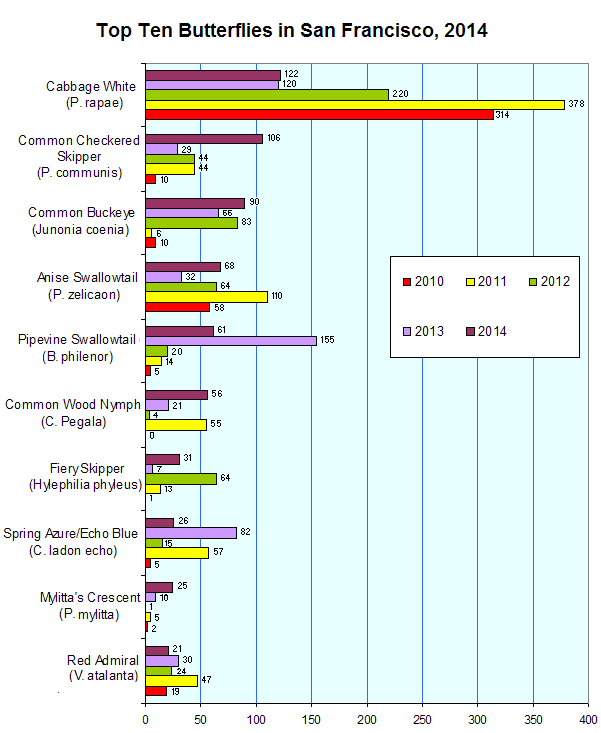
Third was the Common Buckeye. This butterfly is dramatic enough that the US Postal Service put it on a stamp! (That’s the picture at the beginning of this article.) Male buckeye butterflies often perch on the ground, and both males and females visit a great variety of flowers.

The top three butterflies accounted this year for 41% of the insects spotted; other years, it’s ranged from 44-50%.

Which were the top three in earlier years? The distribution has been less stable than one might expect. Many factors can affect butterfly sightings – weather on the day of the Count; the weather the previous winter and spring that could affect the plants the butterflies (and their caterpillars) need for breeding and feeding; and just random changes.

  • The top three butterflies of 2013 were the Pipevine Swallowtail, the Cabbage White, and the Echo Blue, AKA the Spring Azure.
  • In 2012, it was Cabbage White in first place, with the California Common Ringlet and the Sandhill Skipper tying for second place, and the Common Buckeye in third place.
  • In 2011, the Cabbage White, Anise Swallowtail, and Echo Blue.
  • In 2010, the Cabbage White, the Umber Skipper, and the Anise Swallowtail.

THE TOP TEN

The graph below shows the top ten species for 2014, and compares the numbers to earlier years.  The top ten this year accounted for 78% of the total number of insects spotted; in earlier years, it was 82-85%.

butterfly graph 2014For those interested in detailed data for the last five years, here’s the table.

butterfly data 2010-14

Posted in Environment | Tagged , | 2 Comments

Walking in Sutro Forest – June, July 2014

It’s a while since we posted about Sutro Forest conditions, so we’d like to record pictures and observations from the last few weeks. Much of the forest is still very beautiful, especially in the fog. But around 1200 trees have been removed in the last year to contain an “urgent fire hazard” that was not very credible; and to remove trees in poor condition, most of which were not hazardous. It shows.

sutro cloud forest and young tree

If you love the place as a forest, this would be a good time to visit. More tree removal is planned. The forest’s character is changing, with many gaps. The Sutro Stewards are planting these gaps not with trees but with native plants.

THE SUMMER FOREST

It’s summer in the forest now, with frequent overnight or daytime fog.

hiker in Sutro Cloud Forest June 2014Many of the trails are wet and some have puddles.

sutro cloud forest walkOn a recent visit, we started out with the mysteriously beautiful forest wrapped in fog.

fern epiphytes on eucalyptus in Sutro Cloud ForestBy the time we ended our hike, the fog had burned off and the forest was a luminous green with sunlight.

after the fog in Sutro ForestLower down – and in places where the forest has been opened up, it’s much more dry, even dusty. And the areas where the “urgent fire safety” work was performed last year by removing all the trees under 6 inches in diameter, all the ivy, and all the understory, are not able to hold as much moisture as they did before.

deforested area above and beneath medical center wayThe plum and cherry trees have fruit now, and they’re mostly ripe and edible. They don’t attract the same attention as the wild blackberries now ripening all over the city, they’re not as tasty.

plums are ripe in Sutro ForestPerhaps people don’t even know these are here. But we think coyotes may have been snacking on them – some scat along the trail was filled with the pits.

The Native Plant Garden is past its best, but the meadow of orange flags actually had flowers. It’s still got orange flags, but California poppies outdid them for sheer orange color.

the flag meadow in the native plant gardenOn the other side of the trail, the Rotary Meadow had grindelia blooming yellow amid a complex of non-native grasses. One of our group identified rye, wild oat, and wild barley.

BIRDS ARE EASIER TO SPOT

Paradoxically, it’s become easier to see birds in the forest. Before, the forest was so dense that you could hear birds but not easily see them.

Juvenile American robin - sutro forestNow, they are not as many as before, going by the amount of birdsong, but you can spot them – and even a point-and-shoot camera can capture some photographs. The bird above is a juvenile American robin – perhaps a native Sutro Forester.

song sparrow - sutro forestThe bird above is a song sparrow, and below is a redtailed hawk sitting in an acacia tree.

hawkThis one below needs a bit of imagination: it’s a couple of band-tailed pigeons. There actually were four, but they didn’t pose.

bandtail pigeons in sutro forestIn addition to the 45 birds already on our list, there’s one more: A house wren we saw nibbling at the fluff of a dandelion plant. Unfortunately we didn’t get a photograph. We also heard a flyover of red-masked parakeets.

SLUGS AND BUGS

We removed a loose strip of bark from a tree, and found a nursery of pill-bugs. Bird food.

pill bugs under a strip of barkAnd beside the path – the heftiest banana slug we’ve seen in this forest!

banana slugTREES DOWN AND MORE TO GO

white-dotted treeThe first round of tree-cutting is over, and as we feared, another round is likely. A lot of trees along the trails are marked with white dots. Though the marked trees are mostly in poor condition, those are the trees that offer superb habitat for birds and animals. In a forest setting, only those that are actually hazardous should be removed; the others should be saved for wildlife.

Also, removing even the snags (standing dead trees) opens up the forest, which dries it out. These trees are not being replaced; instead, the open areas created are being made into Native Plant gardens, currently full of plastic flags.

The worst-affected area is below Medical Center Way.

The path that joins the Historic Trail from Stanyan to the Fairy Gates trail is no longer the shady tree tunnel that it was before; it’s a full of logs instead.

logged area below medical center way

Deforested area below Medical Center Way

This is what the area looked like before – the picture below was taken in the same area in July 2012. Coincidentally, this area is one the Stewards have been seeking to open up as part of their “restoration” plans centering on the seasonal creek that runs down to Cole Valley.

sutro forest below medical center way july 2012 098

The same area in July 2012

chainsaw stump carvingSomeone with a sense of irony or art has memorialized it with a chainsaw carving resembling an Easter Island moai figure. It recalled an island that has become a symbol of ecological disaster from the loss of its trees. We thought it was appropriate.

The method that UCSF employs is to cut down the trees and leave the logs lying. The smaller branches may be chipped and used for mulch, but in this area they don’t seem to have done that; instead, they have left brush piles. It’s fortunate that fire hazard is low in this forest; otherwise these would be kindling.

One of the trees destroyed was a bee tree. The bees are still hanging around; we hope they can transition to another tree. Though with USCF’s vendetta against snags and other trees suitable for habitat, this may be only a temporary solution.

bee tree down

Posted in Environment, eucalyptus, Hiking, Mt Sutro Cloud Forest | Tagged , , , , , | 8 Comments

The ROSE Disappointment

pesticides and excuses, Twin Peaks, March 2012Some weeks ago, we had alerted our readers to the ROSE (Recreation and Open Space Element  amendment to the General Plan. It’s a bad idea, mainly because of the egregious Policy 4.2 that potentially expands “Natural Area” management principles to all open space in San Francisco, with tree-cutting, access restrictions, and use of toxic herbicides.  Though it cannot be enforced on the UCSF section of Mount Sutro (since UCSF is a state institution, not a city organization), it can provide a dangerous model for adoption.

It was hard-fought through three rounds of approvals, but despite huge public opposition, it passed. Here’s how it went down.

1) The ROSE amendment went to the Planning Parks Commission for approval. Despite considerable public comment opposing it, it passed, with two commissioners voting against it, five voting for it. They pointed out that it would go to the Land Use Committee of the Board of Supervisors. [Edited to correct the Commission name.]

green ringed tree stump2) The Land Use Committee could vote Yes, No, or send it to the full Board of Supervisors without a recommendation.  They took the noncommital option, leaving the full Board to deal with the issue.

3)  Many people who spent the days before the vote talking to City Hall  said Supervisors’ aides reported they were deluged with emails and phone calls – overwhelmingly requesting the Supervisor to vote NO on the ROSE. The vote was delayed to the last hour of the last day when it could be made – at the every end of a 3-1/2 hour meeting. Despite this  outpouring of concern, the NO vote didn’t happen. The ROSE passed, 8-3.

If you haven’t already done so, please take a moment to write a thank you to the three who opposed it: Supervisors Wiener, Yee, and Campos. Their email addresses are: scott.wiener@sfgov.org (Phone: 415-554-6968); Norman.Yee@sfgov.org (Phone: 415-554-6516); David.Campos@sfgov.org (Phone: 415-554-5144)

Thanks to everyone who wrote or called in. We’re disappointed that many of the Supervisors didn’t listen this time, but we’re grateful to the ones who did. And we’re not going away.

imazapyr used here

Posted in Environment, Natural areas Program | Tagged , , | 1 Comment