Killing 5000 Trees in Mount Sutro Forest

[ETA (1 Aug 2011): We’ve just received a recent update from UCSF. It appears the timeline has been pushed out. If the projects are approved, they will start felling trees in August 2012.

This Google Map shows the forest. (You can close the shout-out saying Forest Knolls by clicking on the cross in the corner.)]

A number of people have asked for updates on the Cloud Forest on Mount Sutro.

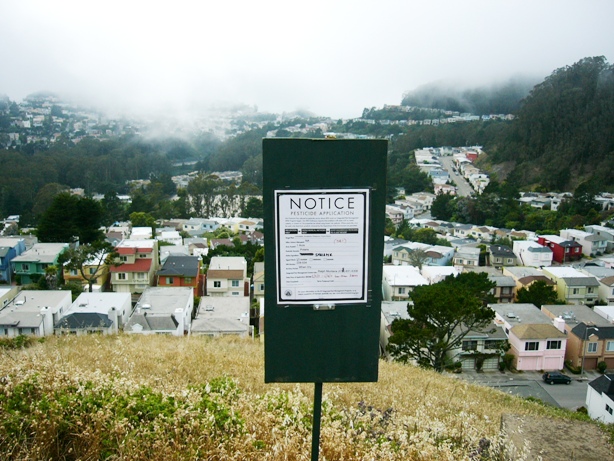
A $250,000 PROJECT TO DESTROY 5000 TREES

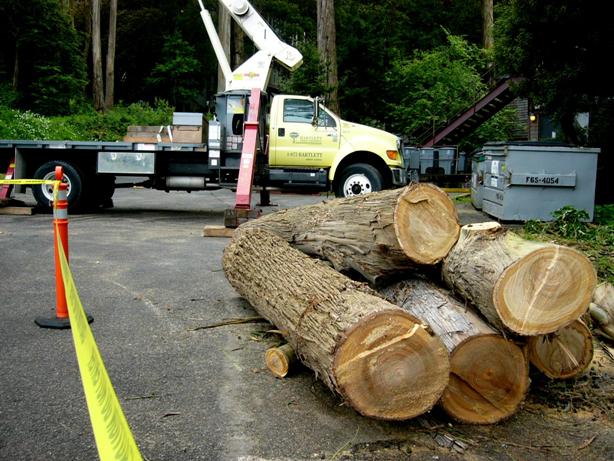
Starting as early as September 2011, UCSF plans to cut trees on 4 “demonstration projects” totaling 7.5 acres. (This is increased from one 2-acre plot in the original 2001 plan, and mentioned in UCSF’s February 2010 letter signed by Vice Chancellor Barbara French.) According to estimates from her at various meetings, this will cost about $250,000, not including the time spent by UCSF employees. (“It’s their job.”)

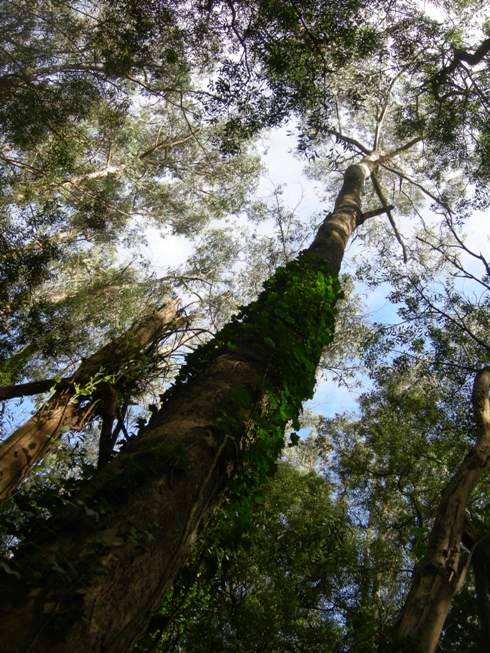
The plan is to space trees an average of 30 feet apart, which would yield about 20-30 trees per acre. Currently, the trees average 740 trees per acre (this sounds like a lot, but the naturalized forest around Tokyo’s Meiji Shrine averages 955 trees per acre). It would mean cutting down 95% of the trees on the project areas.

Estimated number of trees to be felled: Over 5,000.

In addition, they will also remove vines by amputating them up to ten feet above the ground, and remove blackberry, acacia and other understorey plants.
The largest site, #1 in the map, is just above Forest Knolls on South Ridge. It’s approximately 3 acres. The second site, #2 in the map, is 2 acres and it’s on the other side of the mountain near Edgewood. The plan on both these sites is to get the look of a “forest with open understory” — and of course, trees spaced 30 feet apart.  A sort of lollipop forest, with no real habitat or ecology.

(When we explained this to someone who wanted to know why we opposed the plan, they exclaimed, “Thirty feet? That’s not a forest, that’s a neighborhood!”)

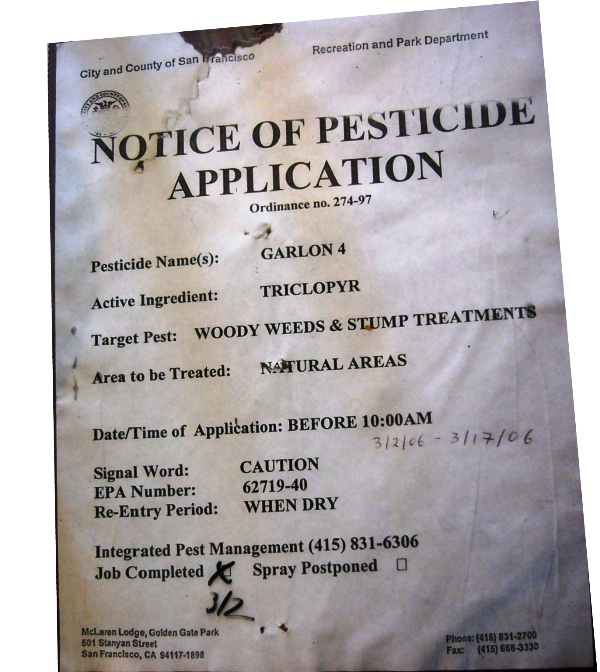
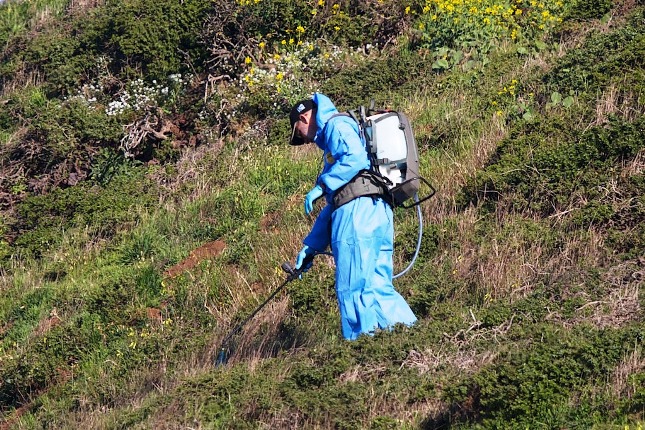
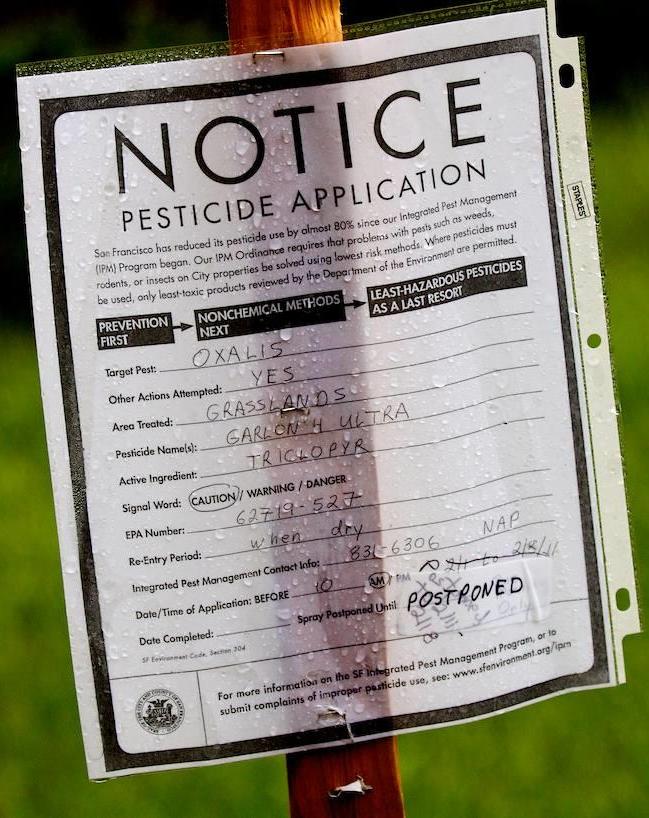
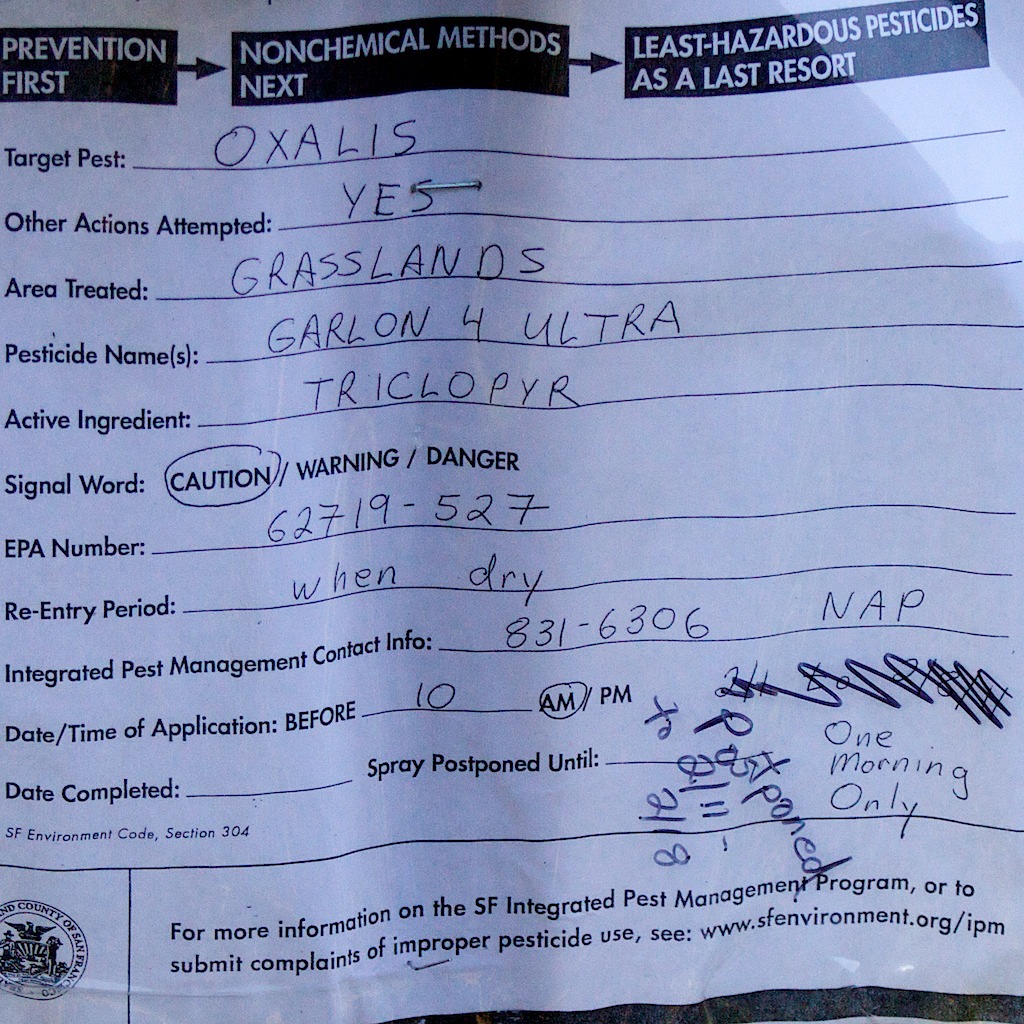
In some areas, pesticides will be used to prevent regrowth of eucalyptus, blackberry, and other plants. The pesticides mentioned are “Roundup and similar glyphosate-based herbicides such as Garlon.” (Of course, Garlon is not actually a glyphosate-based herbicide. It’s triclopyr, and even more toxic.) It’ll initially be tried on one acre, and then, potentially, the whole forest.

Site #3 is contiguous with the Native Garden, and is a half-acre site that is planned as a “grassy area with clear view corridor of the city.” This will involve chopping down trees that block that view.

Site #4, where felling starts in September 2012, is another 2-acre site. Here the trees are to be spaced at 60 feet apart and the canopy opened up.

Site #5 is the “concession” to neighbors who are trying to preserve the forest: This 2-acre area will be “hands-off” for only a one-year period. It’s not clear what this is intended to achieve.

The only thing the “demonstration projects” are intended  to demonstrate is the 30-foot spacing:  how it looks, and how the pesticide works compared with other methods. It is not going to evaluate ecological functioning, water retention, or habitat impacts. It will not consider sound barriers or windbreak effects.

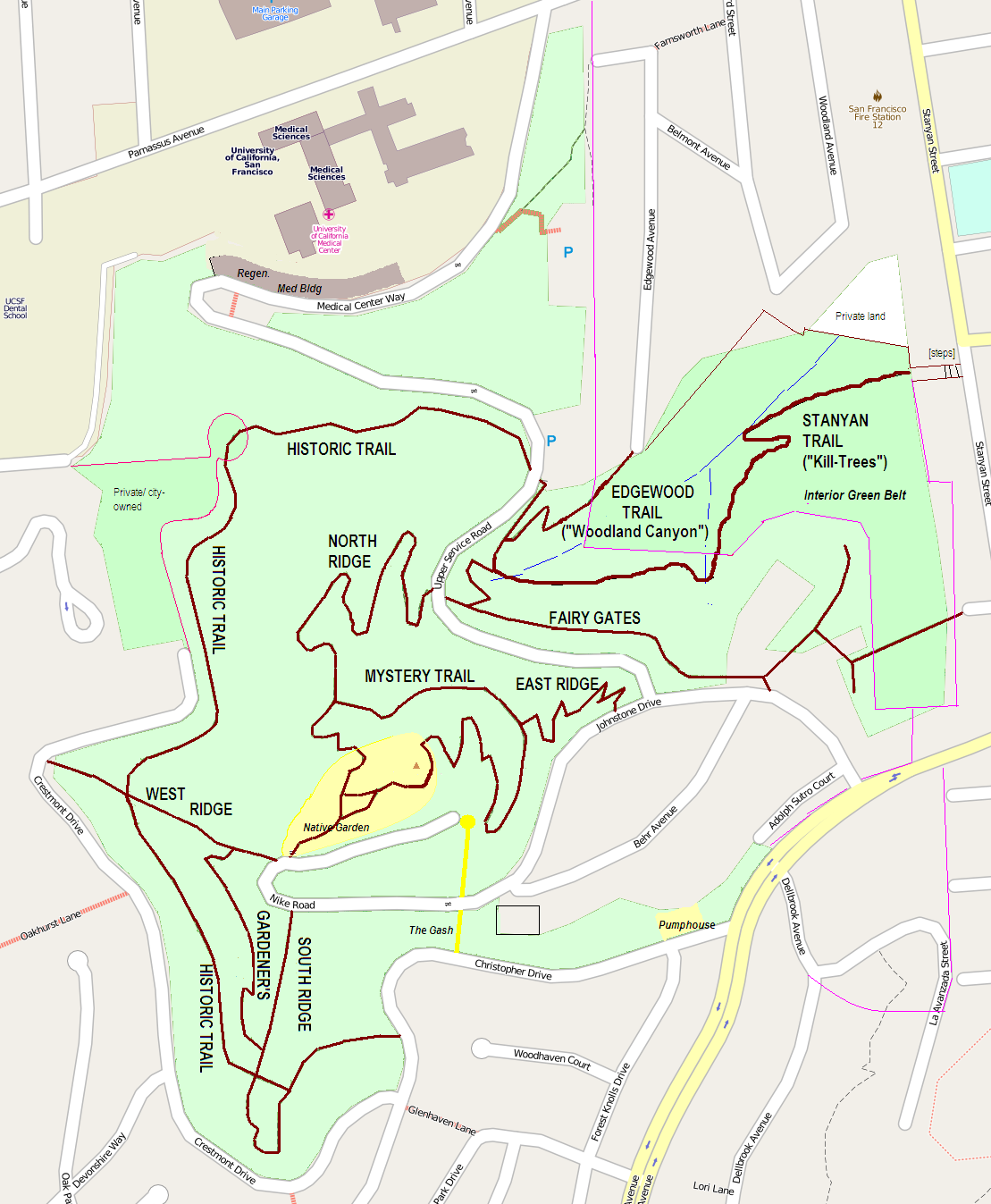
Three new trails are planned (shown in red in the map above). One will punch through the screen of trees between the Aldea campus and the Forest Knolls neighborhood. It’s already been partly destroyed due to work by the SF PUC: the new pump station that backs almost to the Aldea fence line; and “The Gash” — a bare line running from a water tank in the forest down to Christopher. This planned trail can only make it worse.  Another is changing the present straight steep trail from Christopher to a hairpin one with a more gradual slope. The third is a switchback trail connecting Medical Center Way to the Historic Trail.

ULTIMATE PLAN: DESTROY 75% OF THE FOREST’S TREES

Afterwards, the same 30-foot spacing is planned to be extended to another 40 acres of the forest, for a total of 47.5 acres out of 61. (This is much worse than the 2001 plan, which would have affected only about 30 acres.)

At that point, we’re looking at felling around 35,000 trees.

(Note: Why are we using a hand-drawn map? We had originally used a map derived from maps published with no copyright notice in a UCSF document outlining the plan, considering it fair use in discussing the Plan. However, we received a legal notice on behalf of the Sutro Stewards claiming copyright to those maps. We’re still confused as to who owns those particular maps and can grant permission to use them, but we figure that this map the hand-drawn map together with the Google Map serves the purpose of informing the reader.)

Posted in Mount Sutro Stewards, Mt Sutro Cloud Forest, UCSF | Tagged , , , , | 5 Comments

Mount Sutro Forest: Sounds of the Cloud Forest

Bay Area Sound Ecology, an organization promoting awareness of the soundscape, conducts “soundwalks.” These are expeditions that focus on listening rather than just looking. Last evening, Jeremiah Moore and Andrea Williams led such a soundwalk in the Mount Sutro Cloud Forest for World Listening Day.

We started at the bottom of Medical Center Way, amid sound of traffic on Parnassus and the trucks making deliveries to UCSF and the squeak of the windsock’s bearings. Then we took the steps up, exited at Farnsworth, and entered the forest by Edgewood, along the Woodland Canyon trail.

A FOREST IN THE FOG

Earlier, the weather had been sunny. By 6 p.m., the fog rolled in. Birds tend to go quiet in the fog, but there were some chirps and twitters overlaid by a steady background of caws of crows and ravens.

We climbed into the fog by the North Ridge Trail toward the Native Plant garden, and the relative dryness and dust of the trails below gave way to mud. The birds were quieter.  The wind soughed in the tops of the eucalyptus, but we didn’t feel it; at ground level the trees and bushes form an effective wind break. The salient sound was the patter of the forest’s internal rain on the understory plants. This was the cloud forest experience.

In the Native Garden, we stopped for a while, and Andrea conducted a listening exercise. It was very quiet. The creak of eucalyptus. The chirrups of a few birds, now the shrubs in the Garden are large enough to provide some cover. A plane droning invisibly overhead. (The mountain is below a flight path.)

THE FOREST SOUNDS DIFFERENT

Jeremiah, who’d walked the trails before in preparation for this event, spoke of the very different soundscape then. It had been a sunny afternoon, and in the Native Garden, the sounds of the city were a roar. On this trip, the city’s presence was concealed in clouds and silence, its sounds damped by the fog.

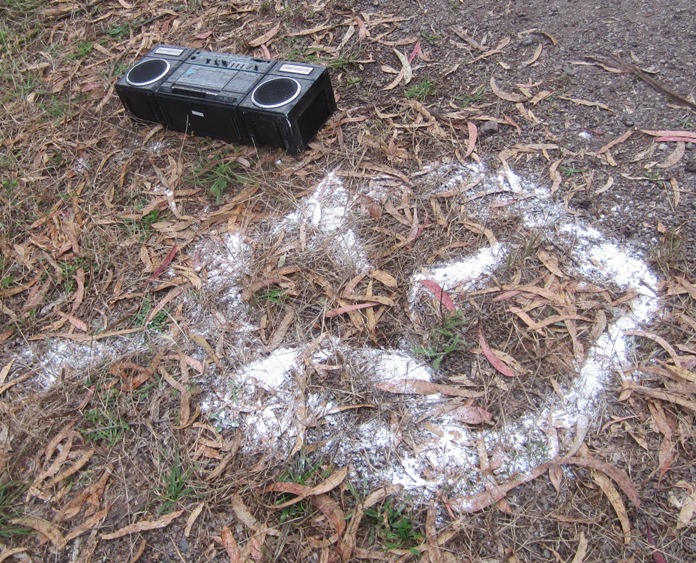
Unusually, we found a piece of junk in the Garden: an abandoned boombox, next to a circle of some kind of chalk powder. Not inappropriate.

[ETA 29 August 2011: Jeremiah Moore’s report is here. It has an impressively detailed and sensitive description of the same soundwalk.]

Posted in eucalyptus, Mt Sutro Cloud Forest | Tagged , , , , , , , | 2 Comments

San Francisco Butterfly Count Results, July 2011


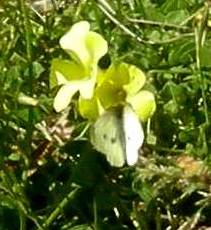
The San Francisco butterfly count, led by Liam O’ Brien and sponsored by the North American Butterfly Association, has announced its results. This year, it was held on July 3 on a bright sunny day, compared with last year’s June 7th in cold foggy weather. It paid off in record numbers: The same number of observers as last year (34 people) saw  990 967 individual butterflies, against last year’s 775; and 26 species compared to last year’s 24 (some of last year’s didn’t show up, but some new ones did). The top ten species accounted for 82% of the sightings (85% last year). This year, the count included Angel Island, which accounted for some of the new species.

Spring Azure/ Echo Blue – Katja Schulz Creative Commons

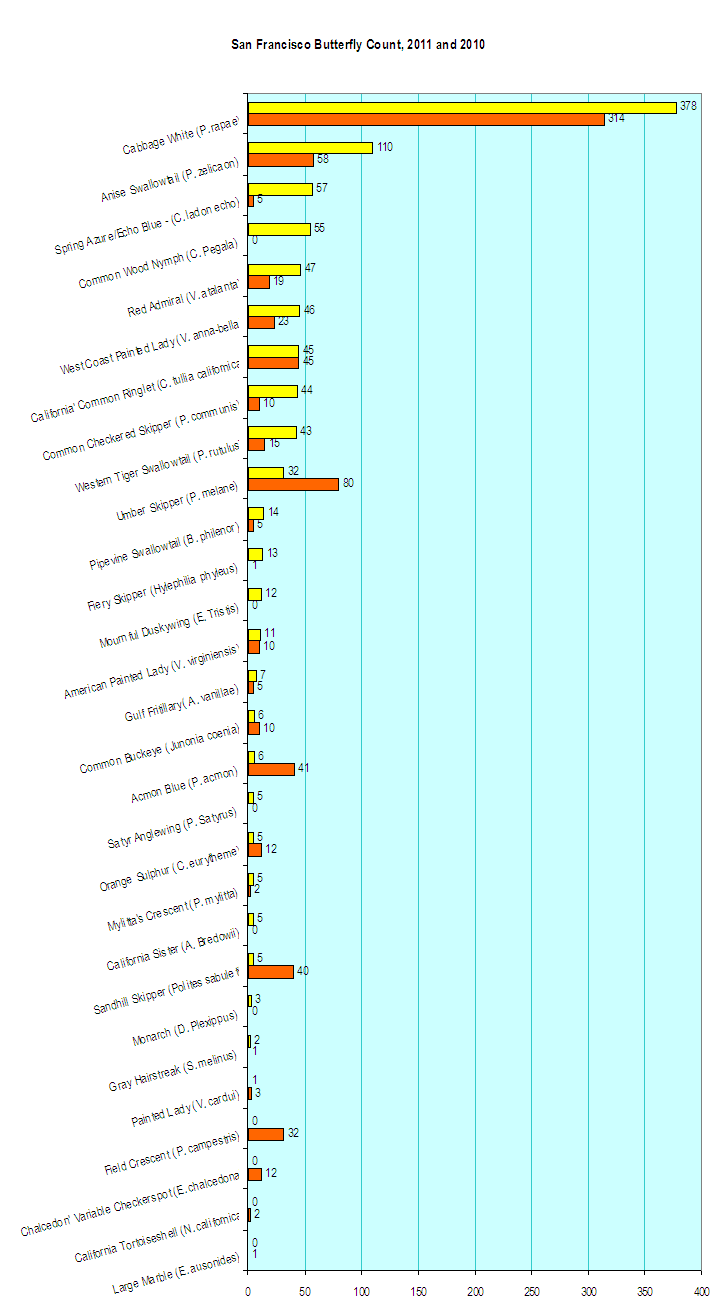
The most numerous species this year were again the Cabbage White (378) and the Anise Swallowtail (110). Both years, these two species accounted for nearly half the butterflies seen (49% in 2011, 48% in 2010).

After that, everything changes:

  • Last year, Umber Skippers were third second most common, but they’re way down the list this year, barely making the top ten.  Instead, the Echo Blue (only 5 spotted last year) and the Common Wood Nymph (none spotted last year) came in third and a close fourth.
  • Similarly, the teams  spotted fewer Acmon Blues and Sandhill Skippers this year, and no Field Crescents.
  • By contrast, they saw many more Red Admirals, West Coast Painted Ladies, Common Checkered Skippers, and Western Tiger Swallowtails.

Could be the weather, the month’s delay, or just random events. O’Brien notes that San Francisco leads the nation’s counts in Anise Swallowtails, which prefer hill tops and use fennel as a nursery plant. San Francisco has an abundance of both — despite fennel being treated as an invasive non-native. (Liam O’Brien keeps the www.sfbutterfly.com website and blog.)

The graph below shows the totals for 2011 (upper bars, in yellow) and 2010 (lower bars, in orange). If you click on the graph, and click again, a larger version shows up.

[Edited to add: This was edited for minor corrections and to add a picture of the Spring Azure/Echo Blue.]

Posted in Environment | Tagged , | 7 Comments

San Francisco, Biodiversity, and the Department of the Environment

We’re aware of San Francisco’s Department of the Environment as the first line of defense against toxic chemicals in our public lands. But they’re more than the defense-against-the-dark-chems guys. They’re the recycling guys. The energy saving guys. The community gardens and Green Businesses guys. Now they’re adding Biodiversity to their long-term plans. Here are some notes from the minutes of the San Francisco Commission for the Environment’s May 2011 meeting:

The addition of a section on Biodiversity for 2013 plans and beyond and possibly before then if funding is secured.  This calls for a focus on protecting the natural environment beyond trees, which is the focus of the urban forestry program.

The minutes indicated support from Commissioner Ruth Gravanis (the Commission’s Vice President):

Commissioner Gravanis stated that she is pleased that a biological diversity section has been added, one area in which San Francisco cannot claim to be an international leader, and is looking forward to working closely with staff to make that happen.   She suggested that the Climate Adaptation Plan address that our own indigenous biological resources are imperiled by climate change and the invasion of exotic species in particular.

And another from the Sierra Club.

Ms. Rebecca Evans, Sierra Club, spoke in support of Director Nutter’s addition of biodiversity to the Strategic Plan, which was further expanded on by Commissioner Gravanis.  She stated that she attended a meeting of the San Francisco League of Conservation Voters where a discussion was held on San Francisco making biodiversity a priority.  It is time for the city to look at this issue and embrace it.  The Golden Gate National Recreation Area has more than 1200 endangered species, more than any other park in the lower forty-eight and we are on the Pacific flyway.

Biodiversity. It’s a good thing. So why aren’t we standing and cheering?

THE PROBLEMS WITH “NATIVE” BIODIVERSITY

Biodiversity means different things to different people, and we’re concerned about the interpretation here. From Commissioner Gravanis’ remarks, it’s clear the focus is on native plants and excludes “exotic” species.

We have several problems with this.

  • First, it can destroy existing habitats and ecosystems in pursuit of an idealized, modified one. This ignores the animal life that depends on the existing ecosystems; and it ignores established ecosystems that probably function better than a newly-established one. (This is what we see in Mount Sutro Forest: A lack of recognition of the unique century-old fog-forest ecosystem, only because it comprises non-native plants.)
  • For instance: In “natural” areas, “non-native invasive” blackberry thickets are being torn out and sprayed with pesticides such as Roundup and Garlon. This destroys habitat; these thickets provide valuable hiding places and food sources for birds and animals. It also destroys a source of berries, ignoring the pleasure people get from foraging. Sometimes, people pick them anyway, unaware that they may have been sprayed with chemicals not necessarily suitable for food crops.
  • Second, it will inevitably require the use of toxic pesticides. In the city’s “Natural” areas, Roundup and Garlon have been widely used; lately, Imazapyr has been added to the arsenal. Roundup, one of the world’s most widely-used pesticides, has been implicated in birth defects in animals and possibly people. In San Francisco, it’s a Tier II pesticide, where Tier I is the most toxic. The SF DOE classifies Garlon, which is much more toxic, as Tier I. Imazapyr, which has recently been introduced for use in “natural” areas, is also Tier II, but has its own problems. It’s banned in Europe.
  • Third, we are concerned about open spaces as recreation.  Who uses these areas the most? We’ve been out there on weekdays, and on weekends. The number one users are dog-walkers, whether walking their own dogs or other people’s. These are the people who *need* to be out of their homes twice a day, with their dogs.  Joggers are the second, together with others who use the parks for exercise: such as (where permitted) bike-riders. Third most common: children with accompanying adults. A distant fourth would be those who are watching birds or merely observing nature — except, of course, that other users also do this. (This breakout doesn’t apply to Twin Peaks, which is a view-platform; the most common users there are tourists and others enjoying the vistas.)
  • Not only do the frequent users deserve consideration — they also make the parks safer for everyone by their presence. The natural areas of the city are not over-used, they are under-populated. On a trip to Bayview Hill one weekday afternoon, we encountered one other person in one hour — a dog walker. In Mc Laren Park — about four. Also dog-walkers.

These are uses that a focus on native biodiversity could severely constrain. The San Francisco Sierra Club’s Yodeler magazine carried a reaction to the Recreation and Open Space Element of the city’s plan. Here’s what it said about recreation: The draft ROSE talks about the benefits of open space for physical fitness through exercise and recreation, but these one can do on city streets or in gyms. Back in 2009, we reprinted an article on “Museumification” in two parts  (here and here). This is the process of making public lands into plant museums that discourage or prohibit recreational uses, via restorations favoring “native biodiversity.”

A MORE INCLUSIVE VIEW

In the search for “biodiversity” (i.e. native plant biodiversity) there’s little focus on ecological function of the “non-native” elements of the ecosystem. It’s usually an article of faith that somehow, a native eco-system is better — even when it’s evident that the non-native plants are important to the habitat. They also increase biodiversity. In a recent talk, Peter Kareiva, chief scientist at the Nature Conservancy, pointed out that California’s plant species had increased 25% because of introduced species.

Posted in Environment, Herbicides, nativism | Tagged , , , , | 2 Comments

Kareiva, Nature Conservancy, and Nativism

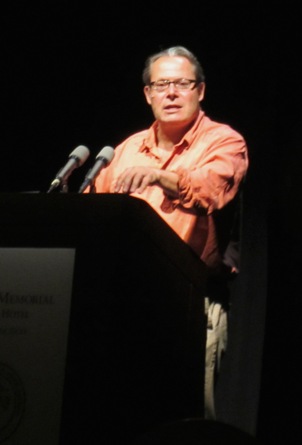
A few days ago, we attended a talk by Peter Kareiva, chief scientist at the well-known Nature Conservancy. (He’s also been elected a member of the National Academy of Sciences.) It’s an environmental organization that prides itself on being science-based; it has some 600 working scientists. Kareiva’s argument was that environmentalism is painting itself into a corner. It’s becoming polarized, misanthropic, dogmatic, and anti-technology. And it’s losing support: In 2011, over half of people surveyed agreed with the statement, “Most of the people actively involved in environmental groups are extremists, not reasonable people.” Back in 1996, Kareiva said, under a third had agreed with that. It’s seen as a preoccupation of the wealthy and the white: the image of an environmentalist is a woman who wears lots of green, is moneyed, and preaches…

NATURE: RESILIENT, NOT FRAGILE

Kareiva took issue with the use of the term “fragile” as a cliche when discussion anything eco-related. Fragile planet. Fragile river. Fragile ecosystem. Fragile species.  This tends to extremist thinking, because if it’s fragile, it will break; there’s no room for compromise. Battles are hard fought and divisive. Spotted owl vs loggers. Fish vs humans. In Uganda, some 5,000 villagers were evicted from a “fragile” habitat rich in fauna to create a reserve — and naturally, created passionate opposition as well. When a political change allowed the villagers to return, they slaughtered the animals to get rid of the wildlife that had attracted conservationist attention. The villagers didn’t want to take the risk of being dispossessed of their land again. But nature isn’t fragile, Kareiva points out. It’s resilient. He gave a number of examples:

  • Mount St Helens, the volcano that in 1980 blew with the force of 10 Hiroshimas and destroyed the surrounding forests and ecosystems — which started to rebound almost immediately.
  • Bikini Atoll, site of nuclear bomb tests until 1958, now has 25% more coral than before (possibly due to excluding humans from the radio-active island).
  • Chernobyl Exclusion Zone, 30 kilometers in radius round the area of the 1986 nuclear accident, is a haven for wildlife including the endangered Przewalski’s horse.
  • In San Francisco city, peregrine falcons are breeding. This bird nearly went extinct owing to DDT contamination, but has now recovered.
  • In Indonesia, orangutans were found thriving in palm-oil plantations, not just in virgin forests.

The threats of imminent danger can be compelling for donors; Kareiva showed a full-page advertisement taken out by several conservation groups indicating the Chinook salmon could be gone by 2017 without action to save them by removing dams. The Nature Conservancy looked at the science behind it, and were unconvinced. But talking later with his counterpart in one of the organizations, Kareiva was told, “Last year was our best fund-raising year.” Extinctions are unfortunate, but not necessarily disastrous. “It’s not just going to stop, it’s going to change. What you’re left with is different” — not a collapse, but a different ecosystem.

  • The American chestnut was a dominant tree in eastern forest, and rained down nutrients in the form of chestnuts. It was a hugely important element in the ecosystem. Then it died out — and the ecosystem changed as a result. It didn’t stop functioning as an ecosystem.
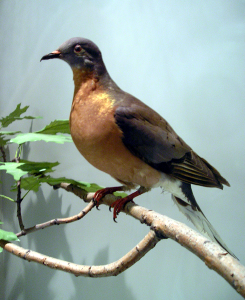
  • The Passenger Pigeon was another thriving species, which by its sheer numbers much have had a major eco-system impact. The last bird died in 1914. The ecosystem changed to accommodate it.

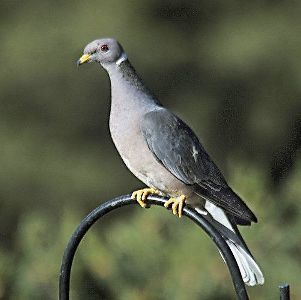
[ETA: Interestingly, the Band-tailed pigeon, described by researchers as the western counterpart to the passenger pigeon, thrives and is not endangered. Bandtails apparently carry a host-specific passenger-pigeon louse that was thought to have gone extinct with the passenger pigeons.]

There are two views of ecosystems. One imagines it as a family, where each member is critical to the family, and irreplaceable; remove enough of  the members, and the ecosystem collapses as surely as a family would do. In Kareiva’s view, it’s more like an office: Everyone has a job to do, but if the person doing it leaves, someone else takes over. In this view, the species filling the vacant slot might be from inside the system, or outside it. It makes no functional difference. (Kareiva thinks we should not allow a species to go extinct — but also notes that it’s a value, a belief, and others might not share it.) There are no pristine places left in nature; the world now has more trees in plantations than in “natural” forests. Over half the world’s humans live in cities, and the trend is accelerating. A view of nature as a “rambunctious garden” makes compromise possible.

A PRAGMATIC APPROACH TO NON-NATIVE SPECIES

When asked about introduced species, Kareiva pointed out that California has 25% more plant species than before. Owing to non-native plants, bio-diversity has actually increased. From a practical viewpoint, too, non-native plants serve functions that the native plants no longer perform, such as holding soil or providing habitat. [We’ve noted some local examples in an earlier post, Interwoven and Integrated: Non-native and Native in Life’s Web.] Nevertheless, Kareiva believes it makes sense to try to police the frontiers: be careful about which species are allowed entry. Some introduced species — like the emerald ash borer — have been a problem. Island ecosystems are particularly vulnerable. But battling non-native plants that have become established can be pointless, counterproductive, and fail the cost-effectiveness test. His preferred approach is set out in a blog post on the Nature Conservancy website. It’s called Invasive Species: Guilty until Proven Innocent?In a thoughtful, balanced article he notes:

Science-based conservation cannot be about knee-jerk platitudes and simple views of good and evil. Policy experts and conservationists who have been working hard to control invasive species should not discourage arguments about invasive species — the fact is we cannot control all invasive species, and in many cases, yesterday’s invaders have become plants and animals that are beloved by local people.

[ETA: 4 July 2011 – This talk, Conservation in the Real World, was sponsored by The Long Now Foundation, and is available as a podcast on their website.  Audio is free to everyone; the same talk is also available as video to members.]

Posted in Environment, nativism | Tagged , , | 6 Comments

Forest Shrine Makeover

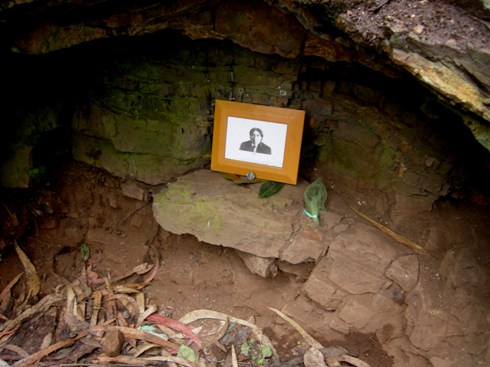
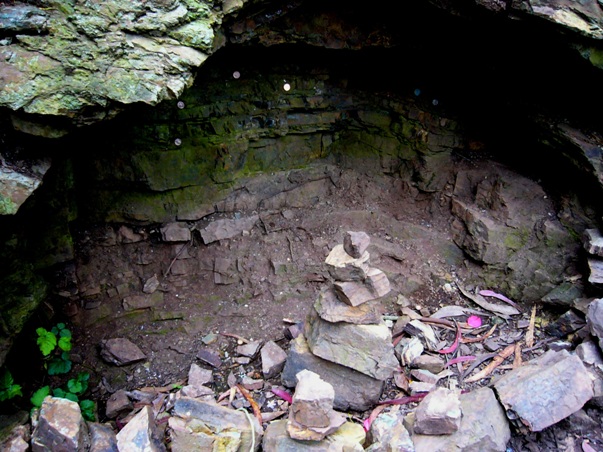
From time to time, we’ve posted about the little shrine in Sutro Forest. When we first saw it, it was a shrine in memory of Ishi, the last of the Yahi, who lived near the forest in the care of professors from University of California (Berkeley).

Later, his portrait was removed, but it still seemed to be a memorial.

Today? Not so much. June 2 was a Sutro Stewards volunteer day, when they work on trails and the Native Garden at the summit. We don’t know if it was an associated event, or a coincidence — but the shrine’s had a makeover.

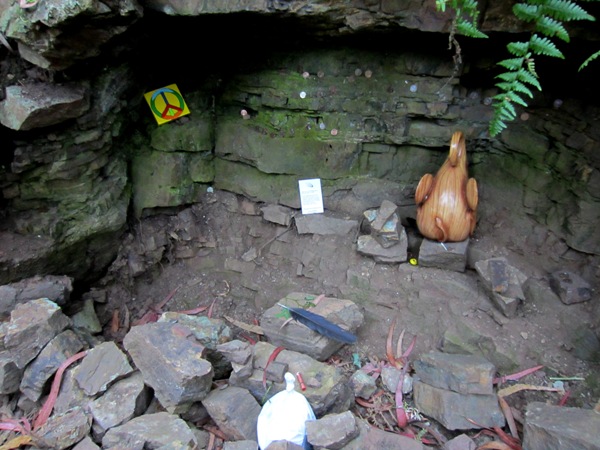
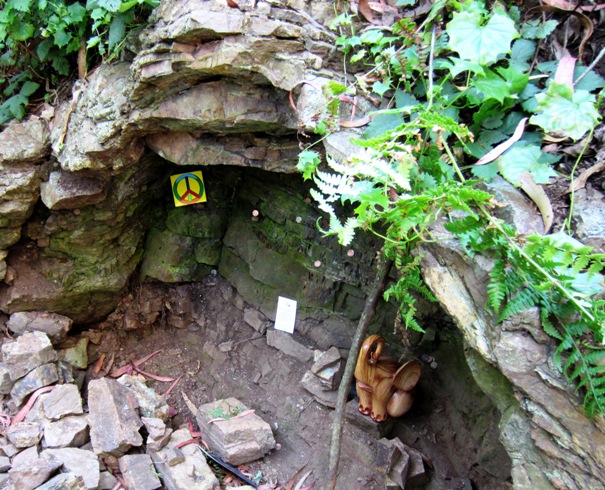
It has an elephant. And a peace symbol. A black raven’s feather.  And a fortune-telling card.

When we first saw it, Saturday, the elephant had its back to the world. It had turned away, or it had been sat in a corner. The shrine contained a white plastic bag, knotted, a broken red crayon, and a yellow plastic bead. The peace symbol was a tiny canvas, brightly painted in acrylics.

Today, the elephant faced forward; and the bag, the crayon, and the bead were gone.  Someone had tidied up. The frieze of coins on the back wall (from the previous look) was still there, as was the fortune telling card.

“Did you see the falling star?” it asked. “Did you make a wish?” It assured us that the world held great happiness for us, and our lucky color was blue. Maybe it was thinking of our jeans.

EDITED TO ADD (25 July 2011):

A few days ago, when we went on the Soundwalk in the forest, someone had added an owl to the shrine, and an abalone shell, and a feather… the romantic fortune card was gone. We hope it brought someone Great Happiness.

Posted in Mt Sutro Cloud Forest | Tagged , | 1 Comment

San Francisco Butterfly Count tomorrow, 3 July 2011

The North American Butterfly Association is sponsoring the annual butterfly count in San Francisco. It’s usually in June, but had to be postponed this year because of the wet weather. So it’s tomorrow, July 3, from 9 a.m. to 5 p.m. If you’re interested, bring lunch, and contribute $3. They are happy to have amateurs.

One group meets at the Randall Museum (199 Museum Way), with Liam O’Brien coordinating. (Email: liammail56@yahoo.com). Another meets at the Presidio and will be led by Matt Zlatunich. (Email him at  mbzlat@yahoo.com).

[Edited to Add: THE  San Francisco 2011BUTTERFLY COUNT RESULTS ARE HERE.]

Posted in Uncategorized | Comments Off on San Francisco Butterfly Count tomorrow, 3 July 2011

A Map of Mount Sutro Forest

Readers of this site may remember that a few months ago, we took down a number of maps after we received a strongly-worded legal letter. We had assumed they were in the public domain (they were based on city/ UCSF documents and bore no copyright marks), and were planning on seeking a legal opinion. However, Ben Pease of Pease Press Cartography has claimed them in a comment. That’s okay with us. We will not use his maps unless he specifically permits it. We believe in respecting copyrights.

So here is our new map. It’s not as pretty as one we hope to develop later, but we think it’s clear, legible, and serves the purpose of informing our readers. (If you click on it, then click again, it opens up to a larger version.) It’s based on a map from “Open Street Map“, a site that encourages crowd-sourcing of maps; we’ve added in some information by hand. We think it’s accurate enough for discussion and hiking.

Posted in Maps, Mt Sutro Cloud Forest | Tagged , | Comments Off on A Map of Mount Sutro Forest

Interwoven and Integrated: Non-native and Native Species in Life’s Web

Lock and key. Co-evolution. “Made for each other.” One of the dogmas offered by nativists is that native plants and animals, evolving together for thousands of years, form a closed interdependent ecology. According to the California Native Plant Society’s website:

Native plants, birds, butterflies, beneficial insects, and interesting critters are “made for each other.” Research shows that native wildlife prefers native plants.

According to native species advocates, exotic invasive plants disrupt this fabric; with no natural enemies in this new environment, they grow rapidly but provide very little by way of ecological benefits to any native plant or animal. They outcompete the natives, goes this argument, causing extinctions.

It’s not generally true. What we find is that native species adapt to the changing environment. In those species — like insects — where reproduction is rapid, they may actually already have evolved to use some of the new resources that introduced plants offer. [ETA Aug 2011: There’s a great story on such adaptation on the website Death of a Million Trees.] Others, like birds and mammals may have flexible behaviours so they aren’t tied to specific plants and ecological constructs.  Instead of ecosystems that can be declared Native or Non-native, they’re actually interwoven into a web of interdependencies that characterize any functioning ecosystem.

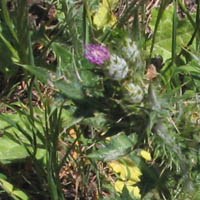
Take, for example, the Mission Blue butterfly. It’s a famously endangered subspecies of butterfly. It’s being reintroduced at Twin Peaks, with considerable effort and investment and uncertain success. Its larvae depend on a particular native host plant, lupine. But the adult butterfly needs nectar, and one of its best sources is a purple non-native thistle.

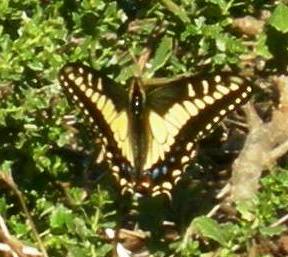
The Anise Swallowtail is a spectacular native butterfly, an eye-catching yellow that’s difficult to capture with a camera. In the 2010 butterfly count, it was the 3rd commonest butterfly in San Francisco… and all because it’s adapted to using fennel, an introduced plant as the host for its larvae.

Photo credit: 123rtf

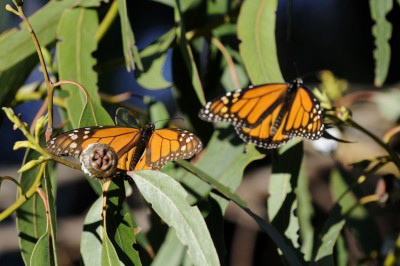
Monarch butterflies, which famously use milkweed as their nursery plant, equally famously use (non-native) eucalyptus for their primary roosting sites in California.

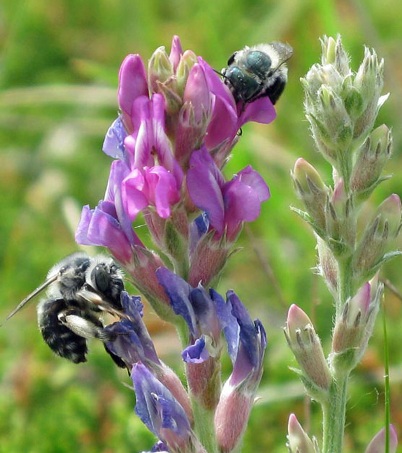
Honeybees, which are non-native, have an eclectic approach to nectar-producing flowers. They use the non-native eucalyptus flowers in seasons when few others are blooming; but in spring and summer, they can be found on ceanothus and lupine and other Native flowers. By pollinating these flowers, they help propagate them. Meanwhile, native bumblebees happily sip from non-native bermuda buttercup (oxalis pes caprae), a copious nectar source. (It doesn’t actually propagate the oxalis because that plant doesn’t set seed in California.)

[ETA: 31 July 2011] In fact, according to a recent East Bay study by UC Berkeley’s Professor Gordon Frankie and his colleagues, only 72 of nearly 700 flowering plants (PDF file) they examined had measurable bee activity (at least one visit in 6 minutes on a sunny day). Of the 72, three-quarters were non-native plants, and a quarter were native. Many garden plants are bred to be unattractive to bees (bright, double-petal flowers without much nectar); but clearly, the ones that do feed pollinators sustain a substantial population not just of non-native-but-essential honeybees, but also of native bees. The researchers found 74 species of bee, of which only two were exotic.]

[ETA 25 Sept 2011: The snowy plover, a threatened shore-bird species, nests in the old Cargill salt ponds on San Francisco Bay.]

EUCALYPTUS AND WILDLIFE

For some reason, many are convinced that birds and animals don’t live in eucalyptus forests. They do. An established and damp ecosystem like Sutro Forest is home to a large number of birds, insects, and small mammals — most of which are native.

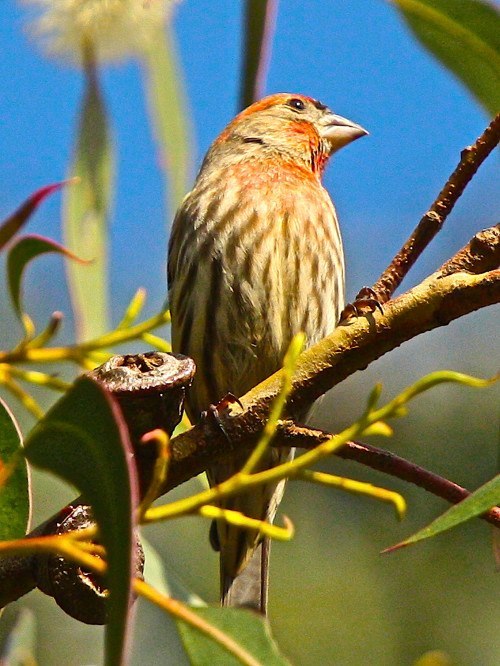
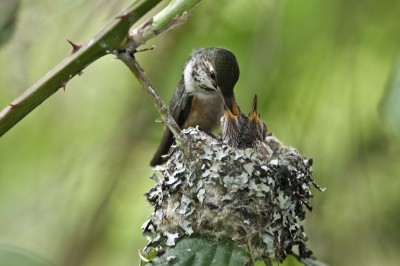
Downy woodpeckers, hairy woodpeckers, and sapsuckers are heard there; winter wrens forage in its undergrowth and call piercingly. Juncos and towhees are relatively easy to see, as are hummingbirds. Over 40 species of birds have been seen and/or heard in this forest. They use the eucalyptus, the acacia sub-canopy, and the blackberry understory as habitat.

INTERFERING WITH NATURE

In a recent op-ed article “Mother Nature’s Melting Pot” in the NY Times, Professor Hugh Raffles (of New School, author of Insectopedia) reflects on integration of Native and non-native species. The tree-preservation blog, Death of a Million Trees, carried a post about this article.

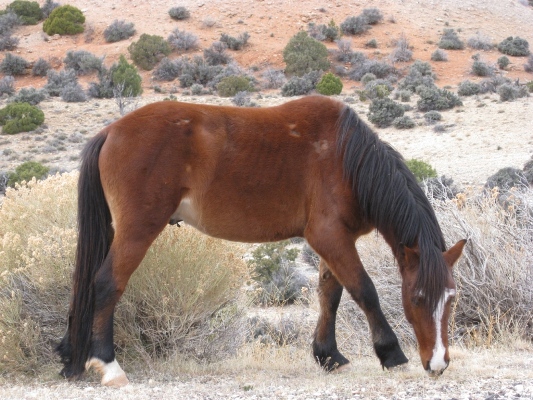
And a recent article in the New Scientist discussed the great horse debate. America had horses for over a million years, and according to the article, they evolved here. Then they died out, 10 thousand years ago. So the wild horses here now, are they to be considered reintroduced native species? Or are they non-native pests? The article concludes with a reference to Mark Davis and his book, Invasion Biology… is native vs non-native really the point?

Nature, after all, doesn’t have such categories. All species compete and co-operate and evolve, whatever their origin. Evolution occurs all the time, and can show visible results quite rapidly. Charlie (who has participated in several discussions on this site) recently sent us an interesting article from an Australian site, which noted that introduced plants were adapting to their new environment by becoming similar to native plants. This leads to the obvious question: If these plants become unique to that landscape, at what point are they deserving of protection as an endemic species?

Trying to restore a landscape to a particular point in time assumes a static view of the environment that is quite unnatural in an ever-changing planet.

[ETA 24 June 2011: Para on horses edited to clarify facts and provide a link to the 17 June 2011 New Scientist article. However, this link will probably expire after some weeks.]

Posted in Environment, nativism | Tagged , , | 9 Comments

Twin Peaks, Glen Canyon, Natural Areas, and Imazapyr

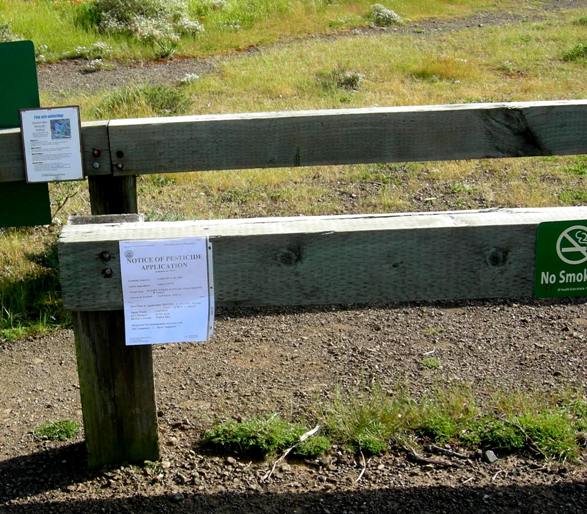
We’ve been seeing the new pesticide notices up on Twin Peaks, the ones we wrote about earlier here. So today, when we saw three more (and there may have been others) we assumed they were more of the same.

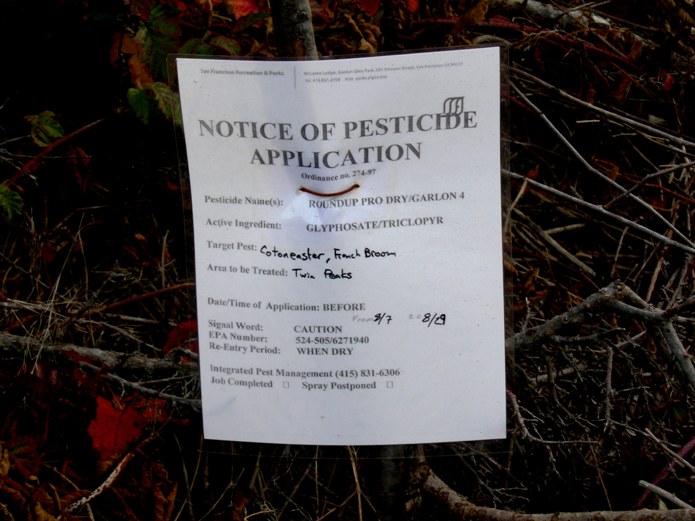
They weren’t. The weren’t attacking ehrhata grass, they were targeting a whole bouquet of plants: cotoneaster; eucalyptus; pittosporum; French Broom.  And the posts on the steep hillside above the homes of Midtown Terrace carried signs for Imazapyr, the newly-approved pesticide for use in “natural” areas, presumably by the Natural Areas Program. Newly approved by SF’s Department of Environment, that is. The Federal Government approved it a long time ago, along with a number of other toxic chemicals.  It’s a Tier II pesticide, and it’s a replacement for Garlon (which we’ve also written about here), which is Tier I. So that’s an improvement, right?

Marginally. Imazapyr has its own problems. One of the factors the Department of Environment considered in approving it is its use in the spartina extirpation project — where also it has been called into question. (This article on the website, Death of a Million Trees, discusses the spartina project.) Here’s what we wrote about Imazapyr in January 2010 when we first found it being used in Stern Grove:

——————————————————————————–

NATIVE PLANTS AND NEUROTOXINS

Imazapyr is sold under the brand name of “Habitat” when it’s for Native Plant Restoration. Its other trade names are slightly less benign: Chopper. Stalker. Arsenal. Assault.

It persists in the soil for up to 17 months. It’s water-soluble, and moves through soil to get into groundwater.  “Traces of imazapyr were detected in the groundwater even 8 years after application,” according to a  study by scientists from the Swedish University of Agricultural Sciences. (Pest Management Science, June 2004.)

It’s a broad-spectrum killer, so it kills most things it hits (except some weeds that have become resistant). It’s also a difficult herbicide to target with any degree of precision.

In fact, some  plants actually push it out, so it gets into the tangled roots below the soil and kills other plants. From the Nature Conservancy’s Weed Control Methods handbook: “… imazapyr may be actively exuded from the roots of legumes (such as mesquite), likely as a defense mechanism by those plants… the ability of imazapyr to move via intertwined root grafts may therefore adversely affect the surrounding desirable vegetation with little to no control of the target species.”

This is the chemical opponents compared to Agent Orange, when the border patrol planned to spray it on tall cane growing along the Rio Grande river. Communities on both sides feared contamination of the water. The plan was suspended.

In people, it can cause irreversible damage to the eyes, and irritate the skin and mucosa. As early as 1996, the Journal of Pesticide Reform noted that a major breakdown product  is quinolic acid, which is “irritating to eyes, the respiratory system and skin. It is also a neurotoxin, causing nerve lesions and symptoms similar to Huntington’s disease.”

Oh, and Imazapyr is illegal in the European Community.

——————————————————————————–

[Edited to Add (31 July 2011):

GLEN CANYON GETS IMA-ZAPPED

  Someone recently sent us this sign   with the comment: “I would like to have no poisons used in the park.” Imazapyr is scheduled for use in Glen Canyon. They also sent a photograph of the area involved with the note: “Because of the placement of the signs, I could not get a good shot of both the sign and the area to be poisoned. So here you have the sign, [and] a side view of the sign in the area …”

The target species this time are fennel and cotoneaster. Fennel is the host plant for the brilliant Anise Swallowtail butterfly. In the last butterfly count (July 2011), butterfly specialist Liam O’Brien wrote that San Francisco might have the highest number of Anise Swallowtails “Seen-in-a-day” in all the counts across the nation. He notes why: “…with 44 hills in San Francisco, it being a hill-topping species, lots of fennel…makes perfect sense.” {Emphasis added.} It’s also listed as a species that commonly attracts native bees in the list published by UC Berkeley’s Professor Gordon Frankie.

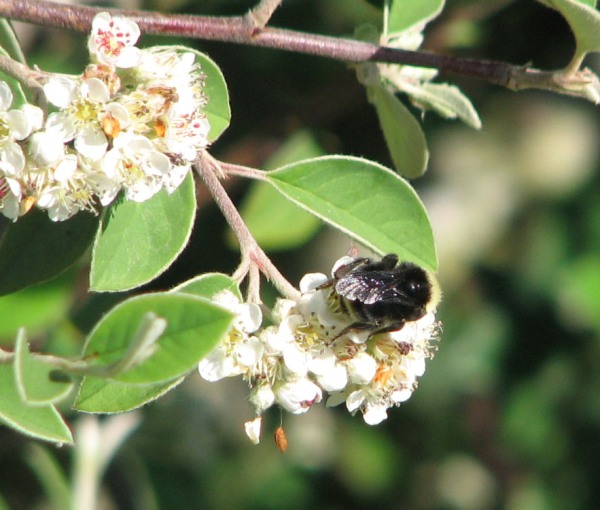
Cotoneaster is a flowering plant. Its nectar feeds bees and butterflies. (The list above included it as a species that attracts both honeybees and native bees.) Its berries provide food to birds and animals.

Is it worth using toxins to remove these from the Canyon, which is a haven for wildlife and a play-space for children?

——————————————————————————–

Here on Mount Sutro, we’re currently reprieved from pesticides because of UCSF’s policy of using none in the forest or on the Aldea Student Housing campus. They’ve used no toxic pesticides in the forest since 2008, and in the campus since 2009. Their plan, which we believe is endorsed by the Sutro Stewards, calls for a re-introduction of Roundup (glyphosate-based)  and Garlon (which they mistakenly refer to as a glyphosate-based pesticide, but is actually the even-more-toxic triclopyr). We would guess that if the Natural Areas are using Imazapyr, they would add that to their Arsenal too….

Posted in Herbicides, Herbicides: Roundup, Garlon, UCSF | Tagged , , , , | 4 Comments

Roundup, Birth defects, and the new trail in Mount Sutro Forest

The new trail connecting Stanyan (just above 17th Avenue) with Medical Center Way opened a few days ago. Though still marred by the stumps of dead trees and amputated shrubs, it provides better access from the Cole Valley side of the forest, and a view of the ravine through which the seasonal creek runs. The recent rains have helped the vegetation grow back.

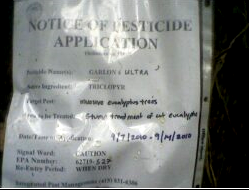
This lies in the city-owned Interior Green Belt portion of Mount Sutro Forest. Unlike UCSF, which has used no pesticides in its part of the forest, the SF Rec & Parks does use Roundup (glyphosate) and Garlon (triclopyr) as it sees fit. We have a notice of Garlon 4 Ultra use as recently as September 2010.

We can only hope they don’t see fit.

We’ve been writing here about the risks of pesticides used in “Natural Areas.”  These are, in particular,  Garlon (a Tier I herbicide according to San Francisco Department of the Environment – SF DOE) and Roundup (a Tier II herbicide, not quite as toxic as Garlon).

ROUNDUP AND BIRTH DEFECTS

Our post about Roundup and birth defects cites the relevant research. In short, Roundup can impact the brain development of vetebrate fetuses. Here’s what we wrote then:

heart breaking

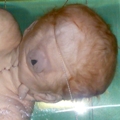
“The actual article, which we read elsewhere describes some of the birth defects: microcephaly (tiny head); microphthalmia (tiny undeveloped eyes); impairment of hindbrain development; cyclopia (also called cyclocephaly – a single eye in the middle of the forehead); and neural tube defects. These are quite devastating. Many fetuses do not come to term, and many babies with these conditions die within hours or days.”

Now someone sent us a link to this article in the Huffington Post. It notes that researchers have found that European regulators have been aware since 1980 that Roundup can cause birth defects… but did not make it public. (Here’s the link to the source report on which that article was based.) We wonder if, in that case, the US authorities were ignorant of the research.

ROUNDUP, SOIL PATHOGENS, AND PLANT DISEASE

Separately,  Don Huber, Emeritus Professor from Purdue University, wrote an open letter to the Secretary of Agriculture about “Roundup Ready” crops. In it, according the the Huff Post report, he said, “It is well-documented that glyphosate promotes soil pathogens and is already implicated with the increase of more than 40 plant diseases…”

We’re grateful that San Francisco has another line of defense in its own Department of the Environment. We’re dismayed that such powerful pesticides are still used in “natural” areas where people hike, children play, and dogs are walked. In fact, we’re not clear how the objective of controlling non-native plants over-rides the precautionary principle of not using risky chemicals.

Posted in Herbicides, Herbicides: Roundup, Garlon, Mt Sutro Cloud Forest | Tagged , , , , , | 1 Comment

Mount Sutro Forest as Habitat: Janet Kessler in ‘Way Out West’

We’ve often written about the importance of Mount Sutro Forest as habitat. (For instance: here.) Everywhere in our city, eucalyptus provides nesting and perching sites for many different birds, as does acacia which grows as a sub-canopy in many parts of the forest. All the bird pictures here were taken in San Francisco.

But it’s not just the trees. Blackberry, the main understory plant of the Mount Sutro Forest, is a very rich habitat plant. It supplies cover, food, and places to den and nest.

photo credit: 123rf.com

Left untouched, it grows 6-8 feet high or taller in the shade of the eucalyptus canopy and the acacia. Its thorny dense bushes provide many cubic feet of space to insects, birds, and animals.

Recently, Janet Kessler pointed this out in an interview with Victoria Schlesinger to Way Out West, an online journal dealing with environmental news in the Bay Area. Kessler is the Jane Goodall of San Francisco’s coyotes, keeping a minutely-observed blog, Coyote Yipps, with detailed photographs of animal behavior. She’s also a photographer of San Francisco’s wildlife, and has exhibited her photographs at exhibitions in the city. She’s posted many of them on her “Urban Wildness” site (the bird pictures above are from that site). She spends hours each day watching wildlife. Here’s what she says about the removal of blackberry in San Francisco:

“…Himalayan Blackberry… is thorny and dense.  Birds live in it. It’s food for lots of animals. It prevented dogs from going into the underbrush area. It was very protective and because it was non-native they took it all out. It was an excellent plant for animals. Instead of thinking, what’s this plant serving? What’s its purpose? What’s it doing? They just thought, ‘Oh non-native, out it goes.’

“There are new studies out by Mark Davis. He’s written a book called “Invasion Biology.” He’s trying to show that not all non-native plants are harmful…”

Please do check out the interview. Not only is it excellent and insightful about wildlife, it’s illustrated with Kessler’s excellent photographs of coyotes, snakes, frogs, raccoons, birds and other urban wildlife.

Posted in Environment, nativism | Tagged , , , | 1 Comment

Mount Sutro Forest, Sunlit

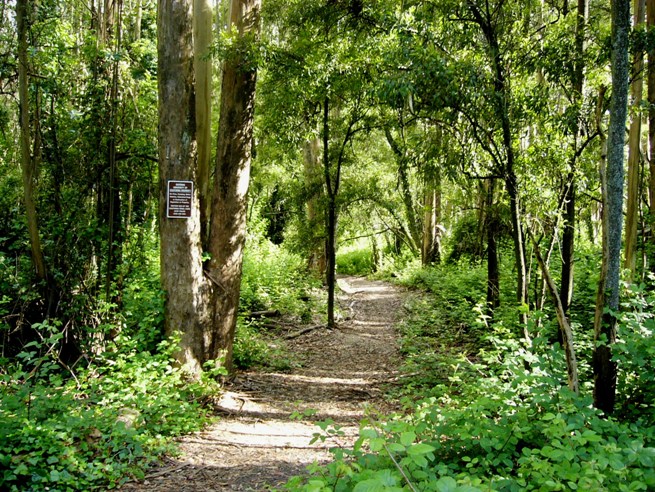
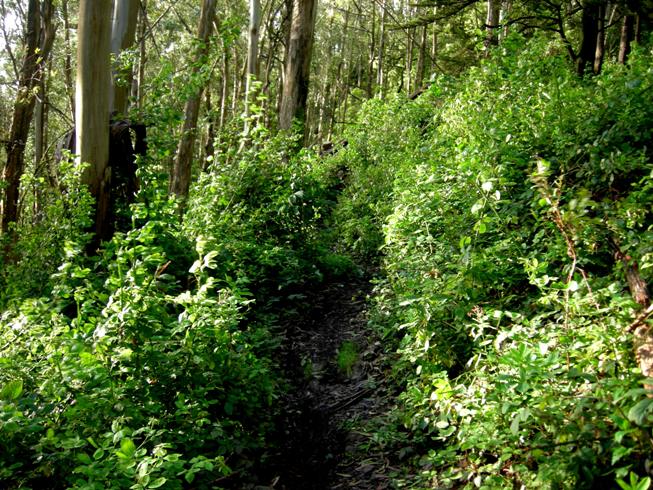
We’ve often spoken here of the beauty of Mount Sutro Cloud Forest on days when it’s wrapped in soft gray fog and the tree tops are hidden in the mist. Then the muffled sounds of the city barely disturb the tapping of the forest’s interior rain on the leaves, and the forest seems immensely large. It’s as if it’s another world in another dimension.

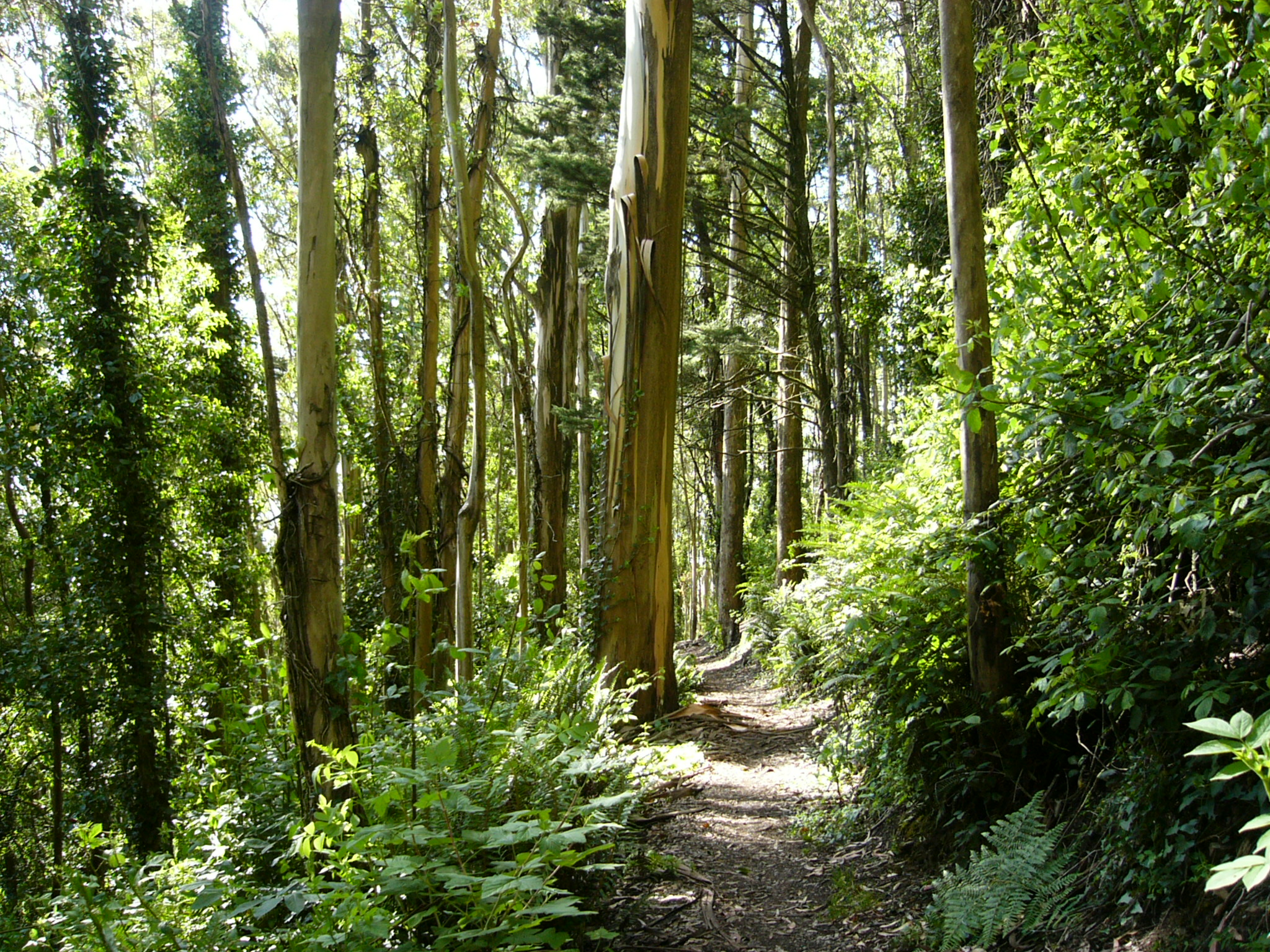
But the Mount Sutro Forest is also lovely sunlit. Yesterday, a drizzly day gave way to a clear afternoon, bright blue sky decorated with fluffy picture-book cumulus clouds. The sunlight slanting through the trees kindled the undergrowth to a glowing green.

Despite the weather, few  people were out. We passed a couple of friendly bike-riders, who called a greeting as they went by. The understory on the South Ridge has begun to heal after being mowed down some months ago; a few birds flew around, and some may have been nesting from the way they darted into the bushes.

It was delightful foray thought the essence of a summer forest (though our summers usually give us the cloud forest experience here in the fog belt).

It looked like a Pissarro painting the De Young museum displayed a year ago, in its Birth of Impression exhibition. Only lovelier.

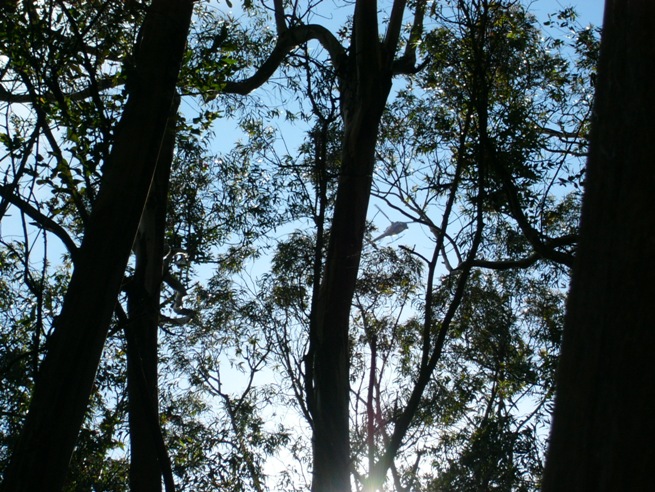
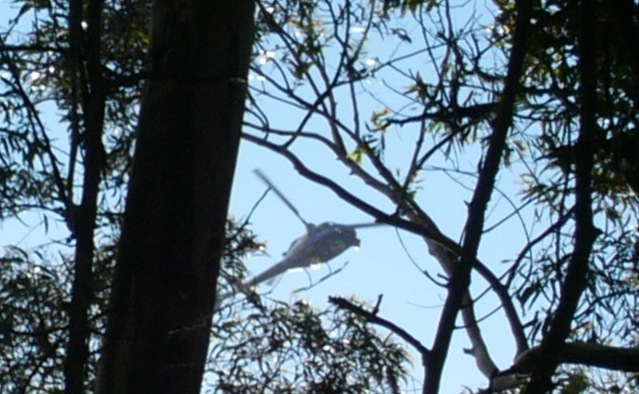
Actually, what drew us into the forest in the afternoon was a hovering helicopter that remained positioned over the forest for a good twenty minutes or more …

Here’s the picture closer in.  What was the copter’s mission? Nothing to do with the forest, it turned out… the issue was closer home.

Returning by the East Ridge trail, we were dismayed at how it’s been denuded of its understory, especially in the area just above the new “Clubhouse” that’s being built on Johnstone. Instead of lush green vegetation, it’s open and dry and littered with twigs and bark.

But in a countervailing piece of good news… at 9 p.m., we heard the soft resonant hoots of the Great Horned Owls. It sounded like two of them, from the forest. We hope they’re back and not just passing through.

Posted in Mt Sutro Cloud Forest | Tagged , , | 2 Comments

SF NAP on Twin Peaks: Rainy Days and Roundup…

Rainy days and Roundup always make me sigh… This report is brought to you from the drenched slopes of Twin Peaks.

And here’s another one…

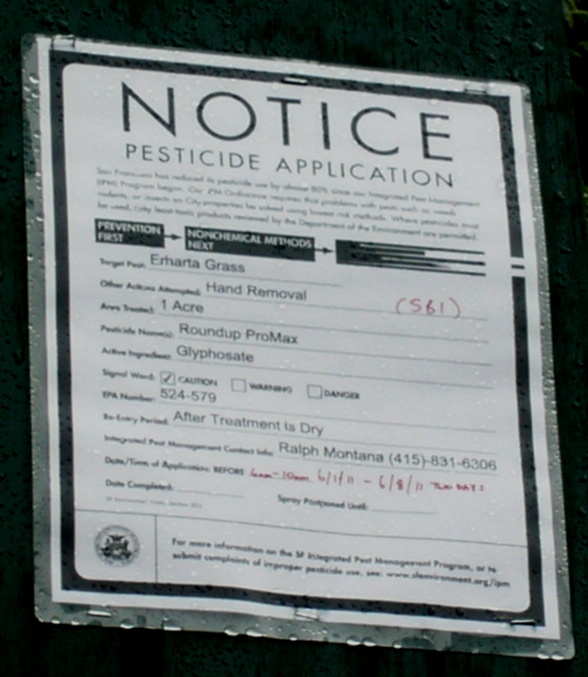
They’re putting the pesticide notices high and visible now, which is an improvement. Also, they’re using Roundup. Though it has its problems — and is a Tier II pesticide — at least it’s not as toxic as Garlon (which is Tier I).

Roundup, Twin Peaks, June 2011

For those who hoped that pesticide applications would stop at one or two in Natural Areas… umm, no. This sign is in the same place where we first saw a pesticide sign back in October 2009 (and a couple of times since). Back then, it was against Cotoneaster and French Broom; now it’s against Erhata grass.

Roundup and Garlon, Twin Peaks, August 2009

Still, we’re relieved that the Natural Areas Program is keeping its promise not to use a combination of Roundup and Garlon — as they did then.

[ETA: Two more notices (they have the same text as the ones shown earlier).]

Posted in Herbicides, Herbicides: Roundup, Garlon, nativism | Tagged , , , , | 3 Comments

Lament for Oakland’s Garber Park

We read this article in the Spring issue of Hills Conservation Network’s newsletter (the link goes to a PDF), and it resonated with us who want to save Sutro Forest’s habitat. Ecological destruction, whether from building and traffic, or from “restorations” inevitably impact wildlife, micro-climates, and atmosphere. It happened in Garber Park, and still continues. This could be the fate of Sutro Forest.

The article is republished here with permission and minor edits.

CHANGES IN OUR GARBER PARK NEIGHBORHOOD by Diana

I have been thinking about our Garber Park neighborhood and how it has changed over the past 25 years that we have lived here on Evergreen Lane. I have been thinking how habitat has altered since 1986 and how the overstory of greenery has declined.

In 1986,Evergreen Lane was truly evergreen. In September of 1987, I recall that our neighbor, Mr. Garfield, a professor at Cal, described it as a “magic street.” At that time the street looked like a green tunnel, with big trees on both sides all the way down to Garber Park. A giant eucalyptus tree stood majestically at the intersection of Evergreen and Slater Lane. The air was cool and fresh, invigorating with the moisture of shaded land.

For several years after we moved into our house, deer abounded. There were spots below our home where they rested during the day. When the heat became extreme in late summer, the deer found cool places to sleep under our house. Often, in the fall, we would see male deer butting heads down the hill, while the does hid in the deeper tree growth.

There were raptors perched in the oak trees and hawks flying across the skies. We would see bats fly by the windows at night. And, at certain times of the year, we would hear owls calling to each other in the dark as they waited to spy mice and other small night-time venturers. Every night, we would be greeted by a mother raccoon and three babies eager to hunt for crumbs that might have dropped from the picnic table on the deck.

Mobs of robins arrived to find berries before they embarked on their migratory journeys. We enjoyed watching the abundance of spiders, tiny orange fellows that would spin their webs on plants in summer, adding dashes of color among the greenery. It was beautiful to watch them spin their slivery architecture; their webs were jewels that reflected the dappled sunlight.

Wild bumble bees built a hive under the house, and yellow jackets would visit us when lunch was outdoors, snatching tiny bits of food from the tablecloth. We had a water snake living in our garden for several years. In the garden, we also hosted voles and, once in a while, we would spot the woodland pack rat, an intelligent, clean animal.

Now, when we look around us, we see changes everywhere. Nature no longer seems as close as it used to be. When we look down at the arena where the bucks once battled, it is empty. It has been years since those scenes occurred. The path between houses here where we often saw three or four deer ambling down together is seldom used. We had one doe and a fawn visit last summer under the house, but they stayed for only a day, then disappeared. We spotted one deer resting down the hill this last year.

We know fatalities have occurred due to heavier and faster traffic on Claremont Avenue; that may account for part of the loss. But we suspect that the deer may miss the trees and bushes that have been removed over the years. Careless pruning has opened up much of the green overstory that once existed.

The raccoon population was bothering a neighbor so raccoon families were trapped and taken away as nuisances. Few have been our way since that time. This last year I counted only four or five cobwebs in the garden.The bumble bees have disappeared, as have the yellow jackets. Wild bees’ nests were destroyed by people who believe that bees’ nests house “dangerous pests.” Someone used a shovel to kill the water snake. Its body was left to rot in the sun.

The robin activity was much lower this year. Perhaps they miss the berries; many of the berry bushes have been removed because they are said to be invasive; they are “not the right kind,” except that the robins really liked them.

We read that rat poison is spread in parks discourage rodents. The poison moves up the food chain to destroy other species. We have never used pesticides or any other materials that would harm the abundant life that the park and the overhanging trees on Evergreen Lane once supported. Yet, the majority of the wildlife described above has disappeared.

Granted, the 1991 fire (which thankfully did not reach Evergreen Lane or go into Garber Park) and construction in surrounding areas have occurred in the intervening years since we have taken up residence here.

But the raptors are leaving us; a few hawks roam the area but lately I have seen or heard only one. Now, with more eucalyptus trees removed, the evening dance of the bats has also disappeared. We have no idea why so many animals, birds, and insects have left us.

Something in the environment has removed what they needed. We don’t know what it is. We know we miss the spontaneous and vibrant natural environment that greeted us here in 1986. Now we are scrubbed and clean. The bothersome species have been banished.

We miss the cool, scented evenings filled with moist, clean air. Dust is much more a part of our life now, seeping into our house through any crack or cranny, making us think twice before we throw open the sliders for fresh(?) air.

With all respect to those who have come to restore Garber Park to its “native” beginnings and have worked hard to remove built up debris, we can’t help but long for that time when venturing into the Park was a near wilderness experience with dark, cool overhead coverings and the unexpected rush of an animal disturbed in its quiet retreat from the heat.

I understand that the work that is going on in Garber Park is well intended… I also feel the magic slipping away.

—Diana

[Note: The Garber Park photographs illustrating this article are by Bindu Frank and used with permission. The animal pictures are NPS public domain photographs. ]

Posted in Environment, nativism | Tagged , , , , | 3 Comments

In Mount Sutro Forest, May 2011

Last Thursday evening, we wandered around the forest. We hadn’t headed that way, but it drew us in, as it often does. Despite the recent habitat destruction here and on the Kill-Trees Trail, it’s still a magical place. Here’s our report.

THE GASH

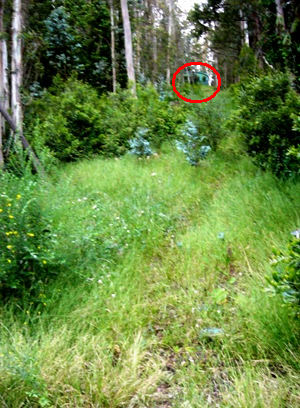
The Gash — the long deforested patch left by the SF Water Department’s work there some years ago — has been an eyesore for years. It had begun to fill out a couple of years ago, but someone stripped down the eucalyptus sprouts that had returned. Now it’s  finally been allowed to heal, and fill in.  It’s looking better, though it’s still a clear view up to the Aldea campus and to the bright green water-tank beyond.

 SOUTH RIDGE

On the South Ridge trails, some of the vegetation that had been mercilessly slashed away is also returning. A few blackberries, native and Himalayan, were in bloom. We saw a lone Douglas iris and a purple cineraria.  Areas that haven’t been hacked had some bird sounds. 

It’s a brief reprieve until September 2011. That’s when the hacking is planned to start in earnest, with the felling of trees, the removal of blackberry, and the amputation of vines. This will certainly alter the habitat as well as the look and feel of the forest — unless it’s stopped.

FORGET THE FORGET-ME-NOTS

forgetmenots in Sutro Forest
Spring with forget-me-nots 2010

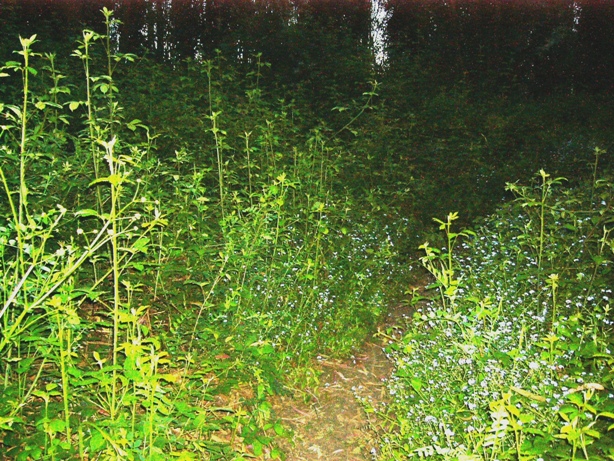
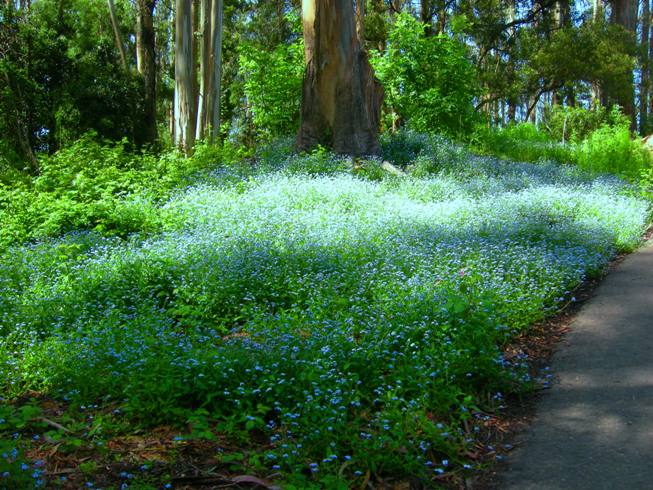
We hope anyone who appreciates the lovely forget-me-nots that grew wild near the summit near the Native Garden entrance got a chance to enjoy them. Someone, probably the Sutro Stewards since they do most of the work there, has covered them deep in woodchip mulch. Presumably because they’re non-native.

Where the forget-me-nots were

(In better forget-me-not news, patches of blue are appearing along Clarendon Avenue on the Midtown Terrace side, where the vegetation has been trimmed back from the road.)

The Native Garden was mostly flowerless except for a few California poppies. But it’s green and lush now, and probably at its best. In summer, it turns brown and looks dead. The Sutro Stewards are replanting a meadow there in the hope of attracting “native pollinators.” The bushes are finally large enough to provide some cover for birds, and we hope we’ll see more wildlife action, avian and others, in future. Right now there’s still not much, though we’ve spotted a few juncos.

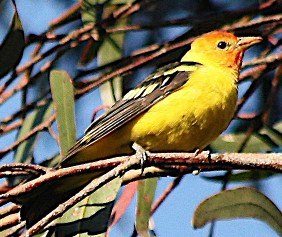
For bird-life, it’s the North Ridge trail (from Medical Center Way to the summit). It’s still quite dense vegetation, and that’s where we saw and heard more birds. We came upon a report recently where someone birded the trail and listed eleven species — including the Western Tanager, which wasn’t on our earlier lists here and here. We’ve added it in. It’s clear that if the forest is left alone, it will revive and regenerate, and the wildlife return.

EDGEWOOD AND SURGE

We emailed UCSF about tree felling around the Surge parking lot behind Edgewood. Nine trees, one of which had actually fallen in a storm, were slated for removal. They assured us they were being careful of birds because the nesting season is now in full swing. From Damon Lew, Assistant Director, Community Relations:

“I checked in with Facilities Management (FM) about this and it turns out that with the storms we had several weeks ago there was a tree that came down near one of our Edgewood neighbor’s property. At that time they identified several more dead and decaying trees that were potential safety hazards and the removal of these trees is the work you saw taking place. FM and the vendor were both aware of the nesting season and they are examining the trees before performing any work to ensure that there are no nests present. It seems that the trees that they are working on are in such poor health that the canopies are bare so it is easy for them to spot any nests.”

When we enquired about the number of trees, he sent us this response:

“Four trees needed to be removed last week. All four were on the edge of the parking lot or the edge of Farnsworth trail. An additional five trees will need to be removed on May 7th. These are either on the edge of the parking lot or near the Surge stairs.”

NO OWL NEWS

Even though we lingered after dusk, we didn’t hear the Great Horned Owls… we’re still hoping they haven’t gone away. (In more hopeful GHO news: they are nesting successfully at Stow Lake and Glen Canyon; both nests have hatched young this year.)

Dusk, mist, Great Horned Owl - March 2010

Posted in Mount Sutro Stewards, Mt Sutro Cloud Forest | Tagged , , , , | 4 Comments

Mount Sutro Forest, Native Plants, and Ideology: Debate between a Climatologist and Charlie – Part III

This is part of a continuing series of conversations between Charlie, a US-based naturalist, and Gov Pavlicek, a climatologist in Europe (on our front-page comments section).  We’re finding their contrasting worldviews interesting.

For those interested in earlier exchanges, here’s Part I and Part II.

As the conversation continued, Charlie spoke of what California has lost. Gov spoke of the biodiversity gained, and the fact that many species presumed to threaten others by their invasiveness aren’t actually doing so. As with the earlier ones, these exchanges are also edited for brevity and focus.

 CHARLIE: THE BUNCHGRASS PRAIRIES ARE GONE FROM CALIFORNIA

Charlie says:

You [Gov] say invasions rarely cause extinction.. well, I say extinction is not everything. Much of interior California was once covered in a bunchgrass and wildflower prairie. This is all gone. Granted much of this is due to factory farming but even in unfarmed areas, the bunchgrasses are quite rare now as are their wildflower cohort. In their place are just a few species: ripgut brome, yellow star thistle, wild oats, black mustard… There are millions of acres covered predominantly by those species and the bunchgrasses are now confined to a few places – mostly clay or serpentine soils that the invasive plants can’t tolerate. They aren’t extinct but they are no longer a meaningful part of the landscape.

They weren’t replaced by an equally diverse multicultural tapestry of prairie grasses and forbs selected from around the world. They were replaced by a handful of agricultural weeds. When invaders are introduced, we don’t introduce their whole ecosystem. If we plunked an intact California ecosystem and an intact South African ecosystem of a similar climate together, next to each other, on a space colony or something, you’d probably get some really neat mixes, the kind you are describing. Maybe that is what you are getting in Europe and I could buy something similar happening in Sutro on a small scale. But, on the grasslands, what you have is the ruderal plants from several ecosystems completely crowding out the normal ecosystem process. So you see what I mean about extinction not being everything? Having a bunchgrass clinging to life on a rock is not the same as a million acres of bunchgrass prairie.

A few more examples:

  • American chestnut was once the dominant tree in much of eastern North America. This huge, beautiful tree provided food for humans and wildlife, was a centerpiece of the ecosystem, and also had very nice wood. The chestnut blight, introduced from Europe, top-killed every chestnut with VERY few exceptions. The chestnut still exists as a coppiced shrub in a few places, so it isn’t extinct. But, the chestnut forest is gone.
  • American elm was decimated by Dutch Elm Disease in much the same way as the chestnut.
  • Woolly adelgids, an insect, are currently killing off most of the Eastern Hemlocks in the same area, and the emerald ash borer may do in most of the ash trees.
  • Similarly, Joshua trees and sajuaro cactus will probably be banished to a few rocky outcroppings in the next 50 years because two grasses – buffelgrass and cheatgrass – are completely dismantling the desert ecosystems of the American Southwest by changing fire regimes.

[Webmaster: And for another example, Sudden Oak Death is killing California’s oak trees. But how is this an argument for preventing those plants that can survive from doing so? These blights are almost impossible to stop, except by quarantines; we can’t chop them down or garden them out. So if the oak goes, and we fell the eucalyptus, we have no forests?]

To me it sounds like a collapsing ecosystem. The idea of blended ecosystems might sound nice when you write it down (though to me it sounds horrible because we lose the uniqueness of place!) but it won’t work. There is no way to transport an entire ecosystem, with all of the insects, bacteria, fungi, etc, etc, to a new continent. You will only transfer a few plants… some become invasive, most die off.

So, it seems like you are pushing for McDonalds and star thistle on every hill. I’m hoping we can retain some of the rich ecosystem diversity on the planet instead.

GOV:  CHANGE IS PART OF LIFE, AND PREFERENCES ARE SUBJECTIVE

Here’s Gov’s response:

Charlie, your note mentions some facts (diseases spread and kill many trees — which is true), but then moves on to personal preferences and views on what is a functioning ecosystem and what isn’t. [An ecosystem that’s “collapsing” is actually one that is changing.]

Chestnut blight….no one likes it. But what does it prove? [Native organisms can also be invasive.] We know that the native Mountain Pine Beetle currently wreaks havoc from Colorado to British Columbia [BC] and Alberta. The current outbreak of mountain pine beetles is ten times larger than previous outbreaks. Huge swaths of central BC and parts ofAlberta have been hit badly, with over 40 million acres of BC’s forests affected. And that is just BC. Some experts have predicted that if the problem is not eradicated, many of Colorado’s mature lodgepole pine forests will be killed within three to five years.

In Europe we have native badgers carrying Bovine TB, causing losses to farmers because cows are infected. We have [native] birch and pine trees constantly invading heath and fields, and thereby limiting habitat for the red list species that cannot survive in forests.

You extrapolate that some species will almost become extinct in the next 50-100 years. First of all: extinction — like you mention — isn’t everything. You are right: it simply happens as long as there is life on this Earth. So the occasional extinction here and there, for whatever reason, is not that much of a deal — especially  if you consider the current extinction rate is because of humans in a more direct sense (as you said, habitat loss for agriculture).

But how can you be sure that the current trend will continue? Can’t local species adapt? Can ecologists predict which species will become invasive and which won’t? No. Have they been able to predict the outcome of an ongoing invasion? Rarely. (Many times, when asked if some species have become extinct they answer : “Not yet” — as if it is inevitable it will happen.)  An example is the Argentine ant, which started to dominate all other ant species in Texas somewhere in the 1980s [and was predicted to drive out the others]. But 15 years later, you had to search for it, according to researchers. The ant is there, but behaves like other ants….

You note the differences. Any chance of things getting back to how they were? At what cost? Is it for the public good or is it to please the few? In The Netherlands, they have started campaigns to convince people their views are the right ones because currently people, as I have mentioned, do not support it.

How come ecologists (among others) do this? Is this the role of a scientist? Seems more like a religion.

Finally: in many cases restoration of landscapes will become dependent on money, if the invaders are present, but kept at bay — they’ll return when the money runs out.  In NL, with much rain and snow, the natural vegetation is temperate forest — broad-leaved, coniferous or a mix. [Thus, keeping areas as open heaths requires costly human intervention.]

CHARLIE: WE’RE ALREADY MANAGING THE PLANET

Thanks for the thoughtful response. I feel like we are in some ways on the same page. Still, I seem to be having trouble communicating my most important point: the native vs non native dichotomy is not what we should be looking at — but that you are going too far the other way in saying that invasive species should not be managed/dealt with either, because most people want to get rid of them because they are often non-native.

There are DEFINITELY native species that are invasive. When changes in the landscape throw off the previous balance, a native invasive acts the same was as a non-native invasive. I think we should manage/control ANY invasive species if we find that it is feasible. I think we need to look at species (and people, if you want to continue that analogy) based on what they do, not where they are from.

The unusual assemblage of plants on Mt Sutro have obviously formed a complex ecosystem, despite the fact that they are from all over the world. I DO think it is really neat, and people should be spending more time studying ecosystems like this. How can an equilibrium form in just a century? Are the fungi, bacteria, etc, implemented and connected as strongly as a native ecosystem that has been similar for 100,000 years?

[Webmaster: Interrupting the conversation to say, maybe yes, maybe no. But if it were removed, the replacement ecology would not even be a century old. It would be brand new, and while it might mimic an older ecosystem, it wouldn’t *be* a 100 thousand year old ecosystem. It would be a representation of one, maintained that way with ongoing effort.]

If so, what makes Sutro different from some of the other Euc groves I have seen with little diversity in the understory, or worse, an arundo or tamarisk stand with essentially NO diversity. There’s a lot we don’t understand here, and it’s really worth a closer look. I initially came to this site because I was concerned that the blackberry, etc, in the understory might infect other areas with more natural ecosystems, and cause ecosystem collapse. I think I do agree though that because it is in the center of a city, and because there is already blackberry all around the greater area, this may not be justification for removing the blackberry.

The native bark beetle problem is often blamed on climate change and I think that is a factor but it seems that the main reason is due to alteration of fire regimes. The trees are too dense, and in some cases too old, so they are more vulnerable to drought and beetle attack. So, they are all dying at once. In this case it is probably too late to solve this problem.

This brings up the point that many invasive organisms are that way due to larger scale management issues that need to be addressed. All land on Earth is being managed by humans (no-action is a management choice at this point) and most places have been managed by humans for at least 15,000 years. In Europe this history is much older. But, while we figure out the best way to manage the land, to allow the more complex ecosystems to persist, a variety of invasive species are causing extinctions all over California and other areas.

We may ultimately realize that if we use a more appropriate management regime the invasives will go away or ‘behave properly’ as an ecosystem component. But, it could take many decades to figure this out and by then, most of the components will be near-extinct. What I propose is that we learn the systems, but we also deal with the symptoms. 

In any event, I apologize for any overdramatic or inflammatory contents that I may have made on this website. I also apologize that you have run across so-called ecologists who were racists, bigots, or xenophobes. I also, however, assure you that while we all have our own biases and shortcomings and irrational fears, mine are not the basis of the ecological management regimes I am advocating.

[Webmaster: Speaking for myself, I find your viewpoints interesting even where we disagree. Thanks both to you and to Gov for stopping by here.]

Posted in Environment, Mt Sutro Cloud Forest, nativism | Tagged , , , , | 1 Comment

Mount Sutro Forest, Native Plants, and Ideology: Debate between a Climatologist and Charlie – Part II

In this post, we continue the conversation between Charlie and climatologist Gov Pavlicek. Gov responded to Charlie’s earlier comment. That discussion is here. 

GOV: “ECOLOGY” AND XENOPHOBIA

From Gov:

“Charlie, thanks for the thorough reply.  I was astonished by the ecologists I know. I’d say they are not secretly conservative on this issue, they don’t seem to know it or acknowledge it. In all other aspects, like me, they are usually progressive when it comes to people or culture.

“On the other hand, I have read some comparisons between the homogenization of nature and culture in a sense that the latter is also “bad”: [that for instance] McDonalds in Nepal would be awful. [However], as with nature, the local people [actually] seem to enjoy it. In theNetherlands [NL] theUniversityofWageningen did research on which woodland forests visitors liked the most in NL. Out of 150 different pictures two clearly emerged as top favorites: one had beech in it, the other oak, and both had a Douglas fir clearly visible. They concluded that people do not reject and indeed like these trees.

“Separately, they asked the same respondents what they thought of exotic trees like Sitka spruce and Douglas fir. Again, respondents highly valued these trees. They rejected the  idea of eradicating them because they somehow did not belong here —  even after an explanation of why they were being removed in some woodlands.  People felt these trees had every right to be there.

“In short: 65% of the respondents favored these trees, 20% were neutral and 15% in favor. Not unlike McDonalds in Nepal, or Mount Sutro forest in San Francisco. Should we get rid of things because 15% of a population wants it?

“I am not alone in finding the resemblance between ecological and cultural xenophobia striking. Researchers like Dov Sax, James Brown, Steve Gaines and Mark King note the same thing. Kate Rawles, a British philosopher, notes the same xenophobic and illogical thinking within [some] British conservation groups.

“It is also quite obvious that people can (and sometimes do) say the same thing about immigrants; and in both cases they base their arguments on exceptions and use examples to support their views. It just shows that (extreme) conservatism is not simply a right-wing thing. I have found the [charge of xenophobia] rejected with anger by ecologists. But a comparison leads to that conclusion.

“First: what is conservatism? It comes from conservare which means “to preserve”. In general we can say that most ecologist see it as a good thing to preserve global biodiversity, to preserve as many species as possible and reject the thought of extinctions and it is clear they want to preserve all kinds of habitats. Moreover, habitats that have changed over the last centuries are “restored” to how they supposedly looked. In what sense is this not conservative? How is that different from people who long for the good old days?

[In the previous exchange, Charlie said, “You mention global warming and think that ecologists, unlike climate scientists, have some racism-based bias and are secretly conservatives…”]

“Racist… I didn’t use that word. Xenophobic. Never used that,  either, but indeed I do find it xenophobic or at least [tending] to it. Simply because there are a lot of organizations, lead by ecologists who strongly are:

  • against globalisation of nature
  • against introduction of species by man (other introductions seem to be fine)
  • where possible, the are strongly in favor of eradication of plants and species they feel [unsuitable]
  • They feel that new trees are not members of a certain ecosystem and fail to acknowledge the fact that these species form a new kind of ecosystem.

“That is the “xeno” part of it: Something that enters [an ecosystemafter]  some randomly chosen point in time will always be a stranger. Everything before that time is no problem. Sometimes they tolerate the stranger, but they rarely accept him.

“The phobia (fear) comes from the many assumptions, demonizations and exaggerations we find in scientific and other literature by those ecologists. It is also clear in the value-laden wording that tell us they see [these species] as not belonging somewhere and causing harm simply by being there.  ‘Alien’, ‘pests,’  ‘plagues,’ ‘prolific,’ to name a few.

“It’s also apparent in the assumption that a new plant crowds out other plants and will lead to extinctions — even though research has shown this has never happened on a continent (Sax and Gaines, 2008, PNAS). This supports earlier research. At the University of Wageningen, research showed that 1 of 1,000 immigrant species become invasive — 999 do not. And how the newcomer enters the new habitat does not matter; whether it spreads by itself or is introduced by man has no influence on the outcome.

“In the comparison between climatologists and ecologists: No peer-reviewed research over the last ten or fifteen years challenges the theory that a rise in CO2 causes a rise in global temperatures. The same is true for the cigarette comparison. In ecology, this is not the case. Like global warming denialists, it [is] ecologists who revert to examples, assumptions and who actively seek media attention to tell us how evil immigrant species are. They are vocal like climate change denialists while not giving us any proof for an ‘invasional meltdown.’

“Climatologists in general are not nearly as vocal, even though their science is unchallenged. They also are quite clear where the uncertainties are and what their total influence is on global warming (for instance: cloudcover).

“Conservation biology is not a science if it tells others what’s right or wrong: It is an ideology.  It’s possible to research all sorts of developments without attributing any value to a particular change. This also prevents others [from becoming] biased before they do their own research, or becoming indoctrinated with specific views on these changes. I think scientists should do everything not to be biased. Biases increase the chances of research being colored by personal preferences rather than scientific facts.

“A final point is that ecology deals with life. Particularly on the massive scale proposed by some ecologists, if we talk about life and death, we talk about ethics. And ethics should not defined by a  group of scientists with specific views on how the Earth should look; it must be  done by a society as a whole. This is where ecology sometimes clashes with laymen, animal right groups and others. (This was why the [newcomer] Grey Squirrel was not eradicated in Lombardia.)

“When we talk about our landscape, it concerns all people who live in it. This is clear on Mount Sutro, but I can give you  examples from Europe as well. Ecology should not tell people what they should think, they can decide that for themselves. What ecology should do is give us sound science and let society decide.”

CHARLIE: INVASIVES, NOT EXOTICS

Charlie responded to Gov’s comments:

“I guess I don’t understand your point here. Are you saying you support globalization of ecosystems? I don’t understand why anyone would support converting every ecosystem with similar conditions across the world, into the same thing. That’s what happens if you mix up all the plants… the opportunistic ones take over, because their predators aren’t there also, and you lose a lot of diversity.

“I understand there is a division between invasive and exotic. I try to be very clear: I am not talking about ‘exotic’ plants but about invasive plants. Only 1 in 1,000 introduced plants (or whatever) are invasive… this is true. How does this justify not doing anything about the [0.1%] that cause a problem?

“I reject the equation of ecosystems of plants with human culture;  all humans are the same species, and biologically we are even all the same race. We diverged less than 100,000 years ago and since we have long lifetimes, we haven’t diverged enough to form separate species. Also, human societies do not act like plants. It is unfair to compare invasive plant ecology with xenophobia or racism.

“If you ask 100 people if they like a tree, of course 60 will say they like it. If they understood that having this one species of tree means a loss of 40 other species [of plants], maybe they wouldn’t feel the same way.

“Yes, conservation has conservative characteristics and it is a bit odd that in the US it is perceived as a liberal cause. This has more to do with struggles over wilderness designation and regulation of access in the American West than anything. When I objected to being called a conservative, I should have been more specific. I do not support or want anything to do with the Republican Party in the United States.

“Again, climatologists DO have emotional and personal responses to their findings. I don’t see the difference between them and ecologists. Both are dealing with complex systems that are difficult to define, but both have come to very overwhelming conclusions. The connection between INVASIVE species and biodiversity loss is really, really strongly established. I can’t find the list (many pages) of references on CAL-IPC that show this connection. I don’t know why you keep prodding the discussion towards ‘hatred of non-natives’ which is a straw man discussion you are creating… I am talking about INVASIVE organisms, most of which are introduced by humans.”

[Webmaster: The CAL-IPC is not exactly unbiased in this matter; the fear of invasives is exactly why they exist. But perhaps you could link to one or two species relevant to Sutro Forest, like blackberry or black acacia?]

“This is a personal issue for me because I have watched too many ecosystems in California be basically ‘crashed’ (like a computer freezing, or an economic collapse of sorts) from diverse, self sustaining ecosystems, to monocultures of 1 or 2 plants. I realize that in 10,000 years the ecosystems will organize into a much more complex form again, but me and anyone I know will be long, long dead before then.”

[Webmaster: I think you underestimate nature, myself. Within a year, insects, birds and animals will find new niches within that habitat, and start to change it. Other plants will enter and compete. I don’t think it’s going to take 10,000 years to get there. There’s change on a human scale, and change on a scale that’s too small, too fast, too large, too slow. But creating stasis in an inherently dynamic system takes work.]

“Essentially the ecosystems I love are being destroyed, and when I try to protect them I am compared to racists and xenophobes and the Tea Party. Why not recognize they [native plant advocates] are trying to protect places they love?”

[Webmaster: Not the Tea Party!]

GOV: MANKIND IS A DISPERSAL FACTOR

Here’s Gov’s response.

Gov: Okey Charlie, thanks again. I do understand that you feel a loss of what you love in nature and I wish, for you, things were different. Of course our discussion does not have to be solely scientific, although I feel that many of the things being said come from the current ecological mainstream, as can be seen in many organizations turning nativist. I’ll try to separate them.

Charlie: I guess I don’t understand your point here. Are you saying you support globalization of ecosystems? I don’t understand why anyone would support converting every ecosystem with similar conditions across the world, into the same thing.

Gov:
“I have no problem with it. Mankind to me is just a relative new dispersal factor, like the wind, landbridges etc. Regionally, biodiversity sharply rises, with the loss of almost no species. We are talking about thousands of new species at the expense of nearly zero….

“So the homogenization of biota. That is [a subjective] aesthetic. Are New York, Bangkok and Paris boring or the same because of cultural homogenization? Because opportunists like McDonalds, Starbucks but also pizzerias can be found everywhere? I have never heard anyone who visits these cities complain. They remain unique, though they have changed and share more similarities than before.

“For the local populations, are they losing something with the addition of Starbucks and Mac? Could be. But most people must like them, or they would not be there. I bring up this example because ecologists use it up regularly as to show how “bad” this is. They call it the ‘McDonaldisation’ of nature, and it’s presented as something we should dislike. To whom are they talking? Not to the majority of people, I am sure.

“In nature, no plants or animals can establish themselves in every climate, unlike McDonalds. So this won’t happen, but some can be seen in more places. But like cities, these places will still remain unique. Marine ecosystems are much more alike because dispersal is easier. Are these systems less interesting?

“Do you see the difference between the Russian and the Canadian Taiga? Or Tundra? The spruce trees are different but look much alike. Many animals are shared already; like the brown bear, the wolverine, the beaver, the wolf, the fox, or the seal. Only a connoisseur would see the difference. Is any one complaining? Siberia is still very different from Canada, despite the similarities. Either way: this is not a scientific argument. It is a subjective preference.

“Who is going to notice the similarities? The lucky few. Others would have to travel 10,000 km instead of 100 to see a Sitka spruce forest….So for local people, [preserving native ecosystems means that] they lose biodiversity instead of winning anything.

Charlie: I understand there is a division between invasive and exotic. I try to be very clear: I am not talking about ‘exotic’ plants but about invasive plants. Only 1 in 1000 introduced plants (or whatever) are invasive… this is true. How does this justify not doing anything about the [0.1%] that cause a problem?

Gov: “Because ‘invasion’ does not equal ‘problem.’ It equals ‘change.’ To you they are a problem, to me they are not, in general.

Charlie: Also, human societies do not act like plants. It is unfair to compare invasive plant ecology with xenophobia or racism.

Gov: I have tried to explain that the way we think about these newcomers is similar. It is not based on science, it is based on our prejudice and fears . You fail to see the comparison, so maybe I am not clear also. Let me cite Dov Sax in a discussion with ecologists (and he himself does peer-reviewed research on invasions and extinction). I could not say it better myself:

————————————
[Gov quotes Dov Sax]

“So the impacts of exotic species on native biodiversity and ecosystem processes vary widely in kind and magnitude. Whether these are considered to be positive or negative, good or bad is a subjective value judgment rather than an objective scientific finding.

“Scientists are no more uniquely qualified to make such ethical decisions than lay people. Scientists are uniquely qualified to collect the facts and interpret their consequences. It is entirely proper for private citizens, including scientists, to be advocates for positions that promote some combination of self-interest and societal welfare. These positions may be based in part on scientific information, such as the documented extent and likely consequences of global warming or a biological invasion. In their professional roles, however, scientists have the obligation to collect, analyse and communicate such information accurately and objectively. When scientists go further and try to impose their own ethical and moral imperatives on society as a whole, they embark on a slippery slope. They risk compromising the principles of unbiased, objective inquiry that are the essence of the scientific method – and the primary reason why society should support and pay attention to scientists.

“Don’t get us wrong. As private citizens we authors are enthusiastic supporters of actions and policies to reduce the ongoing loss of global biodiversity and homogenization of the earth’s biota. We also stand by our comment, however, that many scientists, managers, policy makers and lay people have a deep-seated prejudice against exotic species that comes close to xenophobia. This is apparent in the adjectives used to describe non-native species and their impacts – invasive, alien, plague, foreign, aggressive, catastrophic, insidious, destructive, decimating, devastating, damaging, threatening, assaulting and flooding – to mention just a few. But worse than such words are the unsubstantiated, unscientific tales, too often promulgated by scientists themselves, that biological invasions are somehow unnatural and that as a general rule invading species dominate ecosystems and cause economic losses, wholesale ecological changes and extinctions of native species. Sometimes they do, but the impacts vary enormously with the species of invader
and the environmental setting.

“Moreover, whether these impacts are perceived as positive or negative, good or bad, varies with the moral beliefs of societies and individuals. When scientists claim that their professional credentials uniquely qualify them to make such moral judgements, they exceed their special, time-honoured roles as unbiased collectors, interpreters and communicators of scientific information.”

————————————

Charlie: If you ask 100 people if they like a tree, of course 60 will say they like it. If they understood that having this one species of tree means a loss of 40 other species [of plants], maybe they wouldn’t feel the same way.

Gov: Read again: they were told why [the trees] were cut down. This was rejected by 65%. Only 15% agreed. BTW exactly the same percentage of people support nativist politicians BTW…

Charlie: I do not support or want anything to do with the Republican Party in the United States.”

Gov: Well, I can understand that!

Charlie: Again, climatologists DO have emotional and personal responses to their findings. I don’t see the difference between them and ecologists. Both are dealing with complex systems that are difficult to define, but both have come to very overwhelming conclusions. The connection between INVASIVE species and biodiversity loss is really, really strongly established. I can’t find the list (many pages) of references on CAL-IPC that show this connection.

Gov: Climatologists do so in private and not in papers nor in books for scholars. It ain’t so and I know so. I have done research myself on this matter…I know climatologists and I know those who had to testify for our government. They have not said the development is bad or good. It’s a scientific fact that the Earth warms. What politicans should think about it was up to them. Climatologists in general behave like Dov Sax thinks ecologists should behave, and I agree.

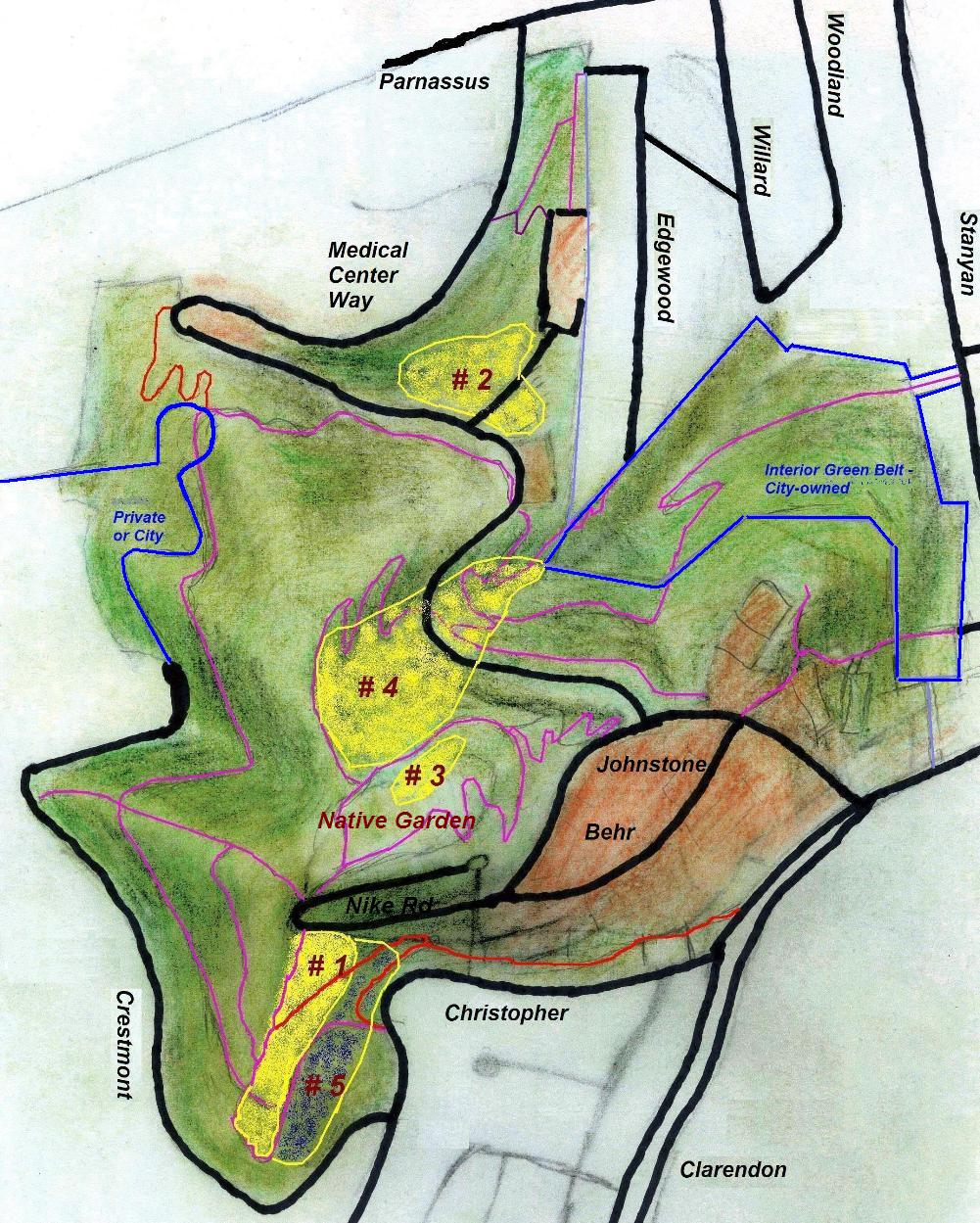
Posted in Environment, nativism | Tagged , , | 2 Comments

Mount Sutro Forest, Native Plants, and Ideology: Debate between a Climatologist and Charlie – Part I

Over the past few weeks, we’ve been hosting an interesting debate on our website, between US-based Charlie (who’s commented here before) and Gov Pavlicek , a climatologist from the Netherlands (NL).  We think this conversation is interesting enough for its own posts. (In fact, it’s so long – currently about 12,000 words – it will be multiple posts. We’ve slightly edited all the posts for readability and focus, we believe without losing the argument.) When we post them all, we’ll link them here.

It started mid-April 2011, when Gov commented on a comment by someone who introduced himself as an Australian familiar with invasion ecology and practice, and said he would regard “eucalypts in the Sutro as not part of the ecosystem of the landscape.”

GOV: INVASION BIOLOGY HAS BECOME AN IDEOLOGY

Gov responded to that, and his response is given below.

“This is the basis for all clear-cutting of so-called nonnative trees. Ecology, conservation biology, restoration ecology and invasion ecology are different from most scientific fields in that they have become an ideology themselves, rather than used only in support of(nativist) nature organizations. Many ecologists actively support, or even work within, conservation groups.

“If you pick up any 5 books on invasion ecology used in Universities, and you realize this will not change any time soon: they are full of value-laden words, constantly negative about newcomers in local natural reserves or even gardens. These books are also filled with assumptions rather than facts.

“I have experience with climate change research, and climatologists often have their own values about the rising temperatures. Simply think of a polar bear drowning because he can’t find the next ice-shelf. It evokes a strong, emotional response. However, in the scientific literature you will not find remarks that the current warming is somehow “unnatural.” It is anthropogenic (caused by humans). And no peer-reviewed research that is about the rate of warming, also tries to tell us what we should think about it and what we should do. That is up to society, not the views of a climatologist who cannot claim that his personal preference is somehow more valid than anyone else’s, just because he studied climatology.

“In ecology, the story is quite different. Apart from constant negative terminology about newcomers (such as: invaders, pests, plagues, unnatural, deviant, prolific, overcrowding)  that cannot be proven in a unbiased, sound scientific way, they also tell us what we should do. The word “eradication” is used constantly in many scholarly books.  This indoctrinates students with the same vision of newcomers in nature. It is difficult to talk to them ( as I have done) without judgmental wording on their side. In my view, this is highly unscientific and reflects an ideology. The basis seems to be fear of change, and they experience a personal loss when something becomes extinct. It is their goal to go back in time instead of moving along and going with the flow.

“The words of the Australian ecologist do not prove that eucalyptus is not a part of the ecosystem. It clearly is part of the ecosystem–  it is growing there and indeed facilitating life of both old- and newcomers. It doesn’t fit his view of what an ecosystem should be. And that is: not influenced by man (I think), or at least, not heavily influenced by man. There’s a name for these ecosystems: novel ecosystems.  Conservation biologists seem to hate this, because with this new name comes credibility. If you read the scientific literature you’ll find they have big problems accepting these systems and it is really causing them to choke when it turns out that these new assemblages are more biodiverse than their ‘native’ counterparts.

“They constantly say that certain plants outcompete others. The question is: if this has never lead to any extinction (and on continents they never did), please tell us the scale. I rarely find the scale on which something is “outcompeted.” I rarely find clear numbers of the drop in percentage cover of some native plant, compared to some invasive. I rarely see any model that can predict what will. What I see most is assumptions. Like ‘if this continues at this rate, the species will be extinct within x years.’ So the key is: will it continue that way and why? No answer there.

“I think most ecologists et al. should get rid of their ideological and single-sided views and develop a more rational open mind to what happens to species in the world. So new ecologists can have their own views and new insights rather than [repeating the biases of their mentors].

“Also they should change their terminology. For example:

  • No more “invaders”, but instead neophytes (if it is a plant).  
  • Pests” cannot be defined, it’s subjective. One calls a Eucalyptus a pest, the other calls it a beautiful and desirable tree.
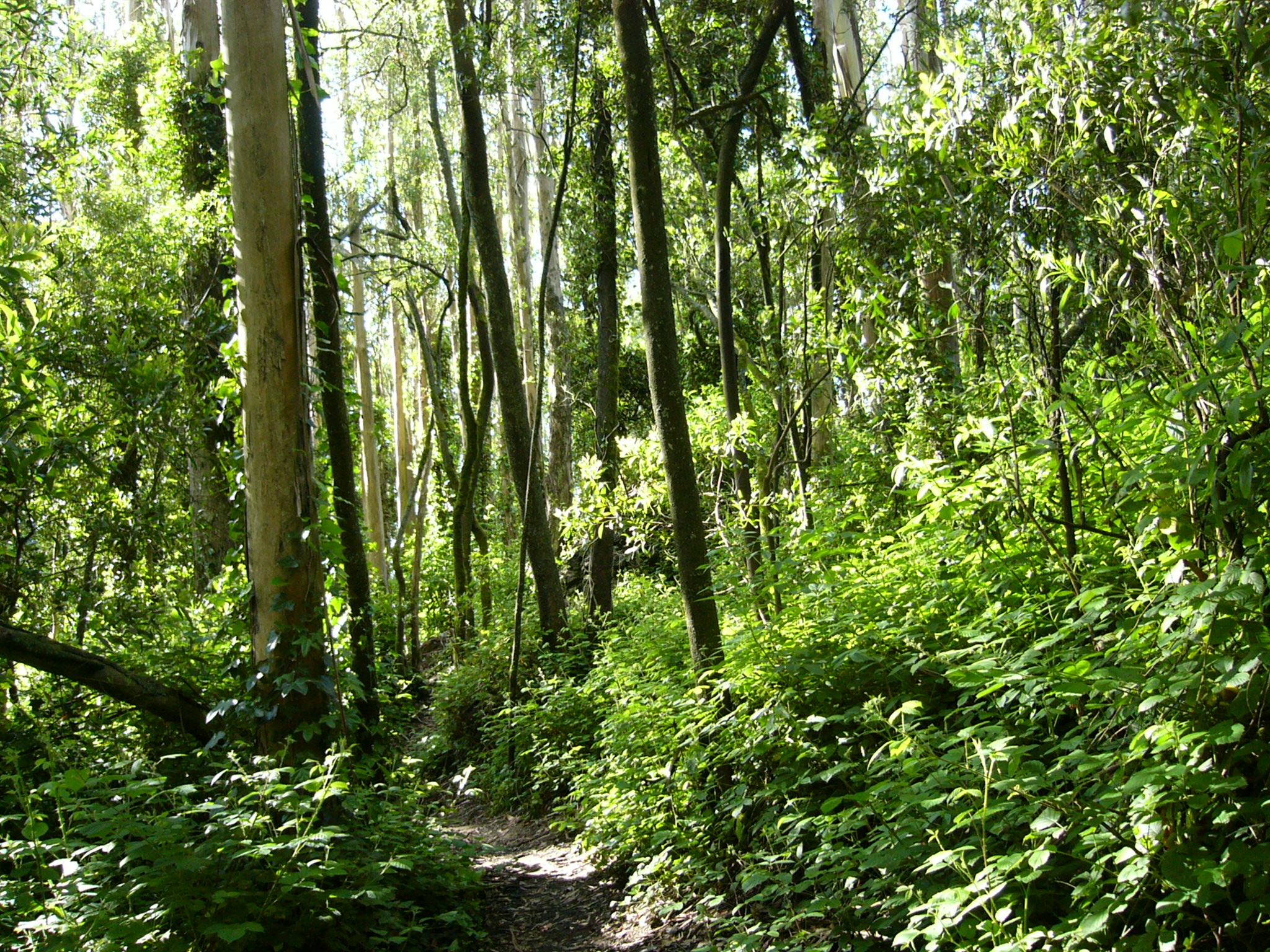
  • Unnatural” should be “anthropogenic”  — it is caused by humans but not therefore “unnatural”. And that is what you can prove: you can prove humans did something, of course. You cannot prove this is right or wrong in anyway.
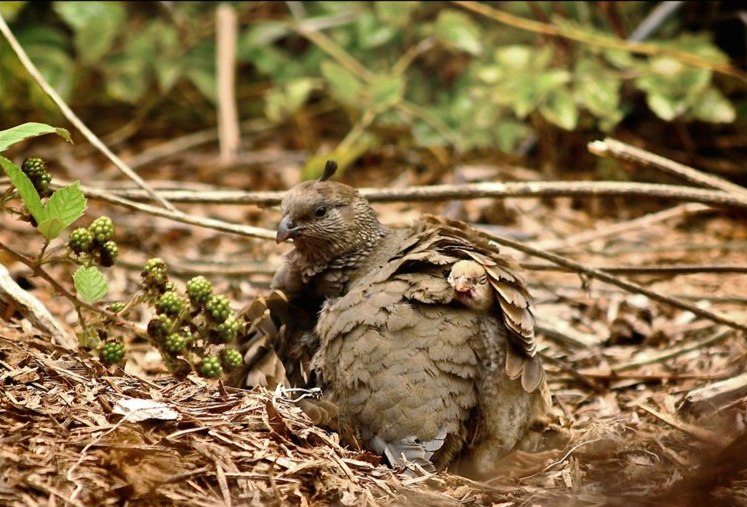
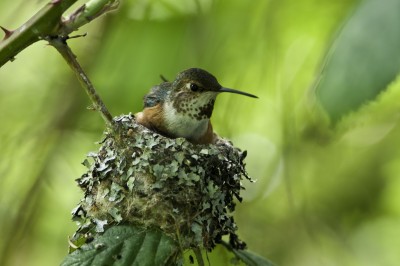
  • Biodiversity: applies to all species. So not only counting native species. It would be like counting only true Native Americans as the people of the US, and then saying that the population of the US is dwindling and the culture is impoverished, omitting the fact that there are almost 300 million Americans with a very diverse cultural life — albeit not Native American.

“Their view in general is rather similar to extreme conservative views in culture and the result is the same: killing things, eradicate things and trying to install a black-white thought-pattern in general towards newcomers. That is the mainstream in ecology.

“The people themselves are not bad and I get along very well with them actually. For instance: when it comes to humans they are not xenophobic at all, and really hate the comparison. But the comparison is valid and Mount Sutro is not the only part of the world where this becomes clear.”

CHARLIE: BEING COMPLETELY UNBIASED IS IMPOSSIBLE AND SILLY

Charlie (who is not the Australian invasion biologist whose comments sparked the discussion) responded to Gov’s comment:

“You mention global warming and think that ecologists, unlike climate scientists, have some racism-based bias and are secretly conservatives. In fact the story is very similar to that of climate change and with a few words changed, these sorts of comments look like something right off of a global warming denialist’s computer. As with climate change, the science is very clear. CO2 warms the climate. Smoking causes lung cancer. Coal mining pollutes watersheds. Invasive  (not necessarily non-native) species are very, very clearly linked with ecosystem service loss and decreased biodiversity during initial invasion.
“This is not true for Sutro any more because it is a very old introduced forest and the ecosystem it replaced is already lost forever. I [personally] believe it was a mistake to plant the Eucs but the damage is already long done. Sutro is very different from most other invaded ecosystems.

“There are a few conflicting studies but you can’t build a compelling argument that invasive plants don’t reduce biodiversity and alter ecosystems without heavily cherry-picking data. If you have anecdotal evidence, by all means share that. Science isn’t the answer to anything. My anecdotal evidence in pretty much every case strongly supports the science.”

[Webmaster: Actually, there are studies showing that biodiversity can increase with the introduction of exotic species… and there’s another showing that a eucalyptus forest and an oak forest in Berkeley California had the same number of species. “Invasive” plants are not invasive in all contexts. If you view ecosystems as static, then it may make sense to try to prevent the flora in a particular area from changing. If you view them as dynamic, then today’s invader may be tomorrow’s hanging-on-by-its-fingernails (or equivalent part) while something else takes over.]

“Of course scientists are biased – they usually care about what they study. Those linking tobacco with cancer may have an anti-cigarette ‘bias’ because people they love are at risk of getting a horrible disease. Climate scientists are biased because they don’t want climate change to starve or drown people. Conservation biologists care about functioning ecosystems and are biased towards their protection. It is impossible to be completely unbiased but I would argue it is also silly.

“There are plenty of valid arguments to be made against restoration of Sutro to native habitat, and most of them have already been gone over here.

  • Sutro is a very established and complex forest, and even if it has replaced a unique ecosystem that is now mostly gone, it does have inherent value.
  • It is a cultural resource used by people who live in the area.
  • It does offer habitat value, filter rainfall, collect fog and reduce erosion.
  • It may be impossible to recreate an ecosystem that has already been destroyed. Urban areas do not necessarily have anything ‘native’ to them except pigeons.
  • The Eucs can’t spread to and destroy other habitat.
  • Some feel that scrubland is not as appropriate or aesthetically desirable as euc forest.
  • Some rightfully are concerned that some forms of conservation exclude humans as part of an ecosystem.
  • Some people believe evolution and formation of ecosystems happens much faster than we think, a view I partially agree with.
  • Yes, there are issues with Monsanto and herbicide, and it is understandable to oppose using these tools. In invasion biology, like in medicine, we are faced with ‘cures’ that also have negative side effects, and we have to balance the negatives with the positive.

“To me the issue is not change in ecosystems, which is of course a constant, but loss of biodiversity by one ‘viral’ species that quickly outcompetes everything else because its natural controls are not present. This is not limited to species introductions, it also happens when a predator or other control is removed from an ecosystem. Either way, one species is thrown vastly out of equilibrium and takes off. Again I don’t like the human-ecosystem comparisons but in some ways it is a bit like a tumor… one component acting in its ‘short term best interest’ and not acting like an ecosystem component. As with chemotherapy, invasive species control is only treating the symptom, and it would be better to figure out why invasions are happening in the first place, but sometimes we can’t.”

[Edited to Add: The discussion continues here.]

Posted in Environment, eucalyptus, Herbicides, Mt Sutro Cloud Forest, nativism | Tagged , , , | 3 Comments

Sutro Forest: Courtesy on the Mountain

Up in the forest this afternoon, we encountered an unusually large number of visitors. Good Friday holiday, maybe? Anyway, in under an hour we saw: Two hikers; three dogs with six people; and five guys riding their cycles. (It’s always guys. Only once have we seen a woman riding on the mountain.)We were impressed by the courtesy from everyone on the mountain. Everyone exchanged greetings, everyone was careful to share the trails.

“Friendly dog coming through,” said one person, as they approached from behind on a narrow trail. The dog was indeed friendly, ears flopping back and doggy smile as it raced up the slope. “Didn’t want you to be surprised,” said the person, and they ran on.

“Don’t jump,” another instructed his dog as they passed by. The dog didn’t, merely giving a polite sniff before continuing on its walk.

We moved aside for the bicycle riders; two legs are more maneuverable than two wheels with momentum. They always thanked us. One dismounted to make way for us instead, and we thanked him. He kindly said he didn’t want to inconvenience us. Two delightful young guys were zipping around on every trail — we may have crossed paths four or five times. It was a joy to see them having such a great time. 

We know the riders are … controversial.  We’ve heard the complaints at meetings, and some have talked to us directly. For joggers or brisk walkers, it’s disruptive when a cyclist comes rushing by. They resent having to break stride and move off the trail, and someone reported nearly being run over. We don’t downplay their concerns, and as more people come onto the trails, this will have to be worked out. But we tend to ramble around the forest, and our own experience has been pleasant.

SPRING FLOWERS

We’ve written before about the habitat destruction from blackberry removal. Parts of the forest are quite bare, with nothing much under the trees. This is hard on the birds, and we heard far fewer of them than last year, especially up on the South Ridge trail; though in areas where the understory is dense, the forest was still bright with bird-sounds.

But in places where the blackberry has been mown down, forget-me-nots line the trail. It’s some consolation, though it doesn’t compensate the birds. The beautiful display of them just before the entrance to the Native Garden is as lovely as last year’s.

We saw a few Douglas iris here and there, and some California poppies and scattered lupines in the Native Garden. And miner’s lettuce, also blooming in tiny white flowers over saucer-shaped leaves. The Native garden is green and lush now, except for the area where the meadow’s being replanted. This is a good time to go look at it; in a couple of months, much of it will be dry and brown.

ISHI’S SHRINE

The shrine we’d written about earlier — that used to be a memorial to Ishi, last of the Yahi — still has its cairn of stones, but the frieze of dimes has been replaced by a line of pennies. It still has a sense of being a special place. Someone cares, someone remembers.

Posted in Mt Sutro Cloud Forest, Neighborhood impact | Tagged , | 1 Comment

Cats, Catbirds: Why the Smithsonian study doesn’t say what everyone thinks it does

There’s been a huge amount of publicity recently about a 2004 study, publicized by the highly-respected Smithsonian. It implies that cats are the main cause of death of songbirds, and has become a talking point for those advocating stronger measures against feral and outdoor cats, even to killing cats. The SF Weekly published an issue with a demonic cat on the cover; even the normally thoughtful New York Times took the press-release at face value. Views From the Thicket, a great blog about Golden Gate Park, repeated the SF Weekly’s story.

But did the study’s results actually merit that kind of spin? We think not.

First, a disclaimer. We’re not advocating here for any particular feline policy. But we do respect all animals and birds, and even more, we favor a thoughtful approach to data. So we went back to the actual study. (You can read it here as a PDF.)

WHAT THE RESEARCHERS DID

Working in three Maryland suburbs filled with homes and gardens, the  researchers tagged a total of 69 baby catbirds with tiny radio-transmitters. They then tracked the birds alternate days until they found a dead bird, the detached transmitter, or lost the signal (when the birds presumably left the area i.e moved more than 5 km from the study sites).

At the end of the study, which was conducted between May and September 2004, they found that 42 of the birds died from various causes: predation, disease, glass panes, etc. Of that 42, they figured 33 were killed by some kind of predator. (They found the predator, or the bird’s remains with the transmitter attached, or they found the transmitter underground). In 19 of the cases, the researcher felt they could make a good guess at what kind of predator it was. Only 6 were killed by cats.

Another 3 were presumed to be killed by cats because of the state of the catbird corpse (missing a head). They thought this was a sure indicator of cat predation, but that’s been disputed. [ETA: A little websearching reveals birds of prey – hawks, owls, falcons, kestrels – seem to bite off the heads of their catch first. (There are slightly gruesome photographs.) If they are disturbed by people or competing birds, this could account for headless dead birds.]

We’ve shown this breakdown in the graphic above, where each circle’s area is proportionate to the number of birds it represents.

Unfortunately, the abstract of the study spun the same data differently:

Misleading phrasing

Is this true? Yes… but does it suggest a misleading conclusion? Also yes. It seems to suggest that around 80% of deaths were caused by predators, and nearly half of those by cats. That is not true. They had only 19 “known” predation events — meaning the ones where the researchers had a guess at Who Dunnit — compared to a total of 33 killed birds. [ETA2:  And 42 dead birds. Taking the guess-work out, here’s the story in graphic form.]

WHAT IF THERE WERE NO CATS?

So let’s do a thought experiment: If Maryland had no cats, how many extra catbirds would have survived?

If we looked  only at the other 60 catbirds, (the ones that weren’t actually or putatively killed by cats) we find 33 died from other causes. They had a less than 50% chance of survival. So even assuming cats killed all the birds the scientists thought they had, only about 4 more birds would have survived.

If the birds killed by cats were in some way more vulnerable than the average — if they were louder, or weaker, or less wary, or already ailing — then they’d probably have been picked off by one of the many other predators. After all, that’s what predators do: They go after the weakest ones of a flock or herd. In that case, having zero cats in Maryland might have made no difference at all to the birds’ survival. Something else would have got them anyway.

So the effect of the cats seems to have been somewhere between 0 and 4 birds. Hardly the stuff of headlines. [ETA3: In any case, with such small sample sizes, statistical analysis is meaningless.]

HABITAT DESTRUCTION IS WORSE

What’s probably much worse for bird populations is habitat reduction. Responsible home-owners and dedicated park managers prune or remove trees, eliminate unsightly brush, trim bushes and plants, use pesticides to eliminate weeds and insects. All of those things destroys part of a bird’s world, maybe all of its world: cover; seeds; insects.

Here in San Francisco, and definitely in Mount Sutro Forest, habitat destruction is an issue. Thickets are being destroyed, because they’re “non-native” and “invasive” (the pictures here show an example the same place before and after this process).

Never mind that they’re the places where birds and animals can live and hide.

Posted in Environment, Mount Sutro Stewards, Mt Sutro Cloud Forest | Tagged , , , , , , | 15 Comments

Twin Peaks and the Mission Blue Butterfly: Why it’s Still Uncertain

[THIS ARTICLE WAS WRITTEN IN APRIL 2011 AND UPDATED Feb 2012]

Last year, journalists were celebrating the return of the Mission Blue butterfly to Twin Peaks. From the SF Chronicle of 7 May 2010: “Everyone comes back to San Francisco, including, on a bright morning on Twin Peaks, the endangered mission blue butterfly.” It went on to say, “Last seen within city limits 30 years ago, the iridescent blue butterfly was spotted Thursday morning flitting about a Twin Peaks hillside…”

Leaving aside the issue of when the Mission Blue was last seen at Twin Peaks (1997 actually and one each in 2001 and 2004),  we wondered whether the single butterfly proved anything much.

The butterfly used to live on Twin Peaks, but it’s not clear how stable the population was. By 1997, only ten butterflies were seen. After that, hardly any were until the recent reintroduction attempt. Some blame the warm wet El Nino conditions of 1998 for a fungus that nearly wiped out the silver lupine, a key host plant for its caterpillars.

A LIMITED SUCCESS

This “return” was the result of a complicated reintroduction, starting in 2008 with establishing patches of lupine, the host plant on which this butterfly lays its eggs. In spring 2009, the reintroduction team (which was led by SF Rec & Parks — SF RPD) brought in 22 pregnant females, and caged them over suitable lupine plants to lay their eggs.

We recently got SF RPD’s October 2010 report on the Mission Blue reintroduction. The team had counted 147 eggs laid in 2009. Over the following months, through end-May, they actually saw a total of 17 butterflies: 6 female, 11 male. Extrapolating, they thought there could be perhaps 20 butterflies this year; the number was unlikely to be as many as 50. [ETA June 2011: Before releasing the 60 butterflies in April 2011, they did check to see if any butterflies descended from the previous release were around. They spotted 2 males. ETA Feb 2012: We asked SFRPD for their observations. They actually spotted 7 butterflies pre-release, 5 males and 2 females.]

Is that success? The report considered it so, mainly because it demonstrated that the butterfly could go from egg to adult on Twin Peaks.

GARDENING THE MOUNTAIN

Mission Blues can’t reproduce without lupine, the only plants their caterpillars will eat. This plant (actually three varieties of it) grows best in disturbed areas. Once the area settles down, natural succession converts it to chaparral, or other invasive plants take over. Patches of lupine are generally on the move.

The Natural Areas Program (SF NAP, the part of SF RPD that’s responsible for Twin Peaks) is maintaining a lupine-friendly habitat by removing shrubs, including the native coyote-brush. The implication, though, is that this intervention will be permanent and ongoing. They will always need to garden for lupine.

While the lupine is critically important to the caterpillars of the Mission Blue, the adults need nectar sources. The butterflies are short-lived (7 days on average for males, 8 days for females) and don’t fly far. Fortunately they aren’t as picky as their larvae, and one of their key nectar sources is an invasive non-native Italian thistle: Carduus pycnocephalus. This grows widely on Twin Peaks, and SF NAP is not trying to remove it for now, until they can plant enough native nectar sources.

In attempting to maintain this lupine habitat for the Mission Blue, SF NAP has been using toxic herbicides: Garlon (triclopyr) and Roundup or Aquamaster (glyphosate). Both have been used all over Twin Peaks.  (Our article about the effects of Garlon is here.)

PROBLEM ON THE PEAKS

Notices: Mission Blue Habitat, Garlon spraying, and No Smoking

We have to wonder whether the success rate (egg to butterfly) will be similar to the 2009 batch — around 14% of the eggs becoming butterflies.   Though SF Rec and Park believe that Garlon isn’t harmful to insects, there really isn’t any way to tell. The studies on triclopyr relate to adult honeybees. Whether the chemicals — both the triclopyr and the “inert” chemicals used with it — will be non-toxic to caterpillars, we don’t know.

[ETA, March 2012: A study of the effects of Triclopyr and other herbicides on Behr’s Metalmark butterflies indicated adult butterfly emergence fell by 24-36%. Is it the same for Mission Blues? We don’t know.]

Mission Blue caterpillars hatch from eggs laid on lupine leaves (new leaves are preferred). They eat the leaves, then climb down into the dead leaves or ground beneath the lupine plants, and go into a sort of hibernation, called “diapause.” After emerging from diapause, they continue feeding, then pupate and emerge as butterflies between March and June. This life-cycle takes a year and brings them into contact with the soil. If that’s been contaminated with Garlon (which can remain in dead vegetation for up to two years) it could poison the caterpillars and reduce the chances of success.

There’s an additional effect possible: Garlon’s unknown impact on ants.  The main threats to Mission Blue larvae are parasites (like wasps and flies that lay eggs on the caterpillar) and predators. Ants tend the caterpillars, which emit honeydew, a sugary pee that ants use for food. The caterpillars benefit because the ants defend them. At least, the native ants do. But Argentine ants are moving into many habitats, and no one knows whether they will tend the caterpillars or eat them instead. One study in Marin suggests that Argentine ants tend the caterpillars of a similar species of butterfly, the Acmon Blue. But another from Florida suggests that Argentine ants use the honeydew but run off when the caterpillar is threatened.

What we don’t know is whether the use of Garlon favors Argentine ants by having a negative effect on ant pupae — thus giving the more competitive ants a clearer field. [ETA: Just read an interesting post on the blog Golden Gate Park: Views from the Thicket about an ant study conducted in 2008 conducted in August-Sept 2006, published in 2008. Argentine ants were present but not invading the parks. Hope it’s still that way. The study is here (as a PDF): argentine ants san francisco research – Clark Fisher- LeBuhn]

BY THE NUMBERS: UP, DOWN, OR SIDEWAYS?

We find the numbers interesting, and perhaps indicating less success than the optimistic journalistic stories.  The report suggested that the imported females may have already laid half their eggs back home on San Bruno Mountain, so the 20 or so butterflies came from only the second half of the eggs. (So maybe if they’d laid them all at Twin Peaks, and the same ratio had succeeded, there’d have been say 40 butterflies, with maybe 12-15 females. Down from 22.)

Ouch.

The introduced Mission Blues were caged over selected lupine plants to lay their eggs; their descendents selected their own sites. A survey in February and May 2010 found 42 eggs. The observers saw more than that, but the sampling method they used didn’t permit counting them. Still, it’s not an encouraging number. Unless they’ve missed 70% of the eggs, there are fewer eggs in 2010 than in 2009. At 42 eggs, they’ve got 7 eggs per observed female, about the same ratio as in 2009 (which was 147 eggs from 22 females).

This population is clearly dwindling.

NON-VIABLE NUMBERS

At this size, the population isn’t viable. Here’s why:

1. The dating game. These insects don’t live long (about a week), and they emerge between March and June. The males usually hatch earlier than the females, which is a good idea when there are lots; it means they’re ready to mate the females as soon as they hatch. With only a few butterflies, though, the males could die before the females arrive. Some females might not find mates at all, and thus not reproduce.

2. Inbreeding. Having such a tiny number increases the chances of the mating pair being siblings. They could lower their breeding success.

3. Bad luck. Anything could upset the numbers still further — birds, rodents, bad weather — and wipe out the colony. The small number means there’s no buffer.

4. The fungus remains. The fungus blamed for killing the lupine in 1998 remains in the soil of Twin Peaks, according to a Fish and Wildlife report. This could mean adverse weather could again kill off the lupine — and the butterflies.

MOVING MORE BUTTERFLIES

The plan now is to move 25 more female butterflies from San Bruno Mountain (assuming US Fish and Wildlife Service gives the permits).

[Edited to Add (24 April 2011):  According to the SF Chronicle, they are relocating “dozens” of butterflies now. There’s a photograph at this link.]

[Edited to Add (2 June 2011): We asked the Parks Department. They got permission to relocate 60 butterflies — 40 female and 20 male; and did so on April 22, 2011. Not sure if they released all of them at the same time or not. ETA (2 July 2011) We found this blog post on Liam O’Brien’s new website, sfbutterfly.com describing the process.]

It may be a long haul, establishing the Mission Blue. The Recovery Action Plan Document (from SF RPD) indicates that in the UK and US successful reintroductions took an average of 11 attempts — and 15 years.

Posted in Herbicides, Herbicides: Roundup, Garlon | Tagged , , , | 9 Comments

Habitat Destruction with Sutro Stewards

Blackberry habitat, 2010

Around this time last year, Sutro Forest was alive with birdsong all day from dawn to late dusk.

We walked up into the Sutro Forest on a peaceful bird-filled evening,” we wrote  in late February 2010. “A few outside noises drifted in. The trees were full of the tweets and trills of bird-sounds

Today, it wasn’t. Down in the Interior Greenbelt, the winter wrens still sang, but not as many or as loudly as last year. That’s where the Kill-Trees trail-work has felled dozens of trees and stripped out a great deal of understory. The South Ridge, incessantly song-filled last year, was even quieter with just an occasional chirp or tweet.

photo credit: 123rf.com

Himalayan Blackberry is a plant that nativists love to hate. It grows quickly and persistently and forms dense thorny thickets, practically impassable. But… blackberry is brilliant habitat for birds, animals and insects. It provides great cover, and a wonderful place to hide. Insects eat the leaves, or stop by at its pale pink flowers for nectar. Some lay their eggs on the leaves and stems. For small animals, it’s a place to hide from predators. For birds, it’s a place to safely nest.

And the nesting season has started in San Francisco. Bird-watchers already report nesting activity: nest building, stick-carrying, even egg-laying. Many birds are territorial, and some of the birdsong we hear is from males staking out their ‘turf.’ If this ‘turf’ is much reduced, many will not find territories or mates.

Habitat destruction, 2011

As we said in our post describing the Sutro Forest’s ecosystem, “A single blackberry thicket can provide a great deal of habitat. Consider one that’s say 8 feet by 10 feet and 6-7 feet tall  (about as high as a person — the normal height for blackberry to grow unless it’s mown down). That’s over 500 cubic feet of habitat for insects and birds. The same thicket, mown down to 1 foot high, will only provide 80 cubic feet of habitat. And it’s much inferior habitat because it offers a lot less protection — it’s flatter and more visible. ” It may also become unsuitable as a nesting site, being not only more visible but low enough to be within easy reach of predators.

That’s what’s happening to the forest now. Most of the thickets have been mowed down. Trails that were perhaps five feet wide with walls of bushes on either side are now maybe fifteen feet of mowed-down ground. The forest is visibly thinner than it was before. The amount of habitat has been sharply reduced.  The two forest pictures here show the same trail, in August 2010 and in February 2011.

TAMING THE WILD FOREST

Each month — and sometimes more often — the Sutro Stewards gather volunteers. (The Sutro Stewards — formerly the Mount Sutro Stewards — are an organization active on the mountain, with UCSF’s support.)  Sometimes they work in the Native Garden; they have a project underway now to replant a meadow with plants attractive to “native pollinators.” In this, we hope they succeed. A lot of time, effort and money has gone into the garden: over $100,000 (mostly from Rotary, and, recently from the SF Parks Trust); and hundreds of volunteer hours if not more. We would like to see their efforts pay off in terms of more butterflies and birds; so far, the Native Garden has not appeared particularly rich in wildlife.

But they’re also mowing down the forest’s understory, pushing down dead stumps, taming the wildness of this naturalized forest. Many of the places that were dense woodlands only six months ago are much more open now.

Nesting in blackberry – Photo Credit: 123rtf.com

SILENT SPRING

The forest has (or had) over 40 species of birds (listed here and here). The small songbirds need places to hide, and love the bushes. The woodpeckers and sapsuckers like the dead or dying stumps of trees, some of which are riddled with delicious insects.

We haven’t heard the Great Horned Owls this year, either. Are they still around?  We don’t know.

Also lost is the sense of seclusion that existed until only months ago. Inside the forest, the city vanished. Its sounds disappeared. It was another world, green and lush and full of birdlife, a canopy of trees overhead stretching into the sky.  Only occasional “portholes” through the foliage showed views toward the ocean or Golden Gate Park. Now, the city is visible everywhere along the outer trails. The forest still stands majestic and beautiful, but the other-worldly feeling is diminished.

Can the forest recover? We believe it can, with the regrowth of the blackberry so the trails are actually trails instead of highways through the forest, with the regeneration of plants amid the trees so ground now covered in ivy and barkstrips is once more lush with bushes. But first, the Sutro Stewards would have to stop destroying habitat.

(Bird photos from 123RF Stock Photos used under license. For other pictures of birds’ nests in blackberry bushes, see here for a catbird nest, here  for a song-sparrow nest, and here for a picture of an Anna’s hummingbird nest attached to a blackberry bush, taken in San Francisco by ace photographer Robert Clay. The last two images are commercially available at the sites linked.)

.

Posted in Environment, Mount Sutro Stewards | Tagged , , , , , , | 7 Comments

Supermoon over Sutro Forest

On 19 March 2011, there was a “supermoon” when the moon looks much larger than usual. This happens when the full moon is also at the point in its orbit when it’s closest to earth. (Technically, according to wikipedia, it’s a perigee-syzygy: The “perigee” refers to the moon in its orbit being at the closest point to the earth, and the “syzygy” in this case, to its being a full moon. [ETA: Here’s the definition of syzygy from astronomydictionary.com:  “An alignment of three celestial bodies. ” So a full moon, when the sun, earth and moon are approximately aligned, qualifies.)

It was certainly brighter than usual, and unusually we had clear skies (mostly) to see it. And then, early in the morning, we caught it setting over the shoulder of Mount Sutro, amid forest and cloud.

A pocket camera couldn’t capture the grandeur and the drama. Even so, we  invite you to look at the picture and imagine (or remember, if you saw it) how silvery and dramatic the scene was.

Posted in Mt Sutro Cloud Forest | Tagged , , | Comments Off on Supermoon over Sutro Forest

Native Plants, Oxalis and the Futility of Garlon

Some days ago, in a comment on our post responding to Jake Sigg’s defense of Garlon, Wendy Poinsot said:

Garlon is effective on oxalis and other broadleaf weeds like dandelion. Who wants a park full of south african oxalis? Not me. To use Garlon safety you need to have an adequate setback from the creek and other drainages. It would be wonderful to restore a more native plant community to Glen Canyon Park. If it was a just a small area, like my garden, we could just keep pulling the oxalis and replant, but for 30+ acres in Glen Canyon, we unfortunately need to use something that will work. There are time-tested safe methods of applying Garlon to get rid of weeds while allowing subsequent replanting. Garlon-type products are what is added to lawn fertilizer and weed control products that so many people use to control weeds in lawns year after year. Hopefully, one or two applications of Garlon, followed by plantings, will go a long way to controlling the oxalis. In the shade, we could actually replace it with the native oxalis — redwood sorrel.

We understand that some people do want to see non-native plants eradicated and substituted with native plants. (Others don’t.) But is it true that “one or two applications of Garlon, followed by plantings, will go a long way to controlling the oxalis” ?

Probably not, and here’s why:

Oxalis, though it’s a rich nectar source for bees, butterflies and other insect pollinators, doesn’t spread in San Francisco by setting seed. (In effect, it gives away its nectar for nothing.) Instead, it spreads through vegetative reproduction. It forms little bulbs underground (“bulbils”) that then grow into new plants. Sort of like potatoes, but smaller.

According to a UC Davis note, the toxic herbicide poisons the visible part of the plant; it doesn’t kill the bulbil. So, the next year, it grows back.  The only way to successfully kill it with Garlon is to keep hitting the oxalis with the chemical, so that the plant cannot form the bulbils and eventually it exhausts them. This means that we’re not talking one or two application, but many of them, year after year after year. Between March and October 2010, the SF Natural Areas Program and Shelterbelt Builders (contractors) made ten applications of herbicides in Glen Canyon, mostly triclopyr (Garlon) or glyphosate (Roundup or Aquamaster).

[Edited to Add: Garlon has been sprayed in Glen Canyon at least since 2006. Someone sent us this: It shows Garlon 4 was used in March 2006.]

A TOXIC RISK

What does this mean for groundwater, wildlife, people and pets?

We’re concerned.

Garlon is known to have a moderate risk of contaminating water. Considering that Glen Canyon really is a steep-sided canyon with a creek flowing at the bottom, it’s probably a lot more than moderate in this location — and on Twin Peaks, or for that matter, Mount Sutro, all of which are steep watershed areas.

Most of the research into Garlon is about immediate effects on people, and some little information about immediate impacts on a few animals, fish, and adult honey bees. There’s little or nothing about the long term impact of exposure year after year. (Most of the categories on the UC Davis data sheet show “no information.”) We’ve several times published our summary of the impacts described in the research thus far.

We’d suggest  that we’re not getting the bang for our toxic buck.  We’re taking the toxic risk, but with no certainty of effectiveness of this or any other herbicide in any reasonable quantity.

OXALIS IN THE FOOD WEB

We’d also suggest that the presence of oxalis isn’t entirely negative, quite apart from its beauty. Oxalis is already clearly and obviously part of the food web in our wildlife environment. Its flowers provide “copious nectar” [according to a UCLA note UCLA note linked here as a PDF: Oxalis_pes-caprae_UCLA_SantaMonicas] which feeds honeybees, bumblebees and butterflies. Birds eat the insects that feed on the plants and flowers. The bulbils are food to gophers, which are in turn food to owls, hawks, and coyotes. And so on. Moreover, it provides a good ground cover, stabilizing dirt and reducing surface erosion.

We’re not suggesting planting more of it… though where the soil has been disturbed (as for instance along the road above the Laguna Honda Reservoir at Clarendon Avenue) the oxalis tends to sprout from bulbils hidden in the soil, and establish itself. But we do think that a futile attempt to poison it out of existence with Tier I pesticides (the most hazardous allowed on City land) negates the Precautionary Principle that underlies San Francisco’s use of toxins and is bad for the environment.

Posted in Herbicides: Roundup, Garlon, nativism | Tagged , , | 8 Comments

Garlon, Natural Areas, and the City

San Francisco’s Department of the Environment (SF DOE) is our second line of protection against chemicals after the EPA; it regulates the use of pesticides on all city properties. We attended their monthly meeting yesterday, mainly because Lisa Wayne, the SF Rec & Parks Open Space Manager, was making  a presentation about “balancing community values in managing San Francisco’s Natural Areas” in response to some of the community outcry against the use of Garlon in Glen Canyon Park.

After emphasizing the importance of the remnant areas of native plants, she said that grasslands in particular are the most fragile and difficult to restore. The native plants they want growing there — such as iris — are difficult to grow in nursery conditions, and even more difficult to maintain when planted out. The plants they don’t want there — like the oxalis — grow with enthusiasm. Though SF Natural Areas Program annually uses about 10-15,000 volunteer hours mainly for weeding,  the plants they object to keep coming back. Hence their need for Garlon, despite its toxicity. It kills the broadleaf plants while sparing the grass and iris.

She acknowledged that the Glen Canyon neighbors have been concerned about the spraying of Garlon; the canyon is heavily used by small children (including preschoolers) and people walking dogs. [Webmaster: In fact, “Glen Park Naturally” a group of neighbors have started an online petition against pesticide use. The link to the petition is here.]

In part, Lisa noted it was a communication problem; though the spraying is done by people with backpack sprayers [webmaster: as in this picture taken on Twin Peaks] some people had the impression that there would be broadcast spraying of the entire canyon. Someone else pointed out that since the oxalis covered broad areas of the canyon, such an assumption wasn’t unreasonable.

She said they would implement the following actions in response to the neighbors:

  • Leave an unsprayed 15-foot area on either side of all trails.
  • Improve the signage to clarify when precisely the spraying would occur.

However, she pointed out that conditions had to be just right, and more often than not, spraying was canceled or postponed. They would be careful about noting when the spraying occurred post facto.

Some audience members wanted SF RPD to give these decisions in writing, to communicate with concerned citizens.

WHEN’S IT SAFE AGAIN?

Speaking from the audience, we also mentioned an email someone forwarded us. It was a response from Dow AgroSciences (which makes Garlon) to the question, is it safe to use where children play? Dow’s answer was that Garlon was a vegetation management product, “in areas such as wildlife openings, forestry sites, along roadways, in ditchbanks, etc.  It is not a product that is used in residential areas.” It went on to say that the “restricted entry interval is 12 hours. So, after 12 hours it is okay for people and pets to enter the treatment area.” (The letter ended with a disclaimer that was actually longer than the letter…and included the words, “No warranty, express or
implied, is given and all warranties are expressly disclaimed, including but not limited to fitness for a particular purpose…“)

At present, Garlon spray warning signs say entry is okay “when dry.” Of course, since the time and date of spraying aren’t always posted, we have no idea how to find out when it’s dry. (Lisa said the people applying it usually stay around until it dries.) In any case, we suggested they consider the manufacturer’s suggestion for a 12-hour safety interval from the time of spraying.

Lisa also said they’re looking for an alternative to Garlon because it’s so toxic, but they haven’t found one.

COMBINING PESTICIDES

On some occasions in the last year, SF NAP (or contractor Shelterbelt) have used Roundup and Garlon in combination. We are concerned about this, because we’ve been able to find very little information about synergistic effects — and at an earlier meeting, Chris Geiger of the SF Department of the Environment had pointed out that not only was it unknown, it was unknowable.

Lisa said they did not intend to use combinations going forward, even if they had occasionally done so in the past.

A speaker from the audience proposed to Chris Geiger that using such combinations should require special justification as an exception. Based on the precautionary principle, SF DOE should regulate their use.

[Edited to Add (March 15, 2011): They confirmed by email with this: “The Natural Areas Program will not be combining Garlon and Roundup in simultaneous spraying in the future.” It was signed by Lisa Wayne, Natural Areas Manager. Thanks, Lisa.]

Another member of the audience asked if  in Glen Canyon and elsewhere,  was water being tested for pesticide contamination? She mentioned that in a California test, of 227 samples, 11.4% contained triclopyr. Chris suggested tests were increasingly sensitive to chemicals, so detected levels could still be safe. There was some discussion around SF PUC testing for herbicides. Apparently they do test for herbicides among other things.

CHANGES TO THE IPM

Afterward, Chris mentioned that they were changing the posting requirements for Tier III chemicals (the safest ones) to permit posting only on the day of the spray, as an incentive to use these rather than the more hazardous Tier II and Tier I chemicals. (Pesticides permitted by SF DOE are divided into three categories, with Tier I the most hazardous and Tier III the least hazardous. Garlon is Tier I; Roundup is Tier II.)

He also said that SF Department of Environment would soon have a new website, which would give information about pesticide use. It  would also be possible to send in complaints and concerns. He got several about Glen Canyon, especially from parents who enjoyed the kid-friendly “sourgrass” — the common name for oxalis. Kids like to pluck and eat it.

Posted in Environment, Herbicides, nativism | Tagged , , , , , | 3 Comments

Century-old Trees Help the Forest Grow

An interesting study from Canada’s McGill University recently indicated the particular value of old trees. In brief:

  1. Trees that are over 100 years old tend to have more moss growing on them at the 15-30 meter (i.e 50-100 feet) level or higher.
  2. These mosses provide a habitat for cyanobacteria.
  3. Cyanobacteria fertilize the forest by fixing nitrogen.

According to an article published in The Science Daily, researchers Dr Zoe Lindo and Jonathan Whiteley of  Mc Gill’s Department of Biology found cyanobacteria in moss growing high in the trees fixed twice as much nitrogen as those in moss on the ground.   Dr Lindo is quoted as saying: “These large old trees are doing something: they’re providing habitat for something that provides habitat for something else that’s fertilizing the forest. It’s like a domino effect; it’s indirect but without the first step, without the trees, none of it could happen.”

Of course, by providing this fertilizing effect and thus encouraging the growth of trees and other vegetation, it also helps to sequester carbon.

WHAT ABOUT SUTRO FOREST?

Most of the trees in Sutro Forest are over a century old, and many of them are 100- 200 feet high, and do have moss and epiphytes growing on them. This would suggest that something like this is indeed happening in the forest.

Of course, in Sutro Cloud Forest, the acacia subcanopy also helps to fix nitrogen. More than ever, we are seeing a beautiful networked ecosystem here, which is under threat of the removal of 90% of its trees, as well as much of its understory habitat.

Posted in Mt Sutro Cloud Forest | Tagged , | 1 Comment

The Shrine in the Forest

Some months ago, we’d written about a little shrine to Ishi, the last of the Yahi tribe, in a small cave along a trail in the beautiful Sutro Cloud Forest. There’d been a little picture of him, and some offerings — scented things, leaves, and a quarter with a tree on it. Then someone removed it.

Recently, walking in the forest, we found the shrine renewed. There was no photograph of Ishi, this time, but a pleasing frieze of ten-cent coins gleamed from its inner wall, and tiny cairns of rocks had been built within the cave, and on its roof.

Posted in Mt Sutro Cloud Forest | Tagged , | 5 Comments

More Garlon for Glen Canyon Park?

We’ve been observing the issue of pesticides at Glen Canyon Park at a remove; but here’s what we understand. The place falls under the Natural Areas Program (NAP), which plans to use Garlon, one of the most toxic herbicides San Francisco permits, to attempt to get rid of oxalis, theoretically to benefit native plants. Garlon works on broad-leafed plants, but not on grasses or iris or conifers.

Glen Canyon Park is a popular one, and it really is a canyon, with steep slopes above a little creek and a pathway through tall eucalyptus to a clubhouse and play area. Small children — including preschoolers — play and hike there. People walk their dogs in the park. A major investment in the park is planned for the near future. So unsurprisingly, when notices went up that the NAP intended to spray Garlon on the canyon slopes, neighbors objected. The doyen of the nativists, Jake Sigg, weighed in on the issue in his newsletter. We discussed that here.

The Garlon spraying was postponed for a week, and we heard a rumor that NAP was considering using Roundup (glyphosate) which is somewhat less toxic. (It’s a Tier 2 Hazard, while Garlon — triclopyr — is a Tier 1 hazard, i.e. Most Hazardous with a High Priority to Find an Alternative.)

Then a sign just said “Postponed” and rumors went round that NAP were going to abandon the use of toxic pesticides in Glen Canyon altogether, in deference to neighborhood concerns.

Not so. Someone just forwarded us a letter from Dennis Kern, Director of Operations at SF Rec and Park, addressed to a citizen. (As an official letter from a city employee, this is we believe non-copyright and can be published here.)

Thanks for your e-mail.  Any rumor that we are discontinuing our controlled use of herbicide in Glen Canyon is incorrect.  As you may know, the Glen Canyon parkland is one of our Natural Areas.  There is no way that we can protect biodiversity and control invasive species in Natural Areas without the informed and controlled use of herbicides as one of our tools.  In particular, Oxalis is not controllable by hand nor any other non-herbicide means.  If we were to discontinue herbicide use at Glen Canyon we would soon lose the biodiversity that our Natural Areas Program is designed to protect.  All of our limited herbicide use is in strict compliance with all City regulations and is performed in partnership with SF Environment.

I hope that this information is helpful.

IT’S LEGAL?

Yes, it is indeed legal. Recently,  SF’s Department of the Environment, which regulates pesticide use on city-owned properties in San Francisco, permitted an exception to allow Garlon 4 Ultra to be sprayed. (Before that, it was only allowed to be daubed or injected, but NAP sprayed it anyway.)  People applying it must wear respirators (though on Twin Peaks, at least on one occasion they have been seen spraying without one). They have to post notices at least 3 days in advance, which we understand they do; and the area is not safe to enter until the chemical is dry. We’re not sure how that’s ascertained, but anyway, if you are visiting sprayed areas, please allow a sensible amount of time from when the spray is completed. This should also be posted on the notice (though sometimes they forget).

WHY WORRY?

If it’s legal, why do we worry?  Here’s why:

When we looked into Garlon, we found that much of the research and information that minimized the risk came from sources such as programs that wished to use the chemical, or from industry sources. The existing research on Garlon is incomplete, and more focused on acute risk than the risks of long-term exposure. In April 2010, we summarized what we read in the Marin Municipal Water District’s excellent chapter on Triclopyr, the active substance in Garlon. Here’s an excerpt from our article of ten months ago.

What stood out, though, was how much is not known, particularly about the effects of repeated low-level exposure. There simply isn’t that much research out there, and few human studies. “Although triclopyr has been registered in the US since 1979, there are still very few studies on triclopyr that are not part of the EPA registration process.” Most of the research that exists is on Garlon 4. What is used on Twin Peaks [and in Glen Canyon] is Garlon 4 Ultra. It’s similar but isn’t mixed in kerosine. It’s mixed in a less flammable but apparently equally toxic methylated seed oil.

What is known makes uncomfortable reading.

  • Garlon “causes severe birth defects in rats at relatively low levels of exposure.” The rats were born with brains outside their skulls, or without eyelids. “Maternal toxicity was high” and exposed rats also had more failed pregnancies.
  • Rat and dog studies showed damage to the kidneys, the liver, and the blood. It’s insidious, because there’s no immediate effect that’s apparent. If someone’s being poisoned, they wouldn’t even know it. In a study on six Shetland ponies, high doses killed two ponies in a week, and two others were destroyed.
  • About 1-2% of Garlon falling on human skin is absorbed within a day. For rodents, its absorbed twelve times as fast. Too bad for the gophers…
  • It isn’t considered a carcinogen under today’s more lenient guidelines, but would have been one under the stricter 1986 guidelines.
  • Dogs may be particularly vulnerable; their kidneys may not be able to handle Garlon as well as rats or humans. “The pharmacokinetics of triclopyr is very different in the dog, which is unique in its limited capacity to clear weak acids from the blood and excrete them in the urine.” Dow Chemical objected when EPA said that decreased red-dye excretion was an adverse effect, so now it’s just listed as an “effect.”
  • There was insufficient information about Garlon’s potential effect on the immune system, or as an endocrine disruptor.
  • It very probably alters soil biology. “There is little information on the toxicity of triclopyr to terrestrial microorganisms. Garlon 4 can inhibit growth in the mycorrhizal fungi…” (These are  funguses in the soil that help plant nutrition.) No one knows what it does to soil microbes, because it hasn’t been studied.
  • It’s particularly dangerous to aquatic creatures: fish (particularly salmon); invertebrates; and aquatic plants.
  • It doesn’t [ETA: generally] kill adult honeybees, but there are no studies of other insects. [ETA: Some studies show slight “acute toxicity” to honeybees.]
  • Garlon can persist in dead vegetation for up to two years.

Given all the information we do have on this chemical (and all the information we don’t have ) we have to question why native plant restoration is worth spraying poisons on some of the highest points in our city. Garlon must be used when the weather is wet; if the plants don’t have water, they will not grow and the chemical won’t work.

In Glen Canyon, it’s being sprayed in the watershed of a creek, and upslope from the play areas of the park. Since it can remain in vegetation for months and years after spraying, it could be contaminating the whole area at low levels.

WHEN WAS THE LAST SPRAY? WHEN’S THE NEXT ONE?

We’re not sure when the last spray was (we are enquiring of Rec & Park, and will report the response here). Neighbors tell us that they heard that one-quarter of the canyon was sprayed some time in January or February 2011.

We also don’t know when the next spray is planned. We presume it depends on weather conditions; we hope neighbors’ objections will be taken into consideration.

We are observing this process with some trepidation. We fear that in less than a year, [ETA: should the Plan be implemented to slash 90% of the trees and all the understory of the forest, and use herbicides to prevent regrowth], this could be the story of Mount Sutro, where two-thirds of the forest is currently pesticide-free — perhaps the only wildland to be so.

The Sharp Park Golf Course is also pesticide-free [ETA2: Since August 2010, when some Roundup was used there], by the way.  The city’s “Natural Areas”, on the other hand, are regularly sprayed with Garlon 4 Ultra, Roundup and other glyphosate-based chemicals, and occasional doses of Imazapyr — which wasn’t a permitted chemical at the time, but they used it anyway.

Posted in Herbicides, Herbicides: Roundup, Garlon, nativism | Tagged , , , , | 2 Comments

Glen Canyon Park and Garlon: Answering Jake Sigg

Recently, several people drew our attention to Glen Canyon and the planned spraying of Garlon 4 Ultra to kill the yellow oxalis flowers there. And someone sent in the notice seen here. Apparently, residents of areas nearby have been understandably upset at City plans for this toxic herbicide in an area that is used by preschools, young hikers and dog-walkers.

Spray posponed to 11-18 Feb 2011

JAKE SIGG DEFENDS GARLON

They also drew our attention to Jake Sigg’s defense of Garlon.

Jake Sigg, whom some regard as the doyen of San Francisco’s Native Plant movement, authors a widely circulated email newsletter, Nature News. There’s lots in it that appeals to nature-lovers like us, though not his support of Native Plant restoration with herbicides (and his opposition to immigrants, plant or human).

But in a recent issue, Sigg spoke of those who had launched the opposition to Garlon 4 Ultra in Glen Canyon. “Spurious, damaging information being circulated regarding herbicide use in our open spaces,” he titled it, and went on to say: “Mischievous people–possibly well-meaning, but uninformed–are circulating false information, and they are doing it in schools and pre-schools, whipping up fears that have no foundation.”

As best as we could tell, he made the following arguments:

1. It’s being portrayed as a new threat, while actually during his long career as a City gardener, there were no restrictions on pesticide use.

2.  “Long experience and studies have adequately documented the safety of using currently-allowed herbicides.”

3.  He’s personally used them for over 50 years without affecting his “health, which is good.”

GARLON IS TOXIC

1. We agree Garlon probably isn’t a new threat (and didn’t see anyone portraying it as such).  We don’t know how long it’s actually been used specifically in Glen Canyon, especially prior to the Natural Areas Program (NAP) management of the site. The records of the NAP (obtained under the Sunshine regulations) are patchy and non-specific about where the various chemicals were used. Anyway, that’s beside the point. Asbestos was thought safe for years, but we wouldn’t use it in our homes now.

2.  Studies DON’T actually indicate the safety of using these herbicides. In our post, based on the Marin Municipal Water District survey of all the research on the field, we note that the research on Garlon is incomplete, focused primarily on immediate toxicity. There’s nothing much on long-term exposure. Marin Water doesn’t use it. Here’s what we wrote after going through the chapter on Garlon from the Marin Municipal Water District (MMWD) draft Vegetation Management Plan: “It was a pretty thorough multi-source review of what was known about the chemical, and it clarified the risks: birth defects; kidney damage; liver damage; damage to the blood.” [Anyone seeking further information may wish to read our post or the MMWD’s draft chapter.]

San Francisco’s Department of the Environment San Francisco’s Department of the Environment (DOE) recognizes the danger. It classifies both Garlon and Garlon 4 Ultra as Tier I: Most Hazardous. It’s listed as HIGH PRIORITY TO FIND AN ALTERNATIVE (their caps).  The use restrictions say: “Use only for targeted treatments of high profile or highly invasive exotics via dabbing or injection. May use for targeted spraying only when dabbing or injection are not feasible, and only with use of a respirator.”

[Edited to Add:  Recently, someone forwarded us an email from Dow AgriScience, the manufacturer, responding to a query about Garlon’s use where children play. Dow’s answer was that Garlon was a vegetation management product, “in areas such as wildlife openings, forestry sites, along roadways, in ditchbanks, etc.  It is not a product that is used in residential areas.”]

Garlon (triclopyr is the active ingredient) is a systemic herbicide. It relies on the plant absorbing it, and dying of disrupted growth. The chemical has been found in dead vegetation for up to two years afterward.

3.  As for Jake Sigg’s personal experience? We wish him long and happy years, but note that he is (and was) a healthy grown man when he encountered the chemicals. He wasn’t an infant, a pregnant or potentially pregnant woman. Also, individual constitutions differ in their sensitivity to toxins, and it may be he’s blessed with one that isn’t very sensitive. Not everyone is as fortunate. Nor does his experience speak to impacts on non-humans: dogs, birds, amphibians or larval insects. These populations are especially vulnerable.

The unattributed flyer reproduced in his newsletter didn’t have any “spurious information.” (We haven’t included it here because we don’t know who sent it and haven’t got permission.) All it said was that a Garlon spray was planned, the stuff is toxic, it’s a bad idea in an area used by preschoolers and by dog-walkers, and that people could call the SF Department of the Environment to protest. “If you would like to register a complaint or ask more questions, you  can call SF Parks and Rec’s pesticide office at 415-831-6306 or go to www.sfenvironment.org/IPM ” it said. The only mistake we saw was a typo which misspelled Garlon as Gabron.

Postponed...

So where’s the false information?

Sigg calls this information “mischievous hysteria” and “groundless.” He considers “it drains staff time and energy from their jobs” and notes the ability to “manage their natural resources … depends in great degree on their ability to employ chemical assistance…”

We hope this note clarifies that the information is not “groundless,” or “hysterical” or “mischievous.” We indicate our sources and our reservations about this (and other) herbicides in use in the NAP. We came to this issue indirectly, via our concerns regarding planned herbicide use in the Sutro Cloud Forest (where the UCSF portion is currently herbicide free though we have heard the NAP portion is not). Our research led to a growing concern with the use of these herbicides, and we would like to see Natural Areas use no Tier I or Tier II herbicides, [i.e. the hazardous and most hazardous ones], even if the cost is that non-native flowers will mix in with the poppies and lupines and coyote bush.

THE WHY OF GARLON

In other communications, the NAP has explained why they must use Garlon. It kills broad-leafed plants, but not narrow-leaved ones like grass or iris. If they used a different herbicide like glyphosate, it would kill the flowering oxalis but also the plants they want to keep. (This doesn’t completely explain why they used a mix of Garlon and glyphosate on Twin Peaks earlier on, but we’ll get to that another time).

[Edited to Add (2): Lisa Wayne, Natural Areas Manager, confirmed they won’t be doing it any more. “The Natural Areas Program will not be combining Garlon and Roundup in simultaneous spraying in the future.”]

The NAP has described the oxalis as damaging to native plants, and in another issue of his Nature News, Jake Sigg attributed the decline of the native plant Miner’s Lettuce to the spread of oxalis and erhata grass. But is it actually true? From our research, oxalis likes sunny spots with warm dry soil, while miner’s lettuce prefers cool damp conditions.

Flowering brilliantly, the oxalis is very visible. Each spring, its yellow flowers are abuzz with bees (both native bumblebees and non-native honey-bees) and fluttering with butterflies. [ETA3: A UCLA profile describes it as “producing copious nectar (escaping through openings to form a nectar pool between sepals and corolla).”  Clicking that link takes you to the PDF file.]  It’s an excellent food resource for insects of all kinds, for the birds that feed on them, and the native rodents (like gophers) that eat its bulbs. The rodents are a foundation species for all kinds of animals and birds, from coyotes to hawks and owls. So oxalis is already part of the ecological food web in our city.

Is trying to wipe out oxalis a worthy (or even achievable) goal when it comes at the cost of using one of the most toxic herbicides the city permits? Both Glen Canyon and Twin Peaks have been sprayed before. Frequently. The oxalis returns. (We’d also like to note that none of our research indicated that triclopyr is a good herbicide against this particular plant.)

Or would we rather live with a plant that plays a role in our ecosystem and dies down in late spring, making way for the burgeoning of the next wave of flowers – the California poppy and the various kinds of lupine?

Posted in Environment, Herbicides, Herbicides: Roundup, Garlon, nativism | Tagged , , , , , , | 7 Comments