Saving the Trees of Glen Canyon Park

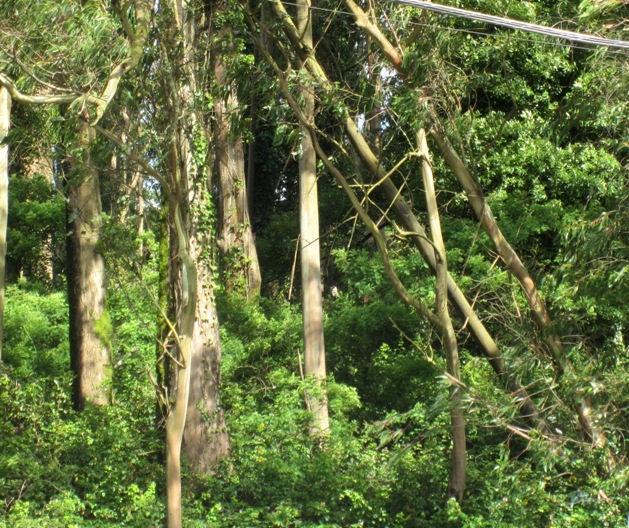
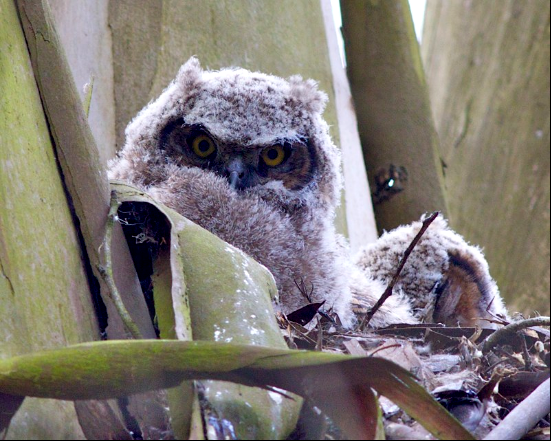
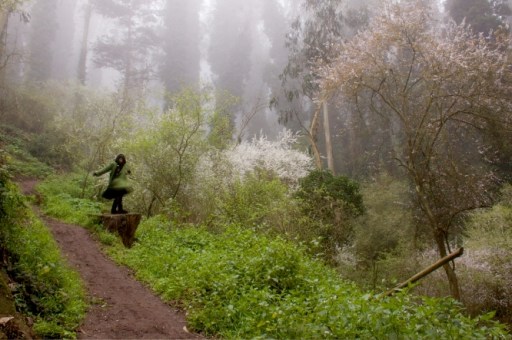
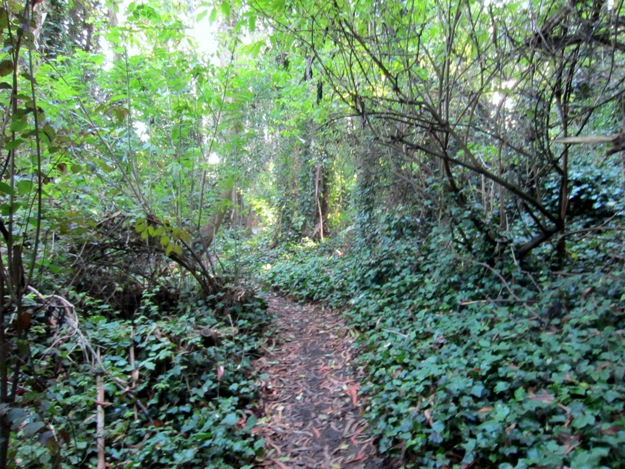
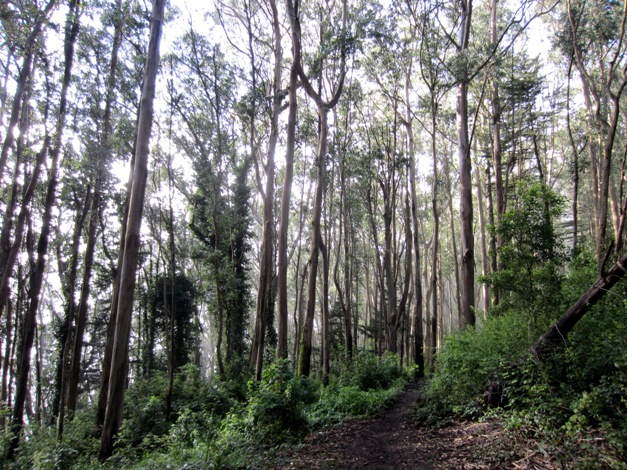
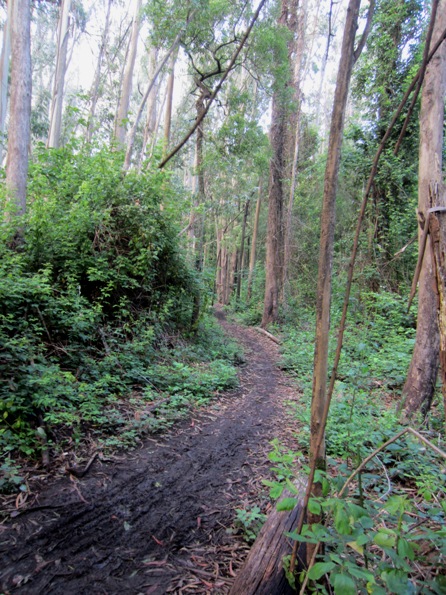
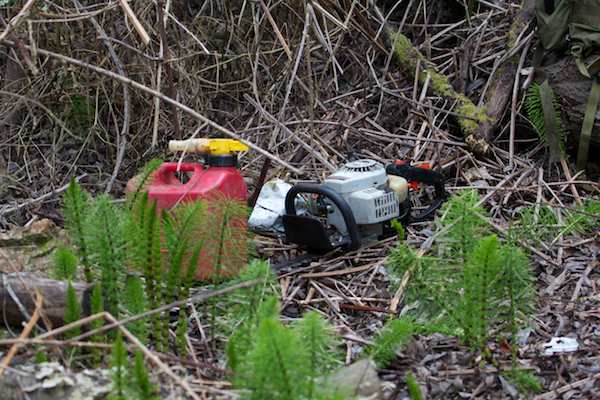
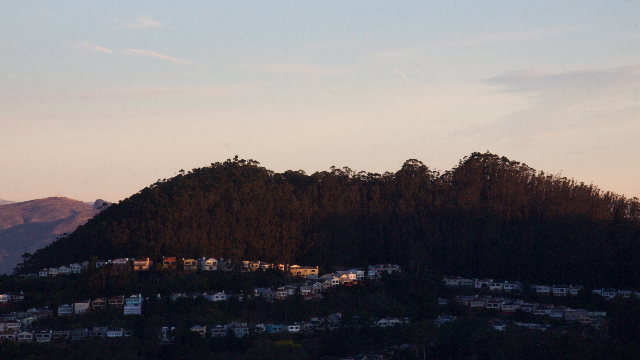
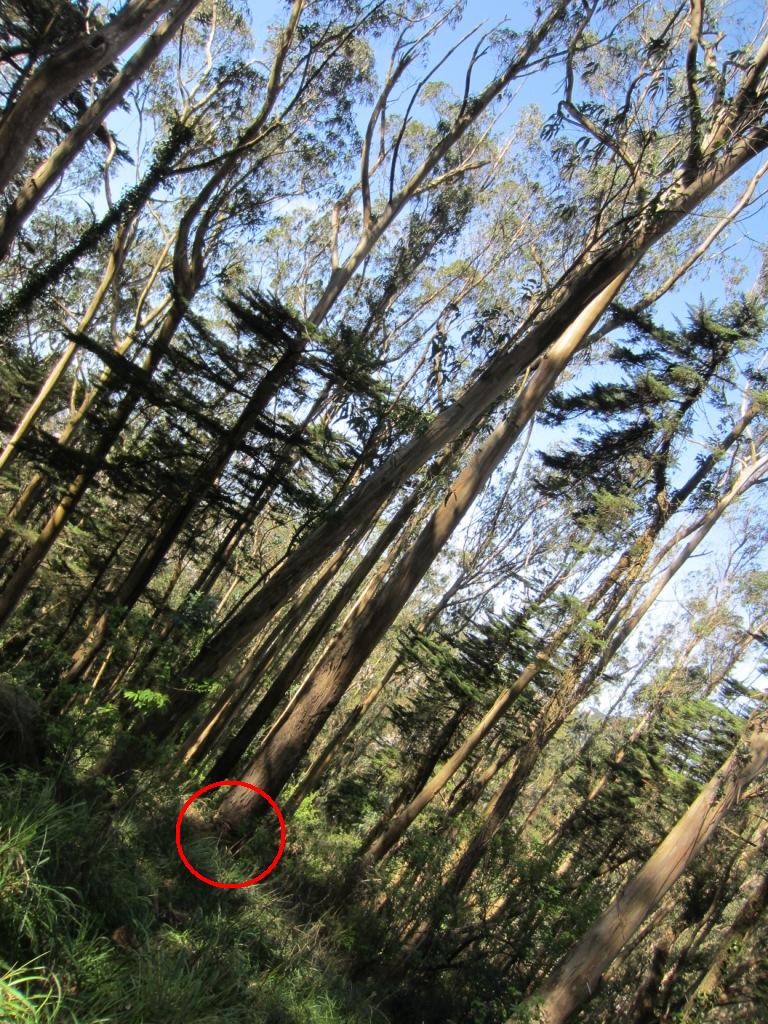
Glen Canyon Park is one of San Francisco’s jewels. It’s a long narrow tree-filled canyon, including the “owl tree” where a Great Horned Owl has raised its young many years in succession, and two natural bee trees.  Of its 70 acres, 60 comes under the Natural Areas Program (NAP). The other 10 acres are for active recreation around a Recreation Center, tennis court and playground.

A PLANNED RENOVATION HIDES UNPLEASANT SURPRISE

SFRPD intends a major renovation in the area of the Rec Center: upgraded playground tennis court, and restroom, and a grand new entrance and a heating system for the Rec Center. They also want to fell 58 trees, including some beautiful old “heritage” eucalyptus trees planted in the 1880s.

SFRPD applied for an exemption from the  California Environmental Quality Act saying that they would not be working in the Natural Areas – but it’s not true. They will be cutting down trees in the Natural Areas. [SF Forest Alliance has an article on their website: NAP Under the Radar.] It’s not the first time they’ve changed their story about what’s happening in Glen Canyon Park; at first, the Rec Center project would involve 10 trees, then the number was suddenly altered to 70 trees, and now it stands at 58.

This is just the beginning of the tree-felling. Another 30++ trees are due to be felled for the trails project. Another 60 or so for a Forestry project. Another 120 for “natural areas” to plant native gardens. And any tree under 15 feet in height – which would include some of the twisty old acacias and willows – aren’t even trees and could be removed at will.

All in all, it’s estimated that over 300 trees will be removed in Glen Canyon.

[See that story here: Denuding Glen Canyon Park]

Given the SFRPD’s track record of changing tree-felling plans, it could turn out to be any number between 250 and 500.

SAVING GLEN CANYON’S TREES

Many have been trying to save the trees. San Francisco Forest Alliance (SFForest) has a petition out, and nearly 3000 people have signed it.  But SFRPD has not discussed revisions of these plans. It’s been changing its story, and even SFForest, which has a research team working on it, had difficulty keeping up with the twists and turns.

[That’s told here: Glen Canyon Park- The Good, The Bad and The Ugly]

With tree-felling due to start on October 15th, someone (not SFForest) filed an appeal with the Board of Appeals.

It’s bought time to try once more to save the trees. Without the appellant Anastasia Glikshtern, the first batch of trees would be gone by now. Though she had originally been given a date of December 5th for a hearing, SFRPD forced her into a hearing on November 14th – giving her hardly any time to document her case, especially since SFRPD has the documents. It also means public comments have to be into their office by 4 p.m. on November 8th, Thursday. You can support this appeal.

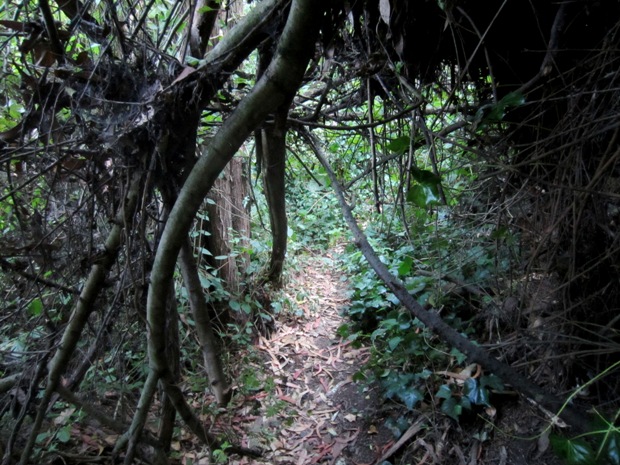
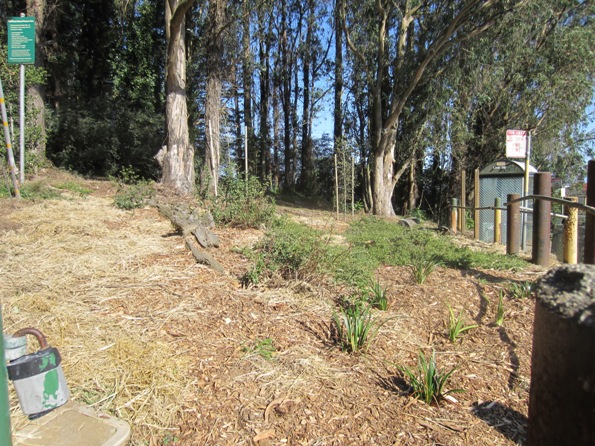
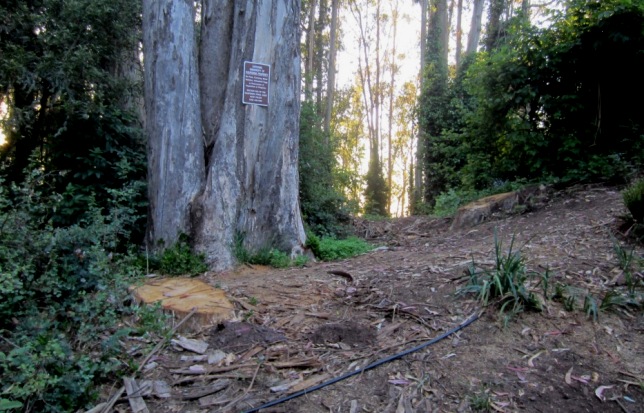
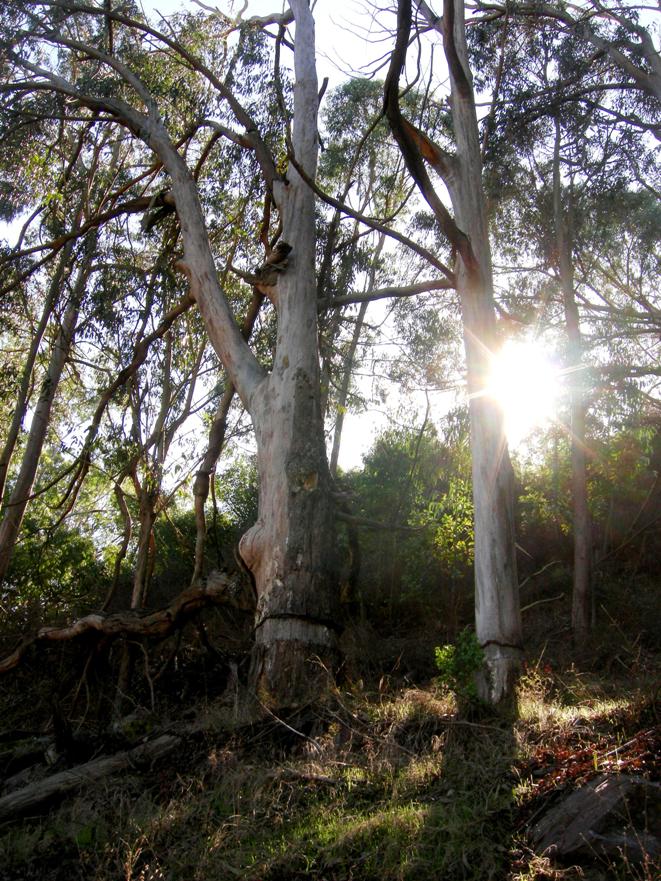
One of the trees to be felled

YOU CAN SUPPORT HER APPEAL

They’ve also made it difficult to support appeals (11 paper copies by November 8th to their Mission St office), but the public can still do so.

Here’s what I wrote as an individual, and resident of San Francisco:

————————————–

I am writing in support of the appeal made by Anastasia Glikshtern, as an individual who is a resident of San Francisco, and  a frequent visitor to Glen Canyon Park.

1.  Contrary to allegations in the press that Ms Glikshtern is a single individual quixotically holding up the project, she is in fact a courageous woman who was willing to put her name to an appeal many people felt was essential in the face of SFRPD’s refusal to work with dissenters to their plans. Had work started as planned on October 15, some 55 trees that are still standing would already be gone. Thousands of people believe that Glen Canyon Park derives its ambiance from its trees and want them preserved.

2.  In its application for a CEQA exemption (Case 2011.1141E)  SFRPD claimed it would do no work in “Natural Areas” of the Park but confine its project to the “flatlands.” This was proved untrue when the project was bid out and it was clear work will be performed in the Natural Areas.

3.  Though a number of community meetings were held, the SFRPD was dismissive of those who wanted to save the trees – at that time, projected to be 10 or11 trees in all – that would be destroyed in all the options SFRPD provided for the project. This includes historic and ancient eucalyptus trees planted around 1887.

4.  Subsequently, SFRPD’s Dennis Kern made a statement at a neighborhood presentation and at the August 15, 2012 Parks Commission meeting that 70 trees would be removed; 10 for the project, and 60 because they were “hazardous.”  Subsequently, Hort Science (the arborist) submitted an updated report (dated October 1) recommending 58 trees for removal (of which 2 had fallen spontaneously). They also provided a risk rating for every tree in the Project area. Only two were “hazardous” in the usual meaning of the word (i.e. scoring 9 or more on the Hort Risk-Rating 3-12 point scale). One was recommended for removal, the other for pruning.

[Webmaster: That information is here: SFGlenCanyon’s article on The “Hazardous” Trees of Glen Canyon.

5. Meanwhile, at a public meeting, a member of the tennis community pointed out that what they sought for the new tennis courts was a change in orientation (from east-west to north-south) not provided for under the Project.

6. I would ask the appeal to upheld on the basis that the community process did not actually note the concerns of neighbors, that information was withheld from the community, and that information provided was erroneous.

————————————–

If you want to write a letter in support – or even better, attend the hearing on November 14th, here’s how.

IF YOU WISH TO SUPPORT HER APPEAL

If you would like to send in letters of support of Anastasia’s appeal, please plan on doing so ASAP. They are due into 1650 Mission St, Suite #304, by November 8th before 3.30 p.m.

  • The Appeals Office says “simple, well written, original letters” bore more weight than petitions (though there are 3000 signatures on those!).
  • The letters have to be font size 12 or larger, double-spaced, and submitted in 11 copies, paper not electronic. They can’t be longer than 12 pages.
  • Please reference: Appeal 12-128 @ 70 Elk Street.
  • Send (or hand-deliver) to: Board of Appeals, 1650 Mission Street, Suite 304, San Francisco, CA  94103

You may also want to come to the hearing. Every public comment will have weight. If everything goes according to schedule, the hearing will be held on November 14th at 5:00 pm at City Hall, Room 416.  Every comment helps with her appeal.
Posted in deforestation, Natural areas Program | Tagged , , | 2 Comments

San Francisco’s Natural Areas: 2012 A Record Year for Pesticide Use

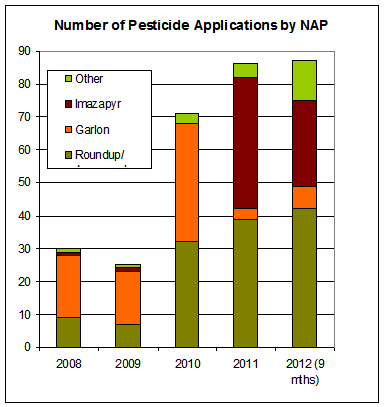
If, like us, you hoped that 2012 might be the year that San Francisco’s Natural Areas Program (NAP) proved us wrong about its escalating  pesticide use — it’s not happening. That ship sailed in September.

Readers of this site will know we’ve been following pesticide use in Natural Areas; we think it’s a distressing preview of what could happen if UCSF implements its Plan for the Sutro Cloud Forest, and revokes its current no pesticide policy. (Thanks, UCSF for keeping Mt Sutro pesticide-free thus far.)

So we obtained the pesticide reports every few months, and compiled them.  In September 2012, the Natural Areas Program’s nine-month pesticide use surpassed 2011’s full year usage by every measure.

  • The number of applications – a total of 87 for nine months – exceeded last year’s 86 for the full year.
  • Volumes of “active ingredients” – SF Department of the Environment’s favored measure – were up 29%.
  • Simple volumes of pesticides used were up 7%, comparing nine months of 2012 to twelve months of 2011.
  • By ‘acid equivalent’ it’s up 24%, part year 2012 against full year 2011.

[If you’re looking for an explanation of these measures, it’s HERE.]

It’s a record year for NAP’s pesticide use. We repeat: In nine months, it’s already surpassed its record in the previous five years.

People have asked where we get our data. We get it from the City, by filing requests for the information. (The data for our calculations of Active Ingredient and Acid Equivalent we get from Material Safety Data Sheets and related technical sources. )

Our analyses are as accurate as we can make them.

Posted in Herbicides, Herbicides: Roundup, Garlon, Natural areas Program, UCSF | Tagged , , , | 2 Comments

UCSF Long Range Development Plan Meeting and Sutro Forest

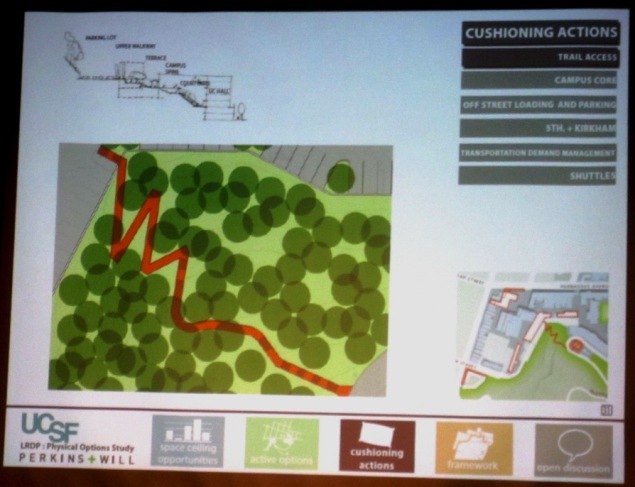
We attended UCSF’s Long Range Development Plan meeting this evening. It’s due 2014, and gives UCSF a road-map through 2035. Most of the discussion focused on how UCSF should get back under their space ceiling, a limit they had decided on back in 1976 but have always exceeded since then. This impacts neighbors, particularly those in the Inner Sunset at 5th and Kirkham.

The format of the meeting was a presentation followed by break-out groups, followed by summaries from the break-out groups. UCSF’s Kevin Beauchamp led the group we were in.

NOVEMBER FOR THE DRAFT EIR ON FELLING IN THE FOREST

However, there was some information about Sutro Forest. Most importantly, the Draft Environmental Impact Report for the plan to fell thousands of trees on Mount Sutro is likely to come out in a month or two, probably mid-November 2012. We will then have 30 days to respond.

In the presentation, they noted that the “Vegetation Management Plan” was likely to proceed after the EIR was done.

OTHER SUTRO FOREST ISSUES

In the LRDP, they are committing to keeping the 61 acres of Mt Sutro as an open space reserve. That doesn’t mean committing to saving the trees, but presumably they will not build anything on it.

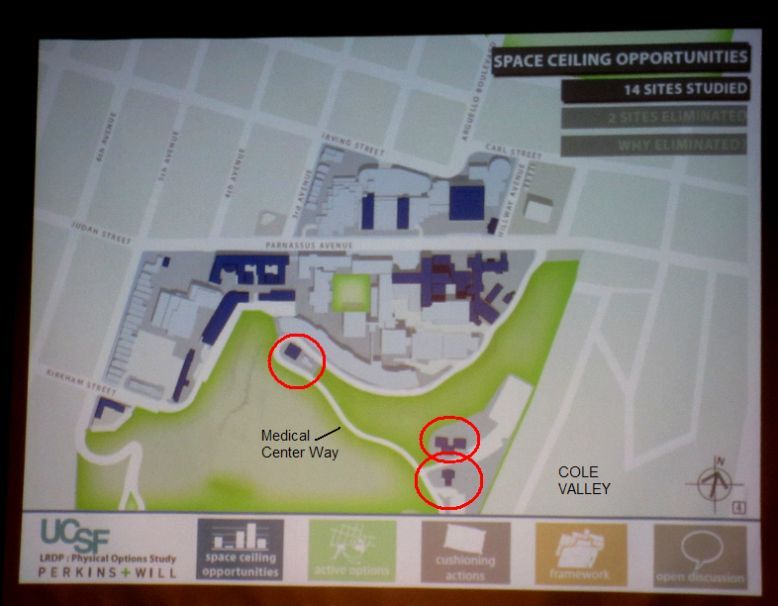
In the forest, three small buildings may be demolished to help free up space ceiling limits: The office buildings at the Woods Parking lot, the Surge Parking Lot, and the elbow of Medical Center Way. (They’re the ones in red circle in this map.) The plan would be to return them to Open Space. In our break-out group,  we questioned what that might mean, and pointed out that UCSF had undertaken to return an area under a demolished dormitory to Open Space by planting it to blend in with the forest.  Instead, UCSF converted it into a chain-link-fenced Native Plant Nursery. (That story is HERE.) This raises questions both about the definition of Open Space, as well as accountability should UCSF just change its mind.

A trail is planned to join the campus with Medical Center Way. (This trail was discussed in the context of the EIR scoping meetings.) While we have no problem with the trail as such, we are concerned about how many trees it would kill.  Our experience with the Kill-Trees trail built in the Interior Greenbelt part of the forest was that it cost us over 50 trees, a number not disclosed in any of the prior meetings. [Edited to Add: That story is HERE.  We should clarify that the Interior Greenbelt is owned by the City, not by UCSF; but our concerns remain.]

Kevin Beauchamp said that the trail would be designed to impact as few trees as possible, and there would be notification and public process in advance. We hope so; when the new trail from the Aldea campus to South Ridge was put in, there was no notification at all. (That story is HERE.)

Posted in Meetings, Mt Sutro Cloud Forest, UCSF | Tagged , , | 1 Comment

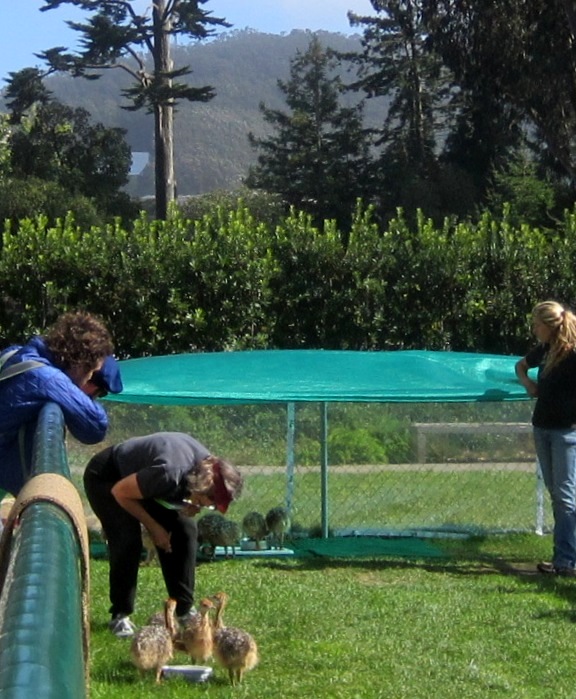
Ostriches below Mt Sutro Forest

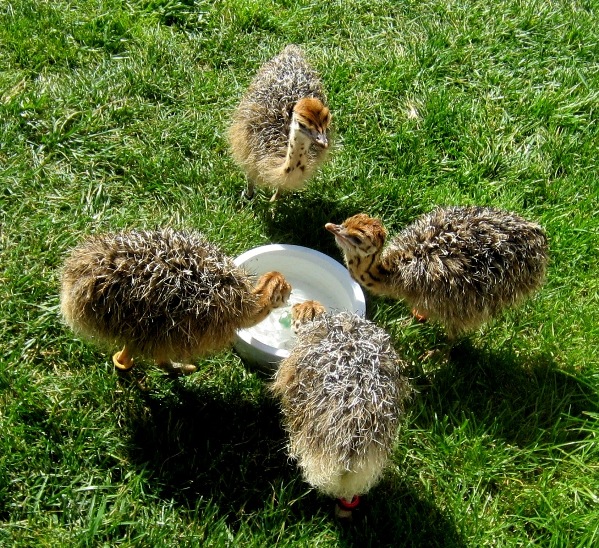
If we were thinking of non-native species of birds, we probably couldn’t get much further than ostriches. So it seemed particularly appropriate to post this picture.

The graceful non-native trees of Mt Sutro Forest fill the background, and in the foreground are the adorable baby ostriches.

They’re part of the California Academy of Sciences’ exhibit on earthquakes. To find out the connection (and for more cute pictures of baby ostriches) click on the picture below.

Posted in Mt Sutro Cloud Forest, nativism | Tagged , , | Comments Off on Ostriches below Mt Sutro Forest

Fact Check: Nothing Grows UnderEucalyptus? (Allelopathy)

Like most people in the US, we’ve been listening to some of the political speeches and the discussion around them recently. And we’re rather heartened by a newly emerging trend: fact-checking.

In the last few months, one “fact” we’ve heard repeatedly is “Nothing grows under eucalyptus,” and the “explanation” that it’s because of allelopathy, the process by which certain plants exude chemicals that poison the soil and prevent other plants from growing there.

  • Dennis Kern of the San Francisco Rec and Parks Department said it at a West of Twin Peaks Central Council meeting.
  • He repeated it at a Parks and Recreation Open Space Advisory Committee (PROSAC) meeting. (That prompted a member of the public to ask Mr Kern if he’d ever visited Mt Davidson. He said he had.)
  • Glenn Rogers, a candidate for Supervisor in the District 7 race, also spoke of allelopathy, adding that eucalyptus forests are “like a desert” and that no wildlife or birds could live there.

IT’S NOT TRUE

As the fact-checkers have had frequent reason to say: It’s not true.

The internal rain of the Cloud Forest nurtures a lush dense green understory even as Twin Peaks turns brown and city parks need sprinklers. Right now, in Sutro Forest, the trees are green and beautiful – and so is the secondary canopy of acacia trees, and so is the dense understory where it hasn’t been cut back.  [See Mt Sutro Ecosystem and Wildlife Habitat]

The only area that is brown and dry is the Native Plant Garden at the summit. It dries out because there’s not enough tree cover to water it. Some areas now are quite denuded.

In fact, if you do find places in San Francisco with bare ground under eucalyptus, it’s because the Native Areas Program of the SF Recreation and Parks Department, or their volunteers or sympathizers have been pulling up undergrowth with great effort – or poisoning the soil not with allelopathic chemicals but with herbicides like Roundup or Garlon or Imazapyr or “Milestone.”

We understand that not everyone walks in the city’s two wonderful eucalyptus forests at Mt Sutro and Mt Davidson (both, ironically, in District 7). But – surely – they’ve driven by them?  We invite all those who think it’s a desert to drive along Christopher Drive and Crestmont in Forest Knolls, or along Clarendon Avenue between Oak Park and the UCSF Aldea Campus entrance, or down Medical Center Way, to see for themselves. (The picture below is from Clarendon Avenue.)

NO WILDLIFE?

The eucalyptus haters have managed to spread a lot of misinformation about these trees over the last few decades. Chief among them is that they’re an ecological desert where nothing grows and no birds or insects flourish.

That isn’t true either.

  • Some 45 species of birds been recorded in Mt Sutro Forest in a couple of birding session. Mt Davidson is a favorite spot for our city’s birdwatchers, and when they visit it, they’re usually spotting birds in the forest’s trees, not on the bare “native plant” side. [The Mt Sutro bird list HERE and HERE; we welcome any additions from birders, especially with photographs.]
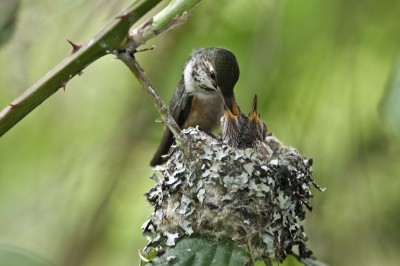
  • Birds from the large Great Horned Owls and Redtailed Hawks nest in eucalyptus trees, and so do woodpeckers and smaller birds like the Western Bluebird and hummingbirds. All kinds of birds use eucalyptus, the ivy it supports, and the understory it sustains, as habitat.  [Related content: The Summer tanager and San Francisco’s non-native plants.]
  • Coyotes use the forest and its dense understory as places to hide and escape people and dogs. [See: Video of a coyote on Mount Davidson.]
  • Bees use the nectar of the winter-flowering eucalyptus when nothing else is blooming. [See: Bees and the Blue Gum Eucalyptus and Herbicides ]

EUCALYPTUS MYTHS AND “CONVENTIONAL WISDOM”

We’ve tried to combat the disinformation by setting up a page listing some of the major eucalyptus myths. Most of the myths can easily be refuted by observers; others have fallen to peer-reviewed published research. The only reason they seem to persist is that those who hate eucalyptus wish the myths to be true, and others accept them.

To be fair, sometimes a myth is so widespread that it’s “conventional wisdom.”

Last year, we joined a guided sound walk of the forest. As we waited on Parnassus Avenue, someone on the tour said that nothing grew under eucalyptus. He’d been to Point Reyes and seen this. “It’s not true here,” we said, but he looked skeptical.

The tour entered the forest at Edgeworth, and climbed up the mountain to the Native Garden, where we paused. There, he sought us out. “I’m amazed by how lush the undergrowth is,” he said. “I had to tell you.” We were impressed that he’d do that. Most people don’t like being mistaken.

But we weren’t surprised. Before we started exploring, we actually believed that birds did not live in eucalyptus forests. Then, the first day we went into the forest, we found it alive with birdsong, and small birds  flitting around the canopy and sub-canopy, hiding in the understory, calling to each other. Later, we heard woodpeckers, and saw the Great Horned Owls that live in the forest.

That’s when we started to question our prior beliefs, and looked for more information. It was there, waiting to be found. We’d had no reason to think about it before.

So we hope this post is taken in the spirit it’s meant: A reason to think again, look for the evidence, and re-consider the myths.

And we’d like to end with an artistic video from photographer and artist Lori D’Ambrosio.

Click on the picture to get the video

Posted in Environment, eucalyptus, Mt Sutro Cloud Forest, nativism | Tagged , , , , , | 1 Comment

Mt Sutro Cloud Forest: An August 2012 Hike

The summer fog’s been hanging around the Cloud Forest, and when we went up there late last weekend, it had lightened but not lifted.

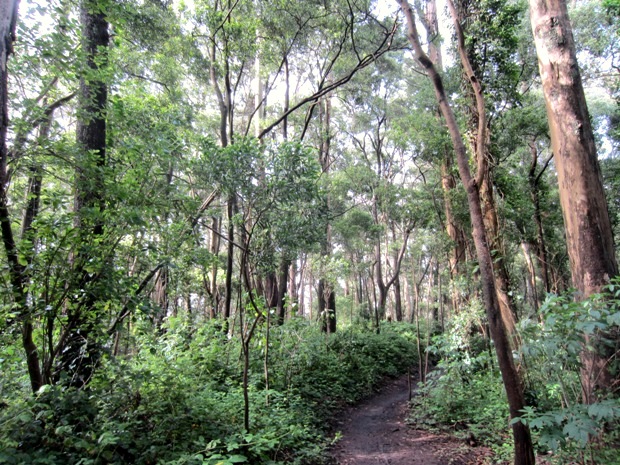
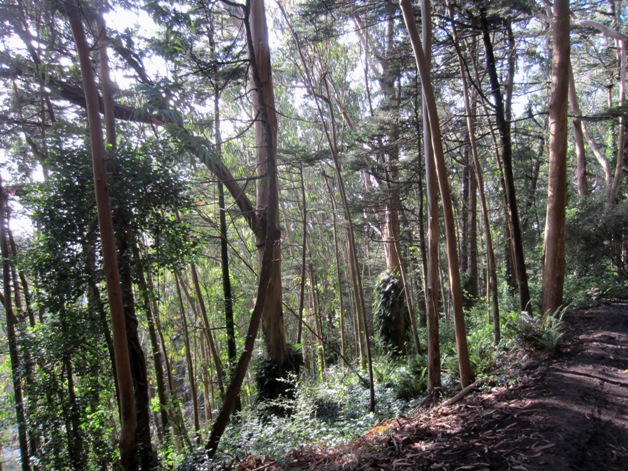
We climbed up by the Christopher entrance to the South Ridge trail. It was cool and green, trees rising into a mist-gray sky. These were the sounds of the forest: The wind in the leaves high above; the creaking of the eucalyptus as they swayed; and the insistent beat of the music from the Outside Lands concert in the Golden Gate Park to the north.

Though we spent a couple of hours on the mountain, we saw only two joggers, two dog-walkers, and a bike-rider. Maybe everyone was at the concert.

STATE OF THE TRAILS

The trails vary from wet to dry, the typical summer cloud forest pattern. It depends on how dense the fog has been in a particular area, how much the unbroken canopy has harvested the moisture, how much the undergrowth has retained, how the path has drained.

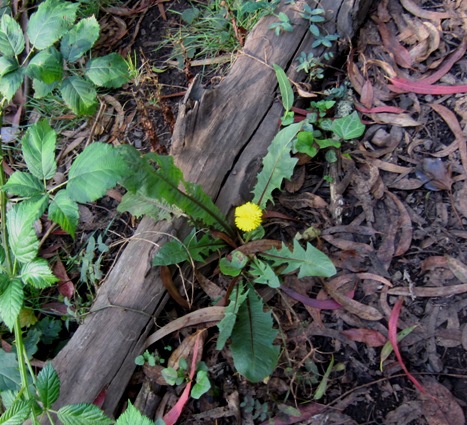
That day, the trail turned abruptly from dry to damp as we climbed into the forest. All along the South Ridge, it was damp; and where the trail was broad, and particularly where it was churned up by bike-riders, it was muddy in stretches, with puddles. The upper reaches of the Historical Trail were beautiful but wet, but dries out as it turns north.  A perfect yellow dandelion shone by the trailside.

[Click here for pointers on foggy-day hiking in Mount Sutro.]

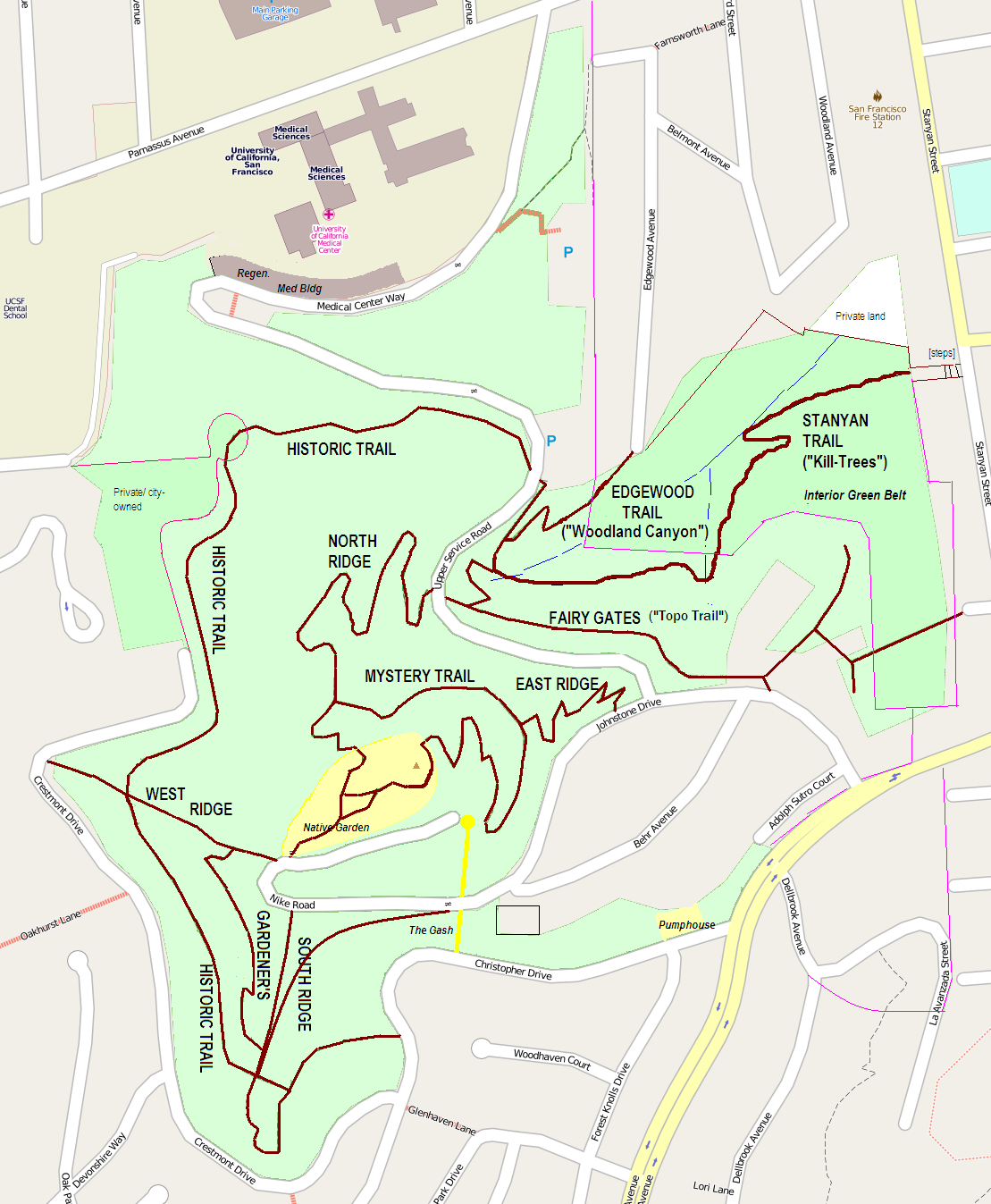
This year, there’s been less fog on the north side of the forest than on the South.  The trails below the paved road that intersects this forest, Medical Center Way, were all dry to the point of being dusty. The Fairy Gates trail started out wet near the Chancellor’s house on the Aldea student housing area, but was quite dry beyond the narrow rock passage.

Also, this is the area where there has been a lot of clearing, and the forest has dried out. Some of the understory has returned, but all over the forest, there are bare patches where volunteers have been at work. We wish they would understand the importance of this understory to the forest’s ecology and the wildlife that live there.

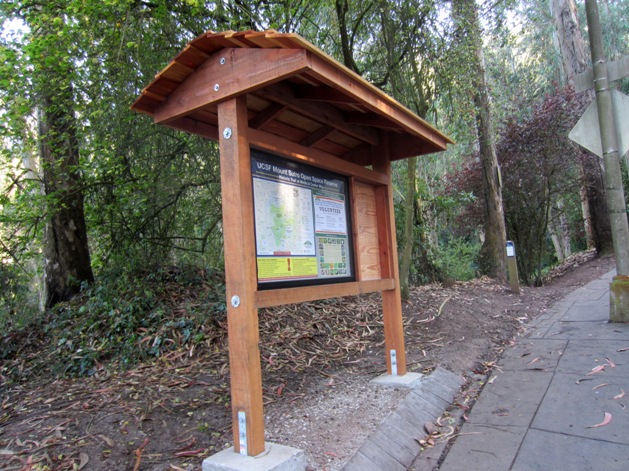
A new signboard, similar to the one up in the Native Garden, has been placed near the Woods Parking lot on Medical Center Way. It has a map of the forest, and recruiting posters for the Sutro Stewards who run the volunteer program.

WILD TRAIL

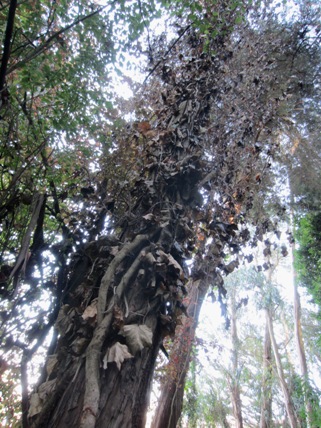
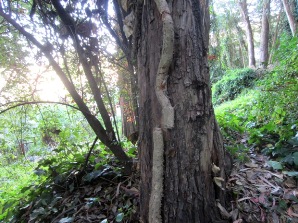
We followed an unmarked wild trail into the Interior Green Belt portion of the forest. It challenging, a narrow uneven trail through dense vegetation and among tall trees, but closer to our forest experience of yesteryear. But even there, there had been clearing. On one tree, someone had cut a thick stem of ivy, destroying the plant as it climbed a tree providing greenery and habitat. (Some believe that ivy kills trees; this isn’t actually true of the eucalyptus. But we’ll go into that another time.)

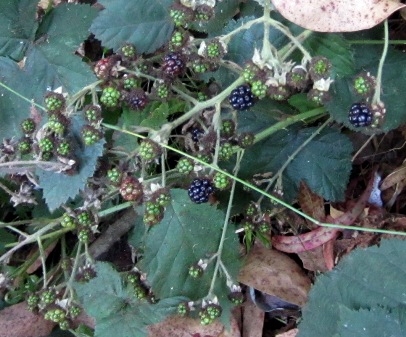
Parts of the trail ran through a bare area behind the houses on Stanyan. The upside was that the additional sunlight made the blackberries fruit abundantly. No pesticides had been used here, and we snacked as we trekked.

Someone had tried to block the pathway with a huge pile of brush and debris, but it was possible to clamber around the blockage. Just as well; it was a longish way back.

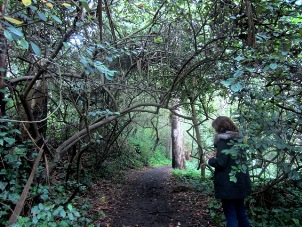
The path dipped under some wonderful tree tunnels and returned into the forest.

Somewhere around here we found a feather. We think it’s probably from a Great Horned Owl. If anyone has a better ID, please comment?

Posted in Environment, eucalyptus, Maps, Mt Sutro Cloud Forest | Tagged , , , , , | 1 Comment

Insects Don’t Prefer Native Plants

New data, but old theories?

One argument that Native Plant Advocates make for their attempts to convert San Francisco’s open spaces to native plants (despite the habitat destruction and pesticide use) is that it’s better for wildlife. In fact, it’s the basis for the Natural Areas Program.

Insects, they believe, prefer native plants. That in turn, according to this theory, provides sustenance for insect-hunting birds and animals, providing a richer and more bio-diverse ecosystem.

Only, it isn’t, and it doesn’t.

Professor Douglas Tallamy (University of Delaware) proposed this theory, and his book Bringing Nature Home has been extremely influential. He speculated that most insects depended on native plants (owing to co-evolution).  Since non-native plants wouldn’t attract insects,  they would erode the base of the ecosystem.

Being a scientist, Prof Tallamy noted that this theory wasn’t based on actual observation. Being a scientist, he had his student collect data on insect use of both native and non-native landscapes. And being a scientist, even though the data did not support his theory, he published it. He wrote: “…there was no statistical difference in the amount of damage on either landscape type.”

The article below, republished with permission and minor changes from the website Death of a Million Trees, provides details and references (and is a fascinating read).

——————————-
DOUG TALLAMY REFUTES HIS OWN THEORY WITHOUT CHANGING HIS IDEOLOGY

In our debates with native plant advocates, the scientist who is most often quoted to support their beliefs is Doug Tallamy who wrote an influential book, Bringing Nature Home:  How Native Plants Sustain Wildlife in our Gardens.    Professor Tallamy is an entomologist at the University of Delaware.

Professor Tallamy’s hypothesis is that native insects require native plants because they have evolved together “over thousands of generations.”  Because insects are an essential ingredient in the food web, he speculates that the absence of native plants would ultimately result in “ecological collapse” as other animals in the food web are starved by the loss of insects. (Reference #1 below.)

Professor Tallamy freely admits that his theory is based on his anecdotal observations in his own garden, not on scientific evidence:

“How do we know the actual extent to which our native insect generalists are eating alien plants?  We don’t until we go into the field and see exactly what is eating what.  Unfortunately, this important but simple task has been all but ignored so far.”  (Reference #1 below.)

This research has now been done to Professor Tallamy’s satisfaction by a Master’s Degree student under his direction.  The report of that study does not substantiate Professor Tallamy’s belief that insects eat only native plants.  In his own words, Professor Tallamy now tells us:

“Erin [Reed] compared the amount of damage sucking and chewing insects made on the ornamental plants at six suburban properties landscaped primarily with species native to the area and six properties landscaped traditionally.  After two years of measurements Erin found that only a tiny percentage of leaves were damaged on either set of properties at the end of the season….Erin’s most important result, however, was that there was no statistical difference in the amount of damage on either landscape type.” (Reference #2 below)

CORROBORATING EVIDENCE

This finding that insects are equally likely to eat native and non-native plants may be new to Professor Tallamy, but it isn’t new to the readers of Million Trees.  We have reported many studies which are consistent with this finding.

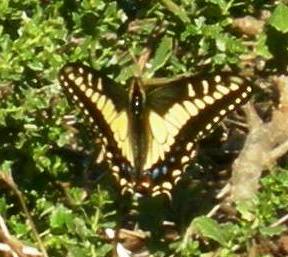
Anise Swallowtail butterfly in non-native fennel

The English garden, where plants from all over the world are welcome

SPECIALISTS VS. GENERALISTS

When debating with native plant advocates, one quickly learns that the debate isn’t ended by putting facts such as these on the table.  In this case, the comeback is, “The insects using non-native plants are generalists.  Insects that are specialists will not make that transition.”  Generalists are insects that eat a wide variety of plants, while specialists are limited to only one plant or plants in the same family which are chemically similar.

Professor Tallamy offers in support of this contention that only “…about 10 percent of the insect herbivores in a given ecosystem [are not specialists],” implying that few insects are capable of making a transition to another host plant.

However, categorizing insects as specialists or generalists is not a dichotomy.  At one extreme, there are some insects that choose a single species of plant as its host or its meal.  At the other extreme, there are insects that feed on more than three different plant families.  It is only that extreme category which has been estimated at only 10% of all phytophagous (plant-eating) insects.  The majority of insects are in the middle of the continuum.  They are generally confined to a single plant family in which the plants are chemically similar.

Putting that definition of “specialist” as confined to one plant family into perspective, let us consider the size of plant families.  For example, there are 20,000 plant members of the Asteraceae family, including the native sagebrush (Artemisia) and the non-native African daisy.  In other words, the insect that confines its diet to one family of plants is not very specialized. 

Soapberry bug on balloon vine. Scott Carroll. UC Davis

Professor Tallamy offers his readers an explanation for why specialist insects cannot make the transition from native to non-native plants.  He claims that many non-native plants are chemically unique and therefore insects are unable to adapt to them.  He offers examples of non-native plants and trees which “are not related to any lineage of plants in North America.”

One of his examples is the goldenrain tree (Koelreuteria paniculata).  This is the member of the soapberry (Sapindaceae) family to which the soapberry bug has made a transition from a native plant in the soapberry family in less than 100 generations over a period of 20 to 50 years.  Professor Tallamy’s other examples of unique non-native plant species are also members of large plant families which probably contain native members.  Professor Tallamy is apparently mistaken in his assumption that most or all non-native plants are unique, with no native relatives.

THE PACE OF EVOLUTION

Even if insects are “specialists” we should not assume that their dependence on a native plant is incapable of changing over time.  Professor Tallamy’s hypothesis about the mutually exclusive relationships between native animals and native plants is based on an outdated notion of the slow pace of evolution.  The assumption amongst native plant advocates is that these relationships are nearly immutable.

In fact, evolution continues today and is sometimes even visible within the lifetime of observers.  Professor Tallamy provides his readers with examples of non-native insects that made quick transitions to native plants:

  • The hemlock wooly adelgids from Asia have had a devastating effect on native hemlock forests in the eastern United States.
  • The Japanese beetle introduced to the United States is now eating the foliage of over 400 plants (according to Professor Tallamy), some of which are native (according to the USDA invasive species website).

These insects apparently made transitions to chemically similar native plants without evolutionary adaptation. If non-native insects quickly adapt to new hosts, doesn’t it seem likely that native insects are capable of doing the same?  That is both logical and consistent with our experience.    For example, the native soapberry bug mentioned above has undergone rapid evolution of its beak length to adapt to a new host.

Although Professor Tallamy tells us that the relationship between insects and plants evolved over “thousands of generations,” he acknowledges much faster changes in plants when he explains why non-native plants become invasive decades after their arrival:  “Japanese honeysuckle, for example, was planted as an ornamental for 80 years before it escaped cultivation.  No one is sure why this lag time occurs.  Perhaps during the lag period, the plant is changing genetically through natural selection to better fit its new environment.”  Does it make sense that the evolution of plants would be much more rapid than the evolution of insects?  Since the lifetime of most insects is not substantially longer than the lifetime of most plants, we don’t see the logic in this assumption.

BELIEFS DIE HARD

Although Professor Tallamy now concedes that there is no evidence that insects are dependent upon native plants, he continues to believe that the absence of native plants will cause “ecological collapse.”  In the same book in which he reports the study of his graduate student, Professor Tallamy repeats his mantra:  “…our wholesale replacement of native plant communities with disparate collections of plants from other parts of the world is pushing our local animals to the brink of extinction—and the ecosystems that sustain human societies to the edge of collapse.”

This alarmist conclusion is offered without providing examples of any animals being “pushed to the brink of extinction.”  In fact, available scientific evidence contradicts this alarmist conclusion. (Reference #3 below)

REFERENCES

(1)    Tallamy, Doug, Bringing Nature Home, Timber Press, 2007

(2)    Tallamy, Doug, “Flipping the Paradigm:  Landscapes that Welcome Wildlife,” chapter in Christopher, Thomas, The New American Landscape, Timber Press, 2011

(3)    Erle C. Ellis, et. al., “All Is Not Loss:  Plant Biodiversity in the Anthropocene,” in PLOS one (A peer-reviewed open-access journal)

Posted in Environment, nativism, Natural areas Program | Tagged , , , , | 1 Comment

San Francisco Butterfly Count 2012 Results

Anise Swallowtail butterfly – Keith McAllister

Every year, the North American Butterfly Association (NABA) sponsors a “July 4th” butterfly count; it’s a count of all the species volunteers spot within a 15-mile radius on a particular day in the 4 weeks before or after July 4th.  In San Francisco, it’s usually organized by Liam O’Brien who keeps the www.sfbutterfly.com website and blog.

This year, it very nearly didn’t happen. Blame it on the fog.

The count was scheduled for June 14th. The weather was  cold and drizzly – San Francisco’s storied summer weather – and it was cancelled. That left little time for a reorganized Count. But with luck and determination, it did happen on July 24th – though with only 16 people participating instead of the 34 who took part last year. They spotted some 919 individual insects (compared with 967 or 990, not sure which, in 2011).

In 2010, it was held on June 7th on a foggy day; in 2012, it was held on July 3rd, a month later and the weather was bright and sunny. This time, it was foggy but clearing to sunshine on July 24th, 2012. As the timing and weather changes, so do the butterflies seen. This year, they again saw 26 species of butterfly (26 last year, 24 in 2010), including the Western Pygmy Blue and the Propertius Duskywing for the first time. Some species seen in 2010 or 2011 didn’t show this year.

[Click for: Article on the 2011 San Francisco Butterfly Count results.

Click here for the article on the 2010 San Francisco Butterfly Count results.]

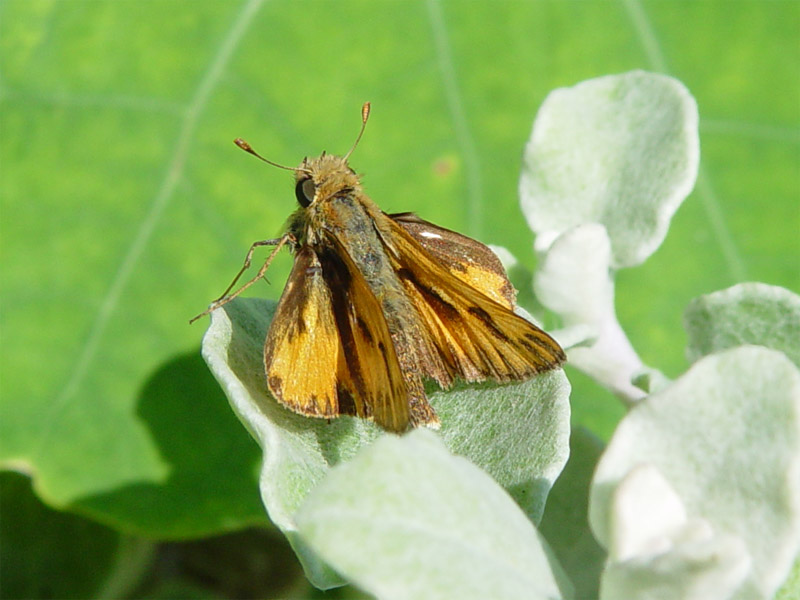
Sandhill Skipper - Franco Folini, Creative Commons

Sandhill Skipper – Franco Folini, Creative Commons

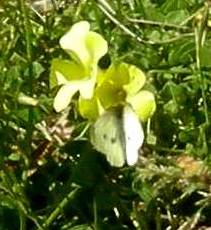
Cabbage White sitting on Oxalis

As in the two prior years, the Cabbage White butterfly easily topped the list. This year, they accounted for nearly a quarter of the butterflies spotted, which is down from over 40% in 2010. But the second most common keeps changing:

California Common Ringlet by David Hoffman (Creative Commons)

In 2010, it was the tiny brown Umber Skipper, (which didn’t even make the top ten this year). In 2011, it was the handsome Anise Swallowtail. And this year, the Sandhill Skipper and the California Common Ringlet – both small brown butterflies – tied for second place.

The Anise Swallowtail, which depends on fennel as its nursery plant, was the third most common in 2010; this year, it came in fifth, after the Common Buckeye.  The top ten butterfly species accounted for 83% of the insects spotted (82% last year, 85% in 2010).

For those interested in all the species listed in the last three years, and the count by year for each of them: Here it is.

Posted in Environment | Tagged , | 2 Comments

Mount Sutro Forest: A Landmark

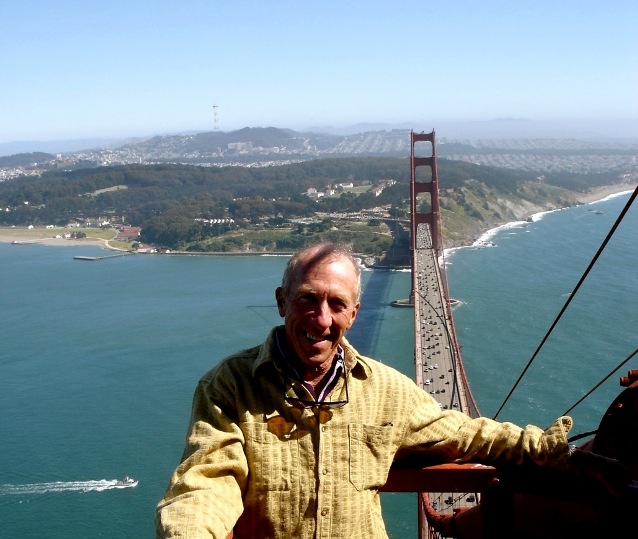
We were sent this great picture by Dr Morley Singer and it’s published here with permission. It was taken from the top of Golden Gate Bridge. Look over Dr Singer’s left shoulder, and you can see Mount Sutro Forest,  next to the Sutro Tower. It’s truly a landmark forest.

Posted in Mt Sutro Cloud Forest | Tagged , , | 1 Comment

Mount Sutro Cloud Forest: Forest report, July 2012

While the rest of the country bakes and burns, we’re having a cool San Francisco fog-belt summer. The other day, strong gusty winds blew the fog blew in from the sea, and we headed up to the forest.

Click on map for larger version

Mount Sutro Cloud Forest is the perfect place on a gray windy day. Inside the forest, the trees and understory – where it hasn’t been cut back – act as a wind-break. On days like this, it’s one of the loveliest and most peaceful places in the city.

It’s a well-kept secret; in two hours, we encountered one jogger and three walkers.

(However, we should warn you to stay away in stormy weather that can knock down trees.)

[Read HERE for hiking information and a map.]

SOUTH RIDGE TRAIL

We took the unmarked trail-head up from Christopher. The slope here was dry, but just a short distance in, it got damp. A small yellow bird searched energetically through the understory – probably a Wilson’s warbler, but its rapid moves defeated our point-and-shoot camera, so no positive ID.

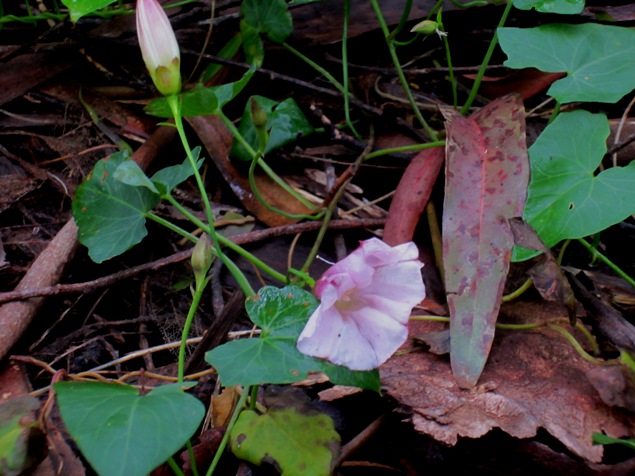
The forest looked lush, almost a jungle. Though the blackberry bushes have been trimmed, it wasn’t the devastation we’ve seen before. Perhaps the Sutro Stewards are being respectful of the bird nesting season, which runs through August. A few delicate convolvulus flowers opened trumpets along the path.

The trails are wet on the southern side: the South Ridge trail, the top of the Historic Trail, the non-DEIR trail from the Nike Rd. There were even a few puddles though it hasn’t rained in a while. This is the forest that Nativists have called a fire hazard… possibly the wettest place in San Francisco outside the Bay.

The South Ridge is the largest cut-zone under the planned tree-felling (for which the Environmental Impact Report is currently delayed.)

THE NATIVE GARDEN

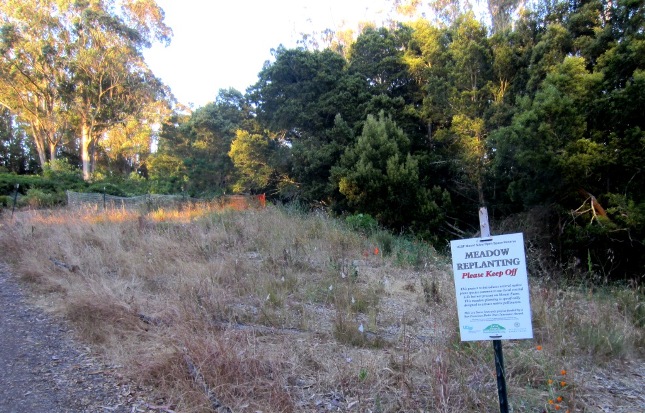
The Native Garden on the summit was, predictably, dry. It’s also within the fog belt, but has no tall trees to harvest the cloud-moisture, and little undergrowth to retain it. (The green bushes behind are non-native acacias.) The newly replanted meadow was all brown grass and plastic flags, with a few California poppies. But as soon as you leave the Native garden and enter the forest, it’s damp again.

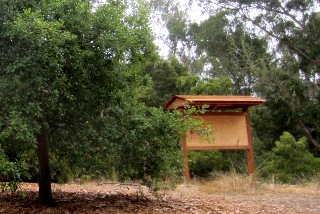
Elsewhere in the garden, a mock-orange was covered with little white flowers. A few oak trees, sheltered from the wind by the forest, have gotten a foothold. Planted some years ago, they are still small compared with the blackwood acacia and the tall eucalyptus.  The new notice-board looks bulky beside them, but unlike their tragic counterparts in Tank Hill, they actually are growing into trees. (Despite numerous attempts, Tank Hill still has no oak trees – just some sad saplings not even three feet tall.)

There’s some trail re-alignment on the East Ridge trail, just above the Student Housing. It’s unclear what the plan is, but it looks like a construction site: dry, dusty and dug up. All the understory is gone. The area also smelled peculiar, we’re not sure why. Maybe red elderberry (aka stinking elderberry)?

Talking of red elderberry, it’s a Native Plant that’s been planted all over the forest and is fruiting now with pretty red berries that birds like to eat.. But if you’re hiking with kids, warn them the berries are poisonous – in fact, the whole plant is. Also, it stinks if it’s picked or crushed.

In the Student Housing area, the Sutro Stewards have taken over the area “Pad #4” where a dorm was demolished. According to an agreement with the community, UCSF was going plant it to blend in with the forest.

“The sites targeted for open space will have retaining walls removed (unless there are geologic or safety reasons for not removing the retaining walls), and will be planted to blend in with the forest.”

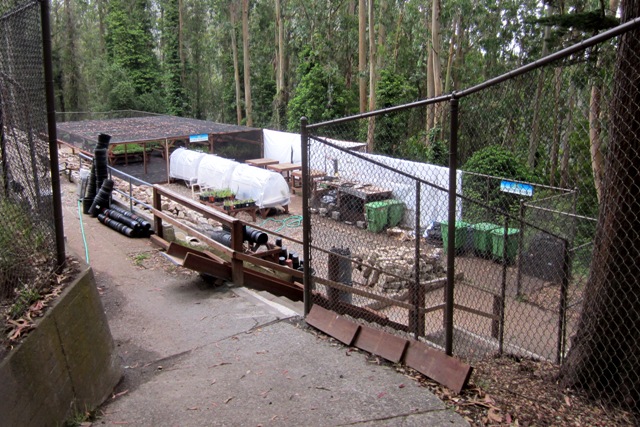
Instead, it unilaterally decided to make it available to the Sutro Stewards as a plant nursery. [Read HERE for the whole story: Chainlink and Concrete Aren’t Forest.] It’s not clear by what calculation this nursery can be considered part of the Open Space UCSF has guaranteed. Anyway, the site is now an active plant nursery.

The Gash – a bare patch in the forest between the Nike Rd and Christopher St,  left by the SF PUC when it laid some pipe is visible from the Nursery. It’s finally been allowed to heal. (Earlier, someone kept pulling down anything that tried to grow there, to the distress of neighbors below.) The house on Christopher is still visible through the vegetation, but is a lot better than the barren strip that existed before.

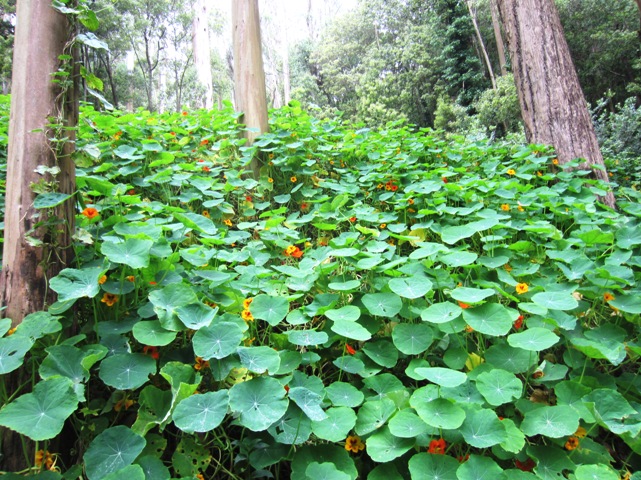
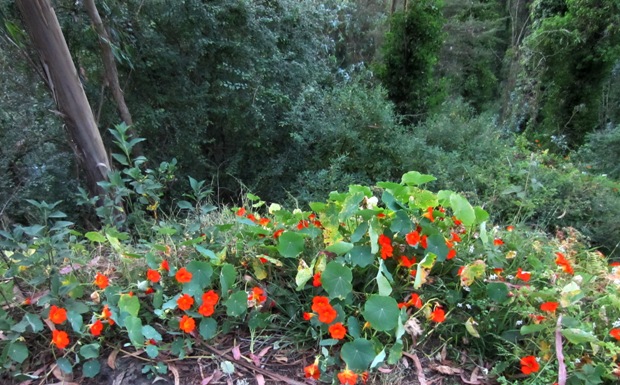
The non-DEIR Trail has also healed somewhat, and a bank of self-sown nasturtiums has brightened some of the newly opened area.

FAIRY GATES TRAIL AND WILD PLUMS

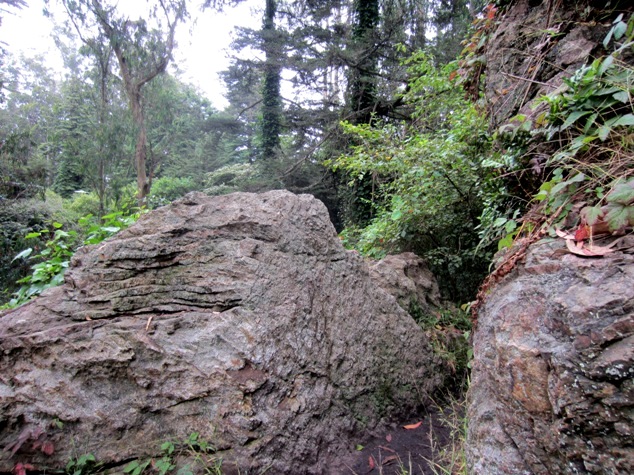
We continued on through the Student Housing to the Fairy Gates trail. Here, the trail is exposed and dry. Still, it’s a lovely trail – entered through a tunnel of trees outside the Chancellor’s house, it hugs the mountainside with a nice view of the vegetated valley below, and passes through a cleft in a big rock – the “fairy gates.”
This part of the forest has many plum trees, heavy now with small red fruit. (We’d mistaken them for cherries, earlier; they’re about the same size.) My companion reached up for a few. “Are they okay?” I asked. I knew UCSF uses no pesticide on the mountain, so that was okay, but I didn’t know how they tasted.

“Sure. I’ve been eating them for years.” They were sweet and ripe. The birds presumably like them too, but there was more than enough to go round – a bumper crop.

Posted in Mt Sutro Cloud Forest | Tagged , , , | 2 Comments

Measuring Pesticide Use by San Francisco’s Natural Areas Program

Vista with Garlon pesticide notice, Feb 2012

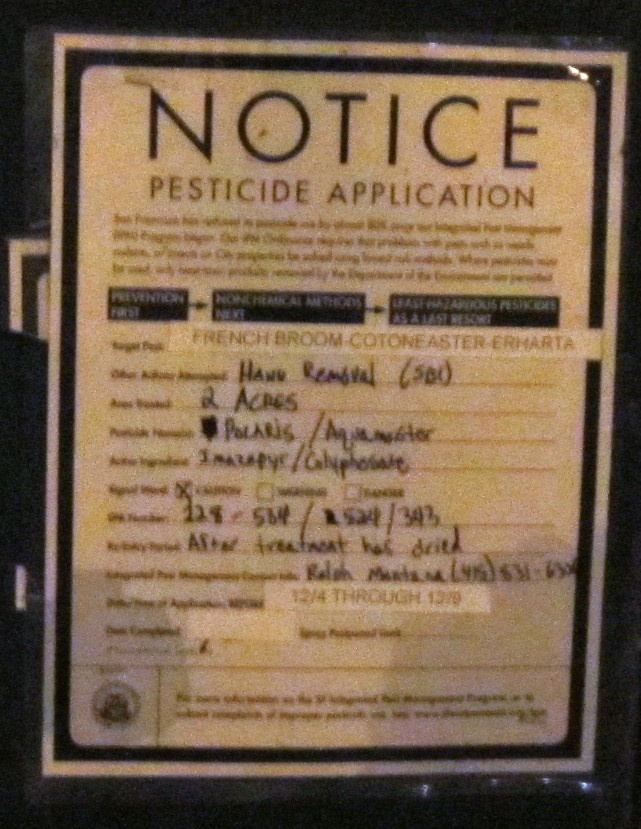
As readers of this site will know, we’ve been following the use of pesticides in Natural Areas. At present, four pesticides are mainly used by the Natural Areas Program (NAP): Glyphosate (trade-names Roundup or Aquamaster); Triclopyr (Garlon and its variants); Imazapyr (Polaris or Habitat); and Amino-pyralid (Milestone). [Here’s our article about these pesticides and our concerns: Natural Areas Program’s Pesticides: Toxic and Toxic-er.]

The SF Department of the Environment (SFDOE) has said that pesticide use [in the Natural Areas] has fallen. Since that wasn’t what we were seeing, we asked them how come. Apparently, it all depends on two things:

  • Gone down compared to when?
  • How are you measuring pesticide use?

This article will try to tease out those factors. There are four ways in which we can measure pesticide use, and each one tells us something slightly different.

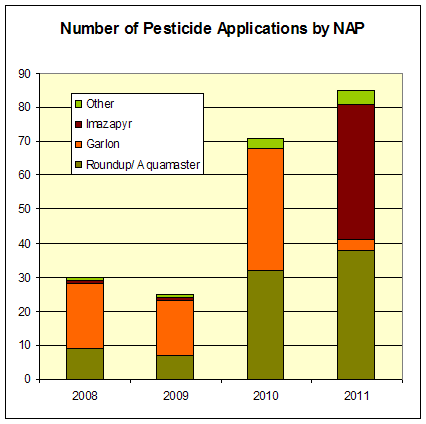
1.  Number of applications

This tells us how many times pesticides were used in Natural Areas. It measures opportunities for exposure to pesticides.

This graph shows the number of applications for the years 2008- 2011, based on data we got from the city under the Sunshine Act.

What do we mean by “opportunities for exposure”? Here’s a thought experiment: Supposing the NAP used all their pesticides at one time in one place. We’d get a big brown patch of dead vegetation, but it wouldn’t have much impact outside that area. If you wanted to avoid pesticide exposure, that would be the place to avoid.

If instead, smaller amounts are sprayed over many parks and many occasions, then the potential to be exposed is much higher. This is what actually happens.

McLaren: Pesticide use “Throughout the Park”

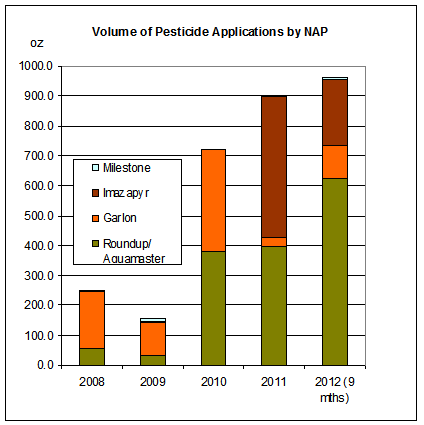
2.  Volume of pesticides used

This is a simple total of all the pesticides used in the Natural Areas, calculated in fluid ounces. It includes the “inert” chemicals – the ones the chemicals companies don’t have to provide any information on, because they aren’t herbicides. But, in some cases, the chemicals are not actually inert. Sometimes, they’re toxic. One example is POEA, the chemical used in some formulations of Roundup.

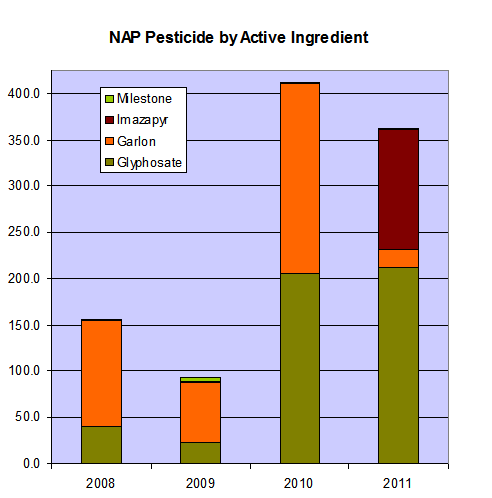
3.  Amount of Active Ingredient in the Pesticide

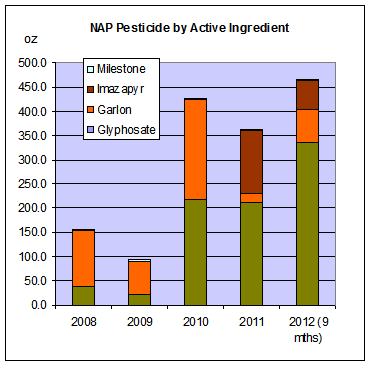
This measure omits the “inert” chemicals in the herbicide, and only considers the so-called “active ingredient.” These are typically chemical compounds based on the named pesticide, like Glyphosate Ammonium salt, or Glyphosate Iso-propylamine salt. Here’s the graph for NAP’s pesticide usage on the basis of the “Active Ingredient.”

[ETA: Edited to insert the correct chart.]

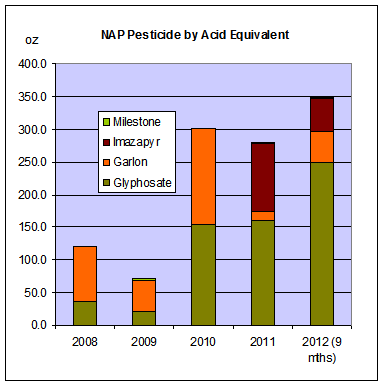
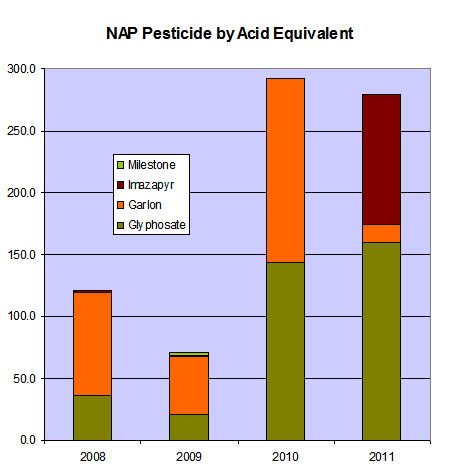
4.  Pesticide Use by “Acid Equivalent”

This is a bit technical, but as long as we’re talking of “active ingredients” this is a more accurate way of calculating it.  Here’s the explanation.

Let’s consider Roundup (or Aquamaster), where the active ingredient is “glyphosate.”

Various versions of Roundup use different glyphosate compounds (like the ammonium salt or the iso-propylamine salt we mentioned above). These molecules are different in size. A heavy molecule has proportionately less actual “glyphosate” than a smaller molecule because the glyphosate part is the same, only the back end, the “salt” is different. So an ounce of iso-propylamine salt would have less glyphosate than an ounce of ammonium salt.

It’s the glyphosate that is the herbicide.

So what acid equivalent does is measure only the glyphosate part of it. It omits the varying “salt” end of the molecule. (It’s the same for other pesticides like imazapyr or Garlon.)

THE BOTTOM LINE

What difference does it make?

In order to compare these various ways of measuring pesticide use, we looked at how they’ve changed from 2008, the first year for which we have NAP’s pesticide data. (Since they’re all different units, we used Index numbers. We took 2008 levels to equal 100, and compared them to that. So an index of 200 would mean it doubled compared to the 2008 level.)

Index numbers: Year 2008 = 100

  • In 2009, pesticide usage actually went down on all measures. (Kudos, NAP!)
  • In 2010 though, it more than doubled on all measures.
  • In 2011, it remained over double the 2008 levels, but it decreased slightly from 2010 on the “Active Ingredient” and “Acid Equivalent” calculations. It is this small decrease that SF DOE considered.

SF DEPARTMENT OF THE ENVIRONMENT

We’re generally fans of SF DOE. As we said in another post, “We’re aware of San Francisco’s Department of the Environment as the first line of defense against toxic chemicals in our public lands. But they’re more than the defense-against-the-dark-chems guys. They’re the recycling guys. The energy saving guys. The community gardens and Green Businesses guys.”

They run our city’s Integrated Pest Management (IPM) system. In the last year or so, they’ve encouraged a number of helpful changes:

  • Better signage, so people can actually see where pesticides are being used;
  • A decision to avoid spraying pesticides for 15 feet on either side of a trail; and
  • A drop in Garlon, one of the most toxic chemicals NAP was using. (Unfortunately, this leaves the NAP using large quantities of Imazapyr, a newer pesticide which doesn’t bio-degrade quickly, breaks down to form a neuro-toxin, and may be bad for butterflies.)

The SF RPD is  reducing the amount of pesticides used on golf courses (except, we understand, for Harding which apparently has some kind of agreement that requires pesticide use to keep it tournament-ready). In Sharp Park golf course in Pacifica, no pesticides have been used since August 2010, to the best of our knowledge.

SO WHY TOXIC PESTICIDES IN “NATURAL AREAS”?

We’ve called for no Tier II (hazardous) or Tier I (most hazardous) pesticides in Natural Areas.

NAP justifies pesticide use in the name of “bio-diversity” – but there’s no indication that the activities of the NAP actually increase bio-diversity at all. Instead, they destroy naturalized vegetation that insects, birds and animals actually use as habitat.  They have targeted, to our knowledge, over two dozen different species of plants. Thus far.

We understand that the SF DOE does not control the NAP’s pesticide use. We asked, at a SF DOE meeting, what happens if a department violated the IPM. The answer was “They’d be embarrassed.” Assuming a lack of embarrassment, it doesn’t appear there are any sanctions. (If we’re wrong, we hope someone will correct us.)

Most people expect Natural Areas to be natural. They don’t expect massive landscaping efforts including the felling of thousands of trees, or the frequent use of toxic pesticides. 
It appears that the only way to stop NAP from using Tier II (Hazardous) and Tier I (Most Hazardous) pesticides is if San Francisco’s citizens demand it.

Posted in Herbicides, Natural areas Program | Tagged , , , , , , , | 7 Comments

Pesticides in San Francisco’s Natural Areas: Rising Volumes

Some months ago, we had written about San Francisco’s Natural Areas Program and its escalating pesticide use. The graph below shows the number of applications of pesticides in the years from 2008-2011.

The San Francisco Forest Alliance, an organization dedicated to preserving public parks for the public, has used this graph in its presentations. Recently, we were told, there’s been a rebuttal:  Claims that while the number of applications might be rising, the amount of pesticide used has may have fallen. (We’ve been told that this claim has been made both by SF Recreations and Parks Dept people, and by San Francisco Dept of Environment staff.)

This defense presumes that the absolute amount matters more than how many areas are affected. Since some of these pesticides are possible endocrine disruptors, they may have adverse effects at very low doses.

[Here’s our article, Why Low Dose Pesticides are Still Hazards.]

But there’s a more important issue with saying that NAP used smaller amounts of pesticides even though numbers of applications rose.

It’s not true.

NAP’s PESTICIDE VOLUMES ROSE EVEN MORE

According to the city’s own records that we received under the Sunshine Act, the volume of pesticides used not only didn’t decrease, they actually went up more than the number of applications.

  • Between 2010 and 2011 the number of applications went up 21%. The volume of pesticide (in fluid ounces) used went up by 25%.
  • Between 2009 and 2010, the number of applications went up 184%. The volume of pesticide used went up by 365%.

WITH TECHNICAL ADJUSTMENTS

Roundup and Aquamaster are glyphosate pesticides, but have different amounts of glyphosate. Technically, the “Roundup/Aquamaster” numbers have to be adjusted for the differing glyphosate content. So we used the “Acid Equivalent” to convert all the number to Aquamaster-equivalent and adjusted the volume numbers.

So, did it make a difference? Not much.

[Edited to Add (July 10, 2012): We did a more detailed study to compare various measures of NAP pesticide use. You can find that HERE.]

  • Between 2010 and 2011 the number of applications went up 21%. The adjusted volume of pesticide used went up 52%.
  • Between 2009 and 2010, the number of applications went up 184%. The adjusted volume of pesticide used went up 264%.

THE BOTTOM LINE

  • Pesticide use did not decrease.
  • Amounts of pesticide used went up even more than the number of applications.
Posted in Herbicides, Natural areas Program | Tagged , , , , , , , | 4 Comments

Sutro Forest: A Tale of Two Riders

We’ve written about bike riders on the mountain before, and our experience has been pleasant. The riders have been careful and polite. [Read: Courtesy on the Mountain]

Others have told us about cyclists zipping down trails and getting in the way of joggers and hikers. We’d never encountered one.

Until today.

We were checking out the Non-EIR trail, the new trail from the South Ridge to the Nike Rd that seems to have been built without the EIR being certified. Suddenly, a voice behind called something. It may have been “Coming through” or words to that effect. I moved, and called a warning to my companion, who moved out just in time.  “I’m coming back the same way,” called the rider as he passed.

And he did, mere minutes later, at speed. My companion dodged him again.

“I said I was coming back this way! Maybe you didn’t hear me.”

Huh what? Did he expect we’d stand by the side of the trail until he returned? “Bicycles are supposed to yield to pedestrians,” we said.

The man bridled. “We built this trail!” he said, sounding entitled. “The mountain bikers did most of the work.” (The Sutro Stewards draw a lot of their volunteers from the SF Urban Riders.) “The person going downhill is supposed to yield to uphill traffic,” the rider added. “Of course I go uphill really fast.” And in both directions, apparently, because he hadn’t yielded coming or going. “Besides, I haven’t ever hit anyone.”

“Good, keep it that way,” we suggested, thinking of three Bay Area rider-caused deaths in the last twelve months.

Next to the small oak tree in the center of the garden, a huge new notice board has various postings from the Sutro Stewards: a map, a set of rules (including “Cyclists yield to all other users“) and a schedule for volunteers.

(Could we use this notice board to communicate with visitors to the forest? Unlikely. Access to the Notice Board is controlled by UCSF’s Community and Government Relations Group.)

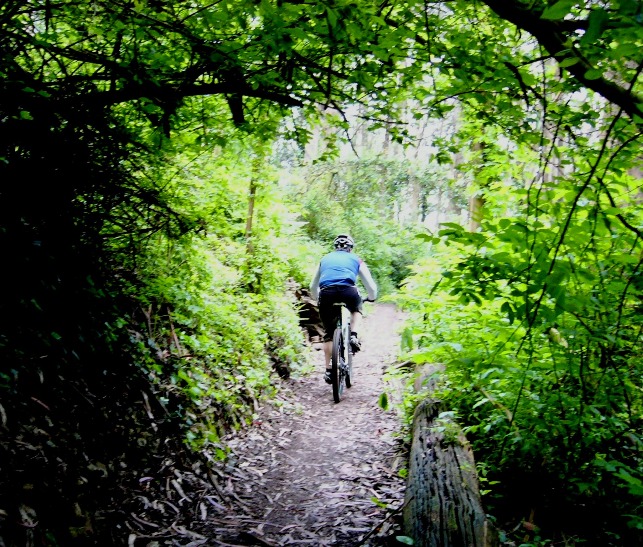
Later, as we continued our hike through the forest, another rider came along.  We moved out of the way. (As we usually do. We understand momentum.) He politely thanked us as he rode by carefully. “That’s more like it,” said my companion.

That’s more the norm, too, thankfully. As if to prove the point, another couple of riders came by, and would have stopped for us if we hadn’t stopped for them first. They thanked us too. (It seemed like Bike Day in the Woods, this evening; we saw quite a number of riders.)

FOREST REPORT

The forest trails are dry right now, especially where the understory has been removed or thinned – which is in a lot of places. Just above the Aldea campus, the Stewards are realigning the trail. It’s not clear why exactly it needed it, but the area is stripped and dusty.
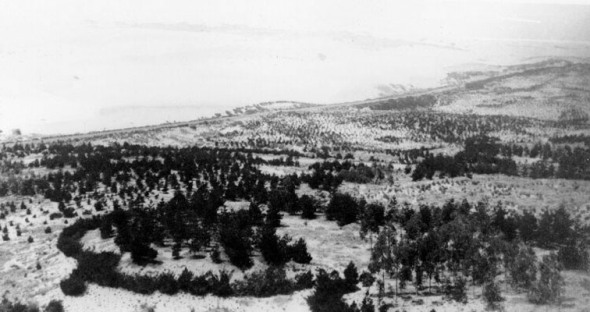
(We’re thankful we got to see the forest as it was back in 2009, mysterious, dense, and criss-crossed with narrow trails. It’s lovely now, but then it was transcendent. And though there were riders, the narrow trails made everyone more careful.)

We were amused by the first graffiti we’ve seen (except tags on a sign). This was a biological an anatomical illustration on a cut log on the South Ridge.

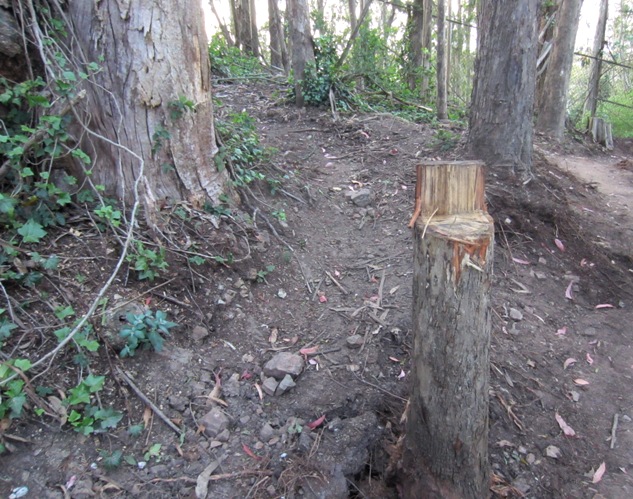
On the Nike Road, up toward the native garden, some trees have been cut down. The stumps are still raw.

Much of the Native Garden is really dry and my companion was not favorably impressed. “This looks like garbage!” he commented. The newly-planted meadow is covered in long brown grass and small plastic flags, with some poppies in between. The Sutro Stewards replanted this last year with a $6,000 grant.

But at least the shrubbery areas are green. The golden lupine is blooming, and some of the shrubs are now quite tall.

“This is much better,” he said. It did indeed look garden-like, a great improvement over the scraggy grass.

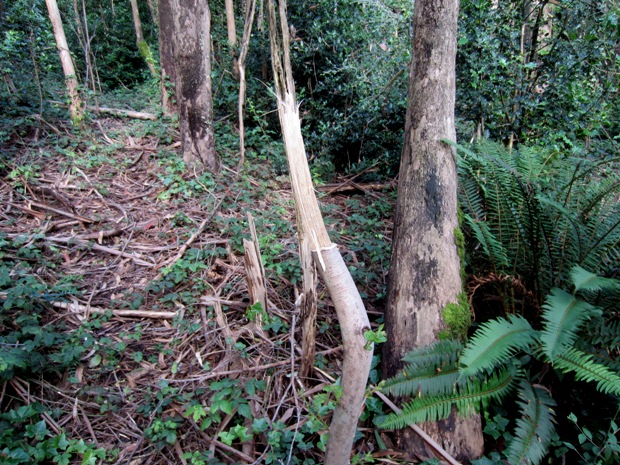
On the other side of the garden, we saw two suspiciously dead eucalyptus trees on the slope below. Wonder what killed them? [Edited to Add: Someone who climbed down and got a closer look thought they had been girdled. There were also a number of tree stumps in the vicinity.]

We went down to the Aldea Campus and the Fairy Gates Trail.

It’s full of nasturtiums, and they’re brilliant. We ended our walk amid flowers so bright that they seemed almost to be glowing from within in the evening light.

Posted in Mount Sutro Stewards, Mt Sutro Cloud Forest | Tagged , , , , , , | 6 Comments

UCSF Postpones Tree-felling Another Year

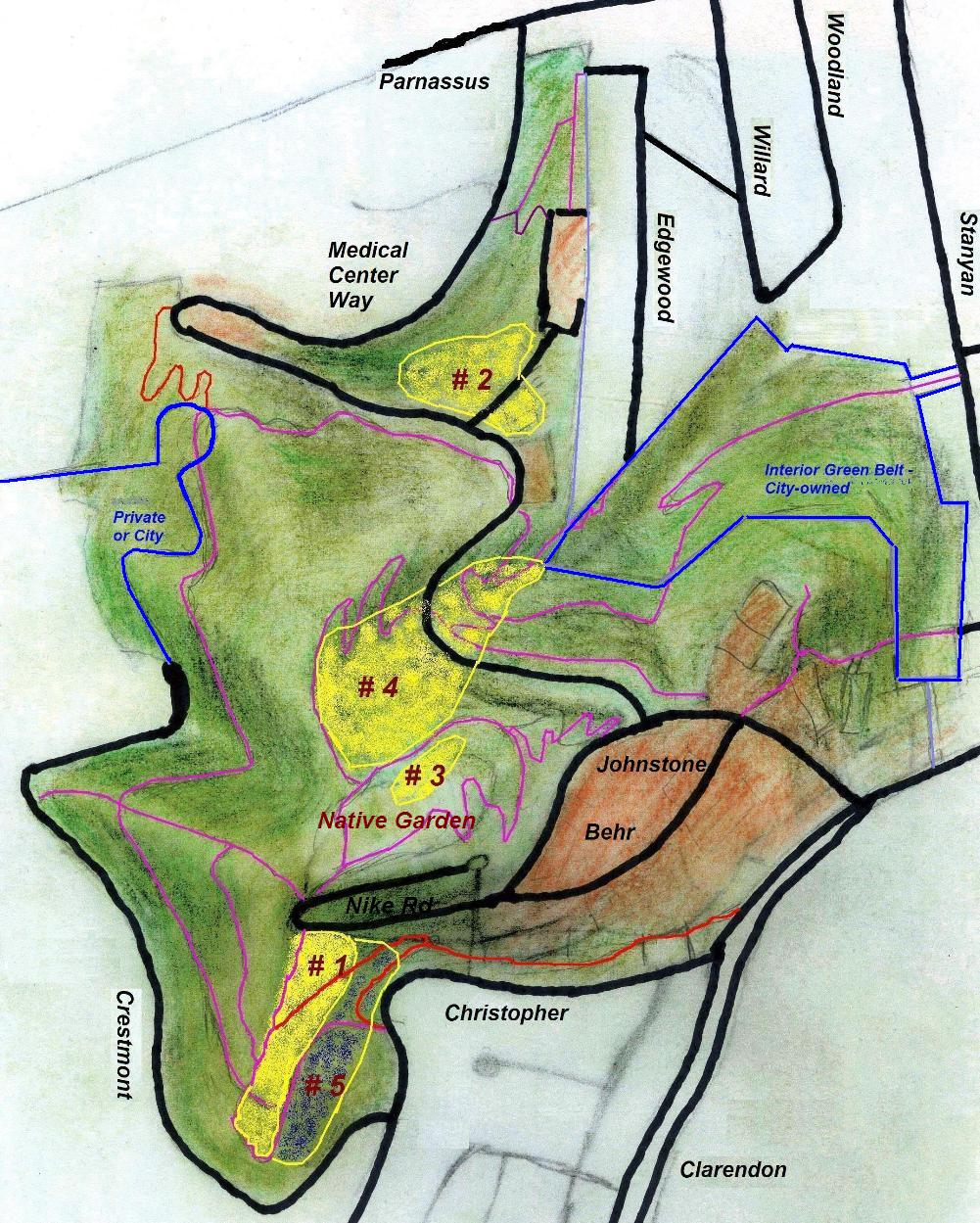
At a public meeting of the Community Advisory Group on 4 June 2012,  UCSF’s Barbara Bagot-Lopez announced that the project to fell trees on four “demonstration”plots would be postponed, probably to the Fall of 2013. (Those are the yellow areas on the map here; you can click on the map for a larger version.)  Before, it was scheduled for Fall of 2012, which had been pushed back from 2011 and earlier, 2009.

(A summary of the proposed project is here.)

An Environmental Impact Study is under way. Because of the number of issues raised at the scoping meetings last year, more time will be needed to investigate them.

The Draft Environmental Impact Report is therefore unlikely to come out before August 2012. After that, the public will have 45 days to comment, and then UCSF will need to respond to the comments. Only then can the final Environmental Impact Report be published, and it will be sent up to the UC Regents for certification. This could take to the end of 2012.

WHY IN THE FALL?

UCSF is careful about the timing of these projects, which would have a major impact on the forest and surrounding areas. They cannot be done in winter wet season, November through April; and they will avoid the bird breeding season from March to July. (The forest is also very wet through the summer, since it is effectively a cloud forest drawing moisture from the summer marine layer.)

Thus, the only feasible time to start is in the Fall. So it would seem the project is likely to be shifted to Fall 2013.

WIND STUDIES

Right now, a wind study is in progress on the mountain, with anemometers in various locations. We are pleased UCSF is doing this study, especially since it had initially decided not to examine the effects of wind.

(See related article: What UCSF’s Environmental Impact Report will Evaluate – and What it Won’t )

But we would like to note that this area gets the most wind and storms during the winter rainy season. We think those wind studies would be critical, especially in evaluating wind-throw (i.e., trees being knocked down by the wind) and the impact on surrounding neighborhoods. We have suggested this to UCSF.

LONG RANGE PLAN FOR UCSF

UCSF has kicked off its discussions for its Long Range Development Plan (LRDP) which will cover the period 2015-2030. This includes all its campuses: Parnassus, Mount Zion, and Mission Bay, as well as smaller areas like Laurel Heights and Bayview/ Hunters  Point.

No specific plans were discussed for Sutro Forest at this meeting. The main issues centered around the Space Ceiling, a 1976 restriction on UCSF expanding beyond a certain square footage on the Parnassus campus. It was imposed as a result of  a huge battle between the neighbors and UCSF, which had major expansion plans that would have impacted the whole neighborhood. But in fact, UCSF has exceeded this ceiling for years. When the new Stem Cell Research Building was erected, UCSF was going to tear down seismically unsafe UC Hall to compensate; but current plans are to renovate and repurpose the building.

Moffit Hospital will need to be replaced; and some smaller buildings torn down (including a couple in the forest, in the Woods parking lot and the Surge parking lot).

THE “COMMUNITY” ACTION GROUP

In making the LRDP, UCSF has sought input from its Community Advisory Group (CAG), which consists of appointees by the Chancellor. This splits separately into informal “Action Teams” for each area, comprising people from the CAG who live around each area.  For Parnassus, the members appear to include Craig Dawson, Kevin Hart, Dennis Antenore, Beatrice Laws, Susan Maerki, and Dave Parrish. (If there are others, it wasn’t clear who since UCSF did not have the names available. Should we get updates, we will edit them in.

Edited To Add: We found a list online; if it is current, these are the Parnassus members. )

The Parnassus CAG team clearly cannot represent our views regarding the forest. At least four of the six (excluding Susan Maerki and possibly Kevin Hart) have spoken strongly in favor of the UCSF plan for the destruction of thousands of trees on Mount Sutro; and moreover, Craig Dawson is the Executive Director of the Sutro Stewards that “work closely with the UCSF Facilities Management department” and have advocated for the plan. Dave Parrish is a member of the same organization.

However, on the simplest criterion we do seem to have agreement: To preserve the Open Space Reserve in which Mount Sutro Cloud Forest exists.

(Apparently, there was some consideration, at one time, of building within it.)

Posted in Meetings, Mount Sutro Stewards, UCSF | Tagged , , , , , , , | Comments Off on UCSF Postpones Tree-felling Another Year

Trees and Income Inequality

Many of us intuitively associate trees and “nice” areas. Realtors know this; if a house for sale is on a tree-lined street, the ad always says so.

In 2008,  researchers looking into the question found that the demand for trees rises with income level. From the abstract:

This study investigates the impact of selected potential factors on the demand for urban forests at the city level…The empirical findings suggest that the demand for urban forests is elastic with respect to price and highly responsive to changes in income. Urban forest area increases as total population grows but at a lower rate than population growth. (Demand for urban forests in United States cities: Pengyu Zhu, University of Southern California and Yaoqi Zhang, Auburn University)

“URBAN TREES REVEAL INCOME INEQUALITY”

Then in May 2012, blogger Tim de Chant wrote about the study: “Wealthy cities seem to have it all. Expansive, well-manicured parks. Fine dining. Renowned orchestras and theaters. More trees. Wait, trees? I’m afraid so.” He went on to analyze the paper – “…for every 1 percent increase in per capita income, demand for forest cover increased by 1.76 percent. But when income dropped by the same amount, demand decreased by 1.26 percent. That’s a pretty tight correlation.

It’s a pattern, the paper’s authors say, that’s typical of luxury goods. Which would be fine if all that trees did was look pretty.  As Mr de Chant points out, trees benefit cities: temperature control, reducing particulate pollution, reducing stress, and even fighting crime. [For this last, he cites a recent article in the SF Chron: “Geoffrey Donovan Researches Trees and Crime.”]

“New York City is aiming to double the number of trees it has to 1 million. Chicago has planted over 600,000 in the last twenty years. And London has been working to get 20,000 new trees in the ground before it hosts the Olympics.

But while large and wealthy cities have recognized this, he points out, poorer cities are much less likely to be planting trees, mainly because of funding issues.

“INCOME INEQUALITY CAN BE SEEN FROM SPACE”

Mr de Chant’s blog-post was picked up by Boing Boing, a popular site that links to quirky and interesting items on the Internet. Its article was headed: Income inequality can be seen from space. “How? It’s surprisingly simple. Turns out, demand for trees in neighborhoods behaves a lot like a luxury item, as opposed to a basic necessity.” It introduced the blog-post, then said, “Then, he went out and found examples, using images from Google Earth.

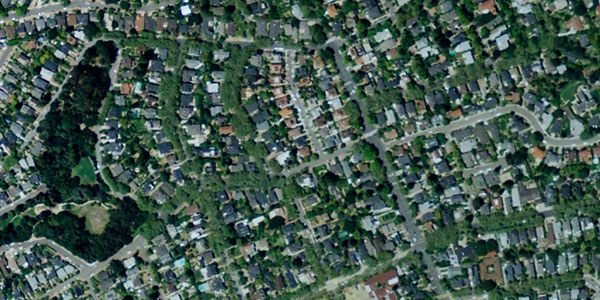
That was in another blog-post on the subject: Income Inequality As Seen From Space. He shows pairs of Google Earth maps of neighborhoods in cities across the world; the poor neighborhoods are relatively tree-less, the wealthier ones are green.

This is one pair of many pictures on his blog-post. It clearly indicates the difference between West Oakland (above) and Piedmont (below).

In case any of our readers are interested in studying this further: On his blog, he requests readers to send him more such picture-pairs.

WHAT ABOUT SAN FRANCISCO?

The story in San Francisco seems to be more mixed. Fortunately, trees aren’t confined only to up-market neighborhoods like Forest Hills and Cole Valley and Sea Cliff. People are increasingly aware of the benefits of the urban forest: (This article lists nine of them.)

Still, it’s difficult. The two organizations planting trees, the City and the non-profit Friends of the Urban Forest, are playing catch-up. Pitch pine canker has affected many of the city’s Monterey Pines, which together with eucalyptus, provide a significant proportion of the urban forest canopy. More trees are destroyed each year, and of course the trees removed are the mature older trees – which provide the most benefits to health, value, and ecology – while the trees planted are saplings.

It’s not helped by plans to gut two of the most important urban forests in the city, both over 100 years old:

A 2007 USDA report, San Francisco’s Urban Forest,  estimated the tree population then at 669,000 trees, with a canopy coverage of under 12% of the city’s area.  Cutting down thousands of trees will have a significant impact on a city-wide scale.

Posted in deforestation, Environment, Mt Sutro Cloud Forest, Natural areas Program, UCSF | Tagged , , | Comments Off on Trees and Income Inequality

The Forest in May

Spring in the Sutro Forest is lovely.

Where the canopy is largely unbroken, the sunlight streams through the trees with the filtered light particular to forests. Last week,  flowers bloomed in the lower reaches of the mountain: the pinkish-purple Robert Geranium, some tiny fairy bells (Disporum smithi) hidden under their leaves; some fringe-cups; some brilliant nasturtiums peeking out; yellow-orange abutilons. The trails were dry then, though a couple of foggy nights since may have damped them down again.

We started our walk in the forest from Stanyan and 17th, the “Kill-Trees Trail.”  It’s a good trail; it provides easier access to the forest from its east side – where street parking is available. And it’s a beautiful part of this woodland.

But while the trail-building elsewhere in the forest required no tree-felling, here 50 large trees have been cut down. (Click on the picture below for a larger version; the white numbers are trees that have been cut down. Several more have been cut since.)

It’s changed the character of the forest. Houses are visible through the trees, and several huge old trees that once guarded the trail entrance are gone, and with them, the sudden magical transition from city to forest. Now it’s more gradual, with a view of houses across in Edgewood and Woodland Avenues, and into the nursery that’s been there for a couple of generations and was resplendent with Pride of Madeira. “They look Jurassic,” someone commented.

The canopy has been opened up, which has encouraged some flowering plants, particularly the Robert geranium, but also fringecups, elk clover – and poison oak.

The undergrowth has recovered from the weed-whacking it endured soon after the trail-building. The blackberry thickets have recovered; for some months, this area had been carpeted only with a shallow layer of Cape Ivy. There’s still ivy,  climbing the columns of the trees and providing crucial habitat for the birds.

The best news is, the birds are back. For about a year, the forest has been uncharacteristically quiet; possibly a combination of the frequent disturbance and the understory destruction discouraged them. But last week, the forest was again bright with bird-sound.

Posted in Mt Sutro Cloud Forest | Tagged , , , | 2 Comments

A Bobcat in Sutro Forest?

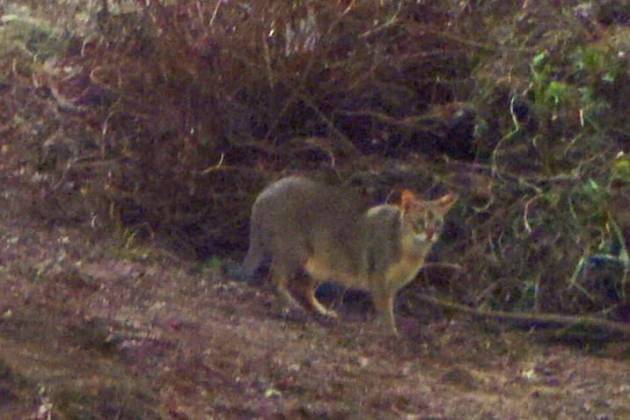
We saw a bobcat today in Mt. Sutro by the Aldea Center,” commented reader RM on  MntSutro.com on 10 May 2012. We were fascinated.

[Edited to replace the public domain picture with one the reader sent us – taken in low-light conditions.]

[ETA: A naturalist who studied the picture thinks it’s probably a very large feral cat, because a bobcat would have a black tip to its tail and ears, and likely have visible ear-tufts.]

(This picture is a public domain photograph, not the actual bobcat the reader mentioned.)

Bobcats aren’t uncommon in wilderness areas around the Bay, and Tom Stienstra, one of our favorite journalists, wrote about them in the SF Chronicle’s blog recently. (Click HERE and HERE for links to his stories and pictures.) Someone told us they’d been sighted in Sharp Park in Pacifica.  But this was the first we’d heard of one in San Francisco.

Sutro Forest is amazing. Great horned owls. Coyotes. Forty kinds of birds. We are so fortunate to have this little piece of naturalized forest in the heart of San Francisco, and the wildlife habitat it provides. UCSF, please preserve this magical place.

[ETA2: Someone else said they’d seen a wildcat on Mt Davidson, which is not far from Mt Sutro. And the photo somewhat resembles this cat picture, taken on the Marin Headlands:

http://www.wildlifist.com/wp-content/uploads/2012/05/DSC7128_800w-copy.jpg ]

Posted in Environment, Mt Sutro Cloud Forest, UCSF | Tagged , , , | Comments Off on A Bobcat in Sutro Forest?

San Francisco’s Natural Areas Program Ignores Breeding Birds

We’d written earlier about chainsaws in Glen Canyon Park, even though spring is the breeding season for birds and animals, a time when trees and thickets should be left undisturbed.

[Click HERE to read that article, Chainsaws in the Nesting Season.]

We could understand if it were commercial builders on a tight time-line and budget that didn’t care about things like that. But this is the San Francisco’s Natural Areas Program – the NAP.  Despite protests from the San Francisco Forest Alliance (SFFA), they haven’t stopped.

Recently, the SFFA website carried a story with photographic evidence that Bewick’s wrens were nesting in Glen Canyon Park. This is unusual; they are known to nest in very few places inside the city.

(Go HERE to read the story and see more pictures of the bird.)

Did it give the NAP pause? Not to our knowledge. They’re still active there with pesticides and… tree trimming.

A great horned owl has been nesting in Glen Canyon for many years, and has chicks again this year.

Someone described it as “our celebrity owl” because the location of the nest is an open secret, and several wildlife photographers have documented the youngsters. One would think that the NAP would be particularly careful of a known nest, with known chicks in it.  (There’s also a nest of red-tailed hawks nearby.)

But no.  Here’s what another article in the SFForest.net website said:

“Yesterday, April 27th, there were at least five trucks with tree-cutting equipment in that park. There was also a sign: “tree work”.  Visitors to the park at first were deceptively relieved when they heard that trees were simply going to be trimmed — they were not going to actually be cut down. But few had thought the issue through: This is nesting season. Everyone who knows anything about wildlife knows that you don’t interfere with habitat when animals are raising their young.

“We don’t know how many birds were displaced, nor how many nests were destroyed. We do know that lopping off limbs occurred within less than 100 feet of our owl family — there was tremendous noise, and tremendous activity. The owl triplets nesting in the crook of a Eucalyptus tree have not fledged — they cannot fly yet.

“And the Red Tail Hawks, though further away, are still sitting on their eggs. Countless songbirds live in these trees. Nesting season is in full swing.

This activity should be protested to your Supervisors, the Parks Commissioners and to the Recreation and Parks Department.”

Please protest. The SFForest website has a “Political Action” tab with relevant addresses and emails.

[Click HERE to go to relevant address and email addresses for Supervisors, the Parks Commissioners, and the Recreation and Parks Department.]

Posted in Environment, eucalyptus, Natural areas Program | Tagged , , , , | Comments Off on San Francisco’s Natural Areas Program Ignores Breeding Birds

Glen Canyon Park: Chainsaws in the Nesting Season

photo credit: 123rf.com

The nesting season for birds is in full swing.

San Francisco’s mild winter and recent rains have provided a window for building and breeding, and they’ve grabbed it. The birding reports are full of lovely stories, from humming-birds to Great Horned Owls to sparrows. It’s the denning season for coyotes, too. Spring’s come for San Francisco’s wildlife.

So we were really dismayed to read about more habitat destruction in Glen Canyon Park, which is wonderful for wildlife. It has trees, dense thickets, and a stream running through it. Except now there are people with chainsaws out in the dense thickets. If there are birds’ nests in there, as there probably are, it will be impossible to avoid disturbing them or even destroying them. Certainly, the activity is going to disrupt all normal wildlife activity beside ripping out the habitat the birds and animals use.

Here’s a note we got yesterday:

This morning the Shelterbelt crew was out there in Glen Canyon clearing way back into the densest part of the forest along the creek — a thicket area no one has ventured in for years. They obviously are not just taking out cape ivy — this is why I haven’t been seeing much wildlife lately.

One would think the Natural Areas Program would respect the cycles of Nature for wildlife in our city.

One would think wrong.

[Edited to Add: We’d like to note that UCSF does not generally approve habitat destruction during the bird-nesting season in Sutro Forest. In fact, their plans specifically take that into account. Thanks, UCSF.]

Posted in Environment, nativism, Natural areas Program | Tagged , , , , | 5 Comments

Why Low Dose Pesticides are Still Hazards

When we speak up against the Natural Area Program’s frequent pesticide use, its supporters frequently tell us that – compared with say commercial agriculture – the Natural Areas Program (NAP) uses  small amounts of toxic chemicals. “The dose makes the poison,” they argue.

But it’s not true.

For now, we’ll leave aside the question of whether it’s reasonable to compare NAP to commercial agriculture (where fears of chemicals are driving a growing Organic movement). What we’d like to talk about today is recent research about pesticides, specifically, endocrine disruptors. Here’s a quote from the abstract of a study by a group of scientists:

“For decades, studies of endocrine-disrupting chemicals (EDCs) have challenged traditional concepts in toxicology, in particular the dogma of “the dose makes the poison,” because EDCs can have effects at low doses that are not predicted by effects at higher doses….

“…Whether low doses of EDCs influence certain human disorders is no longer conjecture, because epidemiological studies show that environmental exposures to EDCs are associated with human diseases and disabilities. We conclude that when nonmonotonic dose-response curves occur, the effects of low doses cannot be predicted by the effects observed at high doses.”

[Ref: Hormones and Endocrine-Disrupting Chemicals: Low-Dose Effects and Nonmonotonic Dose Responses, Vandeberg et al, in Endocrine Reviews, March 2012]

WHY WE’RE CONCERNED

The NAP uses several pesticides rated as “Hazardous” or  “Most Hazardous” by San Francisco’s Department of the Environment. But the one they’ve favored is glyphosate — better known as Roundup or Aquamaster.

It’s strongly suspected of being an endocrine disruptor.

Here’s a 2009 study: Glyphosate-based herbicides are toxic and endocrine disruptors in human cell lines.

Another study, also published in 2009, looked at puberty and testosterone: Prepubertal exposure to commercial formulation of the herbicide glyphosate alters testosterone levels and testicular morphology.  The abstract of the study ends with this sentence, “These results suggest that commercial formulation of glyphosate is a potent endocrine disruptor in vivo, causing disturbances in the reproductive development of rats when the exposure was performed during the puberty period.”

And here’s a study published in 2007,  reflecting the research of a group of scientists from Texas A&M: Alteration of estrogen-regulated gene expression in human cells induced by the agricultural and horticultural herbicide glyphosate

THE NATURAL AREAS PROGRAM DEFENDS PESTICIDE USE

Most people weren’t aware that pesticides were being used in so-called “Natural Areas.” The notices were small and well below eye-level. You had to be looking for them, which isn’t likely for most people out hiking or jogging by, or keeping an eye on small kids. In recent months, the labeling has improved, with taller posts and clearer information.

Now that people are beginning to notice, they’re also objecting. The response we hear most often is “Why would they use herbicides in a natural area?”

So the NAP has started posting explanations, justifying its use of toxic herbicides justifiable against “invasive plants.”

These are plants, they say, are “a handful of non-native species” that are “displacing the rich biodiversity of native flora and degrading our natural heritage.”

WHY WE DISAGREE

We have several problems with this statement.

  • If it’s a “handful,” the NAP must have very big hands. From the pesticide application records, we’ve counted nearly twenty-five different plant species under attack by chemicals — including a couple that aren’t actually non-native.
  • There’s no evidence that all these plants are invasive and that they’re “displacing the rich biodiversity.” Native plants and non-native plants thrive together in natural mixed ecosystems. NAP can never eliminate all the non-native plants; the best it can achieve is a different mix, precariously maintained through intensive gardening.
  • There’s also no evidence it’s working. Using chemicals to kills things is cheap and easy, but it leaves a gap where something else will grow. Given that San Francisco’s environment has changed greatly since the 1776 cut-off used to define “native” plants, it’s not going to be those plants. Rather, what will naturally grow back will be the most invasive plant at the site. An excuse for more herbicides.
  • The NAP is destroying habitat in its quest to kill native plants. Many of the plants destroyed are bushes that provide cover and nesting places, or flowering plants that offer nectar to butterflies, bees and other pollinators and the birds and animals that feed on them. The “native flora” don’t necessarily provide much of either, even if they can be successfully gardened.
Posted in Herbicides, Natural areas Program | Tagged , , , , , | 1 Comment

What Adolph Sutro Didn’t Know About the Eucalyptus Forest

Mount Sutro Cloud Forest, a century-old forest of eucalyptus, was planted by former mayor and philanthropist Adolph Sutro (1830-1898). Like the larger and better-known Muir Woods, it’s the last remnant of a forest that covered a much larger area – at one time, 1100 acres (and included Mt Davidson, the other significant remnant). What he intended is just what Sutro Forest is now:

“…people… will wander through the majestic groves rising from the trees we are now planting, reverencing the memory of those whose foresight clothed the earth with emerald robes and made nature beautiful to look upon.”

Mt Sutro at sunrise by Lori DAmbrosio

(Click HERE for more about the history of the forest.)

Sutro died before the turn of the twentieth century, and so there was much he could not know about the forest he planted.

1)  The automobile.  How could he have guessed that the automobile, so new in his time, would eventually be ubiquitous? San Francisco got its first horseless carriage in 1896, only two years before he died. By 1902, according the the CA DMV’s website, there were 117 motor vehicles in the city. At the time, gas stations didn’t exist, and motorists bought their fuel at hardware stores. Cars were less for transport than for adventure.

Some of the trees are 200 feet tall...

Today, there are perhaps 500,000 cars registered here. Not knowing about horseless carriages, he probably wouldn’t have known about carbon emissions, or pollution, either. Nor would he have known that trees sequester carbon in proportion to their dry weight; so tall dense fast-growing species like eucalyptus would do so particularly well.

(CLICK HERE for a link to a video by the Nature Conservancy that explains how to calculate carbon sequestration by trees.)

Adolph Sutro had no idea that global warming was going to be a problem, or that his afforestation project was already fighting it.

2)  Population and pollution. In 1900, two years after Sutro’s death, San Francisco had a population of 343 thousand. Here, he might have had a suspicion about its growth; in the ten years from 1890, it had grown by 44,000. Still, he’d probably be surprised by the population of 805 thousand. And he’d have been astounded at the growth in the surrounding cities. Back in 1898, the main pollution issue would have been horse-manure. Horses drop 20-30 lbs of dung per day. If he worried about airborne pollution, it would mainly have been windblown sand.

So he probably didn’t think about the ability of his planted forest to clean the air by trapping particulate pollution on its leaves, where they remain until they are washed to the ground – and out of the air we breathe.

3)  Noise. Maybe Sutro knew about noise. There’s no evidence that San Francisco would have been a quiet place, back then, with the clatter of carriage wheels on the newly cobbled streets, the shouts of people, the sound of street cars. But the rural lands he forested were far from downtown San Francisco in those days, and far from the noise; they were surrounded by farms and ranches. Maybe he anticipated that the city would gradually grow outward. After all, it was he who donated a piece of land on the hill he called Parnassus (and now we call Mount Sutro) to the Affiliated Colleges (now University of California, San Francisco), where his daughter Emma studied to be one of the first women doctors. Did he know that the leafy trees would absorb the sounds of the city, making it more peaceful for everyone?

View from Golden Gate Park, 1880

He surely knew they would be a windbreak; eucalyptus was deliberately being planted all over California for just that reason. In fact, Golden Gate Park reportedly started with the planting of a windbreak of trees on the western edge so that the park could be established.

[For nine benefits of our urban forest – with data – click HERE.]

4)  Anti-eucalyptus propaganda. The final thing he couldn’t have known and would probably have found difficult to understand: that a century after his death, there would be people who despised the non-native tree and want to remove it. That the anti-eucalyptus sentiment would develop into a lot of myths that would be used to justify destroying it.

(Click HERE to go to a page on Eucalyptus Myths.)

Or maybe he would understand. Adolph Sutro was Jewish, and from Germany. Living in the 19th century, it’s very likely he did encounter biases. Perhaps as a transplant who thrived in open-minded California, he expected the trees would do the same.

Posted in deforestation, Environment, eucalyptus, Mt Sutro Cloud Forest, nativism | Tagged , , , , , , , , | Comments Off on What Adolph Sutro Didn’t Know About the Eucalyptus Forest

The Murdered Tree on Mt Davidson

[Edited to Add:  This tree finally went down on April 8 or 9, 2013, following strong winds in the Bay Area.]

It’s visible for miles around, the dramatic dead tree high on the brow of Mt Davidson. That’s the Murdered Tree.

Only ten years ago, it was green and flourishing, a soft counterpoint to the splendid view of downtown San Francisco.

“We used to bring a rope swing up here and tie it to that branch,” someone told us, “Our son loved it.”

Well, someone didn’t love it. The tree didn’t die naturally, we learned on a tour with local historian Jacquie Proctor. It was girdled.

WHAT’S GIRDLING?

Though we’d heard of girdling, it’s only in the last two or three years that we’ve understood it’s being used as a deliberate technique to kill trees in San Francisco’s native areas. Before, we heard mostly of deer killing young trees in snowy winters, chewing tender bark when they run out of browse and girdling the trees in the process.

Never had we heard of anyone deliberately doing it to a tree.

So what is girdling, exactly?

If the bark of a tree is removed in a ring around the tree, it starves to death. This is because the living part of the tree is the area just under the bark. That’s what carries nutrients from the roots to the top of the tree. (The heart of the tree isn’t alive, which is why a tree can be hollow but still healthy.)

Supporters of Native Plants were deliberately killing trees in this way. The two beautiful trees above, at Bayview, are clearly girdled.

On Mount Davidson, the girdling was done more discreetly, just above the ground, with the wound hidden by undergrowth unless you actually looked for it.

THE BONEYARD

Also on Mount Davidson is an area called The Boneyard, where tall eucalyptus trees lie dead and their stumps are bleached and gray by the trail. One stump has a nail driven in, possibly used to poison the tree.

The Natural Areas Program plans to fell 1600 trees on Mount Davidson. Of course, more will be lost as the wind pushes down trees that are not wind-hardened. And any tree under 15 feet is considered fair game for tree-killers; those don’t count as trees.

There’s a new organization we’ve written about before, the San Francisco Forest Alliance, that is trying to combat this. Their website is at SFForest.net – or click on the button below to go there. Please sign the petition there if you haven’t already.

Posted in Environment, eucalyptus, nativism, Natural areas Program, Neighborhood impact | Tagged , , | 8 Comments

Mt Sutro Forest – Beautiful Evocation of a Lost Tree

We were sent this clip by videographer and artist Lori Ambrosio, who visited the “Kill-trees Trail” (connecting Stanyan x 17th to Medical Center Way).

We thought it was a lovely bitter-sweet evocation of the trees that were there – only months ago.

Click on the picture to get the video

Clicking on the picture will take you to the video.

Over 50 trees were destroyed along the trail (which is only about 6/10 of a mile). This end of the trail is in the City-owned part of the forest and is part of the Natural Areas Program. Speaking at a meeting last year, Craig Dawson of the Sutro Stewards said that in the UCSF portion of the forest, only one tree was removed while building the trails. This was certainly not the case in the SF RPD land.

We’ll address the details in another post. For now, there’s this.

Posted in Environment, Mount Sutro Stewards, Mt Sutro Cloud Forest, Natural areas Program | Tagged , , , , , , , | 2 Comments

Sutro Forest in February 2012

We were up in Mt Sutro Forest a couple of days ago, the day after Valentine’s Day.

The forest looked appropriately romantic. A number of cherry trees were in bloom with tiny white flowers,  like this one near the entry to the South Ridge Trail on Christopher.

So were the pink-flowering currants in the Native Garden at the summit.

We climbed up the adventurous path to the South Ridge. Just at the top, on the path that bore left, vines formed a gracious green natural archway over the trail.

All the trails in general were a bit muddy, the kind of equal-opportunity mud that occurs after rain.

(The cloud forest mud of summer is different – the paths are wet where the forest canopy is closed, and dry and dusty where it’s opened up. That happens in summer, when the fog comes in.)

If you’re walking in this forest, summer or winter, it’s always good to come prepared for muddy trails. It’s worth it.

A lot of the blackberry has been cut back or removed, and in many places, ivy covered the ground instead. The ubiquitous bird-sound of 2009 and 2010 is a fond memory, replaced by a few calls here and there, and overhead, the call of the crows and ravens. Less habitat, fewer birds.

THE NEW TRAIL

The new non-EIR trail may also be part of the reason. As we noted when we first posted about it, this trail is rather surprising. First, the trails were part of the project as described by UCSF in all the public meetings. So we would have expected that work would start only after approval of the Environmental Impact Report. Second, it goes through the area that was supposed to be untouched as a demonstration of what the forest would look like without intervention (and, hopefully, sound like – since the habitat would have been preserved). This trail, we were told, would not be built until a year after the “demonstration.” Finally, though UCSF generally informed us of other changes to the forest, including tree removals – there was no word of this. We happened upon the trail.

We do not object to trails — within reason. We actually like them. However, too many trails have several negative impacts. They’re like roads. We all need them, but if there are too many, they take away from the ambiance and the habitat. A trail is valuable if it provides access that didn’t exist before. We’re not sure why this one was necessary: It connects two points that were already well connected, merely providing a short-cut.

Many of the trails are too wide. Before, the forest was criss-crossed by narrow trails that provided a sense of adventure and mystery, and the tall bushes and low-hanging branches on each side harbored a lot of bird-life. Now, a lot of that is gone.

We’re glad we got to see the forest as it was before. It’s beautiful now, but the spectacular mysterious isolation that made a visit here like stepping into a different world – not nearly as much.

CHAIN LINK, CONCRETE, AND THE FOREST

Back in 2000, UCSF published clear plans for an old building on the Aldea campus: it would be torn down, and the area would be replanted to merge with the forest. Instead, quite suddenly in May 2010, neighbors were informed that the foundation of the vanished building would be surrounded by a chain-link fence and converted to a native plant nursery. Of course the neighbors were upset, and at a particularly contentious meeting, In June 2010, Vice-Chancellor Barbara French announced she was hitting the “Pause” button. (The whole story is here.)

Well, it’s definitely been Unpaused now. Without any notification to the neighbors, the nursery has been constructed. The Sutro Stewards plan to activate it shortly. UCSF permitted them to continue with their plans without any further discussion, even despite the objections. We received a distraught email from a neighbor who thought she was on the email list for UCSF but had received no information. We hadn’t, either.

THE NATIVE GARDEN

The Native plant garden on the summit of the mountain has greened out. We’re not sure if the grass is native or non-native, but it’s green. There are flowers: pink-flowering currant, and even a few California poppies in the meadow area newly replanted (at a cost of $6,000 granted by the Parks Trust).

Of course, not all of it was pretty. This winter’s rains haven’t been enough to bring some of the plants around. Those looked like this.

ECLECTIC SHRINE

We continued our walk down toward Medical Center Way. On the way, we passed the little cave that started out, two years ago, as Ishi’s shrine. Most recently, it had a wooden elephant and a bright peace sign. The elephant is gone now, replaced by an eclectic collection of symbols – Buddha, Shiva, a Xian warrior replica, a African akua-maa, and several other Polynesian/ native American/ undefined figures. And a mysterious box that we didn’t open. The peace sign is still there.

Posted in Mount Sutro Stewards, Mt Sutro Cloud Forest, UCSF | Tagged , , , | 4 Comments

The $3.4 mn “Park” at Sutro Dunes

We’ve driven by there a hundred times, and never noticed it… but it’s a Natural Area and a park, opposite Ocean Beach. It’s just below the bluff topped by Sutro Park, across the road from some neat condos.  It’s been called Parcel 4, Balboa Natural Area, and from 2010, Sutro Dunes. Recently, someone suggested we check it out.

So we did.

THE BACK STORY

First, some history. This little patch of land was once part of “Playland at the Beach.” As early as 1906, it had a building on it (see the postcard below). After Playland closed down in 1972, most of the acreage was used to build housing.

But not this plot, then called Parcel 4.  The neighbors fought to save it for a park, and the city acquired it for $3.05 mn, ($1.5 mn from the Open Space fund of Rec & Park, and $1.55 mn from the Public Utility Commission’s Clean Water Program).

At this point, the plot looked, unsurprisingly, like a vacant lot. A couple of public meetings were held to figure out what people wanted. Here, two articles from a 2003 newsletter of the Coalition for San Francisco neighborhoods diverge in their account. (The newsletter, which carried two opposing articles, provided much of the back story here.) One says the neighbors wanted an actual park, with a wall to stop blowing sand, benches and trashcans, and one would assume, plants. The other account says,  “The restoration of a sand dune ecosystem was agreed to be a logical extension of the surrounding natural environment. Green lawn and trees would not survive here. Only seacoast-hardy plants native to the area could withstand the salty blasts of ocean wind.”

The plot would have been under the first building on the left

In the event, they artificially created an sand dune site. Since it didn’t actually have any sand, they trucked in $47,000 of sand at a transportation cost of $14,055. Backhoes formed this into “dunes.” No benches were put in (because the homeless would sleep on them) and no wall was built (because it would attract graffiti). The sandy patch was planted with “native plants” grown in a nursery. The pro-sand dunes article said, “The total cost for development of Parcel 4 is $222,201 with $100,000 from the General Fund and $100,000 from a State Coastal Conservancy grant.” That would presumably be in addition to the $3.05 m acquisition cost.

A cyclone fence was thrown around it to protect the plants. That was back around 2003. In an article entitled Sand Francisco, CSFN’s president noted:

The neighbors don’t like it, the costs are egregious, important documents have not been made available to the public, and it has no scientific basis. Yet in the absence of an approved environmental review, this plan is proceeding. An estimated three thousand trees have been destroyed and there are plans to destroy another three thousand. Subjective decisions are being made by people we did not elect that will remove our greenery, waste our tax money, destroy wildlife, and label our families and pets as “intruders,” since our very existence threatens these artificially created “natural areas.”

Patience, counseled the advocate in 2003.

For a preview of how Parcel 4 will look in a few years when the dune plants have spread and established themselves, visit the slopes above Baker Beach in the Presidio, or the Crissy Marsh restoration area, to see how successfully this same dune habitat system attracts both people and visitors from the wild duck, bird and insect world.

Perhaps she envisaged something like the picture at the top of this post, with bright flowers and tall grasses beneath the bluff.

While looking for information, we also came upon this glowing description in the 10 Jan 2010 issue of SF Examiner, called Sutro Dunes blooming like new. It quoted Supervisor Eric Mar: “It’s one of the most awesome natural places in the whole city — it’s a hidden gem.” And a September 2010 application for funding called it “A Place of Refuge and Relaxation.” (It’s a PDF file: COFRound1-SutroDunesPark-1)

SUTRO DUNES IN 2012

So the other day, we actually visited the place. The good news is that there has been some improvement: it has 2 paths, 4 benches, and a trashcan. (The funding application above estimates the benches cost about $20 thousand.)

The bad news is that it still resembles nothing so much as a vacant lot. The hillside above it is green with non-native plants, and non-native trees and bushes grow lush just back of the triangular Sutro Dunes park. In the park itself – some straggling plants grow in clumps amid the sand, decorated by the occasional food wrapper or crumpled paper. The “dunes” are bumps that are barely noticeable. (If you continue along the Great Highway, there are actual natural dunes between the road and the beach.)

Here’s what the hillside above looks like.

Just behind those trees, there’s a stairway amid greenery.

So we walked through the park, several times, looking for birds or butterflies. There were plenty of  birds calling, but they weren’t in the park. They were in the trees and the bushes and the ice-plant.

In fact, they were in the landscaping of the housing across the street. They were on the housing across the street. The only birds that came by the park were a couple of playful crows that chased each other down, then left without  landing. So we looked carefully for any sign of insect life in the park and didn’t find even an ant. We saw no people there either, they were all over on the other side – the beach. (The trash must have blown in.)

We climbed up the stairway to look down at the park. The park starts where the green ends. Volunteers keep the greenery from encroaching; we saw a recent notice saying they were planning to pull out sweet alyssum (which might actually have attracted some insects).

For the record, we don’t oppose attempts to plant native gardens where they don’t destroy existing eco-systems. We find this less egregious than the unnecessary tree-felling in the Interior Green Belt (which we’ll get to in another post).

But we do wonder why anyone considers this particular park natural, a hidden gem, any kind of habitat, or a good use of taxpayer funds or borrowings.

And that pretty picture with blooming flowers at the top of this article? Here it is, on the sign.

Posted in Environment, nativism, Natural areas Program | Tagged , , , | 5 Comments

Pine Lake with Pollution and Pesticides

Someone sent us a note, recently. “There was a sign up at Pine Lake today warning people that the water was polluted!” it said. And here is the picture attached:


“All around the lake, walkers were talking about the NAP [Natural Areas Program],” the note continued.  “Probably all those poisons they keep spraying!’  I heard over and over.”

And then, a follow-up note with another photograph: “There it is – big as life – just a few hundred feet from all the other signs about how unsafe the water is!  It boggles the mind!”

It’s disturbing. Pine Lake, which is at one end of Stern Grove, is popular with children (in fact, there’s a camp close by) and dog-walkers (marked “Laguna Puerca” in the map below).  It’s a well-loved, well-used space. This isn’t the first time someone has sent us a pesticide picture; the last time, it was for pesticides inside the actual lake.

This time, it’s Aquamaster (glyphosate) and Milestone VM (aminopyralid).  We’ve written about Aquamaster before, and it’s bad enough. But we’re particularly disturbed by the use of Milestone. San Francisco’s Department of the Environment classifies it as a Tier I chemical because it sticks around. It’s so persistent that if an animal or bird eats the poisoned plant, its droppings become poisonous. In fact, Dow stopped selling Milestone in the UK because people found it poisoned their compost. So the places that have been sprayed in Pine Lake? They’re going to be Milestoned for a long time.

The so-called “Natural Areas Program” seems to have decided its mandate is to create Native Plant gardens by any means necessary: Chainsaws, poisons, and pollution.

Posted in Herbicides, nativism, Natural areas Program | Tagged , , , , , , | Comments Off on Pine Lake with Pollution and Pesticides

Sutro Forest at Sunrise

Mt Sutro at sunrise by Lori DAmbrosio

Lori D’Ambrosio sent us this lovely picture of Mount Sutro at sunrise. It’s taken from Mt Davidson, another eucalyptus forest under threat – from the Natural Areas Program.

This is what we’re fighting to save. Beauty. Habitat. Not to mention preventing landslides on a steep mountain with all the homes on it.

Posted in Mt Sutro Cloud Forest, Mt Sutro landslide risk, Natural areas Program | Tagged , , | 2 Comments

San Francisco Natural Areas and Escalating Pesticide Use

We spent a couple of hours, the other day, in the beautiful McLaren Lodge, leafing through a thick binder of pesticide reports for the San Francisco Rec and Park Department. It was so thick in part because it contained a lot of nil reports… supervisors of various sections writing in to say things like “No Roundup used in this complex.

The monthly reports from the Natural Areas weren’t nil. Far from it.

Some months ago, we wrote that the pesticide use in the Natural Areas seemed to have increased sharply in 2010 compared with 2009. Oh, said a critic, don’t focus on an individual year. It might  go back down next year, it might just be a blip.

If so, we’re not blip-free yet. According to our preliminary figures (which we will update if we get better information) pesticide applications in 2011 were up 20% from 2010.

[ETA March 2012: There were 86 applications in 2011, vs 71 in 2010.]

The NAP continues to use glyphosate regularly (38 39 times in 2011). It’s mostly switched from Roundup to a different formulation, Aquamaster. This alternative  provides better control over the adjuvant, the stuff that the pesticide is mixed with. It still contains glyphosate, with its attendant risks.

GLYPHOSATE IS STILL TOXIC

Part of the reason for switching to Aquamaster is that POEA, the adjuvant in Roundup, is actually toxic instead of being  inert. But it’s not just the POEA. Glyphosate itself has problems, particularly in terms of pregnancy problems and birth defects. A 2005 article published in the journal of the National Institutes of Health noted that glyphosate was toxic to placental cells (and Roundup was even more so):

“… glyphosate is toxic to human placental JEG3 cells within 18 hr with concentrations lower than those found with agricultural use, and this effect increases with concentration and time or in the presence of Roundup adjuvants.”

In addition, it’s an endocrine disruptor.  French scientists published an article in the journal Toxicology titled, “Glyphosate-based herbicides are toxic and endocrine disruptors in human cell lines.”

According the the guidelines from San Francisco’s Department of the Environment, Aquamaster is to be used “Only as a last resort when other management practices are ineffective.” Since this last resort occurs some 40 times in a year, we suggest the DoE consider reclassifying Aquamaster as Tier I to reflect the latest research on glyphosate.

FROM THE FIRE INTO THE FRYING PAN

The big change this year was the move from Garlon (triclopyr) to Polaris or Habitat (imazapyr). According to the record, Garlon was only used thrice in 2011, while imazapyr was used 40 times.

This is somewhat of an improvement in that Garlon is a very toxic chemical, classified as Tier I; imazapyr is less toxic and classified as Tier II.

Unfortunately, it’s possible that the best thing about imazapyr is that it isn’t as bad as Garlon. It is very persistent, and doesn’t degrade easily. It moves around, being exuded by the roots of the plants it’s meant to poison. And its break-down product is a neurotoxin – it poisons the nervous system. It’s banned in the European Union.

The NAP also used Milestone four times. (That does sound like a last resort.) Fortunately. Milestone is an extraordinarily persistent chemical that has been withdrawn from sale in the UK, and is rightly classified as Tier I, Most Hazardous.

[Edited to Add 2 July 2012: New York prohibits “Milestone”, too.  Read more about Milestone in this article at Death of a Million Trees: Regretting the Use of Pesticides]

[Edited to Add: Milestone is again sold in the UK, with hazard labeling.]

MORE VIOLATIONS OF POLICY

The NAP also continued to violate pesticide guidelines. In August 2011, they used Aquamaster against ludwigia (water primrose) in Lake Merced — a lake that is considered red-legged frog habitat. The guidelines ask for a 60-foot buffer zone. Since the water primrose is in the water (and so, we presume is the frog), this buffer zone’s not happening.

Some readers will remember this post about the dateless sign threatening pretty much all the vegetation near the Twin Peaks reservoir with Garlon and Aquamaster. We never got to the bottom of that. The pesticide records don’t mention it.

[Edited to Add (22 Jan 2012): One of our readers asked about this Glen Canyon notice, too, listing the use of Glyphosate and Imazapyr against ivy and acacia.

Again, we don’t know what happened but it’s not in the pesticide records.]

MORE MONEY FOR SHELTERBELT

Shelterbelt Builders, the contractor the Natural Areas uses for pesticide application,  earned more fees from Rec & Park as pesticide applications increased:

  • In fiscal 2009-10 (year ending June 30), it earned $51 thousand;
  • In fiscal 2010-11, it was paid $78 thousand;
  • In fiscal 2011-12, it’s been paid (or is owed) a total of $84 thousand, and the fiscal year is only half-finished.

[Edited to Add: This is public information from the SF Controller’s website. You can see it here. ETA2: The report on the SF Controller’s website has been changed. Here is the new link. Also, the picture here can be enlarged by clicking on it until it’s readable.]

[ETA 3 (July 2,2012): The latest figures (as of June 24th) indicate that Shelterbelt is receiving  $123 thousand for FY 2012. (This is probably a final number, since the year ends June 30.) The links don’t see to work, but here’s the report.

On Mount Sutro, though the Sutro Stewards’ volunteers have been gutting the understory and destroying habitat, we are glad to say there is still no use of herbicides. Again, our thanks to UCSF for preserving possibly the last pesticide-free wildland in San Francisco. Even if only temporarily.

DOES SAN FRANCISCO HATE ITS TREES?

It’s not a good time to be a plant or a tree in San Francisco. The San Francisco Chronicle reports that the city is handing off 23,000 street trees to homeowners to care for. It estimates it will save $300 thousand. The kind of comments people made on the article don’t bode well for the future of those trees. Meanwhile, it seems to be able to find funding to destroy trees in Natural areas across the city, trash habitat needed by the city’s wildlife, and take out quirky old trees that give some of these wild areas their character.

Posted in Herbicides, Natural areas Program | Tagged , , , , , | 6 Comments

Happy New Year, with Pyrotechnics and Pesticides

Last night, we went to watch the fireworks from Twin Peaks as the year turned over. It was a clear night, despite a little fog earlier on. The hill was crowded with cars and buzzing with anticipation. People jogged or walked up, including one group with something that looked like Minnie Mouse light-up bows on their heads. (We wish all walkers and joggers would make themselves so visible; there were others dressed in dark clothes in the darkness, like ninja pedestrians.)

We drove carefully through the throng of cars and people, to a place lower down and off the main Twin Peaks Boulevard where we could park out of the way…

Then it was midnight, and the city shone below us, and the Bay Bridge with its swag of lights was topped by brilliant bursts of fireworks.

And that notice we’d parked next to, in the first picture? It was a pesticide notice of course, the third we’ve seen on Twin Peaks this month. It was for the Twin Peaks twins: Glyphosate and Imazapyr, both of which we’ve written about before. (Glyphosate is the one linked to birth defects, and imazapyr the one that persists and which has a neurotoxic break down product.) Hurrah. The notice didn’t indicate any spray date or postponement date, though it was supposed to happen in a window of 12-4 to 12-9.

As more people realize how frequent and widespread pesticide use on “natural” areas is, perhaps we’ll find a reduction both in toxic pesticide use and in habitat destruction. We’re hopeful for 2012.

HAPPY NEW YEAR, EVERYONE!

Posted in Herbicides, nativism, Natural areas Program | Tagged , , , , , , , | Comments Off on Happy New Year, with Pyrotechnics and Pesticides

Miranda’s Daily Blog: Day 13

Miranda’s trying to save a forest in Tasmania, on Mt Mueller. We’re trying to save a forest in San Francisco, on Mount Sutro. But here’s what really got me:

“It seems almost crazy, doesn’t it? For someone who loves trees to willingly sit and watch an area of spectacular ancient forest be clear-felled? But if I don’t watch it, then who will? This amazing area of irreplaceable forest would be lost forever and nobody would know. It would be done out of sight, hidden behind locked gates. Just a few kilometers away tourists would drive past on Styx Road, on their way to see the few trees protected in the Big Tree Reserve, none the wiser that right that minute an ancient ecosystem is being wiped off the earth as the bulldozers move in. That to me seems the greater loss, for it to just disappear without any body even knowing it was here. The only ones to see it, the people with chainsaws in their hands. And so, even though I know it will be hard to watch, I want to be here, so that I can bring this out of the secrecy of hidden broken promises, into your lounge rooms and offices. And maybe when the world sees this, they will step in and stop this devastation from continuing.”

Anyone who loves trees will know this. They will look at Mount Sutro Forest, and know this. They will look at the 200 missing trees, felled a few days ago on Hawk Hill in Marin, and know this.

So today, I’d just like to pass this on to everyone who cares about and speaks for the trees, where ever they are on this small planet.

Read her whole post here:   Miranda’s Daily Blog: Day 13.

Posted in deforestation, Environment, eucalyptus, nativism | Tagged , , , | 1 Comment