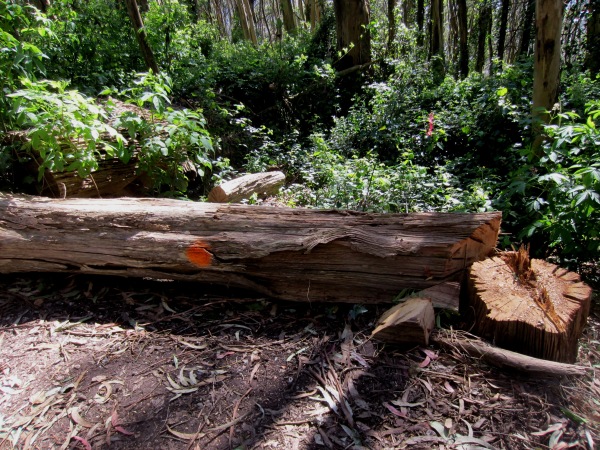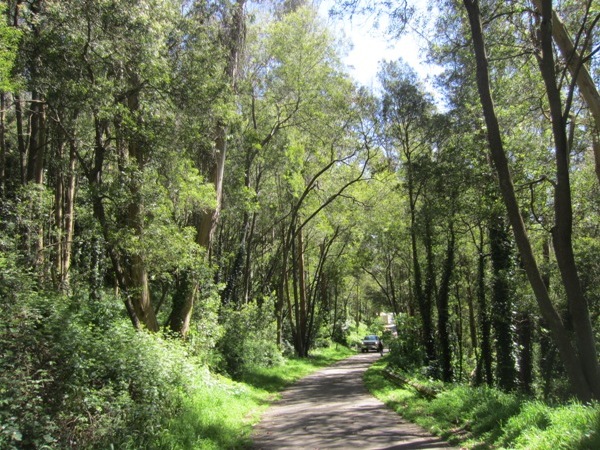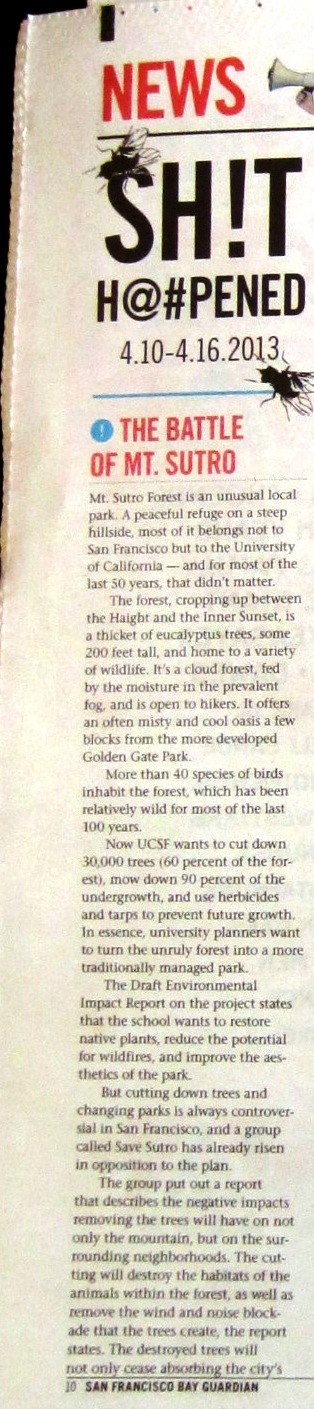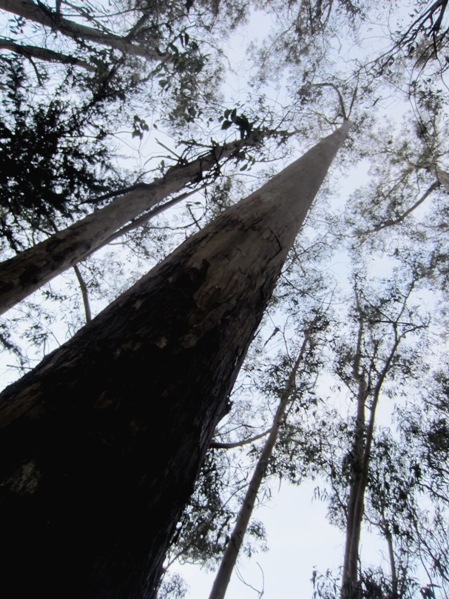
Peaceful Protest for Sutro Forest: Aug 29, 11 a.m. – 1 p.m

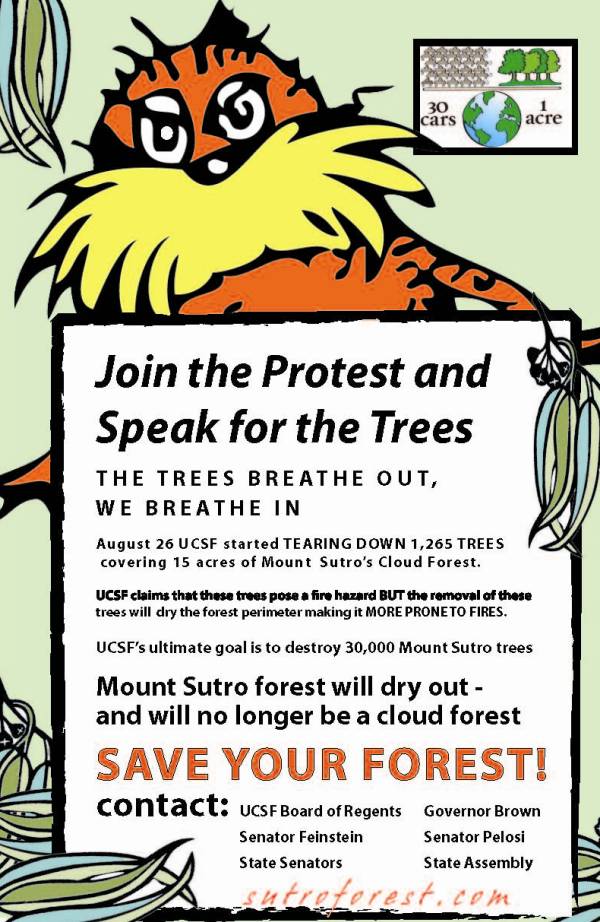
Sutro protest poster Aug 29th

Peaceful protest for Sutro Forest – Aug 29, 11 a.m., 500 Parnassus

  • A peaceful protest is planned for August 29, 11 a.m. to 1 p.m. at 500 Parnassus, outside UCSF’s Millberry Union building.
  • Please come, bring as many people as you can, try to bring a sign to carry.  Bright colors are good.
  • Here’s a PDF version of the above poster if you would like to download and print it. Please spread the word!  SAVE SUTRO PROTEST #1

CUTE POSTER

Here’s another poster you can use:

robin sutro poster jpgAnd here’s that PDF (except it includes the date/ time and replaces the poster we previously had attached here): robin sutro poster 8.5×11 date

Posted in Environment | Tagged , , | Comments Off on Peaceful Protest for Sutro Forest: Aug 29, 11 a.m. – 1 p.m

Sutro Forest Tree-felling Notices Posted

The tree-felling and vegetation removal in and around Sutro Forest that we wrote about HERE is imminent. Notices have been posted on trees in the Forest Knolls neighborhood.

We have a number of concerns about this action, which is being done in the name of “urgent fire safety.”

SHORT NOTICE, NO PUBLIC MEETING

1) This action was planned with only ten days’ notice, and no public meetings, at a slack time of the year when many people are traveling. Especially in the context of the ongoing issues regarding the Plan for Sutro Forest, this gives the impression that UCSF has timed it to avoid community input.

We do not understand how, after so many years, there is suddenly an urgent need and an emergency situation within ten days that requires removing over 1,200 trees. (In the letter to neighbors, UCSF gave the impression that this action was prompted by the fire department; in fact, it is clear that they sought SFFD’s support for the action. The timing was within their control.)

INCREASING THE FIRE HAZARD?

2) We also have a concern that rather than reducing fire hazard, this will increase it. Sutro Forest lies within the Fog Belt, and even now, while much of California (and much of the Bay Area) has fire weather, San Francisco does not. In recent days, much of the Bay Area has had Red Flag warnings from Calfire – but San Francisco was excluded.

fire weather avoids San Francisco

Source: CalFire

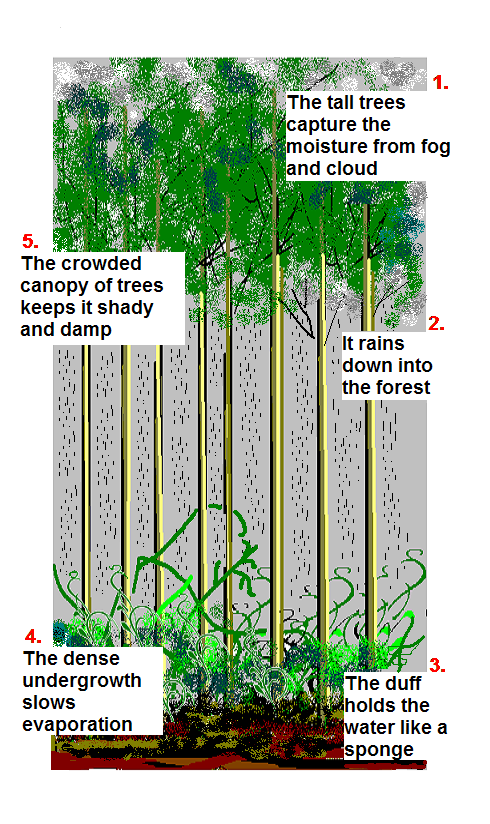
Even within San Francisco, this is one of the foggiest parts of the city, hence the Cloud Forest effect. Opening up the forest and removing vegetation decreases the ability of the forest to store moisture captured from the fog.

Mt Sutro Forest - East side

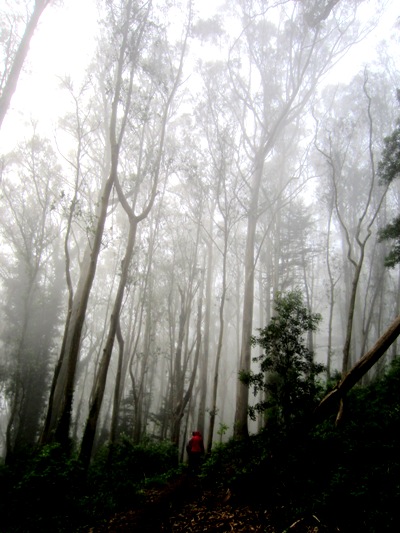
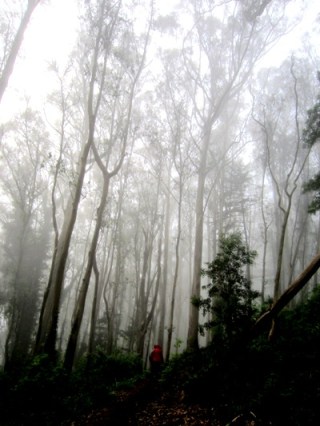
Meanwhile, in Sutro Forest – that’s fog.

Removing even small trees decreases the canopy cover; removing bushes and shrubs will encourage the growth of finer fuels like grasses and such plants that dry out quickly. (Even now, the driest parts of the forest are those where the canopy has been opened and the understory thinned out.) This is particularly true in those areas inside the forest (around the water tanks and the Aldea campus). We can expect they will become much drier than they have been before, and that contiguous areas will also be affected.

INCREASE THE MOISTURE, NOT REDUCE IT!

3) Given the very limited window between fog moisture and rainy weather in San Francisco’s fog belt (estimated at 10-14 days annually) other, less destructive measures could be considered first.

All the sensitive areas (unlike distant wild lands elsewhere in California) have access to a water supply. Artificially increasing the humidity of these areas during such windows is likely to improve the hazard situation far more than measures that *reduce* humidity. It would probably be less expensive than the ongoing maintenance of the “zones.”

DESTRUCTIVE OF TREE CANOPY AND FOREST

4) The concept of vegetation-free zones may be appropriate for flammable wild-lands such as those that exist in Marin, East Bay, South Bay, and Southern California, but not for this micro-climate. We are concerned that if other land managers – such as SF Rec and Parks – follow UCSF’s lead in implementing this kind of procedure without considering the micro-climate of San Francisco in general and the Fog Belt in particular, it may destroy a great deal of our forest lands, reduce canopy cover and habitat, and decrease carbon storage – but not improve and possibly worsen the fire hazard.

5) Though trees with a 6-inch diameter may sound small, it takes *years* for newly-planted trees to reach that size. Many street trees are smaller. In the Mission, a property-owner has been fined $17, 540 for destroying only ten street trees not much larger than that. Removing 1,250 trees is not trivial. As it is, San Francisco has among the smallest tree canopy covers among major cities. Already, normal attrition destroys twice as many trees each year than can be replanted. Massive tree removals of hundreds or thousands of trees make the situation much worse.

6) According to UCSF, the planned actions in Sutro Forest cover over 15 acres. This is around one-quarter of the Open Space Reserve. Again, this is not a minor action. It will have the effect of shrinking the “forest” visually and functionally.

END-RUN AROUND CEQA

7) UCSF claims that this action is exempt from CEQA. However, it is *in addition* to the Plan, and makes it considerably more damaging. We don’t understand how a CEQA process can be underway, and then additional actions can be introduced for the same space but not be part of that action. It eviscerates the CEQA process, changing the base-line even before the process is completed.

We cannot support actions that are intended to make everyone safer, but are more likely to have the opposite effect. Substituting more-flammable grasses that dry out  for trees and understory that are capable of retaining moisture is one of them.

Posted in deforestation, Environment, Mt Sutro Cloud Forest, UCSF | Tagged , | 4 Comments

UCSF Surprise: Felling >1000 Trees On Mt Sutro in Aug 2013

We had thought that UCSF was not going to cut down trees this fall when we wrote One More Year for Sutro Forest.  We were wrong.

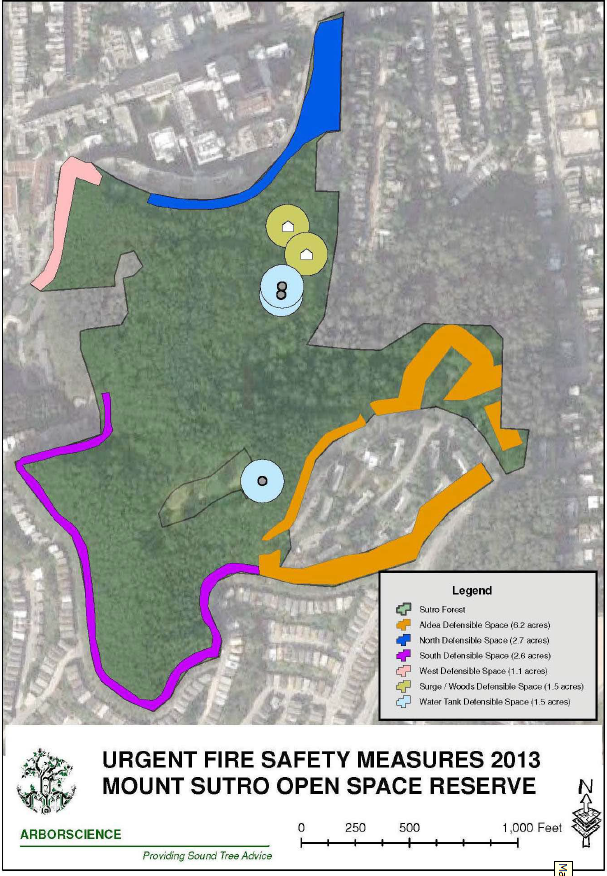
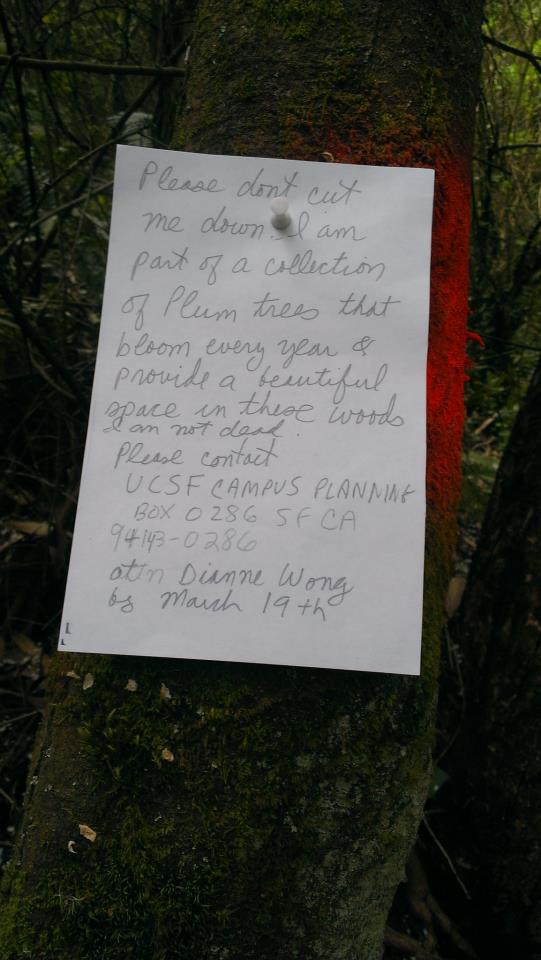
Yesterday, we received a surprise notification from UCSF. It plans to start felling trees for a “Urgent Fire Safety” project from August 26th.   This is separate from (and possibly in addition to) the Plan discussed in the Draft Environmental Impact Report.

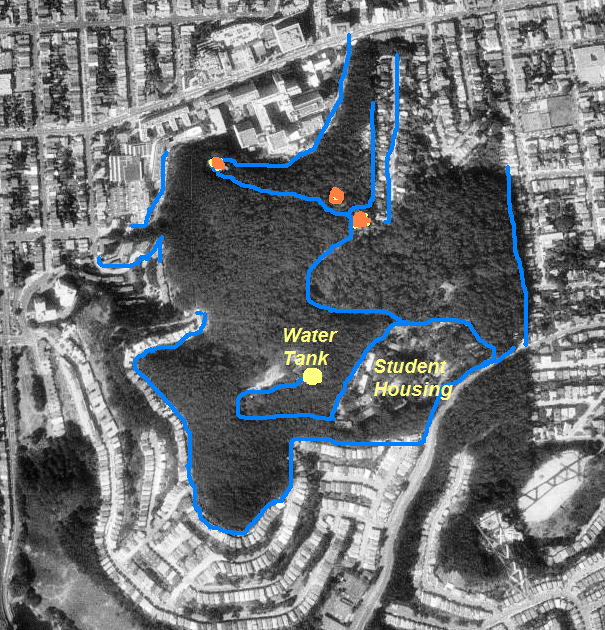
Mt Sutro 'fire safety work' mapMORE THAN A THOUSAND TREES

They plan to do the following:

  • Cut down and chip 1,250 trees under 6 inches in diameter in the colored areas on the map. (This comes to over 15 acres, about one-quarter of the forest.)
  • Remove much of the understory bushes in those areas.
  • Remove an unspecified number of “hazardous” trees of any size through the forest. (Presumably those would be the orange-tagged trees.)
  • They will not use pesticides.

In addition, they note that PG&E will prune/remove trees on Clarendon Avenue, and the city will do so in the Interior Green Belt. So we can expect quite a lot of tree-felling in this area this Fall.

THE UCSF LETTER

UCSF has indicated that work will start on August 26th and take 2 weeks.

ucsf letter abt 'fire safety' work

They also say that because this is “Emergency” work, it is not subject to the California Environmental Quality Act (CEQA) and so is separate from the Plan in the Draft Environmental Impact Report and independent of it. Of course, from an actual environmental viewpoint, this would be an addition to everything in that Plan.

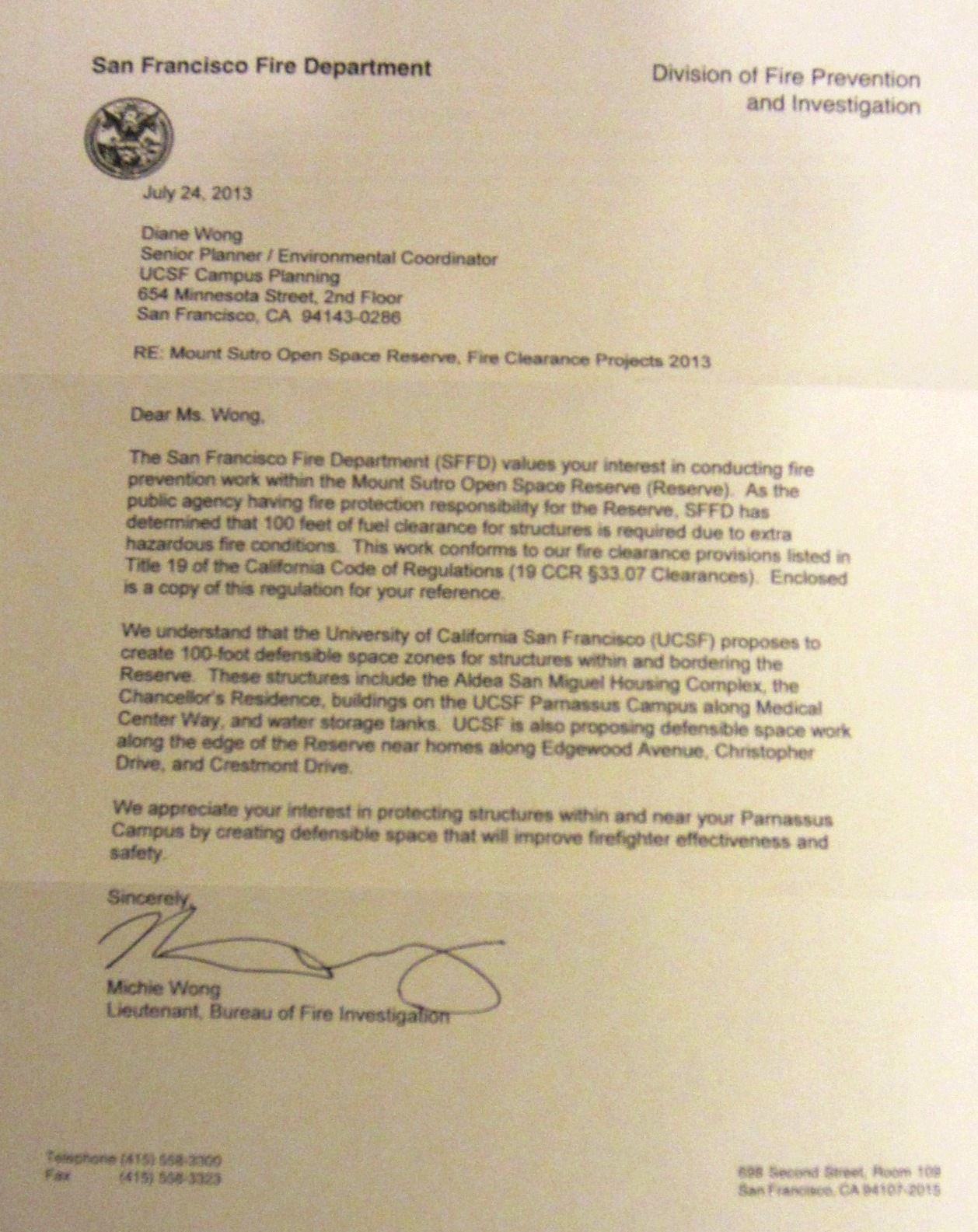
They have obtained a letter from San Francisco Fire Department supporting their proposed actions.

defensible spaceThis is a recent picture from Sutro Forest.

fog in the forest 4

Some see trees and understory; others see fuel.

Posted in Sutro Forest "Fire Risk", UCSF | Tagged , , , | 12 Comments

Getting the Word Out: Media Coverage of Sutro Forest

In the last few days, there’s been quite a lot of media coverage of the plans to gut Sutro Forest; and the related issue of Mount Davidson, where SF Recreation & Parks Department plans to fell 1600 trees.

fog in the forest 3

Some has been more favorable, some less so. All the articles below are open to comments. Please check them out.

It started with a short piece on KCBS radio, which unfortunately isn’t available online. If we get a link or a clip, we’ll post it here. It was followed by no less than four separate media reports in two days.

WSJ article: Click for a larger version

WSJ article: Click twice for a larger version

1)  The Wall Street Journal (WSJ) had a story on August 5, 2013, focused primarily on Mount Davidson. Titled “A Tree Spat Grows in San Francisco” in the paper version, it was called “In San Francisco, An Ecological Battle Grows” online. But the accompanying slideshow (titled “A Debate over Non-Native Trees in San Francisco) mentioned Sutro Forest, and had a picture of people (and pups) on a trail.

2)  That article kicked off a flurry of activity. It was picked up in the SFist, in a concise but pointed story entitled “Tree Wars Brewing Over Removal Of Nonnative Eucalyptus.” It clearly made the point that the battle is between those who care about the trees, and nativists: “Eucalyptus trees introduced to California coastal areas about 150 years ago are the main issue, with community groups praising them as beautiful “cloud forests” and environmentalists rallying for the native habitats they’re chocking out, such as oaks and elderberry bushes.” Only, we don’t think you can call the nativists “environmentalists.” They’re not.

3) Then Salon also wrote about the WSJ story, which it headlined with a provocative, “When Community Favorites are Actually Invasive Species.” This article treated it as a battle between beauty/ emotion/ nostalgia on the one hand, and the environment on the other. Except it isn’t, really. When they’re chopping down thousands of carbon-sequestering, pollution-fighting, run-off-regulating, hillside-stabilizing, habitat-providing, wind-blocking trees — and then using quantities of toxic pesticides to prevent their return — it’s really not “environmentalism.”

4) Finally, KALW radio had both a write-up titled “Mt. Sutro’s eucalyptus trees raise question of how to manage urban forest” and a radio piece based on it (which ran in their Cross-Currents show on Aug 6th).  It was interesting to note small differences between the two, even though from the same source.  The written article was quite balanced. The broadcast lead in with the sounds of the Oakland Fire of 1991 – and the questionable assertion that very-inflammable eucalyptus was the cause – creating a bias that the article didn’t have. The broadcast ended with the suggestion that people comment on the KALW Facebook page.

Even though they varied in terms of how they positioned the story, we’re happy to see the media coverage. We still find people every day in the forest who have no idea it is threatened, with thousands of trees and much of the understory to be removed. We don’t think San Francisco is ready to lose its forests, both for their beauty and uniqueness in this urban setting, and for the ecosystem services they provide us: Sequestering and storing carbon; fighting pollution; reducing run-off; providing a windbreak; stabilizing hillsides; and providing habitat for birds and animals.Copy of sign button

If you haven’t signed our petition yet – please do. We have over 3500 signatures at this time! And if you can help by passing the word on to like-minded people, please do so. We’re also on Facebook, HERE.

sutro forest 3

Posted in Environment, Mt Sutro Cloud Forest | Tagged , , , , , , , , , | 1 Comment

Jake Sigg and Transparency and CalFire

Of late, your webmaster has been carrying on an interesting and detailed debate on the neighborhood site Nextdoor about fire hazard. The other person involved opposes our position, and has been willing to discuss it. We appreciate that; we believe that talking to people with a different point of view is important.

JAKE SIGG’S ALLEGATION

Yesterday, Jake Sigg’s newsletter published a post from our opponent (we follow Mr Sigg’s lead in not naming him) regarding CalFire’s assessment of risk in San Francisco. In that, he [i.e., Mr Sigg]  included an allegation:

SF Forest Alliance/sutroforest.com has been known for selective quotations that alter or reverse what writers intended.  We have all learned to question authority and to insist on transparency.  SFFA/sutroforest.com needs to become transparent in its messages.  Its withholding of the complete opinion of Cal-Fire deprives the public of the information it needs to protect itself. In keeping with that you will find the complete letter at the bottom of this newsletter, sans author ID.”

OBJECTION!

So let us object here. We do not – and would never – “alter or reverse” what writers intended. We stand for transparency, and try as far as we can to include references so people can go back and look at sources if they wish.

Nor have we withheld “the complete opinion of CalFire.” In fact, what we have quoted of CalFire is taken from two sources that readers may verify:

(1) The CalFire website, which we linked when we mentioned it. That is where we obtained this map, which shows that CalFire gives its lowest hazard rating to Sutro Forest (and most of San Francisco).

CAL FIRE map shows Mt Sutro Forest has the lowest level of fire hazard (gray color indicates areas not rated - mainly built areas)

CAL FIRE map shows Mt Sutro Forest has the lowest level of fire hazard (gray color indicates areas not rated – mainly built areas). The blue and pink pointer lines added by us.

We  provide that link again here: CalFire Hazard Map.

We also referred to the page on the CalFire website, where in an update it said:

“Update, 11/2008:
CAL FIRE has determined that this county has no Very High Fire Hazard Severity Zones (VHFHSZ) in LRA [Local Responsibility Area]. Therefore this county will not have a map of recommended VHFHSZ in LRA.”

That link is HERE.

(2) A letter from FEMA to Cal EMA regarding UCSF’s request for funding to cut down trees on Mount Sutro.

We did indeed post an excerpt from that, given below.

fire hazard FEMA critWe do not think that “alters or reverses” the intent of the letter. But if someone wants to verify this, the full letter is here, in two parts:

Mt Sutro PDM – Letter from FEMA – Environmental-Pt 1

Mt Sutro PDM – Letter from FEMA – Environmental-Pt 2

And if they would further verify that this indeed is the letter – it is available to anyone who requests it under the Freedom of Information Act from FEMA, and as Public Records Information from UCSF.

SO IS WHAT CALFIRE SAID DIFFERENT?

We think that what we’re seeing is different conclusions reached by our opponent and ourselves.

What CalFire explained to FEMA, and to our opponent, is that fire has two factors: Fuel Rank, and Rotation Rank (or the risk of ignition). Fuel rank is only density of vegetation, and we, UCSF, and our opponent all agree that the vegetation density in Mount Sutro Forest is high.

The second factor is the risk of ignition, and that is low in most of San Francisco. (The CalFire map above shows a little orange spot on the edge of San Mateo County that has High – but not Very High risk.) San Francisco’s climate is cool and not extreme. Right now, while the rest of the country has a heat wave, the fog blows through our city.

forest 6Ignition risk is particularly low in Mount Sutro Forest, which lies directly in the city’s fog belt. The Cloud Forest effect increases moisture levels considerably as the trees harvest moisture from the fog, and store it in the dense understory. It’s obvious that the best way to keep ignition risk low is to trap that moisture and reduce evaporation.

We are unsure whether the recommendations discussed there come from our opponent, or from an individual within CalFire. (It does not appear on the CalFire website.)

We hope to make our own contact with that organization, and if we do, we will write about it here.

WHY THE UCSF PLAN IS COUNTERPRODUCTIVE

Even if the Plan reduced the Fuel Rank (and we don’t see how it would, given that the Plan would be to fell the trees and leave them there as logs and chips), it would raise the ignition risk by drying out the forest, reducing both harvested and retained moisture, and by increasing wind velocities in this very windy part of San Francisco.

FEMA had similar questions for UCSF. This is again a quote from the same letter cited above.

FEMA Letter - drying the forestWe don’t think this is a good trade-off, especially since this is not a distant wild-land, but in the midst of the city with access to water sources and fire-fighting capability.

map usgs ed paved roads in Sutro ForestThere is actually a fire-station on the Stanyan side of the forest, a fact that was cited during the hearing about opening the trail from Stanyan into the forest through SF RPD’s Interior Greenbelt.  At that meeting, Ray Moritz (who was also hired by UCSF separately) allayed neighbors’ concerns about increased ignition risk from such a trail by saying that overall risk was low. The report of that meeting, written from contemporaneous notes, is HERE.

We don’t think a model based on increasing ignition risk while reducing fuel is workable for this site. And aside from the environmental damage this “solution” would cause, in reduced carbon sequestration, poorer pollution control, potential hillside destabilization, increased water run-off, lost habitat, and use of substantial amounts of toxic pesticides – this is not reversible in the short or medium term. If we discover it’s all a horrible mistake, it cannot be undone once the trees lie on the ground as logs and chips.

Posted in nativism, Sutro Forest "Fire Risk" | Tagged , , , , | Comments Off on Jake Sigg and Transparency and CalFire

Sutro Cloud Forest is Foggy while Fires Burn Elsewhere

The summer fog has rolled into San Francisco, and we’d been watching the forest hopefully while Life delayed our visit.

We finally made it on the kind of evening that makes you fall in love with Sutro Cloud Forest all over again. A few others apparently agreed; we encountered two riders on their bikes, and two joggers.

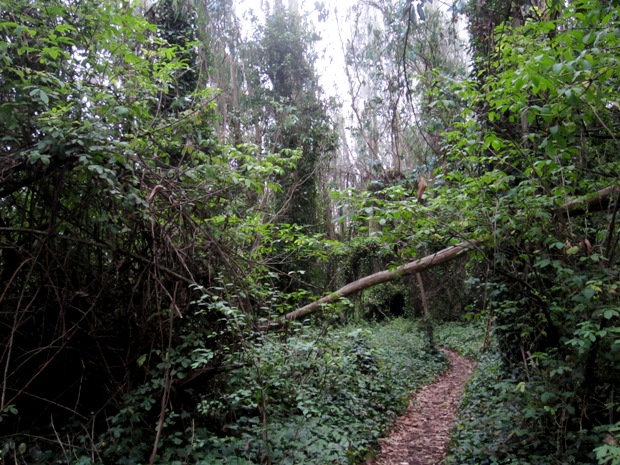
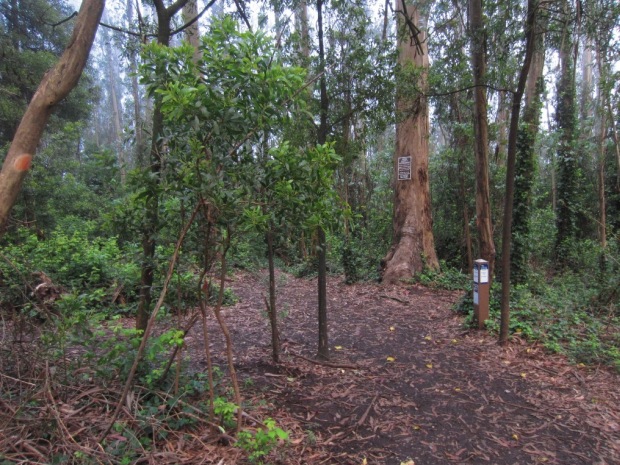
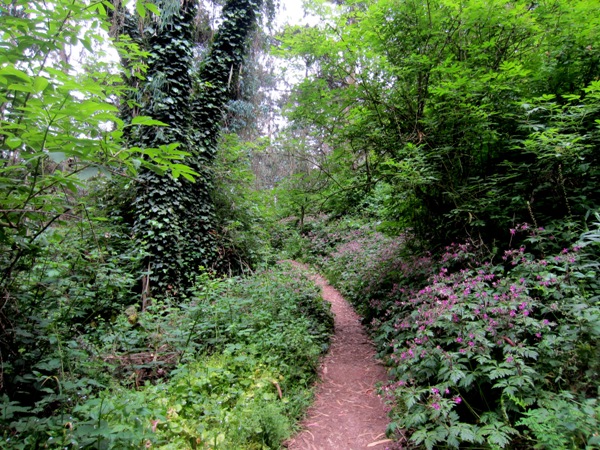
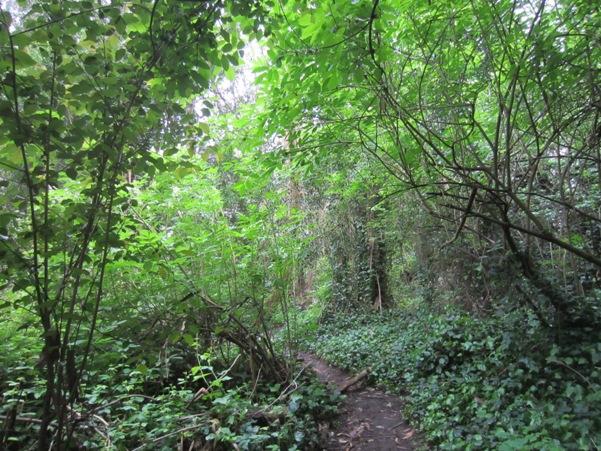
trail under treesThe understory was green and fresh with all the moisture, and the paths on the South Ridge damp. These trails haven’t been over-widened for some time, and are interesting and full of character.

trail under the beamLike this one that ducks under a tree that fell, but like most of Sutro Forest’s falling trees, never made it to the ground. Other trees catch them instead.

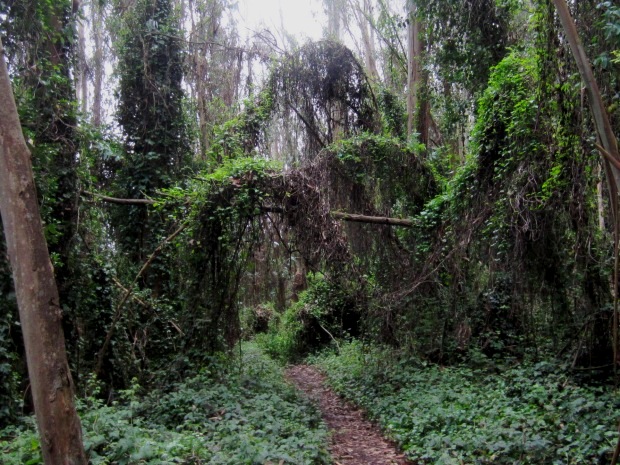
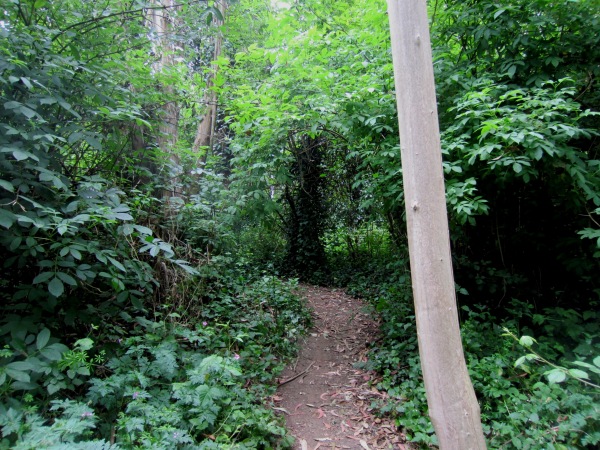
triple arches 2This is a particularly neat bit of the trail – vines have grown over thin branches and formed a triple archway.

ferns and blackberry and poison oakThe poison oak – some of which climbs the tree-trunks as vines – is turning red. There are Poison Oak warnings at every entrance to the forest.

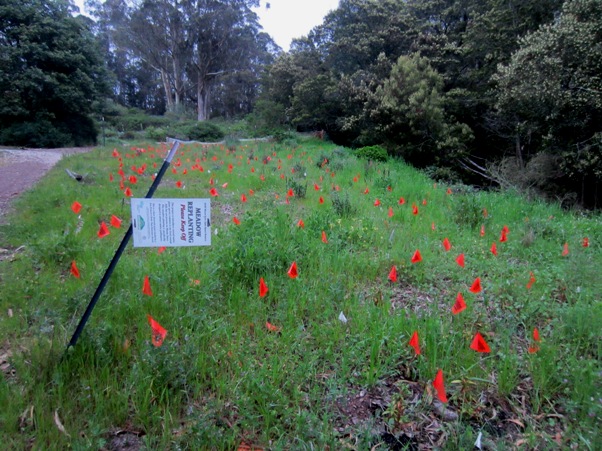
flags in the Native MeadowThe fog was blowing in even as we climbed the trails, and by the time we reached the Native Plant garden with its crop of little orange flags in the restoration meadow, it was quite hazy.

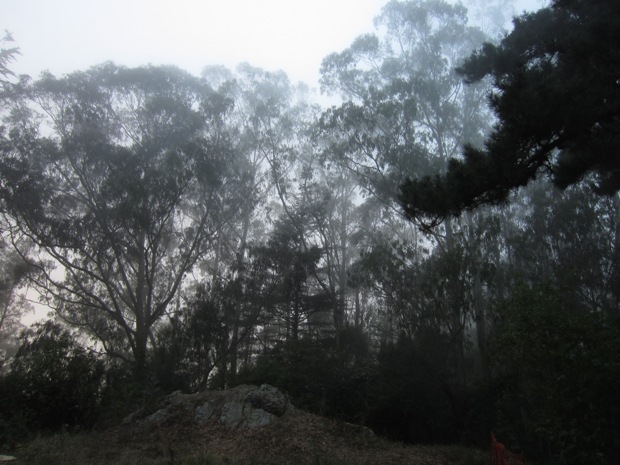
trees in the fogThe trees appeared in soft shades of gray.

fog in the forest 3

fog in the forest 4In most places, the trail conditions are good – damp enough to give a good footing. In some areas, the trails are still dry, but not so much as to be slippery with dust.

imaginationSomeone had left a button on a log on the trail: It said Imagination. Was it left deliberately? It felt quite appropriate.

nasturtiums part of the food chainAlong the road to the water tank, nasturtiums were blooming, their orange flowers much brighter than the orange plastic flags in the Native Garden. This one was clearly part of the food chain – something had been munching on its leaves.

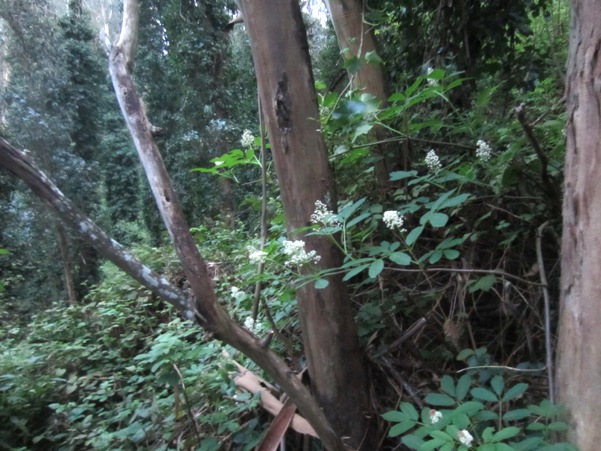
mock orange bloomingA mock orange (?) bloomed enthusiastically with its jasmine-like flowers.

The camera battery gave out 100 pictures into the hike. This was unfortunate, because for the first time, we saw two raccoons on the trail. The first politely moved off the trail as soon as it saw us; the second froze, as though it couldn’t believe its eyes. Had the camera been functional, it would have posed. Instead, we waved and yelled at it to make way; it disappeared into the understory.

THE SOUTH RIDGE AND DEMONSTRATION PLOT #1

damp inside the forestMost of area in these pictures will be directly affected by the earliest part of the UCSF Management Plan.

  • On three acres all along the South Ridge (above the Forest Knolls Neighborhood), 90% of the trees and 90% of the understory habitat is to be removed.
  • On the few remaining trees, all the vines will be cut off at the ten feet. This will kill the vines above that level and leave them to dry out.
  • One one acre, they will experiment with toxic herbicides – glyphosate (the active ingredient of Roundup) and the even more toxic triclopyr (active ingredient of Garlon). They will compare this with two other methods, ‘Tarping’ (i.e. covering stumps with tarpaulin) and manual removal. Since the target is 85% regrowth prevention, we expect that only pesticides will achieve that objective. This would be the cue to permit pesticide use on all treatment areas – initially, 7.5 acres of “Demonstration Areas” and later, 3/4 of the Reserve.
  • cardboard and mulch in Native Plant Garden on Mt Sutro 2At present, no pesticides have been used anywhere in the forest since 2008, and in the Student Housing since 2009. Even the Native Garden, which requires the kind of heavy maintenance that all gardens do, is being managed with cardboard and mulch.
  • The trail up to the South Ridge is to be reinvented as a sweeping hairpin trail, with another unnecessary trail running parallel to Christopher, the paved road in Forest Knolls. In building these trails, there’ll major disturbances to the forest. Trails are also used, in many cases, as an excuse to remove trees.

We are grateful that project implementation has been delayed for a year, and will not start until August 2014.

FOG FOREST AND FIRE HAZARD

San Francisco’s marine layer that turns Sutro Forest into a de facto Cloud Forest makes this one of the dampest places in the city outside the actual bay. Meanwhile, it’s fire season elsewhere. A grass-fire burned 50 acres in San Jose. (Click HERE for details.)

Could this happen here? The forest is not a fire hazard now, but it could be made into one, by thinning the trees to dry it out and make it more windy.

Grass fires ignite relatively easily, and move fast. And they have been known to occur in San Francisco. The picture below is from a grass fire on Bernal Hill in May 2013, which slightly damaged two homes. According to our sources, the same area had a fire two years ago.

bernal grassfire May 2013 - Janet Kessler

In August 2009, firefighters battled a “grass and brush” fire in Glen Canyon Park. sprinkler system pipesAnd there had been another, smaller, fire in Glen Canyon earlier the same year, in May.

We’re glad that the Native Plant Garden on Mount Sutro is supplied with an irrigation system. We hope that UCSF ensures that it is functional and is ready to turn it on should a fire start in the dry grass of the meadow sections there.

dry grass in the Native Plant Garden

Posted in Mt Sutro Cloud Forest, Sutro Forest "Fire Risk" | Tagged , , , , , | 1 Comment

Invasion Biology – Pseudoscience? – Talk in Berkeley, 14 July 2013

David Theodoropoulos, author of the book “Invasion Biology: Critique of a Pseudoscience” will be giving a talk in Berkeley this Sunday. It’s jointly sponsored by East Bay Pesticide Alert and the Social Justice Committee of the Berkeley Fellowship of Unitarian Universalists.

There will also be a short presentation on Mount Sutro and the threat to this forest.

It’s open to everyone; please come if you can. It’s at 6.30 p.m., 1924 Cedar, Berkeley. Details below.

David Theo talk


Posted in Environment, Herbicides, Mt Sutro Cloud Forest | Tagged , , , | 1 Comment

The Making of the Mt Sutro Tree Spirit Project

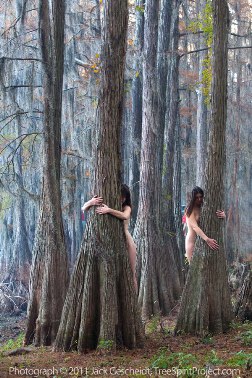
treespiritproject - sutro forestYesterday, we published a picture made in Sutro Forest for the Tree Spirit Project, which creates art photographs of sylvan nudes to draw attention to endangered forests and trees. (Click here to go to the Tree Spirit page for Mount Sutro.)

Jack Gescheidt, the artist and tree-lover who organized it, kindly sent us some pictures showing the making of the picture. The men and women in the picture are volunteers (as is true of all Tree Spirit Projects).

[Edited to Add: These photographs were taken by Ray Madrigal, whose website is HERE.]

Jack_Gescheidt_TreeSpirit_Sutro_Forest_0026_550p_WEB Jack Gescheidt Tree Spirit Project

Photo Credit: Ray Madrigal

Sutro_Forset_making_of_0027_550p_WEB

Photo Credit: Ray Madrigal

Jack_directing_Sutro_0031_550p_WEB Jack Gescheidt Tree Spirit Project

Photo Credit: Ray Madrigal

HERE TO STAY

And here, again, is a compressed version of the resulting picture entitled “Here to Stay.”

HereToStay_TreeSpiritProject_740p_WEB Jack Gescheidt Treespirit

Here to Stay – Photographed in Sutro Forest by Jack Gescheidt for the Tree Spirit Project

Posted in Environment, eucalyptus, Mt Sutro Cloud Forest | Tagged , , , , , | 1 Comment

Tree Spirit Project in Mount Sutro Forest

DownByTheRiverside_vertical_Jack Gescheidt Tree Spirit Project

Down By The Riverside – Jack Gescheidt, Tree Spirit Project

Jack Gescheidt – tree-lover, photographer, artist – uses his photographs to publicize forests at risk in his Tree Spirit Project. He calls for volunteers who pose naked among the trees, and makes a beautiful and telling picture. (The website has a gallery of pictures from forests and trees – the thumbnail  here is an example.)

From his website:

The mission of The TreeSpirit Project is:

  • To share the love of trees and nature in community gatherings, and in the resulting photographs;
  • To heighten people’s felt connection to the natural world;
  • To encourage and inspire people to express these feelings in their own unique way;
  • To raise awareness of the critical roles trees play in our lives, both globally and personally.  Trees play an essential role in creating and maintaining life-sustaining earth, air, and water.  By their very presence, trees also enrich our daily lives in numerous, inexplicable, and profound ways.    –  Jack Gescheidt, 2013

“Although the making of each TreeSpirit image is a unique and unpredictable experience, being among trees and feeling connected to them is an ancient, reliable alchemy.  Humans and trees have been connected, interdependent, for thousands of years, and still are.  In practical, scientific terms, we need trees to survive as a species.

Last Saturday, July 6th, the Tree Spirit Project came to Mount Sutro Forest. This was the announcement:

treespiritproject - sutro forestWe weren’t there, but we understand the event was peaceful and beautiful. Despite some concerns about conflicts, it all went well.

‘HERE TO STAY’

It certainly was dramatic. The photograph below, entitled ‘Here to Stay’ is published with permission. (Please contact Jack Gescheidt if you wish to reproduce it.)

HereToStay_TreeSpiritProject_740p_WEB Jack Gescheidt Treespirit

Here to Stay – Jack Gescheidt, Tree Spirit Project

We’d like to thank Tree Spirit Project for caring about this forest, and for spreading the word.

SIGN THE PETITION

There are still people who don’t know about the destructive UCSF Plan that could fell over 90% of the trees and mow down 90% of the understory in 3/4 of the forest, and potentially use gallons of toxic herbicides to prevent regrowth. Though the implementation has been delayed by a year to late summer 2014, it is only a delay, not a withdrawal of the project.

If you want to oppose this Plan, please sign the petition:

Copy of sign buttonIf you want to help further, please write to the decision-makers and ask them to re-think this Plan: The Regents of the University of California; UCSF Chancellor Susan Desmond-Hellman; and Governor Jerry Brown (who is also a Regent). Details here: What You Can Do.

Posted in Mt Sutro Cloud Forest, UCSF | Tagged , , , , , | 5 Comments

Westside Observer “Cannot Comprehend the Logic” of UCSF’s Sutro Plan

The West of Twin Peaks Central Council is one of San Francisco’s oldest neighborhood organizations. It’s actually a “club of clubs” – an umbrella organization comprising twenty west-side neighborhood groups. It meets every month to consider issues that concern its member organizations.

On June 24th, 2013, one of the issues they considered was Sutro Forest. They invited presentations from UCSF and from the San Francisco Forest Alliance/ SaveSutro, which were reported by The Westside Observer, a local newspaper.

A REPORT…

Here’s that report. (It’s not online yet; we’ll provide a link when it is.)

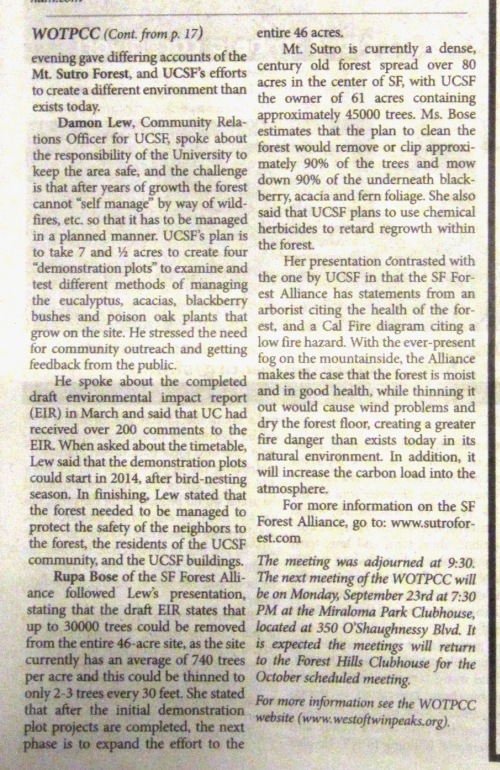
westside observer July-August 2013 WoTPCC presentation reportWe think it’s a very fair characterization of the presentations (though the thinning would be worse, to only one tree every 30 feet.)

… AND AN OP ED

The Westside Observer’s Mitch Bull couldn’t “comprehend the logic of the proposal by UCSF to better ‘manage’ their section of the Sutro Forest.” Here’s his take on it:

westside observer July-Aug 2013 Save Sutro Forest 1He ends by saying, “The UCSF draft EIR elicited over 200 comments. I hope they listen.

Posted in deforestation, Meetings, Mt Sutro Cloud Forest, UCSF | Tagged , , , , , | 1 Comment

Sutro Forest June 2013: Trails and Flammability

The summer evening was golden and lovely, and though it was getting late, the forest beckoned. We met a few others in the forest – a dog-walker, three joggers, and as we were leaving, three bicycle-riders, all out enjoying the weather.

It’s the first time we’ve been up to the forest since we learned that the felling will not start in August 2013, but has been delayed a year.

sutro forest 3The Plan is to:

  • Cut down up to 90% of the trees on each treated acre, to achieve a 30-60 foot spacing, chip the felled trees except for the larger logs, and leave them lying there;
  • To mow down 90% of the understory (blackberry, ivy, acacia, etc);
  • To amputate the vines between 0-10 feet so they die above that level; and
  • To use pesticides if necessary to prevent regrowth; the target is 85% regrowth prevention, which suggests that pesticides will indeed be needed.

It was something of a relief to know the immediate threat’s been postponed. Most of the trees in the picture above are in Demonstration Area #1, South Ridge. So is most of the understory habitat, as in the second picture down.

south ridge trailsutro forest 1The acacia sub-canopy (the shorter trees under the tall eucalyptus canopy) would also be targeted. It’s non-native, too.

acacia subcanopy in Sutro ForestAnyway, we’re happy to report that except for those that were cut down by mistake on the South Ridge, the orange-blobbed trees are still there. They give character to the trails and the forest. We hope that UCSF will rethink this and only remove those that are actually hazardous. Only recently, we heard that a [red-shafted] flicker (woodpecker) was nesting in a eucalyptus in the Presidio. These birds need snags and failing trees as habitat.

[Edited to Add: Go HERE for some great pictures of the flicker and chicks.]

TRAILS REPORT

Trail conditions are mixed, but generally good. We’re moving into a typical summer pattern – where the forest has been opened up, the trails are dry, even dusty; in more unspoiled areas, they’re damp.

trail with twisted treeThey aren’t actually muddy except for small patches here and there.

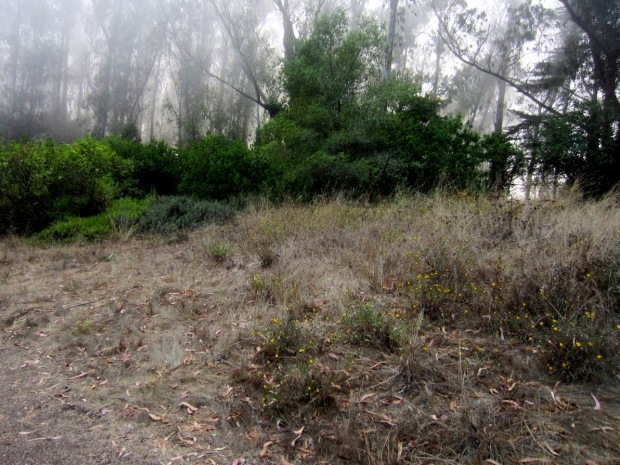
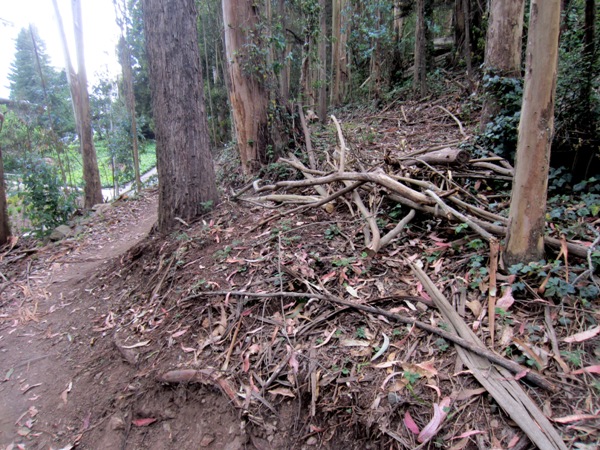
some trails are quite dampBut where the forest has been opened up and the understory removed, it’s dry and dusty.  Here’s the bottom end of the East Ridge trail, where it joins the Aldea campus. That pile of brush looks almost like someone’s stacked some kindling.

Sutro Forest East Ridge trail near Aldea campusHere’s a still-vegetated part of the same Trail.

East Ridge trail dampHOW DRY IS THIS FOREST?

We’ve been discussing Fire Hazards in various forums recently. Someone mentioned that with this remarkably rainless winter and spring we’ve had, the forest is quite dry. It’s true some bits of it *are* dry – and of course the worst is where it’s been opened out. The actual forest has a high moisture content; everything about it – including and especially the Cape Ivy – retains moisture. And even on hot days, there’s often a mist or fog in the night.

The native plant garden on the summit is past its prime. The meadows are brown. Most of the flowers are done, and the plants drying out. This one, still planted with orange flags, is tinder dry.

native plant garden meadow June 2013Even there, it’s not all so bad. Some shrub areas are green and thriving (especially if they’re close to eucalyptus trees that will water them with fog moisture), and the mock orange (I think) is still flowering.

mock orangeWe still don’t understand how anyone familiar with this forest could consider it a fire hazard – and more importantly, believe that the Management Plan  would actually reduce that hazard. It’s apparent that it would actually increase the risk by drying out the forest, and destroying the windbreak that slows the spread of fires even if they were to ignite.

Here’s another meadow in the Native Plant Garden, which is an open area, and planted with native plants.

native plant garden meadowAnd here’s a picture of an untreated, unmanaged area of forest, taken the same day.

unamanaged forestThe difference in moisture and flammability is apparent.

AN ACCESSIBLE FOREST

water tank 1 at Mt Sutro summitMoreover, as we pointed out in a previous post, this forest only appear inaccessible. It has paved roads (shown in blue) and water tanks. (There’s actually another water tank as well, not shown below.)

map usgs ed paved roads in Sutro ForestIf UCSF is so concerned with the dryness of the forest in extreme weather years, it could  could arrange for water to be sprayed from tankers to damp down the forest. It would only be needed once or twice in a very dry and fog-free year – which is extremely rare. Even after this dry winter and spring, the forest is lush and green. It would be a lot cheaper than the multi-million dollar Management Plan, and it would be a lot less destructive.

Posted in Mt Sutro Cloud Forest, UCSF | Tagged , , , | 1 Comment

One More Year for Sutro Forest

We recently learned that UCSF will delay project implementation, which was otherwise likely to start in August 2013.

notes in the forest - Gina HallWith the unprecedented number of written comments on the Draft Environmental Impact Report (EIR), and the spoken comments at the February 2013 meeting, UCSF has found it needs more time to respond. Until it does so, the final EIR cannot be issued or certified. We had analyzed the potential time-line back in April, before UCSF knew that it would need more time to deal with comments.

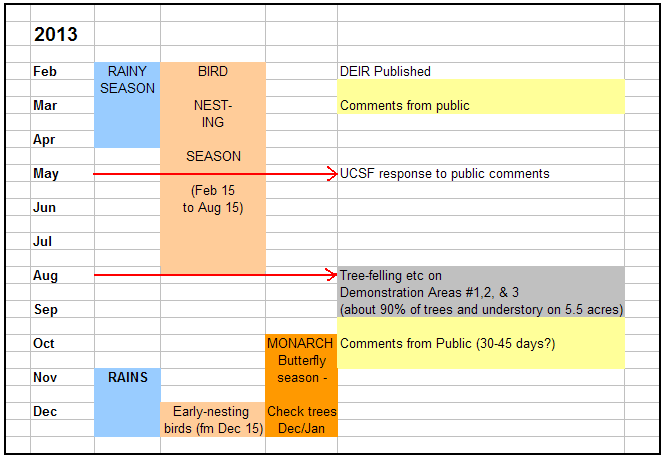
UCSF avoids any major work in the forest during the bird nesting season (mid-February – mid-August), and during the rainy season (November – April).  This means they can only schedule project implementation for August-November. Now, they don’t expect to complete the process (EIR finalization, certification, project approval) before this window closes. What they told us was:

“Although the timeline is not set in stone, any implementation of proposed management actions on Mt. Sutro would not take place until late-summer/early-fall of 2014.  We are planning to hold a public meeting after the responses to the Draft Environmental Impact Report are complete.”

TIME TO RE-THINK THE WHOLE THING

This does not mean that the Management Plan is withdrawn, only that the decision-makers have more time to re-think it. Please write to them to urge them to do so. Also, please continue to spread the word. We keep hearing that a lot of people – even those who love the forest – know nothing of the destructive Plan that hangs over it.

(Please go HERE for addresses and What You Can Do.)

6. Interior Greenbelt Trail Sundappled forest - Tony Holiday

Posted in Environment, Mt Sutro Cloud Forest, UCSF | Tagged , , , | 9 Comments

Tasmania Saves its Forests: Thanks, Miranda!

Miranda in TasmaniaSome readers will recall we wrote to support of Miranda Gibson, who’s been fighting to save areas of Tasmanian forest that were to be destroyed by commercial logging. She spent a year up in a tree in the forest, the Observertree.

It’s done. The forests have been declared a World Heritage Site and preserved in perpetuity.

Partially logged forest in Tasmania - Wikimedia Commons, TTaylor

Source: Wikimedia Commons

Those who signed the petition to save the forests received this letter from Tony Burke, (the Australian  Minister for Sustainability, Environment, Water, Population and Communities).

Excerpts:  “I am very pleased to be able to tell you that the World Heritage Committee has today accepted our nomination for an extension to the boundary of the Tasmanian Wilderness World Heritage Area…

The boundary will include the iconic Upper Florentine and areas within the Styx, Huon, Picton and Counsel River Valleys…
They’re protected forever now. Your work and advocacy has helped make this real.”

Importantly, it adds: “For the first time it’s been done, not through a political process, but through a genuine community process where industry and environment groups came up together with a package that they thought would deliver what each of them wanted most.”

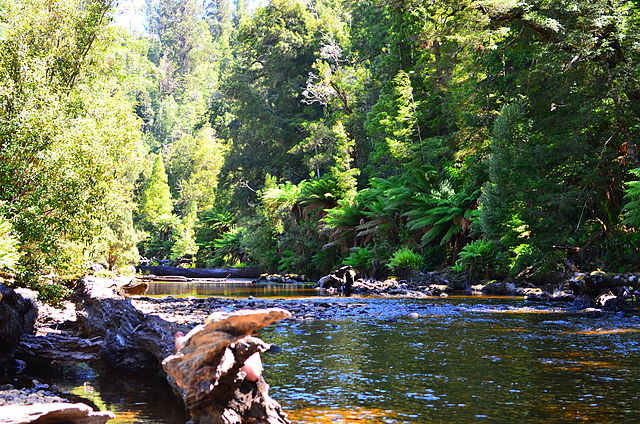
Forest, Styx River, Tasmania - Source Wikimedia Commons - melissaaubrey1981

Source: Wikimedia Commons

This is marvelous. We’re thrilled – and heartened.

Perhaps decision-makers here, too, will recognize the value of our forests, and reverse the plans to gut or destroy forests on Mount Sutro, on Mount Davidson, and in the East Bay hills.

Mount sutro forest - still green

Posted in Environment, eucalyptus | Tagged , | Comments Off on Tasmania Saves its Forests: Thanks, Miranda!

War on Trees in the Bay Area

In a world where climate change is a reality, and trees our only defense (aside from actually reducing carbon emissions), it would seem to be a no-brainer that preserving existing trees would be environmentally important.

Sunset  for  Hundreds of Thousands of Trees

Sunset for Hundreds of Thousands of Trees

The carbon sequestration and storage – particularly in eucalyptus trees, which are large, fast-growing, long-lived, and have dense wood – as well as their benefits in pollution control and moisture capture would seem to encourage preservation and planting. Instead, we see multiple plans to remove hundreds of thousands of trees across the Bay Area.

It’s like a war on trees.

mt davidson path and pesticide notice

Mt Davidson path and pesticide notice

All these projects propose to use pesticides to prevent re-sprouting of  the felled trees for up to seven years afterward, and also to spray “invasive” non-native vegetation. The pesticides mentioned include glyphosate (the active ingredient of Roundup and Garlon), triclopyr (Garlon – even more toxic that glyphosate), and imazapyr (an extremely persistent chemical whose breakdown product is neurotoxic).

Needless to say, the dead trees will not be sequestering any more carbon. Nor will they be storing it. The wood from the felled trees will be chipped and left on the ground, except for the pieces too large to chip, which will be left there as logs. These will decay, returning the carbon to the atmosphere.more logs

TREE-FELLING – HERE, THERE AND EVERYWHERE

We’re aware of three major initiatives to cut down trees in the Bay Area. Though the land managers are different in each case, the projects are remarkably similar: Cut down trees, grind the smaller ones into chips and leave the larger ones as logs, and leave them lying on the ground; use pesticides to prevent regrowth, and to discourage the invasive plants that will naturally follow.

We’ve passed  all the deadlines for comments on their Draft Environmental Impact reports. However, this is a good time to show your support by signing the petitions if you haven’t done so already. It’s also a good time to write to decision-makers.

Native Plant Garden, Mt Davidson Feb 20121)  In San Francisco and Pacifica the Native Natural Areas Program plans on cutting down 18,500 trees.  This is in addition to hundreds of trees – maybe more, because we’ve lost count – of trees have been and will be felled for projects (such as Glen Canyon and McLaren Park) and for Urban Forestry, where trees ‘in decline’ or having ‘poor suitability for preservation’ are being removed even when they’re not hazardous. (To be clear: We support the removal of trees that are actually hazardous, but not declaring trees to be hazardous as a reason to cut them down.)

The land manager in this case is San Francisco Recreation and Parks Department (SFRPD), mainly – but not solely – through its sadly misnamed “Natural Areas Program.”

Where it stands and what you can do: The City will need to respond to the large number of comments they received. We understand that a new consultant has been hired for that purpose. Meanwhile, you can read about the Plan at the San Francisco Forest Alliance website (www.sfforest.net) and write to Mayor Edwin Lee, as well as the Supervisor for your District.

Sutro Forest trees

Sutro Forest trees

2) In Sutro Forest, the first phase of the project calls for felling 90% of the trees in demonstration areas totaling 5 acres – initially around 3,000 trees.  The second phase potentially extends this to a total of 44 acres, with a loss of 27,500- 35,000 trees. The land manager in this case is University of California, San Francisco (UCSF). Another 19 acres of the forest is owned by the City and falls under the Natural Areas Program described above.

Where it stands and what you can do: Comments on the DEIR for the Mount Sutro Open Space Reserve are also closed, and UCSF is considering how to respond. However, please write to the decision-makers and check this page to see what else you can do.

lake-chabot cropped Photo credit MillionTrees dot me3)  In the East Bay, three separate but connected projects threaten nearly 500 thousand trees. What’s worse, they are asking FEMA to fund it.

  • UC Berkeley plans to clear-cut 284 acres in Strawberry Canyon, Claremont, and Frowning Ridge, removing all non-native trees: Eucalyptus, Monterey Pine/ cypress (yes, they’re non-native too), and acacia. That’s about 54,000 trees.
  • The City of Oakland plans to remove an estimated 23,000 trees on 122 acres in two areas: the Northern Hills Skyline; and Caldecott Tunnel.
  • The East Bay Regional Park District is planning to remove approximately 409,000 trees by “thinning” existing forests on a total of 1653 acres.

Where it stands and what you can do: The comments period on the Draft Environmental Impact Statement (DEIS) closed on Monday, June 17th. Until FEMA has had a chance to digest and respond to all the comments it would have received, we don’t expect to know where it stands. They are also raising funds so they can mount a legal challenge if necessary. Go HERE if you’d like to make a donation.

PEOPLE LOVE TREES AND OPPOSE THESE PLANS

Opponents of these destructive plans have put out petitions, and thousands of people have signed them.

  • Copy (4) of sign buttonThe petition against the Natural Areas Program’s tree-felling has around 3,000 signatures (most were hard-copy, as supporters went and got signatures and mailed them in). The online petition is still live; if you have not signed and would like to do so, click HERE.
  • Copy of sign buttonThe petition against gutting Sutro Forest has over 3400 signatures as of June 21st, 2013. This is entirely online. If you haven’t signed, and would like to, the link is HERE.
  • Tsign for East Bay Hillshe Hills Conservation Network petition against deforestation in the Berkeley/Oakland Hills has over 5700 signatures.  (Click HERE to sign if you would like to have not done so yet.)
Posted in deforestation, Environment, eucalyptus, Herbicides, Mt Sutro Cloud Forest, nativism, Natural areas Program, UCSF | Tagged , , | 2 Comments

Action Alert: TODAY is Deadline for East Bay Tree-felling Comments

This article is reprinted with permission from SFForest.net

more logsThe deadline for comments on the Draft Environmental Impact Statement (EIS) for the East Bay Tree-felling plan is TODAY. From the FEMA website:

Submitting Comments on the Draft EIS

Written comments must be submitted or postmarked by midnight on June 17, 2013. Oral and written comments may be made at any of the three public meetings. Written comments may also be submitted through:

  • via email at EBH-EIS-FEMA-RIX@fema.dhs.gov,
  • via fax at FAX: (510) 627-7147, or
  • via mail to P.O. Box 72379, Oakland, CA 94612-8579.

If you’re considering submitting a comment, please do so now. The Draft EIS is available HERE; it’s a long document. The Executive Summary is quite short – and telling. It’s here as a 16-page PDF: Executive+Summary-East Bay

Please ask FEMA not to fund a futile Native Plant restoration project that will only increase the fire hazard by:

  • Destroying the wind-break;
  • Converting living trees into dead fuel on the ground;
  • Reducing landscape moisture from fog drip during the summer; and
  • Encouraging the growth of more-flammable plants.

It will also use thousands of gallons of toxic pesticides on steep hillsides where they can get into the watershed. It will release carbon emissions on a huge scale. This project is not only environmentally destructive, it is a huge waste of funds that should be used to actually reduce hazards, not increase them.

Ask them to approve the No Project alternative.

Read on for more details.

THE PROJECTS

The East Bay Hills projects include three related projects by UC Berkeley, the City of Oakland, and the East Bay Regional Park District (EBRPD). They all seek money from FEMA to cut down trees as a “fire hazard.”

The first two projects (UC Berkeley/ Oakland Hills) will essentially clear-cut all the non-native trees in the projects areas: eucalyptus, Monterey Pine (yes, it’s “non-native”!) and acacia. This would be around 77,000 trees. They will chip the smaller trees and branches, leaving a mulch up to 2 feet deep on the ground. The larger branches and logs will be left unchipped. Pesticides – Roundup, Garlon, and Imazapyr – will be used to prevent re-sprouting and to kill non-native shrubs. They hope that native plants and trees will move into the treated areas, creating an oak-bay woodland.

The third project (EBRPD) is slightly different, in that it proposes to “thin” the forest and cut down some 409,000 trees but leave around 60 trees per acre standing. It proposes chip the felled trees, spread the wood chips as mulch to a depth of 4-6 inches and burn the rest. It also plans to use prescribed burns to control the understory.

You can read about this plan and the tree removal calculations HERE.

Even though this has been positioned as a fire hazard reduction project, it is clearly targeted at native plant restoration – using Federal Emergency Management funds. All the management actions are likely to increase fire hazard. Those pushing this plan have emphasized the flammability of eucalyptus (which isn’t actually more flammable than most trees) but avoided the more important comparison: Will the landscape that will replace a felled eucalyptus forest be even more flammable?

mg_ecowatch_3536 east bay express

East Bay Express article. Photo credit East Bay Express

There’s a good article about this in the East Bay Express, HERE

A LOSE-LOSE-LOSE PROPOSITION

In fact, this is a Lose-Lose (actually a Lose-Lose-Lose-Lose-Lose!) Plan. Here’s why:

  • Those seeking a reduction in fire hazard – which is, really everybody – will find that instead the fire hazard has increased, as we’ll explain below.
  • The Native Plant enthusiasts who hope that Native Plants and trees will recolonize the treated areas will be disappointed. There’s no plan to replant or to garden those areas; the only tools are a deep mulch of eucalyptus chips and non-selective pesticides. This article suggests that the most likely plant to move into such areas would be broom – which is non-native and considered invasive because it can actually deal with the kind of conditions that will result.
  • Anyone who loves trees and the environment, which will suffer from the loss of carbon storage and pollution control, not to mention the beauty of the trees. Actually, most of the residents of the Bay Area.
  • FEMA, which could have used the funds for competing projects that reduce, not increase, hazards.
  • The taxpayer who will be paying for this anti-environmental mess.

The worst of it is that it is essentially irreversible. If the planners realize that most of what the opponents say is true, they cannot grow back trees that took decades to become what they are now. They cannot sequester the carbon they’ve released. They cannot cure the people whose health has been adversely affected by pesticides. All they can do is declare victory and move on.

Is there a potential win for anyone? Well, maybe. It will empower the people who will be giving out the contracts, and benefit the contractors who actually do the work and the pesticides suppliers.

And UC Berkeley’s Long Range Development Plan calls for building 100,000 square feet of additional space in the hills. It would undoubtedly be convenient to have the tree removal funded by FEMA.

PROBLEMS WITH THE PROJECT AND THE DRAFT ENVIRONMENTAL IMPACT STATEMENT

  • This plan will convert living trees full of moisture into fuel – dead wood and wood chips on the ground. These are much more flammable than any living tree. In fact, even one of the research papers the EIS quotes says as much: “Sites where the activity fuels piles had not been burned or where they had been masticated (mechanically chipped into small pieces and spread over the treatment area) were excluded from the study because research suggests these additional fuels increase fire severity.” (Malcolm North and Matthew Hurteau, “High-severity wildfire effects on carbon stocks and emissions in fuels treated and untreated forest,” Forest Ecology and Management 261 (2011))
  • The wood chips could take up to 20 years to decompose. According to the EIS, they have a “half-life” of 5 years, meaning that half of it will be gone in five years. A pile that’s 2 feet high would be 12 inches deep in 5 years, and 6 inches deep in 10 years – leaving a fire hazard there for decades. And there’s also the potential for subsurface smouldering fires that can burst out under the right conditions.
  • Wind speeds will rise since the wind breaks provided by the trees would be gone. Fires in the East Bay are wind-driven fires, and eucalyptus and other tall trees actually fight fire by breaking the wind-flow. Even the EPA recommended preserving large and tall trees in place (according to Appendix K2 of the EIS).
  • The replacement landscape will be more flammable. Removing trees will encourage grasses and shrubs, making for a more flammable landscape of faster-moving fires that can reach structures more quickly. The forest shade tends to inhibit the growth of these plants. The plans intend to encourage the growth of native plants – but doesn’t provide for planting or tending them. They assume that the existing seed banks and seeds from adjacent areas will grow there. Actually, it’s more likely that broom and other fast-growing non-native species will take over. When these dry out, they are much more flammable than the trees. In any case, the native chapparal is also very flammable.
  • The loss of shade and the moisture harvested from the fog will make for a drier, more fire-prone landscape. The EIS suggests that the harvested moisture is compensated by the trees using moisture from rain, so the net amount of water is the same. This is just silly: the fog comes in California’s dry season, and provides additional moisture at a time when the landscape is dry and thus lessens flammability. During the rains, the landscape is green and not flammable.
  • If some of this acreage does actually become oak-bay woodlands, as the land managers hope, there’s another problem: Sudden oak death, which is spreading through California and could provide dead trees as fuel. The EIS ignores this threat entirely.
  • The Draft EIS significantly understates the effect on carbon sequestration. The trees will no longer store carbon; instead, they will be releasing thousands of tons of it into the atmosphere. But the EIS ignores the carbon stored in the branches, leaves, and roots of the felled trees, and in the soil. They also miscalculate the amount of carbon that will be released in the EBRPD section of the plan. They may have ignored 80% of the actual carbon emissions caused by the project.
  • Thousands of gallons of toxic herbicides will be spread over the East Bay.
  • Prescribed burns will further affect air quality, and could get away and cause wildfires and serious damage.
  • Erosion and landslides could occur on steep slopes when the tree roots no longer stabilize the slopes.
  • Increased wind speeds with the loss of wind-breaks will affect quality of life, and likely cause the wind-throw of non-targeted trees.

WHAT ELSE YOU CAN DO

sign for East Bay Hills

Sign a Petition

If you have not yet done so, sign the Hills Conservation Network petition. It has over 5500 signatures already.

Contribute. Hills Conservation Network are also raising funds for potential legal action. If you would like to contribute, their website is HERE and includes a Paypal button.

Posted in deforestation, Environment, eucalyptus, Herbicides, nativism | Tagged , , , , , , | 2 Comments

How Many Butterflies? San Francisco Butterfly Count, 2013

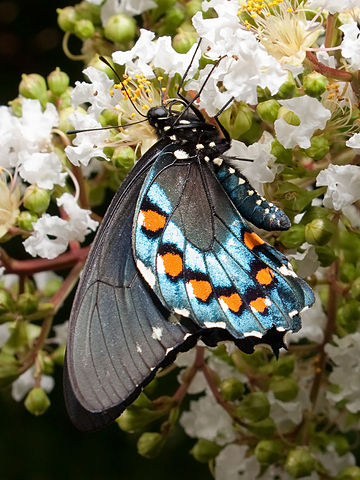
320px-Pipevine_swallowtail_butterfly Devilrose 8 wikimedia commons

Pipevine Swallowtail Butterfly – Source: Public Domain, Wikimedia Commons

Each year, in June or July, a group of volunteers goes out and counts butterflies.

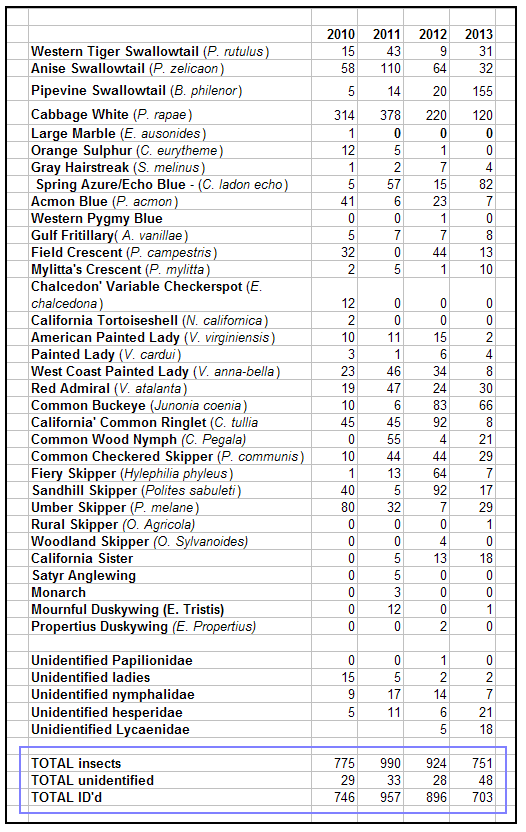
This year’s butterfly count in San Francisco was on June 8th, and yielded 751 individual butterflies, of which 703 were identified by species. (The spotters ID’d the remaining  48 only by family.) It’s down quite a bit from last year and the year before. It added one butterfly not recorded here before: the Rural Skipper.

But the real surprise was the butterfly that topped the list.  This is the first year since 2010 (when we started following the San Francisco Butterfly count) that Cabbage Whites did not top the list.

Instead, they were overtaken by the Pipevine Swallowtails from Angel Island, where a count of 140 butterflies of this species added to the 15 spotted on the mainland to bring the total to 155.

THE TOP THREE BUTTERFLY SPECIES

Cabbage White sitting on Oxalis

Cabbage White sitting on Oxalis

The top three butterflies of 2013 were the Pipevine Swallowtail, the Cabbage White, and the Echo Blue, AKA the Spring Azure, and they accounted for just over half the identified butterflies. (There were a few that were id’d by family but not species.)

  • Last year, 2012, it was Cabbage White in first place, with the California Common Ringlet and the Sandhill Skipper tying for second place, and the Common Buckeye in third place.
  • In 2011, the Cabbage White, Anise Swallowtail, and Echo Blue.
  • In 2010, the Cabbage White, the Umber Skipper, and the Anise Swallowtail.
Source: Katja Schultz, Wikimedia Creative Commons

Echo Blue Butterfly. Source: Katja Schultz, Wikimedia Creative Commons

  • The top three butterflies usually account for around half of the butterflies identified. This year, it was 50%. In previous years, it’s varied between 44% and 58%.
  • The ten most seen species accounted for 85% of the total butterflies spotted, around the same as in previous years, when it was 82-85%

San Francisco Butterfly Top Ten 2013

WEATHER AND BUTTERFLIES

This is an annual count, and it’s nationwide. The North American Butterfly Association (NABA) sponsors a “July 4th” butterfly count; it’s a count of all the species volunteers spot within a 15-mile radius on a particular day in the 4 weeks before or after July 4th. In San Francisco, it’s usually organized by Liam O’Brien who keeps the www.sfbutterfly.com website and blog.

The problem for San Francisco is that June and July weather is notoriously variable, largely because the fog can roll in at any time and create completely different weather conditions. This year’s count on June 8th took place over a month earlier than last year’s Count That Nearly Wasn’t (July 24th). The weather started out warm, but the fog arrived around noon, and that would have affected the numbers.

In 2010, it was held on June 7th on a foggy day; in 2011, it was held on July 3rd, a month later and the weather was bright and sunny. In 2012, it was foggy but clearing to sunshine on July 24th. As the timing and weather changes, so do the butterflies seen. 

Butterfly Count HistoryThe number of people seem to matter less… there’ve been only 16 people in 2012 and 2011, compared with 34 in the two earlier years. But the number of butterflies spotted didn’t seem directly correlated. Neither did the number of parties – 9 this year and last year, 10 in 2011, and 14 in 2010.

The other factor that could affect the butterflies is, of course, the preceding rainy season. If it’s too dry for their favored plants to do well, fewer eggs are likely to make it through the larval stage and pupation.

THE PIPEVINE SWALLOWTAIL

Battus_philenor_02 Kaldari Wikimedia Commons Public Domain

Pipevine Swallowtail Butterfly – Source: Wikimedia Commons, Public Domain

According to the wonderful butterfly website from UC Davis’s Professor Art Shapiro, the pipevine butterfly has an interesting relationship with its nursery plant, a vine called Dutchman’s Pipe, (Aristolochia californica). The plant contains aristolochic acid, which makes the caterpillars poisonous, so they don’t get eaten.

But it also means that the little caterpillars have to eat the youngest and most tender leaves that don’t have enough of the stuff to kill them. The larger leaves are okay for the larger caterpillars, but only in small doses; as they eat it, the plant responds by increasing the aristolochic acid content, so the larvae are forced to move on to other leaves. They sample all the leaves, but don’t eat enough to kill the plant. (They can, however, eat so many of the seeds that the plant fails to reproduce that year.) The adult butterflies nectar on a variety of flowers, but they apparently only reproduce on aristolochia plants.

DETAILED RESULTS

Butterfly Count ListIf you want to read back, the articles for previous years are here:

Click here for: Article on the 2012 San Francisco Butterfly Count results.

Click for: Article on the 2011 San Francisco Butterfly Count results.

Click here for the article on the 2010 San Francisco Butterfly Count results.

Posted in Environment | Tagged , , | 3 Comments

Presentations: How Did it Become Mt Davidson?

Mount Davidson – the smaller, taller forested mountain just to the south-west of Mount Sutro. Like Mount Sutro, it’s a forest surrounded by neighborhoods. Unlike Mount Sutro, it has a landmark cross on top, visible above the trees.

How did it get that way?

mount davidson forested 2009

Why is the Eastern side treeless?

If you took historian Jacquie Proctor’s hiking tour of Mt. Davidson for SFFA last year, these questions were answered.

But whether or not you did: you are invited to her ALL NEW slideshow this summer about the history of the City Beautiful Movement-inspired neighborhoods on the slopes of San Francisco’s highest hill––Mt. Davidson––as well as the story of the unique City park and monument at its peak, as featured in her book, San Francisco’s West of Twin Peaks. See the following San Francisco Public Library locations and dates:

Tues., June 18 at 7 PM – Parkside Branch (1200 Taraval St at 22nd)
Tues., July 2 at 6:30PM – Anza Branch (550 37th Ave.)
Wed., July 10 at 7 PM – Merced Branch (155 Winston Dr.)
Sat., July 13 at 2 PM – Ingleside Branch (1298 Ocean Ave. at Plymouth)
Mon., July 29 at 7:00 PM – Sunset Branch (1305 18th Ave.)

Jacquie Proctor on Mt D

Posted in Meetings | Tagged , , | 1 Comment

Hiking through Mount Sutro Forest – Tony Holiday (Part 2)

Tony Holiday is a San Francisco resident who likes hiking the area. This is republished with permission and minor changes from “Interior Greenbelt Unmarked” on his blog, Stairways are Heaven.

In this, the second of two articles, Tony hikes up Stanyan in Cole Valley – which is steep enough for sidewalk steps at the upper end – then goes through the forest, and then goes out through the Oakhurst Lane staircase in Forest Knolls, down to Warren Drive and the Garden for the Environment on 7th Avenue.

[Read the previous article here: Hiking Through Mount Sutro Forest – Tony Holiday (Part 1)]

———————

INTERIOR GREENBELT UNMARKED
(May 18, 2013)

Several years ago the uppermost Interior Greenbelt Trail into Mount Sutro Forest was a tad more challenging, when I’d pull myself up along the side of a building just before exiting at the Aldea residential area.

This trail’s at the top dead-end of Stanyan, a short distance above the Stanyan trailhead for the lower Historic Trail. [Webmaster: See Hiking Through Mount Sutro Forest Part I.] Upper Stanyan’s steep, with sidewalk steps on both sides (pics 1 through 4).

1. Stanyan sidewalk steps up to Belgrave - Tony Holiday2. Stanyan sidewalk steps up to Belgrave - Tony Holiday3. Upper Stanyan sidewalk steps - Tony Holiday4. Upper Stanyan sidewalk steps east side - Tony HolidayTurning right at Belgrave & Stanyan will take you to a trail-head with old wood posts and a few steps into the forest (pic 5); no trail markers at either end. It’s steep; you don’t want “challenging,” bypass this one. Last time I was there, a guy was walking his bike up.

5. Interior Greenbelt trail at Belgrave at top of Stanyan - Tony Holiday(Another trail can be seen here, an offshoot from this one, that veers to the right just behind upper Stanyan homes but then climbs so you’re not overly close to their backyards. This was recommended by a fellow hiker a while back and twice trekked by me. But this is rougher than the main one and difficult to follow at times. It does, however, exit partway along the lower Historic Trail. Might this be a possible future trail extension to connect with the Lower Historic Trail from the Belgrave trailhead?)

But I digress. Partway up the main one, a tree limb across the trail is perfect as a bench. Climb over and continue up, eucalyptus aromatherapy, birdsong, and unspoiled forest surrounding you (pic 6).

6. Interior Greenbelt Trail Sundappled forest - Tony Holiday

7. Upper Greenbelt Trail zigs around and continues up - Tony HolidayIt zigs by the foot of a residence (pic 7) and comes out (more easily these days) at Behr & Johnstone, with a trailhead-with-marker for the delightful Fairy Gates Trail (pics 8, 9, 10) nearby.

8. Fairy Gates Trail - Tony Holiday9. Further on Fairy Gates Trail - Tony Holiday10. Fairy Gates Trail meets Medical Center Way - Tony HolidaySlightly uphill from here is the Aldea Center (11th pic) and trail head for the East Ridge Trail.

11. Aldea Center - Tony Holiday

STAIRWAY IN FOREST KNOLLS NEIGHBORHOOD

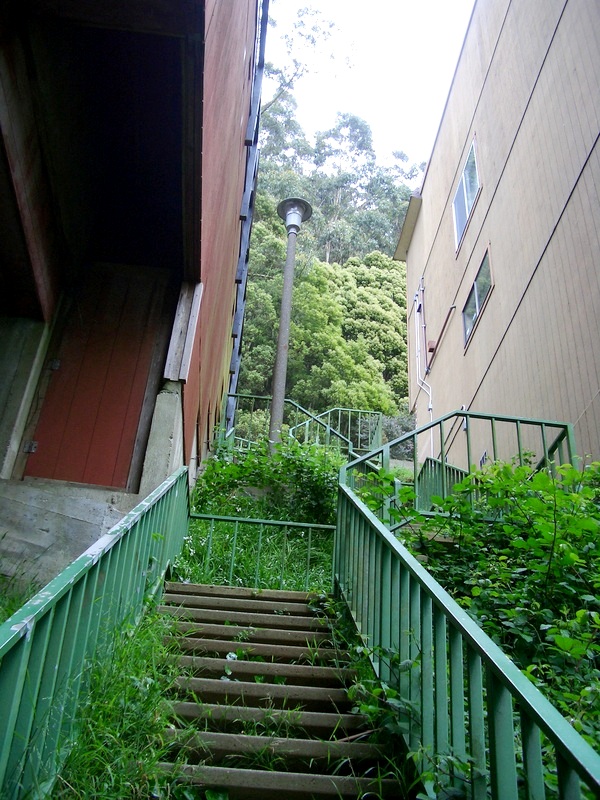
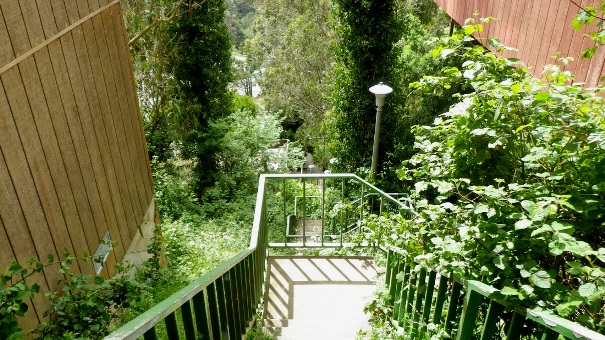
Back down to Clarendon and a block or so to the west to enter the Forest Knolls ‘hood at the foot of Christopher, then onto Crestmont. Winding past Devonshire and the “Not a Through Street” signs, to descend the 355 Oakhurst Lane steps (pics 12, 13, 14, 15) to Warren…

12. Oakhurst Lane 1 - Tony Holiday13. Oakhurst Lane 2 - Tony Holiday14. Oakhurst Lane 3 - Tony Holiday15. Oakhurst Lane 4 - Tony Holiday…onto Locksley, and into Garden for the Environment via the short rope-railed garden stairway here.

16. West Side of Sutro Forest 1 - Tony HolidayLast pic: west side of Forest Knolls and Sutro Forest. [Webmaster: Garden for the Environment is just visible to the left of the picture, behind the black car.]

————————–

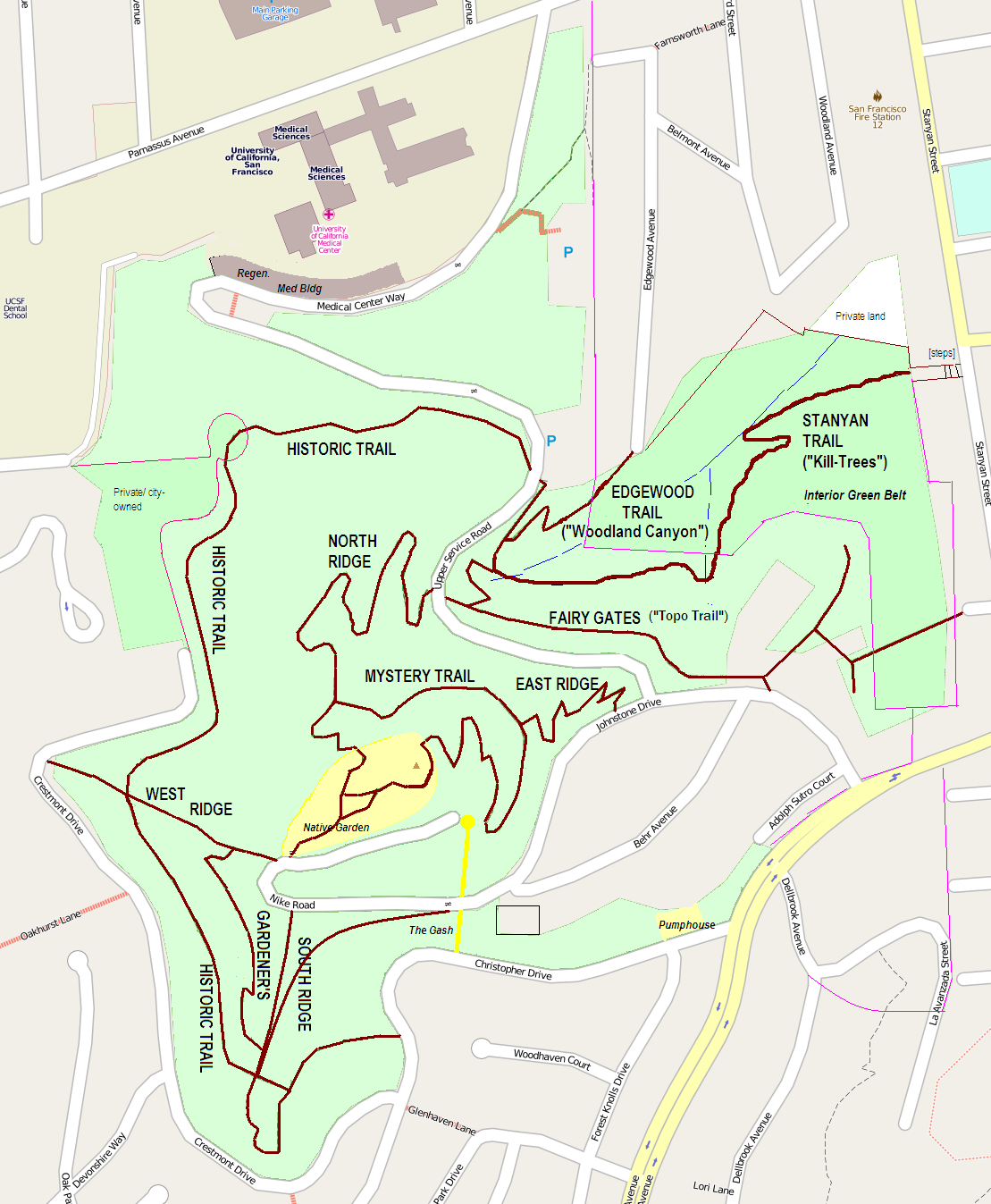
[Edited to Add: These maps may help to trace the route.]

Save Sutro Forest Trail Map

Posted in Environment, Hiking, Mt Sutro Cloud Forest | Tagged , , | 1 Comment

Hiking Through Mount Sutro Forest by Tony Holiday (Part I)

Tony Holiday is a San Francisco resident who likes hiking the area. This is republished with permission and minor changes from “Both Historic Trails” on his blog, Stairways are Heaven.

This, the first of two articles, describes a hike that starts at the trailhead on Stanyan just above 17th, and ends at Parnassus near the UCSF campus.

————————–

BOTH HISTORIC TRAILS
(May 18, 2013)

Mount Sutro’s lower Historic Trail (Interior Greenbelt Park) begins at Stanyan (across from 17th), where another of those park trail infosigns has been added (first pic), and climbs up through the Interior Greenbelt part of the forest.

Trailhead at Stanyan above 17th - Tony Holiday

Two more new signs have been added at this trail head: “Quiet please up to the Forest 125′ ” and “Quiet down to the Street 125′ ” (it starts off between homes on Stanyan): second pic. This trail’s between two others just recently hiked.

trailhead at Stanyan - quiet up to the forest - Tony Holiday
The lower Historic winds up ‘n around (pics 3 through 6) and connects with the Fairy Gates and Edgewood Trails.

lower historic trail - Tony Holidaylower historic trail 2 - Tony Holidaylower historic trail 3 - Tony Holidaylower historic trail 4 - Tony HolidayCrossed the road at the end of the Fairy Gates (pic 7) to continue steeply up, past the nursery and onto the short, unmarked Quarry Road Trail. At the end of this is a marker for the upper Historic Trail.

Fairy Gates Trail start - North Ridge trail to left - Tony HolidayPaused for lunch on the Historic at a favorite rock just off the trail (pics 8 and 9), curving around to the north with the hospital buildings seen below through the trees, and down to the road.
Upper Historic Trail - Tony HolidayUpper Historic Trail - Road below is Medical Center Way - Tony HolidayA THEN pic (10): the grand opening of the newly discovered and renovated Historic Trail back in 2007, a free grouphike.

THE 2007 Grand Opening of newly discovered Historic Trail - Tony HolidayThis was the way we first reached the trail back then, alongside the tank; now the trailhead looks like this: pic 11.

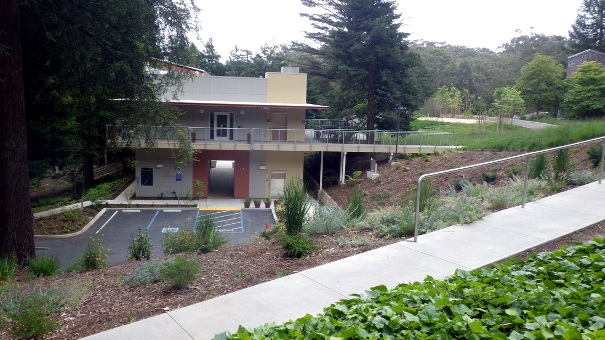
NOW - Trailhead for Historic Trail up from Medical Center Way - Tony HolidayFrom here it’s a short distance through the permits-only parking lot to descend the attractive wood-railed, wood-and-concrete stairway (135 steps: pics 12 through 16).

North stairs up from Medical Center Way - Tony HolidayUp to the permits-only parking lot - Tony Holiday135 steps on this side - Tony HolidayStairs up into the forest - Tony HolidayPartway up - Tony HolidayAt the foot, just follow Medical Center Way around from the backs of the hospital buildings out to busy Parnassus.

————————–

[Edited to Add: These maps may help to trace the route.]

Save Sutro Forest Trail Map

Posted in Environment, Hiking, Mt Sutro Cloud Forest | Tagged , , | 3 Comments

People Overwhelmingly Favor Preserving Mount Sutro Forest

In recent weeks, we’ve had several developments regarding Sutro Forest.

COMMENTS OVERWHELMINGLY FAVOR PRESERVING THE FOREST

UCSF has compiled and published the public comments on the Draft Environmental Impact Report (DEIR).  Though the comments are meant to address the DEIR, many commenters treated it as a referendum and showed their support for preserving Sutro Forest as it is.

UCSF received 189 comments; 164 opposed the plan, and only 20 supported it. Another 5 were ambivalent or supported part of the plan and opposed other aspects of it. That’s a ratio of 8:1 in favor of preserving Sutro Forest.

They’re available as a PDF here: MtSutroDEIRCommentLetters

sutro forest

The next step will be for UCSF to respond to the comments and publish the final EIR; after that, the University of California’s Board of Regents will need to certify that the EIR is complete, and then they can approve the project.

Demonstration Area #4

CLICK HERE FOR SUTRO FOREST VIDEO

Tree-felling in the Demonstration Areas could begin by mid-August after the bird nesting season. Ron Proctor made an 8-minute video about  Sutro Forest, showing the Demonstration Area plans. Please do take a look, and share it with others who may be interested.

APRIL 21 MEETING

The April 21st meeting drew around 30 energized supporters, who are taking the initiative to spread the word. We had presentations on Sutro Forest, Mount Davidson (where 1600 trees are to be felled), and the San Francisco Forest Alliance’s mission to preserve public parks for the public. We hope to make these presentations available online soon.

PESTICIDES AND CANCERSutro DEIR pesticides

At the meeting, Dr Morley Singer talked about a new article in the (peer-reviewed, highly-respected) journal of the American Cancer Society, reporting a link between cancer and pesticides.

SFForest.net reported on that in an article called Pesticides and Cancer, Glyphosate and Gut Bugs. It pointed out that one of the pesticides specifically mentioned was glyphosate (Aquamaster/ Roundup), and also discussed an article that showed glyphosate could adversely affect the friendly bacteria in human intestines, causing health issues.

Glyphosate is one of the pesticides that UCSF could potentially use in Sutro Forest.

COST ESTIMATES

UCSF draft report coverWe obtained some Sutro Forest cost information from UCSF. The meetings held in 2009 and 2010 and all the outreach cost around $52 thousand. Preparing the EIR is budgeted at $275 thousand, all of it to outside consultants or contractors. (They don’t appear to keep track of the time spent by their own employees, though it’s clearly substantial.) Most of this amount came from the Campus Planning budget, but $65 thousand came from the Chancellor’s Fund.

We are still trying to get estimates of the cost of implementing the Management Plan.

Posted in Environment, Mt Sutro Cloud Forest, UCSF | Tagged , , , | 2 Comments

Sutro Stewards: The Good, The Bad, and the… ???

In recent months, many people have asked us about the Sutro Stewards, and we’d like to explain our position. We’re not affiliated with them.

The Sutro Stewards are a volunteer group that works primarily on Mount Sutro. Craig Dawson is the Executive Director. The group originated under the umbrella of Nature in the City, an organization promoting native species of plants and insects in San Francisco. Currently, it’s a partner of The Parks Alliance.

It’s a group we wish very much we could supportbut we don’t. This is why.

THE GOOD

First, credit where credit is due.

sutro forest path

  • The Sutro Stewards have, since 2005, kept the trails clear. Sutro Forest is a temperate cloud forest, or fog forest; it captures most of its summer moisture from the fog. In common with cloud forests everywhere, its understory grows dense. Without maintenance, the trails get overgrown.
  • They built the “Historic” Trail on the upper part of the mountain with the loss, according to Craig Dawson, of only one tree.
  • Native Plant replanted meadowThey also maintain the native garden at the summit. Contrary to the popular belief that native gardens need no work because they’re perfectly adapted to the place, it actually takes many labor-hours of maintenance. It also requires persistence. They have been trying to restore one small section of meadow as a section for Native pollinators for over two years now; it still has more orange flags than flowers.
  • Especially laudable: They do so without using any pesticides.
  • The Sutro Stewards regularly organize two or more volunteer days every month with (UCSF-provided) pizza and (donated) beer on offer. The SF Urban Riders (bicycle-riders who ride the trails) often provide much of the physical labor – which other forest-visitors may not know.

THE BAD

But here’s where we part company. Their vision for the forest is — not a forest. It’s an “Open Space” with native species of shrubs and grasses and plants, and a few oaks and redwoods. It’s trees spaced even further apart than the 30-60 feet provided in the UCSF Plan.

In our opinion, this forest is a unique treasure for San Francisco — a de facto cloud forest at near sea level, made possible because it lies within the fog belt. Destroying this ecosystem would be a tragedy.

Copyright Paul Hudson

Copyright Paul Hudson

where the understory has been gutted - Mount Sutro ForestMuch of the work the Sutro Stewards do destroys habitat and has a negative impact on the forest’s ecosystem. Separately from keeping the trails open, the Sutro Stewards also remove or mow down large sections of the understory, even when it is not directly on the trail.

Executive Director Craig Dawson has made a public comment on UCSF’s Draft Environmental Impact Report on Mount Sutro Forest. UCSF has published the compilation of the comments (189 of them, opposing the plan by a ratio of 8:1), and it’s available here: MtSutroDEIRCommentLetters

Mr Dawson’s comment is on page 327 of the document. It’s quite detailed. We’ll try to summarize his points here (and readers are welcome to read the document for themselves). In brief: He considers the forest a danger, and unhealthy. He supports the UCSF Plan, though with some exceptions:

  • He believes even more trees should be felled. The tree-spacing (at 30-60 feet) is too close. He also wants all eucalyptus along the creek to be removed. If this were implemented, our tree removal estimates would be conservative.
  • Sutro DEIR pesticidesPesticides should be used on a wider range of plants than those specified in the plan. Presumably, this would mean more pesticide use than the already huge amounts described in the Plan.
  • Demonstration Area #3 (where eucalyptus shading the reed grass is to be removed) should not be done. The reed grass needs the moisture the trees provide. (We actually agree with this. The Pacific reed grass is a forest species, and often associated with eucalyptus. There’s a similar issue on Mount Davidson, where the Natural Areas Program asks for tree-felling to benefit reed grass  – but will probably kill it.)
  • He wants more native vegetation to be grown on Mount Sutro. (We actually do not have a problem with native plants, only with the destruction of the ecosystem and habitat that already exists there.)

Of course, we disagree completely with his characterization of the forest (which we consider healthy, based on the assessment of two certified arborists and an ecologist) and safe (based on the assessment of CalFire). We also completely disagree with his recommendations.

His support for tree-felling comes as no surprise, (though we were startled that he asks for even more than the Plan says).  At every meeting we attended, the Stewards and their allies supported this plan.  Peter Brastow of  Nature In the City, originally the parent organization of Sutro Stewards, referred to eucalyptus as a “weed” during one of UCSF’s meetings. And in the process of opening the new trail that connects Stanyan with Medical Center Way, a lot of trees were felled  in the City-owned portion of the forest — as noted on this website earlier.

Neither does the support for pesticide use surprise us.  Speaking at the UCSF scoping meetings, the Sutro Stewards also supported that. At present, UCSF uses no pesticides at all on its portion of the forest.  The Plan potentially permits the use of pesticides such as glyphosate (Aquamaster or Roundup) and Garlon. We strongly oppose this  — particularly since the forest is on high ground above residential neighborhoods and the Bay.

We believe the Sutro Stewards play an important role in UCSF’s potential actions. Executive Director Dawson has been a member of UCSF’s Community Advisory Group (CAG) for decades, and also of the Parnassus Community Advisory Team (PCAT). In his comment, he mentions being “directly involved since 1997.” In our opinion, he and his allies have been an important factor in developing this Plan. We surmise that UCSF would be unlikely to proceed without the backing of the Sutro Stewards, who currently do most of the work on Mount Sutro.

HUH WHAT?

As this website indicates, we’re in favor of debate and discussion on these issues. We get the impression that the Sutro Stewards and some of their supporters prefer to block dissent. Some examples:

  • The Legal Letter: Readers of this website may recall the strongly-worded legal letter in behalf of Sutro Stewards from a prominent law firm, saying we were defaming the Sutro Stewards by alleging they were felling trees and applying herbicides. Of course they weren’t – they were supporting tree-felling and pesticide use rather than performing them. (We weren’t allowed to publish the letter, but we have related its contents in our response. ) This letter also stopped us from using certain maps illustrating the UCSF plan for discussion and criticism. They were taken from a UCSF publication outlining the plan. The publication contained no indication that the maps were copyright to anyone beside UCSF, and indeed, it resembled a map that UCSF had earlier published under its own copyright. Even though we disagree on forest-related issues, UCSF so far has never objected to the use of their illustrations for the purpose of discussion on this website. (Yes, UCSF does know about this website.)
  • A Facebook Freeze: Even before that, when we posted a comment responding to something they wrote on the Sutro Stewards Facebook group, our response was promptly deleted. That Facebook presence is managed by the Sutro Stewards Executive Director, Craig Dawson, and several associates.  More recently, similar responses have been reported by others, including someone who wrote to us.

WE DISAGREE WITH THE SUTRO STEWARDS

We believe debate and discussion are important. We’ve hosted opposing views on this site, and made every attempt to respond to them. (With some exceptions:  our comment policy is HERE).  We sympathize with the saying (misattributed to Voltaire according to Wikiquotes, it was actually Evelyn Beatrice Hall, writing under the pseudonym of Stephen G Tallentyre): I disapprove of what you say, but I will defend to the death your right to say it.

But we do disapprove. We completely disagree with felling of thousands of trees, use of pesticides in one of the few wild areas that have been free of them for years, and the mowing down of most of the understory habitat. We are saddened that the group has stewardship of a forest whose very components they despise as non-native and invasive: eucalyptus, blackberry, acacia, ivy. It’s a forest in the hands of its enemies.

sunlit woods

Posted in Environment, eucalyptus, Herbicides, Mount Sutro Stewards, nativism, UCSF | Tagged , , , | 8 Comments

May 2013: Mount Sutro Forest Hike in a Dry Spell

We’ve had an unusually dry winter here in California, and even San Francisco’s had a hot spell recently. So what’s happening in Mount Sutro Forest, usually so damp and green?

In brief: It’s not damp, but it is green. The trails are all dry now – and the understory is still green and lush where it’s been allowed to thrive.

still lushThe forest is beautiful right now. Even the small plants and grasses by the trail edge aren’t dying or stressed by drought.

Sutro Forest - herbaceous layer is still green

Mount sutro forest - still green

This fine Sunday afternoon, we encountered a few other people – maybe a dozen hikers, two with dogs and one with a baby; two joggers, one with music; and a bicycle rider.

Mount Sutro Forest with visitors

There’s been quite a lot of understory removal in various areas; while this destroys habitat, it does make the birds easier to spot. (We’re unsure this is an improvement from the bird’s point of view.) There were wrens darting around under the blackberry bushes, juncos flying around the forest, bushtits busily foraging…

CREATING A FLAMMABLE FOREST

There are a few dry areas. The grass  in the Native Garden is beginning to yellow.

yellowing grass in Mount Sutro's  Native Plant GardenBut the worst spots are areas where the understory has been removed and left covered in sticks and bark.

Undergrowth removal dries out the forest

As a result of talking up of the fire hazard – irresponsibly, in our opinion – people have become concerned. Here’s reader Thom Taylor’s comment on our previous post: ‘…you keep mentioning that Sutro is a “cloud forest”, but with the record heat we’ve experienced over the past week and a half we haven’t seen a drop of moisture in the Bay Area. I was hiking Sutro yesterday and it is incredibly dry up there right now. Are you arguing that even during these spurts when we experience extremely warm temperatures that a dry forest like Sutro would pose no fire danger?’

As these photographs show, the fire danger is not from the forest where it’s lush and dense. The plants there remain green year round – even through dry spells like this one – so they contain and retain moisture. They slow evaporation by trapping moisture, protecting it from sun and wind. Moisture content is an extremely important factor in reducing fire risk.

But this forest, that usually has a very low fire risk, can be made more flammable. When the understory is mowed down or ripped out, and instead there’s  flammable sticks and bark. Or when it’s opened enough that the small plants and grasses actually do dry out – like in the Native Garden.

There’s been no rain for over 2 weeks. But the forest still hasn’t dried out, unlike the Native Garden grasses. The trails are dry, but the plants are not.

We’ve had no rain these past two weeks, but we have had a little fog some nights – and that’s been enough to keep the forest green. The trees harvest the moisture, and the layers of vegetation conserve it by retarding evaporation. This is the mechanism that the Plan will destroy.

With 90% of the trees and understory gone, the moisture will quickly evaporate. The increased wind will worsen the effect. The driest parts of the forest right now are where the Sutro Stewards have denuded the trails of their understory.

If UCSF was actually concerned about fire hazard, here’s what they would do:

1)  Discourage the Sutro Stewards from removing this dense green understory.  Blackberry and ivy don’t burn readily. Cape Ivy is particularly fire-resistant because of its high moisture content.

2)  Check to ensure that the Native Garden’s existing irrigation system remains functional, even if the plants are not irrigated once they are established. The Native Garden has fine fuels in the form of dry grass, and is probably the most flammable area of the forest.

3) Encourage forest neighbors to check for fuel build-up on their roofs, especially in winter when they may be using their fireplaces. This could be done by simply sending round flyers once or twice each season.

understory removed along East Ridge trail

Posted in Environment, eucalyptus, Sutro Forest "Fire Risk" | Tagged , , , , , | 6 Comments

Sutro Forest “Fire Hazard” – Lesson from the Oakland Hills

We are publishing, with permission and minor edits, this statement from a Board Member of the Hills Conservation Network.  This East Bay organization includes among its Board people who were directly impacted by the Oakland fire, and are dedicated to improving fire-safety – and not by felling trees.

——————————————–

LESSONS FROM THE OAKLAND HILLS FIRE OF 1991

I do not live in San Francisco, but I have occasionally enjoyed hiking the trails of Sutro Forest.  Last time I was there I encountered a professional photographer who was taking photos for a magazine in New Zealand.  She told me that she had not expected to see such a unique forest in the middle of a city. She said she would value the photos she had taken of Sutro Forest more than any photos she had taken of S.F. City streets and the Bay, including the view from Marin Headlands.   She described the experience of being in Sutro Forest as”spiritual” and inspirational, a “rare find,” not at all what she had expected to see in San Francisco.

Demonstration Area #4

As a representative of Hills Conservation Network (HCN), I want to primarily address the issue of fire hazard.

All of the members of HCN’s board of directors live in the North Hills of Oakland, within the area that was almost completely burned in the Oakland-Berkeley fire of 1991. My house, built in 1939, is in a strip of about 15 houses on Alvarado Road that did not burn, although all of the houses and vegetation (plants and trees, native and nonnative) above and below that strip, as well as everything across the street burned to the ground.

My family was fortunate. We do not know why these 15 houses and a few others here and there in the hills were spared. But we do know that the fire stopped just as it reached three towering eucalyptus trees that stand at the edge of Garber Park, a 13-acre city of Oakland park that also did not burn in the fire (even though it was and still is filled with largely unmaintained trees and understory). The flames of the fire did not touch those three eucalyptus trees which had stood there for more than 100 years, even though at that time, there was plenty of bark litter on the ground under them.

After the fire, as you can imagine, fire survivors cast a great deal of blame on various public agencies, including first responders such as the Oakland Fire Department (OFD), for its lack of training in fighting wildfire. (In fact, an Oakland fire fighter had restarted the fire on Sunday morning when he walked, stamping his boots, over the cinders and ash left from a small fire that had seemed to have been extinguished the previous day. As he walked, sparks and embers lying under the cinders flew up; the hot wind carried those sparks into dry grass and brush, and then into pines–that is how the Sunday fire started and soon spread out of control as the flames ignited wooden roofs and houses close by.)

I won’t list all of the issues that led to the rapid and tragic spread of the 1991 fire. The important ones were that:

  • After the first 20 minutes, there was no power to pump the water uphill–so there was no water in the hydrants;
  • There was a total lack of radio communication between the OFD and fire districts from neighboring towns that had tried to come to Oakland’s aid;
  • The streets in the hills were narrow and winding;
  • Cars had been allowed to park on both sides of the street, so fire trucks could not get up to the fire, and residents could not get out – some of them died trapped in their cars.

I will not deny that trees of all species, native and non-native, did help to spread the fire. But some eucs and other tall trees with hardwood trunks were still standing–with their leaves intact–in various places where everything else burned. After the first half hour of the fire, the flames were leaping from house to house, not from trees to houses, although the trees close to and leaning over houses burned, especially where dead leaves had fallen into gutters, and the house was unlucky enough to have wooden shingles.  Even though it was a hot day, the trees did not “explode.” The popping and banging sounds came from cars exploding as gas tanks ignited.

Yet within two years after the fire, the eucalyptus trees were being blamed for the fire–and to prevent another terrible fire, the advice was to remove all of the eucalyptus in UC owned forests, in East Bay Regional Parks, and in Oakland’s public parks that had not even been involved in the fire–and were several miles from any structure.  It was certainly easy and safe to scapegoat the eucalyptus trees since they could not defend themselves and native plant advocates in this area had been trying to get them removed for years, a campaign that is still going on. We trust that UCSF will be able to see through the fog of this propaganda campaign against nonnative vegetation, and make a decision that will be best for both fire safety and Sutro Forest.

Our organization, Hills Conservation Network, came together because a group of fire-area residents realized that it was important for fire safety to research and publicize the real reasons why the 1991 fire spread out of control so quickly. The majority of those on our board of directors lost their houses in the fire. So, we did not start our organization because we are “tree-huggers.” We are committed to learning as much as we can about preventing wildfire and educating our neighbors about the importance of big hardwood trees (such as eucalyptus) in providing not only carbon storage that cuts the greenhouse emissions warming our planet, but also in mitigating fire risk.

Based on our experience of the 1991 Oakland-Berkeley fire, and on our research,  we of the Hills Conservation Network believe that Mt. Sutro forest should be preserved. Even more than the trees in Garber Park, that, I repeat, did not burn, even though they were close to the fire, the tall trees of Mt. Sutro are draped in cooling mist for most of the year. The understory at Mt. Sutro is moist, providing an almost fire-proof ecology.  If this understory is removed, and the trees are removed, what you will have left are weeds, growing profusely in the sun once the shade canopy of trees is no longer there.

Board member
Hills Conservation Network

——————————————————–

ABOUT HILLS CONSERVATION NETWORK

Based in San Francisco’s East Bay, the Hills Conservation Network (HCN) is committed to fire mitigation in the hills without deforestation.  The HCN website is HERE, and their blog is HERE.

They issue quarterly newsletters following fire hazard reduction and tree-protection issues. Their Autumn 2012 newsletter (PDF) featuring the Oakland Fire Department’s response to some of the issues in the 1991 fires is HERE .

They are currently battling a plan to cut down hundreds of thousands of trees in the East Bay, and are in the process of raising funds for a potential legal defense. That information is HERE.

Posted in Environment, eucalyptus, Sutro Forest "Fire Risk" | Tagged , , , , , | 4 Comments

A Tree Story in Mount Sutro Forest

There’d been a couple of really windy days in San Francisco recently, and trees went down all across the city. In Sutro Forest, too, one fell across a trail. We received notice of it from UCSF’s Damon Lew:

“Due to the high winds earlier this week we have been notified of a downed tree in the Mount Sutro Open Space Reserve.  The tree pictured below has fallen across one of the unnamed trails (between the Historic and South Ridge Trails) impeding passing.  The location of the tree is denoted by the “X” on the map included below and we are hoping to have Bartlett’s Tree Experts onsite this week to remove the fallen tree from this location.  If you happen to be visiting the area please be aware of this hazard and feel free to contact me with any questions.”fallen tree location UCSF letter 9 april 2013

In fact, they had Bartlett there within three days. That’s when we received a message from a someone who had been in the forest and saw at least four trees that had been taken down that had been standing the previous week. “I thought UCSF wasn’t starting this till August,” they asked, “Was I wrong?

tree-noteWe wondered, too, and went into the forest for a look. The downed tree had been sectioned so the trail was passable, but a number of other trees had been cut down too.

Among them was the “Please don’t cut me down” tree we’d seen on a recent walk. It lay beside the trail, no longer a snag but a log.

smiley face tree

We sent an email to UCSF about the trees, and Barbara Bagot-Lopez responded that she’d check with Facilities Management. Later she wrote, “I confirmed that UCSF has not cut down any trees. I believe they have removed the tree that fell and was blocking the trail.”

Not quite, we explained when we wrote back.  “They cut through the fallen tree to open up the trail, which is good. (They’re not actually *removing* the trees.) But they also did cut down some other trees around the fallen tree, so perhaps the information they gave you is not 100% accurate. (See the photographs attached – it wasn’t just the fallen tree.)” And we attached a few photographs, including the one above.

We honestly didn’t expect to hear anything more. But yesterday, we – and everyone on the UCSF listserv – got this message:

“This is a follow-up to the communication below notifying the listserv of an emergency tree removal in the UCSF Mount Sutro Open Space Reserve.   On April 10th, Bartlett Tree Experts (Bartlett) was onsite to remove a downed tree that had fallen over on a trail during the April 8th windstorm.  While on the site, a Bartlett employee noticed additional trees in the immediate area that were marked with orange paint.  The marked trees are part of a separate, ongoing maintenance project to identify dead and hazardous trees for possible future action.

“Bartlett independently chose to remove 12 trees, upon determining that their condition could lead to possible failure and pose a safety hazard to trail users. The removal of the additional trees was not authorized by UCSF.  Bartlett subsequently informed UCSF that the 12 trees were all dead, each smaller than 12” in diameter, and several had sustained additional damage by the original fallen tree. 

“Any tree removal performed within the Reserve requires prior written authorization from UCSF Facilities Services, which this did not have.   Bartlett has accepted full responsibility for the unauthorized removal.  UCSF has suspended any further contracts with Bartlett for a period of 90 days, which includes tree-pruning work along Nike Road, for which another contractor is being sought.

 “We will continue to notify the Sutro listserv of future routine maintenance actions taking place within the Reserve.”

So we appreciate that they made the effort to get to the bottom of it.

But wait – was the Nike Rd work supposed to have finished by now? Here’s what they wrote the listserv about that:

I’m writing to inform you that Bartlett’s Tree Experts will be pruning several trees along Nike Road this week beginning on Tuesday, April 16th.   Approximately 14 trees will be pruned along Nike Road (see attached map) as they have branches that are bowing out above Nike Road.  These branches pose a potential safety hazard to those using the road.    The work will be performed from April 16-18 with no noisy work before 9:00 am and after 5:00 pm.   Nike Road will be closed to public access during this time.

And we have to say – we’re a little troubled about the errant tree-felling. It reminded us of another mistake,  one that killed a bee-tree in Glen Canyon Park.  There seems to be an implementation problem in our parks and forests.

Nike Rd

Posted in Mt Sutro Cloud Forest, UCSF | Tagged , , | 4 Comments

San Francisco Bay Guardian: SH!T H@#PENED – The Battle of Mt Sutro

Who can resist a title like that?  “SH!T H@#PENED – The Battle of Mt Sutro”

So when one of our readers told us about this SF Bay Guardian article, we went looking online. No luck. We went right out for a paper copy. All the news-boxes were empty, but we found a few copies at a favorite cafe.

Here’s a photograph of the article, in two pieces. Clicking on them will make them large enough to read.

BG Sutro Forest April 2013

sf bay guardian story on Sutro Forest April 2013 pt 2

Posted in Environment, UCSF | Tagged , , , , , , | Comments Off on San Francisco Bay Guardian: SH!T H@#PENED – The Battle of Mt Sutro

The Importance of Eucalyptus

It’s Earth Day today, and we’d like to talk about the importance of Eucalyptus trees. Surprisingly, even some people who identify as environmentalists have no idea of the far-reaching value of these trees in our environment.

eucalyptus in san francisco

San Francisco has a lot of eucalyptus trees, mainly in its parks. According to a 2007 USDA report on San Francisco’s urban forest, this species accounts for over 16% of the the total of 669,000 trees in the city. This more than any other kind of tree. It’s a sturdy, fast-growing, graceful tree that grows where others will not – in areas of high wind.

(Monterey pine and Monterey Cypress are next, together accounting for about 12%. But unlike the eucalyptus trees, which are healthy and long-lived, many of these trees are nearing the end of their lives and have infections of bark beetles and pitch pine canker.)

CARBON STORAGE

looking up a treeAs we enter a world of increasing climate change, we’re starting to understand the value of carbon storage. Trees capture carbon dioxide from the atmosphere, and store it in their wood, roots and leaves – and in the soil beneath them. The actual amount stored is proportional to the dry weight of the wood and organic matter. Eucalyptus is particularly good at sequestering carbon.

  • Its wood is very dense, which means it holds more carbon for each cubic inch of wood;
  • It grows fast, which means it take up carbon quickly;
  • It grows large, which again means it stores more,  in the trunk and branches and its root system.
  • It lives a long time, around 400-500 years in the kind of wet conditions we have in San Francisco, which means it will not be giving back the carbon any time soon.

According to the Report, “Of all the species sampled, blue gum eucalyptus stores
and sequesters the most carbon (approximately 24.4% of the total carbon stored and
16.3% of all sequestered carbon).”

In places like Sutro Forest, where it grows in association with acacia trees – a nitrogen-fixing species – it’s even better at storing carbon. The carbon gets stored in the trees and the soil.  Sutro Forest is an excellent carbon sink.

HABITAT FOR WILDLIFE

flowering_gum with bees susan walter 3Eucalyptus is also excellent as wildlife habitat, despite contrary claims.

  • Summer Tanager eating bee, San Francisco. Copyright Mark Rauzon

    Summer Tanager eating bee, San Francisco. Copyright Mark Rauzon

    Eucalyptus has nectar-rich winter-blooming flowers. It’s the largest flowering plant in the world. In the Bay Area, it flowers when few other trees or plants are in bloom, and its flowers are rich in nectar. It provides a food source to insects and the birds that feed on them, as well as directly to nectar-feeding birds.

(And if you’ve heard the urban legend about eucalyptus resin killing birds – it’s not true.)

  • hawk nest by Janet KesslerEucalyptus trees provide nest sites for a whole variety of birds. As the trees mature, cavities form or are excavated by woodpeckers. These form nest sites not just for woodpeckers, but Western Bluebirds and other cavity-nesters. The crooks of the branches provide nesting spaces for Great Horned Owls and for Red-tailed Hawks.
  • Bewick's wren in San Francisco photo from SFForest.netWhere ivy or other vines are allowed to grow on eucalyptus trunks, they provide additional nest sites – as well as excellent cover for little birds, bats, and small animals to hide from predators like hawks.

In areas like parks – or Sutro Forest – where the leaf litter is allowed to accumulate under the trees, it provides an excellent habitat for small reptiles like salamanders. The damp environment is good for animals like banana slugs, which have been seen in the forest.

POLLUTION AND SOUND CONTROL

Like all trees and bushes, eucalyptus helps control pollution, especially particulate pollution. The particles are trapped on the leaves, and washed to the ground when it rains – thus staying out of our lungs. Barriers of trees and dense vegetation also help absorb the sounds of urban life.

The Report calculates an “Importance Value” based on the percentage of trees plus the percentage leaf area. For eucalyptus, that is calculated at around 27%. (Monterey Pine is higher, at 31%, but as we said – there are issues with the health of that species.)

SLOWING WATER RUNOFF

San Francisco is working hard to slow water run-off, to keep rain water out of our sewer system and let it soak into the ground. They’re encouraging people to use build sidewalk gardens and use permeable paving so water can get through to the ground rather than run off.

Eucalyptus is excellent at slowing water. It moves a lot of water, sucking it in through the roots, and transpiring it through its leaves.   The leaf litter and plants that grow below it also help in trapping wand slowing water. In San Francisco, they help enormously in slowing run-off; you can see the obvious difference after a rain-storm between the water running off Twin Peaks Boulevard in a river, and the relatively small amounts running off Mount Sutro.

NATIVISTS DESPISE EUCALYPTUS

As we’ve been reaching out to let people know about the threat to Sutro Forest, we’ve been encountering some people who despise eucalyptus. We’re not talking of developers, who don’t actually hate trees, only obstacles of whatever species or nature. We mean people who identify as environmentalists – as we do, too. But they have focused on Native Plants, and fail to recognize the importance of eucalyptus in our environment.

We urge UCSF, the Sutro Stewards, and SFRPD to recognize the urban environment we live in, and the unique value of eucalyptus in our city. No other tree is as useful from an environmental standpoint. It’s time to stop attacking these trees and to start recognizing how much they’re doing for us.

San Francisco had, in 2007, only 12% canopy cover – less than almost every city in the report except Jersey City, NJ. Our city cannot spare its majestic and valuable eucalyptus trees.

Two girdled trees

Posted in Environment, eucalyptus, Mount Sutro Stewards, nativism, Natural areas Program, UCSF | Tagged , , | 9 Comments

Save the Forests! Meeting – 21 April 2013

Jointly with San Francisco Forest Alliance, we’re holding a meeting about the planned tree-cutting – not just on Mount Sutro, but also on Mount Davidson and elsewhere in San Francisco.  It’s on Sunday, April 21, 2013 from 4.30 p.m. to 6.30 p.m.

Please come if you can!

————————————————

sutro-forest-south-view2

The San Francisco Forest Alliance and Save Sutro Forest are holding a meeting on 21 April 2013 to talk about the planned felling of trees on Mount Sutro — and on Mount Davidson. These actions would gut two important urban forests near our neighborhood and irretrievably alter the landscape.

forest-girl-3aDo you want to know:

  • How many thousand trees do they plan to cut down on Mount Sutro? On Mount Davidson?
  • Who’s “They”?
  • What about Pesticide use?
  • When will this happen?

For answers to these questions and more…
Come to the San Francisco Forest Alliance meeting.

WHERE: Miraloma Park Clubhouse, 350 O’Shaughnessy Blvd,  San Francisco, CA 94127

WHEN: April 21st, 2013 (Sunday) – 4.30 p.m. to 6.30 p.m.

Mount Davidson - also at risk

Mount Davidson – also at risk

Posted in Meetings, Mt Sutro Cloud Forest, Natural areas Program | Tagged , , | 1 Comment

Mount Sutro Forest “Management Plan” Timeline

hiker in Sutro ForestThe public comment period for the Mount Sutro Draft Environmental Impact Report (DEIR) closed on March 19th. A lot of people are saying, Now What?

The bottom line: Unless the project is delayed or cancelled, tree-felling could start in mid-August 2013. The time to work on saving this forest is NOW. [Edited to Add: It’s been postponed to mid-August 2014. See One More Year for Sutro Forest.]

These are the next steps for UCSF before it can start cutting:

1. Respond to Comments. UCSF needs to respond to all the comments people have sent in. We asked how long this would take. UCSF’s Barbara Bagot-Lopez says they estimate it will take about 2 months. That brings us to around the middle or end of May, 2013. [Edited to Add: There were so many comments, and they were so substantive, that UCSF needs more time to respond. This will carry them past the “window” after the nesting season and before the rains, hence the postponement for another year.]

2. Certify the EIR. After they respond to the comments, the University of California Board of Regents has to certify the final Environmental Impact Report (EIR). Usually, that’s just a compilation of the DEIR, plus the comments, plus UCSF’s response to the comments. What certifying the EIR means is that the UC Regents accept that the document properly sets out the environmental impacts resulting from the project, and that the objections and comments have been answered. Then UCSF would prepare and file a Notice of Determination with the State Clearinghouse. We don’t know when this would take place, but since the Regents can delegate their authority to anyone they choose, it could happen immediately after the final EIR. They wouldn’t have to wait for a meeting of the Board.

3. Approve the Project. Once the EIR has been certified, the Regents would decide whether to approve the project. (They could also approve the No-project alternative, or the Reduced Project alternative. We wrote about those HERE.) We have heard – we don’t know how accurate this is – that the Regents generally support whatever decision the UCSF Chancellor makes. If so, it would depend on what Chancellor Susan Desmond-Hellman wants to do.

THE LOGISTICS OF LOGGING

Once the approval is in place, work on the first stage of the project – the Demonstration areas – can start. However, UCSF has said it will avoid working during the bird nesting season (approximately Feb 15-Aug 15).  So we presume the tree-felling can start any time after Aug 15th, and finish by mid- or end-September.

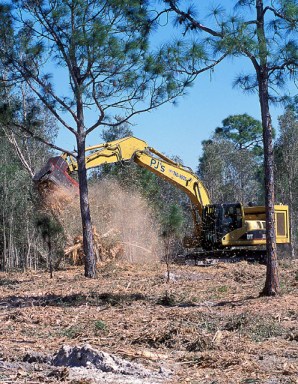
DEIR Timeline

Coming soon to Sutro Forest?

Coming soon to Sutro Forest?

1.  The Demonstration Projects may take about a month.  The DEIR says that one “Brontosaurus” machine will be used at a time, and that it should take 2-10 days to finish work on a “Demonstration” area. We expect that work on Demonstration areas #1, #2, and #3 (totaling 5.5 acres) will be done in about 30-45 days, finishing by end-September 2013.  This will involve cutting down about 3,000 trees (our estimate), mowing down 90% of the understory, and cutting off vines to 10 feet above the ground.

2.  UCSF will ask for feedback from the public on the “demonstration” plots. We expect they will have a period of around 30-45 days for this feedback. (We’ll update this if we get more information.) This will take it into November, when the rains usually start; and we think the next stage will only take place the following year.

If, however, they do decide to work later in the year, they will call in a butterfly expert (possibly Liam O’Brien, who has consulted for SF Recreation and Parks Department on butterfly issues) to inspect the trees in December or January to avoid cutting down a tree where Monarch Butterflies are currently wintering.

MORE TREE-FELLING

Year Two (2014). In year two, probably in the late August/ September 2014 window between birds’ nesting and rainy weather, they will complete the Demonstration projects by felling nearly all the trees on Demonstration Area #4, and planting native plants – what the DEIR calls “conversion planting.” (They are spacing the trees in Area #4 about 60 feet apart, which would leave some 20-30 trees on the site instead of around 1500 now.)

In the same year, they may start work on the second stage. That would be where they extend the same management plan – 30-foot spacing, mowing down the understory, cutting the vines – to a total of 38.5 more acres. Since the DEIR says that no more than 15 acres will be done at any given time, they will probably do about 10-13 acres.
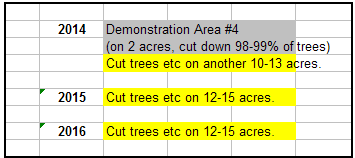
deir timeline continued

This is also the year when they decide on pesticide use. In Year 1, only one acre will be sprayed with pesticides (Aquamaster, i.e. Glyphosate; and Garlon 4 Ultra, i.e. Triclopyr). They will  compare this for effectiveness and expense with two other acres, where they’ll prevent  regrowth by tarping, or by manual removal (or maybe goats). We have heard that the Sutro Stewards’ Executive Director Craig Dawson thinks pesticides will be necessary. So we think it is probable that pesticides will be used more widely in the forest in the second year to get rid of “non-native species” – which includes most of the forest.

Though the DEIR says that no more than 15 acres will be worked on at “any given time” (and not “in any given year”) the section on herbicide use suggests that they expect to stagger the project over 4 years, doing a quarter each year. So we expect that the project would be completed by end-2016. After that, pesticide use would continue for another 6 years.  Pesticides would also be used for maintenance along the trails and in all the Native Gardens (of which there will be several).

This is a little ironic, since the SF RPD’s Native Areas Program has agreed not to use pesticides for 15 feet on either side of trails to reduce  risk to people and pets. UCSF would be going from the safest wildland in the city in terms of chemical use, to the worst.

WHAT COULD IMPACT THIS TIMELINE

This timeline is an estimate we’ve made from the information in the DEIR. A number of factors could delay it, or compress the times.

1. The whole project could be delayed by a year if UCSF needs more time to respond to comments, and does not certify the final EIR before the tree-felling window in the Fall.

It could also be delayed – or even cancelled – if the UC Regents (or the UCSF Chancellor) decide to wait on this certification , or on the approval of the project.

2. It could also be delayed by any funding constraints.

3.  The project time-line could be compressed if the winter is dry and there is time – and funds – to start the second stage of the project immediately after the public comment period on the Demonstration Projects closes. This could bring the project forward by a year, so all the tree-felling is done by 2015 instead of 2016. Any other dry years where two sections of work could be done in the same year would also have this effect. In 2013, SF RPD were felling trees in Glen Canyon Park through January; under similar conditions, UCSF may decide to do the same.

WHAT YOU CAN DO

Here’s what you can do to help save this magnificent forest:

If you have not written to the UCSF Chancellor, Susan Desmond-Hellman, or to the Board of Regents, this is a good time to do so. Also, if you have not signed the petition, please do so HERE!

1. Write to the Board of Regents of the University of California, and ask why a premier medical institution is engaging in a controversial, expensive, and environmentally destructive project.

They can be contacted at their website HERE. Their address is:

OFFICE OF THE SECRETARY AND CHIEF OF STAFF TO THE REGENTS
1111 Franklin St., 12th floor
Oakland, CA 94607
fax: (510) 987-9224

Their email address is: regentsoffice@ucop.edu

2. Write to Susan Desmond-Hellman, Chancellor of the University of California San Francisco, asking her the same thing. Here’s her address:

University of California, San Francisco
513 Parnassus Avenue, S-126
San Francisco, CA 94143-0402
Phone: 415/476-1000
Fax: 415/476-9634
Email: Chancellor@ucsf.edu

3. Subscribe to this site to keep updated. (see the box on the top right)

4. “Like” our Facebook page Send us your contact (email) stating your support, your particular issues with what is going on, and if you would like to help by being part of our “critical mass” of supporters.

5. Help us get the word out! Distribute this two-page flyer by email, or by printing it out and handing it to people, or putting it up in public places that permit it – for instances, shop windows. Here’s the latest flyer: Mount Sutro Forest Flyer April 2013

6. Let us know if you would like to help in other ways, such as contacting supervisors and other government officials, giving talks, or give us your own ideas for helping out.

Email us at fk94131 at yahoo.com

Posted in deforestation, Herbicides: Roundup, Garlon, Mt Sutro Cloud Forest, UCSF | Tagged , , , , | 2 Comments

March End, 2013 – Mount Sutro Forest Hike

By the time we went up to the forest, the day’s rain had stopped. The world of Mount Sutro forest was fresh and green. The world of homes and automobiles fell away at the trailhead.

It’s a wonderful time in the forest. The trails are damp but firm, with very few puddles. The understory seems to be growing back – we hope the Sutro Stewards are leaving it alone through the nesting season – and we heard birds throughout the forest. Not as many or as loud as there used to be even three years ago, but still enough to claim the forest.

green trail - Mount Sutro Forest

the forget-me-nots are back - Mount Sutro ForestThe understory was dotted with flowers: Society Garlic, elderberry, the occasional dandelion, lupine, and blackberry. Others we couldn’t name, though maybe someone will. The pink-flowering currant still drips its delicate flowers, but it’s nearing the end of its season. And the forget-me-nots are back along the paths – and especially at the top of Nike Rd, where they’d been mulched away two years ago.

elderberry flowersdandelion

flower tbd

Even the Native Garden’s looking nice. The rain has greened out the meadow sections, which are generally scraggly and dry nine months of the year. Though the pink-flowering currant is past its prime, some lupine is in bloom.

Native Plant garden - Mount Sutro Forest

The replanted section is still growing bright orange plastic flags, but a few flowers have emerged among them. We’ll see if they attract native pollinators as intended. The plastic fencing around it is mostly gone, and it looks like they knocked the sign sideways in the process of removing it.

Native Plant replanted meadow

ORANGE BLOBS AND TREE LETTERS

We encountered one of the tree-letters we’d reported earlier. This said the same thing: “Please don’t cut me down. I might be “dead” but I am beautiful to look at and can be a home to birds and other living things. Forests need dead trees.

tree-note

Beneath the note, someone had scrawled, “I am a fire hazard.”

damp soil near note tree But it’s not. As long as the forest is left alone, a functional cloud forest, it does not get dry enough to ignite. Besides – we don’t think the Management Plan to cut down the trees, chip them, and leave them where they fall is likely to help.

In the picture below, they haven’t (as far as we know) cut down any trees. But they have ripped out the understory, and mulched the ground with branches and bark.

where the understory has been gutted - Mount Sutro Forest

That’s the look that the Management Plan seems to be going for, except that this picture still has too many trees. All but one or two trees in this picture would be chopped down, chopped up, and left on the ground.  It would not be less flammable or safer than what’s there now.

orange blob smiley

Someone made an orange blob into a smiley

Already, there are a lot of orange blobs. It seems that every trailside tree that isn’t perfect, anything that’s quirky or leaning or odd or dying, has been blobbed. But the note-writer, whoever it is, is right. Dead and dying trees are important as habitat. Insects find them easier to get to, and then birds like woodpeckers hunt the insects. Cavities develop and birds nest in them. And the quirky trees – they’re part of the forest’s character. No one wants a forest that’s full of trees like lamp posts.

quirky tree with orange mark - Mount Sutro Forest orange blob trees - Mount Sutro Forest
.leaning tree orange blob - Mount Sutro Forest

Sutro Stewards Native Plant NurseryThe Sutro Steward’s Nursery still isn’t blending in with the forest as UCSF promised neighbors; it’s looking more like a worksite.

Sutro Stewards Native Plant Nursery

WHAT’S THE BLUE TARP?

We saw this blue tarp up a few days ago, and wondered why it’s there. Has the hill-side become unstable? [Edited to Add: We asked UCSF. They said, “The purpose of the blue tarp is that there were some issues with minor rock sliding on that particular spot.  The tarp was laid down to limit water intrusion until a more permanent solution could be found.”]

blue tarp above Medical Center Way

hand-drawn map with neighborhoodsThis is quite close to Demonstration Area #4, where most of the trees will be removed. (They’re going for a 60-foot spacing.)

Demonstration Area #4

The picture below shows what it looks like at present. And if it reminds you of photographs of rain-forests and cloud forests – it does us, as well. The “Demonstration Projects seem to have targeted some of the most beautiful and untamed parts of the forest. We hope we can stop this destructive Plan.

Posted in Environment, Mount Sutro Stewards, Mt Sutro Cloud Forest, Mt Sutro landslide risk | Tagged , , , , , | 4 Comments

Bucketloads of Herbicides Coming to Sutro Forest

NAP 2008 to 2012 pesticide active ingredientWe’ve often praised UCSF here for keeping Mount Sutro forest pesticide free. No pesticides have been used there since 2008. We’ve said things like “This may be the last pesticide-free wild land in the city. (Thanks, UCSF!)”

On the other hand, we have been following SF Recreation and Parks Department’s Natural Areas Program (NAP) with dismay. Its pesticide use has been growing. As of end-2012, it had its highest usage yet. (The graph shows pesticide usage based on Active Ingredient, one of four measures used in calculating pesticide use.)

That’s all about to change for the worse. Much worse.

Though UCSF says it plans to be very careful in its usage of pesticide, our expectation that this project would require gallons of pesticides is reflected in the Draft Environmental Impact Report (DEIR). That’s provided information we could analyze against NAP data.

SUTRO FOREST: NAP x 5 (OR 15!)

It’s quite appalling. On the 48 acres it may treat with Aquamaster (glyphosate, the same active ingredient as Roundup) and Garlon 4 Ultra (triclopyr), it’s contemplating levels of use between 5 and 15 times what NAP uses in an entire year in all its 1100 acres of parks. The graph below compares the DEIR projection to NAP’s 2012 levels (the yellow band).

Sutro DEIR pesticides

  • In Year 1, the year of the Demonstration Projects, they would use pesticide only on one acre, one-third of Area #1. That’s an experiment, and according to the DEIR, it could use on that one acre about one-third of what NAP used in 2012  in all its parks. That would be the first phase of the project.
  • In Year 2, if pesticide proves the best way of stopping regrowth, they would extend this use to DemonstrationArea #4, which is to be lagged one year. Either that year, or the one following, as they carry on to Phase 2, they  would extend it to another 15 acres; and then another 15 the following year, and so on. The DEIR anticipates using pesticide on 80% of the Reserve (UCSF’s nomenclature for its part of the Sutro Forest), or 48 acres.
  • For each area, they’d use the most pesticide for the first two years, then halve it for the next two years, then halve it again and keep it at that level.
  • Since the implementation of the Plan would be staggered (no more than 15 acres annually), the use of pesticides would rise sharply in the first 4-5 years as more acreage was felled and treated. Then it would slowly decline, to plateau at levels roughly 5 times what NAP used in 2012 in all its parks combined.

This was going to be a way to make the forest healthier and safer?

Have the Sutro Stewards seen these projections? Just the Demonstration Projects would use as much pesticide as all the Natural Areas put together. The Stewards and their volunteers are the ones who will actually be working these areas.

Posted in Herbicides: Roundup, Garlon, Mount Sutro Stewards, Natural areas Program, UCSF | Tagged , , , , , | 10 Comments