New Scientist: Nativism and “Message Enhancement”

An article in the latest New Scientist, a well-reputed science magazine suggests that misguided nativism is doing more harm than good, in particular by misusing resources. Titled “Living with Aliens” in the print edition, and “Immigrant species aren’t all bad” on line, the article discusses the extreme stance taken by Nativists.

Professor Mark Davis points out that (a) most immigrant species are harmless; (b) with global trade and travel, a globalised biosphere is inevitable; and (c) unless a species is clearly identified as harmful, investing huge amounts to eradicate it is wasting resources urgently needed elsewhere.

Excerpt (emphasis added):

—————

“Philosophers, social scientists and some invasion biologists have challenged the choice of language used to describe non-native species and have argued that conclusions about them sometimes rest more on prejudice than science. Others have criticised the preference for native species as scientifically unsound, arguing that invasive species do not represent a separate category, evolutionarily, biogeographically or ecologically. Others have pointed out flaws in the claim that non-native species are the second-greatest extinction threat after habitat destruction. In fact, with the exception of insular environments such as islands and lakes, there are very few examples of extinctions being caused by non-native species.

“Despite this more nuanced approach, many of my invasion biologist colleagues are reluctant to discard the nativism paradigm. Some have told me that “message enhancement” is a necessary strategy when dealing with the public and policy-makers, in order to get their attention.”

————–

Message enhancement? a.k.a…. Exaggeration?


Posted in nativism | Tagged , | 3 Comments

1 acre = 30 cars

I stole this graphic from the Nature Conservancy website (which I’ve linked here, so I hope they won’t mind).

We’ve been hearing about the carbon impact of chopping down all those 120-year old trees. Until now, I didn’t have an easy calculator, even as a rule of thumb, for what the impact would be. Thanks to the Nature Conservancy, we do now.

If you click on this graphic, it will take you to a Youtube video about trees sequestering carbon. That video is about a 100-year-old red oak. I imagine the story isn’t any different for a 120-year old eucalyptus.

orestcarbon101graphic

So lets talk of the impact of chopping down most of the trees on 14 acres.

About 400 car-years? (Assuming some few trees are left standing.) And let’s not forget, bushes sequester carbon, too, especially if they are green year-round. The forests they talk about are less dense than the ones on Mt Sutro. This forest probably sequesters even more carbon.

And the whole forest? The 61 acres that UCSF owns are like keeping 1830 cars off the road for a year. If we include the 19-acre interior park belt, it’s like taking away 2400 cars.

Posted in Uncategorized | Tagged , , , , , , , | 2 Comments

California Eucalyptus: A Biological Treasure

Someone posted an intriguing note on the A Historic Forest page of this website. It suggested something we hadn’t thought of before: that the eucalyptus here may be a repository of genetic material not found even back in Australia.

Here’s what he posted:

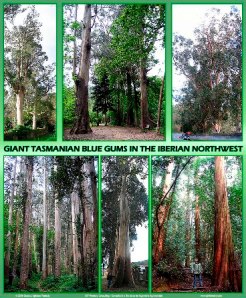
“Considering the timespan of its planting, the trees at Mt. Sutro may be something more than historic. San Francisco Bay in California is one of the very few areas of the world where some of the oldest Eucalyptus globulus grown out of Australia during the 19th century still stand.GiantGlobulus small

“In Europe, where these trees arrived more or less at once, the oldest standing E. globulus are in the range of 100 to 125 years old, and are normally protected as heritage trees.

“The total number of eucalypt trees in these circumstances around the world is very small over the total, ranging optimistically some few thousands only.

“For the case of Mount Sutro, their historic value may be complemented with a “hidden” genetic value. Indeed, they could be considered “genetic repositories” that could allow to “trace back” the Californian E. globulus landrace to its original race or races in Australia, be it mainland Australia or Tasmania.

“In other words, they are living pieces of biological archaeology. Their original parent trees might no longer be standing due to clearing as Australia was built. Mount Sutro trees could be … a lost tribe and the last of their kind.

“Each old eucalypt cleared down for concrete in California is a vanishing footprint of history. And, maybe, a vanishing nowadays-unique gene pool.”

Posted in eucalyptus, nativism | Tagged , , , , , | 11 Comments

The 10-15% Mitigation

So with all the brouhaha about this project, and the cost — destroyed trees, the gutting of a historic forest, the time, the effort, the distraction from more pressing problems currently facing UC, and the taxpayer dollars (both through FEMA and UC) — we would expect a really substantial reduction in risk. Wouldn’t we?

Maybe not.

According to the Edgewood FEMA application appendices, “We believe that at least a 15% hazard reduction is a realistic estimate of anticipated improvement in the situation.” (Attachment #35)

The South Ridge project is worse. According to the South Ridge FEMA application appendices, the project will be “10% effective in reduce[d] damages, losses, and casualties resulting from fire in the project area.” (Attachment #30, page 151).

Posted in Sutro Forest "Fire Risk" | Tagged , , , | Comments Off on The 10-15% Mitigation

A Rebuttal to UCSF’s Response to FEMA

This is an edited version of the letter sent to FEMA regarding UCSF’s response to their questions. Emphasis has been added.

——————————–

[We were] quite surprised to read the details of UCSF’s response August 16 response to FEMA’s questions of July 21st. Most of it seemed to merely reiterate the assertions in its original application, and the new information was in fact rather confusing.

Please excuse the length of this letter. [We]would like to draw FEMA’s attention to a number of issues.

WILDFIRE HAZARD

1. UCSF has provided an updated fire hazard map (July 2009), which shows an increased hazard on Mt Sutro.

The only major activity in the last 6 years in this century-old forest has been extensive trail-building by the Mount Sutro Stewards, which has had the effect of opening up the forest and thereby drying it out. It’s surprising that with this evidence, UCSF is arguing for more of the same.

The project areas of South Ridge and Edgewood are still not marked as hazard areas on the 2009 map – which is different from the 2003 map used in the FEMA application.

The 2009 map shows the West Ridge, the North Ridge, and an area below Johnstone Drive near the Chancellor’s residence – all areas where trails have been built in the last few years.

2. Meanwhile, the California Department of Forestry and Fire Protection, on its website, notes as recently as November 2008:

Update, 11/2008: CAL FIRE has determined that this county has no Very High Fire Hazard Severity Zones in LRA (Local Responsibility Areas).

3. The UCSF letter references fires between 1899 and 1948.

In 1899, the trees would have been mere saplings, and indeed the event was reported as a grass fire.

Later, logging in the forest, created exactly the kind of open conditions that UCSF seems to wish to recreate with the FEMA grant. Clearly, the thinned, dried-out forest is at greater risk from fire. Once logging stopped, so did the fires.

The letter references a mysterious fire recalled by a resident, requiring a 10-engine response. If a fire within the last 20 years required a 10-engine response, it is surprising that no newspaper report on the subject can be found. In any case, data should be available in the Fire Department’s records. UCSF should provide this documentation, together with any further details of the fire. Otherwise, the recollection may be faulty.

4. The letter mentions a fire in Marin “where there are large stands of eucalyptus.” This is presumably a reference to the Mt Vision fire. The letter also refers to the fire on Angel Island. In actual fact, neither of these fires involved eucalyptus. (As a further datum, even in the Oakland fires, the main cause was not eucalyptus or any trees.)

The Mount Vision area is primarily chaparral, with some forest of Douglas Fir and Pine. The Mount Vision Fire of October 1995 was a chapparal fire – a fire of the low scrub and grasses which actually would resemble the vegetation on Twin Peaks, not on Mount Sutro. In the dry season, the scrub and dry grass is extremely flammable – much more so than any tree. Caused by an illegal campfire, the Mt Vision fire involved no eucalyptus. http://www.sfsu.edu/~geog/bholzman/ptreyes/tripfire.htm

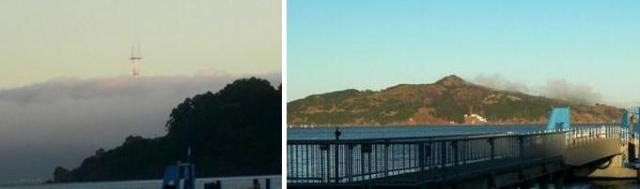
Angel Island, because of its location, has quite a different micro-climate than Mt Sutro, which is within San Francisco’s fog belt. According to the visitor information website, http://www.angelisland.org/faq2.htm “It is generally enjoys sunnier and warmer weather than San Francisco, which has many more days of fog.”
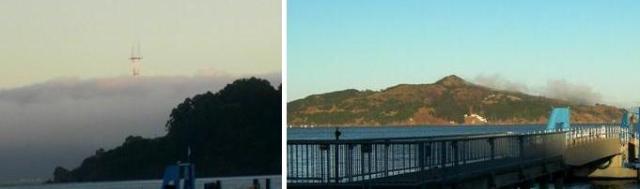
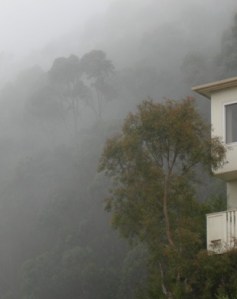
Same-hour photos - Twin Peaks and Angel Island

Same-hour photos – Twin Peaks and Angel Island

The Angel Island Fire was also grass and chaparral fire – Angel Island was denuded of nearly all its eucalyptus more than a decade ago. The residual 6 acreas of eucalyptus didn’t burn. Before the trees were cut down, the only fires seem to have been structural fires. After the eucalyptus was removed, there have been at least two fires, in August 2006 and October 2008, both of which burned grass and chaparral.

WEATHER CONDITIONS

The forest lies squarely within San Francisco’s fog belt. Without going into technical terminology as to what constitutes a cloud forest, it is clear that Sutro Forest experiences fog drip through the summer especially, and gets perhaps 30-40% more moisture than the non-wooded areas. This keeps the moisture content high year-round.

UCSF refers to several weeks when “dry, hot winds blow from the northeast.” We would like to see documentation about this. Those of us who have lived in San Francisco – and Forest Knolls/ Cole Valley – for many years, have hardly encountered even a warm breeze, let alone hot dry winds, in the fall or at any other time. The winds are usually cold and damp, coming as they do from the ocean. This should not be a matter of opinion. Weather patterns are recorded. UCSF should produce evidence of hot dry north-easterly winds blowing past Mount Sutro.

WILL THE PROPOSED MITIGATION REDUCE THE HAZARD?

UCSF claims that having fewer trees will reduce the risk of wildfire. Angel Island and San Bruno Mountain clearly demonstrate this is NOT the case. The dense tree cover, which traps the moisture in the forest, keeps it damp year round, and the dense shade discourages the growth of grasses and easily flammable vegetation. The blackberry and fern remains green and damp. Grasses, on the other hand, dry out – as is apparent in the Native Garden at the summit.

UCSF says it will not reseed the area. Unless it actively controls growth by extensive use of herbicides, weeds will take over whether or not it replants. The greater sunlight will allow the growth of flammable plants, and the drier conditions in a thinned forest will make them more vulnerable to fire. Besides, even if UCSF does not re-seed the area, Mt Sutro Steward Volunteers might well undertake to do so. Tree removal is the most difficult and expensive part of the native plant conversion, which the Mt Sutro Stewards have openly declared as their objective.

UCSF mentions preventing insect infestations, and providing easier access. There is no evidence of the insect infestations mentioned in the letter, and the two project areas are already the most accessible in the forest. South Ridge is accessible by a paved road to the summit, and Edgewood is bounded by Medical Center Way and a car park. In fact, the applications note that as a reason these areas were selected.

While all these trees were planted around the same time, eucalyptus is a tree that regenerates spontaneously from lignotubers. There is already age variety within the forest as new stems have sprouted over the last century. There is little risk of any mass die-off. The forest is currently healthy and damp. Some dead trees are natural to any forest, and are an important habitat for woodpeckers and other birds.

ALTERNATIVES

UCSF has only discussed clearly appalling alternatives such as clear-cutting or prescribed burns.

If there was a fire risk for some few weeks each year, one alternative would be to spray the forest with water once or twice a year. This is not as far-fetched as it sounds. The garden at the top of the mountain is already irrigated. Much of the mountain is already accessible by paved road. With the co-operation of the fire department, water could be sprayed over the two areas UCSF now plans to gut, and the forest preserved. It would be cheaper, and not an irreversible move as this one is.

THE “DEMONSTRATION” PROJECT

The letter makes reference to a Long-term Plan and a demonstration plot of 2 acres. The small area was chosen specifically because of neighborhood objections. UCSF’s long-term plan had very little to do with fire-management. It was more a plan to gradually convert the forest to native species. Though UCSF says it was adopted with neighborhood input, their own plan makes it clear the neighbors were very skeptical.

In fact, the Plan said, ‘The primary reason this short-term strategy was adopted is because the community members involved in the planning process did not support a long-term management plan until some management actions had been implemented in small, relatively unseen demonstration areas of the forest.’

So the demonstration, which was initially about forest thinning for native plant conversion, was only supposed to be 2 acres, a size which would be a relatively small problem if it failed. Now, because UCSF believes it can obtain the FEMA grant, the “demonstration” area is upped by a factor of four. It’s the whole of the South Ridge, which is not exactly small and relatively unseen.

Wasn’t the FEMA money was to supposed to reduce fire hazards, not fund demonstrations of forest conversion?

THE ROLE OF MOUNT SUTRO STEWARDS

The letter refers to the Mount Sutro Stewards, one of whom provided much of the “evidence” of fire-hazard.

Many of us believe that this organization provided the main impetus for the planned projects. The Mt Sutro Stewards are volunteers from ‘Nature in The City,’ which declare as the first of their Goals: “Restore the natural landscape, biodiversity, natural areas, watersheds and local ecological processes of the northern San Francisco peninsula, the Franciscan bioregion.”

Native Plant activists are anti-eucalyptus as an ideology.

Indeed, the May 18, 2009 public meeting on these proposed projects kicked off with a slide presentation on native plant restoration on Mt Sutro, made by one of the Stewards, [ETA: Craig Dawson, subsequently Executive Director of Sutro Stewards] which included pictures of plants in the Native Garden, and slides of mature oak trees which he presented as representing the future of this forest. The UCSF presenter deferred several audience questions to others in that organization.

Many of the neighbors are convinced that native plant supporters in general, and UCSF in particular, seek to use FEMA to fund removal of eucalyptus forests to make way for native plant conversions – which, ironically, increase the risk of fire.

The FEMA application also contained several factual errors. We pointed these out.

Posted in Uncategorized | Tagged , , , , , , | Comments Off on A Rebuttal to UCSF’s Response to FEMA

A Walk in the Woods With Barbara French

Dr Morley Singer arranged a walk in the forest with Barbara French, Associate Vice Chancellor, University Relations, to discuss the issue of the possible project to cut thousands of trees.

We set out at 8.30 a.m., walking through the Interior Green Belt and up to the Native Garden at the summit, then back down the trail to the Aldea campus and on to the Edgewood planned cut, before returning via the trails to where we started.

We pointed out the difference between the dried-out areas where the forest was thinned and opened, and the dampness of the trails where the dense cover and undergrowth held in the moisture. Dr Singer discussed the history of neighborhood opposition to tree-felling on the mountain. We also talked about the apparent native-plant activism involved in the project.

We thank Ms French for her willingness to come on this walk, and for being receptive to the concerns of the community, and look forward to a positive resolution to the issue.

Several concerned people also spoke at the UC Regents meeting on the subject of the Mount Sutro forest. We met Chancellor Susan Desmond-Hellman, who said she would move into her residence in the woods in October. We look forward to that, as it will give her an opportunity to see what we are talking about here.

Posted in Uncategorized | Tagged , , , , , | Comments Off on A Walk in the Woods With Barbara French

In the News: UCSF; Tree Planting; Native Herbicides

We’re starting a new feature here:
In The News. We plan to post summaries of relevant news items (or other pieces from the internet), and comment on them.

SAVING FORESTS IS ONE OF THE MOST EFFICIENT CLIMATE REMEDIES

wwf-logoThis article in the newswletter of the World Wildlife Fund comes from its Swedish arm. It urges the Swedish government to protect forests, because it’s one of the most efficient climate remedies.

And here’s a great Youtube video from American Forests, promoting its Global ReLeaf 2 program – to plant trees.

We shouldn’t have to say that it applies as much to eucalyptus as to any other tree.

DOES THE SF CHRONICLE HATE TREES?

It’s a strange question to ask, in a world where forests and trees are one way to combat global warming. Trees take decades to grow to a decent size, and any time one is “removed” it stops sequestering carbon and starts to release it into the atmosphere.

In two articles on October 11, there were references to tree-removal that sounded almost jubilant. The first was in an article looking at Santa Cruz 20 years after the Loma Prieta earthquake. In the description of the rebuilt downtown, it says: “Gone are the overgrown trees that made the street dark by day and a druggy hangout at night.” And another, describing the work on Doyle Drive, talks casually of “removing trees for the new Doyle Drive approach.”

We’re not saying trees should never be chopped down. Some do have to go – when they’re a hazard, or when the space they occupy is urgently needed for road-building. But it’s a cost, and in more than money.

We’re sensitive about this, of course, because of the threat to the trees of Sutro’s Cloud Forest. Still, it does seem that with nativist thinking spreading, respect for trees and what they do for the environment has plummeted in favor of some kind of assessment of them as illegal aliens or something. It’s unlikely, though, that 1 acre of chaparral – or even 1 acre of a “sun-splashed sprawl of specialty stores” – equals 30 cars.

NOBEL PRIZE FOR UCSF’S ELIZABETH BLACKBURN

UCSF’s Elizabeth Blackburn won the Nobel Prize yesterday (Oct 5, 2009), (with two others – Carol Greider of Johns Hopkins and Jack Szostak of Massachussets General) for her work on telomeres. It’s a proud moment for everyone associated with UCSF. This is hugely important work, and is part of what makes UCSF the marvelous institution it is. Congratulations, Dr Blackburn, and congratulations UCSF!

Which makes it so much more galling that this institution we respect so much is notably unscientific in its management of its facilities. Particularly Sutro Forest.

POST-HOLES AND ROUNDUP

This isn’t a news item, but I thought people would be interested.

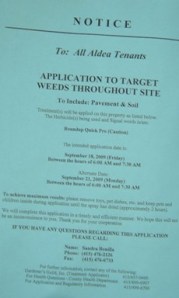
Roundup Quick Pro in Aldea

Roundup Quick Pro in Aldea

1. UCSF is using Roundup in the Aldea student housing area on the west side of Mt Sutro. Why they think this is a good idea in family housing where small children and pregnant women many be present, I am not sure. Aldea has naturalistic landscaping; I didn’t know they’re doing chemical maintenance. One of our Sutro neighbors has been providing UCSF with evidence about its dangers and trying to get them to stop – apparently to no avail.

[ETA: In November 2009, they did stop. Here’s the link.]

2. The mysterious holes along the trail in the forest have been puzzling a lot of people. UCSF eventually got back to me.

Posthole in the Native Garden

Posthole in the Native Garden

They’re post-holes. Mt Sutro Stewards are going to put up signposts because people have been getting lost. Also, they’re concerned that if someone is alone and injures themself, they would have no way of telling the emergency responders where to find them.

AVOIDING ROUNDUP HERBICIDE

The SF Chronicle’s gardening section had a question from a local gardener, asking how to avoid using herbicides to remove bindweed. The expert, Pam Pierce, responded by suggesting various methods – and reinforcing the questioner’s decision not to use Roundup:

“Roundup’s active ingredient, glyphosate, is not registered for (meaning not legal to use around) food crops. It can last in soil for up to a year. While it isn’t highly lethal in an acute poisoning sense, it can have many ill effects on your health.”

While of course no one is planning to eat food from Mt Sutro (except maybe blackberries) it is quite disturbing to think of herbicides leaching into the watershed and getting onto us and our animals for a year after they have been applied.

UC FEES GOING UP – UP – UP

The SF Chronicle carried a news item about how UC was going to raise its fees for undergrads not once, but twice for a total of over 30%…
They’ve laid off nearly 900 people, and will lay off another 1,000. They’re deferring hiring and purchasing.
And they’re planning on spending over $100,000 to gut 14 acres of forest in a project of no urgency (in addition to some $350,000 of taxpayer funds through FEMA).

SAN FRANCISCO TREE PLANTING

The SF Chronicle newspaper noted that the city has exceeded its target of planting 25,000 trees in five years. (Click on the link and scroll down to see the item.) We’re very encouraged- that’s 5,000 trees annually. They look nice, and help sequester carbon. Now figure that UCSF’s plan will remove, according to their own estimate, over 3,000 trees. Well, they might argue, they are all under one foot in diameter (approximately 3 feet around). So the question is, are the trees San Francisco is planting any larger than that?

If not, and this misguided plan goes through, we hope UCSF is planning to fund the city to plant 3,000 trees to compensate.

HERBICIDES AND NATIVE PLANTS

The environmental organization The Nature Conservancy had an article on its blog entitled: No Spray Zone: Are Pesticides Really Controlling Invasives? We found it echoed many of our concerns about the planned use of herbicides on Mount Sutro.

Excerpts: “Spraying pesticides for invasives control has long struck me as one of those cases where “the cure is often worse than the disease.”

“Many pesticides have well-documented negative effects on fish and birds and humans. It would seem that we should apply them judiciously and only as a last resort.

“Perhaps the real issue here is humanity’s relationship with non-native species. Too often, conservationists appear content to label all non-native species as “bad” and thus seek to eradicate them by any means necessary.

“It’s time to face up to the reality of the “invasive species” issue: It’s complicated.

“The rapid spread of invasives may be a symptom of deeper ecological problems, not the problem itself. Thus, using chemicals is only treating the symptom, not addressing the real issues. I’ll refrain from making any comparisons to U.S. health care.

“In other instances, invasives may be so established on a landscape that we can only hope to manage them, and eradication attempts will be proven folly.”

THE UNDEAD GARDEN

In July, the San Francisco Chronicle published a citizen complaint about a city-maintained garden at Howard and Embarcadero, which he said “looked dead.”

The Chron investigated. In an article titled S.F. garden isn’t dead – just in transition, it reported no, the garden wasn’t dead, only the plants in it were. “At this stage of the year, most of the annual plants are in fact dead…” said a spokesperson.

It was a native-plant wildflower garden. The plants had bloomed in spring and was now were throwing seeds and dying (in July). When the rain came, the whole thing would green up again. The rain comes in … December? January? So there’s going to be an Undead Native Garden for six months of the year. There were a few comments there; the best one was the first, from someone who quoted the Monty Python ‘Dead Parrot’ skit:

“Mr. Praline : I’ll tell you what’s wrong with it, my lad. It’s dead, that’s what’s wrong with it.
Owner : No, no, ‘e’s ah… he’s resting.
Mr. Praline : Look, matey, I know a dead parrot when I see one, and I’m looking at one right now.
Owner : No no, h-he’s not dead, he’s, he’s restin’!”

Is this what is planned for Mount Sutro? (The Native Garden on the summit already looks a bit like that, but without the trash.) Having a hillside that’s “resting” for six months of the year in a flammable and ugly condition doesn’t seem like a great idea.

Rotary native plant garden in June

Rotary native plant garden in June

Rotary Garden, September

Rotary Garden, September

Posted in Uncategorized | Tagged , , , , , , , , , , | 9 Comments

Peter Scott’s article on Native Plant Restoration

We were sent this article, with a request to re-publish it on this website. The author, who wrote this in the context of the East Bay, kindly gave permission. Emphasis has been added.

————

NATIVE PLANT RESTORATION: IT LOOKS A LOT LIKE GARDENING
by Peter Scott

Native Plant interests are altering landscapes all across the Bay Area, affecting all residents. In opposition to the opinions of a considerable number of organizations and worthy individuals, I have proposed that there really is no such thing as a “native” plant. Measured by the earth’s age, all plants are newcomers.

NO SUCH THING AS NATIVE

Even as species developed and spread over millennia, there never was a time when a static, balanced plant community existed. Unless one returns to the primeval ferns, the idea of “native” vegetation depends on a snapshot of the environment at an arbitrarily selected moment in history.

What follows, for those who buy into that frozen moment in time, is a list of species that they consider to be “good” (native) and a list of species that they condemn as “bad” (non-native: a.k.a exotic, alien, invasive).

The time frame favored by most nativists in this country is the period just prior to the arrival of European immigrants. For our San Francisco Bay area, ignoring the mission settlements, this criteria suggests late 18th century up to about 1835.

We have no photographs of our East Bay hills from that era; cameras were not yet available. We do know that very soon after settlers arrived, the land in this area was heavily grazed and logged; the earliest photos show the hills as barren grassy slopes. This is the image that nativists propose: grassland with a scattering of oaks, and chaparral lining gullies and creeks.

City agencies and various interest groups publish lists of “native” (approved) plants and non-natives. Most of the plants in your yard are not on the approved list – but poison oak and coyote brush are. And there is some fudging going on: redwoods are not native to our Claremont Canyon, but are now being planted and watered by loyal nativists.

NEO-CREATIONISM

Peter Del Tredici, a member of the Massachusetts Invasive Plant Advisory Group and a senior research associate at Harvard University’s Arnold Arboretum wrote an article for Harvard Design Magazine(Spring-Summer, 2004) “Neocreationism and the Illusion of Ecological Restoration” that comments on the issue of native plants.

Here are some excerpts:

“Implicit in the proposals that call for control and/or eradication of invasive species is the assumption that the native vegetation will return to dominance. That’s the theory. The reality is something else.”

“To assert that planting native species will restore the balance of nature is just another way of ignoring the problem.”

“The very same processes that have led to the globalization of the world economy— unfettered trade and travel among nations— have also led to the globalization of our environment.”

“[Native vs exotic] is an issue that seems to bring out the worst in people, not unlike the debates over gun control or abortion. . . [That] this pre-Columbian environment no longer exists— and cannot be recreated— does not seem to matter.” “. . this so-called restoration process… looks an awful lot like gardening, with its ongoing need for planting and weeding. . . Is ‘landscape restoration’ really just gardening dressed up with jargon to simulate ecology?”

To read the complete article, go to: http://www.gsd.harvard.edu/research/publications/hdm/back/20_ontechnology.html

A NATURALIZATION CEREMONY FOR PLANTS

On a recent nature walk in the hills with David Amme, EBRPD’s Wildlife and Vegetation Program Manager, and expert on native plants, the discussion about good and bad species turned to the apparent non-feasibility of getting rid of all the “exotics.” Amme responded that not all non-natives are “bad guys” and we should accept the fact that they are going to be part of our wildland environment.

Dramatically, in half-jest, he took off his cap and held it over his heart, saying: “I think we should just have a naturalization ceremony for these plants.” I think it shocked some of the others but I admired his realistic response.

Nativists like to claim that an environment of native plants is healthier, and inherently more fire resistant, but there is no scientific basis supporting those claims. Fire likes dry fuel of any description, especially grasses, brush and small-diameter limbs.

Restoring the hills to an open grassland dotted with trees and chaparral will simply encourage annual fires like those that race through the canyons of Southern California, because that environment is imminently more prone to ignition than a mature, canopied forest.

The tall trees in and around Claremont Canyon catch the moisture in the morning fogs and increase the humidity in the understory; the first step toward discouraging ignition is to maintain the canopy.

FOLLOW THE MONEY

What the native-plant adherents are attempting is a redefinition of the concept of “wildland.” Instead of an untamed and undomesticated ecology, they are substituting a managed and maintained artificial landscape. As the Harvard professor wrote:

“It looks a lot like gardening… “And when something doesn’t appear to make sense, one strategy is to follow the money. Clearly, there are nativists who derive an income from the landscape transformation they so earnestly support.

A natural landscape is an evolving community of species, continually changing according to environmental conditions. There will be newcomers and there will be casualties. As David Amme pointed out, Mediterranean exotics “just love it here” because of our extended rainy season, and they are not what he calls “bad guys.”

On the other hand, we have “native” bad guys like coyote brush: the new growth is fine, but underneath is a tangle of small-diameter, oil-laden dead wood. In a Diablo wind, the coyote brush hurls as many firebrands as any tall tree.

The point is: we need to abandon the native/nonnative concept. It is based on false assumptions, it supports species-cleansing, and it distracts (and diverts financial support) from more important issues in the wildland-urban interface.

Posted in Uncategorized | Tagged , , , | 4 Comments

Fog Log

So we’ve entered that crucial “September to November period when fire risk is greatest,” according to the UCSF letter.

Mount Sutro is squarely in the fog belt. The question is, Whether between the end of summer (and fog) and the beginning of winter (and rain), is there enough dryness to raise fire risk? We’ll find out. What we’re starting here is a Fog Log. It will be updated for every day’s weather. We will also look out for the “dry hot winds” blowing “from the Northeast.”

September summary: 7 fogless days. Maximum consecutive fogless days: 2

[Edited to Add: At the end, we posted the Fog Log Conclusion: Seven Dry Days

“Here are the results: In the three months, the longest stretch the forest was without either fog or rain was ONLY 7 DAYS.”]

————–

September 1st Week: 6 days; of which 2 consecutively fogless – defined as days with no fog morning or evening.

It’s very foggy now as we write (Sept 5th). It came in earlier in the day and became denser toward evening. So far, we have had two hot fogless days: Sept 2 & 3 with wind from the north-west or the west. By Sept 3 evening, the fog blew in on the wind from the sea. The winds have been westerly. Sept 6th: Woke to fog. Around noon the sun broke through.

September 2nd Week: Of 7 days, 2 fogless, but no consecutive fogless days.

Sept 7: Bright and sunny, (high 60s/ low70s max), westerly wind. Sept 8: Started out sunny. At 4.30 p.m, the fog arrived. Sept 9: Some bright blue sky, and then fog mixed in. Sept 10: Sunny and clear. Sept 11: Started out clear. Fog came in around 7.30 p.m. Wind is westerly, 20mph. Sept 12: Weird weather; very loud thunder early in the morning, splats of rain, dense fog not burning off. Sept 13: Some rain.

September 3rd Week: Fogless days, 1; fogless streak, 0.

September Fog
September Fog
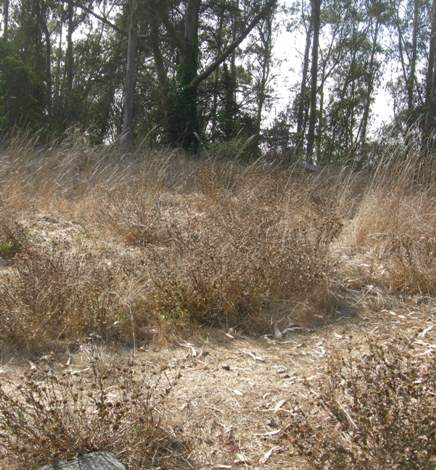
Though foggy, it's dry in the native garden...
Though foggy, it’s dry in the native garden…
While in the forest there were even a few puddles.

Sept 14: Morning and evening fog. Sept 15th: Sunny in the day, thick fog at night. Sept 16: Dense morning fog. Sept 17: Morning fog, burning off around 10.30 a.m. Sept 18: Bright and clear.      Sept 19: Foggy nearly all day. Sept 20: Foggy morning, burned off around 10.30 a.m. – and came back around 5. I can’t even see the forest. (It cleared later – around 8.30 p.m.)

September 4th Week: Fogless days, 2; fogless streak, 2

This is a week to watch out. The weather forecast is for hot weather at the start of the week. (ETA: Nope.)

Sept 21: Morning and evening fog. Cool and sunny in between. Who stole our heatwave? Sept 22: Overnight fog. Bright and sunny later, foggy again by 7.30 p.m. Sept 23: Morning fog. Afternoon fog. Evening fog. Sept 24: Foggy all day. Walked in the forest; it was raining in there. Not in the Dry Garden, though. (See the pictures.) Sept 25: Morning fog, burning off to bright sunshine. Sept 26: Sunny! Sept 27: Sunny. Again! (Late night fog).

September 5th Week: Fogless days, 2; fogless streak, 2

Sept 28: Clouds, some fog. Sept 29: Sunny with clouds. Sept 30: Sunny!

Posted in Sutro Forest "Fire Risk" | Tagged , , , , | 4 Comments

Evidence: Opening The Forest Raises Fire-risk

Opening up the Mt Sutro Forest has had the effect of increasing fire-risk. This is the evidence from the trail-building in the forest over the last few years. So why is UCSF planning to open it up much more?

We learned that the fire-risk map for Mt Sutro had been updated in July 2009. The one in UCSF’s FEMA application dates back to 2003.

That’s shown here on the first map. The only two fire-risk areas on the mountain are the treeless Native Garden on the summit, and the Crestmont Hills project area in the Forest Knolls neighborhood, where the trees were removed because a developer was hoping to build there.

Ed 3 sutro ucsf map
map 2009 comparisonThe second is the July 2009 map. There are several more fire-risk areas:

The new spots: The Community Garden off 7th Avenue, near Laguna Honda lake; the West Ridge; the North Ridge; an area below Johnstone near the Fairy Gates Trail.
The old spots, the Native Garden and the Crestmont Hills Planned Development no longer seem to be at risk.

In this century-old forest, the only major difference in the last few years has been the opening of a number of trails. While the trails provide access to users of the forest they also have the effect of drying out the forest (because the duff that holds the moisture is removed right down the soil surface). Trail-builders also leave flammable material around.

With this evidence front and center, UCSF now plans to open up the forest still more, making it even more flammable – in areas where there are no red patches yet: South Ridge and Edgewood.

Edited to Add:

I walked yesterday in the Interior Greenbelt (which is contiguous with UCSF’s Sutro Forest, on the eastern side). It felt like a field experiment in opening/ drying.

Near the beginning of the trail (going right from Belgrave) there are large open sections – in some cases, so open you can see Cole Valley and the neighboring home. Here, the trail was dry and slippery with leaves and dust.

Further in, where the forest became denser, the trail was damp. Same forest, same day.

UCSF should really reconsider the way it thinks about this forest.

Posted in Sutro Forest "Fire Risk" | Tagged , , , , , , , , , | Comments Off on Evidence: Opening The Forest Raises Fire-risk

Michael Pollan Takes on Native Plant Ideology

Someone sent us a New York Times magazine article by author and UC Berkeley professor Michael Pollan, he of the locavore food fame.

He describes the storm of letters he received when he published a story about his failed attempt to create a “natural garden” in his yard. This prompted him to look more closely into the whole Native Plant movement.

You can read the article, Against Nativism, here.

The article touches on the need for weeding and herbicides to maintain Native Gardens; the Nazi German precedents; notes that migrations of species are natural and it’s futile to attempt to block them; and ends with an endorsement of “multihorticulturalism” — an acceptance of multiple species from everywhere, on their own merits.

This is important at a time when eucalyptus has been demonized as a “foreign weed” and using herbicide for years to destroy it for some reason sounds like a fair trade-off. We imagine that the need for Save Sutro wouldn’t even exist if the trees there were some other species.

Eucalyptus is indeed foreign to this land (as are most of us!) but whether it is a weed or not depends entirely on whether we desire it at a particular location. A “weed” is merely a plant in the wrong place – one that is not fulfilling the role we people wish in the place it’s growing.

Some quotes from his article:

On the practical aspects of nativism – and the inevitable need for herbicides:

“At this late date, after the flora of this continent have been transformed irrevocably by the introduction of Eurasian species, a garden of native plants won’t long remain one without ceaseless and sedulous weeding. This fact ties the natural garden up in some uncomfortable environmental knots. Many of its advocates … find themselves condoning, albeit mumblingly, the use of herbicides as a way to create the clean horticultural slate required to establish a native-plant meadow.”

On the historic roots of native plant movements:

“I had always assumed that the apotheosis of the native plant was a new phenomenon, a byproduct of our deepening environmental awareness. But it turns out that there have been outbreaks of native-plant mania before, most notably in Germany…”

Where? Strangely enough, in Nazi Germany.

“… pre-World War II Germany saw the rise of a natural-gardening movement “founded on nationalistic and racist ideas” that were often cloaked in scientific jargon. Inspired by the study of “plant sociology,” a group of landscape designers set out—as one of their number put it in 1939—”to give the German people its characteristic garden and to help guard it from unwholesome alien influences,” including foreign plants and landscape formality, which they condemned as both anthropocentric and apt to weaken the “Nordic races.””

He disclaims the fascist link, naturally, being a reasonable man.

“Am I implying that natural gardening in America is a crypto-Fascist movement? I hope not. I mention the historical precedent partly to suggest that the “new American garden” is neither as new nor as American as its proponents would have us think.”

America’s flora, it turns out, are as global as America’s people.

“migrations of species by whatever means is an abiding part of natural history; in any event, they’re almost always irreversible. Turning back the ecological clock to 1492 is a fool’s errand, futile and pointless to boot. It seems to me we gardeners would do better to try to work with the mongrel ecology we’ve inherited—to start out from here.”

He does make a plea for a more inclusive movement.

“But if we must have a national garden style, there’s no reason it has to be xenophobic, or founded on illusions of a lost American Eden. Wouldn’t a more cosmopolitan garden, one that borrowed freely from all the world’s styles and floras, that made something of history rather than trying to escape it—wouldn’t such a garden be more in keeping with the American experience?”

Posted in Uncategorized | Tagged , , , , , , , | 5 Comments

Laurel Heights vs UCSF: Environmental Review Problems. Replay?

At the request of a neighbor who provided the relevant references, we researched the Laurel Heights Improvement Association v. Regents of the UC case. It is, he suggested, quite relevant to the current situation.

In 1993, UCSF famously lost a case brought by the Laurel Heights Improvement Association. The case, which went to the State Supreme Court, is so significant that environmentalists nationwide often cite it when they want Environmental Impact Reports (EIRs) filed before projects can proceed.

“UCSF spent a lot of time, energy, and money in that losing case — only to try to now repeat the mistake,” he comments, “while U.C. President Yudoff is bemoaning the State budget cuts, program cuts, and brain drain from UC.”

In the Mt Sutro FEMA applications, UCSF does seem to be making similar mistakes. UCSF wants to avoid an updated EIR on the Mt Sutro Project, as seems to be requred by the California Environmental Quality Act [CEQA].

In the FEMA application, they make repeated reference to an EIR that was done in 1991. The section relating to Parnassus Heights (that is, Mt Sutro) discusses the environmental impact of demolishing three existing buildings on their campus.

Why an EIR is needed at Mount Sutro

The 1991 report, geared to assessing the impact of demolishing buildings on the campus, does not consider the environmental impact of gutting 14 acres of historic forest, which would significantly change its character and ecosystem.

It also, in answer to whether the project is in, near, or likely to affect any type of waterway or body of water, answers with a simple negative. In fact, Laguna Honda lies downslope of the South Ridge, and could very likely be affected by the tree-felling, the changes to the mountainside, as well as by the toxic herbicides planned to be used.

The South Ridge Project. Laguna Honda Lake is the blue patch.

South Ridge Project. Blue patch is Laguna Honda Lake.

The guideline for cultural resources are clearly being ignored. Among them:

* Association with an event or person of recognized significance in Californian or American History;

Sutro Forest is clearly associated with Adolph Sutro. Love him or hate him, he was significant.

* Has a special or particular quality such as oldest, best example, largest or last surviving example of its kind;

This forest is the best and largest surviving section of the once-extensive Sutro Forest that covered over a thousand acres. As such, it is an important part of San Francisco’s history.

* Is at least one hundred years old and possesses substantial stratigraphic integrity;

It is nearly 120 years old, and except for the built-up areas, or those altered by trail-building, is essentially untouched.

————
THE LAUREL HEIGHTS vs UCSF CASE

For anyone who’s interested, here’s a 10-point summary of the story of Laurel Heights and UCSF, drawn from the judgment (on Ceres.ca.gov )

A Project Mired in Controversy [This subhead is actually from the judgment. Sounds familiar already?]

1. UCSF bought a building in Laurel Heights in 1985, planning to relocate its School of Pharmacy biomedical research unit there. It then started the CEQA process.

2. The move proved to be intensely controversial, because neighbors felt that research involving toxic chemicals, carcinogens, and radioactives was too high-risk for a residential neighborhood. [At least there are no radioactives under discussion at Mt Sutro. Chemicals and carcinogens, yes.]

3. After the meetings, UCSF proposed mitigation measures, and the Regents certified a final EIR, ‘concluding that the environmental effects had been reduced to a level of insignificance.’

4. The Association challenged the 1986 Final EIR for failing to comply with CEQA. It went to court, lost, and appealed.

5. In 1987, the Court of Appeal reversed the decision, because of (a) insufficient description of the project (b) inadequate discussion of feasible alternatives to the project and (c) a lack of significant environmental mitigation.

6. The Supreme Court then granted review. It agreed with (a) and (b), but found it did provide for mitigation. Because of the problems with the description and the alternatives, it told the Regents to do another EIR, and not to expand or change the Laurel Heights operation until then.

7. In October 1989, UCSF published a new draft EIR. It got a huge amount of comments. The Laurel Heights Improvement Association itself submitted letters with over 50 pages of comments on 150 different topics with 5000 pages of exhibits. [And we thought our website was getting detailed!]

8. In April 1990, the final EIR was published in six volumes, over 2,000 pages. UCSF didn’t circulate it for comment, though it included major changes – and the Association asked it to do so. Instead, the Regents certified the EIR.

9. Laurel Heights challenged it in court. They lost. They appealed. The Court of Appeals agreed that the new EIR was significantly different and needed to be circulated.

10. UCSF appealed to the State Supreme Court. They lost.

Among the comments in the judgment:

‘We have repeatedly recognized that the EIR is the “heart of CEQA.”’

‘With certain limited exceptions, a public agency must prepare an EIR whenever substantial evidence supports a fair argument that a proposed project “may have a significant effect on the environment.”’

“There must be good faith, reasoned analysis in response [to the comments received]. Conclusory statements unsupported by factual information will not suffice.”

Posted in Uncategorized | Tagged , , , , , , , | 1 Comment

Edgewood and Farnsworth

So far, we have concentrated mostly on the South Ridge, planned for the first tree-felling. But recently, we walked around to Edgewood and Farnsworth, the site of the second cut. That appears even more problematic than South Ridge, in some ways.

Building behind the trees

Building behind the trees 1

Building behind the trees

Building behind the trees 2

Edgewood and Farnsworth, the two streets most directly affected, is a bucolic area of single-family homes. It doesn’t even feel like you’re in the city – except, on the other side of the forest is the UCSF Medical Center, and soon, the new Stem Cell Research building.

If these trees are felled and the forest thinned, instead of the sights and sounds and scent of eucalyptus, the Edgewood and Farnsworth neighbors will have the sights, sounds, and smells of an active multi-storied building. Two, actually.

“It wouldn’t be Edgewood any more,” I commented.

“No,” said my companion. “Edgepark. EdgeCarPark.”

There’s been some talk of planting “other trees” instead of the wonderful screen of eucalyptus and vine. We can’t think what other trees will do the job in anything under 30 years. If they grow there at all. The Nativists have other plans for the mountain – they want to convert it to something like Twin Peaks or Tank Hill.

We love Twin Peaks. But like Tank Hill, its glory lies in its views, not its vegetation, which besides the native plants includes non-native grasses, wild mustard, and enough weeds that they dump weedkiller on the whole thing from time to time.

Edgewood Forest

View of Edgewood forest

Posted in Uncategorized | Tagged , , , , , , | 1 Comment

Article in the Examiner

The Examiner today carried an article saying we are fighting to retain the forest. They spoke to Dr Morley Singer; to someone at UCSF; and to Sean Elsbernd. They note Dr Singer’s point that this is a quarter of the forest, and once it is destroyed, the integrity of the whole is compromised because the trees support each other. They also note that UCSF plans more meetings in the fall. We hope that this will mean future Sutro Forest articles are less one-sided than those in the past.

Posted in Uncategorized | Tagged , , , , | Comments Off on Article in the Examiner

Letter: Grass fires are worse…

We received this letter from “Bewildered in Berkeley” in response to David Maloney’s letter exonerating eucalyptus in the 1991 Oakland fire.

————

Thanks for telling us about the Oakland-Berkeley Mayors’ Firestorm Task Force analysis of the cause of the 1991 fire in Oakland. It’s discouraging that there is such a long history of experts such as Mr. Maloney trying to inform the public of the reality of wildfires. All available evidence tells us that wildfires in California cannot be blamed on eucalypts, yet fear of fire continues to be used successfully by native plant advocates to justify the removal of non-native vegetation, especially eucalypts.

The history of such efforts to inform the public goes back even further. In September 1991—just one month before the fire of October 1991 — Alexander “Sandy” Kerr wrote a critique of University of California’s Fire Management Plan of 1986. Sandy Kerr is the son of former UC President, Clark Kerr. When he wrote this report he had been “a wildfire control officer” in Australia for 7 years.

He informed UC that their plans of 1986 for “cutting and treating (poisoning stumps) of 101.5 acres of eucalyptus ‘sprouts’ …to be converted to…grass or grass/coast live oak savanna…” will increase fire hazard. Using actual wildfires in Australia as examples, he explained that grass fires are far larger and more destructive than fires in eucalyptus forest. Drawing upon data from the standard reference on the subject (Bushfires in Australia, Luke and McArthur), he reported that grass fires are hotter, move more quickly, and are more difficult to fight than fires in eucalyptus forest.

Mr. Kerr concluded his report: “A major objective of the ‘Fire’ Management Plan for the UC Hill Area is to re-establish native plants, especially perennial grasses…As a result of their narrow understanding of ecology, the authors of the plan have inadequately considered the likely possibility that neither native plants nor wildlife will benefit from the large-scale conversion from eucalyptus trees… And they have overlooked or downplayed the negative effects of this conversion on important ecosystem functions such as carbon fixation.”

Ironically, Mr. Kerr was prompted to write this critique because the UC President had sent a letter to UC alumni about the dire budgetary situation. The President said, “The help of our alumni and friends is urgently needed, now more than ever.” Had his advice been heeded, UC could have saved a great deal of money.

UC’s budgetary crisis in 1991 pales in comparison to what it faces today, yet it refuses to abandon its plans to destroy the Sutro forest, a waste of money that will also increase the risk of fire.

Why is it necessary to have this debate repeatedly? Why is UC unable to read and comprehend basic information, widely available to anyone with an interest in informing themselves or to observe actual events such as the post-eucalyptus fire on Angel Island? Why is UC so committed to native plants that it is willing to waste scarce resources and put the community at risk? How can UC continue to demand the destruction of healthy trees at a time when it is flat broke? How can UC justify destroying healthy trees, releasing their sequestered carbon into the atmosphere at a time when the disastrous consequences of global warming become more apparent every day? It is truly a mystery.

Bewildered in Berkeley

—————

The Hills Conservation Network operates in the East Bay to find fire-safety solutions that are cost-effective and not destructive of forests.

Posted in Uncategorized | Tagged , , , , , , , , | 1 Comment

Task force report: Trees are not a Primary Fire Hazard

David Maloney, a member of the Task Force investigating the 1991 Oakland Hills fire confirms that even there – in Oakland’s climate of more extremes and less humidity than Mt Sutro’s cloud forest – trees were not the primary problem. Not even eucalyptus trees.

This letter was also published in the Contra Costa Times.

(Emphasis has been added.)

————

Task force report confirms trees are not primary fire hazard

By David Maloney

Posted: 07/30/2009 10:42:02 AM PDT

I retired from the Oakland Fire Department in 1988. In 1989 I began working for the Department of Defense as chief of fire prevention at the Oakland Army Base. In 1991 I was appointed to the Oakland-Berkeley Mayors’ Firestorm Task Force. Our job was to investigate the causes of the 1991 Hills Fire and make recommendations to prevent its recurrence.

The Task Force Report concluded that the spread of the fire was mostly due to the radiant heat generated by burning houses. A burning house has a sustained radiant heat transmission of 2,500-3,000 degrees. The spread of the fire was not due primarily to burning trees — eucalyptus or any other species.

The July 17 article failed to mention another crucial fact. There are two species of eucalyptus that predominate in the East Bay Hills: The blue gum, which is highly fire-resistant, and the dwarf blue gum.

The characteristics that determine the fire resistance of any tree are how high from the ground its branches begin and the thickness of the tree’s bark. The blue gum has a very thick bark, enabling it to withstand fire, and its branches begin about 25 feet from the ground, — a ground fire will blow past it without catching its leaves on fire. An example of the blue gum is the copse of trees on the University of California campus close to Oxford Avenue.

The dwarf blue gum has a thick bark but its branches are low to the ground. A ground fire will transmit relatively easily to its leaves, thereby causing the tree to burn. Many native California trees, such as oak, also have branches low to the ground.

In the late 1990s the federal government clear-cut blue gum eucalyptus from Angel Island. The eucalyptus canopies that provided shaded avenues for countless hikers and bikers were replaced by grass, brush and shrubs. In 2008 the worst fire in modern Angel Island history occurred, and consumed 400 of the island’s 740 acres. It burned much of the grass, brush and shrubs that had taken the place of the clear-cut eucalyptus. Blue gum eucalyptus is a dominate species. It precludes grass, brush and shrubs from growing around it. If the blue gum eucalyptus had not been cut down, the grass, brush and shrubs could not have survived, and the fire would not have been as extensive as it was.

My experience on the task force was that many people who wanted only native California plants and trees on our hillsides seemingly deliberately ignored the facts of the major cause of the fire, and the difference between the blue gum and dwarf blue gum.

The Hills Conservation Network is correct in its support of thinning out the East Bay Hills wooded areas. It would be a waste of taxpayers’ money to clear-cut the East Bay Hills of trees that are highly fire-resistant, and it could lead to another devastating fire. Because of our conclusions, new fire prevention codes relative to housing construction were promulgated by the State of California and various cities throughout California. There were no new fire codes promulgated relative to the species of trees that would populate the East Bay hills.

—————-

(The Hills Conservation Network operates in the East Bay to find fire-safety solutions that are cost-effective and not destructive of forests.)

Posted in Uncategorized | Tagged , , , , | 5 Comments

Old San Francisco: Sand, wind, and windblown sand

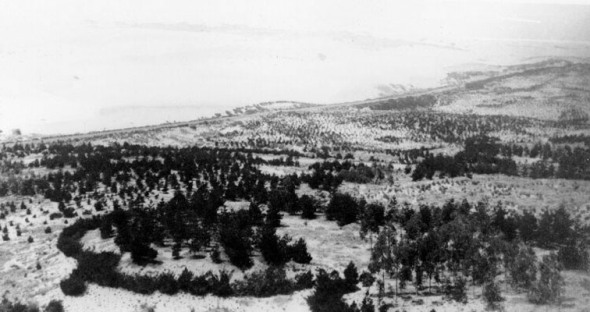
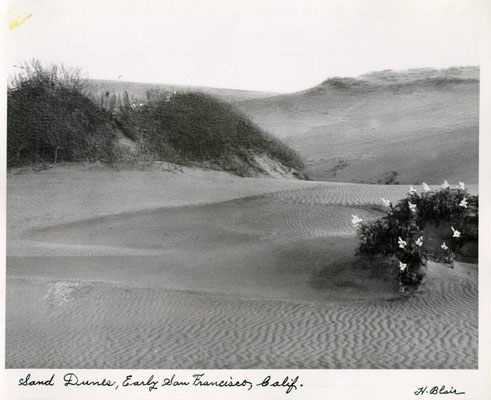
San Francisco, at the time when Sutro planted the historic forest, was a world of windblown sand that got into everything, including residents’ lungs.

View from Golden Gate Park, 1880

View from Golden Gate Park, 1880

We received a letter from a San Franciscan who has “a small San Francisco library and enjoy[s] its history.” It contains an extensively substantiated description of San Francisco before the tree-planting and the building of Golden Gate Park.
————————————————–
“San Francisco being a narrow tip of a spit of a peninsula with the Pacific on one side and a huge bay on the other side did not provide the type of environment the nativists seem to think. It appears that S.F. was one sandy and dismal place throughout most of the city until the park tamed much of the dunes.

“The “Significant Natural Resource Areas Management Plan” states that it was “maybe” like San Bruno or the Marin Headlands. Clearly, from what I read of early San Francisco, that is not the case. Sand seemed to permeate everything throughout the city.

“ If ever there were a location to place a grand city and do minor environmental harm,” he concludes, “S.F. was the place. To think that the nativists want to turn back the clock is so laughable that it is shocking that it might be reality.”

He provided five separate pieces of documentation that make fascinating reading. For those interested, they are given below.

———-
1) “The ultimate authority of early San Francisco, ‘The Annals of San Francisco,’ provides a very bleak picture and underscores the lack of vegetation.” (1855)

Source: The Annals of San Francisco By : Frank Soule, John H. Gihon, M.D., and James Nisbet; originally published, 1855, D. Appleton & Company

Part Second, Chapter 1; excerpt: (my notes—tip of the peninsula, entrance to Gate)

“On this subject it may be stated that all the shores in the mouth of the bay are liable to be washed off every year, by the combined strength of wind, tides, local currents, and floods. In the great freshets of spring 1825 more than fifty yards of land were swept away to the westward of the fort.”

“The depth of the water on the bar at low tide is considerable enough to permit the largest ship of war to safely cross it. The strait itself has a depth varying from five or six to sixteen fathoms and upwards. The shores are bold and rocky, and in some parts precipitous, swelling on the north side into mountains of upwards of two thousand feet in height.” (my notes—north side refers to Marin County) “On both sides they are quite bare and barren. The strong winds and heavy fogs which constantly assail them, and their own sandy or rocky nature, have effectually prevented trees or luxuriant vegetation of any kind from growing.”

….”As he approaches the strait from the south, the voyager has seldom perhaps seen so dismal a looking place. A multitude of low, bleak sand hills on the sea shore, often swept over by flying clouds of dense mist, first greet his eyes.”

———-
2) “Memoirs of actual residents and what they recorded — not much vegetation — mostly SAND and a “wretched” place to live.” (1918, 1856):
Source: San Francisco Memoirs, 1835-1851, Eyewitness Accounts of the Birth of a City Compiled and introduced by Malcolm E. Barker; Londonborn Publications, 1994

Excerpt from Steve Richardson, 1831-1924, memoirs published in the “San Francisco Bulletin” between April 22 and June 8, 1918.

“If the plain truth must be told, the cove of Yerba Buena was a dismal thing to look on in those early days. The beach was right enough, but to the westward stretched a wilderness of desolate, forbidding sand dunes, often shifting their positions overnight. When one considers that many of them were 100 or more feet high, one can realize the uncertainties of the landscape. When the trade wind blew in fresh from the ocean, it carried with it an almost incredible burden of both fine and coarse sand that got into clothes, eyes, nose, mouth—anything that was open in short—besides penetrating the innermost recesses of a household. Only sound lungs were proof against the accumulation of sharp, gritty material daily inhaled. In fact the place long had the reputation for unhealthfulness, not entirely undeserved, until the leveling of the dunes and the reclamation of the park tract checked the shifting sands for good.”

Sand Francisco

Sand Francisco

Excerpt from “Eliza Woodson Farnham shows her disdain in this excerpt from her 1856 book, California, In-doors and Out.”

“THAT WRETCHED PLACE, SAN FRANCISCO”

Describing her trip from south of Santa Cruz (quite beautiful) north to San Francisco ( an awful place):

“On either hand you have heather wastes intermingled with flowering shrubs, many of which, in their seasons, are very beautiful. At this time all the more productive regions were sparkling with the flowers common to the country, chief among the eshcholtzia, purple and blue lupin, columbine, white and variegated convolvuli, fleur de lis, white lily, and innumerable smaller flowers of exquisite beauty, with whose names, being no botanist, I am unacquainted. “….

“Yet a ride through the valley is one of the most charming in the country, so fertile is it—so adorned with the orchard-like trees that take on new forms in their groupings from every point of view by which you approach or recede from them. It only begins to be disagreeable when you reach the hills some ten or twelve miles from San Francisco, and grows constantly more so till you reach the same point on your return. Here the San Francisco winds meet you face to face, and search you like an officer of the customs. They grow more unpleasant till you enter the city, by which time you are thoroughly chilled and dampened by the humidity with which they have been charged. Your eyes, ears, nostrils, and mouth are filled with the sand they have hurled at you, and you just begin to remember that out of Santa Cruz one must expect to encounter many disagreeable things that one has entirely forgotten the existence of in that delightful spot.”

“San Francisco, I believe, has the most disagreeable climate and locality of any city on the globe. If the winter be not unusually wet, there is some delightful weather to be enjoyed. If it be, you are flooded, and the rainy season closes to give place to what is miscalled summer—a season so cold that you require more clothing than you did in January; so windy, that if you are abroad in the afternoon it is a continual struggle. Your eyes are blinded, your teeth set on edge, and your whole person made so uncomfortable by the sand that has insinuated itself through your clothing, that you could not conceive it possible to feel a sensation of comfort short of a warm bath and shower by way of preliminaries. ”

———-

3) “Early MUNI travails because of SAND all the way even to third street from Hayes Valley.” (1860)

Public transportation in San Francisco—again, sand in the city is a big issue
Source: San Francisco: Mission to Metropolis By Oscar Lewis; Howell North Books, 1966

“Then on July 4, 1860, service was commenced on the city’s first street railway….extended out Market to Valencia, and ended on Seventeenth Street. Of problems encountered by that pioneer venture, one of its owners later recalled that:
‘The entire line of Market Street from Hayes Valley to Third Street was a succession of sand hills…After they were cut through and the railroad started, we had much trouble keeping the sand off the track. The cutting, for economy’s sake, was narrow, and, as the sand dried in the embankments, it slid down and covered the tracks. This difficultly was finally overcome by the use of brush or scrub oak, which was used as a short thatch that covered and held the sand.”
———-

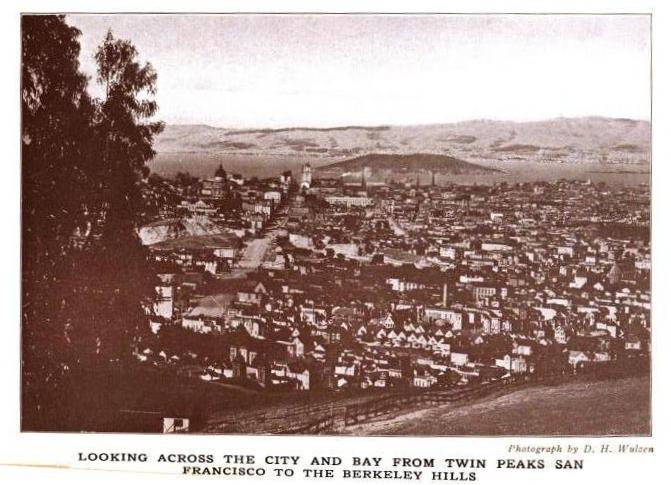
c. 1904. Photo by DH Wulzen

———-

4) “Not even the native-Americans deigned to live here–it was much too desolate.”
Source: Mirror of the Dream By T.H. Watkins and R.R. Olmstead; Scrimshaw Press, 1976

Prologue… “In the northeast corner of Golden Gate Park, otherwise a monument to the wonderful changes that can be wrought by men who have a visionary purpose, stands a little copse of stunted, windblown oaks—a thoughtfully preserved remnant of the original climax vegetation of the windswept peninsula that became the city of San Francisco. Some of the Indians who lived in the hills of Oakland and Marin and San Mateo must have known these oaks. They were a people who seem to have been fond of excursions, for we know something of their making of the tule canoes in which to cross the bay, but there certainly was little to keep them long on the desolate hills hereabouts. The natural setting of San Francisco is magnificent only to a people with a dream and purpose associated with a whole world of geopolitics and commerce, and only in this setting of the mind could the site of San Francisco acquire a meaning and a history. To the thoroughly practical folk who occupied the Bay Area for thousands of years before white man, San Francisco was not even a particularly nice place to visit.”
———-
5) “A collector’s book promoting S.F. because of the diversity of trees and John McLaren’s park.”

Source: San Francisco and Thereabout By Charles Keeler; Published by the California Promotion Committee, 1903

“The trees and shrubs of the park have been brought from all over the world—from various parts of North and South America, Siberia, China, Japan, Australia and Africa. It is claimed that no other park has so great a variety of trees, the temperate climate of San Francisco supporting the plant forms of all but torrid countries.

To the energy, taste, and enthusiasm of Mr. John McLaren, for many years park superintendent, is largely due to the miracle of making the wind-swept sands into a garden of rare beauty.”

Posted in Uncategorized | Tagged , , | 8 Comments

Puzzled #6 – UCSF: Landslides

The sixth in our series of responses to UCSF’s July 9th letter.

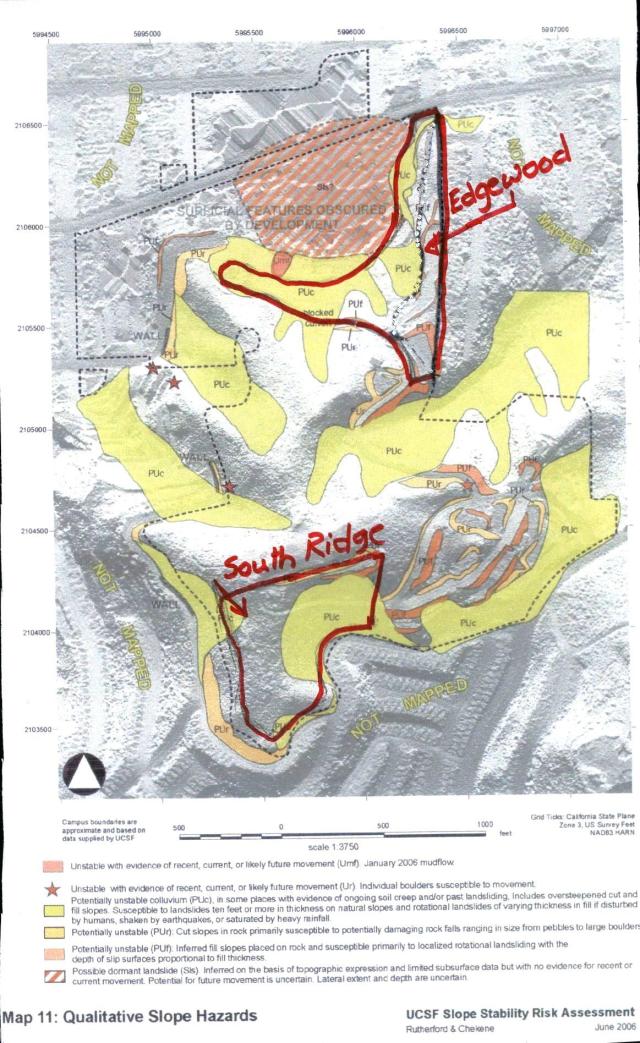
This is about potential landslides. We’ve included two maps from the FEMA application which clearly indicate this needs discussion.

Red boundaries shown tree-felling sites. Colored areas indicate landslide risk.

Red boundaries shown tree-felling sites. Colored areas indicate landslide risk.

The letter asks, “Will the projects cause landslides that will put roads and houses at risk?”

It goes on to say, “No. The remaining vegetation will help infiltrate rainfall. On slopes over 30%, vegetation removal will be done selectively and by hand with this in mind. No private homes are downslope from either of the demonstration areas.

Really? Downslope from the South Ridge, just across the street, are the private homes on Christopher and on Crestmont .

Instead of the existing trees and thick bush, the “remaining vegetation” – which could be as little as 10% of what’s there now – plus some new grass and wildflowers are supposed to consolidate the slope above our homes. Twin Peaks and Forest Knolls are proof that they don’t do so well at it.

Landslide under blue tarp. South Ridge at top left.

Landslide under blue tarp. South Ridge at top left.

erosion twin peaksWe accept the project supporters here don’t expect landslides. Neither did whoever stripped vegetation from the nearby slope (Warren Drive) that lay under a blue tarp for months; or the people who built the Forest Knolls home that slid down the mountain. (See: Forest Knolls home destroyed in landslide-1979)  Nor did whoever did the landscaping that results in rockslides on Twin Peaks every rainy season.
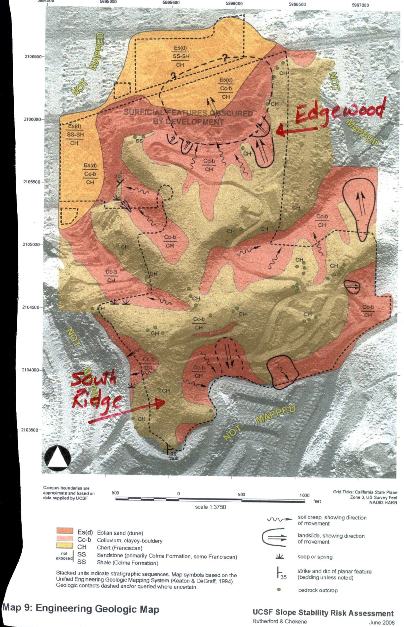
The fact is, this mountain is vulnerable to landslides as the map above shows (it’s produced by Consulting Engineers and is part of the FEMA application). In fact, as the next map shows, there have actually *been* landslides in the past in both sites. (Look for the double arrows.) And there’s a map of landslide risk prepared by state geologists (with FEMA funding) indicating most of the mountain is a landslip zone.

Pink areas and wiggly arrows show landslide risk; double line arrows show past landslides.

Pink areas and wiggly arrows show landslide risk; double line arrows show past landslides.

So, the obvious question follows: Rather than this destructive, controversial project, “Were other options considered?

This is what the letter said: “UCSF does not consider alternatives such as clear cutting and controlled burning to be acceptable. The overall concept of using a mixture of livestock grazing, mechanical equipment, hand labor and limited herbicides appears to be most effective.

Clear-cutting? Controlled burning? We can see why those wouldn’t be good options. Neither, for instance, would pouring concrete over the hillside (which Hong Kong has actually done to stabilize steep slopes). Or leveling the mountain.

Instead of all these drastic and potentially dangerous choices, the best option would be: First, do no harm.

We already have a stable densely-vegetated slope that isn’t covered in thousands of applications of Roundup herbicide. If we strip it off 90% of its vegetation and it lands up in someone’s garage, it won’t console them much to know that it was unexpected.

At a later date, we will make suggestions about caring for this forest which we all love. [ETA: We did.] Except for those who can’t stand eucalyptus and blackberry, of course.

Posted in Uncategorized | Tagged , , , , , | 3 Comments

Puzzled #5 – UCSF: Strange Objectives

Today’s discussion is about Objectives.

What are the objectives of the projects?” the Q&A asks, and proceeds to list the following:

“• To substantially reduce the amount of highly combustible fuels to prevent a fast-moving, high-intensity fire that could spread to adjacent residential areas.”

Well, we’ve talked about that one already. The proposed changes would increase the risk of a fast-moving high-intensity fire, not decrease it. Think of Angel Island, which had no wildland fires until chaparral was substituted for eucalyptus – and it’s had two, two years apart (2006, October 2008)
There’s an analysis in the latest newsletter at the Hills Conservation Network.

“• To improve the health and safety of the remaining trees”

The report on Mount Sutro makes it clear that thinning is likely to hurt the health and safety of the remaining trees, by exposing them to increasing wind. In fact, it advocates extreme caution in thinning the forest for precisely that reason.

“• To provide easier fire equipment and personnel access in the event of a wildfire

These two areas are already the most accessible in the forest.

Edgewood is actually bounded by a car park, and the loop of Medical Center Way. It’s probably the single most accessible area of the forest. South Ridge is accessible by paved road. There’s water at the summit. It seems rather that these areas have been chosen for their accessibility. Indeed, the original letter mentioned easy access by machinery as one of the reasons these lots were chosen.

“• To replace some of the highly flammable eucalyptus with more fire resistant species.”

Like what? The grass and native bushes mentioned are notoriously flammable and were directly involved in the two fires mentioned later in the letter, Angel Island and Mt Vision. It’s stuff that has *evolved* to burn.

“• To increase biodiversity, increase age diversity to better resist wind damage, reduce the potential for insect infestation, and attract wildlife.

The forest is already a habitat for wildlife. In fact, compared with the native garden at the summit, the forest has far more birds. (Research shows that eucalyptus forests support around as many bird species in the same or greater densities as oak forests… we’ll post more about that later.) Destroying proven habitat in order to create different habitat that might just attract wildlife seems… puzzling. We can identify the birds and animals that are there now, if we look closely. We can only guess at what may show up if we destroy it. The Native Garden doesn’t appear to have much.

As we mentioned before, wind damage is likely to increase with thinning, not decrease.

Reducing the potential for insect infestation sounds like “insects might destroy the forest, let’s get it before they do.” Trees with additional wind-stress and in a dryer environment will be more vulnerable to insects, not less.

Age diversity really isn’t an issue for eucalyptus. It regenerates like redwood (which is why they need to pour Roundup on it to kill it). As the trees die, they will naturally be followed by younger trees. Without doing anything.

“• To create a more attractive and less hazardous environment for the public.

UCSF Mount Sutro Proposed Vegetation Management Projects 2 July 2009

As Frost would have said: ‘The woods are lovely, dark and deep…’
Only a confirmed eucalyptus-hater could find this beautiful forest unattractive. There is no evidence of any hazard other than the usual ones of walking a trail in the woods.

Article in Indybay: ‘It is a tragedy that this amazing forest has fallen into the hands of those who despise the very trees and bushes that comprise it.’

Posted in Uncategorized | Tagged , , , , | 1 Comment

Puzzled #4 – UCSF: Cloud Forest ?

The fourth in our series of responses to UCSF’s July 9th letter.

According to the letter, “The forest is not a “Cloud Forest” (these are native forests found in tropical and subtropical areas of the world), but Mount Sutro does experience fog drip. Fog drip encourages the growth of undesirable highly flammable understorey (the area of a forest which grows in the shade of the forest canopy).

So it’s not a Cloud Forest because it’s not in a tropical or subtropical area?
Well, no. It’s a Temperate Cloud Forest.

The forest gets 8-12 inches of moisture from fog precipitation annually. This compares with San Francisco’s average annual rainfall of 21.5 inches. So the the forest gets around a third of its moisture during the summer months, from fog.

This means that the forest should be managed as a Cloud Forest. The first thing is not opening it up and drying it out.

As for “encouraging the growth of undesirable highly flammable understorey” – it may be undesirable to the writer of the letter, but to a lot of wildlife, it’s home.

It’s also a lot less flammable than the grasses and seasonal wildflowers they plan to plant there instead. Those dry out completely in summer. These bushes stay green all year and hold in the moisture that the trees capture.
And if scientists at San Jose State and UC Santa Barbara are right, (as reported in the San Francisco Chronicle) global warming may bring us even more fog.

Posted in Uncategorized | Tagged , , , , , | 3 Comments

Puzzled #3 – UCSF: Demonstrating what?

Today, I’m moving from puzzlement into bafflement on the topic of Demonstration Projects.

UCSF says it ‘wants to take advantage of FEMA funding to do a larger demonstration project in the South Ridge area (8 acres rather than 2 acres). This would be more effective in reducing the potential for a damaging fire.’

So the demonstration, which was initially about forest thinning for other purposes, was only supposed to be 2 acres, a nice manageable size and not a huge problem if the demo failed. In fact, their own Plan said, ‘The primary reason this short-term strategy was adopted is because the community members involved in the planning process did not support a long-term management plan until some management actions had been implemented in small, relatively unseen demonstration areas of the forest.’

So the 2-acre site was supposed to demonstrate that the proposed actions wouldn’t look awful and endanger the forest. That’s what demos are, right? An opportunity to demonstrate that something works.

Now, with FEMA money, the “demonstration” area is upped by a factor of four. It’s the whole of the South Ridge, which is not exactly small and relatively unseen. And instead of being a visual and practical demonstration for the “community members involved in the planning process” it’s now, apparently, about demonstrating reduced fire hazard.

So how do you do that? Set the thing on fire and see what burns? If we’re right and these moves increase the fire hazard by drying out the forest, will UCSF have the funding to put in irrigation as they’ve done in the other dry open patch, the Native Garden?

I thought the FEMA money was to supposed to reduce fire hazards, not fund demonstrations of forest conversion.

Posted in Uncategorized | Tagged , , , | 4 Comments

The Northern Flicker (woodpecker)

I was browsing the net today and came upon evidence of another species of woodpecker that uses the forest – an excellent photograph of a Northern Flicker on the SFCitizen blog. It was taken in the Sutro Forest.

Posted in Uncategorized | Tagged , , , , , | 1 Comment

Puzzled #2 – UCSF: Roundup Herbicide

So, still considering the puzzling letter dated July 9, 2009.

Today’s topic: Roundup Herbicide

According to the letter, “UCSF is proposing to limit the use of herbicides to spot treatment of eucalyptus stumps, cut vines and blackberry roots only where needed to prevent regrowth, and where other means of prevention are expected to be ineffective.

“Proposing to limit” sounds good. However, they are proposing to “limit” it to eucalyptus, vines, and blackberry. Those comprise all the major species in the forest, so perhaps “limit” is giving the wrong impression. We’re talking thousands of applications here. Probably for years, since eucalyptus continues to resprout for upto nine years after it’s been cut.

The letter goes on to say, Pesticides will not migrate off-site primarily because the stumps will absorb them and application will be done long before the rainy season.”

It sounds far-fetched to believe there’ll be no migration from thousands of applications on a steep slope. The application will have to be made so precisely that there’s no excess. And the migration off-site can take place through groundwater, which could absorb chemicals both from the soil and from the decaying vegetation killed by the Roundup. Springs and seeps on Mt Sutro (and these exist in the project area) will also become contaminated. And though they plan not to apply it in the rainy season, the fact is that the forest is damp year round. In August, long after the rains have finished, it is actually slushy.

Migration can also take place by being tracked on the clothing, shoes and paws of people, dogs, and other animals wandering through the forest. Or from the dust and leaves blown down the mountain into our neighborhoods by the winds which will increase once the forest is thinned.

Monsanto claims that glyphosphate (Roundup) degrades quickly have been challenged. Monsanto defenders are not always independent – the company has admitted to a web-based campaign to smear scientists challenging its claims.

Why are we so concerned, anyway? Roundup is legal, right?

It is legal, but it is also highly controversial, having been linked with non-Hodgkins Lymphoma (a cancer) and other unpleasantness, including birth defects of various kinds. It is dangerous to amphibians, and presumably some live in the Laguna Honda lake downslope of the forest. There is growing evidence that this chemical is far from harmless.

A June 2009 article in the Scientific American is titled “Weed Whacking Herbicide Proves Deadly to Human Cells.” It notes that while most studies focused on Glyphosphate, the active ingredient of Roundup, the risks from the so-called “inert” ingredients are as high or higher – and have not been studied as closely.

“Until now, most health studies have focused on the safety of glyphosate, rather than the mixture of ingredients found in Roundup. But in the new study, scientists found that Roundup’s inert ingredients amplified the toxic effect on human cells—even at concentrations much more diluted than those used on farms and lawns.”

The forest could be poisonous for years after this effort.

The letter continues: “UCSF is as concerned as the public about the use of pesticides and we intend to minimize use to the greatest extent practicable.”

This would be nice. The minimum required use is zero – this forest is safest left alone, not thinned, dried out, and poisoned.

Posted in Uncategorized | Tagged , , , , , | 2 Comments

Puzzling letter from UCSF: Fire Hazard?

The enclosure to the July 9th 2009 letter from UCSF’s Assistant Vice Chancellor was puzzling. It managed to concentrate a large number of questionable statements in a very small space, and will keep this blog busy for a while!

Today: Let’s talk about the risk of fire.

1. In support of the purported danger, the note refers to two actual wildfires at other locations: Mount Vision fire in Point Reyes in October 1995; and the Angel Island fire in October 2008. According to the note, “These areas have similar terrain, climate and vegetation as Mount Sutro.”

They do not.

The Mount Vision area is primarily chaparral (grasses and bushy scrub), with some forest of Douglas Fir and Pine. The Mount Vision Fire of October 1995 was a chaparral fire – a fire of the low scrub and grasses which actually would resemble the vegetation on Twin Peaks, not on Mount Sutro. In the dry season, the scrub and dry grass is extremely flammable – much more so than any tree. Caused by an illegal campfire, the Mt Vision fire involved no eucalyptus. http://www.sfsu.edu/~geog/bholzman/ptreyes/tripfire.htm

Angel Island, because of its location, has quite a different micro-climate than Mt Sutro, which is within San Francisco’s fog belt. According to the visitor information website, http://www.angelisland.org/faq2.htm “It is generally enjoys sunnier and warmer weather than San Francisco, which has many more days of fog.”

Fog photos taken in the same hour: Sutro Tower, Angel Island

Fog photos taken in the same hour: Sutro Tower, Angel Island

The Angel Island Fire was also grass and chaparral fire – Angel Island was denuded of nearly all its eucalyptus more than a decade ago. While many talked about how terrible the fire would have been had the eucalyptus been there, the residual eucalyptus didn’t actually burn. Before the trees were cut down, the only fires seem to have been structural fires. After that, there have been at least two, in August 2006 and October 2008, both of which burned grass and chapparal.

Native plants like dry grasses and coyote bush are extremely flammable. They are part of a fire ecology. This makes sense when the chaparral is burning miles from habitation – but not so when it’s in the middle of a city.

The current plan for Mt Sutro is to open up the forest: The forest floor will be much more open with more sun exposure and with clearings of native grasses, wildflowers, and brush.”

This sounds like a plan for increasing the fire hazard, unless UCSF is putting in an irrigation system as they have in the Native Garden. Since that garden required a $100,000 grant from the Rotary Club, it’s not clear where the funding for irrigated open clearings of dry grasses is coming from.

2. The note states, “In December 2008, the City and County of San Francisco adopted the San Francisco Hazard MitigationPlan (http://campusplanning.ucsf.edu/pdf/CCSF_Hazard_Mitigation_Plan.pdf ), which identified portions of the Sutro forest as a “Very High Wildfire Hazard” (see page C-13).”

It’s very unclear how exactly the area got designated as Very High Fire Risk. The map basically shows every eucalyptus grove in the city in red. It’s also not clear where the map comes from, since the information available on the Cal Fire website designates the area as having Moderate Risk, its lowest rating. The source document, a more detailed map from Cal Fire [ABAG] shows only one area in the forest as High Risk: The Native Garden at the summit, where the risk is in fact mitigated by the irrigation system.

[ETA (March 2013) There’s a discussion of all the “fire hazard maps” HERE. To summarize: UCSF showed three maps that purported to show fire danger, but actually were erroneous – and ignored the actual Fire Hazard map from the most reliable source, CALFIRE. The response of FEMA, which actually spoke to a CALFIRE person about the discrepancy, is HERE.]

3. There’s a reference to three fires, the latest ten years ago, that were quickly spotted and extinguished. That’s the point, isn’t it? These fires didn’t spread. Calling them “wildfires” is somewhat exaggerated. They were also all manmade, which makes one wonder about continually broadening access to the forest.

[ETA (March 2013): In the meeting regarding opening the new trail from Stanyan into the forest, Ray Moritz (who UCSF also hired as an arborist) minimized the fire danger. You can read that report HERE.]

It is apparent, when the data are examined critically, that the fire risk has been overstated – and that the planned actions will actually increase, not decrease the fire risk by introducing native grasses and shrubs and increasing the sunlight into the forest sounds. Angel Island didn’t burn until the trees were gone. San Bruno mountain had a grass and scrub fire starting from a prescribed burn.

Posted in Sutro Forest "Fire Risk", UCSF | Tagged , , , , , | 3 Comments

Dr Singer’s letter to the Chancellor UCSF

This letter was received from Dr Morley Singer.

—————

Chancellor Michael Bishop, UCSF, July, 2009

Dear Chancellor Bishop,

I am writing you at the suggestion of your associates, Barbara French and Deborah Brennan, following phone conversations with them expressing the concerns of the neighborhoods around UCSF about the attempt to cut down many of the large healthy trees in 14 acres of Sutro Forest. This large-scale destruction is to be funded by a FEMA grant application and also by UCSF directly. Ms. Brennan and French have assured me this letter will come to your attention.

I will briefly introduce myself as a friend of UCSF, having taken my Residency training in Anesthesia there, and serving as a Research Fellow in the CVRI under Dr. John Severinghaus (who also suggested I write you.)

I was on the UCSF Faculty for 10 years and created and directed the first Intensive Care Unit for Moffitt Hospital. I write this as one of the many neighbors strongly opposed to the tree removal project and as an alumnus with serious concern for the potential adverse publicity for UCSF.

1. The UCSF Grant Application is a thinly disguised effort by native plant advocates (who regard eucalyptus trees as ‘foreign weeds’) to destroy the trees and replace them with ‘native‘ plants— shrubs and grasses. They use the threat of fire as a justification for FEMA funding. (Note that UCSF’s 72-page 2001 Management Plan for Mt. Sutro barely mentions fire as a concern.)

The grant application contains much incorrect and misleading information. We have carefully reviewed the application and would be happy to provide you with detailed evidence of inaccuracies.

2. Major concerns expressed by the neighborhood include:

  • Extensive tree cutting is likely to actually increase the fire danger.
  • The trees act as a windbreak protecting the homes east of the forest from wind driven fires.
  • The trees pull down the fog and keep the forest damp, decreasing the threat of fire.
  • The native grasses that would be planted are highly flammable.
  • The area is not rated as a high-risk fire zone.
  • There has not been a serious fire on Mt. Sutro in the last 100 years.
  • The literature of fire protection agencies does not even mention destroying forests. There are simpler methods to decrease the fuel load.

These methods are widely practiced and endorsed by State agencies.

  • In order to prevent re-growth of the eucalyptus trees, the plan calls for repeated applications of “Roundup”, a herbicide whose toxicity is gaining increased attention.
  • Large- scale tree removal adversely effects water drainage and soil stability.
  • Large -scale tree removal may cause catastrophic failure of the remaining trees.
  • The native plants previously introduced on the summit of Mt. Sutro have required an extensive and expensive irrigation system. There is no plan to pay for another such system, its maintenance, and the extensive water consumed.
  • Fewer trees means less absorption of carbon dioxide, directly counter to the entire country’s approach to global warming.
  • The loss of trees would adversely affect birds and other wildlife.
  • The forest is a unique physical and aesthetic asset contributing to the quality of life of many. Most environmental organizations favor having more trees in urban environments, not removing them..

We would be happy to present supporting detail on each of these items. This is not necessarily a complete list.

  1. Most unfortunately, UCSF Communications with the neighborhood have been devious, biased, misleading and lacking in truth and candor. At a public meeting in May UCSF’s Orlando Elizondo’s statement of intending to listen to the community was met with jeers and laughter. Non UCSF native plant advocates were invited to make formal presentations. A totally biased presentation by UCSF was set up to make it appear the plan was approved and fait accompli and the work would start shortly. This was seen as an attempt to discourage opposition. The Grant has not yet been awarded.

So, in addition to having opposing views, the neighborhoods are emotionally hostile and have lost confidence and trust in UCSF communications and future actions.

4: Current Activities of the neighborhood to oppose the plan include:

  • Organizing the various neighborhoods around UCSF to coordinate actions. We have a mailing list and a website.
  • Contact with city-wide media to inform the general population.
  • Contact with California legislators. Assembly-person Fiona Ma is already actively assisting us.
  • State Senator Leland Yee has criticized the basic concepts of the native plant program quite harshly in the past.
  • Contact with city Supervisors and the Mayor’s office.
  • We are in communication with FEMA officials expressing our strong concerns.

We have no objection to planting native plants. But the destruction of 14 acres of Sutro Forest would remove 25% of the forest, with multiple adverse effects and no benefits. It is an experiment that would not get past the ethics committee at UCSF if humans were involved. It would be an environmental and aesthetic disaster for the surrounding neighborhoods and the city. It would be a public-relations disaster for UCSF.

We would be pleased to meet with you in person to discuss this further and to answer any questions. I understand your imminent stepping away from your position as Chancellor, and I imagine a happy return to the laboratory. I plead with you in all sincerity to address this issue. It is not too late to head off its potentially adverse effects. In the Chancellor’s residence you have undoubtedly appreciated the unique environment of Sutro forest. It would be a fine legacy to preserve it.

Morley M. Singer, M.D.

177 Belgrave Ave., San Francisco, CA 94117

Tel: 566-1371 or 209-753-2115

Email: mzinger1@comcast.net

Posted in Uncategorized | Tagged , , , | Comments Off on Dr Singer’s letter to the Chancellor UCSF

Friendly Invasive Species

Someone forwarded me a thoughtful article from the Science section of the New York Times, entitled “Friendly Invaders.”

Drawing on the work of Dr. Dov Sax (Brown University) and Dr Steven Gaines (UCSB), and also Dr James Brown of the University of New Mexico (among others), it points out that ïnvasive species” very seldom drive native species to extinction. Instead, they increase the biodiversity of the area to which they’re introduced.

Peopl often think of an ecosystem as having a limited number of niches, which Drs Sax and Gaines argues is not true. Exotics can create additional niches. Local species adapt to those niches, often through a process of rapid evolution. (Evolution can go really fast for species that reproduce rapidly and have large numbers of offspring.)

I thought this was particularly interesting in the context of eucalyptus forests. There’s evidence that something like 100 native species of birds and animals use eucalyptus forests and habitat. They’ve adapted to eat the seeds, eat the insects found under the peeling bark, nest in trees (including, apparently, under the peeling bark), and hide in the thick duff that forms under these trees.

A quote from the article: “I hate the ‘exotics are evil’ bit, because it’s so unscientific,” Dr. Sax said.

Posted in Uncategorized | Tagged , , , , | 2 Comments

Hairy or Downy Woodpecker Song?

Last week, walking in the forest, I heard what at first sounded like frogs. I listened more carefully, and realized it was a woodpecker of some kind. I’m a birder of more enthusiasm than expertise, and I usually need my bird-book and binocs to identify a bird. I didn’t have those (and besides, I couldn’t see the bird). What I did have was my camera, so I took a video/ audio recording of tall trees with bird noises. Then I started sending the video to people who knew more than I did.

[Edited to Add: Someone published it on Facebook, and if you want to listen, here’s the LINK .]

A friend of a friend came up with an answer: It’s a Hairy Woodpecker. They like forests with large trees, apparently, which we still have here. (If you click on the underlined link, it takes you to a website where they have an audio of the bird sound.)

———-

Okay, I just got a different answer from another birder, Harry Fuller, who thinks it’s a Downy Woodpecker, possibly with a background of House Finches.

“The woodpecker is almost definitely a Downy from the brief, rapid drumming…they nest across SF as well…Nuttall’s very rare in SF in summer, Hairy unusual and likes much denser woodlands…my wild guess on the bird song: a young, recently fledged House Finch, there’s a raspy portion after the first rapid trill…few SF birds have that in any song…it’s not the “real” House Finch song but it has the right speed and quality…none of the other possible birds sound like that: from Icterids, to Bewick’s Wren to Robins to White-crown Sparrow to California Towhee to goldfinches to warblers…I was just in Sutro Hts. over the weekend on a visit to SF and there were dozens of House Finches, about half of them new birds…suspect same is true on Mt. Sutro…most song bird males do not get their “true” song until their first breeding season and simply practice nonsense songs their first summer.”
————

Either way,  I’m pleased.  According to the USGS Bird Checklist for San Francisco Bay, the Downy Woodpecker is uncommon in all seasons, and the Hairy is an accidental visitor.

[Edited to add: There are Downies in the area – here is a link to Craig Newmark’s blog, showing a Downy at his bird-feeder. Craig lives next to the Interior Green Belt part of the forest.]

If anyone else wants to take a crack at this, email fk94131@yahoo.com and the video-clip (about 30 seconds’ worth) can be e-mailed to you.

Posted in Environment, eucalyptus | Tagged , , , | 5 Comments

Herbicides (Roundup) and the Forest

This letter is from Alicia Snow, a frequent visitor to the forest. It has been minimally edited to provide direct links and redact one name.
—————————————–

Roundup Quick Pro in Aldea

Roundup Quick Pro in Aldea

Roundup – the herbicide of choice used by UCSF all over our forest, is now found to have a so-called inert ingredient that is carcinogenic.

I have been after UCSF’s [spokesman] for some time regarding the liberal use of Roundup in the forest, sending him many articles about Monsanto’s egregious products and ugly tactics on farmers world wide. He always has ignored all those articles. We are all at risk from these chemicals, but dogs, being closer to the ground and likely to lick things down there, are that much more at risk.

Below, I have copied and pasted 2 emails I sent to [the spokesman] with the links to Monsanto’s products. I sent him these in March of 2008.

Email #1 ——————
The gardeners told me that the spray they use when
they spray at the housing area at Mt. Sutro is
Roundup. I thought you should know about this
article. Pretty scary stuff.

“Here is a very recent expose done for French TV and aired there last week.

And here is an English language site to read on Roundup. I also have been given some DVD’s about the subject. If you want further info, simply Google: Monsanto Roundup. Lots of ugly stuff pops up. This is just
one of many
: http://www.safe2use.com/pesticidenews/roundup.htm

Alicia Snow
——————————-

Email #2

Here is the three part story of a British documentary on Monsanto, genetically modified soy, and Roundup.

Part I Part IIPart III


I beg you to reconsider further Roundup spraying in the forest. Nothing can be worth this kind of trouble. Plants get more and more resistant, and more and more spraying doesn’t work. What about all the little kids living in the housing area? What about all the neighbors living around the forest? Monsanto wants no one to know about this, but the word is getting out in other countries, and the internet is our source of truth.

Please watch this and get back to me.

Alicia

———————————–

Posted in Uncategorized | Tagged , , , | 2 Comments

Disability Access?

Unsigned letter from e449081@bsnow.net
————
Now that Sutro Stewards has opened up Mt Sutro to public access, UCSF must make it accessible to people with disability.

A paved road already reaches the mountain top. Pave over the native garden, which will reduce the worst fire-risk on the mountain and provide parking. Then pave the major trails for wheelchair access, starting with the Summit Trail.

Posted in Uncategorized | 2 Comments

Caring for a Temperate Cloud Forest

clouds blowing in
Managing a temperate cloud forest is quite different from managing a regular dry forest.

The most important thing is: Don’t open it up to dry out.

When the forest is opened up, the area immediately becomes dryer. Today, on a foggy day in June, we hiked up the Southern side of the forest to the Native Plant Garden on top. The trail on the South side was dry – but only a foot to the side, the soil was damp.

This is even more obvious when you compare the forest with the open Native Garden on the summit, which is bare of trees. NPG Grass
sprinkler system NPG It has been planted with native plants theoretically drought-tolerant. And yet, the garden is very dry -even on a foggy day. It survives only because it has a sprinkler system. (This is referred to as the “intact Rotary meadow” on the Nature in the City website. Rotary it most certainly is, since they paid $100K for it; meadow it may be; intact, not so much.) [Edited to add: In Oct 09 we learned that the garden isn’t actually being watered; so presumably the plants are managing. Perhaps that’s why they look rather dry. The green bushes at the back, “black acacia” (we think) are part of the forest.]
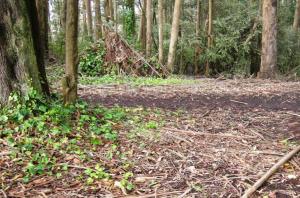
Only steps away, the trails under the trees are wet. Without sprinklers.
sutro forest june 25 09 012

Continue reading

Posted in Uncategorized | Tagged , , , | 5 Comments