Dusk in the forest (with owls)

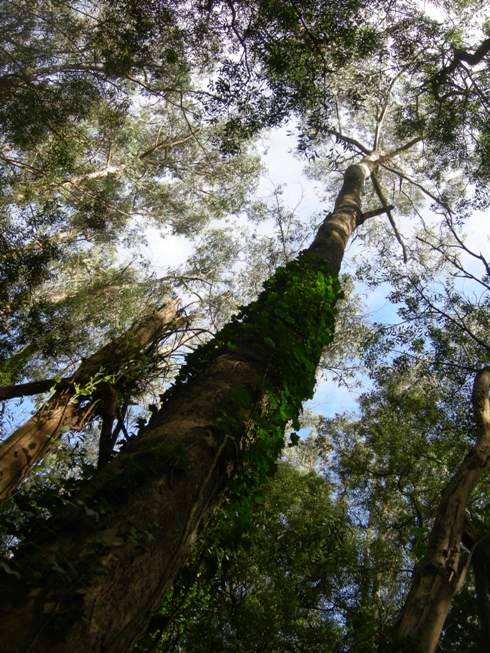
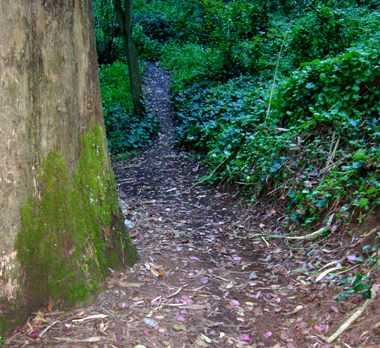
We walked up into the Sutro Forest on a peaceful bird-filled evening. A few outside noises drifted in. The trees were full of the tweets and trills of bird-sounds,  but the creatures themselves, evidently looking to settle in for the night, were well-hidden.  It felt even more like another world than usual.

Late February in the Native Garden

After all the rain, the trails were wet, even squelchy, with occasional puddles. Small stones and gravel have been laid on some paths on the south ridge, and elsewhere it’s been mulched with what looks like eucalyptus chips.

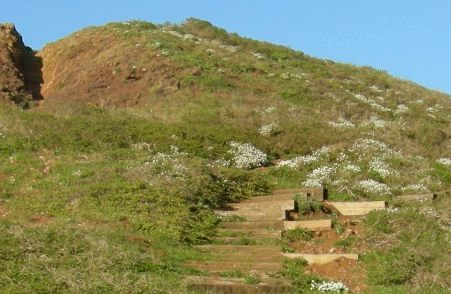
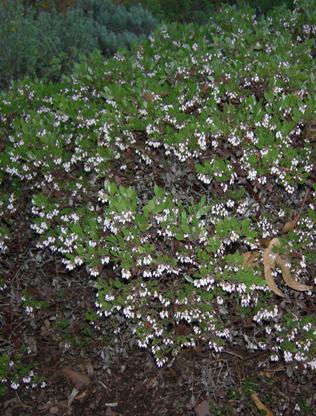
The Native Garden was more-or-less bird-free; one may have disappeared into the bushes, not sure. But it’s blooming: pink-flowered current with pretty sprays of flowers, the tiny white bells of the manzanita, and the blunt dull-blue spikes of ceanothus. There were a few purple lupins. Also the bright sulfur-yellow of the Bermuda buttercup, still scrolled tightly against the weather.

Pink flowering currant

The grass, native and non, was green instead of the dry brown we’ve seen all year. This may be as good as it gets in the Native Garden.

As we walked back into the woods,  we gradually noticed another sound behind the loud twittering of the birds and the occasional raven’s caw overhead: A soft hooting. The Great Horned Owls.

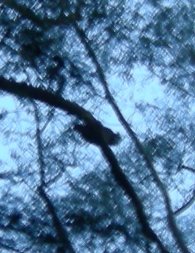
Great Horned Owl looking down...

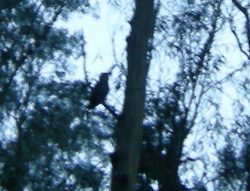
And then, along a darkening trail, we saw them: A pair, in two different trees, talking quietly to each other. A flash would have been an intrusion as lurking humans are not. So here are the flashless photos. These are the birds Nature-In-the-City wants gone.

The second owl

Posted in Environment, eucalyptus, Mt Sutro Cloud Forest | Tagged , , , , | 2 Comments

“Nature in the City”: Tree-huggers vs Tree-killers

Recently, we posted a reader’s note about a talk from the organization called ‘Nature in the City’ (NC) on the “urban forest.” (Those are NC’s quote-marks; they apparently don’t believe in urban forests). NC is the parent organization of the Mt Sutro Stewards, which backs the destructive plan to gut Mt Sutro’s Cloud Forest.

SE Farallon

These are our notes from that talk, which you can listen to here (scroll down until you find it). Given that it was positioned as “education”, we were disturbed by the strong bias as well as the inaccuracies. “A deep well of misinformation,” commented someone who heard the talk. We have to agree.

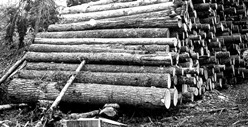
The only good tree?

NC’s Josiah Clarke kicked off with two slides: A shot of the nearly bare Southeast Farallons, and a “bunch of logs” (similar, not identical, to the pictures here).  “I’m definitely not a hater of trees…” he said, noting that the pictures reflected his “background with trees”.

Native plant toyon and eucalyptus

NC then listed all the ways in which non-native trees are bad: they shade the ground; they provide a perch for raptors (of which more later); they make the soil more acidic so native plants can’t grow under them; and through allelopathy, they poison the soils around them so only blackberry, ivy and holly can grow. [Not quite. Here’s a picture of toyon, a native plant growing under non-native eucalyptus.]

In addition to eucalyptus, NC dislike black acacia. “Very allergenic,” they called it, in addition to being non-native and invasive. [Not really. It’s mildly allergenic, less so than oak. The AAIFNC notes that acacia is a “Minor cause of pollen allergy February to March…” while Oak is listed as a “Major cause of pollen allergy March to May…”]

NC referred to non-native trees as “deadweight” and “stagnant trees,” and made sweeping assertions about their lack of contribution to the eco-system. [In fact, Mount Sutro Cloud Forest has 93 species of plants. California’s eucalyptus forests have complex eco-systems – especially one as old as the Sutro Forest. No one has surveyed its fauna, particularly insects and reptiles. The forest is full of songbirds, both in the canopy and the dense understory, while we have seldom seen more than one or two individual birds on the Native Garden on top.]

And for “tree-huggers” who objected to the destruction of century-old heritage forests, NC compared the 120-year-old trees to “toxic waste” and “broken-down old buildings.”  They also disparaged anyone who mourned the thousands of trees cut down at Inspiration Point…

Other things they weren’t a hater of (but obviously didn’t like):

  • Great horned owls. “More common now than they’ve ever been.” They believe they endanger the weasels, brush rabbits, shrews, and quail that are “on the brink and disappearing.” [No, they’re not, actually. All those species are quite common, with a Conservation Status of “Least Concern.”]
  • Hawks, red-tailed and red-shouldered, because they’re predators and they’re not rare. [True. Neither are any of the species NC apparently root for.]
  • Ravens, because they’re predators; they saw one eating a sparrow. “We’re managing for ravens” NC said disparagingly, which was odd because as enthusiastic birders, they should know that San Francisco has quite a number of bird species.

The only bird he seemed to favor were Nutall’s white-crowned sparrows and rose-breasted grosbeaks, but not enough to support the mature trees the latter prefers. (The grosbeak shows up at feeders in Cole Valley at the edge of the Eucalyptus forest. Check this link for a picture – scroll down. It also notes that 30 species showed up at Craig Newmark’s Cole Valley bird-feeders… hardly evidence that “we’re managing for ravens.”) And quail. [None of these birds is rare, either; they’re all listed as being of Least Concern.]

He showed a picture of a toyon and a band-tailed pigeon. “This is the lock and key mechanism” he said, implying that they were interlocked elements of an eco-system. [Umm, no. The band-tailed pigeon will eat any kind of berry or seed and it loves bird-feeders. Also, it’s a forest bird, not a chaparral-dweller. And toyon berries are eaten by many kinds of birds – and raccoons, all of which help spread its seeds.]

Actually, NC wasn’t so keen on some native trees, either, with a reference to over-planting of redwoods in the artificial canyons of downtown San Francisco.

NC advocated cutting down existing non-native trees and replacing them with specific native trees. [Most would be unsuitable for the conditions of our city. Douglas Fir requires much more rain. Oak doesn’t like wind, and is susceptible to Sudden Oak Death, besides being allergenic. And so on.]

NC favors these:

  • The endangered Mission Blue Butterfly [but apparently does not object to toxic chemical use where it pupates at ground level, or where the ants that tend its 3rd and 4th instars live];
  • The Nutall’s subspecies of the white-crowned sparrow [no conservation status, noted as common and flexible];
  • The Callophrys Dumetorum butterfly [not the Callyphors Dumetorum as NC misspells it on their website] which NC calls the Green Hairstreak, but UC Davis calls the Bramble Hairstreak. However,  Butterflies and Moths of North America refers to it as the “Coastal Green Hairstreak” and describes it as “G5 – Secure – Common; widespread and abundant” though it notes its range is limited and should be protected.

NC said that the governing principle of conservation should be to preserve the “last of the least and the best of the rest.” We have no quarrel with that principle. But in fact, none of the species favored, (or even the species disfavored), fall into these categories. With the single exception of the Mission Blue.

Actually, the Green Hairstreak Corridor is a good idea, whether or not the butterflies (whatever they’re called) are rare. We’re supportive of efforts to preserve nature in the city — but not by destroying it.

We’re puzzled why the Nativists in San Francisco don’t work with nature rather than against it – for instance,  underplant urban forests in Golden Gate Park with those native species – such as ferns – that prefer shade and moisture, rather than trying to create “sunny glades” where the sunshine is limited and toxic chemicals are necessary.

We’d suggest an over-riding aphorism: First, do no harm.

Posted in Environment, eucalyptus, nativism | Tagged , , , , , , , , , | 11 Comments

Low Fire Risk and the “Historic Trail”

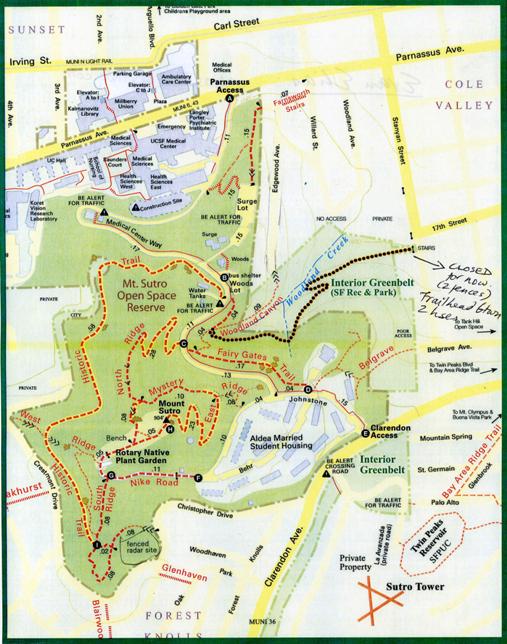
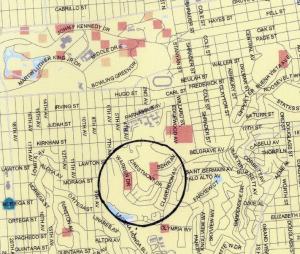
I attended a meeting called by Parks and Rec this evening, to discuss opening access to the forest at 17th and Stanyan in Cole Valley. This the black dotted line in the map below. [ETA: The map was distributed at the meeting.] The trail would lead through the Interior Green Belt, and join existing trails in UCSF’s part of the forest. Access to the “historic trail” is from a space between two houses, about the size of a vacant lot. At present, it’s fenced off.

This was the second meeting on the issue. I didn’t attend the first, but this meeting was to deal with the issues raised in the first one (held in June or July, there were two dates reported).

Mt Sutro and proposed Historic Trail

Right now, the proposal is to ask the Parks Commission to allocate $50,000 for the purpose. The breakout is something like this (I didn’t keep precise notes, but I’ll make corrections later if needed):

Mt Sutro Stewards (for clearing the trail)  –      $ 6,500
Tree assessment (for hazardous trees)-             $ 5,650
Hazard tree removal                                                   $10,000
Reopening the trail (fences, staircase)                $10,000
Environmental investigation                                  $13,000  (<– not sure)
Contingency                                                                     $4,850

ETA: From the Rec and Parks document, I have a different set of figures:

TASK

AMOUNT
TRAIL RESTORATION
Materials (erosion control, seeds, etc.) $6,500
Tree Assessment $5,560
Hazardous Tree Removal $10,000
RE-OPEN TRAILHEAD
Refurbish Trailhead & Remove Fences $7,000
TRAILHEAD ENHANCEMENT STUDY
Environmental Evaluation $15,000
SAFETY/SECURITY
Privacy Screen at Trailhead $10,000
215 LF of Chain Link Fence $16,125
PROJECT MANAGEMENT $4,360
CONTINGENCY (10%) $7,455
TOTAL $82,000

——-

Ray Moritz, who we have met before as a forester, introduced himself as a Fire Ecologist. He said that fire danger was related to three things: The fuels; the topography; and the weather. He noted that the fire danger was mild, because though the terrain was steep, there was a low amount of fuel on the ground and the trees were so tall that the canopy was unlikely to catch from a ground fire. Most importantly, in San Francisco, the window of opportunity for a fire was very small; there were only a few days annually when the forest was dry. He also said cigarettes (which people had feared as an ignition source) are actually not a danger. [ETA: He made 16 practical experiments with oven-dried eucalyptus leaves and cigarettes; he did not achieve ignition even once.] The greatest danger, he suggested was when people did not clear debris from the roof area around fireplace chimneys. However, he pointed out that the fire station was nearby, with a response time of under two minutes, and a fire hydrant sat opposite the proposed trailhead.

Some neighbors were still concerned about fire, not just by the trail but in the context of the whole forest. (We’re guessing that UCSF’s position on the issue when seeking the FEMA grant has worried some people.) Mr Moritz said that while fire-risk varied at different spots on the mountain, the overall risk was low. If it is indeed a low risk, they replied, they would like to see confirmation in writing, and would like to see the report in writing. Craig Dawson, of Mt Sutro Stewards, later noted they had done some further research.

————-

Another concern was with hazardous trees. One neighbor pointed out there were at least 15 hazard trees that had been marked but not trimmed or removed.

Other concerns were with traffic and parking, potential criminal activity and homeless camps, drunken teenagers at night; unleashed dogs, maintenance and operations. The presenters suggested that they greatest use of the trail would be by neighbors and people coming by public transport, as with the trail starting at Edgewood; that there would be joint patrols by UCSF and Parks; the park would close at 10 p.m. and anyway, opening up the forest reduced the likelihood of camping and crime by having more eyes watching; unleashed dogs were prohibited; and maintenance and operations would be provided by Mt Sutro Stewards and volunteers.

————-

Lisa Wayne of the Parks and Recreation department made a presentation describing the project. She said that no environmental review was needed to open the trail; but that a later phase of the project, to remodel the trail-head, might require one.

Later, when someone else asked her specifically, she said there was no intent to introduce native plants along the trail. In fact, Marvin Yee, in his presentation, specifically mentioned leaving the blackberry bushes and other dense vegetation in place to discourage people from straying off the trail. (We think this will also be beneficial to birds and wildlife.)

————-

We were pleased at the reassessment of the fire risk, particularly since the area of the forest we’re talking about is contiguous with the Edgewood cut zone.

Posted in Environment, eucalyptus, Maps, Meetings, Mt Sutro Cloud Forest, Neighborhood impact, Sutro Forest "Fire Risk" | Tagged , , , | 11 Comments

Erroneous “Facts” from “Nature in the City”

A few days ago, under the auspices of Shaping San Francisco, ‘Nature in the City’ (NC) offered a public talk on the “urban forest” (their quote-marks, they don’t appear to believe in urban forests).  NC is the parent organization of the Mt Sutro Stewards, which backs the destructive plan to gut Mt Sutro’s Cloud Forest.

The thrust of the talk, by Josiah Clark, was that non-native trees in San Francisco — particularly eucalyptus, Monterey cypress, and Monterey pine — should all be replaced by native ones that probably existed here in pre-European times.  He believes that native trees actually would grow here, (contrary to the understanding that most of them cannot stand the wind and difficult growing conditions in San Francisco) — if we expand our definition of native trees.

Someone sent us this response, noting a number of unsupported or erroneous points made  in the talk.

———

1. NC claims that our palette of “native” trees is too narrow. They advocate for destroying Monterey pine and cypress, and for planting trees like Douglas fir. (Impractical)

Fact: Douglas fir is no more native to SF than Monterey pine and cypress, but it is less well adapted to the San Francisco climate.  Douglas fir needs more moisture than San Francisco gets: “Douglas fir is grown on the sites where the rainfall is higher than 800 mm [32 inches] per year… (Wind and Trees, Cambridge University Press, 1995, page 474.) San Francisco’s annual rainfall averages 22 inches.

2. Non-native trees are invasive. (No)

Fact: Using historical aerial photographs of six Bay Area parks in the East Bay and Marin County, McBride and Russell found that from 1939 to 1997, areas of eucalypts and Monterey pines actually decreased while areas of Manzanita and coyote brush increased. (McBride, Joe and Russell, William, “Vegetation Change and Fire Hazard in the San Francisco Bay Area Open Spaces” )

3. Insects are dependent upon native plants. (Not necessarily)

Fact: As we might predict based on simple evolutionary principles, this is a myth. Insects reproduce abundantly and have short lives, which means that they can adapt and evolve more quickly than longer-lived mammals.  .

Art Shapiro at UC Davis reports that California native butterflies have adapted to non-native vegetation and some now depend upon those non-natives for survival. He explains we would expect this, because most native plants are dormant during the dry season and therefore not a year-around food source.  The native butterflies have adapted to the continuous food source provided by many non-natives. (Shapiro, Arthur M., “The Californian urban butterfly fauna is dependent on alien plants”, Diversity and Distributions, 2002, 8, 31-40. )

The writer goes on to add: “I have met Art Shapiro a couple of times and had the opportunity to ask if his findings about the adaptation of native butterflies could be generalized to other insects.  He said, without a doubt other insects were equally capable of making such transitions to non-native plants, but that it would take research dedicated to each individual insect to prove that.”

4. A lot of trees  are “native” to San Francisco. (Untrue)

NC claims there were many trees in San Francisco before the arrival of Europeans.  They believe that the conventional wisdom (that there were few trees) is based on the lack of an historical record predating the arrival of Europeans, and that early settlers removed trees for firewood and to convert forest to grassland for grazing.

Fact: There is an historical record that predates the Europeans, proving there were few trees:

  • A UCB thesis document contains many quotes from the first Europeans explorers, all indicating that there were few trees.  (Clark, William Carey, “Vegetation Cover of the San Francisco Bay Region in the Early Spanish Period”, Geography Master’s thesis (UCB), 1952.)
  • The book The Making of Golden Gate Park has evidence that virtually all of Golden Gate Park was sand dunes.  It also describes how difficult it was to grow trees in San Francisco because of the wind. (Clary, Raymond H., The Making of Golden Gate Park, The Early Years: 1865-1906, San Francisco: California Living Books, 1980.)
  • Richard Henry Dana visited California prior to the Gold Rush.  At the time of his visit there were a handful of Spanish living in what is now San Francisco.  Dana describes the desolate, treeless landscape in his book Two Years Before the Mast. (Dana Jr., Richard Henry,  Dodd, Mead & Co, 1840.)

5. Native Americans may have destroyed the trees. (Unlikely)

Fact: There were very few native Americans living in San Francisco because of the climate and the lack of food sources.

6. Native trees grow in neighboring locations such as Muir Woods and Crystal Springs, proving that they also grew in San Francisco. (Not really)

Fact: The microclimates are different. A tree that will grow in Muir Woods will not necessarily grow in San Francisco.  Most of San Francisco’s so-called “natural area”  are on the tops of hills (Tank Hill, Kite Hill, Golden Gate Heights, Mt. Davidson, Twin Peaks, Edgewood, Buena Vista, Billy Goat Hill, etc) because these are the few undeveloped areas in the city.  Because they are hills, we know that they are windy.  They were barren historically and that suggests that the trees that are native to SF did not grow on them.  Both Muir Woods and Crystal Springs are sheltered valleys, with different climates and therefore growing conditions.

———-

Josiah Clark was followed by Doug Wildman from “Friends of the Urban Forest.” Doug considered the idea of replacing San Francisco’s tree inventory with “native” trees interesting.

But he also raised the practical issues of growing them in street conditions (tolerance of traffic and pollution, fruit drop and leaf drop, invasive root systems, low-growing or spreading habit), and pointed out that sidewalk trees needed owner acceptance.

Posted in Environment, Meetings, nativism | Tagged , , , , | 4 Comments

Native Plants and Neurotoxins

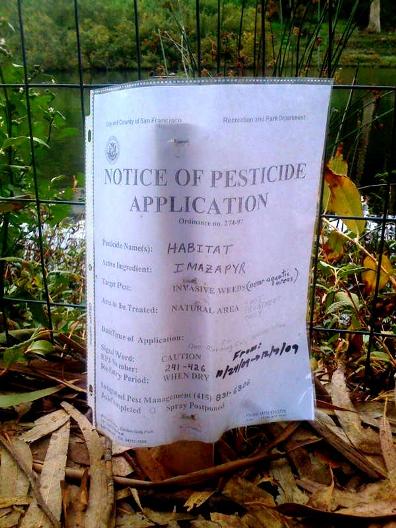
It appears that Native Areas in San Francisco are again linked to toxic herbicides. We’ve posted earlier about Twin Peaks and Garlon/ Roundup.

This time, it’s Imazapyr in Stern Grove.

(posted with permission from A.S.)

Imazapyr is sold under the brand name of “Habitat” when it’s for Native Plant Restoration. Its other trade names are slightly less benign: Chopper. Stalker. Arsenal. Assault.

It persists in the soil for up to 17 months. It’s water-soluble, and moves through soil to get into groundwater.  “Traces of imazapyr were detected in the groundwater even 8 years after application,” according to a  study by scientists from the Swedish University of Agricultural Sciences. (Pest Management Science, June 2004.)

It’s a broad-spectrum killer, so it kills most things it hits (except some weeds that have become resistant). It’s also a difficult herbicide to target with any degree of precision.

In fact, some  plants actually push it out, so it gets into the tangled roots below the soil and kills other plants. From the Nature Conservancy’s Weed Control Methods handbook: “… imazapyr may be actively exuded from the roots of legumes (such as mesquite), likely as a defense mechanism by those plants… the ability of imazapyr to move via intertwined root grafts may therefore adversely affect the surrounding desirable vegetation with little to no control of the target species.”

This is the chemical opponents compared to Agent Orange, when the border patrol planned to spray it on tall cane growing along the Rio Grande river. Communities on both sides feared contamination of the water. The plan was suspended.

In people, it can cause irreversible damage to the eyes, and irritate the skin and mucosa. As early as 1996, the Journal of Pesticide Reform noted that a major breakdown product  is quinolic acid, which is “irritating to eyes, the respiratory system and skin. It is also a neurotoxin, causing nerve lesions and symptoms similar to Huntington’s disease.”

Oh, and Imazapyr is illegal in the European Community.

Posted in Environment, Herbicides, nativism | Tagged , , , , | 11 Comments

Tree trimming and removal

UCSF is doing some maintenance work on the Nike Road (connecting the Aldea campus with the Native Garden). We got a notification that said:

In the area of Mount Sutro along the Nike Road that leads from the Aldea housing complex to the summit, UCSF Facilities Management will be addressing several hazardous tree conditions. This work includes safety pruning to remove dead and/or broken tree branches and removal of dead and fallen trees. All trees are located along the Nike Road and are representing a high risk of failure.

“The work will take place Tuesday January 19 through Friday January 22. Staging will start after 8 am, and noisy work will be limited to the hours of 9am to 5pm.

This project is unrelated to the proposed fire mitigation projects.”

We were concerned about this and requested further information, including whether Nike Rd was a public right-of-way, whether there would be any visual impact from Christopher Drive (which is overlooked by Nike Road), and whether the SF Tree Council had been notified. Here’s what Barbara Bagot-Lopez of UCSF’s community relations department told us:

“UCSF owns this property, including Nike Road, and it is our responsibility to maintain the property and make sure it is safe.  We expect that approximately ten dead and fallen trees will be removed; the bulk of the work will involve safety pruning. The visual impact from Christopher Drive will be minimal to none.  The SF Tree Council is on my notification list, but — as always — please feel free to forward my email notices to other interested parties.”

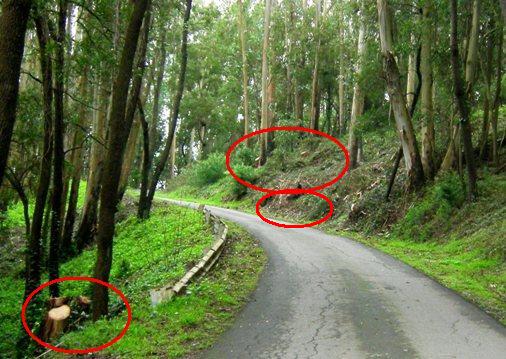
Edited to Add: We took a look around Jan 30 and 31st. The trimming’s been done.  It’s pretty much as UCSF described – some 10-20 trees and large branches removed. Except for the fresh-cut stumps, the visual impact is quite minor.  Most of the missing trees were relatively small.

After trimming

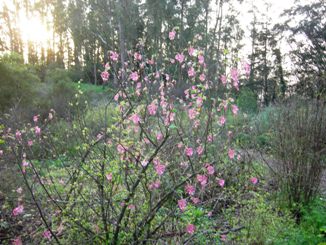
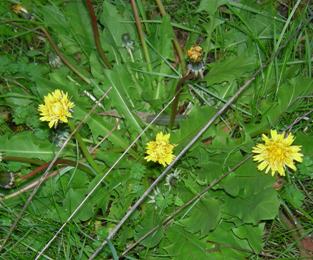
And – The Native Garden has some flowers at last. It still has a lot of dead plants, but some of the bushes are beginning to bloom. I actually saw a hummingbird there, trilling a challenge to others in the forest (who were trilling right back).

pink-flowered currant

yellow-flowered interloper

Still dry

Posted in eucalyptus, UCSF | Tagged , , , | 7 Comments

Twin Peaks in Bloom

Twin Peaks is covered with wildflowers. Right now, it’s mainly the white clusters of sweet alyssum (Lobularia)…

Alyssum flowers on Twin Peaks

Sweet Alyssum

Sweet Alyssum

But the yellow oxalis (oxalis bes-caprae) is beginning to flower, too, and soon there’ll be drifts of it all over the mountain…

Yellow oxalis

[ETA Feb 28: Like this!]

And then it’ll be time for the wild mustard (brassica)…

wild mustard

Roundup

Garlon 4

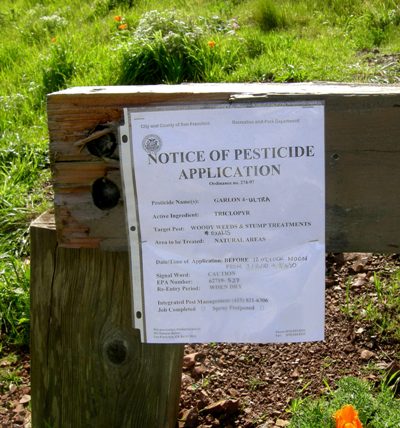
After that, since none of these is a native plant — and the peaks are being managed by nativists as a Native Plant area — the next thing to cover these hills will be the toxic herbicides: Roundup (glyphosate) and Garlon (tricyclopir).

Then, perhaps, the disturbance caused by the pesticides will prime the soil for the most competitive plants to return, and next year there will be more alyssum, oxalis and mustard.

But what of the broader effects of eco-disruption? The area claims to be habitat for the Mission Blue Butterfly, whose caterpillars require nurturing by ants. Wonder how ants and caterpillars like Roundup and Garlon…

And given that Twin Peaks is one of the highest areas of the city and water flows off it like a river when it rains, we also wonder how much of the herbicide is ending up in the Bay. And the ocean.

[ETA: Predictably – Garlon 4-Ultra spraying, March 2-16, 2010]

Posted in Environment, Herbicides: Roundup, Garlon, nativism | Tagged , , , , , | 1 Comment

‘Heartbreakingly Beautiful’ Trees

Redwoods photograph by Laura Morton

Redwoods photograph by Laura Morton

Almost as though in response to our item about the Chron’s indifference to trees, the 27th December issue carried Tom Stienstra’s marvelous piece about the Peters Creek redwood grove, which passes the “blindfold test.”

“What is the Blindfold Test? Imagine that someone blindfolds you and takes you on an adventure. At the payoff spot, they stop and remove the blindfold.

Q: Do you even have a clue where you might be? A: No. Q: Is the beauty of the place heartbreakingly gorgeous? A: Yes. Q: Are you shocked that such a place exists and you never knew about it? A: Yes.

It was illustrated by a lovely picture by Laura Morton (above – click to access the image at SFGate), labeled “The redwoods at Portola Redwoods State Park deep in the interior of the Peninsula are heartbreakingly beautiful and uncommonly secluded.”

That article could have been written about Sutro Cloud Forest. (Lower photograph)

Sutro Cloud Forest Trees


———

[Edited to add: And – no one seems to want to cut down the skinny tall trees on either side of the tall central redwood in Laura Morton’s picture.]

Posted in Environment | Tagged , | Comments Off on ‘Heartbreakingly Beautiful’ Trees

Tree-friendly? New York Times vs SF Chronicle

Yesterday’s Bay Area section of the New York Times carried an article on trees that was both sad and refreshing. Sad, because it talked of tree-destruction – which seems to have become a California Thing. Refreshing, because it actually appeared to care rather than to applaud. Somehow, our own Chronicle’s response to dead trees seems to vary from indifference to approval.

We especially noticed NYT’s coverage of trees felled in Palo Alto. “California Avenue in Palo Alto, once a leafy street of shops and restaurants, now has the shops without the leaves, giving it the ambience of a one-stoplight town,” said the story. “A city contractor chopped down 63 mature holly oaks in 36 hours in September, prompting weeks of fury.” [It did: Palo Alto Online covered it here.]

San Francisco Chronicle’s reporting, some months back, of a similar action in a Santa Cruz shopping area, said: “Gone are the overgrown trees that made the street dark by day and a druggy hangout at night.” (However, a Chronicle blogger did mention the “denuding” of the three blocks in Palo Alto, mentioning it “was part of a beautification plan” but also giving a signal-boost to a Youtube video made by a furious neighbor.)

———

Separately, the NY Times article talked about the mysterious destruction of trees in Oakland’s parks and city properties, eventually blamed on — the Oakland Zoo. The zoo apparently claimed it had “written and verbal permission to remove invasive tree species” and didn’t realize they also needed city permits.

How trees become “invasive” in city parks is a little baffling. What are they invading and how, even if they are a vigorous species (in this case, acacia) ? Is this knee-jerk nativism at work?

The Zoo is planning to plant 50 oak trees in restitution. Maybe they’ll slowly grow to replace the trees that are gone, if Sudden Oak Death doesn’t get them first.

[Edited to add: The San Francisco Chronicle covered this story on Jan 15, 2010. Predictably, it was dismissive both of the trees and the concerns of neighbors, who oppose the zoo’s cutting of over 300 tree. The Chron’s spin on it was that the black acacia was a non-native, invasive fire-hazard; and it quoted the Oakland Deputy  fire-chief as saying, “The Oakland Fire Department has recommended the removal of all highly flammable trees in the hills…”  We’re not sure how that’s relevant, as black acacia is considered only moderately flammable.  We’re all in favor of elephant snacks – separate from the issue of elephants in captivity. But cutting down trees isn’t the only way to do this.]

———

There’s one item in the NYT article that perhaps both nativists and tree-lovers can agree on – the assassination of live oak trees in an El Cerrito nature reserve is deplorable. Someone apparently drilled holes in the trees and injected plugs of poison over a period of two years. Homeowners are suspected of destroying the trees to gain open vistas.

Posted in Environment, nativism, Neighborhood impact | Tagged , | 2 Comments

Global Warming & Quarter-mile relocations

Someone drew my attention to an article in today’s San Francisco Chronicle: “Global Warming to Keep Animals, Plants On Move.”

The story was about a study from a scientific team from Cal Academy of Sciences, UC Berkeley, and Carnegie Institute of Science, which said that plants and animals will have to move an average of one quarter mile per year, owing to global warming.

“I’m encouraged by [Peter] Fimrite covering this story,” my correspondent added. “Its relevance … might be more clear if the article were introduced with a brief reminder that the destruction of millions of trees all over the Bay Area, releasing tons of sequestered carbon and reducing the capacity to absorb CO2 will accelerate climate change, contributing to the demise of the native plants that nativists are committed to saving. In other words, nativists are shooting themselves in the foot by advocating for the destruction of healthy trees just because they are non-native.”

Posted in Environment, nativism | Tagged , , , , , , , | 1 Comment

Trees, Copenhagen, and Climate Change

Carolyn Blair, Executive Director of the SF Tree Council (contact details below), added a comment to this website yesterday mentioning an article about the meeting at Copenhagen. We felt it deserved a separate post.

“Did anyone see this important article?” she asked. It was an op-ed piece by Bernd Heinrich, “Clear-cutting the Truth About Trees” in the New York Times of Dec 20. (Bernd Heinrich is a professor emeritus at the University of Vermont.)

The article advocates “..a new definition of earth-friendly reforestation. These new stands of growth — if managed as true forest rather than as a single-species, single-aged crops — would contain a mixture of mature and transitional-growth trees. Any tree cut down would immediately generate a race of others to replace it at that spot, and the winner will emerge from a natural selection of seeds and seedlings most suited to grow there.”

We’d like to point out that this describes Sutro Forest rather well. In the last 70-80 years, it’s been managed by natural selection – by not interfering with it. It’s 80% eucalyptus because eucalyptus is best-suited to the environment there, not because someone is trying to grow a eucalyptus plantation.

(Excerpts from the article are given below.)

———-

“Part of the problem is the public misunderstanding of how forests and carbon relate. Trees are often called a “carbon sink” — implying that they will sop up carbon from the atmosphere for all eternity. This is not true: the carbon they take up when they are alive is released after they die, whether from natural causes or by the hand of man…. planting more trees is decidedly not the same thing as saving our forests. Instead, planting trees invariably means using them as a sustainable crop, which leads not only to a continuous cycle of carbon releases, but also to the increased destruction of our natural environment…”

“…Since planting new trees does get one credits, Kyoto actually created a rationale for clear-cutting old growth…This is horrifying. The world’s forests are a key to our survival, and that of millions of other species. Not only are they critical to providing us with building material, paper, food, recreation and oxygen, they also ground us spiritually and connect us to our primal past. Never before in earth’s history have our forests been under such attack….To preserve something it first has to be valued, and the most effective means of valuing it is to have a practical use for it. If the discussions in Copenhagen were any indication, mankind sees little value in forests, but much in tree plantations.”

Instead, Heinrich advocates natural selection as a way to build forests: “Any tree cut down would immediately generate a race of others to replace it at that spot, and the winner will emerge from a natural selection of seeds and seedlings most suited to grow there. No, this isn’t the fastest way to build up carbon credits. But it is the only real way to preserve the planet, and ourselves.”

————-

The comment also referenced another article, in the San Francisco Chronicle, called ” Climate Change Agreement / Copenhagen becomes Hope-nhagen for the Earth.” It was written by Daniel Kammen, a professor at the UC Berkeley and a member of the Intergovernmental Panel on Climate Change. His conclusion: Despite an agreement “long on promise and short on specifics,” it is still an important step forward, drawing countries like China, India, and Brazil into the discussion, and setting a “2-degree Celsius maximum climate change target.” Now, he says, “…the hard work really begins: To create the clean-energy economy and grow those green jobs; to invest in human capital and innovation, not just burning a legacy of often-dirty fuels; and to operate in a framework where the longest holdouts on our climate future are suddenly finding ways to innovate.”

————-

The contact details for the San Francisco Tree Council:

SAN FRANCISCO TREE COUNCIL
Carolyn Blair, Executive Director
2310 Powell Street, #305
San Francisco, CA 94133
sftreecouncil@dslextreme.com
415 982 8793

Posted in Environment, eucalyptus, Mt Sutro Cloud Forest | Tagged , , , | Comments Off on Trees, Copenhagen, and Climate Change

Eucalyptus Saves Rare Native Plant!

Nancy Wuerfel sent us this note:

Franciscan manzanita (photo by Stan Shebs, used under GNU license)

“For those who blame the eucalyptus for “taking over” the forest, please note that they were responsible for protecting this rare plant in the Presidio and keeping it safe from harm. Give credit, where credit is due!

*********

“SF EXAMINER 12-15-09 page 6

“FRANCISCAN MANZANITA
“The shrub that was believed to be extinct but was discovered in November near the Golden Gate Bridge was confirmed to be the rare plant native to San Francisco. The last wild Franciscan manzanita was believed to have perished in the 1940s when cemeteries where it grew were moved to allow for neighborhood expansion. Crews recently cleared eucalyptus trees for work on the Doyle Drive project and exposed the plant …”

Manzanita in Native Garden on Mt Sutro

ETA: Other reports say the plant may be relocated because it is in the way of the Doyle Drive project. The picture  by Stan Shebs is taken from Wikipedia and is a representative photo of arctostaphylos hookeri ssp franciscana (not the actual specimen at the Presidio).

ETA 2: According to a report in the San Francisco Chronicle, the plant was indeed relocated under cover of darkness at a cost of  $175,000 to a spot about a mile away from its original site. The San Francisco County Transportation Authority covered the cost.

Posted in eucalyptus, nativism | Tagged , | 4 Comments

FEMA, New York Times

The New York Times blog yesterday linked to this website, via an article about FEMA and the East Bay. We’re flattered, though the opening sentence of the article, about “non-native, frowzy eucalyptus” didn’t promise unbiased reporting. (To be fair, this was the NYT blog, and blogs are usually about opinions. We just think it might be interesting to drill down a little…)

Here’s the story.

FEMA has decided to do an environmental review before sanctioning over $5 million in taxpayer funds to UC Berkeley and to East Bay Regional Park District to fell trees on their land, ostensibly to reduce fire-danger. This review will take around two years.

The Hills Conservation Network (HCN) supports this, because they believe that (a) Chopping down a lot of trees (even eucalyptus) has knock-on effects on habitat, ecosystems, microclimates, soil stability, pesticide use, and aesthetics, and (b) The proposed plan will not actually reduce fire-danger.

Claremont Canyon Conservancy (CCC), which was pushing for the project, is very angry about the delay. They think that somehow HCN is making FEMA ask for the environmental review. (This is a “significant misreading” says HCN in their December 2009 PDF newsletter with a front page story about the issue.)

The spokesperson for UC Berkeley’s Fire Research and Outreach center said the problem with managing the eucalyptus groves and removing the freeze-killed dead ones is that eucalyptus grows back, and “In under 10 years, the fire problem is back.” In a separate interview with the Oakland Tribune (linked from the NYT blog), he noted, ” When you look at an area that has already been treated versus what hasn’t, the risk is 10 percent greater.” (So it there’s a danger of fire every 50 years now, there would, post-project, be a danger of fire every 55 years? Or that if it destroyed 3500 homes then, it would destroy only 3180 after treatment? We also wish he’d quoted the research on which he based the estimate.)

—————-

We think FEMA has the right approach.

Once the old trees are gone, they are gone.

If there are Unintended Consequences – whether increased flammability because chapparal is even more flammable than trees, the massive use of toxic pesticides like Garlon, the destruction of habitats for birds and animals, changes in slope stability or in microclimates – they must be lived with.

Surely at a time when the whole country is dealing with a load of Unintended Consequences in multiple areas, a little extra caution is to be lauded?

There’s no need to rush in. Conduct the review. See if the plan actually will improve fire safety, rather than merely appearing to do so. Count the environmental cost. Then decide.

—————-

What’s the connection to Mount Sutro? In a word, FEMA.

HCN is seeing a pattern of Native Plant advocates applying for FEMA funds to chop down eucalyptus. HCN therefore supports our effort to save Sutro Forest from being gutted with a removal of up to 90% of the biomass on nearly a quarter of the forest.

Nativists are also advocates for the use of powerful and toxic herbicides such as Roundup and Garlon to prevent the regrowth of eucalyptus and a host of other non-native-and-therefore-undesirable trees and bushes. This is a concern for environmentalists in the East Bay and also here on Mount Sutro. But that’s an issue for a future post.

Posted in eucalyptus, Herbicides: Roundup, Garlon, nativism | Tagged , , , , , , | 6 Comments

The Fog Log Conclusion: Seven Dry Days

Moon and contrail over Sutro Forest

Today was the last day of the Fog Log, keeping track of that crucial period, “September-November, when dry, high-intensity winds blowing from the north-east combine with high air temperatures and low humidity,” according to the UCSF letter.

Here are the results: In the three months, the longest stretch the forest was without either fog or rain was ONLY 7 DAYS.

Once a week is about how often most people water their potted plants.

There were no dry hot winds from the northeast (or anywhere else).

———–

WHAT WE DID

For three months, from September through November, we updated a daily Fog Log. We wanted to know, between the end of summer (and fog) and the beginning of winter (and rain), was there enough dryness to raise fire risk? We kept track not only of the fog and rain, but also looked out for the “dry hot winds” blowing “from the Northeast” that the UCSF letter also mentioned.

At no time was the forest dry. On every visit, even at the end of a week-long dry period, the forest was damp. The only dry areas were where it had been opened out – the native garden and some areas on the trails. There were no dry hot north-easterly winds.

Native Garden Nov-end 09

In fact, by November end, there was green grass even in the driest spot on the mountain: The Native Garden.

Here are links to the daily fog logs, by month:

September had only 7 days that were fogless. Dry streak, 2.

October had 14 fogless days; Dry streak, 7 days.

November had 24 fogless days; Dry streak, 6 days.

(ETA: The fog came in Dec 1 evening.)

Posted in Sutro Forest "Fire Risk", UCSF | Tagged , , , , , | 10 Comments

Stewardship of a Forest

Two weeks ago, I visited the forest surrounding the Meiji shrine, in Tokyo, Japan. As with the Sutro Cloud Forest, I was struck by the wonderful old trees growing in the heart of a city, and wanted to find out more. I found this article, which starts:

Meiji Shrine Forest

“There’s a deep, lush forest close to the center of Tokyo. The trees grow on the grounds of Meiji Shrine, and as soon as you’re under them you’re in a world of tranquility, away from the hustle and bustle of the big city.”

Exchange “Tokyo” for “San Francisco,” and “Meiji Shrine” for “UCSF,” and you could be talking about our own Sutro Cloud Forest.

The forest at the Meiji shrine was also planted, about 80 years ago, on 178 acres of formerly open land. [ETA: Here’s the Google map, together with one of Sutro Forest. (As a deciduous forest, the Meiji shrine forest may change depending on which season the map was updated.)]

It’s about twice the size of Sutro Cloud Forest (80 acres including the Green Belt), but only two-thirds as old.


Honda Seiroku planted the forest in Tokyo with 100,000 trees of 365 species, a density of 560 trees per acre. Today, there are 170,000 trees in that forest, a density of 955 trees per acre.

Mt Sutro Cloud Forest

Mt Sutro Cloud Forest

According to the FEMA application Sutro Forest has 740 trees per acre.

The management plan for the Meiji Shrine Forest is clearly laid down: “The idea was to let Nature take its course once the planting was done… the trees were allowed to grow and reproduce without human intervention.

In the 80 years since that forest was planted, it’s lost a third of the original species. Has the loss in biodiversity prompted a change in plan? Not really, because it is natural for the trees best suited to the environment thrive at the expense of the others.

The article describes the philosophy behind managing the woodland: ” All we do is keep watch over the trees growing on their own, and help them remain in a natural state,‘ says Okizawa Koji, a horticulturist administering the shrine forest. If a tree falls over it is allowed to rot where it is and return to the earth. All leaves falling on pathways are gathered and dropped on the forest floor. Nothing is taken out of the forest, nothing is brought in. Everything is left to nature…

What is evident from the article, and from a visit to the forest itself, is the deep reverence in which this forest is held. It is considered a treasure.

Is this true of Mt Sutro’s Cloud Forest?

Not so much. The Mount Sutro Stewards – who have de facto management of the forest – support the destruction of thousands of its trees. They look to reduce its density to a few trees per acre, more suited to a plantation than a forest. Indeed, they consider it a “plantation” – here’s a quote from an article by Jake Sigg, one of the Stewards (posted on the SF Urban Riders website):

” All “forests” (in this case, not a forest but a plantation) must be managed, whether by nature or by man. “

He goes on to say, “Adolf Sutro’s plantation is no longer robust, in part because decades of prodigious self-sowing means that there are too many trees competing for too little space and other resources, something that wouldn’t happen in a natural forest.”

He talks of “prodigious self-sowing” as though it’s a bad thing. Uh, no. In fact, that is the natural way. Plants self-sow; the successful survive, the others don’t. It is precisely what does happen in a natural forest. It’s only in a garden or a plantation that people artificially intervene. What holds good for Seiroku-sama’s forest is also true of Sutro’s forest.

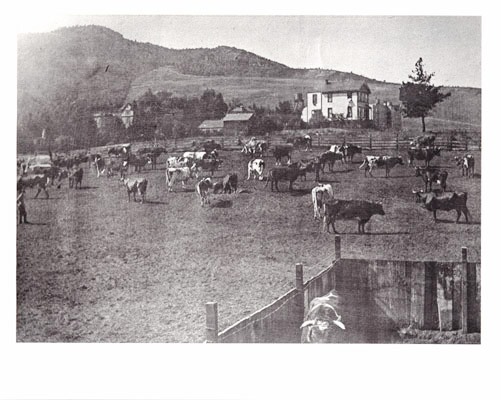
'Lange Dairy at Carl and Cole, Looking SW at Mt Sutro'

Mr Sigg’s article refers regretfully to the original planting: “Mt Sutro was one of those inappropriate areas—putting a tree plantation on top of a priceless wildflower/ grassland...” His regret, though, may be misplaced. As early as 200 years ago, non-native grasses already dominated the grasslands of California, especially in ranches and farms. They grew faster, adapted better and were better fodder. Since dairy cattle grazed where Cole Valley is now, grasslands on Mount Sutro were likely already of these varieties. In any case, the nearby Twin Peaks, never afforested, requires effort and herbicides to achieve even what little it does in terms of “native” plants.

Habitat

BLACKBERRY IN THE ECOSYSTEM

He goes on to say, “ Further, the now-changed Sutro environment creates conditions for the invasion and proliferation of Himalayan blackberry, and English, Algerian, and Cape ivies. They form smothering blankets and impenetrable thickets that deprive access to both humans and animals…

It’s true the thorny blackberry thickets (whether Himalayan Blackberry or California Blackberry, both of which grow there) deny access to people . Animals and birds, though, get into them just fine. In fact, owing to that impenetrability, they provide important cover and safe nesting and denning sites.

Blackberry bushes provide safety

Or at least they did, until the Stewards started ripping out the forest’s understory of “invasive blackberry” – a plant that not only provides protective cover for the birds and animals, but in the berrying season is a major food source for fauna, and year round helps conserve the moisture of the Cloud Forest.

Jake Sigg’s article continues: “The blackberry and ivies, incidentally, also prevent the trees from regenerating, as seeds can’t germinate in the ivy/blackberry thickets. It is ironical that the blue gums carry the seeds of their own destruction, and only humans can assure their continuance here.” These were the trees that were self-sowing prodigiously? The same trees that for 100 years before the Stewards intervention thrived and grew and multiplied on the mountain?

The only excuse for this destructive maintenance is an aversion to non-natives. The article stresses that the trees are Tasmanian; the blackberry Himalayan; and the ivies, English, Algerian and from the Cape. (There’s also poison oak in the forest, but that’s native and warrants no mention.)

The Mt Sutro Stewards’ efforts to keep the Mountain’s trails open are laudable, despite the trade-off in the drying out of the forest and the disturbance of habitat. Their destructive intervention in the remaining forest is not.


Posted in eucalyptus, Mt Sutro Cloud Forest, nativism, Neighborhood impact, UCSF | Tagged , , , , , , , , , , , | 11 Comments

Herbicide Moratorium on Mt Sutro

Earlier on, we posted about the use of Roundup on the Aldea campus. (We had heard reports that it was used in the Mt Sutro Cloud Forest, too; but there were contrary reports at the October 19th meeting. Until we had actual evidence, we did not post anything about it.)

Today we received an e-mail from UCSF, confirming that herbicides had been used both in the forest up to a year ago, and – as we know from a September 09 spraying notice – much more recently at the Aldea Student Housing on the mountain just below the forest.

But importantly, it says that they are halting herbicide use pending investigation of less-toxic alternatives.

To quote:

“Herbicides have not been used in the Mount Sutro Open Space Reserve since 2008, and are not being used at Aldea pending an evaluation of a herbicide commonly known as “Roundup”. UCSF is evaluating Roundup as a result of recent studies on the active ingredient in Roundup and similar glyphosate-based herbicides. What these studies show is that the active ingredient in Roundup is not the toxic concern. The concern, we understand, focuses on the surfactant, which helps the solution absorb into plant material. Recent research, including proposed work in the Marin Municipal Water District watershed, shows that the active ingredient works well with corn-based surfactant. UCSF is presently looking into the effectiveness of utilizing corn-based surfactants.”

Of course, that’s not completely right. The surfactant POEA is the most immediate concern, but Glyphosate (the active ingredient in Roundup) has been linked to non-Hodgkins Lymphoma, lung damage, and damage to the red blood cells, and fetal damage in pregnant rats. According to a study at the University of Caen, “AMPA [a metabolite of glyphosate] and POEA separately and synergistically damage cell membranes like R[oundup] but at different concentrations. Their mixtures are generally even more harmful…”

The e-mail made a reference to “sparing use” of herbicides. We have to say that the spray notice in September 09 didn’t make it sound “sparing.” It covered “pavement and soil” which is just about everything except for actual buildings. Considering that Aldea is family housing, and women living there may be or become pregnant, it’s not clear why the cosmetic look of clean pavement justifies the use of toxic herbicides.

Edited to Add: The UCSF website still talks of the use of herbicides “only as necessary” both on the campus and on the trails in the forest.

[…spot-application of herbicide, only as necessary (supervised by licensed applicators according to State and County safety standards and with notification flyers posted in advance)]

July 31/ Aug 3 2009, 7 AM-2.30 PM

Roundup Quick Pro in Aldea, Sept 18/ 21, 2009 6.00AM - 7.30AM

Well, of course they must consider it necessary if they use it … but we thought they had stopped. We have a query in as of 28 Nov 09, and will update this further. Meanwhile, we’re wondering what “only as necessary” means, anyway. According to the Aldea notices we saw, Roundup Pro is applied to “all grounds at Aldea San Miguel.” And fairly frequently: Here’s a notice for July 31/ Aug 3, and then another for Sept 18/21.

[Edited to Add: The UCSF website has now been updated to say that no herbicides have been used in the forest since 2008, and are not in use at the Aldea campus until studies are completed.]

Posted in Herbicides: Roundup, Garlon, Neighborhood impact | Tagged , , , , , | 10 Comments

Cutting Down Trees

Someone brought over the November/ December 09 copy of the Sierra Club Magazine. It fell open to the centerfold. There in a big blue box and large letters it said:

————-

It’s cool because people are cutting down trees instead of spending Saturday playing videogames.”

————

In that case, just like the trees in Sutro Cloud Forest, the trees so gleefully being felled were non-natives.

Sutro Forest

Sutro Forest viewed from Forest Knolls

There’s always a good reason to cut down trees.

– They’re non-native…

– They’re in the way and the land is more valuable without them…

– They can be sold for lumber…

– They block the view…

It’s tough to argue that other people should preserve their trees when what we’re doing with ours is chopping them down. Fell Sutro Cloud Forest, save the Brazilian cloud forests. Kill the century-old eucalyptus trees, save the century-old pines.  But ideology aside, non-native trees are beneficial just like the ones that are native elsewhere.

Urban trees, native or not,  have multiple benefits:

Edgewood Forest

Forest hides UCSF hospital behind Edgewood

– They clean the air;

– They sequester carbon (1 acre=30 cars);

– They act as windbreaks;

– They muffle sound;

– They screen ugly buildings.

On Mount Sutro, the density of the forest creates an oasis that feels as though you’re completely outside the city. As long, of course, as we preserve that density.

Here in San Francisco, the Department of the Environment and Friends of the Urban Forest is offering residents the option of buying Christmas trees that can later be planted as urban trees. They note that the city could use another 100,000 trees, and only 12% of San Francisco is covered in greenery, compared to over 20% for Chicago, Seattle and New York. They’re offering magnolia, the Australian small-leaf Tristania; strawberry tree; and the New Zealand Christmas Tree. (The magnolia and the strawberry tree don’t like wind. The Australian and NZ trees are okay with it.)

Posted in eucalyptus, nativism, UCSF | Tagged , , , , , | 1 Comment

Slate magazine on Invasives

Someone sent me a link to a thoughtful article in Slate magazine called “Don’t Sweat the Invasion” by

The author starts out with the example of tamarisk, also known as salt-cedar; it’s an “exotic invasive” that spreads along river-banks, and provides habitat for various birds. One of these is an endangered flycatcher.

Ironically, nativist thinking has encouraged the USDA to use imported (exotic, but who-knows-if-they’re-invasive) Asian leaf-eating beetles to kill the tamarisks by eating them to death. Theoretically, this allows native flora to return. Maybe. Anyway, in the interim, the nesting birds are straight out of luck. In March 2009, this led to a lawsuit by the Center for Biological Diversity and the Maricopa Audubon society.

The article uses this event as a springboard to look at the whole issue of nativist restorationism, and make some sensible observations.

There’s an argument that even the dichotomy between “native” and “non-native” is ultimately meaningless. Species have always migrated; to identify one as native is to draw an arbitrary line in time.”

And something that’s particularly relevant to Sutro Forest:

“Once an ecosystem has absorbed a new species, any targeted intervention is likely to have significant ripple effects.”

Exactly. This forest has altered the microclimate, provided a habitat for birds and animals. This is what gutting the forest will destroy.

And frankly, it probably has as much bio-diversity as the iconic Muir Woods. Just because the “bio” comes with descriptors like Tasmanian, Himalayan, English, Scotch doesn’t reduce the numbers or the diversity.

Posted in nativism | Tagged , , , , , , , | 1 Comment

Volunteers, pizza, and $30/hour

On the new improved web-page about Mt Sutro, UCSF has included some information on how they work with the Mount Sutro Stewards, a volunteer nativist group (responsible for the Native Garden at the summit),  which builds and maintains the trails in their forest. The Stewards bring in volunteers from everywhere (Boy Scouts, Santa Clara University students, anyone willing) to come work on the mountain.

The Stewards work closely with the UCSF Facilities Management department, gaining the University’s approval for the work they propose to do and following up after all volunteer work days. UCSF provides hand tools for use by the Stewards, and supplies pizza and water for the volunteer workers.

UCSF goes on to say it’s very grateful. As it should be. It’s getting thousands of hours of free labor, paying pizza. The value of that labor is $30/ hour. (That’s in the FEMA application.) Nice terms, if you can get them.

Posted in UCSF | Tagged , , , , | 1 Comment

November Fog Log

As we said in the original Fog Log post, we’re keeping track of that crucial “September to November period when fire risk is greatest,” according to the UCSF letter.

“Mount Sutro is squarely in the fog belt. The question is, Whether between the end of summer (and fog) and the beginning of winter (and rain), is there enough dryness to raise fire risk? We’ll find out. What we’re starting here is a Fog Log. It will be updated for every day’s weather. We will also look out for the “dry hot winds” blowing “from the Northeast.” There is a link from the front page.

September had only 7 days that were fogless (i.e. no fog morning or evening). And, these were interspersed with fog-days; the maximum consecutive number of fogless days was 2.

October had 14 fogless days; the longest stretch without fog (or rain) was 7 days. It also had 4 rainy days.

November had 24 fogless days; the longest stretch without fog (or rain) was 6 days. It also had 4 rainy days.

———————-

This is the November Fog Log.
(Note: Special thanks to Weather Watch for keeping track when the Webmaster couldn’t.)

November First week: Fogless: 4; Cloudy, 1; Foggy, 2. Clear streak: 5

Sunday, Nov 1: Clear as a bell, no fog. Nov 2: Sunny. Nov3: Sunny. Finally, there’s an easterly wind – but only at 6 mph. And not so hot, nor so dry; humidity is 77%. [ETA: Hmm. Blink, and it’s gone. Now the wind is reported as SW, 4 mph.] Late-night fog. Nov 4: Cloudy, clearing to sunny. Nov 5: Cloudy. Nov 6: Foggy and drizzly. Nov 7: Clear and cold.

November Second week: Fogless: 2; Cloudy: 4; Foggy/ drizzly: 1; consecutive fogless: 6

Native garden November 2

Native Garden in November

Nov 8 and 9: Clear. Nov 10: Overcast and cold. Feels like winter! Nov 11: Overcast, clearing to sunshine. Winds westerly, humidity 83%. Still damp in the forest (from 5 days ago?) In fact, even in the Native Garden is beginning to green out. Nov 12, 13: Clear and cold. Nov 14: Very foggy and drizzly overnight, clearing to sunshine around 11 a.m.

November Third Week: Clear, 6; Rain, 1. Clear streak, 5.

Nov 15, 16, 17: Sunny and/or clear. Nov 18, 19: Clear. No sign yet of the hot dry winds from the northeast. Temps in the 50-60F range. Nov 20: Rain. Nov 21: Clear.

November Fourth Week + 2 days: Clear, 7; Fog or rain, 2. Clear streak, 4.

Nov 22: Misty and damp. Nov 23, 24, 25: Blue skies. Nov 26: Blue skies giving way to gray. Nov 27: Fog and rain. Nov 28, 29, 30: Clear and sunny.

Posted in Sutro Forest "Fire Risk", UCSF | Tagged , , , , , | 1 Comment

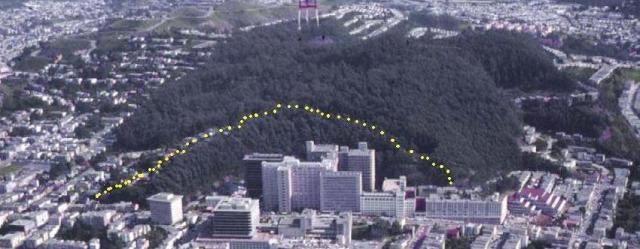
“Least Visible” South Ridge and Edgewood

UCSF’s presentation suggested that the planned cut areas are inconspicuous from offsite.

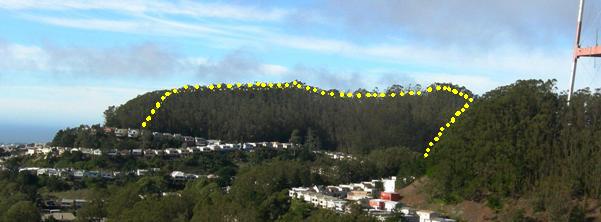
South Ridge Cut Zone small

South Ridge, the View from Twin Peaks

This is South Ridge (above). The yellow dots outline the planned Cut Zone. The homes below it are the Forest Knolls neighborhood.

———–

UCSF Edgewood Cut Zone 1

The Edgewood Cut Zone

And this shows the Edgewood (and Farnsworth) Cut Zone. Removing that area of forest would integrate the neighborhood into the parking lot, the rear of the hospital, the power plant, and the new stem cell research building (not visible here because the picture predates the construction).

(This picture is taken from UCSF’s own FEMA application; we just added the yellow dots to indicated the Cut Zone.)

Posted in eucalyptus, Neighborhood impact | Tagged , , , | 3 Comments

Fire Hazard Map(s)?

Fire Hazard maps are critical to substantiating that there even is a hazard. The maps associated with this Plan don’t achieve that.

TWO MAPS THAT DON’T MATCH

Map 1: Extracted from Citywide map

Map 1: Extracted from Citywide map

UCSF’s 19 October presentation included a map called City-Wide Wildfire Hazards. (Page 18 of the presentation.) Let’s call that Map 1. It showed red and yellow dots of Very High and High wildfire hazard, in a sea of green Moderate hazard. The resolution is poor, but there’s a splotch of red around Mt Sutro.

The map, prepared by private consultant URS, claimed its source was CDF FRAP Data, 2005. That would be the California Department of Forestry and Fire Protection, known as CalFire.

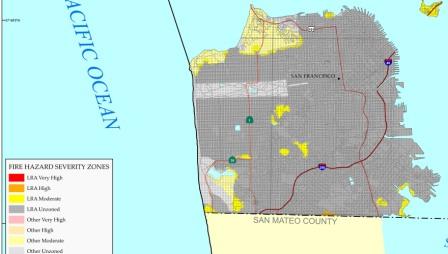
CalFire looks at fire hazard in both the State Responsibility Area (the Presidio/Ocean Beach/ Fort Funston) and the Local Responsibility Area (everything else). CalFire has maps by county, showing areas of Very High Fire Hazard zones.

We opened up that map for San Francisco. Let’s call it Map 2. It shows Mount Sutro as a Moderate fire hazard, the lowest hazard rating. It’s the same rating as the Presidio and Lincoln Park Golf Course. Below that is “unzoned.” If you look carefully at the bottom of the map, there’s a small orange spot. That’s the edge of San Bruno mountain. It’s the only High fire hazard area on the map.

CalFire's San Francisco Map

Map 2: CalFire's San Francisco Map

Even though they are ostensibly from the same source, there is no way to reconcile the two maps. The source for Map 1 completely contradicts it.

MORE MAPS, MORE CONFUSION

And now for more maps, which we’ll call Map 3 and Map 3a.

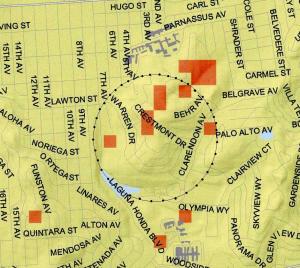
Map 3 is the one used in the FEMA application, purporting to show Very High Fire Hazard on Mt Sutro. In fact, it showed two areas, one in the Forest Knolls neighborhood, and one in the Native Garden. Map 3 gave its source as ABAG, the Association of Bay Area Governments. At least on this occasion the map checked out with its listed source, even if the Fire Risk was on Warren Drive instead of in the forest. It was based on 2003 data.

ed 2 sutro ucsf map

Map 3: Association of Bay Area Governments, 2003 data

Then we were informed that the ABAG map had been updated in July 2009. We went back to the ABAG website, and here’s the updated map, which we’ll call #3a. The red spots have shifted; the one on Warren Drive is gone. This time there are some in the UCSF forest, but they aren’t in the planned cut zones. They’re on the northern ridge and the western ridge – where trails have been built in recent years. None of these areas are the target areas for the planned tree-felling: South Ridge and Edgewood.

July 2009

Map 3a: Association of Bay Area Governments, 2009 data

If Maps #3 and #3a are reliable, it would indicate that all the trail-building in recent years has opened the forest and increased the fire hazard.

Why would UCSF want to drastically increase the fire hazard by gutting 14 acres of forest?

——————–

UCSF did try to explain the map confusion on October 19, but we were left even more confused. They said that when they put in the FEMA application, they relied on Map#3 (based on 2003 data) because that’s all they had.

Based on that map, there should have been no FEMA application, because the only fire-hazard it showed was in the Native Garden, easily fixed by turning on the irrigation system.

They explained – something ?- by saying that whichever agency published the map didn’t have responsibility for UCSF’s forest. Since all four maps do have coverage of Mt Sutro, this left us even more confused.

THE BOTTOM LINE

1) Map #1 is contradicted by the Source it lists, CalFire.

2) Map #2 is a draft map showing Moderate risk on Mount Sutro. CalFire updated it by saying it had determined there were no areas of Very Severe Fire Hazard in the Local Responsibility Area.

3) Map#3, the basis for the FEMA application, doesn’t indicate a fire-hazard in the project areas.

4) Map# 3a, the updated version of Map#3, suggests that the proposed project is precisely the wrong way to mitigate fire risk.

Posted in eucalyptus, Maps, Meetings, Sutro Forest "Fire Risk" | Tagged , , , , , , , | 5 Comments

Help Save Mount Sutro Trails

San Francisco Urban Riders, (SFUR) a group of bicycle riders, has a good post on saving Mount Sutro Trails. The article was intended to encourage cyclists to come to the meeting that UCSF held yesterday (and to the walk planned for Saturday October 24th). We say it’s a good post, because even though they come down on the other side of our effort to save Mt Sutro, there’s a lot there we agree with. [ETA: We particularly liked that they mentioned we think the forest is “a marvel.” Yes.] And one point we don’t.

First, what we agree with is that the trail-building on Mt Sutro is really good work, and we appreciate it. We’ve encountered mountain bikers up there, and they are unfailingly courteous and pleasant. We like having this wild area open to this activity. (See the posts on Museum-ification.) Some of us ride, too. And for those who volunteer to keep the trails open for everyone to use, thank you.

So, where do we disagree?

The main point is the “long dry spells.” If you’ve been riding your bikes up there, you know there aren’t any. Mount Sutro is in the fog belt. After a short spring comes the summer fog, and we’re lucky to get 3-4 fogless days at a stretch before the fog rolls in again. And when it’s foggy, the tall eucs grab the moisture, and it practically rains inside the forest. The duff holds in the moisture like a sponge; the blackberry and and ivy protect it from evaporation.

UCSF spoke about a high-risk period from September to November, when the fog disappears and we get hot dry winds. So we are keeping a Fog Log. Check it out.

We also disagree with Jake Sigg’s analysis of eucalyptus. But we’ll get to that separately.

Back to the topic at hand. We appreciate that SFUR and Mt Sutro Stewards have been doing marvelous work in keeping the trails open. What we don’t see is why this connects to the dangerous plan to gut nearly a quarter of the forest. The only reason seems to be some strange kind of a reciprocity – we keep the trails open, so help us get FEMA funding for a project we want. The fire danger in the two selected areas is minimal – so it has to be about something else. When the leaders talk longingly of lost wildflower meadows (like Twin Peaks?) it would seem that might just be native plants.

The support of the neighbors who live with mountain and the forest is also important to encouraging UCSF to keep the trails open to communities like bikers. We share a lot of common ground (no pun intended).

The planned 14-acre tree-felling project though, has nothing to recommend it, and a lot of downsides for the surrounding communities:

  • An increase in fire hazard;
  • An artificial re-rating of the area from moderate fire risk to very high fire risk, driving up insurance and reducing home values;
  • Gallons of toxic herbicides being spread on steep slopes above our neighborhoods;
  • The risk of landslides once the trees are gone; the loss of a windbreak;
  • and a loss of the sight, the scent, the sounds of the forest.
Posted in eucalyptus, Herbicides: Roundup, Garlon, Meetings, Mt Sutro landslide risk, nativism, Sutro Forest "Fire Risk" | Tagged , , , , | 9 Comments

Report: UCSF Oct 19th Meeting

We report on the UCSF October 19th meeting seeking community input into the “Fire Mitigation” project. [Italics in brackets are our comments.]

It was a well-run meeting, moderated by Daniel Iacafano of Moore Iacafano and Goltsman. Barbara French, UCSF’s Associate VC for Community Relations, opened by saying that UCSF made a mistake in rushing through the FEMA project without community involvement. They now intended to thoroughly listen to the community.

UC’s powerpoint presentation is here.

They noted that the major objections were:

(1) The “FEMA plan” was entirely different from the 2001 Plan. (This was a Plan for the management of the forest that had been developed over several years, and published in 2001. It is available on UCSF’s website here.)

(2) That the “FEMA plan” was not about fire hazard, but actually an native plant restoration plan. The proposed changes would actually increase the fire hazard.

Lori Yamauchi, Assistant VC of Campus Planning made a presentation laying out some of the key differences between the 2001 Plan for the Forest, and the FEMA plan. The key differences were (1) The 2001 plan had multiple objectives, but the FEMA plan was all about fire-hazard. She noted that the FEMA plan focused on fire-hazard because they wanted FEMA funds and that’s what it gives money for. (2) The 2001 plan called for a 2 acre demonstration plot in an inconspicuous area, while the FEMA plan is about 14 acres, a much larger area [and it’s not inconspicuous!]. (3) The 2001 plan calls for Adaptive Management, a gradual ten-year process, while the FEMA plan must be implemented within 3 years.

She also attempted to explain the fire-hazard maps submitted to FEMA that did not show a fire hazard in the project areas. [We address that separately.]

Maric Munn presented achievements to date, which included removal of all hazardous trees in areas close to housing or parking; clearing the building site for the new Stem Cell Research Building coming up behind Edgewood; and landscaping a mudslide area below Edgewood caused by a broken water pipe.

Some 200 people attended; over 40 people commented, with strong opinions on both sides of the issue, and some few in the middle. The applause indicated there were people on both sides who did not speak. The community present fell into roughly three groups: The neighbors; people representing various groups; and of course the Mt Sutro Stewards and their volunteers.

THEMES [and our comments in brackets]:

1. Everyone loves the trails. People on both sides complimented Mt Sutro Stewards on building and maintaining the trails.

2. If you love the trails, you should support the plan. This was implicit in the statements of many speakers, most notably from Nature in the City, the umbrella organization for the Mt Sutro Stewards. [Unless gutting 14 acres of forest is considered a quid pro quo for trail-building, we do not see a logical connection.]

3. A need for forest management. People who live on Stanyan, near the Interior Green Belt (which is actually not part of the Plan) felt this especially.

4. Fire-danger, pro. Some speakers did believe there was a fire hazard and were concerned about it. One had witnessed a fire some years ago, which was put out by the Fire Department.

5. Fire danger, con. Long-term residents noted they’d never seen “Hot Dry winds” in Sutro Forest (as the FEMA application suggests); that if UCSF really thought this was a fire mitigation project, they would be looking to rebuild Aldea housing with non-flammable materials, and clearing defensible spaces. They considered the fire hazard exaggerated to get FEMA money for native plant conversion. Some Plan supporters considered this justified, as a way for UCSF to get federal dollars to fund forest management even if fire danger was not an issue.

Others pointed out that a FEMA grant on these grounds would reclassify this entire area as a Very High Fire Risk instead of the Moderate risk it is now, affecting both insurance rates and home values as it would become a required disclosure.

6. The Native Garden. Many people were unimpressed by the Native Garden, dry and dead eight months of the year, and considered it a failed experiment. Some people actually like it, despite the dead plants, as an open and changing space. Someone noted that though the irrigation system is in place, it is no longer being watered. [Which may be why it appears dead 8 months of the year.]

7. Toxic chemicals. The plan calls for Roundup and Garlon to be used. A lot of people on both sides were against the toxic chemicals, and urged UC to not use them. Someone urged everyone to go online and find the Material Safety Data Sheets for Garlon. Two volunteers said there are no toxic chemicals being used in the forest at present. [Which is excellent. Of course, they are being used in the Aldea campus, which is not so excellent, and indicates UCSF would be comfortable with the use of herbicides.]

8. Environmental Impact Report (EIR). UCSF sought an exemption from environmental review in the FEMA application. The Laurel Heights case (where the neighbors sued to get and comment on an EIR, and won in the Supreme Court) was mentioned. Many people on both sides of the issue felt UCSF’s attempt to get an exemption for an Environmental Impact Report (EIR) was mistaken, and it should definitely get one if it intends to proceed with this project. [ETA: Barbara French sent in a clarification about this. We posted it in Comments below.]

9. The 2001 Plan. People who were involved in the 2001 Plan process were dismayed that UCSF had chosen to throw all that out, and instead just start over with the FEMA plan.

10. Trusting UCSF. A number of people present had ties, current and former, to UCSF. Many suggested UCSF had not proved trustworthy, saying one thing and going back on it, ignoring community input, and attempting to bypass legitimate processes. Others like what has happened with the forest in the last ten years (primarily trail-building) and are willing to trust UCSF on that basis.

11. Loving eucalyptus. A surprising number of people (including people supporting felling them) claimed to love eucalyptus. Someone accused Save Sutro of loving just one kind of tree. [Actually, we love all kinds of trees.]

12. Global warming. Some people raised the issue of the value of urban trees in a number of ways, including the impact on global warming.

13. Wildlife. Some speakers noted that the forest is full of nocturnal wildlife, and these would be forced into a more limited space if a quarter of the forest is severely disturbed – and into the neighborhoods.

14. Gratitude to UCSF. Many speakers expressed gratitude to UCSF for making the forest accessible to the community; and for taking a step back from this controversial plan.

15. All the speakers clearly valued the forest, no matter which side they took on the “FEMA Plan.”

Posted in eucalyptus, Herbicides: Roundup, Garlon, Meetings, Mt Sutro landslide risk, nativism, Sutro Forest "Fire Risk" | Tagged , , , , , , , , , , , , , , , , , , | 14 Comments

Museum-ification – Pt 2

This continues Paul Gobster’s article from Pt 1.

——————

Landscape and Land Use History

Cranz and Boland (2004a, 2004b) do not identify how the recently developed ecological parks in their sample came into being, but in my own research I found sites originated in two ways: (1) designation of existing park space for ecological management; and (2) purchase or transfer of private or public land for use as new park space. The first type includes parks or portions of parks that may have retained natural characteristics by design or in some cases through neglect and are seen in a new light as having potential for ecological management. Many of the 50 nature areas in the Chicago Park District fall into this category, and range from historic designed landscapes in the naturalistic style such as Montrose Point and the Lily Pool in Lincoln Park; to man-made lagoons such as Lincoln Park’s North Pond and Gompers Park’s lagoon and wetland; to small prairie gardens such as those in Indian Boundary and Winnemac Parks (Figure 1). Many of the 30 natural areas within the San Francisco Recreation and Park Department’s Natural Areas Program were designated within existing parks because of the natural features that still remain; these include lakes such as Pine Lake and Lake Merced and remnant plant communities such as Bayview Hill and Glen Canyon (Figure 2).

Parks of the second type may also have been purchased or transferred specifically because they contain natural remnants or characteristics worthy of protection and restoration in a more public setting. Others may be brownfields or have otherwise been significantly altered by previous uses, and ecological management is used as a strategy for rehabilitation as well as for environmental values as a long-term goal (e.g., DeSousa 2004). Examples of both of these types can be found at the Presidio of San Francisco, a former U.S. Army property in the northwestern corner of the city that in 1994 was transferred to the National Park Service as part of Golden Gate National Recreation Area. Sites with natural remnants include Lobos Creek and Baker Beach, while Crissy Field includes a major tidal marsh restoration on land that was filled beginning in the 1870s and used for the 1915 World’s Fair and then as an army airfield (Boland 2004) (Figure 2).
As these examples show, urban parks often have a complex landscape history, and restorations that ignore or deny the multiple layers of cultural design and change that may have taken place can lead to a form of museumification that some have called Disneyfication.

Here the complex and sometimes unpleasant storylines are edited from the landscape, leading to a portrayal that is one-dimensional and reinforces positive themes (Huxtable 1997). In many North American projects, restorationists attempt to turn landscapes back to the way they might have been prior to European settlement, even though a site may have since been farmed, filled in, or put to use for a variety of other purposes. Early proposals for ecological restoration of dune communities at the Presidio called for removal of the non-native forests planted by the U.S. Army during the 1880s, some of which were subsequently spared because of their functional and historic values (Baye 2001; Joseph McBride, personal communication, 25 February 2004). Not only can failure to acknowledge these cultural changes reduce the richness of landscape history, but ignoring the extensive landscape modifications of soils, microclimate, and other factors that may have occurred to a site can also limit the success of restorationists in bringing back earlier plant communities.

In addition to landscape history, the museumification of urban parks through restoration can also change the land use patterns of sites. Urban land, particularly parkland, rarely lies unused, and in the advent of restoration this frequently means that some current uses must now be restricted. Like many urban parks in the United States, parks in Chicago and San Francisco went through a period of neglect beginning in the 1960s and 1970s, and not only did less developed spaces become wilder looking, but there was less enforcement of what kinds of activities took place there. In Chicago’s Lincoln Park, the remoteness of Montrose Point made it a popular place for gangs and drug activity, while the rocky gardens at the Lily Pool made an attractive climbing area for children.

In San Francisco, open meadows and wooded paths such as those at Pine Lake became popular areas for walking dogs off-leash, and in some parks where crime and gangs had gained a stronghold, dog owners helped to reclaim the parks for themselves and other users. While restoration has gone far to bring deserved attention and resources back into urban parks and reduce socially undesirable uses, like the naturalistic park movement it has also pruned the spectrum of otherwise acceptable behaviors down to those passive appreciative activities that are deemed appropriate for this revised context to ensure minimal degradation of the now fragile environment.

Characteristics of Restoration Design

Natural area restorations are sometimes criticized as looking too unkempt when placed in an urban context, and elements of design are often suggested to provide the public with visual cues to signal that these sites are in fact being cared for (e.g., Nassauer 1995). But these design conventions can be taken too far, making restorations into outdoor museum exhibits. At some of the restoration sites in the Presidio, boardwalks direct movement through a site, giving the visitor few choices to see what lies beyond the edge. In some places fencing provides a physical or symbolic barrier between the visitor and the vegetation, adding a further element of separation and distance.

At some locations, plants in the immediate foreground are labeled, and while this helps visitors know what they’re seeing, it also objectifies them and gives the impression that the site is more a botanical collection than an ecosystem. Are the labeled plants representative of those that might appear on an average site or are they plants of particular interest, put there because of their rarity, beauty, or some other characteristic? Do they occur on site in an arrangement or distribution that might occur naturally, or are they planted there like a botanical collection so that visitors might see a range of them in the course of their walk through the site? The ambiguity in presenting nature this way is another aspect of how design can lead to museumification.

Beyond these design elements, how the restoration process itself is implemented in urban parks can also lead to museumification. Here there is a clear contrast between community-based restoration projects and those done by hired professionals, the latter of which are often treated like museum gallery installations. For a complex project like the North Pond restoration, the site is largely fenced off to public use and a team of park professionals and private subcontractors comes in to deal with the various aspects of developing the restoration. Working like any construction project, their sequence of activities includes demolishing existing nonnative species and other discordant elements; bringing the infrastructure of water quality, soil, drainage, pathways, and other human and environmental systems up to acceptable levels; planting and establishing the plant and animal collections; installing fencing, benches, and other site furnishings for visitor control and comfort; and developing signage, brochures, and other interpretive materials.

Hopefully working on schedule and within budget, the restoration is declared “completed” and opened to the public under great fanfare. Restoration done in this fashion may fit within the constraints of an agency’s capital projects procedures but tends to cast nature simply as an artifact under control by humans for humans (e.g., Katz 1992).

Impact on Nature Experience


People experience nature on a variety of levels, from looking out the window to cultivating plants for food and pleasure. Each type of nature experience can yield a variety of benefits to people and it would be wrong to call one better than another. Yet at the same time, urban park restoration has the potential to deliver a broader set of experiences beyond the passive appreciation of nature. In this respect, while some of the urban park restoration sites I looked at in Chicago and San Francisco are visually beautiful and contribute not only to the local environment but also educate people about ecological health and diversity, I feel they are experientially narrow. By truncating landscape history and restricting how the sites are used, and by treating nature as a museum object that is created and presented as a finished product, they limit the range of experiences that urban nature can provide.

Some restoration critics I interviewed in San Francisco spoke about how restoration efforts were reducing the types of nature experiences they once had. One person grew up in a neighborhood above what is now the Lobos Creek restoration and recalled how her everyday explorations in the meadow and forest areas led to her love of nature and desire to pursue a career in biological science. She may have not become so hooked if her interactions with the site were repetitions of the same boardwalk scenery. Another person enjoyed photographing plants and wildlife at Pine Lake near her home and was fearful that the new restoration plan for the site would fence off access to the edge of the lake where all the action was. Several others used their dogs as motivators to take regular walks through natural areas but are seeing that as sites are improved through restoration, access with dogs is being restricted.

My own observations of restoration projects in Lincoln Park conducted before and after their completion corroborate these sentiments, not only in terms of how they restrict people’s type of nature experiences but also raising questions of equity in who gets to have a nature experience. Use of the Lily Pool is now highly regulated and supervised by site docents, and the rock climbing by children that I observed during a site reconnaissance 10 years ago is strictly forbidden. The shoreline of North Pond that had been mowed to the waterline and trampled down to dirt banks by fishermen and waterfowl is now covered in lush vegetation fenced off to access by both user groups. Access to the water’s edge is provided at a few rocky ledges built along the shore but the pond has not been restocked with sport fish as fishing was deemed to be incompatible with the new goals for the restored site.

Even if the pond is eventually restocked, the current design is unlikely to facilitate fishing, for as a manager of a youth urban fishing program told me, similar shore access done for the lagoon restoration at Gompers Park doesn’t work for fisherman because “the access areas aren’t where the fish are” (Bob Long, personal communication, 18 August 2006). Finally, while the restoration of Montrose Point has eliminated gang use, the increased habitat of trees and shrubs has now made it a popular place for cruising and on-site sex. This has created an uncomfortable situation for restorationists and the birding community, and to deter what is perceived as an inappropriate use of park space much of the habitat has been fenced off and dozens of signs have been erected in the name of protecting the environment for migratory birds (Edwards 2005).

Children are a stakeholder group of particular importance when it comes to nature experience, and much attention has been given in recent years to how children in cities are suffering from a “nature-deficit disorder” (Louv 2005). Nature can provide an ideal setting for creative, unstructured play, both for individual imaginations to run free and as a focus for the negotiation of social roles and responsibilities. Digging holes, building forts, climbing trees, catching insects or fish, collecting rocks and flowers, and other activities that are motivated by natural environments can be highly creative endeavors for children and depend on an active interchange between them and the environment (e.g., Johnson and Hurley 2002; Miller 2005; Sobel 1993). The wild and weedy nature that existed in many of these urban park areas prior to restoration provided these sorts of opportunities, and if they weren’t exactly sanctioned no one seemed to care because little effort was being put into managing them. Now displaced by a more ecologically
diverse yet more fragile nature, these kinds of activities are discouraged just as they are in more manicured park settings. Children are much less likely to attain satisfying nature experiences through passive forms of interaction and thus may be disproportionately affected by such changes (Nabhan and Trimble 1994).

The result of this museumification is that we are creating a significant gap in the spectrum of nature experiences available to urban children precisely at the nearby places where children stand the best chances for getting acquainted with nature. Thus while striving to achieve authenticity in the restoration of ecosystems we may be sacrificing the authenticity of children’s nature experiences.

Expanding the Spectrum of Nature Experiences

To me, one of the great ironies in these examples of urban park restoration is that while the product can be a restrictive and objectified nature for some people, the process of restoration as it is practiced by others through volunteer stewardship provides many opportunities for multidimensional, highly interactive nature experiences. Even restoration sites where the initial phases are treated as a construction project usually rely at least in part on a corps of volunteers for subsequent management. These restorationists tramp across natural areas collecting specimens for study and monitoring bird and butterfly populations; they cut and dig and even light fires to burn off invasives and recycle nutrients to the soil; and in doing so they often have profound nature experiences that cut across all dimensions of aesthetic, recreational, social, educational, and even spiritual values (e.g., Grese et al. 2000; Miles et al. 1999; Schroeder 2000).

Thus, if part of the disjunction between the design of nature and the experience of it lies in the difference between who is a visitor and who is a manager, then part of the solution might be to expand the contingent of managers, in effect letting more people inside the gates of paradise. This kind of outreach is happening in many restoration programs, where business groups, seniors, singles, and children are recruited into programs to work on restoration projects in the broader context of community service, improving physical health, meeting people, and learning about nature (e.g., Earth Wise Singles [www.EarthWiseSingles.com]; Mighty Acorns [www.mightyacorns.org]; also see Pretty 2004). The type of hands on interaction with the environment can be geared to the desires and skills of the individual or group, with the goal of changing those seeking a nature experience from detached observer to active participant. Ecological restoration needn’t even be at the forefront of an activity as long as it is compatible with restoration goals. For example, at the Lobos Creek restoration, the federally endangered San Francisco lessingia, a tiny sunflower, requires periodic disturbance to perpetuate itself. The current design and behavioral norms of the restoration project discourage the very kinds of human use needed, and recognizing this site designers have thought about scheduling fun activities like annual “dune dancing” (Terri Thomas and Michael Boland, personal communication, 5 May 2004).

These kinds of outreach programs can go far to build more interactivity into the experience of restored environments, but as most are directed toward specific activities and done on a schedule overseen by supervisory personnel they do not fit into everyone’s nature experience needs or desires. Serving a broader range of individuals may require looking to alternative models of urban natural areas management, particularly ones that allow for more unstructured and perhaps more environmentally impacting activities (e.g., Gobster 2006, 2007). The effect here is to do away with the gates of paradise altogether. If the objective in managing a natural area is not to protect fragile remnant ecosystems, managers might consider allowing environments that may be weedier and more resilient to disturbance so a greater amount of unstructured nature interaction can take place.

For example, in response to trends in the loss of nature experiences by children, the Forest Preserve District of DuPage County in suburban Chicago has initiated an effort that supports and encourages youth to engage in unstructured nature exploration and play such as climbing trees, building forts, and catching and releasing frogs and other small animals (Strang 2006). The teaching of safe and ethical nature play-skills is also built into more structured environmental learning programs, and when time is given during a program to use them it proves to be the high point of the children’s learning experience. At other sites where the protection of a sensitive species or habitat is a particular concern, a natural area that provides the necessary conditions but does not require complete ecological restoration may allow for a greater variety of human uses. Spatial zoning has been applied to some natural areas in San Francisco, where outer areas allow greater use for people and their dogs but still provide a wild buffer for protection of the interior zone. Temporal zoning is another strategy that is being used in other locations, where some uses are restricted during seasonal periods such as bird nesting or migration but at other times are allowed (Ryan 2000).

In their early-twentieth-century park designs, Jensen and Simonds not only pushed the idea of naturalism toward a greater incorporation of regional biodiversity, they also struggled with how naturalistic urban parks might enable children and adults to have more hands-on contact with nature. Children’s gardens, rustic play pools, and play spaces created in forest openings are a few examples of how these designers sought to make what they saw as the virtues of the countryside more accessible to those who lived in cities (Grese 1992; Robert E. Grese, personal communication, 7 May 2007). This struggle continues with twenty-first-century ecological park design, and while our increased knowledge of ecological primacy, nature-deficit disorder, and environmental equity makes the balancing of nature protection and use issues more complicated, it also makes it more incumbent upon us that we try to achieve that balance.

Urban parks needn’t be conceived as either paradises or parking lots, and many alternatives are possible that can creatively expand the spectrum of nature experiences available to adults and children. Is the museumification of nature inevitable at some restoration sites? In cases where species protection is a top priority, human use is very high, or the educational value of a collection outweighs more experiential considerations, such a restoration with its experiential limitations may be the only alternative. But in other cases natural areas managers might relax their assumptions on how restoration should proceed. As a guiding principle of urban park restoration, authenticity should be conceived as having both ecological and experiential dimensions, and management that considers both of these needs can help strengthen the role of urban parks as a bridge between nature and culture.

Acknowledgments
I thank Robert E. Grese, James R. Miller, Robert L. Ryan, and Herbert W. Schroeder for their helpful comments on an earlier version of this article.

References
Ashworth, Gregory J. 1998. “The Conserved European City as Cultural Symbol: The Meaning of the Text.” Pp. 261–286 in Modern Europe: Place, Culture, Identity, ed. Brian Graham. London: Arnold.
Baye, Peter. 2001. Draft Recovery Plan for Coastal Plants of the Northern San Francisco Peninsula. Portland, OR: U.S. Fish and Wildlife Service.
Berdahl, Daphne. 1999. “ ‘(N)Ostalgie’ for the Present: Memory, Longing, and East German Things.” Ethnos 64 (2): 192–211.
Boland, Michael. 2004. “Crissy Field: A New Model for Managing Urban Parklands.” Places 15 (3): 40–43.
Carlson, Allen A. 1977. “On the Possibility of Quantifying Scenic Beauty.” Landscape Planning 4 (2): 131–171.
Chicago Park District and the Lincoln Park Steering Committee. 1995. Lincoln Park Framework Plan: A Plan for Management and Restoration. Chicago: Chicago Park District.
Conway, Hazel. 1996. Public Parks. Buckinghamshire: Shire Publications.
Crandell, Gina. 1993. Nature Pictorialized: “The View” in Landscape History. Baltimore: John Hopkins University Press.
Cranz, Galen. 1982. The Politics of Park Design: A History of Urban Parks in America.
Cambridge, MA: MIT Press.
Cranz, Galen, and Michael Boland. 2004a. “Defining the Sustainable Park: A Fifth Model for Urban Parks.” Landscape Journal 23 (2): 102–120.
Cranz, Galen, and Michael Boland. 2004b. “The Ecological Park as an Emerging Type.” Places 15 (3): 44–47.
DeSousa, Christopher A. 2004. “The Greening of Brownfields in American Cities.” Journal of Environmental Planning and Management 47 (4): 579–600.
Duane, Timothy P. 1999. Shaping the Sierra: Nature, Culture, and Conflict in the Changing West. Berkeley: University of California Press.
Edwards, Jeff. 2005. “Sex in the Age of Environmental Disaster: Sex Imperils Migratory Birds.”
AREA Chicago. http://www.areachicago.org/issue1/migratorybirds.htm (accessed 25 April 2007).
Egan, Dave. 1997. “Old Man of the Prairie: An Interview with Ray Schulenberg.” Restoration and Management Notes 15 (1): 38–44.
Gobster, Paul H. 1999. “An Ecological Aesthetic for Forest Landscape Management.” Landscape Journal 18 (1): 54–64.
. 2001. “Visions of Nature: Conflict and Compatibility in Urban Park Restoration.” Landscape and Urban Planning 56 (2/3): 35–51.
. 2002. “Nature in Four Keys: Biographies of People and Place in Urban Park Restoration.” Paper presented at the conference on Real-World Experiments: Strategies for Reliable and Socially Robust Environmental Research, 3–5 October, Bielefeld University, Germany.
. 2004. “Stakeholder Conflicts over Urban Natural Areas Restoration: Issues and Values in Chicago and San Francisco.” Paper presented at 4th Social Aspects and Recreation Research Symposium, 4–6 February, San Francisco, CA.
. 2006. “Urban Nature: Human and Environmental Values.” Paper presented at the Commonwealth Club of California, 7 April, San Francisco, CA.
. 2007. “Models for Urban Forest Restoration: Human and Environmental Values.” Pp. 10–13 in Proceedings of the IUFRO Conference on Forest Landscape Restoration, ed. John Stanturf. Seoul: Korea Forest Research Institute.

URBAN PARK RESTORATION
. 2008, Forthcoming. “Yellowstone Hotspot: Reflections on Scenic Beauty, Ecology, and Aesthetic Experience.” Landscape Journal 27 (2).
Grese, Robert E. 1992. Jens Jensen: Maker of Parks and Gardens. Baltimore: Johns Hopkins University Press.
Grese, Robert E., Rachel Kaplan, Robert L. Ryan, and Jane Buxton. 2000. “Psychological Benefits of Volunteering in Stewardship Programs.” Pp. 265–280 in Restoring Nature: Perspectives from the Social Sciences and Humanities, ed. Paul H. Gobster and R. Bruce Hull. Covelo, CA: Island Press.
Hall, Marcus. 2004. Earth Repair: A Transatlantic History of Environmental Restoration. Charlottesville: University of Virginia Press.
Huxtable, Ada Louise. 1997. The Unreal America: Architecture and Illusion. New York: The New Press.
Johnson, Julie M., and Jan Hurley. 2002. “A Future Ecology of Urban Parks: Reconnecting Nature and Community in the Landscape of Children.” Landscape Journal 21 (1): 110–115.
Jordan, William R., III. 2003. The Sunflower Forest: Ecological Restoration and the New Communion with Nature. Berkeley: University of California Press.
Katz, Eric. 1992. “The Big Lie: Human Restoration of Nature.” Research in Philosophy and Technology 12: 231–241.
Louv, Richard. 2005. Last Child in the Woods: Saving Our Children from Nature-Deficit Disorder. Chapel Hill, NC: Algonquin Books.
Miles, Irene, William C. Sullivan, and Frances E. Kuo. 1999. “Psychological Benefits of Volunteering for Restoration Projects.” Ecological Restoration 18 (4): 218–227.
Miller, James R. 2005. “Biodiversity Conservation and the Extinction of Experience.” Trends in Ecology and Evolution 20: 430–434.
Nabhan, Gary Paul, and Stephan Trimble. 1994. The Geography of Childhood:WhyChildren Need Wild Places. Boston: Beacon Press.
Nassauer, Joan I. 1995. “Messy Ecosystems, Orderly Frames.” Landscape Journal 14 (2): 161– 170.
Olmsted, Frederick Law, Jr., and Theodora Kimball, eds. [1922] 1970. Frederick Law
Olmsted, Sr.: Landscape Architect 1822–1903. New York: Benjamin Blom, Inc.
Pretty, Jules. 2004. “How Nature Contributes to Mental and Physical Health.” Spirituality Health International 5 (2): 68–78.
Rybczynski, Witold. 2000. A Clearing in the Distance: Frederick Law Olmsted and America in the 19th Century. New York: Touchstone.
Ryan, Robert L. 2000. “A People-Centered Approach to Designing and Managing Restoration
Projects: Insights from Understanding Attachment to Urban Natural Areas.” Pp. 209– 228 in Restoring Nature: Perspectives from the Social Sciences and Humanities, ed.
Paul H. Gobster and R. Bruce Hull. Covelo, CA: Island Press.
San Francisco Recreation and Park Department. 2006. Significant Natural Resources Area Management Plan, Final Draft. San Francisco: San Francisco Recreation and Park Department.
Schroeder, Herbert W. 2000. “The Restoration Experience: Volunteers’ Motives, Values, and Concepts of Nature.” Pp. 247–264 in Restoring Nature: Perspectives from the Social Sciences and Humanities, ed. Paul H. Gobster and R. Bruce Hull. Covelo, CA: Island Press.
Simonds, Ossian C. [1920] 2000. Landscape-Gardening. Amherst: University of Massachusetts Press.
Sobel, David. 1993. Children’s Special Places: Exploring the Role of Forts, Dens, and Bush Houses in Middle Childhood. Tucson, AZ: Zephyr Press.
Society for Ecological Restoration. 2004. The SER International Primer on Ecological Restoration.
Tucson, AZ.: Society for Ecological Restoration International.
Strang, Carl. 2006. “Places to Play.” DuPage Conservationist Summer: 1.
Wall, Geoffrey, and Philip Xie. 2005. “Authenticating Ethnic Tourism: Li Dancers’ Perspectives.” Asia Pacific Journal of Tourism Research 10 (1): 1–21.
Young, Terrence. 2004. Building San Francisco’s Parks, 1850–1930. Baltimore: Johns Hopkins University Press.

Posted in nativism | Tagged , , | 4 Comments

Museum-ification – Pt 1

Someone sent me an interesting paper on Museumification of urban nature, by Paul Gobster, published in “Nature and Culture” journal in Autumn 2007. He talks of how “parks as postcards” interfere with peoples’ natural interaction with parks, and its particular impact on children, especially in the context of ecological “restoration.” He suggests compromises. For anyone interested in reading it, the 6000-word article is reproduced with permission, below and in Museum-ification Pt 2.

I was reminded of a recent visit to Tank Hill. A crocodile of school children, maybe 8-10 years old, arrived from the Belgrave side, clambering up the steps behind the young man, presumably their teacher. As he guided them around to the eastern side to look at the view, he directed them to stay out the area demarcated by dead wood, the “native plant” areas. If it wasn’t for the dead wood, no one would have known anything – inside was brown and dry; outside was brown and dry. It was touching to see the care with which they all went around.

There was nothing, really, but the view – which is admittedly spectacular, 270 degrees over Bay and ocean. Tank Hill itself was as dead as if it was paved with concrete, except for the few eucalyptus tree that survived the great Battle of Tank Hill, Neighbors vs NAP.

I don’t know what the children thought. They didn’t look particularly impressed or excited. After a bit, they all went down again.

Mt Sutro is not museumified. Hikers and dog-walkers wander its paths, mountain-bikers ride its trails, and if someone wants to pick berries or flowers, I don’t suppose anyone will mind. Be careful of poison oak, though.

—————

Paul H. Gobster is Research Social Scientist with the U.S. Forest Service’s Northern Research Station in Chicago. His research merges quantitative and qualitative approaches
to understand how people perceive, use, and experience landscapes for aesthetic and other values. His current work examines stakeholder perceptions and values in natural areas restoration and management, access and equity issues in urban parks, and the environmental characteristics of urban outdoor settings that encourage active everyday lifestyles. E-mail: pgobster@fs.fed.us

————-

Urban Park Restoration and the “Museumification” of Nature
by Paul H. Gobster

ABSTRACT
Ecological restoration is becoming an increasingly popular means of managing urban natural areas for human and environmental values. But although urban ecological restorations can foster unique, positive relationships between people and nature, the scope of these interactions is often restricted to particular activities and experiences, especially in city park settings. Drawing on personal experiences and research on urban park restorations in Chicago and San Francisco, I explore the phenomenon of this “museumification” in terms of its revision of landscape and land use history, how it presents nature through restoration design and implementation, and its potential impacts on the nature experiences of park users, particularly children. I conclude that although museum-type restorations might be necessary in some cases, alternative models for the management of urban natural areas may provide a better balance between goals of achieving authenticity in ecological restorations and authenticity of nature experiences.

KEYWORDS
urban parks, ecological restoration, nature experience, authenticity, children, landscape criticism

Urban Nature: Between Paradise and a Parking Lot

They took all the trees
Put ’em in a tree museum
And they charged the people
A dollar and a half just to see ’em

— Joni Mitchell, from “Big Yellow Taxi” (1970)

To some people, the phrase “urban nature” may sound like an oxymoron. Nature is the opposite of the city, something that we escape to rather than a part of the culture that is city life, and if nature and culture do come together their union is more a cerebral one than a physical one. Yet as far back as the mid 19th century, landscape architects, medical doctors, and others began to advocate for nature in the city, and naturalistic public parks such as Birkenhead in Liverpool (1845) and Central Park in New York (1858) were created to present nature as a source of aesthetic appreciation and passive re-creation to city dwellers (Conway 1996; Rybczynski 1999). Ideas of urban nature have continued to evolve, and in recent decades we have come to see the creation of “ecological parks” within cities (Cranz and Boland 2004b). Here, in addition to providing pleasure and repose to humans, urban nature is managed for its own intrinsic value—to provide habitat for animals, conserve rare and endangered plant species, and restore entire ecological communities as they once existed before the city “paved paradise.”

Although this century-and-a-half evolution of park design has gone far to bring nature back into the city, it is my contention that little headway has been made in exploiting the key role urban parks might have in strengthening the ties between nature and culture. To the contrary, some current attempts at ecological restoration in urban parks may distance people from the experience of nature even further than did earlier naturalistic designs, leading to a form of detached observation not unlike what one might experience in a museum. Instead of providing a bridge between nature and the city, between Joni Mitchell’s paradise and parking lot, park restoration can lock nature inside the gates of paradise and leave people on the outside looking in.

In this article I explore this “museumification” of nature as it applies to urban park restoration. As a social scientist with a background in landscape architecture, my concern is that if ecological park design is to be successful within cities it must pay as much attention to human values related to the experience of nature as it does to ecological values such as ecosystem health and biodiversity.

I begin with a brief review of the development of an appreciation for nature experiences and how it came to be manifested in urban park design. I then look more closely at ecological restoration within an urban park context and examine its effects on nature experience, drawing from my work on the phenomenology of landscape experience (Gobster 1999; Gobster forthcoming), research on stakeholder perceptions of urban natural areas programs in Chicago and San Francisco (Gobster 2001, 2002, 2004, 2006), and an attempt at landscape criticism (Carlson 1977; Gobster 1999).

I pay particular attention to children as park users, as their interactions and experiences with nature may be disproportionately affected by museumification. I close with some suggestions for how alternative models of restoration might help to maximize the diversity of nature experiences while minimizing ecological impacts to urban natural areas.

Readers should take caution that this is an exploratory essay and is based on my personal experience and a limited number of cases in my research that focus on small, highly urban city park natural areas in two U.S. cities. Thus my observations and conclusions may not generalize to larger urban restorations, wildland settings, or situations in other countries. My aim here is to highlight what may be an uncommon but significant phenomenon in the hope that it might generate further discussion and criticism.

The Evolution of Nature Experience in Urban Parks
Romantic Nature and the Social Norms of Urban Park Use

Naturalism as a design theory for urban parks is rooted in the Romantic Movement that began in eighteenth-century Europe. Before this time people held considerable apprehension toward wild nature, but as the landscape became more humanized and urban living more common, nature became a subject of aesthetic appreciation among the upper class. Landscape painting and scenic touring of the countryside led to aesthetic ideas of scenic, pastoral, sublime, and picturesque nature. These were given form in garden and estate design, and naturalistic landscapes carefully composed with harmonic proportions of trees, grass, and water features quickly replaced earlier formalistic designs (e.g., Crandell 1993).

As an interpretation of nature, naturalism focused largely on the passive appreciation of visual scenery, and when the public parks movement started in Europe and the United States a century later naturalism came to define not only how parks should look but how people should act in them. For example, Frederick Law Olmsted conceived his design for New York’s Central Park as a “series of naturalistic pictures” and from its earliest stages of construction warned his park commissioners that substantial measures would be needed to prevent children and adults from “completely ravishing” the scenery: “A large part of the people of New York are ignorant of a park, properly so-called. They will need to be trained to the proper use of it, to be restrained in the abuse of it, and this can be best done gradually, even while the Park is yet in process of construction” (Olmsted and Kimball [1922] 1970: 58).

Olmsted’s worst fears about park use were quickly confirmed, not only in Central Park but in cities across the United States and elsewhere. In many places these reincarnations of nature in the city were instantly popular, and as use grew so did degradation of the turf, ornamental plantings, and park furnishings. Unlike the private estates that first launched naturalistic landscape design, public parks were a great experiment in democratic open space equity (Young 2004) and many urban park users were common people unaccustomed to relating to nature as a picture. Adults with recent agrarian and subsistence roots saw nature in a much more interactive and functional way, and to them collecting flowers, walking off paths, and using park space for more active uses seemed perfectly appropriate nature-related behavior. Children seemed especially out of place in this postcard view of nature, and climbing, digging, and other unstructured explorations of nature through play activity were instead construed as vandalism.
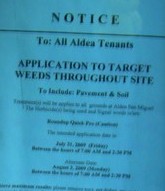
Mass use and limited space of urban parks necessitated different ways of relating to this naturalistic view of nature, and Olmsted and other urban park supervisors soon developed extensive rules of behavior for park goers, often enforcing them with deputized park keepers who patrolled the landscape, keeping a watchful eye on those who might willfully or ignorantly engage in improper park behavior. A neighborhood parks and playground movement also grew to accommodate more active kinds of recreation for adults and children, and over time successive waves of development
tested new models for how urban parks might accommodate user needs and control behavior. But unlike naturalistic parks, for the most part these models—with their ball fields, paved courts, play structures, and indoor facilities—were less about providing a bridge between nature and culture than they were about social issues such as physical health, assimilation, and class equity (e.g., Cranz 1982). In contrast, while naturalistic parks helped to increase the equity of people’s access to nature, the social controls put on use likely led to an inequitable distribution of desired nature experiences.

Ecological Nature and Urban Park Design


Although the primary goal of naturalistic park design was for aesthetic appreciation, in many cases the park landscape also provided wildlife habitat and other environmental services such as flood control, wind protection, and moderation of the urban heat island. Landscape architects practicing in the midwestern United States such as Jens Jensen and O. C. Simonds were enamored with the regional prairie and savanna landscape, and at the turn of the last century began creating symbolic renditions of them in urban areas using a primarily native plant palette (Grese 1992; Simonds 2000).

While concepts of biological diversity and ecological succession were not yet well understood, these designs could rightly be considered among the earliest attempts at urban ecological design. Ecological restoration incorporates land management activities aimed at returning the structure, composition, and function of a damaged or degraded ecosystem back to a key historic trajectory in order to achieve goals of ecosystem health, integrity, and sustainability (Society for Ecological Restoration 2004). Explicit attempts at ecological restoration were started by ecologists such as Edith Roberts at Vassar College’s arboretum and botanic garden in the 1920s, Aldo Leopold at the University of Wisconsin Arboretum in the 1930s, and Ray Schulenberg at the Morton Arboretum in suburban Chicago in the 1960s (Egan 1997; Hall 2004; Jordan 2003). While the restoration movement started in earnest in the 1970s and ’80s and quickly spread to management of more extensive lands at and beyond the urban fringe, I find it a curious coincidence that these earliest efforts were all located within arboretums and botanic gardens, which are commonly referred to as “outdoor museums” of plants. With missions of conservation, research, and education, these institutions may have set the stage for how ecological nature should be presented to the public and how in turn people should respond and interact with it, particularly in more confined, urban settings.

The transfer of ecological restoration principles and practices to urban public parks was just a matter of time. Urban park researchers Galen Cranz and Michael Boland (2004a, 2004b) have recently documented the emergence of the “ecological park” as a new model of urban park design in the United States and Europe. In their analysis of 125 designs for urban parks published in landscape architectural journals between 1982 and 2002, the researchers found that ecological parks were the second most popular design for parks (24%) behind “open space” parks (42%). Ecological parks include parks where themes may embrace sustainable practices, the use of recyclable materials, and other “green technologies,” but elements common to ecological restoration figure prominently in many designs: use of native plants; restoration of ecological plant communities and systems such as rivers; community-based stewardship; and restoration of wildlife habitat. Significantly, most of the ecological parks they identified had been established since 1991, and based on past park development trends the researchers predicted that the development of urban ecological parks will continue to increase over the next decade.

Park Restoration and Museumification


Over the last decade I have been studying the social aspects of urban park restoration, first in Chicago and more recently in San Francisco (e.g., Gobster 2004). In both locations I have examined conflicts over natural areas restorations to understand the meanings and values that different stakeholder groups have toward urban nature, with the aim that using this knowledge can increase the success that restorations have in addressing human and ecological goals. In the course of my own experiences of sites and those of stakeholders I have studied, I have come across situations where the design and implementation of restoration projects seem to limit rather than increase the range of nature experiences provided by urban parks.

Although the word “museumification” sounds somewhat awkward and jargony, it seems to fit my and others’ impressions of these places and for lack of a better term I will use it to label the phenomenon I describe here.

Museumification is a process in which places or subjects of the everyday world are transformed in ways that can lead people to think and act toward them as if they had been placed in a museum. Museumification can be accidental or intentional and its aim might be to conserve or commodify, but the end result is a shift in the meanings, behaviors, and experiences people have in relation to a place or subject. While there has been at least one use of the term to refer to nature and landscape (Duane 1999), museumification is increasingly being applied to areas such as architecture and historic preservation (e.g., Ashworth 1998; Huxtable1997) and tourism and cultural preservation (e.g., Berdahl 1999; Wall and Xie 2005).
How does museumification happen in the context of urban park restorations? What does it look like? What are the effects of museumification on those who experience it? In the following sections I describe these three dimensions of museumification based on archival information about the landscape history and recent planning of sites (e.g., Chicago Park District and Lincoln Park Steering Committee 1995; San Francisco Recreation and Park Department 2006); personal observation of sites; and interviews and site visits with park professionals, restorationists, and restoration critics. These various types of cognitive, experiential, and evaluative information form a skill set needed by one adopting the role of what environmental aesthetics philosopher Allen Carlson (1977) proposed as the “environmental critic,” one whose task, like an art or architecture critic, is to assess the merits of a landscape.

While Carlson’s environmental critique was focused on assessing landscape beauty, my attempt at landscape criticism here aims more broadly at assessing how restoration projects are planned, designed, and used by people for nature experiences. This includes aesthetics but may also include recreational, educational, safety, and stewardship goals (e.g., San Francisco Recreation and Park Department 2006). Finally, it is not my purpose here to provide a detailed assessment of the merits of individual projects, but rather to describe the phenomenon of museumification and illustrate it with examples from different urban restoration sites in Chicago and San Francisco.

This article is continued in Part 2.

Posted in nativism | Tagged , , , | 5 Comments

The Cloud Forest’s Driest Day

It’s raining now, the evening of Monday Oct 12th. This may herald the beginning of winter’s wet weather.

On South Ridge

On South Ridge

In October we had the longest stretch of fogless rainless weather – seven days. In recent days, we’ve had high clouds, but not the kind the forest could catch the moisture from. In fact, yesterday, Oct 11th, may have been the driest day in the forest. We were there.

Around on Sunday afternoon, it was a surreal experience. The forest was beautiful, full of bird-sounds and jet-roar. The Blue Angels were zooming by behind the eucalypts (but they weren’t holding still for the camera).

Damp beneath the surface

Damp beneath the surface

Anyway, we were on another mission: to see what the forest looks like when it really dries out.

The mud puddles were gone. The squishy mud was gone. All the paths were dry.

But when if you kicked at a rut, it came off in clods of mud, revealing damp earth underneath.

Kicking up dust in the Native Garden

Kicking up dust in the Native Garden

The only places that were dry and dusty were where the forest had been opened out – like the Native Garden. There you could actually kick up dust.

The rest of the forest was green and growing, with a high moisture content.

Greenery on the driest day

Greenery on the driest day

Edited to add: It’s mid-day of October 13th now, with rain and wind. I’m standing looking at the stately dance of the forest as it waves in the wind. It is a thing of ethereal beauty. If I had video I might show you, but nothing would capture the scale and grace of these amazing trees.

Posted in Sutro Forest "Fire Risk" | Tagged , , , , , , , | Comments Off on The Cloud Forest’s Driest Day

UCSF calls two meetings

UCSF has called two meetings to discuss the project.

1. Monday, Oct 19 2009, 6.30 p.m. [Our report, with some comments, is here.]

UCSF Millberry Union, 500 Parnassus Ave. $1.50 validated parking in UCSF public parking garage.

2. Saturday, Oct 24th 2009, 12 noon.

Sutro Walking Tour, starting on the Aldea student housing area at Johnstone and Behr. (This is off Clarendon Avenue.) Parking is available.

Quote from the notice:

“UCSF is committed to a thorough discussion with neighbors and will use this feedback to shape how these projects proceed.”

Posted in Uncategorized | Comments Off on UCSF calls two meetings

The Appalling Example of Twin Peaks

We always love going up to Twin Peaks, the place for the iconic view of our magnificent city. Recently, though, we were on a different mission: To look at Twin Peaks, not from Twin Peaks.

This is a “native area” – one where the nativists are attempting to “restore” the habitat to what it might have been a couple of hundred years ago. It could be an example of what Mt Sutro would look like if the Stewards’ hopes for “restoration” are achieved and the eucalyptus felled.

What we saw (once we ripped our eyes from the view) wasn’t encouraging.

rockslide

rockslide

Rockslides and erosion. In many places around the peaks, rock had slid down the mountain onto the road. It looked like enough to bury a car or take down a garage if it landed against a house (which fortunately don’t exist right there). There could be more after this winter’s rains – there are many bare areas.

Trash

Trash

The trash. It was all over, but particularly visible in the tinder-dry plants. (Is that the native coyote bush? Not sure.) Some of it was the kind of trash people leave when they visit a place – cigarette butts, plastic bags, wrappers. Some was thrown there.

Edited to Add: Oh, and we forgot – graffiti. Some people just can’t resist leaving their mark…

Roundup Pro and Garlon

Roundup Pro Dry and Garlon 4

Roundup and Garlon toxic herbicides. The ammunition in the constant battle for native plants. It has to be dumped over large patches of the mountain to keep down the weeds and save the native plants.

butterfly 3

twin peaks 003Weeds, dry vegetation, and de-vegetation: bare rock.
Same place, a month later

Same place, a month later

There wasn’t much wildlife – some Brewer’s blackbirds, some white-crowned sparrows, and this impressive butterfly. We looked it up. It’s an Anise Swallowtail. Its caterpillars live on non-native fennel. Oops.

Posted in Herbicides: Roundup, Garlon, nativism | Tagged , , , , , , , , | 28 Comments

October Fog Log

As we said in the original Fog Log post, we’re keeping track of that crucial “September to November period when fire risk is greatest,” according to the UCSF letter.

“Mount Sutro is squarely in the fog belt. The question is, Whether between the end of summer (and fog) and the beginning of winter (and rain), is there enough dryness to raise fire risk? We’ll find out. What we’re starting here is a Fog Log. It will be updated for every day’s weather. We will also look out for the “dry hot winds” blowing “from the Northeast.” There is a link from the front page.

September had only 7 days that were fogless (i.e. no fog morning or evening). And, these were interspersed with fog-days; the maximum consecutive number of fogless days was 2.

October had 13 fogless days; the longest stretch without fog (or rain) was 7 days. It also had 4 rainy days.

———————-

This is the October Fog Log, week by week.

October 1st week: Four fogless days, cool and bright. Started with sunny bright days on Oct 1, 2, 3, 4, no fog. Chill north-westerly winds on 3rd and 4th. Oct 4th, the weather report says 83% humidity.

October 2nd week: Two sunny days, for a fogless streak of seven days. Cloudy/ foggy rest of the week. No dry hot winds. Oct 5, sunny and cool. Humidity about 74%. No dry hot winds yet. Oct 6, bright and sunny. Oct 7 started out sunny, but around 2 p.m. the fog’s back. That ends a one-week fogless streak (Sept 30-Oct). Oct 8 – cloudy. Oct 9th high clouds and sun. Oct 10 Overcast. Oct 11 Overcast.

Night fog over Forest Knolls (view fm Twin Peaks)

Night fog over Forest Knolls (view fm Twin Peaks)

October 3rd week: Rainy 3; “fogless” 1; Foggy, 3. October 12, cloudy with humidity at 80%; evening rain. Oct 13: rainstorm overnight, most of the day. Oct 14: Cloudy. Oct 15: Rain. Oct 16 and 17: Morning mist, then sunny, then evening fog. Oct 18: Foggy.

October 4th week: Rainy 1; Fogless 2; Foggy, 4. Oct 19: Rain. Oct 20: Sunny, then fog. Oct 21: Sunny. State of the forest: damp. Some trails on the east side were already dry after yesterday’s rain, but by the side of the trail, the duff was wet under a layer of fallen leaves. The Native Garden had some grass sprouting, not sure if it’s native or not. And the fog returned at night. Oct 22: Morning fog, the sunny. Oct 23: Sunny. Oct 24: Morning fog, clearing to sunshine. Oct 25: Sunny.

The duff was wet above the dried-out trail

The duff was wet above the dried-out trail

October Final Week: Sunny, 4: Foggy, 2 (6 days) Oct 26: Sunny, evening fog. Oct 27, 28, 29, 30: Sunny. Oct 31: Very foggy.

Posted in Sutro Forest "Fire Risk" | Tagged , , , | 2 Comments