Concrete and Chainlink Aren’t Forest

Pad #4: “will have retaining walls removed (unless there are geologic or safety reasons for not removing the retaining walls), and will be planted to blend in with the forest.”

Ten years ago, on 18 January 2000, UCSF issued an agreement with the community about its intentions for the Aldea student housing. [Edited to Add: Here is the letter: Aldea Housing Agreement 2000 01]

One section is directly relevant here. It was going to knock down two old buildings on “pads #4 and #5” and return them to Open Space :

“The sites targeted for open space will have retaining walls removed (unless there are geologic or safety reasons for not removing the retaining walls), and will be planted to blend in with the forest.”

Sounds reasonable to us.

On June 14th, we got a message from UCSF:

“I am writing to notify you that beginning this week (Monday, June 14, 2010) a new chain link fence will be installed at the Aldea Housing area on the site of pad number 4…   Per UCSF’s agreement with the community,  pads 4 and 5 will be returned to the “Open Space Reserve” and pad 4 will now be used as a seed propagation area in order to grow plants that can be replanted throughout the Reserve.  The fence will be installed around the existing concrete foundation of pad 4 and will include two emergency exit gates and one drive through gate.” [ETA: It’s been built. See photograph.]

chainlink fence in Aldea

Chain link fence doesn’t blend…

How does this conform to UCSF’s agreement with the community? A chain link fence with three gates over a concrete pad doesn’t resemble “planting to blend in with the forest.”

And why were neighbors notified only when work was due to start?

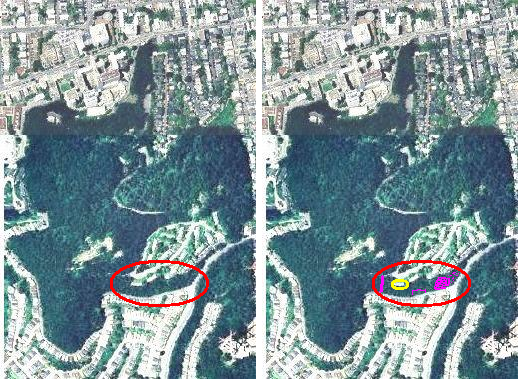
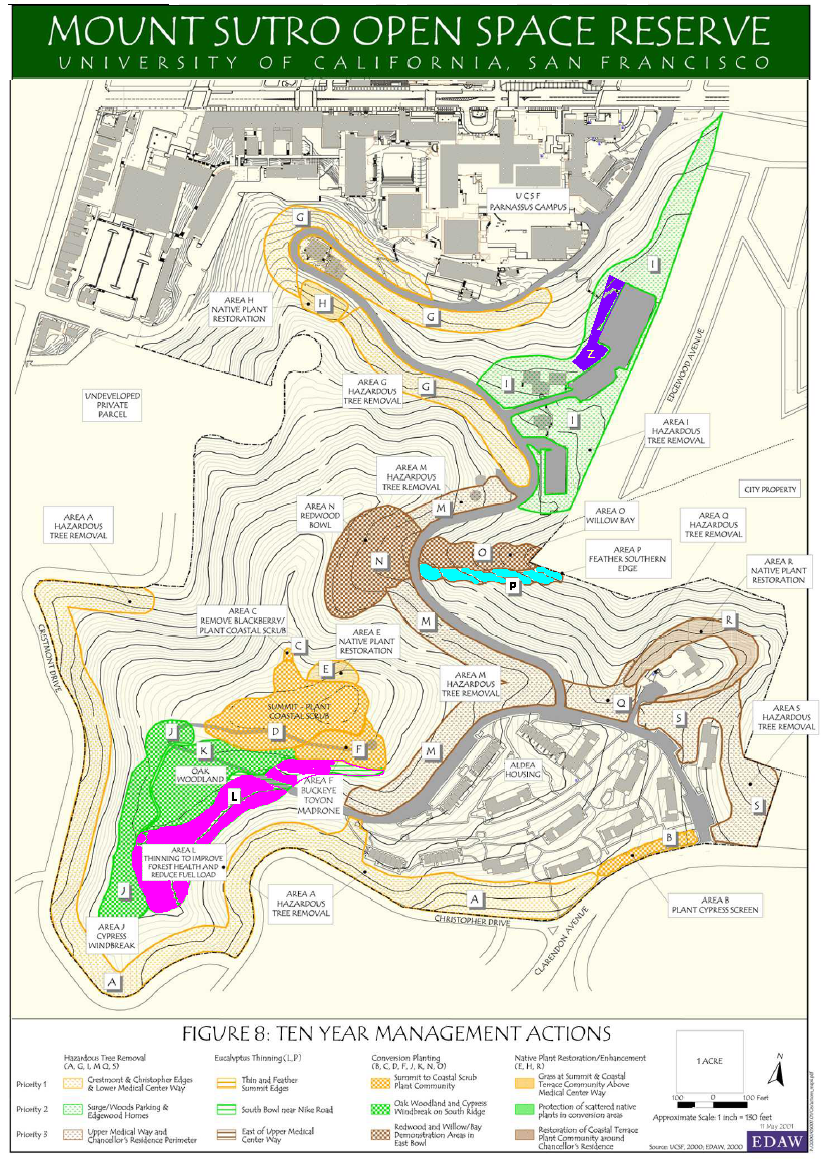
This is area of the forest once formed a dense screen between the Aldea campus and the Forest Knolls area. In fact, the Aldea student housing was not visible from Christopher or Clarendon. (See map on left.)

Now, mainly as a result of the SFPUC project, that screen is in tatters, the housing clearly visible, and wind speeds higher. A gap has been slashed through the forest where the water line was laid (pink line). A new pump-house has been put in (pink blob) and the trees on that whole area removed.

We would hope that UCSF would actually, as per their agreement, plant trees that would blend into the forest and improve the density of the forest screen. (Pad #4 is the one circled in yellow, and pad #5 the one next to it.)

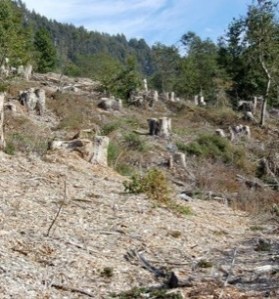
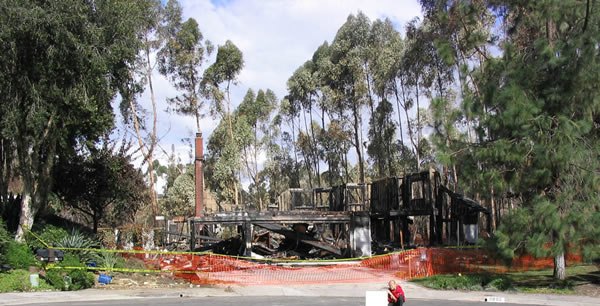
[Edited to Add: Pad #5 still has a building on it, apparently still in use. Pad#4 was knocked down earlier and was open as shown in the first picture.]

[ETA2: We found an August 2009 letter which said:  “The renovation of three of the five original housing units (Buildings 2, 3, and 5) are nearly complete and will be open for occupancy in the fall of 2009. These three buildings will contain a total of 42 one-bedroom apartment units for occupancy by single students.

“Future plans for the site of Building 4 will be to allow the area to return to its natural open space environment. Plans are currently underway to build a new community center on the site of Building 1 . Construction for the community center will begin in the fall of 2009 with a target completion date of summer 2010.”

So by this time, plans for Building #5 had already changed to renovation, not demolition (we’re not sure when or why); but Pad 4 was still supposed to “return to its natural space environment.”

Meanwhile, we received an e-mail from UCSF that said they would paint the fence brown and grown elderberries on it…

ETA 3: At the community meeting on 30 June 2010, Vice Chancellor Barbara French said that something had gone wrong with the process, and the project was now on pause. However, she was not clear whether the fence would be removed or not, nor whether the concrete would be removed.

Aldea Housing is increasingly visible

Posted in Neighborhood impact, UCSF | Tagged , | 13 Comments

Butterfly Count Results, 2010

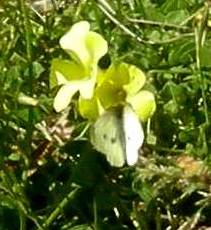
Cabbage White sitting on Oxalis

Umber Skipper by TW Davies, Cal Academy of Sciences

It’s nice to have positive things to say about Nature in the City (which we’ve disagreed with, more than once), and this is really a win. Despite some pretty cold foggy weather, their June 7th Butterfly Count got 34 participants and spotted 24 species of butterfly – a record.

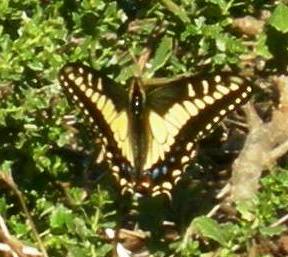
Anise Swallowtail, Twin Peaks

The most common species remains the Cabbage White, which accounted for over 40% of the butterflies counted. Next was the Umber Skipper, a tiny butterfly barely larger than your finger tip. Third was the spectacular Anise Swallowtail. The top ten species accounted for over 85% of the butterflies counted. Of course, this is just one year’s result, and may have been biased by weather, visibility, and observer accuracy. Still, we think they did a pretty awesome job. Congratulations.

For anyone interested in more detail, here’s a graph of the results. A total of 775 butterflies were counted, of which 29 were not specifically identified. (Click on the graph and click again for a larger version.) The data are available on Nature-in-the-City’s website.

2010 Butterfly Count Results

Posted in Environment | Tagged , , , | 8 Comments

Report: UCSF’s Agenda Planning Meeting #2

This evening we had the second of three scheduled agenda planning meetings. Those present were the usual agenda-planners, with the addition of Walter Caplan (President, Forest Knolls Neighborhood Organization) who had been outside the country at the previous one.

This meeting had a greater level  of  discussion of the issues between the opposing sides, and as such was more of a workshop.

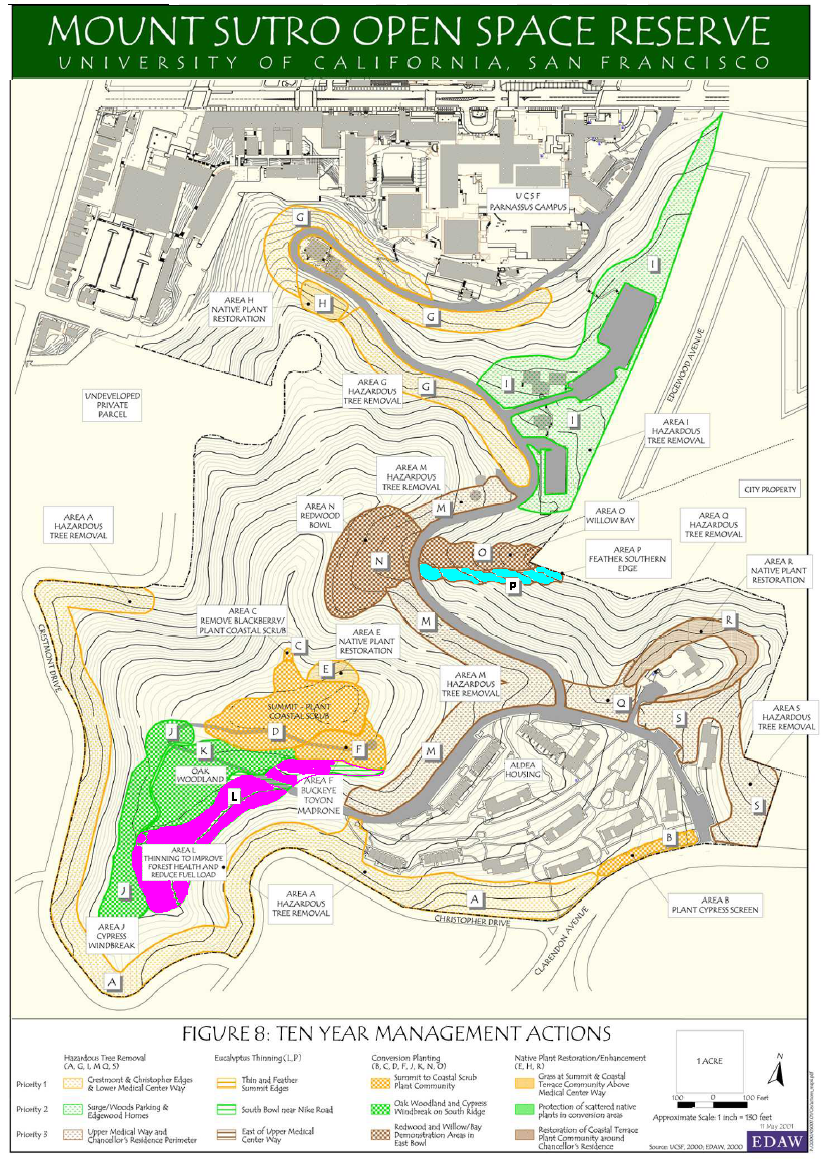
The map above is not the one used at the meeting, but we’re staying with it for consistency. (The map used was just a map of the forest, similar to the one on the home page of this website.)

The main focus of this meeting was the Demonstration areas, where various actions are planned to see what works on the mountain. Three were mentioned at the previous community meeting. They were South Ridge, shown in pink as Area L on this map; Edgewood, estimated as the area shown in purple as area Z; and along the creek, area P shown in turquoise. Three new ones were considered. (They were not precisely defined, so all of these map markings are estimates based on the discussion.)

  • The Northwest area above Kirkham, where a neighbor was concerned about hazardous trees (probably somewhere within the area of  light purple wavy stripe, area Y);
  • The “Classroom area” off the Historic Trail (shown in Cobalt Blue as area W);
  • Another Northwest corner area where Nootka Reedgrass grows beneath blackberry (Area H contiguous with Area W);

Some of the issues raised:

  • Limits to demonstration areas. Are “demonstration areas” limited to 2.8 acres? How large an area can be demonstrated on before it ceases to be demonstration and becomes implementation?
  • Maintenance vs restoration. What are the boundaries between “maintenance” and “restoration” for the purposes of the Environmental Study? (Maintenance is permitted, but changes to the eco-system are not.)
  • View corridors” as a positive vs the sense of containment with a dense forest, isolated from the sound and sight of the city. How do the views compare with Twin Peaks and Tank Hill?
  • Trails. Expanding the trail system to coordinate with other areas (Interior Green Belt, etc) vs avoiding further trail expansion to maintain the character of the forest.
  • Changes to the forest eco-system, including animals and insects. The need to collect data on the results of actions already taken, e.g. the Native Garden.
  • What is actually  being demonstrated? Visual impact; effect on eco-systems; whether native plants will grow and how much care they will need; maintenance inssues; animal and insect use of the “restored” area.
  • To whom is it being demonstrated? An “assessor” (selected how?) or the community? Or both?

Walter Caplan raised the issues of UCSF’s legal obligations, and suggested recourse to the original agreement plus getting a legal opinion as to hazards and liabilities. Barbara Bagot-Lopez said it’s on the UCSF website and promised to send the link, which we will add. [Edited to Add: She sent us the link; we’ve posted the agreement here.]

Several people asked for cost estimates for all the activities under consideration.

Non-herbicidal methods of regrowth prevention were mentioned, but not actually discussed. They will be on the agenda for the next meeting.

Posted in Environment, Meetings, Mt Sutro Cloud Forest, nativism, Neighborhood impact, UCSF | Tagged , , | 2 Comments

Mission Blue Butterfly- An Uncertain Experiment. Why?

This post was sparked by our discussion in comments with reader JMC, who advocates replacing the Sutro Forest with Mission Blue habitat (disturbed grassland with lupines and other flowering plants).

Recently, a Mission Blue butterfly was spotted on Twin Peaks amid much jubilation. It seemed like a successful experiment in establishing an additional population of the endangered insect. (The main population is on San Bruno Mountain.) While one butterfly is certainly a lot better than no butterflies, it seems to us that the jubilation is premature. As we said in our response to the comments, we’re rooting for the Mission Blue, and admire the effort by the Parks and Recs staff and the volunteers who made this elaborate reintroduction. But we think it’s too early to celebrate.

This butterfly is the end result of extensive work and the input of 22 pregnant Mission Blues.

  • It was a multi-year effort. First, lupine, the food plant, was planted (the caterpillars feed on three different kinds of lupine).
  • Once that was established, 22 pregnant female butterflies were brought to Twin Peaks from San Bruno Mountain in April 2009.
  • They were placed in net cages over lupine plants so they would lay their eggs there.
  • According to the Draft Restoration plan, each female could lay “up to several hundred eggs.” This means 2-3000 eggs could have been laid. Maybe as many as 6,600…

Mission blue eggs hatch into caterpillars which eat the lupine, shedding their skins as they grow. The larger caterpillars are tended by native ant species, who protect them from predators while benefiting from “honeydew” – sugary caterpillar pee. When they’ve grown to their full size, they form their pupae near the base of the plants, or even on the soil beneath, and remain there for months. They hatch into butterflies in spring, sip nectar from a range of flowers,  mate, and lay eggs on lupines.

With a life-cycle of about a year, April and May would be around the time for the hatching. Only a single butterfly was spotted. [Edited to Add: None were seen during the June 7th Butterfly Count, but it may have been too late in the year.]

Of course, spotting only one (male) butterfly didn’t mean he was alone. We hope there were more, with enough of each sex, so they found mates during their one-week lifespan. Otherwise, it’s going to be like that old joke:  The easiest way to make a million dollars is to start with five million…

[Edited to Add (March 2011): We obtained a report from SF’s Parks and Recreation Department about the Mission Blue.  Over nine surveys, they actually spotted 6 female and 11 male butterflies. The report extrapolates that the population could be 20-50 butterflies with the lower number more likely. The report recommends bringing in another 25 butterflies in 2011 to add genetic diversity. “the status of the population will remain tenuous until substantial population increases occur,” it notes.]

[Edited to Add (April 2012):  Click here for an updated article about the Mission Blue Butterfly on Twin Peaks]

GARLON AND MISSION BLUES

If we have a win this year, it’s still not over. The fact that the 2010 batch succeeded (if it has) doesn’t mean that the next generation will make it. Though JMC believes Garlon used on Twin Peaks has “little to no effect“, one butterfly does not prove the point. And there’s no Garlon research on larvae; the insect research was on adult honey-bees.

The starter group of 22 Blues were caged over selected lupine plants, hopefully in a Garlon-free area. But will the butterflies make the same choice?

The butterflies may not be as vulnerable to Garlon, since they fly from flower to flower and only live a week or two anyway.  But they may feed from nectar on Garlon sprayed flowers. We know it can cause birth defects in rats. We don’t know what it does in butterflies, because there haven’t been studies. Does it reduce the number of viable eggs? Does it decrease the number of healthy caterpillars hatched? We don’t know.

Even if hatched healthy, the caterpillars they live near or on the ground for months, and would be more vulnerable to toxins  than the adult butterflies. Does the Garlon reduce the success rate of caterpillars? We don’t know that either.

We also don’t know about the impact of Garlon on the native ant species that “nurse” the caterpillars. Is Garlon favoring Argentine ants? And will Argentine ants behave the same way as native ant species? One student has observed them milking caterpillars of a different species of butterfly, so there’s hope. But they might also view the eggs and caterpillars as food.

UNCERTAINTIES

And quite aside from the risks from Garlon, there are all the usual dangers: Weather conditions, predators (mainly birds) [ETA: rodents also prey on the larvae and pupae, apparently; and a parasitic wasp is also a problem], and just the normal variation in reproductive rates.

Even if the reintroduction is successful – as we hope it will be – we disagree with JMC on the value of destroying another flourishing eco-system in Sutro Cloud Forest. This region has other open spaces where lupine grows or could be grown, and Mission Blues reintroduced. That’s what diversity is about – having both the coastal scrub and the Sutro Cloud Forest.

Posted in Environment, nativism | Tagged , , | 5 Comments

Butterfly Count: June 7th

We’ve talked about Nature In the City and its negative attitude to trees.

Today’s post is positive: They’re leading a San Francisco Butterfly Count, in collaboration with the North American Butterfly Association. We believe it will be okay to count non-native butterflies…

If you’re interested in joining, it starts at Randall Museum on Monday, from 9 a.m. 5 p.m. The details are here. Bring lunch, and contribute $3.

[Edited to Add: For the count results, go here.]

Posted in Environment | Tagged , , , | 1 Comment

Report: UCSF Sutro Forest Meeting May 2010

This is a report on UCSF’s May 25th Community meeting. There are some changes following from previous meetings:

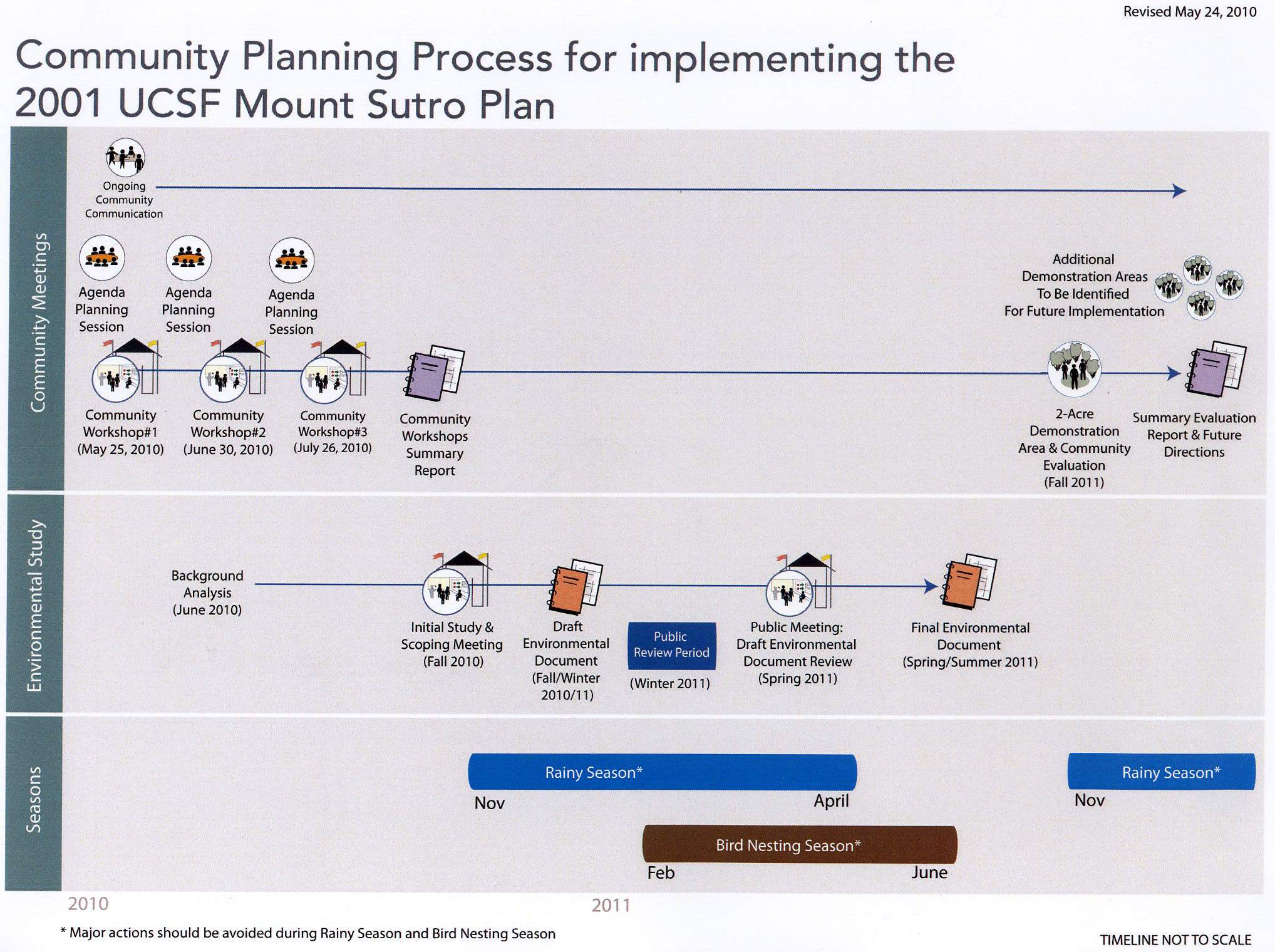
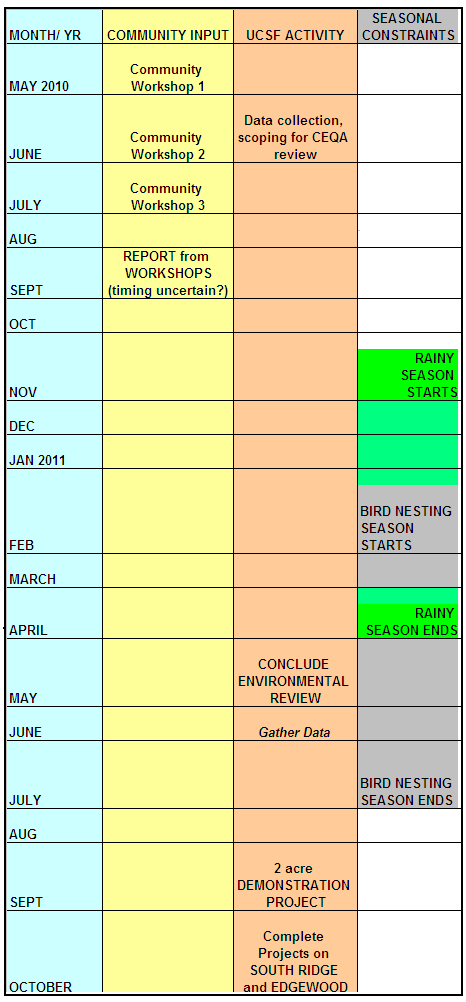
  • The Environmental Review shows six steps instead of just a black box.
  • The ending is not a predetermined cutting of trees on South Ridge and Edgewood (as originally shown) but additional demonstration areas and a report.
  • The other major change was that we’re now talking about three demonstration areas.

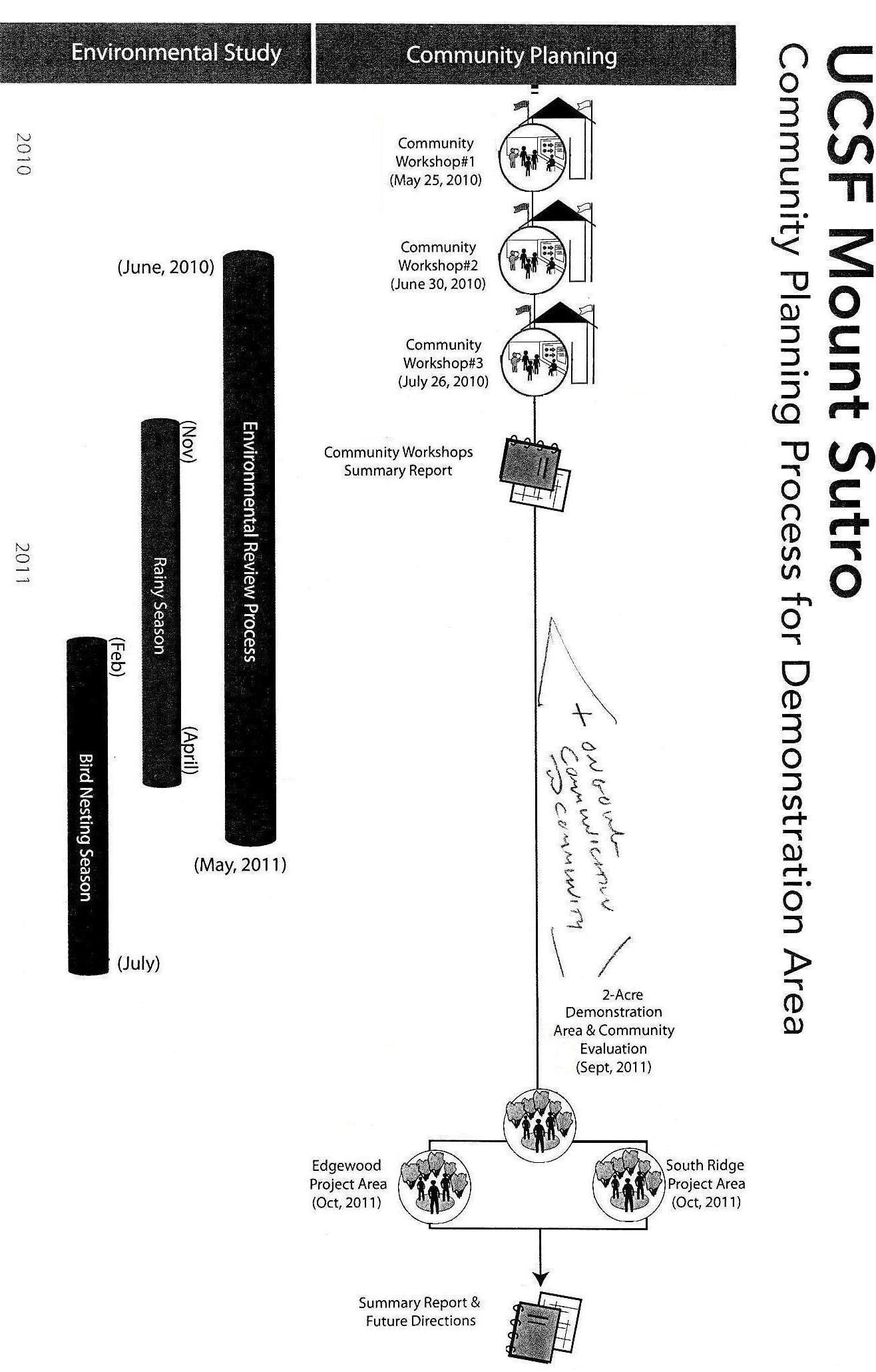
In response to the inputs at the Agenda-setting session, UCSF’s Sutro timeline has been revised, and the Environmental review portion detailed further.  (And in response to our humorous “black box” comment, the time-line was provided in color!)  If you click on the Time Line picture below, and click on it again, a larger version will appear.

UCSF's Sutro Timeline (v.2)

The meeting was not very well attended (compared to previous Forest meetings). There was a substantial contingent from UCSF; a small group from the Native Plant supporters (mainly the Mt Sutro Stewards); and another from the neighbors associated with saving the Forest. Many who came to the agenda-planning session did not come for this one. Only one person present had not been to earlier meetings; her concern was hazardous trees and potential landslides above Kirkham Heights (on the western side of the forest).

THREE DEMONSTRATION AREAS

The other major change was that we’re now talking about three demonstration areas.

Three demonstration areas

The first remains area L on South Ridge, shown in pink. This is just above Forest Knolls.  Here, the proposal is to “thin” the trees to average 30 feet apart, and remove the entire understory (“mow it down” according to forester Ralph Osterling). The issue of herbicides remains open. The second is below the parking lot behind Edgewood. This area was not actually defined, but was estimated at about one acre. We have inserted the purple area (Z) as our best guess as to where it would be. In this area, the trees are already well-spaced and the understory quite thin, so very little would be done other than Safety Pruning, canopy raising (trimming away lower branches and removing vines), and hazardous tree removal. Again, the issue of herbicides remains open, but seems to be considered more sensitive. The third, if it gets to that, would be the area  P shown in blue; it runs along the seasonal creek and abuts the Interior Green Belt. The Nativists saw this as a potential stream restoration project, with the planting of willows. A neighbor pointed out that this would be a particularly risky place to use herbicides.

We objected to the use of South Ridge as a demonstration area, for the following reasons:

1. As a long thin strip along the whole of the South Ridge, it could impact a much wider area than just the two acres with an added risk of windthrow for trees below it (i.e. trees being knocked down by the wind). This is a windy area of the mountain, and tree removal thin the windbreak we have there now.

2. The planned “thinning” and gutting of the understory would inevitably affect the integrity of the forest, which is a functional cloud forest, by drying it out.

3. This would impact wildlife in the forest.

4. Visually, it would be evident both from inside and outside the forest.

5. Inevitably, herbicides used on high ground above the Forest Knolls would wash down the hillside into our community.

Kirkham was proposed as an alternative demonstration site, but Steward Dan Schneider said that area was complicated by private ownership of some of the land in the area.

No one from Edgewood was present at the meeting. The issues there are noise from the power plant and visual screening from the rear of the UCSF buildings.

The presenters emphasized a focus on Adaptive Management – i.e., do something, see its impact, then take the next step based on the new information.

THE MEETING

The meeting opened with a welcome from Vice-Chancellor Barbara French, and was run by Daniel Iafacano. Lori Yamauchi and Maric Munn made the same presentations as they made at earlier meetings; Ray Moritz, a forester hired by UCSF made the same presentation about other eucalyptus thinning projects in the Bay Area as at the March 2010 meeting. (All the presentations – including Diane Wong’s on Environmental Review – are here as a PDF file at UCSF’s website.)

Since the group was fairly small, there was time for questions, and the native bird “beak-gumming” myth got some discussion in the context of the Highway 1 project (which was completed in 2009) and had native bird habitat as one of its objectives.  (This was part of Ray Moritz’s presentation on other examples of eucalyptus thinning.)

ENVIRONMENTAL REVIEW PROCESS

Diane Wong (UCSF Campus Planning) made a presentation about the planned Environmental Review (ER), and responded to some of the questions we had emailed earlier.

1. UCSF is a lead agency and can do its own ER. It will be done by UCSF staff, staff from the Office of the President, consultants with UCSF supervision, and attorneys both inhouse and outside.

2. They must look at all actions that could potentially be taken on the mountain to avoid “piecemealing” where the project is broken into tiny portion, each of which is innocuous but which together have a major impact. They must look at the full range of potential outcomes from the Adaptive Management plan.

3. The proposed project is not exempt. After an initial study, they would use a Circulated Document to either get a Negative Declaration (i.e. that they project will not have a significant impact) or require a full Environmental Impact Report.

4. In terms of experience, UCSF has been the lead agency for several EIRs:  the Long-Range Development Plan, the Mission Bay campus, the helipad Supplementary EIR, the Osher Building EIR and addendum, and the Regenerative Medicine Building (i.e. the “Stem Cell Research Building”).

5. The relevant CEQA topics are: Aesthetics, land use, air quality (greenhouse gases), biological resources, cultural resources, geology, hazards and hazardous materials (including pesticides), hydrology, noise, populations and housing, public services, and recreation.

6. Diane produced a list of community concerns that essentially came out of the agenda-setting meeting. We added one: Wildlife.

7. Diane also mentioned activities that were exempt from the moratorium on changes while the ER was in progress: maintenance, such as pruning and shrub and weed removal and trail maintenance; hazardous tree management; gardening such as new plantings in the Native Garden; and minor changes like adding trail markers.

ISSUES

The other issues were the same ones that have been raised before: The Nativists (and the Moderator!) talked about bio-diversity; the Stewards, about native plants. We talked about an ecological survey and preserving the integrity of the eco-system; other neighbors raised the issues of wildlife – including insects and reptiles.  We tried to put the issue of bio-diversity into the larger context of the Western part of the city. Herbicides were mentioned, and will be discussed in more depth at later meetings.

A representative of San Francisco Urban Riders (who is also a founder member of the Stewards) spoke of  View Corridors (i.e. removal of trees and understory to allow views of the city).

A neighbor asked if there was any chance, in the context of the new Long Range Plan (2012-2020), that either or both of the two areas of South Ridge and Edgewood would be used for other purposes such as construction. Lori Yamauchi, Assistant Vice Chancellor-Campus Planning, said UCSF had a complete commitment to maintaining the entire 61 acres as open space.

NEXT STEPS

  • For the present, UCSF appears to be using the 2001 Plan as a guide and road-map.
  • The next agenda-planning meeting is on June 8th, and the next Community meeting on June 30th.
  • The third agenda-planning meeting is on 12 July, and the third (and possibly last) Community meeting is 26th July.
Posted in Environment, eucalyptus, Herbicides, Maps, Meetings, Mt Sutro Cloud Forest, nativism, Neighborhood impact, UCSF | Tagged , , , , , , , , | 6 Comments

East Bay: Intent to file a Petition

(Edited to update the information in the post)

Hills Conservation Network has decided to file a petition under California Environmental Quality Act (CEQA) against the East Bay Regional Parks District (EBRPD) and its Board of Directors.  It’s sent a notification through its lawyers, Lozeau Drury.

The legal notice challenges the actions of EBRPD in (1) adopting the Wildfire Hazard and Resource Management Plan and (2) certifying the associated Environmental Impact Report in violation of CEQA requirements. (This Plan intends to cut down hundreds of thousands of trees – mostly eucalyptus but also acacia and Monterey Pine – over a large area in the East Bay, and use toxic herbicides to prevent regrowth.)

Here’s more information from HCN:

The East Bay Regional Park District (EBRPD) plans to destroy more than 500,000 trees adding some 100,000 metric tons of carbon dioxide to the atmosphere and a massive amount of pesticides to the environment.

The East Bay ridgeline from Castro Valley in the north to Pinole in the south is in danger of being forever altered by a misguided vegetation management program adopted last month by the East Bay Regional Parks District (EBRPD).

The Hills Conservation Network (HCN) filed suit challenging EBRPD’s vegetation management program. The lawsuit alleges numerous violations of the California Environmental Quality Act (CEQA). If implemented, EBRPD’s program will irreparably harm the beautiful, vibrant and diverse ecosystem of the East Bay hills.

HCN is comprised mostly of survivors of the 1991 Oakland/Berkeley fire, people deeply concerned that the East Bay Regional Park District, using parcel tax receipts from 2004’s measure CC, will create an environmental nightmare.

EBRPD’s vegetation management program will destroy critical habitat by drastically reducing the tree canopy; release enormous amounts of sequestered carbon dioxide and; poison the environment with the widespread and long-term application of pesticides known to increase health risks to people, pets and wildlife.

Large scale removal of pine, eucalyptus and acacia trees is a radical plan to restore the landscape to the way it may have looked 200 years ago. Removal of thousands of trees eliminates their ability to absorb carbon dioxide, a main culprit in global warming. This is poor forest management and ineffective fire prevention — and it harms the environment. Taxpayer dollars could be put to better use by thinning the trees and clearing debris under them instead of removing vast numbers of mature, healthy trees.

Despite HCN’s repeated attempts to achieve a more moderate plan at a lower cost and without the substantial negative environmental consequences, EBRPD has refused to engage in meaningful dialogue. The result is the current lawsuit.

The suit, filed May 25, 2010 in Alameda County Superior Court seeks an injunction preventing any tree removal, and asks that the EIR adequately analyze the impacts of this 20-year project, which it currently does not do.

(For more information contact HCN’s Dan Grassetti at (510) 849-2601)

Posted in Environment, eucalyptus | Tagged , , , , | 1 Comment

Urban Forests and Migratory Birds

We’d like to thank “Sutro Resident” for a comment with a link that led us to an interesting piece of research: That migratory birds may depend heavily on small urban forests as they pass through, and even small forests are useful (though larger ones are better). The link was to a report in the BBC News, headed Urban trees ‘help migrating birds’, by their Science and Environment Reporter, Mark Kinver.

Migratory birds don’t generally fly non-stop from the point of origin to their destination. They break journey along the way, feeding and rebuilding their strength for the onward journey. The ability to do this is critical; without it, a bird cannot successfully make the journey any more than an aircraft with inadequate fuel can reach its destination.

Researchers Steve Mathews and Paul Rodewald of Ohio State University captured Swainson’s Thrushes migrating through Columbus OH, and released them in seven patches of urban forest of various sizes; the two smallest were 1.7 acres and 11 acres, the largest was 94 acres. Even in the smallest ones, 72% of the birds stayed out until they were ready to continue their journey (i.e., they didn’t fly to another nearby forest to break journey).

In the five larger ones, all the birds stayed, indicating that they found the resources they needed to rebuild their strength for the remainder of the migration. In the larger areas, they tended to stay toward the middle of the forest rather than the edges.

Though the study looked at data only from 91 Swainson’s Thrushes, the authors think the same might apply to other forest-dependent species, and suggest this underlines the importance of urban forests.

Mt Sutro Forest is about 80 acres in size (considering the UCSF portion and the contiguous Interior Greenbelt). This would suggest that it is a valuable resource not just for resident birds, but for forest-loving migrators. They are more difficult to spot than in open spaces (for people and hawks alike!) but visitors to the forest will find it full of avian sound, from the treetops, from the understory, and even the ground. Indeed, the evidence suggests that this forest is indeed important to birds.

Posted in Environment | Tagged , , , , | Comments Off on Urban Forests and Migratory Birds

Increasing Biodiversity

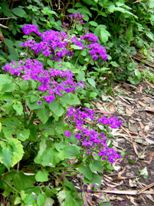
Cinneraria (introduced, naturalized)

The New Scientist, a well-reputed science magazine, ran an editorial recently headed, “Let’s put an end to biosentimentality.”

It argued that “While a few introduced species have wreaked havoc, some biologists argue that most increase biodiversity, both directly and by spurring evolution.” It points out that a large number of extinctions within the next century are essentially inevitable and we “cannot be choosy about future sources of diversity.”

Eucalyptus - introduced, naturalized

Eucalyptus is not one of the species that “wreak havoc” – despite numerous myths to the contrary. Far from invading native areas, a study showed that in fact tree cover declined in several Bay area parks in the 60 years ending 1997. It is a victim of fires, rather than a major contributor; the fires start in the exceedingly flammable grass and shrublands. It does not kill birds by beak-gumming, as some people have argued. It does not kill plants growing beneath it through excessive allelopathy… and so on.

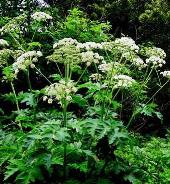
Cow parsnip - native, planted

The ecosystem on Mt Sutro is a very special one, with a large number of plant species and bird species, and an unstudied number of reptiles, small mammals, fungi, and insects. It’s easy to fail to recognize what is there, since it hasn’t been properly studied. But a knee-jerk conversion to native plants and a fragmenting of this treasure, a forest that looks, feels like an old-growth functional cloud forest and ecosystem will reduce biodiversity, not increase it.

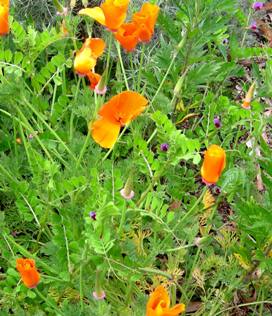
California poppy intermingled with vetch, non-native but nitrogen-fixing

Posted in Environment, eucalyptus, Mt Sutro Cloud Forest | Tagged , , , | 1 Comment

Report: UCSF’s Agenda-Planning Meeting

After withdrawing its FEMA proposal, UCSF decided to go ahead on its own. It convened a small group of supporters and opponents for an agenda planning meeting prior to its planned Community workshop. UCSF plans to hold three such meetings, and three such workshops. From UCSF there were: Barbara Bagot-Lopez, Kevin Beauchamp (who had made the presentation regarding the new Long Range Plan in February 2010), Judy DeReus, and Julie Sutton, a supervisor in the Landscaping and Grounds Division of UCSF Facilities Management.

The default now is for UCSF to pursue the 2001 Plan for the forest. It involves eventually felling about half the eucalyptus acreage. (The map above is based on the 2001 Plan map, cropped and with certain areas re-colored.)

The immediate plan has two components:

1. Two demonstration plots, of two acres on South Ridge and less near Edgewood.

The first plot is area L, shown in pink. This is along South Ridge, above Forest Knolls. Here, the plan is to “thin” the eucalyptus trees.

The second plot P, (blue in the map above) is above the seasonal creek on the Edgewood side of the forest. The plan here would be to demonstrate Native Plant conversion.

The target date for this work would be September 2011.

2. Immediately thereafter, proceed with the original plan to fell trees on the whole South Ridge and Edgewood. The target date is October 2011. This is actually unclear, since the FEMA plan called for thinning everything within the Edgewood loop, but the 2001 map above only shows hazardous tree removal in those areas.

**************

The intent of the meeting was to collect agenda items.

Some of the items:

THE GAME PLAN

  • Should UCSF revisit the 2001 Plan as a decade has passed and things have changed?
  • The need for a comprehensive ecological study.
  • Is the location of the demonstration area (or areas) predetermined or could it be changed? Judy DeReus (UCSF) said South Ridge was chosen because it was near homes and the Aldea housing; on a flat and therefore relatively accessible part of the mountain; and least visible from outside. (Actually, it’s pretty visible from Forest Knolls. And Twin Peaks. And, of course, Google maps.)
  • What is the demonstration area supposed to demonstrate? And how is it a demonstration if the next month, the next phase starts without any time given to see if the demonstration is successful? At least a year would be needed to see a full cycle of seasons.
  • The mountain has different micro-climates and terrain, and different management areas have been proposed (the letters on the map above).  Would more demonstration areas be needed?
  • The expected life-span of a project like this if the eucalyptus that has been thinned grows back.

THE LOOK OF THE FOREST

How can neighbors understand how the forest would look after the project?

  • Bus trips to see San Francisco sites where eucalyptus felling and thinning had been done, e.g. the Presidio and Glen Canyon.
  • A simulation.
  • Marking trees that would be felled so it was clear how it would look afterward.

CLOUD FOREST AND FIRE DANGER

The issue of fire-danger came up again. Craig Dawson (Mt Sutro Stewards) said the experts kept reiterating there was fire danger. We pointed out that the 2001 report said there were a maximum of ten dry days a year, and we kept a Fog Log in 2009 and found only seven dry days. We also pointed out that the proposed plan would increase fire risk, not reduce it. Julie Sutton (of UCSF) said she was concerned about fire risk from campfires and cigarettes of the homeless. (When we talked later, she said she was most concerned about the East Ridge Trail. I mentioned Roy Moritz’s experiment to her. Recently, I walked the East Ridge Trail – and it is drier than much of the forest, because a lot of the undergrowth has been removed and it is drying out this steep area. The easiest way to reduce the dryness would be to allow or encourage dense undergrowth again.)

It was decided to keep fire hazard as an agenda item.

The issue of whether it’s a temperate cloud forest came up. Julie said Cloud Forests are at higher altitudes. We said it was functionally a Cloud Forest. (Because the marine layer here is very low, we get a similar effect to a cloud forest at a much lower altitude.)

Peter Brastow (of Nature in the City) said it was not a forest at all but a plantation, and eucalyptus was the largest weed. (We thought that was Jake Sigg’s line! We also wonder why those who despise the forest have Stewardship of it.)

OTHER ISSUES

  • Dan Schneider of SFUR mentioned historic preservation – in particular, views from the mountain around 1900. He talked about sight lines for views.
  • Alicia Snow talked about herbicide use as an issue.
  • Erosion risk and soil stability when vegetation is removed. Peter Brastow of Nature in the City mentioned geological conservation because a falling tree could damage the rocks below.
  • An Edgewood neighbor addressed specific issues for Edgewood, where the trees screen the area from the light and noise from the hospital, and provide a windbreak.
  • A neighbor who already has rodent problems pointed out that felling in the forest could drive vermin into the communities.

THE PROCESS

  • The process map would need to reflect that the demonstrations actually were demonstrations, not just a preliminary action.
  • We raised the issue of the Environmental Review, who would do it, qualification, certification, and outside consultants for whole or part of it. Kevin Beauchamp (UCSF) who is responsible for this part of the plan said what level of Environmental Review was required would depend on the outcome of community meetings. Without that, there was no clarity on the ultimate management plan for the mountain that had to be included in the review.
  • We requested a clearer breakdown of the EIR steps, since it was currently (literally!) a black box. Barbara Bagot Lopez (UCSF) assured us the original was purple…

This is the process map (changed to a vertical format for easier reading on the website).

Posted in Maps, Meetings, Mt Sutro Cloud Forest, Neighborhood impact, UCSF | Tagged , , , , , , | 7 Comments

Deforestation: US percentage highest

Average Forest Cover Loss, 2000 -2005 (% per year)

Deforestation. It’s not just for Brazil any more.

When people think about deforestation and global warming, they mostly think about Brazil. The Amazon rain forests. People in poor countries fecklessly chopping down forests to get at the land and the mineral resources they cover, unable to value or protect the forests that are the world’s lungs and the only practical way to sequester carbon.

A study from the National Academy of Sciences showed that, between 2000 and 2005 (the years the study covered)  the US  lost its forest cover at a faster rate than Brazil – 6% per year, compared with Brazil’s 3.2%. (The study is written in academic language; a more accessible article based on the data was published on mongabay.com.)

The San Francisco Bay Area clearly does not intend to be left behind. Thousands of trees have been “removed” in the Presidio and in UC Berkeley. And besides the thousands of trees that may be felled on Mt Sutro, up to a million more trees are threatened in the East Bay, ostensibly to reduce fire-hazard but more probably for native plant “restoration.”

The website A Million Trees has been set up to monitor these projects, fight unnecessary tree-felling, and draw attention to the issues of deforestation, toxic herbicides, and the potential for increased fire hazard.

Posted in Environment, nativism | 1 Comment

Protecting Mount Sutro Cloud Forest Helps Biodiversity

We’d like to put Mt Sutro Cloud Forest in the context of the bio-diversity in the Western part of San Francisco.

This is an 80-acre forest (including both the UCSF portion and the Interior Green Belt). That’s fairly large for a garden or a park. But in fact, it’s only one small habitat among many in the western part of the city.

The Westside habitat is quite varied: It has grasslands and meadows, chaparral and open woodlands, lakes and creeks – and dense forest. In particular,  Sutro Cloud Forest. It’s this biodiversity that supports a range of plant and animal (including insect) life. (Unfortunately, much of it is subject to toxic herbicides, but Sutro Forest has been clear of the chemicals since 2008, and the Aldea Student Housing from 2009.  Thanks, UCSF!)

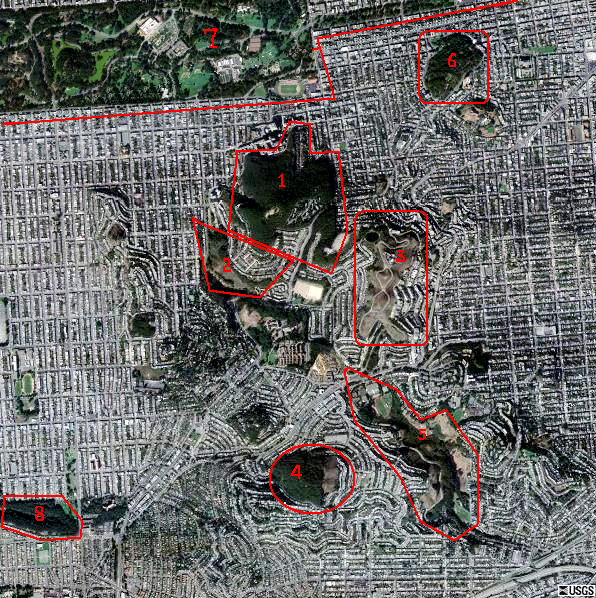
This is a rough map (based on a 2005 USGS picture) of some of the major habitat areas of this part of the city.

1. Sutro Cloud Forest – a relatively dense eucalyptus forest, with a well-developed understory and year-round damp conditions. (Free of pesticides since 2008.)

2. Laguna Honda lake – Mature chaparral and shrubs, fairly dry, sloping down to a year-round lake with little human access. (Pesticide status unknown.)

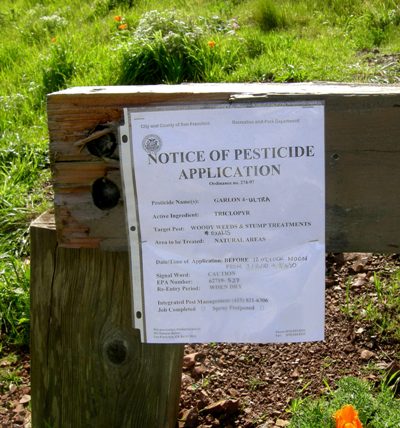
3. Twin Peaks – native and non-natives grasses, forbs, and shrubs. (Garlon, Roundup used. ETA Aug 2011 — also Imazapyr.)

4. Mt Davidson – eucalyptus woods, open shrubland. (Edited to Add: Garlon used.)

5.  Glen Canyon – open shrubland and grassland, wooded creek, sparse eucalyptus. (Pesticide status unknown. ETA: Roundup, Garlon and Imazapyr used.)

6.  Buena Vista Park – grass, shrubs, open stands of trees. (Pesticide status unknown.)

7. Golden Gate Park – multiple habitats including open grassland, lakes and ponds, stands of trees, shrubbery. (Herbicides used.)

8. Stern Grove – open eucalyptus and redwood groves, meadows, water. (Imazapyr in use, maybe others.)

This list does not include the beach, Lake Merced, the open woods and grassland on the grounds of the Laguna Honda Hospital. It excludes all the backyard habitats (mostly lawn, shrubs and flowers, with varying levels of pesticide use) and street trees.

But none of them are old-growth cloud forests like Mt Sutro Forest.

Some creatures – like migrating birds and butterflies – can access all these areas (which fall into the radius of a few square miles) and choose territories or terrain that suits their needs. Others – including some reptiles and flightless insects – may live and breed in a restricted but suitable place. Sutro Cloud Forest adds to the biodiversity of the area, providing dense forest cover for the creatures that need such forests and damp conditions. It’s worth preserving the integrity of its ecosystem.

Posted in Environment, eucalyptus, Herbicides, Maps, Mt Sutro Cloud Forest, UCSF | Tagged , , , , | 13 Comments

San Francisco – an Urban Forest Map

It’s ambitious: a database listing every tree in San Francisco.

There’s a new wiki in town: An Urban Forest Map that relies on crowd-sourced information, rather like Wikipedia. The project is live now (in beta), and anyone can play.

The software will allow all the different organizations that track San Francisco’s trees to share information. According to an article on KQED’s website, developer Amber Blieg says 17 different entities in the city manage and track trees, but had no easy way to share information.

The software will also allow citizen scientists to add trees to the database. There’s even a software to help identify tree species: The Urban Tree Key.

CAL FIRE funded the project, and Blieg developed it in co-operation with Friends of the Urban Forest, and the City of San Francisco.

If they can pull this off, it will yield information about tree species, sizes, and allow users of the database to derive information about tree-cover, risk from pest infestations, and climate change effects. Trees help cities by mitigating urban heat islands, reducing and purifying storm water run-off, as well as providing habitat for birds, animals, and insects. And making the urban landscape lovelier and raising property values.

There are good reports on the project on the KQED website, (“An Earth Day Natural: San Francisco’s Tree Census ); in the Science section of the major online magazine, Wired, (“The Plan to Map Every Tree in San Francisco“); and on the Environment News Service (Earth Day 2010 San Francisco: Mapping the Trees).

The San Francisco Chronicle, which apparently dislikes the mayor as well as trees, distinguished itself with a rather silly report that managed to give the impression that it was a City project with citizens being dragged in to substitute for government employees. It starts with, “No, it’s not your imagination. Everyone has gone a little census crazy these days… Yup. San Francisco Mayor Gavin Newsom announced today the city had launched a tree census…

Wonder if the Chron has heard of Wikipedia or Yelp… or has any idea about crowd-sourcing information.

Posted in Environment | Tagged , , | Comments Off on San Francisco – an Urban Forest Map

Dialogue with Sutro Biker

This conversation with Sutro Biker started in the Comments. We felt it was interesting enough to have it in a separate post instead of buried at the bottom of a page.

************************************************************************

Sutro Biker (SB): I still can’t believe all the misinformation on this website. The fact is, this city cannot manage the the trees it has. San Francisco cannot allow endless seeding in of a truly unsustainable species – eucalyptus. Yet another just fell over the path the other day at Stern Grove.

“Save” Mt. Sutro needs to start finding some common ground with folks by putting forward a plan to prioritize management of the many hazardous eucalyptus trees existing right over trails and next to houses. Period. To defend anything beyond starting with a basic safety standpoint, stopping funding sources to manage the trees, puts this website in the careless category.

Webmaster (WM): Sutro Biker, we try to avoid misinformation on this site… if you have specifics, point them out and we can discuss them. If we’re wrong, we’ll correct it.

You say eucs are unsustainable, but the only evidence you offer is that a tree fell over in Stern Grove. Trees do fall occasionally, euc or not. Stern Grove has particular tree-management issues.

We would like to point out that we have no problem with the removal of hazardous trees.
(We wouldn’t be “stopping funding” for that, even if we had that power.  And as UCSF points out, it’s something they consider their responsibility.)

SB:  Furthermore: the biodiversity standpoints for eucalyptus are so bird-centric. I’ll bet you folks have no idea about how great the biodiversity for the total system WAS before Sutro hatched his tree-stand-tax incentive plan!
WE HAVE NEVER BEEN HERE BEFORE IN HISTORY WITH THE LIFE-CYCLE OF EUCALYPTUS TREES – and now it has come home to roost; a forest we can’t manage for basic safety DIRECTLY because of the mis-info. and efforts of folks behind this extreme, do-nothing website! Bummer for San Francisco and Mt. Sutro users! Good luck neighbors!!!

WM:  Sutro Biker,  on bio-diversity – you have a point. We talk mostly about birds because we have that information – people watch birds. A 2001 report mentions 93 plant species. No one seems to have studied the insects, reptiles, or mammals using the forest, or the fungi on the trees and in the soil.   That’s why our recommendation to UCSF is to commission a study of the full eco-system before messing with it.

And as for pre-eucs biodiversity – perhaps Twin Peaks would be an example? It’s never been euc-covered as far as we know. Maybe Sutro Forest would have been the same – non-native grasses, oxalis, mustard, replanted native flowers, and regular Garlon spraying.

(Unless it was covered with buildings instead.)

SB:  Your view of Twin Peaks is clearly incomplete and skewed. Replanted natives only? And besides the usual manually managed aggressive introduced plants?

WM:  Well, what we’ve seen seemed predominantly grasses, mostly non-native, but with some recently-planted native bunchgrass on the hill above Midtown Terrace. A number of replanted natives, including poppy, lupin, Douglas Iris, checkerbloom. Flowering non-natives, including oxalis, mustard, sweet alyssum, dandelion, and calendula. Butterflies, including migrating red admirals, and anise swallowtails that breed on non-native fennel. Pocket gophers (native). If it’s incomplete, what would you add?

(We won’t talk about graffiti, rockslides, or trash.)

SB:  I researched how biocides are applied there, and as much I detest the chemical companies and becoming fully dependent on them, at least to the Parks Dept’s. credit, biocides are not broken out as a first line “defense“. Furthermore, I learned that the Dept. is careful in how they are applied, using primarily spot application.

WM: How do they manage spot applications? They’re using Garlon against oxalis, which covers the whole area in spring, intermingled with all the other plants. And the signs went up almost as soon as the oxalis came out – from end-Feb to end-March.

We  hope they are careful. Garlon’s not acutely poisonous, so you don’t get ill right away. But it’s insidious: its caused horrid birth defects in rats, and can poison kidneys, liver and blood. There are few long-term studies of chronic exposure. Garlon is inherently problematic, and there just isn’t enough information about its effects to feel safe. Also, it can be found for upto 2 years in dead vegetation, and has been found in waterways, too.

It’s cheap and easy and legal and lethal. But really, when the idea is to improve the environment, the tradeoff just doesn’t seem worth it.

SB: Studies have been done on eucalyptus under-stories and the general consensus is that they are more limited in species and species richness  in comparison to mixed forests.

WM:   We looked into it a bit. Here’s one report on eucalyptus forests – and it starts out by saying, “The wildlife in a Eucalyptus forest varies depending upon the geographic location of the grove.” It also says,  “Contrary to popular belief, many animals, both vertebrates and invertebrates, have adapted to life in the Eucalyptus groves. Moisture from the air condenses on the leaves and the drippage keeps the groves moist and cool even during the dry season. This is a suitable ground habitat for a wide variety of animal life.”

Also, are “mixed forests” the right comparison?

Many of California’s forests are dominated by one or two species: The redwood forest in Muir Woods; the oak-bay forests on some hillsides. No one wants to revise their vegetation.

Or should the comparison be with Twin Peaks?

SB:  Evident is the at least 75% Algerian ivy (euc. strangler) and Himalayan Black berry —

WM:  Not sure how you get the estimate of 75% Algerian ivy and Himalayan blackberry – and 75% of what? There’s actually quite a lot of diversity if you look carefully. If the eucs were going to be strangled, they would be gone by now. The ivy’s had a hundred years to take them out.

SB:   —  chronic homeless persons habitat —

WM: We’ve heard one homeless person has made a long-term camp somewhere around the Interior Green Belt, not UCSF land.

SB:  — and general trail maintenance and user nightmare.

WM:  It’s a forest, of course it has trees, shrubs, and undergrowth. The thorns and the lush growth make this safe animal and bird habitat. Those who find this annoying do have the choice of Twin Peaks, Tank Hill, or Golden Gate Park. It’s unclear why people who dislike the trees would want to walk or work in the forest. Or why anyone would want to reduce biodiversity in the area by removing a Cloud Forest ecosystem to substitute another similar to Tank Hill or Twin Peaks.

SB: Again, the safety issue for families as well is of paramount importance.

WM:  Quite so.

SB:  As a naturalist, I can tell you a study will be a waste of money and simply stalling positive processes allowing people to do the necessary work there doing fire mitigation, restoration etc. – relationships to the mountain diversifying it’s safety and future. I hope somehow through this process you realize that many positive things are happening on Sutro.

WM:  Surely, if you’re a naturalist, you understand the need to study of the existing ecosystem before changing it? Wouldn’t that be the scientific approach?

The fire risk is minimal because of the micro-climate. “Restoration” – by which I presume you mean felling trees and removing understory to replant with “native plants” can be destructive of this ecosystem, which we would not consider positive at all.

SB:  We humans have made blanket changes to the ecosystem there: “Sutro’s Plantation/Forest”;

WM:  Certainly we have, and it wasn’t just with the forest. There was a Rancho there before, and then a dairy farm with cattle (and thus, non-native grasses) in Cole Valley. There have been blanket changes all through San Francisco. Golden Gate Park is one example, and the city itself, another.

SB:  — and we will continue as a culture to diversify the forest with other species with far less harsh a hand than Sutro’s with a plantation forest. Realize that it will be okay and that is it a great idea to diversify the eucs.

WM:  Harsh a hand? We’d consider felling thousands of trees far harsher than planting them. Thanks, but no thanks. This “diversification” could destroy the integrity of a 120-year-old ecosystem.

SB:  Your fog will move over!

WM:  Yay! Do I get to be Fog Master, too?

SB:  Quit stalling this process and enable folks that want to be there, working there on the trails in nature, be there to enjoy it safely NOW!

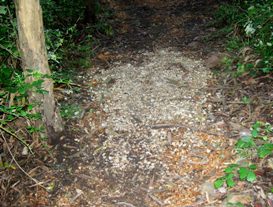
Rock mulch on trail

WM: We could as fairly say, if you dislike the eucs, why be there at all? Twin Peaks, as you point out, could use some help.  We’re not objecting to trail-work or to the bikers – though Nature in the City apparently is.

Someone told us that  Josiah Clark (of Nature In the City) publicly declared that though bicycles are ‘green’ on the road, they have no place on Mount Sutro’s trails. We found this a bit odd, because we’re aware that bikers work to maintain them. We also think they do so sensitively – like mulching soggy areas of the trail with rocks, which gives a dry surface while allowing the moisture to remain beneath for plants and animals.

Moon and contrail over Sutro Forest

We think the Stewards, the Urban Riders, and the public could all share this place with safety and courtesy, and without damaging the beauty of the forest or the integrity of the eco-system.

This plan would give UCSF lower ongoing maintenance costs than if the forest were converted to a native plant garden, and avoid thousands of doses of toxic herbicides.

Is that a lot to strive for?

Posted in Environment, eucalyptus, Herbicides, Herbicides: Roundup, Garlon, Mt Sutro Cloud Forest, nativism, Sutro Forest "Fire Risk", UCSF | Tagged , , , , , , | 7 Comments

Garlon in Our Watershed

Garlon is one of the two pesticides that UCSF proposed to use to prevent re-sprouting of felled eucalyptus, blackberry and vines. It is regularly used on Twin Peaks, one of the highest points in the city.

We should mention that on Mount Sutro, UCSF is currently using  no herbicides at all. Neither is the Marin Municipal Water District, and it’s easy to understand why. Someone sent me the chapter on Garlon from the Marin Municipal Water District (MMWD) draft Vegetation Management Plan. (You can read that here:Chap4_Triclopyr_8_27_08 ) It was a pretty thorough multi-source review of what was known about the chemical, and it clarified the risks: birth defects; kidney damage; liver damage; damage to the blood.

[Edited to add: Garlon is also used by the East Bay Regional Parks District.]

Garlon, the herbicide called triclopyr, kills broad-leaved plants (not grasses or conifers) by sending them a hormonal signal to grow uncontrollably. This weakens the plant until it dies. Its breakdown products are triclopyr acid and then ‘TCP’ – both of which are, fortunately, somewhat less toxic than Garlon. (Imazapyr,  by contrast, breaks down into a neurotoxin.)

THE DANGERS OF GARLON

Garlon 4

What stood out, though, was how much is not known, particularly about the effects of repeated low-level exposure. There simply isn’t that much research out there, and few human studies. “Although triclopyr has been registered in the US since 1979, there are still very few studies on triclopyr that are not part of the EPA registration process.” Most of the research that exists is on Garlon 4. What is used on Twin Peaks is Garlon 4 Ultra. It’s similar but isn’t mixed in kerosine. It’s mixed in a less flammable but apparently equally toxic methylated seed oil.

What is known makes uncomfortable reading.

  • Garlon “causes severe birth defects in rats at relatively low levels of exposure.” The rats were born with brains outside their skulls, or without eyelids. “Maternal toxicity was high” and exposed rats also had more failed pregnancies.
  • Rat and dog studies showed damage to the kidneys, the liver, and the blood. It’s insidious, because there’s no immediate effect that’s apparent. If someone’s being poisoned, they wouldn’t even know it. In a study on six Shetland ponies, high doses killed two ponies in a week, and two others were destroyed.
  • About 1-2% of Garlon falling on human skin is absorbed within a day. For rodents, its absorbed twelve times as fast. Too bad for the gophers…
  • It isn’t considered a carcinogen under today’s more lenient guidelines, but would have been one under the stricter 1986 guidelines.
  • Dogs may be particularly vulnerable; their kidneys may not be able to handle Garlon as well as rats or humans. “The pharmacokinetics of triclopyr is very different in the dog, which is unique in its limited capacity to clear weak acids from the blood and excrete them in the urine.” Dow Chemical objected when EPA said that decreased red-dye excretion was an adverse effect, so now it’s just listed as an “effect.”
  • There was insufficient information about Garlon’s potential effect on the immune system, or as an endocrine disruptor.
  • It very probably alters soil biology. “There is little information on the toxicity of triclopyr to terrestrial microorganisms. Garlon 4 can inhibit growth in the mycorrhizal fungi…” (These are  funguses in the soil that help plant nutrition.) No one knows what it does to soil microbes, because it hasn’t been studied.
  • It’s particularly dangerous to aquatic creatures: fish (particularly salmon); invertebrates; and aquatic plants.
  • It doesn’t [ETA: generally] kill adult honeybees, but there are no studies of other insects. [ETA: Some studies show slight “acute toxicity” to honeybees.]
  • Garlon can persist in dead vegetation for up to two years.

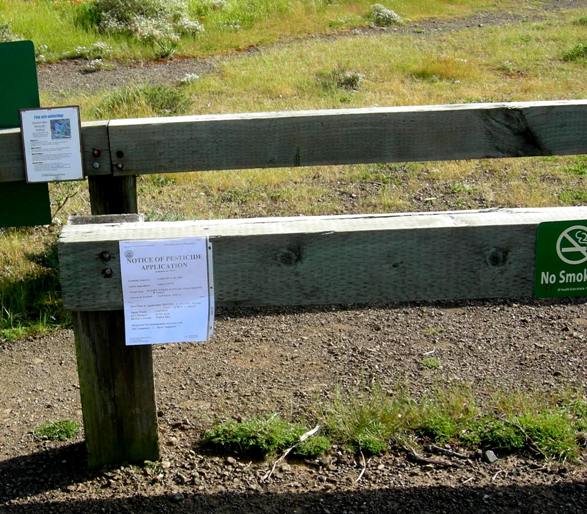
Given all the information we do have on this chemical (and all the information we don’t have ) we have to question why native plant restoration is worth spraying poisons on some of the highest points in our city. Garlon must be used when the weather is wet; if the plants don’t have water, they will not grow and the chemical won’t work. But the runoff from these hills is enormous during the rain – it washes down in rivulets and streams, and it will end in the reservoirs, the groundwater, and the bay. Garlon notices were up on Twin Peaks for most of March 2010.

FUTILE POISON?

We also question whether it even achieves the the nativists’ objective. On Twin Peaks, it’s targeted at oxalis, but Garlon is not a precision instrument. It will kill all broadleafed plants, native or otherwise, and favor grasses. Over time, Garlon use will convert Twin Peaks to non-native grasses (because those grow faster than native ones).

Slightly ironic

We can only speculate what it does to resident insect populations, because there’s no data. No ant studies. No caterpillar studies. No Mission Blue Butterfly studies, despite its use in a Mission Blue Butterfly area. The only studies show that adult honeybees aren’t being immediately killed. Long-term hive studies? None of those, either.

Meanwhile, the soil chemistry is probably being altered, and a regular dose of toxins added to our watershed in our “Native areas.” We have no idea whether there’s a particular risk to dogs being walked in Garlon-sprayed areas, or to pregnant women there or in the homes below the Garlon-sprayed hills. Based on the current levels of research and information, we’d guess that San Francisco’s Recs and Parks has no idea either.

Posted in Environment, eucalyptus, Herbicides, Herbicides: Roundup, Garlon, nativism | Tagged , , , , , | 22 Comments

Another Eucalyptus Myth: Bird Death (via Audubon)

One of the saddest myths about eucalyptus is that it causes the death of small birds by “beak-gumming.”
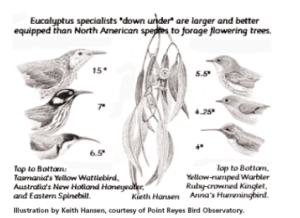
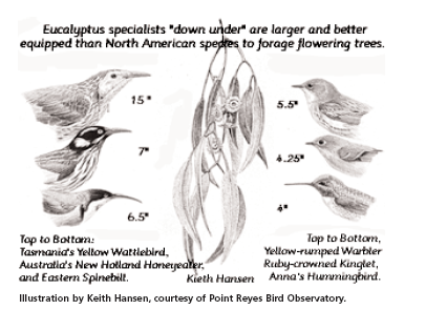
MISLEADING ILLUSTRATION

According to this myth, small birds like kinglets foraging in eucalyptus flowers accumulate gummy residues that suffocate them. It’s all because Californian birds have short beaks compared to the longer beaks of Australian birds that co-evolved with eucalyptus. It is usually  illustrated by the picture here (taken from an NPS brochure).

It’s a myth.

A new article (reprinted here with permission) by Lynn Hovland in the Hills Conservation Network newsletter describes where this myth originated, and how eucalyptus-phobes  seized on it, passing it into “the conventional wisdom” as one birder phrased it.  And it explains why it gets its facts wrong. In summary:

  • The theory (and picture) conveniently ignores a host of small-beaked Australian birds that forage in eucalyptus.
  • The source of the gum is undetermined; the eucalyptus flower is not especially deep.
  • Other birders have not found numerous dead birds under eucalyptus.

Read the whole article below.

————————-

BIRDS AND BLUE GUM: LOVE OR DEATH?

Brochures distributed by various agencies in northern California state that the flowers of eucalyptus trees kill birds. According to these brochures, birds feeding on insects or on the nectar of eucalyptus flowers may have their faces covered with “gum” and die of suffocation. Luckily for the birds, according to one brochure, most of them prefer native vegetation, and avoid eucalyptus groves.

These stories are, of course, extremely upsetting to all of us who love birds.

The bird-suffocation story began with a 1996 article by Rich Stallcup, a legendary birder who writes for the Pt. Reyes Bird Observatory. In the PRBO Observer, he reported that, on one day in late December, he counted, in one eucalyptus tree:  20 Anna’s Hummingbirds, 20 Audubon Warblers, 3 Orange-crowned Warblers, 10 Ruby-crowned Kinglets, a few starlings, 2 kinds of orioles, a Palm Warbler, a Nashville Warbler, a warbling Vireo, and a summer Tanager.

That was an unusually large number of birds, even for Stallcup to see in one tree, but what most surprised him, he says, is what he found under that blue gum eucalyptus tree: a dead Ruby-crowned Kinglet, its face “matted flat from black, tar-like pitch.”

Years before, Stallcup recalled in the article, he had found “a dead hummingbird with black tar covering its bill” under eucalyptus trees. This was all Stallcup needed to come up with his theory about what had happened.

This theory is now stated as fact in restorationist literature and it is stated three times as fact in the Plan/EIR issued by the East Bay Regional Park District in August 2009.
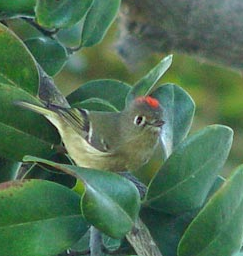
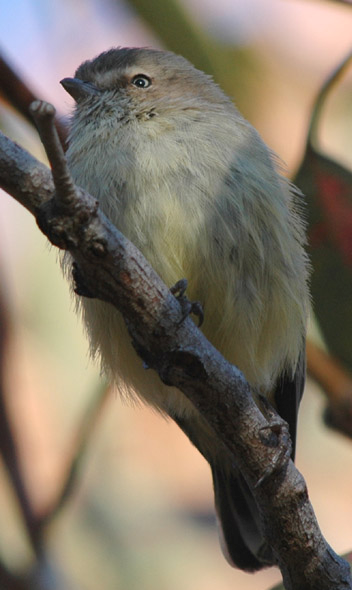
Ruby-crowned Kinglet, San Francisco. Credit: Will Elder, NPS.gov

Stallcup theorizes that North American birds are different from birds indigenous to Australia. He speculates that North American birds such as kinglets, warblers, and hummingbirds have evolved short, straight bills while Australian birds evolved long, curved bills. Thus, he says, when American birds with short bills seek nectar or insects on eucalyptus flowers, they have to insert their whole head into the blossom, so they get gummy black tar all over their faces.

We have great respect for Stallcup’s ability to identify birds.  But we have a few problems with his theory.

Australian Weebill. Credit: Stuart Harris

1. A bird-loving friend who has photographed birds in Australia points out that Australian field guides show birds with a wide variety of bill length and curvature.  When he was in Australia, he saw birds with small bills just like American kinglets and warblers.  “How do you suppose the Australian Weebill got its name?” our friend asked.  Many of us not so familiar with Australian birds have seen parakeets and other small small-billed parrots native to Australia. Weebills  and many other American and Australian birds with small bills forage on eucalyptus leaves or flowers.

To see more birds of Australia, go to this terrific website. It features photos of many small-billed birds.
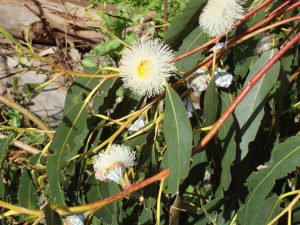
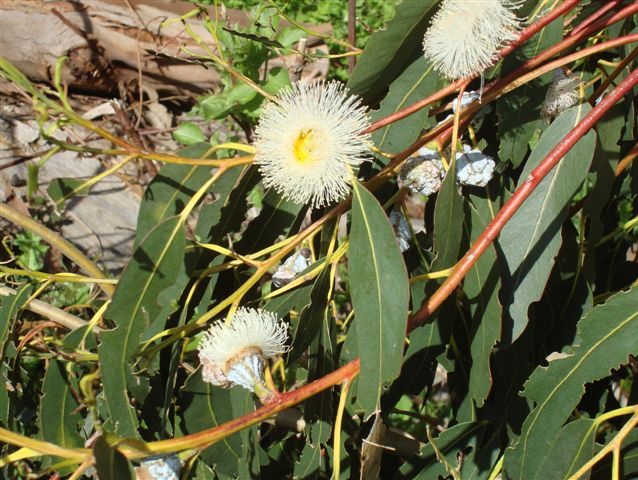
Blue gum eucalyptus flowers on tree, March, 2010. Credit: John Hovland,

2. Where’s the gum? The flower of a blue gum eucalyptus tree has no gum, glue, or tarlike substance on it or in it. The gum in “gum trees” refers to the sap or resin that, in some species, comes from the trunk. Other species of gum trees, such as the sweet gum (Liquidambar) are common sidewalk trees in Berkeley and Oakland. The flowers on the blue gum eucalyptus are white or cream-colored with light yellow or light green centers. There is no black, sticky, gummy or tarry substance in or on the living flower. In fact, both the Ruby-crowned Kinglet and the Australian Weebill are leaf-gleaners. They take insects off leaf surfaces, not from flowers. If the kinglet had gum on its face, the gum did not come from a eucalyptus blossom.

3. A euc flower looks most like a chrysanthemum, with longer petals. Unlike a morning glory, the euc flower is not shaped like a tube that a bird would need to poke its bill into to get nectar or insects. A hummingbird is more likely to pick up a sticky substance from inside a cup-shaped tulip, poppy, or any of the tiny tube-flowers such as California fuchsia, Indian paintbrush, watsonia, or honeysuckle that hummingbirds love. Common sense tells us that no bird, even a tiny one, could suffocate while feeding on a euc flower or leaf.

Photo of Watsonia, Willow Walk, Berkeley, 2010. Credit: John Hovland.

4. We have all seen hummingbirds poking their beaks into tube-like flowers. If you peel back these tube-like flowers, you will sometimes find a sticky substance on your finger.  You’ve probably seen birds, especially tiny hummingbirds, sipping from these flowers. How do they escape getting nectar on their faces? An article in the NY Times proves truth is stranger than the fiction of suffocated hummingbirds. The article explains that a hummingbird gets nectar from a flower by wrapping its tongue into a cylinder to create a straw about ¾ inch long extending from its bill. This means that a hummingbird’s face does not touch the surface of a flat type of flower such as the flower of a blue gum eucalyptus.

After Stallcup wrote his article in 1997, it was accepted by birders and eucaphobes all across America. In January, 2002, Ted Williams, wrote about the “dark side” of eucalyptus in his opinion column called “Incite” for Audubon Magazine.

Stallcup, he wrote, had told him he had found 300 dead birds over the years “with eucalyptus glue all over their faces.” Williams wrote that the bird artist, Keith Hansen, who illustrates Stallcup’s articles, had found “about 200 victims.”(How did one kinglet and one hummingbird in 1997 add up to 500 victims by 2002 even though few if any other people have seen even a single victim?)  Williams and Hansen also describe the suffocating material as “gum.”

Williams, in that same over-the-top column, dares to contradict Stallcup, claiming that he has heard only one Ruby-crowned Kinglet in a eucalyptus grove, and has never actually seen any birds in eucalyptus trees. Yet he repeats (and exaggerates) Stallcup’s story about eucalyptus suffocating birds. The National Park Service, U.C.,  EBRPD, and the Audubon Society   have spread Williams’ interpretation of Stallcup’s story—apparently without questioning any part of it.

Stallcup and Williams are bird-lovers and writers. They are not scientists. David Suddjian, a wildlife biologist, has read Stallcup’s theory about birds suffocating on the “black pitch” of eucalyptus flowers, but in his article, “Birds and Eucalyptus on the Central California Coast: A Love-Hate Relationship,” he casts doubt on Stallcup’s claim that the kinglet (and other birds) could have been suffocated by eucalyptus flowers. Here is an excerpt from his article:

“. . . in my experience and the experience of a number of other long-term field ornithologists, we have seen very little evidence of such mortality.  It has been argued that the bird carcasses do not last long on the ground before they are scavenged. However, when observers spend hundreds of hours under these trees over many years but find hardly any evidence of such  mortality, then it seems fair to question whether the incidence of mortality is as high as has been suggested. Not all bird carcasses are scavenged rapidly, and large amounts of time under the trees should produce observations of dead birds, if such mortality were a frequent event. . .more evidence is needed.”

The Suddjian article is not generally favorable to eucalyptus trees. However, Suddjian notes that more than 90 species of birds in the Monterey Bay Region use eucalyptus on a regular basis. Additionally some rare migratory birds bring the total to 120 birds seen in euc groves. These include birds that use eucalyptus trees, leaves, seeds, or flowers for breeding, nesting, foraging, and roosting. A complete list of birds that depend on eucalyptus trees is too long to include here. We encourage you to click on the link to the Suddjian article so you can look for the names of the various bird species and note how they use—and depend on—eucalyptus trees.

The following excerpt is from the section “Wildlife” in BugwoodWiki, an article on eucalyptus globulus (blue gum) by the Nature Conservancy. It is from a field report “Eucalyptus Control and Management” (1983), compiled by the Jepson Prairie Preserve Committee for The Nature Conservancy’s California Field Office:

“Over 100 species of birds use the trees either briefly or as a permanent habitat. The heavy-use birds feed on seeds by pecking the mature pods on trees or fallen pods; so they must wait for the pods to disintegrate or be crushed by cars. Among the birds that feed on seeds in the trees are: the Chestnutback Chickadee and the Oregon Junco.

“Examples of birds that feed on ground seeds are the Song Sparrow, the Fox Sparrow, the Brown Towhee, and the Mourning Dove.

“Birds that take advantage of the nectar from blossoms either by drinking the nectar or by feeding on the insects that are attracted to the nectar include Allen’s hummingbird, Bullock’s Oriole, Redwinged Blackbird, and Blackheaded Grosbeak.

“Birds that use the trees as nest sites include the Brown Creeper, which makes its nest under peeling shags of bark and feeds on trunk insects and spiders, the Robin, the Chickadee, the Downy Woodpecker, and the Red Shafted Flicker. The Downy Woodpecker and the Red Shafted Flicker peck into the trunk of dead or dying trees to form their nests. When these nests are abandoned, chickadees, Bewick Wrens, house wrens and starlings move in. Downy Woodpeckers use dead stubs to hammer out a rhythmic pattern to declare their territories.

“The Red-tailed Hawk prefers tall trees for a nesting site. It therefore favors eucalypts over trees such as oak or bay. Great Horned Owls use nests that have been abandoned by Red-tail Hawks or they nest on platforms formed between branches from fallen bark. The Brown Towhee and the Golden-crowned Sparrow are birds that use piles of debris on the ground for shelter during rains.”

Notice that this article, written for the Nature Conservancy after weeks of observing birds in eucalyptus groves, does not mention finding any suffocated birds under the trees.

When we asked Chris Davey, president of Australia’s Canberra Ornithological Group, if there could be any truth to the story that eucs suffocate birds, he replied,  “It’s a wonderful thing these urban legends!

So how did those dead birds end up under eucalyptus trees?

A friend suggests (only half-seriously) that a few birds (including the two that Stallcup says he found) got some kind of sticky goop on their faces from another source. He theorizes that when the birds realized they were dying, they returned to the eucalyptus trees, and, chose to die under them because they had loved the eucalyptus trees so much.

—Lynn Hovland

——————————–

A few further thoughts to this article:

  • No analysis of the material that apparently suffocated the birds has been published. Apparently, it was just assumed to be eucalyptus resin.
  • No necropsy results indicating that the birds indeed died of suffocation was published either. The “gum” on the face could have been incidental to death from other causes.
  • What about the benefits the tree provides? It helps  a large number of birds to survive by providing cover and a winter food source (insects and nectar). It’s been suggested that if the eucalypts were felled, the birds would migrate south. In fact, the habitat to the south is not exactly unspoiled. Cutting down eucs would reduce net habitat, and thus, bird populations.

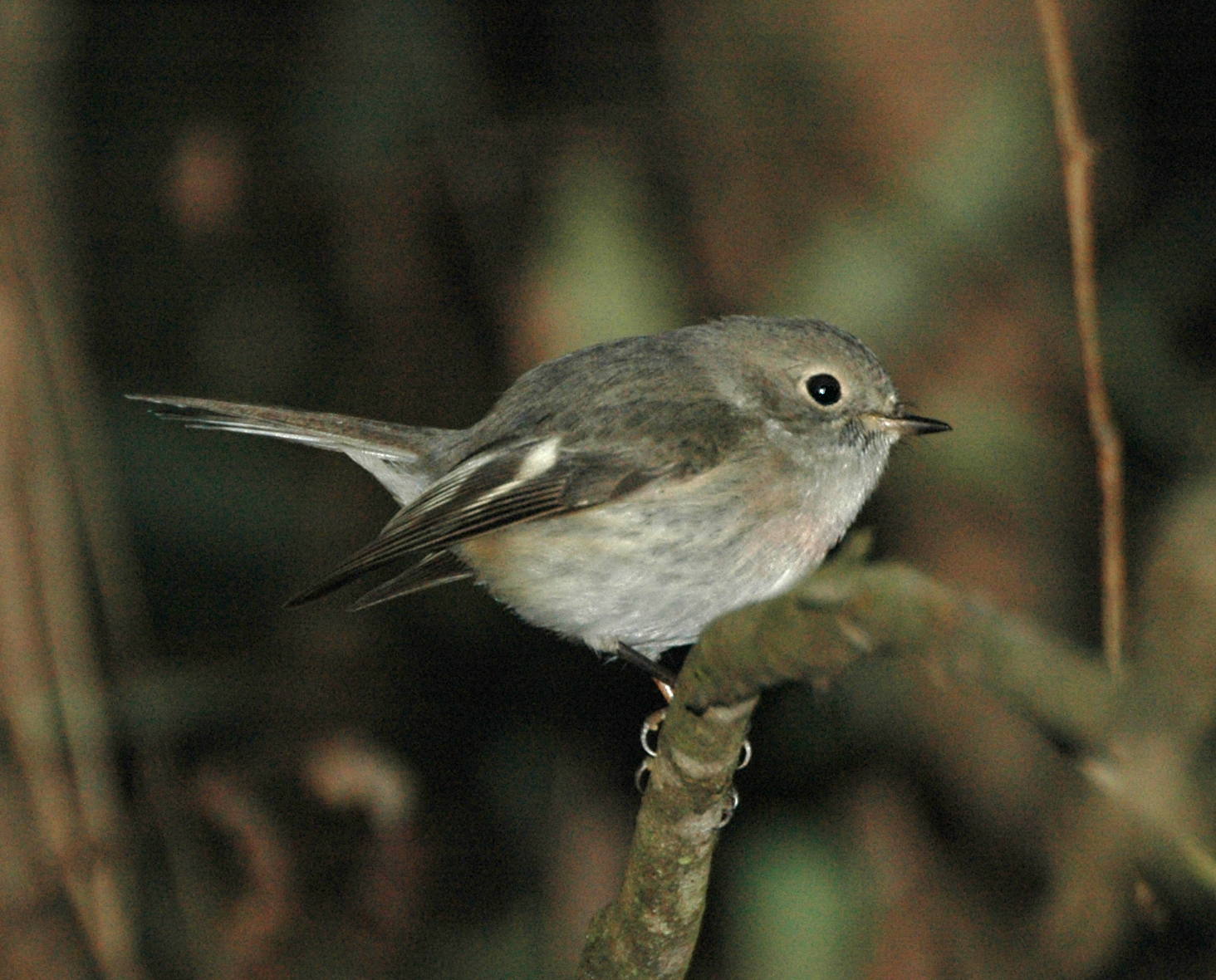
Finally: Here are two more short-beaked birds from Australia.
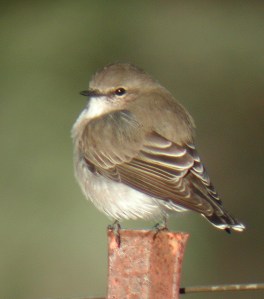
Jacky Winter, Australian bird. Photo credit "Aviceda" (Creative Commons)
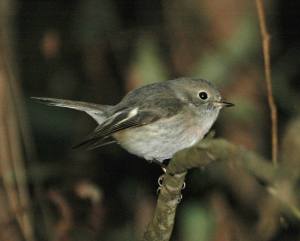
Australia's Rose robin, photo credit "Aviceda" (Creative Commons)

Posted in Environment, eucalyptus | Tagged , , , , , , , , | 28 Comments

Flowers in the Forest

Usually, we’re up in the forest for the trees, and those are certainly lovely.

But it’s spring in the forest, and it has flowers, too. We even saw a cineraria. The native garden is finally all green. The pink-flowered currant is over, but a scattering of golden california poppies punctuate the green of the grass; there’s some pink checkerbloom (also called wild hollyhock); some lupin is flowering, and so is the ceanothus. And little patches of luminous yellow oxalis.

A sunny day, and so there were butterflies. Anise Swallowtails air-dancing, and this time it may have been a mating dance rather than a territorial one, though we couldn’t be sure. A female cabbage white (Thanks, Art Shapiro of UC Davis for the identification) browsed the oxalis. There were some red butterflies, too, but they didn’t settle long enough for an identification – could have been Tortoiseshells.


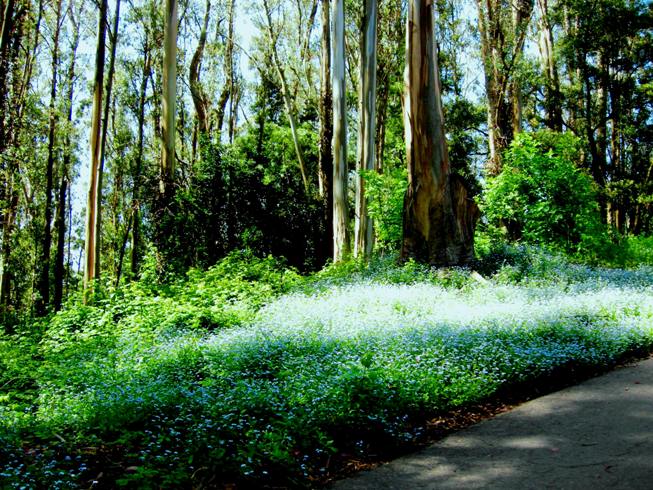
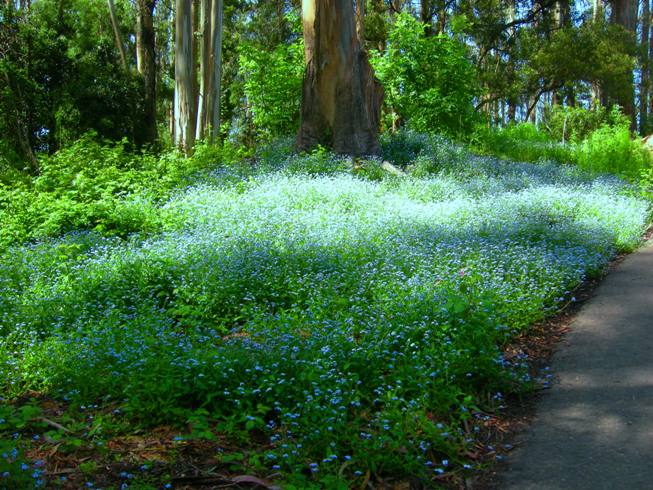
Little patches of forget-me-nots are blooming along the trails, but the loveliest beds of them lined the top end of Nike Road (which connects the Aldea campus to the Native Garden). Light-blue drifts of flowers, blooming right under the eucalyptus (where, the myth has it, nothing grows).

Oh, and no Garlon or Roundup. (Thanks, UCSF.)

Posted in Mt Sutro Cloud Forest | Tagged , | 1 Comment

A New Plan for the Forest

Back in 2001, UCSF published a Plan for Sutro Forest, based on data that had been collected in previous years (including a 1999 report on the forest). One of the objections neighbors had to the so-called “FEMA Plan” – i.e. the actions proposed in the application to FEMA – was that it clashed with the 2001 plan. Now that UCSF has withdrawn its application to FEMA, it is planning its next steps for the forest.

————-

UCSF’s email announcement that it is withdrawing the application to FEMA – and with it, the immediate plan to gut 14 acres of forest – was a sensible and rational move, in view of the questions the project raised.

While UCSF is considering next steps, we have some suggestions. The key one is that, instead of immediately investing the University’s funds in an environmental review, this is an opportunity to revisit the 2001 plan. We understand the process involved extensive public comment, and a survey of the forest. At the time, it was probably state of the art. However, now over ten years old, this plan is outdated.

Here’s why we suggest a new start:

  • AB 32, California’s Global Warming Solutions Act, was passed in 2006. Global warming, and the Carbon sequestration value of the forest, wasn’t considered in the 2001 Plan.
  • UCSF is just about to start putting together a new Long-Range Development Plan (LRDP), roughly 2012-2030. According to a presentation by UCSF at the February 25th Inner Sunset Park Neighbors meeting, one of the six key questions to be addressed is: How will the LRDP incorporate environmental sustainability and Climate Action Plan goals? We would suggest this provides a good context in which to re-evaluate the forest.
  • Though the forest was studied for the 2001 plan, the study was essentially limited to the plant species, the topography, and the weather. The complexity of its ecosystem deserves a more thorough investigation. The entire plan was informed by the questionable assumption that the forest needed active management because it was failing, senescent, and if not actually infested with a fatal pest, very close to being so. In fact, much of the windthrow was due to a single bad season; such storms will inevitably cause tree-failures even of healthy trees, and short of the destruction of all tree-cover, is not easily prevented.
  • Increasing evidence of the dangers of pesticides such as Roundup, Garlon, and Imazapyr is accumulating. This is particularly important on Mt Sutro since it is high ground and a watershed area, and surrounded by residential communities including the UCSF student housing. Yet the tree-felling attempts and native-plant restorations would require significant quantities of these chemicals to be used for years.
Sutro Forest trees

Sutro Forest trees

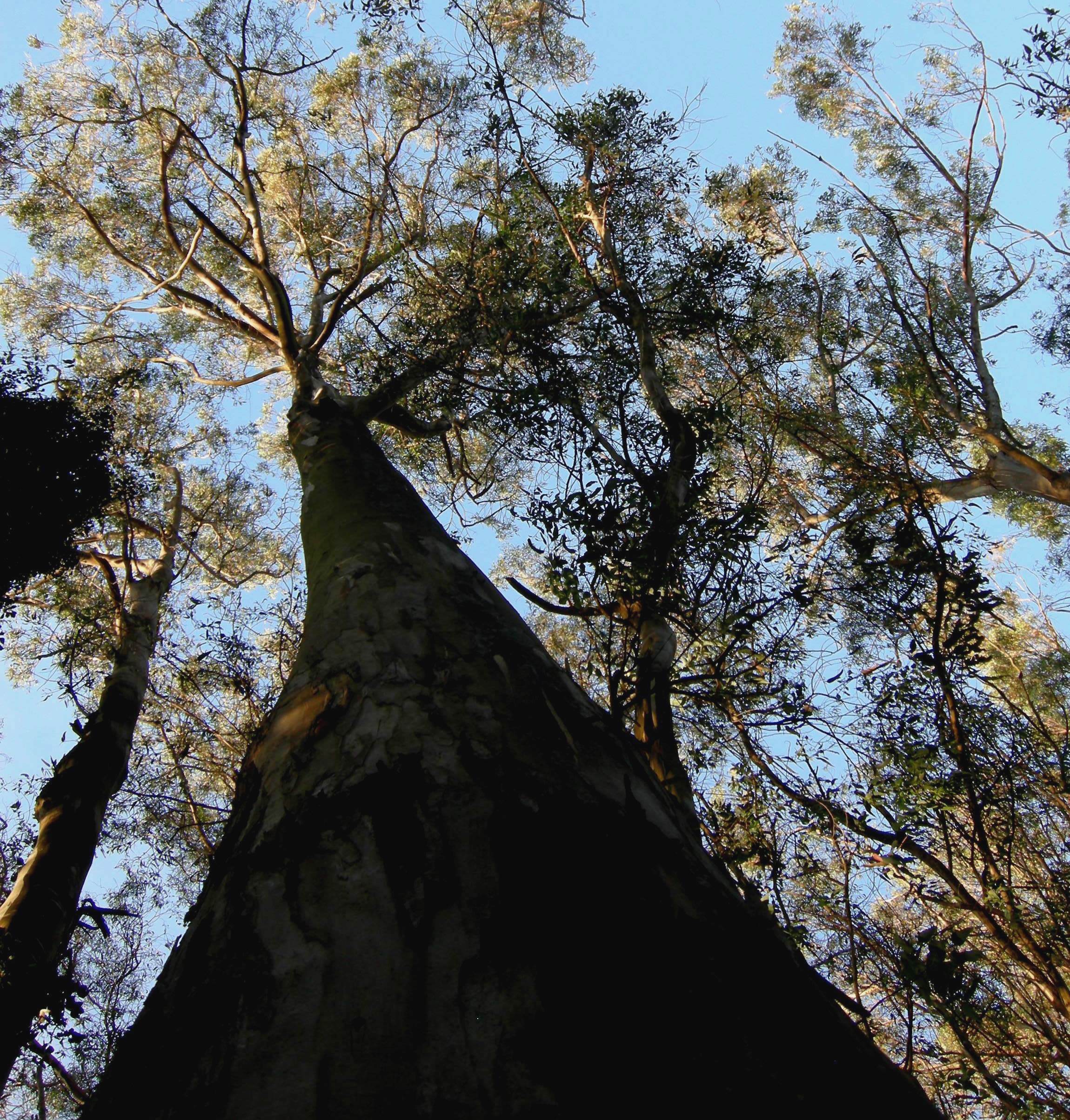
We would like to see UCSF reframe its view of the forest as a stable 125-year-old Cloud Forest with a potential 400-500 year life span and the characteristics of an old-growth forest. Not just “Open Space,” it is both a biological treasure and part of San Francisco’s Cultural Heritage – the remnant of a eucalyptus forest, one-fifteenth the size it once was. It is a miniature, San Francisco version Muir Woods. And though smaller than that iconic forest (and dominated by naturalized rather than by native trees) it is nevertheless home to a large number of bird and animal species.

We would urge a much more thorough study of this wonderful entity. In particular, we would like to see a study (a) all the bird species in the forest (b) all the animal species, including reptiles and insects (c) all the plant species – including fungi and mosses (d) a model for how its forest ecosystem works.

Posted in Uncategorized | 6 Comments

Sutro Cloud Forest’s Micro-climate

Sutro Cloud Forest is in the fog belt, and all summer long, its gets fog nearly every day. It’s never dry — and here’s why.

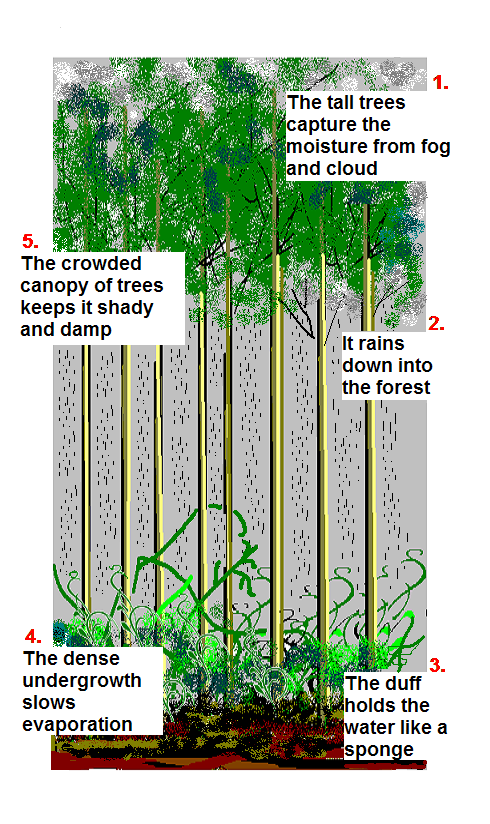
The trees grab the moisture from the fog and clouds (1 in the picture); it rains down onto the forest floor (2). There, it soaks into the duff — the  crumbly layer of dead and decaying leaves, twigs and other plant material accumulating on the ground beneath the trees (3). This material holds it like a sponge.

Above the duff, there’s a dense layer of understory plants that stop the water from evaporating – blackberry, ivy, ferns, poison oak, and 90 or so other plant species (4).  And above it all, there’s the tree canopy, which not only captures the moisture in the fog, but by shading  the forest floor, further helps to slow evaporation (5).

The result is that not only is the forest damp all the time, it also would take a long time to dry out – especially since the longest period it goes without rain or fog  is about 7-10 days in a year.

DON’T DRY OUT THE FOREST

The best fire-protection for a cloud forest is to make sure that it doesn’t actually dry out. Here’s what would help:

1. Disturbing the duff as little as possible, so it retains the ability to hold the water.

2. When building trails,  cut channels  across trails so water crosses and soaks into the duff on the other side to reduce run-off along the trail.

3. Preserving the undergrowth so it insulates the duff from evaporation.

4. Preserving the trees so they both capture moisture and provide the shade of the canopy.

Thinning the trees and the underbrush would break this mechanism. Tree canopies are not where fires start, it is the dry grass and underbrush. Thinning opens up the forest, increasing evaporation, and  making it  drier and more flammable. Especially around areas of trails, it’s important  to preserve the duff at the edges, the undergrowth, and the trees.

Posted in Environment, eucalyptus, Mt Sutro Cloud Forest, Sutro Forest "Fire Risk" | Tagged , , , | 17 Comments

A Forest Full of Birds

Sutro Cloud Forest is always alive with birdsong. We couldn’t identify the birds from their calls; we’re not that expert at birding. We were delighted, therefore, to hear from someone much more knowledgeable. Keith McAllister sent us a list of nearly thirty species from one day’s birding around the forest in late March 2010. (His list is given here, and illustrated below.)

That day, Twin Peaks had only four species visible: the Common Raven, the White-crowned Sparrow, the Song Sparrow and the Golden-crowned Sparrow (“maybe, or maybe immature White-crowned”).  Two of these, the raven and the song-sparrow were also found in the forest. Similarly, the open Native Garden at the summit of Mt Sutro had only three bird species – the two hummingbirds and the bushtit – all of which were also found in the forest.

It would appear that chaparral and brush don’t actually form a richer environment for birds than do eucalyptus forests with acacia, blackberry and ivy and 90 other plant species.

We’ve illustrated the list with pictures from the public domain (made by government employees or placed in public domain by the maker) or Wikipedia’s creative commons licensing (the photographer’s name is in brackets under each picture).

Edited to Add: Craig Newmark, who lives on the edge of Sutro forest, has kindly given us permission to use pictures he took at his birdfeeders. Photographs  from his bird list are labeled ‘CN’.

Clicking on any picture gives a larger version.

BIRDS SEEN and/or HEARD IN  SUTRO FOREST
(including Green Belt forest south of Clarendon)

Red tailed hawk (CN)

Red shouldered Hawk

Cooper's Hawk

*************************************************************************

Band-tailed_Pigeon (Peter Wallack)

Anna's hummingbird (CN)

Allen's Hummingbird

*************************************************************************

American robin (CN)

Northern flicker (CN)

Downy woodpecker (CN)

*************************************************************************

Hairy woodpecker M (Grantus)

pacific slope flycatcher (Goingslo)

Hutton's Vireo

*************************************************************************

Western scrub jay (CN)

Steller's jay (CN)

Chestnut backed chicadee (CN)

*************************************************************************

American crow (MDF)

Common raven

Pygmy Nuthatch (CN)

*************************************************************************

Winter Wren (USDA)

Ruby crowned Kinglet

Bushtit on blackberries

*************************************************************************

Hermit Thrush

Cedar Waxwing (CN)

Townsend's warbler (CN)

*************************************************************************

Wilson's warbler (CN)

Song sparrow (CN)

Darkeyed junco (CN)

*************************************************************************

Lesser goldfinch (CN)

Mr McAllister notes that the Cedar Waxwing  was in a pine tree at the forest/Twin Peaks boundary. There was also a Varied Thrush (or a Song Sparrow mimicking a Varied Thrush.)

We think that birding through the seasons might well yield more species that use the forest. Mr Newmark, who lives right next to the forest, has had 30 species visit his bird-feeders; about half do not overlap with the list above.

UPDATE: We’ve added more species in another post, for a total of 44 45 species.

Posted in eucalyptus, Mt Sutro Cloud Forest | Tagged , , , , | 18 Comments

Sutro Forest 2010-2011: UCSF Meeting update

UCSF’s meeting was intended to inform the neighbors about the reasons for the withdrawal of the FEMA application; reaffirm their commitment to a safe, healthy, beautiful and usable forest; and lay out next steps. Barbara French opened the meeting with why they withdrew the FEMA applications:

  • They were more aggressive than the adaptive management principle called for in the 2001 Plan for the forest;
  • FEMA indicated that the environmental review would take about 2 years, much longer than UCSF wanted.
  • Once an environmental review started, UCSF would need to maintain the status quo until completion.

NEXT STEPS

Instead, UCSF itself will do a full environmental review, as required by the California Environmental Quality Act . They hope to use UCSF funds that had been set aside as matching funds for the “FEMA project.”  This review (through its Campus Planning office) would cover all intended actions over the full 61-acre area of the forest to avoid “piece-mealing.” It would take about a year, and would be preceded by three community workshops.

With the conclusion of the environmental review, eucalyptus trees would be “thinned” on 2 acres as a demonstration. (The location and nature of the demonstration would be subject to community input.) As soon as that was done,  work would proceed on the South Ridge and Edgewood cut zones. The whole plan would take into consideration the rainy season as well as the bird nesting season. Tree-felling would start around September 2011. The graphic below lays out UCSF’s timeline for next steps:
There were some concerns as to how a Demonstration project in September 2011 could be followed in October by action on South Ridge and Edgewood, since the success or failure of the Demonstration would take years to show.

While the environmental review is under way, no new projects are allowed, though routine maintenance is okay. Several people wanted to know where the line was between maintenance (acceptable) and management (not).

Ray Moritz, forester, presented pictures and descriptions of other eucalyptus-thinning projects in Marin and in San Rafael.

MT SUTRO STEWARDS

A number of Mt Sutro Stewards spoke, including Jake Sigg who essentially made the points described in our earlier posts here and here. He didn’t want to call this a forest; he preferred to use the word “plantation.” [Clearly inaccurate, since a plantation is for cropping – unlike Sutro Cloud Forest.] He described the difficulty of talking to UCSF as “trying to fornicate through a mattress.”  (There was applause… )

Many Stewards expressed disappointment at UCSF’s delays on the 2001 plan, and their lack of financial contribution beyond pizza.  The only reason the Native Garden is not overgrown is because of their volunteer efforts. Someone wanted to know if they could get an accounting of forest-related expenditure from UCSF, but apparently the accounts are only captured by work order.

Mr Hoogasian of the Rotary Club advocated cutting down around 25 big trees to open up views from the Rotary-funded Native Garden. (We actually think it will ruin the forest’s feeling of seclusion and distance from the city.)

NEIGHBORS’ COMMENTS

  • Neighbors were against the use of toxic herbicides, currently part of the plan.
  • The fire risk is small because the actual “window” of dry weather is so small that the forest does not have time to dry out.
  • The experience of Scripps Ranch indicates that tree removal can create “bowling alleys” for sparks to fly straight through to structures; and also pointed out that talking up fire risk could adversely affect both insurance rates and home sale disclosures – even if in reality that risk was small.
  • Undergrowth removal will adversely impact the wildlife habitat in the forest. As a 125-year-old ecosystem that’s an island in the midst of asphalt and concrete, there will be nowhere for the animals to go. Mr Ralph Osterling, forester, responded by saying that animal populations fluctuate anyway.

TRAIL MARKERS

Separately, UCSF also spoke of the plan to place trail markers on the mountain to avoid people getting lost and also allow emergency responders to locate people in case of, say, medical emergencies.

HAZARDOUS TREE SURVEY

Three trees fell during recent storms, including one that fell on a car. A new survey of hazardous trees will be undertaken, and hazards removed as necessary. UCSF noted they had already completed some hazard removal (presumably on Nike Road).

Posted in Environment, eucalyptus, Herbicides, Meetings, Mt Sutro Cloud Forest, Neighborhood impact, Sutro Forest "Fire Risk", UCSF | Tagged , , , , , , | 8 Comments

UCSF’s FEMA move angers “Nature in the City”

Recently, someone sent us an anti-UCSF diatribe from the newsletter of Jake Sigg, a steering committee member of Nature in the City. (That’s the parent organization of the Mt Sutro Stewards.) The topic under discussion: UCSF’s withdrawal of the FEMA applications.

We were astonished by its tone even more than its content. (Excerpts from the note have been published on the Nature in the City website. They haven’t included the bits we’ve quoted below.)

The note accused UCSF of “reneging on its commitment to the community,”  insisted that it should fund its 2001 plan, and professed not to understand why UCSF “have withdrawn the FEMA grant applications and, presumably, why fire is no longer considered a danger.  Although there was opposition to the plan from a handful of activists, most attendees were very supportive, making UC’s about-face puzzling.

We’ll ignore “handful of activists”  (in fact the forest has been an ongoing contentious issue among a broad group of people). But UCSF clearly explained its reasons in an email to neighbors, and again at a community meeting in February where Craig Dawson of the Mt Sutro Stewards was in fact present. There’s no mystery, no reason for puzzlement.

——

The note seemed to include a veiled threat to withdraw the volunteer efforts of the Mt Sutro Stewards:

Much work has been done on the mountain, but it has been done almost entirely by volunteers and with outside funding by the Rotary Club (for the Summit Garden).  Aside from giving very little initial assist by its groundskeepers and feeding pizza to the volunteers, [UCSF] has done virtually nothing.  The volunteer Sutro Stewards have logged over 20,000 hours over the last four years…The University has plainly not held up its commitment to the 2001 management plan, and no amount of wordsmithing can put a good face on its abandonment of responsibilities to the community…
The investments contributed by The Rotary Club of San Francisco and the Mt. Sutro Stewards volunteers stand to be lost again to the blackberry, broom and ivy without serious commitment and immediate funding for the necessary maintenance and proactive forestry management just to keep things the way they now are. I’m sure UC is not aware of the consequences of its decision; all the more reason why it should listen to people who do know .”

Since Mr Sigg points out that the work has all been done by the volunteers, we are not sure why there is any urgent need for an injection of funding now – unless he is suggesting that the volunteers will be withdrawn.

He is clearly taking it personally. “As one who has donated hundred of hours of my time and knowledge, I feel abused and unappreciated.”  He also mentioned writing a note on Eucalyptus (that would be the one we discussed here and disagreed with on multiple levels.) In it, he “also raised the specter of landslides burying the new stem cell research buildings.”

MISUNDERSTANDING FEMA

Mr Sigg seems to have misunderstood the purpose of FEMA funds applied for.

By confusing it with the 2001 plan, with the Sutro Stewards volunteerism, and the Rotary Garden at the summit, he underlines concerns that the FEMA application was not about fire hazard reduction, but actually about landscape management.

Even his own note on eucalyptus – the one we disagreed with – suggested that the trees in the Edgewood cut should be felled as a landslide risk to the new building. Leaving aside whether there’s such a risk, or only a specter thereof, such an evaluation should already have been part of the original project plan. Remediation would have been part of that capital plan and part of that environmental review.

That’s not what the FEMA funds application was for. It was for fire hazard reduction. There’s no substantiated fire hazard in Sutro Cloud Forest.  Our fog log shows the forest doesn’t dry out. The Sutro Stewards own trail-building ally, SFUR (the cyclists) note on their website, “Remember this is Sutro, it’s not dry ever, really.” And finally: CalFire considers the fire hazard moderateits lowest hazard rating.

Posted in Environment, eucalyptus, Meetings, Mt Sutro Cloud Forest, Mt Sutro landslide risk | Tagged , , , , , | 4 Comments

Twin Peaks: Belligerent Butterflies and herbicides

Twin Peaks is still enrobed in spring.

The brilliant oxalis now shares its glory with the golden glow of California poppy, the elegant blue spikes of lupin, spots of pink where the wild hollyhock blooms and the dusty purple of the ceanothus. The bumble bees that feasted on oxalis earlier in the season are now checking out the lupin and ceanothus. The honeybees are on to the wild mustard.

Meadowlark

Meadowlark

Some white-crowned sparrows hang out in the shrubs and sing; others hang out in the parking lot with the pigeons.  A meadowlark  perched on a bush, commenting “quick!” at intervals. A couple of ravens did the tourist thing, landing on top of a peak and looking at the scenery, but it may have been territorial rather than aesthetic appreciation.

Avian tourist

The Aggressor

Anise swallowtail, defending

The butterflies acted territorial as well. Two butterflies were air-dancing, but they were of different species. It soon became clear it wasn’t a dance, it was a fight. A Red Admiral buzzed an Anise Swallowtail, looking for all the world like a crow buzzing a hawk. Apparently some  butterflies are territorial and belligerent. Not sure what it achieved; neither butterfly left the hillside.

And what would spring be with only blossoms, birds, bees, and butterflies?

Native Areas must have herbicides. The Garlon’s back. It’s unclear if they missed the earlier spraying (12-16 March), or if they just feel the hillsides need more Garlon 4 Ultra. The date on the new notice in 15-29 March.

One of the notices for the spraying of this toxic herbicide hung next to a No Smoking sign, and just in front of another sign informing us this was a sanctuary for the Mission Blue butterfly.

Ironic, that.

Slightly ironic

*****************************************
Edited to Add: As of 5 April ’10, the Pesticide notices were still up on Twin Peaks, still with the March 29 date. It was not clear whether the spraying was ongoing or had been done, or had been rescheduled. It also wasn’t clear how they were going to spray, since the presumably desirable native plants and the hated non-natives were all growing in the same area…

Posted in Environment, Herbicides, Herbicides: Roundup, Garlon | 7 Comments

Srsly, Ms. Feinstein?

When ten thousand trees are cut down on 400 acres of steep hillsides, it stands to reason it’ll have a major environmental impact. Four “fire hazard mitigation” proposals from UC Berkeley, Oakland, and East Bay Regional Park District plan to do just that, with funds from the Federal Emergency Management Agency (FEMA).

So when FEMA called in December 2009 for a full environmental review before it would release the funding,  it acted as we’d like all our federal agencies to act: prudently and thoughtfully. We were bemused, then, to read a letter from Senator Feinstein —  forwarded to us by her office — urging FEMA to just send the money to UC Berkeley. Let me say we’re generally fans of Senator Feinstein, who struck us as someone who cares about the environment (save the recent kerfuffle about Delta water).

East Bay’s “fire hazard mitigation” plans intend to cut down eucalyptus (of course!) and acacia and pine on 395 acres of land. Four separate FEMA applications are involved, all for East Bay projects. (Other projects in the East Bay have similar intentions;  if they all go through,  the total number of trees felled could go up from tens of thousands to hundreds of thousands.)

There’s strong reason to doubt that the plan will actually reduce fire hazard.  The press quotes UC Berkeley’s Scott Stephens, associate professor of fire science: “When you look at an area that has already been treated versus what hasn’t, the risk is 10 percent greater…”  ‘Treated’ meaning where all the trees have been felled. Quite aside from what that “10%” number means in real life (A fire in 21 years instead of 20? Ten houses burned instead of 11?) is there going to be *any* reduction in fire hazard?

Maybe not. Native plants and brush are actually more flammable than trees. Eucalyptus was not the cause of the 1991 Oakland fire, often used to give eucalyptus a bad reputation. Photographs from San Diego’s Scripps Ranch fire (2003) show eucalyptus surrounding homes that burned out, still green (see the picture below). Angel Island, once covered with eucalyptus, had no fires until the tree were all chopped down but for 6 acres. It’s had two substantial fires since, in 2005 and 2008. It also had a smaller fire, 2-3 acres, in 2004.  And there’s evidence that eucalyptus can actually fight wind-driven fires – the kind that most threaten the area – by breaking up wind-flows and trapping live embers.

Eucalyptus beside burned house (photo credit: scrippscentral.com)

Given that the “treatment” may be ineffective or worse – and the possibility that native-plant agendas underlie the rush to destroy these trees – FEMA is proceeding with proper caution.

In any case, the projects would undoubtedly affect the micro-climates, slope stability, wildlife, and water-flows. And that’s not even considering the climate change impacts as thousands upon thousands of dead trees release their carbon back into the atmosphere. All these risks need to be considered, and where necessary, mitigated.

The Senator’s letter notes the FEMA funds have been held up for up to five years. But that’s hardly the point, is it?  If thousands of trees are destroyed, they are not coming back. If taxpayer funds are spent, they’re gone. If it worsens the fire hazard (as it did on Angel Island), the only option open will be to explain it away with completely unverifiable descriptions of how much worse it would have been had the eucalyptus been there. If it harms the environment, we will either have to live with it, or spend more $m to mitigate the effects.

The letter was especially surprising since the Senator’s husband, Richard Blum, is a regent of the University of California. Surely, whatever her private feelings on the matter, it would have made sense to avoid the appearance of interfering? Especially in a case where an environmental review has been called for?

Posted in eucalyptus, nativism | Tagged , , , , | 2 Comments

Why Eucalyptus Trees can Actually Fight Fires

We were sent an article recently that was quite intriguing.

It suggested that rather than adding to fire risk, eucalyptus actually fights wind-driven fire up to the point it is overcome. It does this by breaking up the flow of the wind, and trapping flying embers that would otherwise lodge in homes and buildings, setting the dry structures on fire. Essentially, eucalyptus can act as a firebreak.

Burning up to the Eucalyptus

(Photograph and article courtesy W. Lofft, Scripps Central, San Diego CA)

The article, below, based on work by Computational Physicist David Porreca, points out that fires in California (and Australia) are driven by hot dry winds. The way these winds flow, and the dry vegetation they feed on, have a major effect on these “vorticity-driven fires.”  The best way to understand these flows in through a mathematical technology called Computational fluid dynamics – which simulates things that flow.  It’s become one of the best tools for understanding the dynamics of wild fires.

Here’s a long excerpt:

“Gum barks [i.e. eucalypts] are ‘flammable’ (like all other dried vegetation), but they act as wind and fire breaks.  In wind situations such as Santa Ana’s, the tree canopies swing back and forth like a windshield washer in the high velocity winds, [and] actually both protect and assist the gum barks in their survival by retarding the flying embers in flight...  The vivid photos from Scripps Ranch [fire] in 2003 not only show few tree tops singed, they also clearly display unburned trunks in the vicinity of structures otherwise decimated.

“Gum barks are thus now used for both wind and fire protection. Tall and older gum barks of various varieties are considered better than others for actually deflecting embers and retarding the advance of airborne embers. The major culprit in long distance leap-ahead of plume effects and plume creation are the flying embers, as well as the advancing firestorm’s tsunami-like heat torrent.  Flying embers can leap 1-2 kms ahead–and are usually the major cause of home ignition in advance of the firestorm—with embers lodging under eaves or in other wood-joined exterior components of the home.

“On the Big Island of Hawaii, non-indigenous ironwood and gum bark wind and fire breaks are planted all over the dry western part of the island, especially between the lava fields and the populated west coast of the island.  This has been done for years, precisely because these trees break up the turbulent flow dynamics and can reduce the flying embers.”

Read the whole article below.

—————————————————————————————————————

Continue reading

Posted in Environment, eucalyptus | 6 Comments

Nativism vs the Environment

When most people think of preserving natural areas, they envision saving green growing things from encroachment by parking lots and housing development. Nativists focus on a different agenda – removing non-native plants and substituting natives.

What’s wrong with that?

Several things.

Garlon 4 Ultra, Twin Peaks

1. Toxic herbicides. Since non-native plants are well-established, and the air in our city is full of dispersing seeds from hundreds if not thousands of species, the only way to carve out native plant gardens is by using toxic herbicides – Roundup, Garlon, Imazapyr. And it’s not a one-off effort; the pesticide use has to be repeated several times each year, as we see at Twin Peaks or Stern Grove.

Imazapyr, Stern Grove

2. Destruction of trees. The Native plant movement in San Francisco works actively to reduce the number of trees and the extent of tree cover. This directly conflicts with the importance of trees in sequestering carbon.

3. Quixotic conversion to native trees. Even where they are willing to accept trees, they would remove the eucalyptus and black acacia and Monterey cypress and Monterey pine, and plant oak, douglas fir, and a few other species. Unfortunately, most of these have problems. Oak is slow-growing, and vulnerable to Sudden Oak Death, a fungal infection that has spread widely through California. (Oak is also quite allergenic.) Douglas fir requires more rain than San Francisco gets.

4. Habitat destruction. San Francisco’s wildlife is adapted to non-native plants, and for good reason. Eucalyptus, blackberry, ivy and holly provide excellent cover, and are a rich food source. They all flower and provide bee-pasture. Generally, native plants offer lower nutrient density than the non-natives – they do not grow as thickly, they have fewer flowers for a shorter season, and most have less fruit (the toyon is an exception). Many die back for much of the year, unlike the eucalyptus and blackberry, the holly and the ivy. Returning these areas to native plants would kill off birds and animals who no longer had territories in which to live and breed, and their populations would fall.

In fact, our lives depend on non-native plants. Almost everything we eat is non-native; very few people would want to revert to a diet of acorn-flour, fish, and game. Most of what we plant in our gardens is non-native.

We support the preservation of current native plant areas. Like old-growth chaparral, for instance.

We just oppose destruction of other habitats for conversion to native plants.

Posted in Environment, Herbicides, Herbicides: Roundup, Garlon, nativism | Tagged , , , , , , | 10 Comments

Euca-phobia and Fire Myths

This is an extensive excerpt from an article by Peter Gray Scott on the subject of the myths surrounding Eucalyptus and fire [with emphasis added]. It is quoted here with permission.

——

One by one, myths about eucalyptus are pitched at us and, one by one, we must knock ’em down. Like the WMD myth, the apparent intent of those who pitch these myths is to keep propping up the fear factor, to support the eucaphobia that unfortunately grips some of our neighbors. Repeat something scary enough times and in some peoples’ minds it becomes fact.

Myth 1: Eucalypts were responsible for, and exacerbated, the ’91 [Oakland, CA] fire.

The truth is that eucs were nowhere near the origin of the fire on Saturday, October 19. The fire started in dry brush, grass and scrub oak on a steep slope above Buckingham Boulevard. There were some pines nearby but the fire did not jump into them. The fire restarted on Sunday, October 20, as flare-ups in dry brush within and just beyond the area that burned on the previous day. It spread first into oak trees. By the time the flames reached the first grove of eucs (1/6 mile away, just above Charing Cross) the conflagration was no longer a vegetation-fueled fire; it was a full-fledged structure-fueled fire that consumed everything in its path.

Myth 2: Blue gum eucalyptus trees are uniquely hazardous because they are oily, and explode in a fire.

Tree experts disagree with this myth. The leaves of blue gum eucalyptus trees contain oil; so do the leaves of bays and many species of chaparral. However, the trunks of eucalyptus trees are described as “fire-resistant (like redwoods).” Their trunks resist ignition, and the leaves are close to 50% water (koalas live off them). When, finally, the tree’s temperature reaches an ignition point, the euc will outgas a flammable haze, producing a sudden bright flare . . . but this is not an “explosion.” It poses no extraordinary risk, and it occurs significantly after other species have already burned.

Myth 3: Eucalypts are responsible for advancing the fire-front by “spotting”—projecting burning bits ahead of the flames.

In the first version of this myth, the leaves were blamed because they were said to be uniquely aerodynamic. However, experiments demonstrated that a) the leaves don’t fly very well, b) they don’t fly at all once burned, and c) they are incapable of maintaining an ember. So that myth was modified. Now it’s claimed that the euc’s bark strips are the culprits. This assertion appears in serious presentations, like Jerry Kent’s history of the hills fires and EBRPD’s Environmental Impact Report, but it is unsupported by any evidence, and it denies common sense and actual experience. Why should eucalyptus bark embers fly but not burning oak twigs, bay branches and coyote brush limbs?

The truth is: all loose material flies in a Diablo wind. During the 1991 fire, a fire-fighting pilot reported seeing a burning sheet of plywood at 2000 feet!

Myth 4: Eucalyptus forests are prone to dangerous crown fires.

The opposite is true. Because the mature trees’ lowest limbs tend to be more than 8 feet above the forest floor, no “fire ladder” sends the flames into the crowns; because the eucalypt’s wood and leaves naturally resist ignition, the underbrush and surface fuel is consumed before the euc reaches ignition temperature. Films of Australian wildfires show the fire sweeping through the understory, but leaving the eucalypts’ crowns green and intact. Photos of the ’91 fire indicate the same fire behavior in Gwin Canyon. The 2006 Broadway Terrace fire demonstrated this same characteristic.

——-

In conclusion, he points out that “In an effort to forestall climate change, cities and nations around the globe are busy protecting and planting thousands of trees. Ironically, organizations that historically have supported protection of the environment and the health of the planet—the Sierra Club, the Audubon Society and others — are actively supporting tree removal projects. But it is clear they are advocates for a very different agenda: Although they superficially support fire risk mitigation, their true mission is restoration of native plants.”

Posted in eucalyptus, nativism | Tagged , , , , | 10 Comments

Spring and Garlon at Twin Peaks

This morning, Twin Peaks was radiant.

Not the view from Twin Peaks, which is always amazing: the flowers. It was splendid with drifts of oxalis and mustard, california poppy and lupine, iris and calendula, all set against a vivid green from the lush grass growing there after the winter rain. In some lucky places, there was a honey scent of sweet alyssum.

The honey bees and bumblebees were busy with the oxalis. A little flock of California Tortoiseshell, a migratory butterfly, chased each other over a hillside, but posed briefly for the camera. As did another Californian, the pocket gopher.

California Tortoiseshell butterfly

Twin Peaks is seldom like this. The flowers bloom only in the spring, and the oxalis and the california poppies scroll their flowers shut like parasols when it’s gray or wet. It takes a sunny spring morning to bring out these flowers in all their beauty.


Pocket gopher

Predictably – since this is a Native Area – the pesticide is coming out to get rid of the oxalis. They’ve scheduled Garlon spray for March 2-16, before noon. Pity it’ll be just when the flowers are at their loveliest, and if the spray-days are sunny, they’ll hit the bees as well. Presumably they’re not native.

Posted in Environment, Herbicides: Roundup, Garlon | 8 Comments

UCSF Update and March 24 meeting

We attended a meeting at UCSF today, in which they addressed several planning items.

On Mt Sutro, UCSF was seeking money from FEMA to gut a quarter of the forest in the name of fire hazard mitigation. What UCSF’s Lori Yamaguchi  said was that FEMA told them: FEMA would want an Environmental Impact Report (EIR);   it would take two years to do one; during that time, UCSF would not be allowed to do anything on the mountain; FEMA would focus “narrowly” on hazard removal.

So they have withdrawn both applications. What UCSF plan to do next is (1) a California Environmental Quality Act review for the whole mountain, all 61 acres of it. They expect this will take one year, and involve community feedback. (2) Set up a 2-acre demonstration plot, probably on the South Ridge. (3) Then get more community feedback before moving forward. They plan to adhere to the Adaptive management principle. She said they have enough funding to do the CEQA, the demonstration plot, and the 14 acres of South Ridge and Edgewood, but not the whole 61 acres. So they are seeking other sources of funding.

  • UCSF has called a meeting on Wed, March 24, 2010 at 6:30 p.m., at UCSF Millberry Union on 500 Parnassus Avenue to discuss this plan.

(Click on the picture above for a larger version, and again for an even bigger one.)

In other items, Kevin Beauchamp (pronounced “Bo-shawm”) presented the principles for the next Long Range Development Plan, approximately 2012-2030. One of the principles will be Environmental Sustainability and Climate Action Goals. He clarified this would include consideration of greenhouse gases.

Michael Bade made a presentation about the new Regeneration Medicine Building under construction now (aka the Stem Cell Research Building). It’s impressive. It is going to be a “ribbon” 660 feet long and 63 feet wide, running along the base of Medical Center Way (the orange building on the map below). About 250 people will work there.

EDGEWOOD, FARNSWORTH, PLEASE NOTE

However, this does highlight something  for the Edgewood neighbors to consider: The whole area below Medical Center Way is going to be built up. There’s a power plant there now. If the Edgewood Cut goes ahead, leaving only a sparse canopy and widely-spaced trees, this will remove the visual and noise-absorbing screen between the dense campus and the Edgewood neighborhood. Low-growing shrubs won’t have the same effect as 100-200 foot trees and dense thickets of blackberry and ivy.

Also: The plan calls for something to be done with the small UCSF buildings (in red below) near Edgewood, which are “obsolete.” It was not clear if they would be rebuilt into something big-and-shiny or if they would be knocked down.

New building (orange); cut zone (yellow); obsolete buildings (red); Edgewood and Farnsworth (green)

Posted in Maps, Meetings, Mt Sutro Cloud Forest, Neighborhood impact, Sutro Forest "Fire Risk", UCSF | Tagged , , , , , , , , | 8 Comments

Old Growth Forest on Mt Sutro

Some months ago, we got into a discussion with “Jimbo” about old-growth forests, in the comments section of the front page of this website. (Scroll down to see the discussions.) At the time we said: “As for old-growth, I don’t know who said that (except you). We said 100-year-old cloud forest, which is demonstrably true.”

Well, today we want to revisit that statement. Jimbo was on to something. Mt Sutro Cloud Forest certainly does appear to have the characteristics of an old-growth forest. Where this is coming from is an interesting article on the Muir Woods National Monument website about old-growth forests, which we quote in detail below.

Some of the trees are 200 feet tall...

It starts with, “There are four characteristics that slowly develop through time, and together define an old-growth forest.”  It lists the characteristics as: (1) Large live trees; (2) Multi-layered structure; (3) Dead trees; (4) Interdependent communities.

Anyone walking through Sutro Cloud Forest with an open mind and heart will see all these things.

“An old-growth forest is not only a product of a vast amount of time, it is also a result of several other factors, such as adaptation and luck. Even the most highly adapted forest could not withstand repeated disturbances. This makes old-growth very rare in the cycles of nature, but even rarer when humans are included in the picture… These forests provide habitat for hundreds of birds, mammals, amphibians, reptiles, insects and plants. They minimize soil erosion, produce clean water and air and maintain high biological diversity, which is crucial for this planet.”

The eucalyptus that dominates this forest – as redwood does Muir Woods – is clearly beautifully adapted to the location. If it’s chopped down, or the forest gutted as planned, it will completely alter its ecological characteristics. This would seem to put an extra responsibility on UCSF and the Mt Sutro Stewards to protect this treasure from disturbance.

(For more detail, keep reading.)

—————–

Continue reading

Posted in Environment, eucalyptus, Mt Sutro Cloud Forest, nativism | Tagged , , , , , | 3 Comments